


In order to compare dry-type transformer costs, buyers must evaluate two different quotes for a transformer that have different specifications. One quote will include an external low-loss core along with an internal enclosure type rating of IP54, while the other transformer will be priced ex-works for less cost but use a standard core without an enclosure. The discrepancy between the quotes could create the perception that there is a difference between suppliers when, in fact, it is due to differences in specifications. The only way to eliminate the discrepancy is to obtain the same specification for both products and price them accordingly.
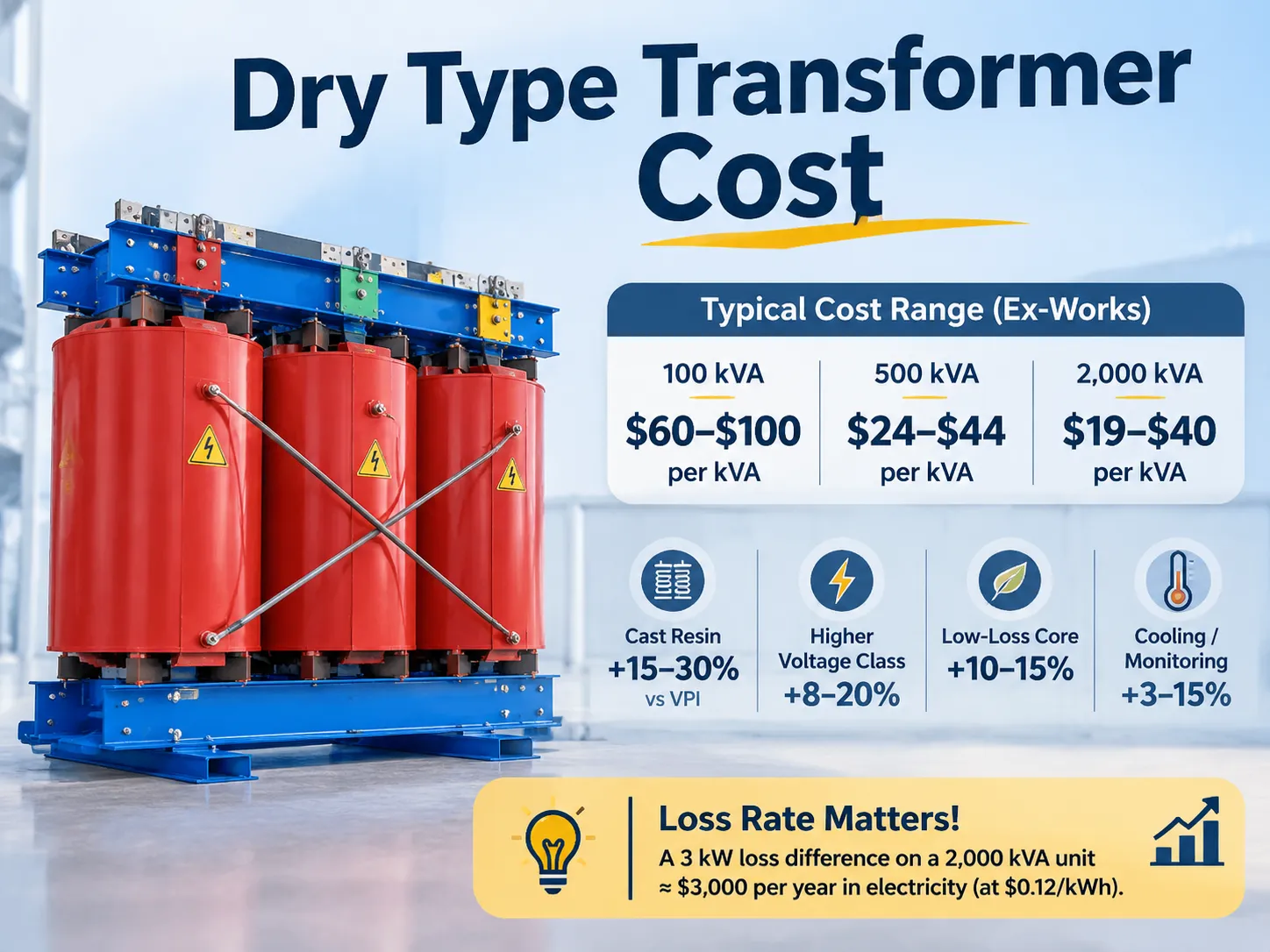
Quick answer: expect to pay between $60 and $100 per kVA for a standard three-phase transformer from an ex-works supplier at 100 kVA, between $24 and $44 per kVA at 500 kVA, and between $19 and $40 per kVA at 2,000 kVA. All figures are ex-works, before freight and duties. Cast resin costs 15 to 30 percent more than VPI (vacuum pressure impregnated) at the same rating. A higher voltage class adds 8 to 20 percent, a low-loss core adds 10 to 15 percent, and cooling or monitoring packages add 3 to 15 percent.
What the price is made of, before any discount
The core is the first. Grain-oriented electrical steel is the usual choice, while amorphous metal costs much more but reduces no-load loss by as much as 60 to 70 percent. In a small transformer the core is the largest part of the overall material cost; in a larger one it is a much smaller share.
The windings are the second largest portion, and the most flexible in terms of choice of materials. Copper is more expensive than aluminium, but it needs a smaller cross-sectional area to achieve the same result in losses, so a copper transformer needs less material and is more compact and more efficient; an aluminium transformer is cheaper to buy and larger.
Insulation systems comprise the third largest portion of transformer materials. The typical process, referred to as VPI (Vacuum Pressure Impregnation), involves impregnating the winds with resin after winding, while Cast Resin refers to the process of encapsulating the winding in a mould made of epoxy material. Cast Resin will require the use of moulds to create the winding encapsulation, which means that in smaller transformers, the additional cost of the moulds will be amplified as fewer total kVA will be able to utilise each mould.
The enclosure and cooling systems comprise the fourth largest portion of transformer materials. The most basic cooling system will comprise a natural-convection air-cooled transformer (IP20); the most expensive systems would be IP54, IP65, or Forced Air; and Acoustic Treatment would be an additional cost.
Testing and documentation are the fifth, and they are the portion that users generally eliminate to obtain the lowest price. Routine testing is included by definition; type tests, a witnessed FAT, a loss guarantee with performance penalties and third-party certification do not fall into that category.
Price by kVA band
The pricing described in these tables represent guidelines for planning purposes but are not price quotes; the costs provided for the pricing are for three-phase configurations, either 50 or 60 Hz, with Standard Impedance, (per) IEC or IEEE Compliances, and Ex-Works Pricing Terms.
| Band | Typical use | Indicative price (USD) | Price per kVA |
|---|---|---|---|
| under 1 kVA | control circuits, machine tool transformers | 80–400 | 200–400 |
| 1–5 kVA | small machine feeds, lighting, instruments | 300–900 | 120–180 |
| 5–30 kVA | workshops, small buildings, isolated loads | 900–3,500 | 90–150 |
| 30–225 kVA | commercial buildings, small plants | 3,500–14,000 | 55–95 |
| over 225 kVA | hospitals, data centres, industrial plants | 14,000–100,000+ | 19–45 |
Cost per kVA falls rapidly as the kVA rating increases, and the fall comes from a structural element of the transformer rather than from commercial pricing. The enclosure, terminals, testing and documentation cost approximately the same on a 50 kVA unit as on a 500 kVA one, so the larger rating spreads them over more capacity.
A buyer that compares the cost per KVA between two units of different KVA ratings is actually comparing companies that operate at different levels of business.
Three anchor points from 2025 pricing give the shape: a 100 kVA unit at $6,000–10,000 in VPI or $8,000–12,500 in cast resin, a 500 kVA unit at $12,000–22,000 or $16,000–28,000, and a 2,000 kVA unit at $38,000–80,000 or $50,000–100,000. The cast resin premium in those figures is 25 to 35 percent at 100 kVA and narrows towards 20 percent at 2,000 kVA.
For Distribution applications (provided that the unit is installed near the loading point), the range of dry-type distribution transformers spans from 30 KVA up to 2500 KVA.
Cast resin versus VPI: the 15 to 30 percent question
Both types of transformers will be considered dry-type and both types will have the allowable locations on the locations of fire-proof installation indoors.
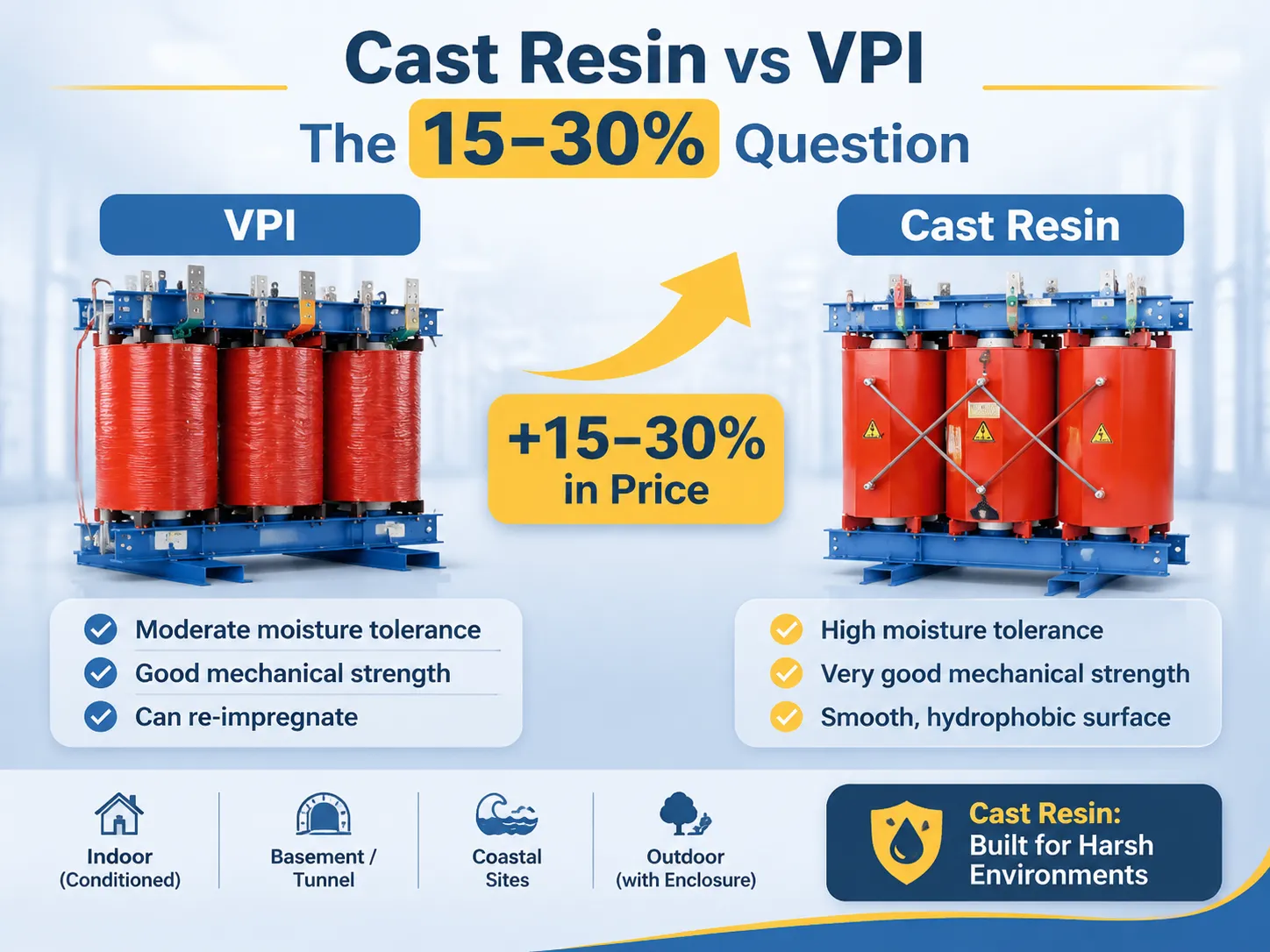
VPI uses a vacuum to impregnate the windings with polyester or epoxy varnish and cure the coil. The resulting coil is solid and has good mechanical properties but the winding does not have a similar water permeability protection from humidity or pollution as a cast resin insulated winding therefore, it attracts conductive dust in humid or polluted environments and often requires cleaning.
In a cast resin system, the coil is encapsulated in an epoxy resin using fillers. The coil has a smooth, hydrophobic surface and is highly resistant to mechanical damage. A cast resin winding will withstand high levels of condensation, dust, and humidity and are most often used in areas that have been designated as “non-conditioned environments,” such as basements, tunnels, coastal sites, and outdoor installations.
| Property | VPI | Cast resin |
|---|---|---|
| Price at same rating | baseline | +15 to +30 % |
| Moisture tolerance | moderate, needs clean dry air | high, tolerates condensation |
| Mechanical strength against short circuit | good | very good, rigid casting |
| Repairability | winding can be re-impregnated | casting replaced as a unit |
| Typical installation | indoor, conditioned or filtered | basement, tunnel, coastal, outdoor with enclosure |
An example of a cast resin (CR) unit in the common distribution class of 10kV dry type transformers from the SCBH series is constructed on a standard core & coil base and has all aspects of enclosure, IP rating and temperature rise configured for specific customer orders; therefore the cost adjusts according to customer configuration, not kVA.
Voltage class, losses and the adders that surprise buyers
A class is defined by several factors: a different insulation class (or dielectric strength), a percentage increase for low-loss core material (amorphous, or high-grade grain-oriented steel with a step-lap joint), forced air cooling versus regular air cooling, and compliance with regulatory agencies. Each of these items leads to a price increase over the standard transformer price.
The basic insulation requirements for transformers are based on what is known as the “class of voltage”, and the voltage class description includes two distinct levels of insulation as follows: Class I is 1 to 2 kV, Class II is 2 to 3 kV, Class III is 3 to 5 kV, Class IV is 5 to 11 kV, Class V is 11 to 22 kV and Class VI is 22 to 35 kV.
Voltage Class is the most important determining factor when determining the price of a transformer. The enclosures for classes I, II, III, IV, and V transformers are constructed with 8 to 20 percent more physical insulation than the class VI transformer enclosures. That step is why the same kVA can appear at two very different prices.
The transformer loss specification is the second most important item when determining the total transformer price. A low-loss core (i.e., amorphous+high-grade grain-oriented steel with step lap joint) will cause a price increase of 10 to 15 percent at the time of purchase, and will greatly reduce no-load losses over a 20-year operating period that typically runs 8760 hours per year. In most situations, the energy savings over 20 years will exceed the premium paid for low loss core material.
Cooling is the third: forced air cooling versus regular air cooling. Compliance is the fourth: the cost of type testing, a witnessed factory acceptance test, UL or CE marking, and a loss guarantee with a penalty schedule. Those are all upfront costs and they are the first items eliminated from competitive quotes.
The sixth item on competitive quotes is freight, duty, and exchange rate, and it has the potential to vary between 5% and 25%, thus making it possible for the total to be different by much more than the cost of the equipment being shipped.
Total cost of ownership: the calculation that changes the decision
The total cost of ownership is the number that changes the decision on purchasing.
The transformer purchase price typically represents approximately one-third of the transformer total cost during its lifespan. The remaining costs are from energy losses due to the core and windings, maintenance, and costs associated with the failure of the transformer.
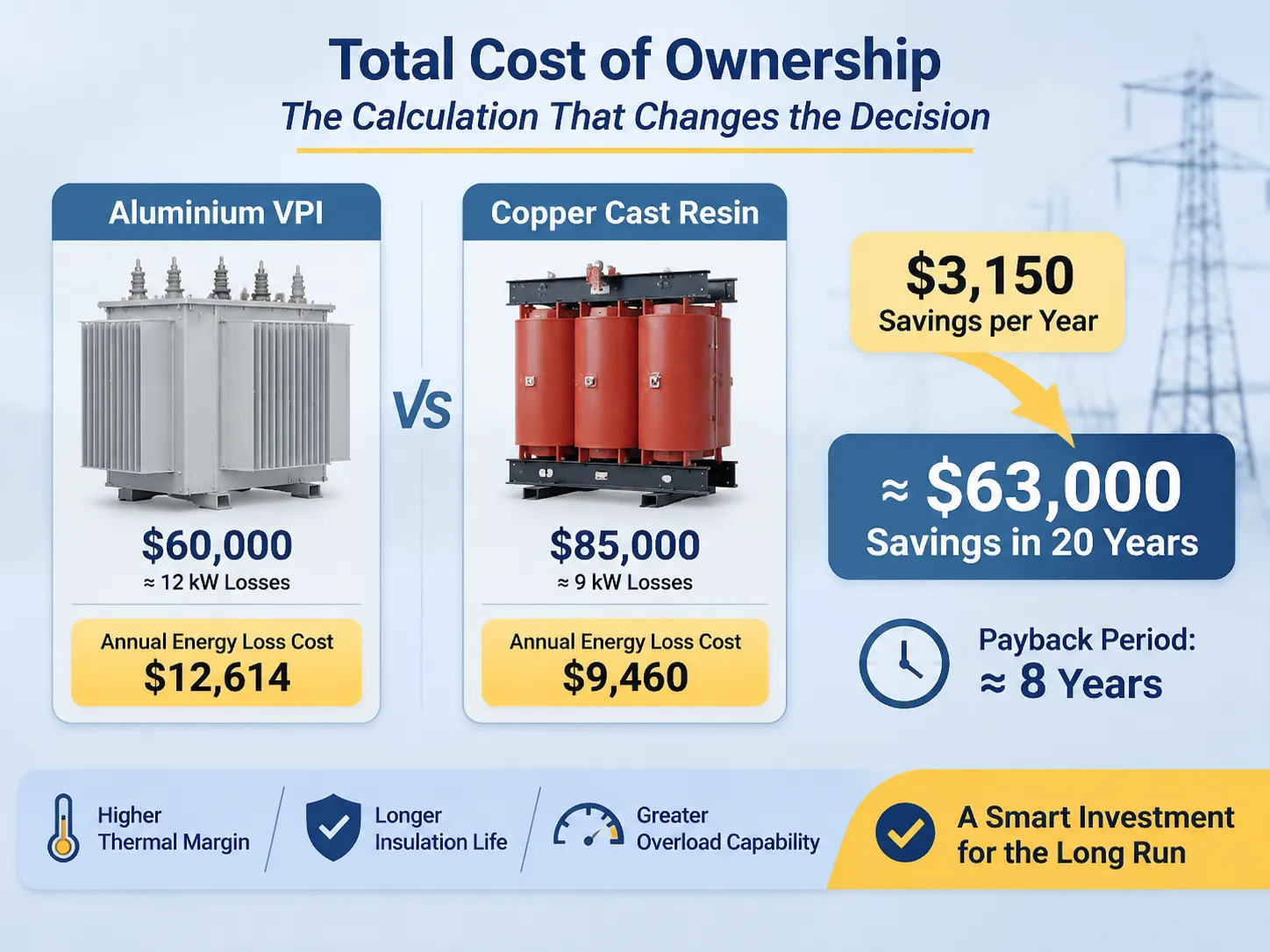
For illustration, there is the example of a 2,000 kVA transformer with an aluminium VPI winding priced at $60,000 and with approximately 12 kW of total losses compared to a copper cast resin transformer at $85,000 with approximately 9 kW of losses. The estimated energy loss cost per transformer per year is $12,614 for the aluminium transformer, and $9,460 for the copper transformer (a difference of approximately $3,150).
Over a period of 20 years the potential savings from purchasing a copper transformer are approximately $63,000 compared to the capital cost premium difference of $25,000 for a copper transformer; this equates to a payback period of approximately 8 years for the additional investment in copper. Once the payback is reached, it is simply savings for the transformer. The additional thermal margin of a cooler transformer, longer insulation life, and greater overload capability of a cooler transformer should further provide justification for purchasing the copper cast resin transformer.
This calculation is valid only if the loss data is guaranteed. A quote that says “low losses” without giving an actual number and has a penalty cannot be evaluated on the same basis as a quoted value. The buyer that accepts this type of quote will have no recourse available should the unit arrive and is 15 per cent higher than the quoted amount.
For projects where the load profile is known, the same arithmetic can be completed based on the actual duty cycle rather than on full load, which usually produces a more advantageous outcome for the efficient unit since the no-load loss is always present; hence, there will always be a better performance from the efficient unit regardless of the loss factor.
A packaged installation where this was completed is outlined in Pakistan’s dual power supply project; the transformer selection was based on the duty cycle instead of the final price per kVA.
New, replacement and used: three different markets
The following are three distinct markets associated with different types of units (new, replacement and used):
A new unit has a warranty, a loss guarantee and a type test report. The table prices above represent the price for a new unit, and the lead time for a standard rating will vary from 8 to 16 weeks; for custom units, it will be longer.
A replacement unit is a new unit purchased for an existing footprint. The price of replacement units is usually 5 to 15 per cent more than a greenfield order due to the fact that the enclosure and terminal positions need to match the existing unit; while the engineering cost is usually included in this price rather than material. Often, choosing a standard replacement unit along with a modified cable box creates a lower-cost option but may extend the time frame for the project.
A used unit is yet another situation with an entirely different value calculation. The price of the transformer may be between 30 and 50% of the original price, as described above. However, there are some inherent risks involved in purchasing used transformers. For example, when purchasing used transformers, the buyer will not know the amount of loss incurred during shipment prior to receiving the unit. Furthermore, it is possible for the insulation to absorb moisture while stored and, therefore, the specification of the type test will no longer reflect the true condition of the unit upon arrival. For these reasons, a used transformer may be an excellent option for temporary power, backup or spares, but may be viewed as a poor investment for critical loading applications where losses will be a significant factor in the overall operating cost of the unit.
If you decide to go the route of purchasing a used transformer, your specification should clearly identify whether or not the quoted price includes: enclosure, terminal arrangement, testing and documentation. All of these items are typically excluded from the quotation and represent an additional cost that the buyer must incur at a later date.
A note on colour, and other specifications that do not affect price
Some buyers may ask for the transformer to be painted in a specific colour. The question is easy to answer: paint colour has little or no effect on how a transformer performs electrically and will have a negligible impact on price. Standard RAL colours have standard costs due to the time required to produce them. Non-standard RAL colours, 2-pack polyurethanes and corrosion class-rated paints, all increase the cost of the transformer because of the processes used in the manufacturing of those finishes as opposed to simply being different pigments.
The same logic applies to many other requests made by buyers. Colours of enclosures, colours of nameplates or languages used in manuals do not change the electrical design of a transformer. If a supplier is pricing these items as engineering changes, he/she is either confused about the request or is padded quoting.
Be aware of the following areas: corrosion class that should match at least urban (C3), coastal (C4), offshore (C5), IP rating, terminal orientation, lifting arrangements if applicable to your site. These are examples of areas where a small change in specification can produce significant changes to what you may receive.
Installation, testing and the costs outside the transformer
Transformers are typically only half the cost of the installation (the other half being installation related) and it is wise to have a separate line item for transformer costs on your budget.
Foundation/civil works for a pad mounted transformer can vary between $500–3,000 depending on if the unit requires a fire rating or plinth. Costs for lifting/moving the transformer can range from $300–1,500 depending on the type of access; for example: basement installations with narrow doorways will cost more than ground-level installations. Termination costs are based on the number of cores used and the number of sides terminated; a 2000kVA transformer with numerous LV cores may easily exceed the total cost of a small transformer when termination costs are included.
Testing & Teardown — Testing and teardown costs can range from $500–2,000. This is where the low bidders miss this point; they may still run, but they will not have a baseline for your future inspections.
What to put in an RFQ so the quotes compare
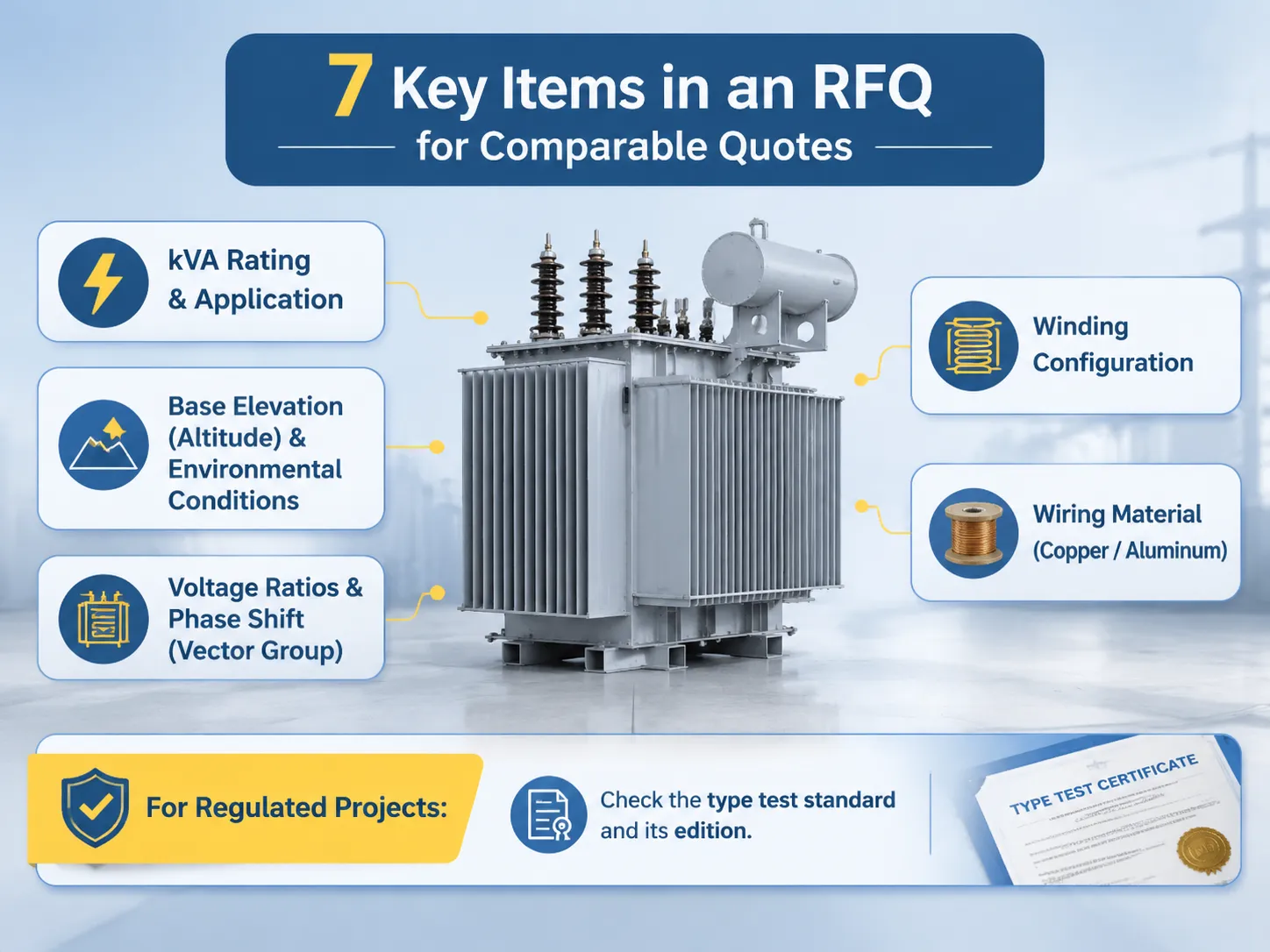
The 7 line items required for RFQs to obtain comparable quotes.
Compare kVA rating and application; base elevation (altitude) and environmental conditions; transformer voltage ratios, alignment of phase shifts (vector group); design/configuration of winding; wiring material (Copper/Aluminum). When comparing two quotes side by side, all seven items are necessary but not sufficient to determine whether the lower quote represents a lower specification. The difference will not be apparent until the commissioning stage, not at the bid stage.
A further consideration to add for a regulated project is the standard to which the design is type tested, along with its edition. It is not correct to assume that a unit tested to an earlier edition is non-compliant, as the buyer should understand the reference document stated in the certification. The SCB series of domestic transformers and international cast resin transformers are compared in SCB13 versus international cast resin transformers, demonstrating where the designs are different and where they are the same.
Frequently asked questions
Why would you use a dry type transformer?
Dry type transformers do not have oil. An absence of oil means no vault, no fire-rated enclosure (in most jurisdictions), no oil containment and less maintenance. As a result, dry type transformers are the default for indoor use (basements, tunnels, high-rise buildings and hospitals), where an oil-filled transformer would necessitate fire separation that is more costly than the transformer itself.
What is the average cost of a transformer?
There is no single average, because the price per kVA falls with size. A standard three-phase dry transformer rated at 100 kVA usually costs between $6,000 and $12,500; a 500 kVA unit between approximately $12,000 and $28,000; and a 2,000 kVA unit between $38,000 and $100,000. The range is not purely a function of kVA, but of winding technology, voltage class and losses.
How much does a transformer cost?
If installing a dry-type transformer, plan on approximately $60-$100 per kVA at the 100 kVA size and $19.00-$44.00 per kVA at the 2,000 kVA size for standard loss rated product. If using a cast resin unit, you can expect an increase of 15% to 30% to the price of the product; for a “low-loss” transformer core, expect an increase of 10% to 15%; and if the voltage requirement will be for a higher voltage class transformer, expect approximately 8%-20% to the cost of the transformer.
How much does a 225 kVA transformer cost?
Typically, a standard three-phase dry type unit at a 225 kVA rating is priced between $8,000 and $18,000 with the highest priced units generally being comprised of cast resin and utilized at a higher voltage class rating. A 225 kVA transformer is at the higher end of the 30 kVA to 225 kVA band and is, therefore, priced closer to the 500 kVA price range than the 100 kVA range.
Does a dry type transformer cost more to maintain than an oil-filled one?
Generally less maintenance is required. Dry-type transformers do not need testing for oil levels nor do they require oil replacement or oil leak management. Routine maintenance procedures generally consist of cleaning the windings in dusty areas and monitoring and checking the fan cooling sources as well as the temperature monitoring devices. Over the course of 20 or more years, the maintenance savings realized on dry transformers will partly offset the initial larger purchase cost.
References
- CHBEB — Dry-Type Transformer Price Guide 2025
- NPC Electric — Dry Type Transformer Cost Factors and Selection Guide
- SGB-SMIT Group — Cast Resin and VPI Transformer Technology
- Hitachi Energy — Dry Type Distribution Transformers
- U.S. Energy Information Administration — Industrial Electricity Prices
Conclusion
Cost factors for dry type transformers are driven by four primary factors in this order, kVA and voltage class, winding technology and loss specifications, and finally enclosure/test package. Buyers are encouraged to spend the discipline to obtain and compare two similar brief’s from two vendors and to also request that each become explicit in providing loss numbers attached with a penalty.