


Transformer lead times peaked in 2023/early 2024, but have been getting better since the end of 2025, although they are still not back to the traditional two- to four-month lead times for standard distribution transformers in 2019. The Transformer market is split into two distinct parts: 1) Standard Distribution Units that are available in months; and 2) Large or Custom Units still have years of lead times.
Quick answer: Lead times for standard distribution transformers are generally 16 to 30 weeks from order to delivery for units ranging from 50 kVA to 2,500 kVA, down dramatically from a 50 to 80 week lead time in the peak of 2023. Typically, medium-voltage dry-type units will have a lead time of 12 to 24 weeks. At the same time, however, large power transformers greater than 100 MVA still will typically carry an 18 to 30 month lead time while generator step-up transformers may still carry lead times longer than 30 months or more. In addition, custom specifications for large units will typically add 8 to 16 weeks for design approvals and type testing as well. Pricing for transformers has risen between 60 and 90 percent since 2020. Pricing has also flattened out and is now at a similar point as it was four years ago.
In the following sections: ranges of transformers currently available, reasons for the continued shortfall of transformers in the marketplace; break down transformer lead times by product; outline what impacts transformer lead times; compare standard versus custom transformers; describe what features can be provided by various manufacturers, including our own; outline the strategies that can protect a schedule; explain how a quoted lead time is structured; provide a list of questions that should be asked before placing an order.
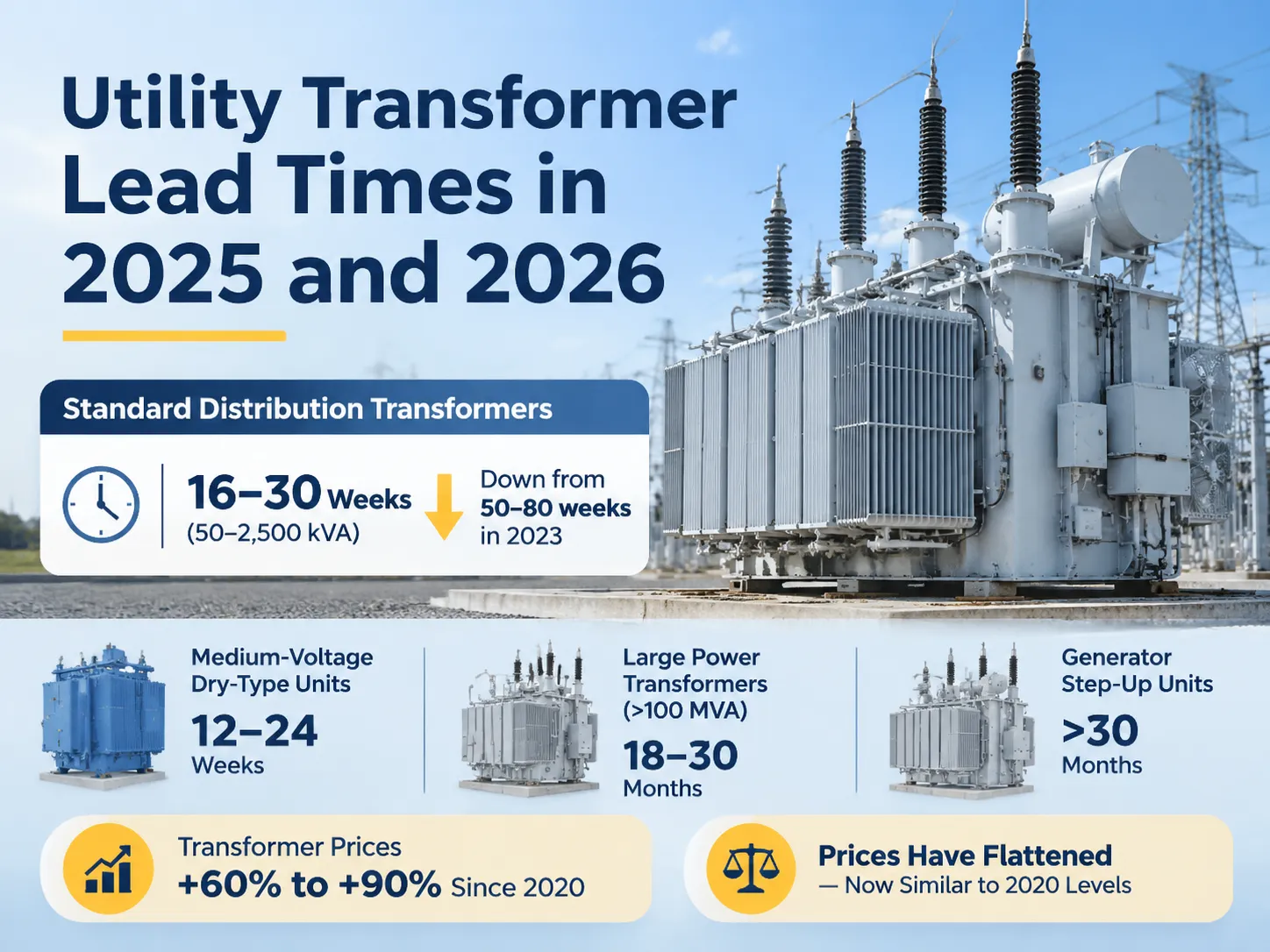
To Summarize Transformer Lead Times in 2025 and 2026
Peak Pinch Point: 2023 to Early 2024 and After. Utilities began ordering ahead of load growth and energizing renewable projects while factories that manufacture grain-oriented electrical steel could not expand at the same pace. In 2023 a 500 kVA pad mounted unit was quoted at 70 weeks; now it’s being quoted at 20 – 26 weeks.
The recovery is not evenly distributed. Recovery depends on the type of product being produced. A catalogue distribution unit based on standard core and coil designs can be manufactured in months. However, if the unit requires a new tank design, a non-standard impedance, or a type test, the timeline for production will differ with delays occurring at both the factory floor and engineering offices.
The recovery of the large power transformer sector is the least improved compared to the other transformer categories. In this case, steel is not the bottleneck but rather the test bay and skilled winders. The capacity of either of these cannot be added within a year. A 200 MVA unit ordered in 2026 must be forecast as being available in 2028.
Why the Industry Remains Behind
There are three impediments to recovery in the industry. None of these is attributed to order backlogs.
A very small number of mills around the globe manufacture grain-oriented electrical steel and cannot quickly commission new annealing and coating lines to produce grain-oriented electrical steel. The construction of a new production line is a multi-year capital expense and it will take several years to absorb the demand shock. This is why core materials—not copper or labor—set the tone of the supply shortage.
Skilled winders take time to train. Although winding a distribution transformer is a repeatable process and can easily be done by anyone, a 100 MVA unit is something different entirely, and due to the shrinking, ageing workforce that is available to do this job, only a small amount of qualified people are left in each market.
Regardless of how many total units are assembled within a facility, the test bay capacity for large power transformers is what limits the overall throughput of any given factory. A single large power transformer can spend multiple days in a test bay, which, in turn, makes the test bay floor area within a manufacturing facility the costliest square meter by far. There have been minimal changes within the global community in terms of test bay capacity over the past decade.
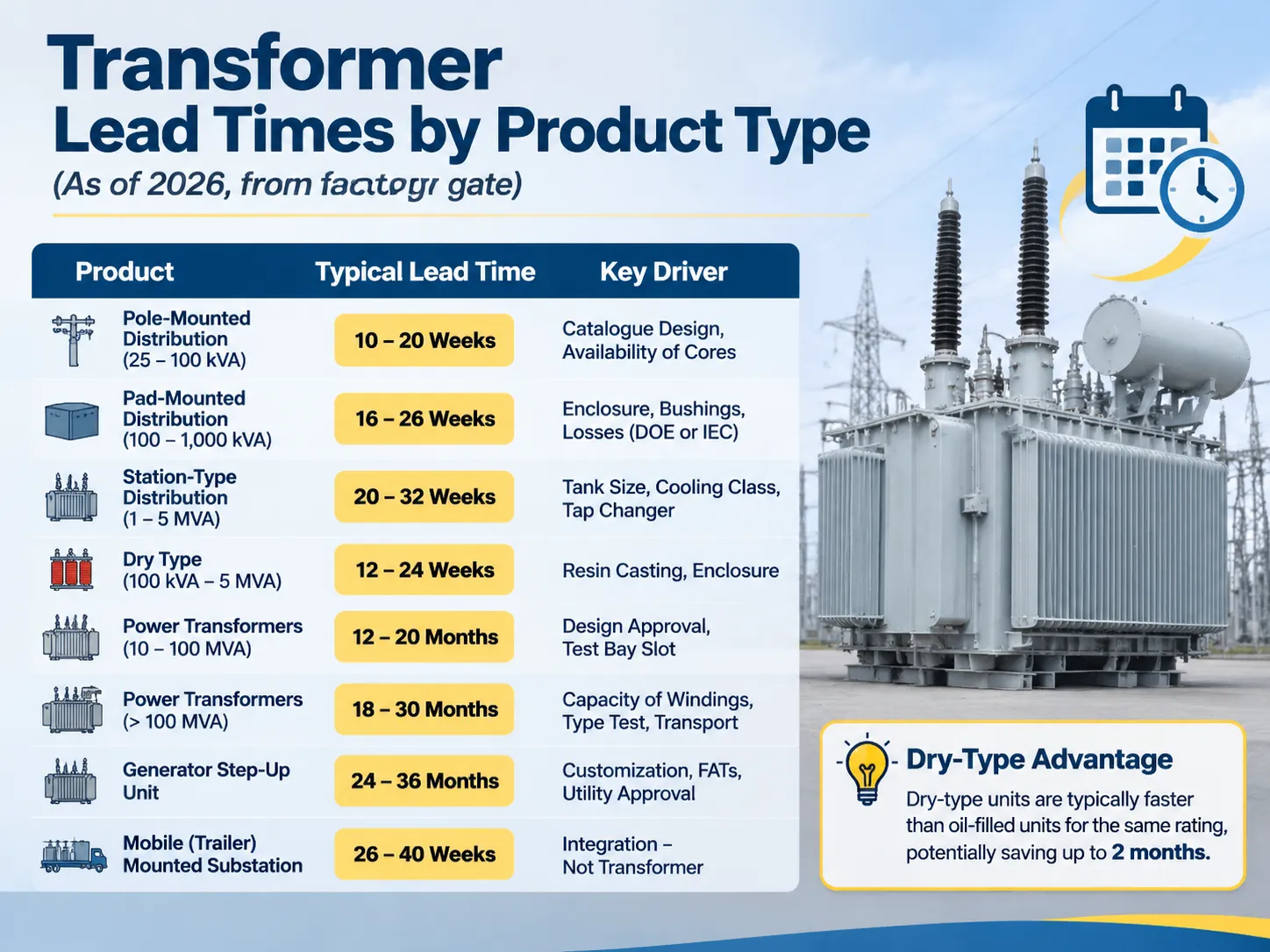
Lead Times by Product Type
The table below represents the range of time frames quoted for new transformer orders delivery from the factory gate as of 2026. Additionally, please keep in mind that freight and job site work add to this total.
| Product | Typical Lead Time | Driving Factor |
|---|---|---|
| Pole-Mounted Distribution (25 to 100 kVA) | 10 to 20 Weeks | Catalogue Design, Availability of Cores |
| Pad-Mounted Distribution (100 to 1,000 kVA) | 16 to 26 Weeks | Type of Enclosure, Bushings, Losses (DOE or IEC) |
| Station-Type Distribution (1 to 5 MVA) | 20 to 32 Weeks | Tank Size, Cooling Class, Tap Changer |
| Dry Type (100 kVA to 5 MVA) | 12 to 24 Weeks | Casting Capacity of Resin, Enclosure |
| Power Transformers (10 to 100 MVA) | 12 to 20 Months | Design Approval, Test Bay Slot |
| Power Transformers (Greater than 100 MVA) | 18 to 30 Months | Capacity of Windings, Type Test, Transport |
| Generator Step-Up Unit | 24 to 36 Months | Customization, FATs, Utility Approval |
| Mobile (Trailer) Mounted Substation | 26 to 40 Weeks | Integration – Not Transformer |
Note: Dry-type units are of interest because they are typically faster than oil filled units for the same rating. Since a cast resin unit does not require a tank or oil processing, the production sequence is shorter, which can allow a project to save up to two months if an indoor dry type is accepted.
The price and delivery for a 100 kVA unit is a good benchmark as that is the size of the volume market and that is where most of the lead time recovery has occurred.
What Can Change It: Size, Voltage and Specification
Size is the most apparent variable and it is not a linear progression. Doubling the rating of a transformer virtually doubles the quantity of the materials required and will introduce a significant increase in complexity at the cooling class transition points, voltage levels when the insulation becomes an issue in the design, and the overall sizes that are not within the envelope of the typical shipping arrangements.
Insulation has a direct connection to the voltage of the installed transformer. For example, a 33 kV (from a design and manufacturing standpoint) is a common voltage rating. The 132 kV unit will require bushings, clearances, and impulse tests, which will require building and storing the transformer in a different factory and placing it into a different completion line.
As the voltage of the transformer continues to increase, the number of companies that produce transformers above approximately 145 kV (as a guide) decreases significantly. For this reason, it can be expected that the lead times for these types of products will grow faster than the electrical rating of the product.
Thirdly, specification: an example of a compliant distribution transformer from the DOE (Department of Energy) with a standard impedance would be considered a catalogue product. However, the same rating but with non-standard impedance for parallel, a specific tap range, an assured low level of noise, or a specific vector group would constitute as an engineered order and, because of the requirement for engineering approval, could take up to six weeks.
The oil-immersed distribution transformer in the 20 kV voltage class serves as a good example. The factory builds the units to the various ratings of the product based on the catalogue of standard builds for each of those ratings, while the 20 kV insulation class establishes the design family to which the transformer belongs.
Custom vs. Standard – Two Timing Clocks
As mentioned before, a standard unit runs by means of a production clock, where the processes of receipt of material, winding, assembling, testing, painting, and shipping overlap; therefore, the factory will be able to forecast the lead time of all of these steps because the design for the standard unit will always be available.
A custom transformer may have the same structure as a standard transformer but have 2 timing clocks operating on the same order. The design clock will start with the day the customer orders and will conclude when the engineering and the utility approve the drawing. Once a project starts producing, the production clock begins counting down. So, estimating 10 weeks of production time (from the manufacturer) + 20 weeks for the project delivery to arrive = 30 weeks total time frame from “start to finish.” This is why projects that are anticipating using catalogue estimates fall behind schedule.
By removing the specification approval process for early-stage design and accepting a generic design early on, it is possible to compress the length of time required for the production process. Most non-standard impedances have a standard because the study that was conducted assumed a value of the impedance; there is no specific reason why that impedance type is needed for a particular project.
A Manufacturer’s Review of Expectations
Grid-scale manufacturers, including both Hitachi Energy and Siemens Energy, cite longer quotes than their competitors and typically hold to their dates more closely than others. A manufacturer that provides a 24 month quote for large power transformer manufacturing facilities has a more reliable delivery date than one that provides a 14 month quote for smaller power transformer manufacturing facilities. Large manufacturers have their own testing bays and have greater control over winding capacity than do smaller manufacturers.
The European Mid-Market, (represented by SGB-SMIT), is in the middle of the pack: they manufacture distribution and medium power units with delivery times ranging from 16 weeks to 30 weeks, with an advantage over non-European manufacturers due to access to European documentation and shorter shipping distances.
North American distribution manufacturers, including Prolec GE and ERCO, represent an expedited route for North American projects; they estimate 16-30 weeks for delivery, build to meet the project specifications (there is no adaptation of the IEC design to meet project specifications), therefore they are able to provide faster turnaround than overseas manufacturers.
The Chinese manufacturers, such as TBEA and China XD, are price competitive and can provide a completed distribution unit in a very short time frame of between 12 and 20 weeks, plus delivery time, and are frequently the quickest source of power transformer units for African and Southeast Asian regions. The only thing limiting the production of transformers is the documentation and approvals at the receiving end; however at SUBIAN we have complete control over the time it takes to manufacture both cores and windings for all of our transformers.
Timeframe Expectations
The construction lead times for our oil-filled and dry-type distribution transformers are based on the size of the transformer you would like to order, but also on whether the transformer involves a configuration with unique impedances, enclosures, substation packages, etc. The standard timeframe for ordering an oil-filled distribution transformer is generally between 12 and 20 weeks, and between 10 and 16 weeks for the dry-type distribution transformers. If you have a standard rated transformer in stock, it will qualify for the shortest quoted timeframe (12 to 20 weeks) for manufacturing & delivery. Any timeframes given that exceed those for the least costly method to manufacture & deliver the transformer (12 to 20 weeks), are based on unique specifications.
Unlike other manufacturing facilities that manufacture their own winding, our facility builds all of our own tanks and windings in-house. This offers SUBIAN a manufacturer lead-time advantage compared with those manufacturers who must purchase their windings or tanks and have limited control over their speedy production.
SUBIAN will always provide you with an ordered slot for your order rather than just an estimated time frame. For us, when we have our own winding department, tank building facility and testing bay; we will be able to guarantee your ordered lead-time. Whenever we quote transformer or substation prices, we will always list the lead-times for the ordering slot in the quotation.
The only limiting factor in the overall manufacture of your requested transformer is the length of time required to obtain Utility Approval. While the Utility Approval process is an integral part of our construction timeframe, the Utility Approval timelines fall outside of SUBIAN’s manufacturing construction timetable. Therefore, if your order requires an industry witness acceptance test, approved third-party type test, or Utility specification review, those timelines must be accounted for.
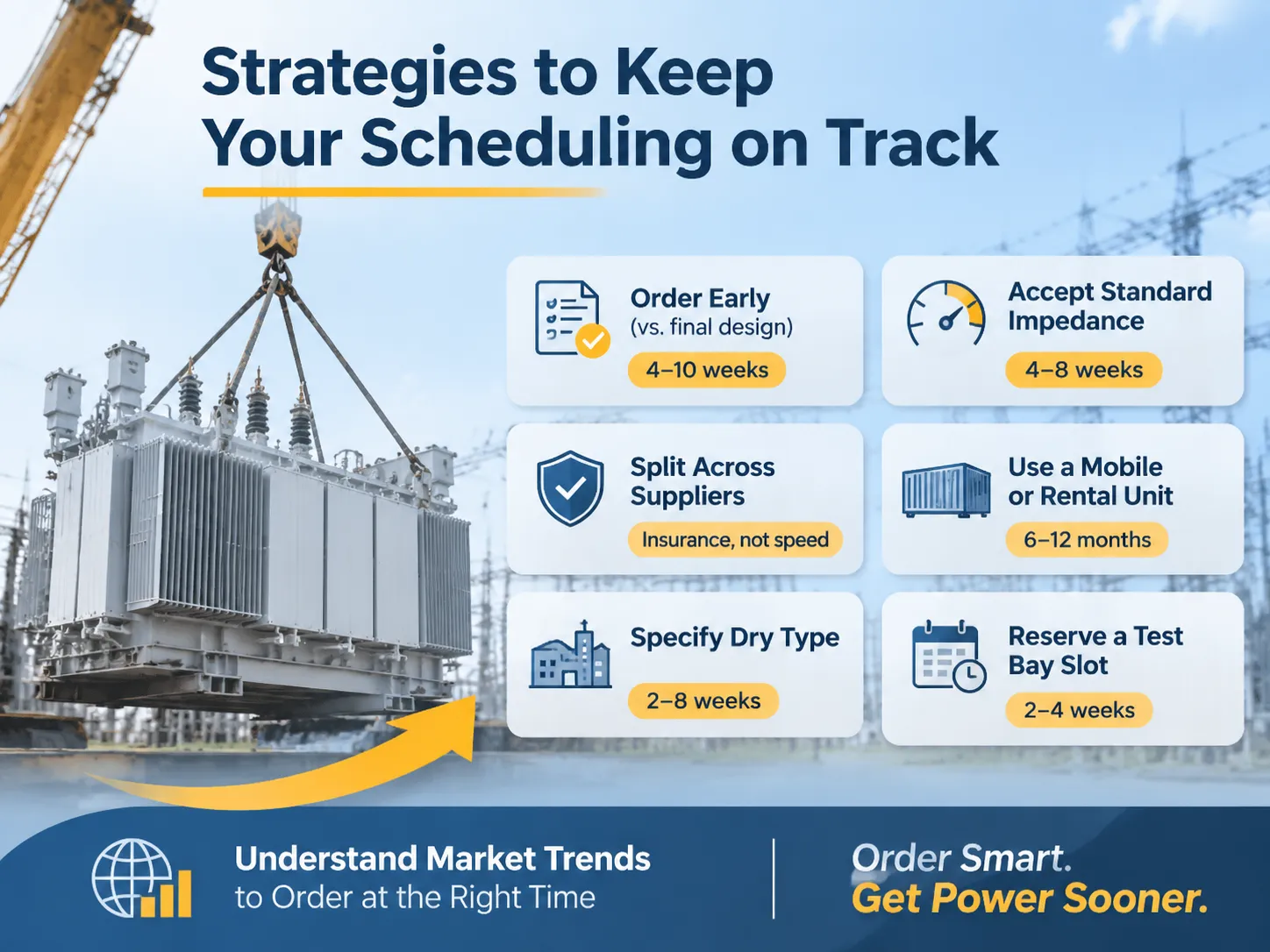
Strategies to Keep Your Scheduling on Track
| Tactic | What it buys | When to use it |
|---|---|---|
| Order before the design is frozen, against a performance spec | 4 to 10 weeks | Any project with a hard energisation date |
| Accept a standard impedance and tap range | 4 to 8 weeks | Where the study allows it |
| Split the order across two suppliers | Insurance, not speed | Multi-unit projects |
| Use a mobile or rental unit as an interim | Bridges 6 to 12 months | Replacements and emergency capacity |
| Specify dry type where the building allows | 2 to 8 weeks | Indoor commercial and industrial |
| Pay for a reserved test bay slot | 2 to 4 weeks | Large power units with a fixed date |
Thanks to that row, the entire project can occur much faster than it would normally. By ordering a transformer based on the performance specification prior to finalizing the single line diagram, it allows for a transformer to go to production sooner and to be changed later in the event that the calculated impedance changes; while a project that waits for the fully approved drawing will have already spent approval time twice.
When analyzing the global transformer market, it provides the backdrop for understanding the reasons for ordering in a certain time frame, thus making ordering today to take advantage of the seasonal demand.
Definition of “Lead Time”
A lead time is the amount of time between a signed order with a deposit and notice of dispatch readiness. The lead time does not count freight shipping time, customs clearance time, site delivery time, installation time, or commissioning time; there are variations that can add anywhere from four to sixteen weeks depending on routing.
Typically, three factors are excluded and frequently overlooked. Most large manufacturers usually count the approval of the order separately from the approval of the drawings and some don’t even include the approval of material for production until all approvals are received, at which point it will have to be produced on a scheduled basis.
Factory acceptance tests often require a witness and a slot of time to conduct. Spare part delivery is commonly shipped after the main unit.
The best way to determine the lead time for your product is to request a schedule rather than just a single number. The schedule should list all of the important milestones in the order fulfillment process, such as the date the order was placed, the date all drawings were approved, the date all materials were released, the date all windings began, the date the unit was test conducted, and the date the unit was shipped.
If a supplier can provide you with a detailed schedule, it is likely he/she has planned to complete the order and the supplier who only provides a single date has not.

Some Questions to Ask Your Supplier
- Is the quoted lead time based on the date the order was placed or the date the drawings were approved?
- If you need to approve the drawings, what is the average number of weeks required to get approval?
- Does the supplier include factory acceptance testing as part of the above lead time?
- Are any of the components for the transformer purchased from third-party vendors, and what are their respective lead times?
- What is the current lead time to manufacture a transformer of the same rating for another customer (note: this question differs from the previously requested standard lead time)?
- If the specifications change after the drawing release, what will be the additional number of weeks and cost to produce the revised product?
- Does the factory have a reserved production slot for the order, and is there a provision in the contract for its use?
- What is the penalty/credit to the vendor if the equipment is not delivered on time?
- What will be included with the shipped unit, and does this include routine test reports and material certificates?
- What is the lead time for ordering spare bushings, tap changers and oil? A transformer that has a two-year lead time for a spare bushing presents a potential two-year outage risk. Typically, spare parts for substations fall under the category of substation components, as they are included in the same package with the main unit (i.e., when ordered together, not separately later).
Frequently Asked Questions
What is the 80 percent rule on transformers?
This is an industry standard and not a requirement of the National Electrical Code (NEC). It is common for transformers to be designed to carry continuous loads at no more than about 80 percent of their nameplate rating, because prolonged operation with loads exceeding that shortens the life of the insulation and does not allow for future load growth. For example, NEC requires that overcurrent protective devices are sized at 125 percent to provide an equivalent margin from the opposite side.
Once the transformer is finally ordered, how long does it take to get a new one?
The timeframe for receiving a transformer can vary greatly based on size and design from a few weeks (12 weeks or more) for smaller dry-type standard models, three years for a custom generator step-up transformer, up to and including also having to wait for a type test. The main factors that determine delivery time are rating, voltage class, existing design, and the type of test required to complete the transformer.
Why does it still take so long to get a lead time for a transformer?
There are three major factors that contribute to this: The availability of grain-oriented electrical steel is highly limited to a small number of mills, skilled winders need years of training, and the available test bay capacity limits the number of large units that can be completed by a factory at any given time; therefore, none of these factors can be easily increased.
Will I be able to get a transformer in a shorter time frame if I pay more?
This depends; it may be possible to purchase a reserved slot on the production schedule for a large transformer or purchase air freight to expedite delivery for a smaller transformer. However, it would not be possible to purchase steel that is not ready for rolling or to procure winding skills not available in the workforce.
References
- Hitachi Energy: Transformer Delivery and Project Capability
- Siemens Energy: Power Transformer Manufacturing
- SGB-SMIT Group: Distribution and Power Transformer Range
- U.S. Energy Information Administration: Grid and Capacity Data
- Electrical Engineering Portal: Transformer Procurement and Specification
Conclusion
The question of lead time has been split into two sections. Distribution-type transformers will be available again in months, while large power transformers will continue to take at least two years from order to delivery. If a project is planning on purchasing a distribution transformer, yet attempts to place an order for a large power transformer, they will most likely miss their required delivery date.
To protect a project schedule, it is recommended to order against a performance specification before the drawing has been finalised. Always ask the supplier for a confirmed schedule, rather than a specific date. Suppliers that are able to confirm their estimated approved order date, estimated winding date, and estimated test date have planned their order, and their plan is worth far more than the commitment of weeks from that date.