


The oil filled transformer industry is evolving at a much faster rate than it has in the past, partly due to technology but mostly because manufacturers have been devoting more resources to develop and manufacture their products.
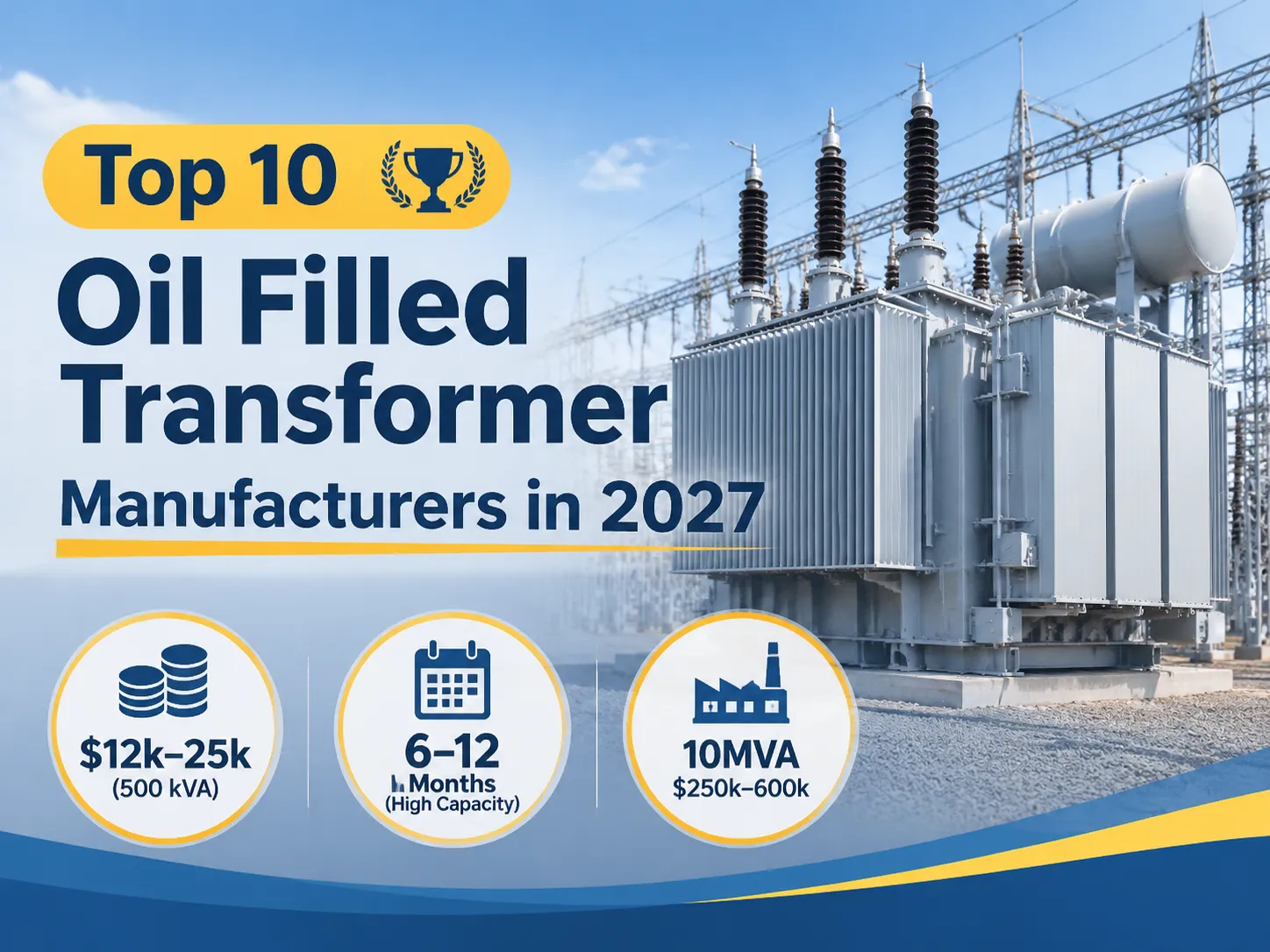
Quick answer: Ten manufacturers, or companies that offer oil-filled transformers are listed below, grouped into 3 main categories. The first grouping consists of the European and Japanese manufacturers, who produce large utility style transformers and serve the grid of North America; the second group is North American and Indian manufacturers that lead the way in distribution rated transformers; and the third group consists of Chinese firms that produce the vast majority of volume at the lowest overall cost in terms of delivered price. Here are a few examples of what these products cost: $12,000-$25,000 for 500kVA distribution units; $18,000-$35,000 for 1000kVA units; $250,000-$600,000 for 10MVA power transformers; delays of 6-12 months for high capacity types.
The sections below provide an overview of how this list came to be compiled, a description of the differences between the oil-filled transformers and dry types, a regional summary profile of each company in the list, a range of price information by transformer rating, details regarding manufacturing and operating efficiency, and a guide to applications and pricing for transformers. At the end of this document, there is also a look at where SUBIAN is positioned among these manufacturer profiles.
What Went Into Creating This List
The four criteria used to create this list are consistent with those used to create any supplier shortlist. The company must manufacture (not simply resell) the transformers being purchased, serve industries outside of their home country (most purchasers are buying outside their country), provide enough information in a technical data sheet for specification (thereby eliminating those companies that provide pricing on request), and have sufficient manufacturing capacity to build a number of transformers of the ratings specified in a regular project (thus eliminating those companies that only manufacture generator step-up transformers).
The order of this list is intentionally not ranked based upon revenue. A revenue ranking would rank manufacturers of large-scale transformers higher and those of distribution transformers lower; however, a company that is building large-scale transformers may not be able to manufacture what the vast majority of project purchasers require (Distribution Transformers). Therefore, the manufacturers are grouped according to their area of expertise and the order of each group is based on their capacity to produce transformers.
The only category lacking on this list is Trading Companies that sell (broker) transformers between factored designs. Trading Companies provide a valid means of obtaining better pricing on transformers, but provide little or no options for Type Test Certification, and therefore would dilute the value of the entire list if included as a manufacturer.
Difference between Oil Filled Transformers and Other Types of Transformers
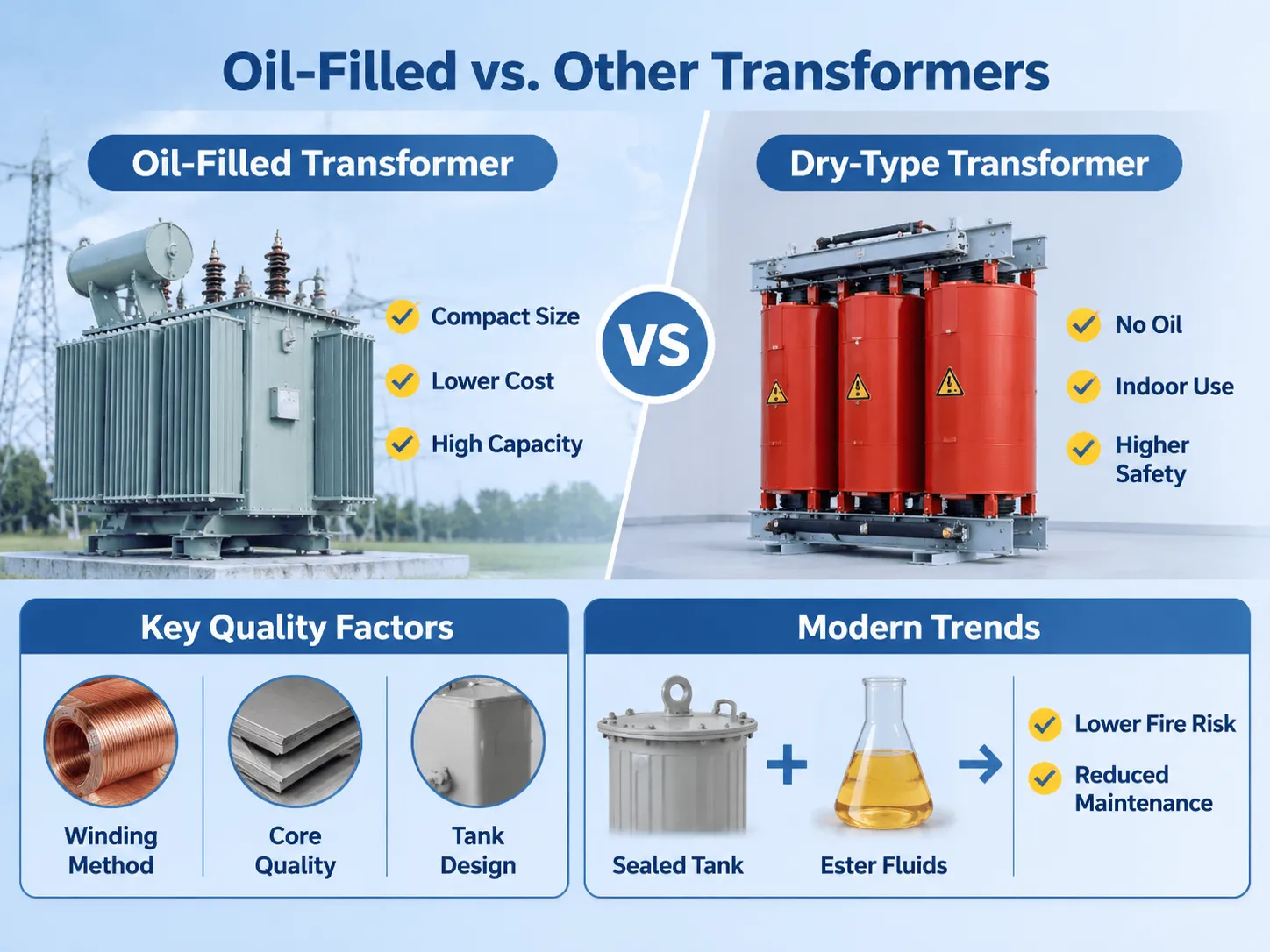
An oil-filled transformer places the transformer core and windings into a tank of mineral oil. The oil, besides providing cooling to the transformer, also raises the dielectric strengths of the transformer winding insulation because air is replaced by oil in the gap between the core and windings. An oil-filled transformer is much smaller than an equivalent dry type transformer, so it is less expensive than an equivalent dry type transformer and can be manufactured to operate at much higher rated capacity than dry, at ratings where a dry type becomes economically impractical.
In addition to the size and weight of an oil transformer, the cost associated with the installation also is a major factor in the overall cost of ownership; therefore, oil-filled units are typically used at outdoor sites, whereas dry units are most commonly used indoors. However, because the codes that regulate the installation of oil-filled transformers generally restrict the placement of the unit in a building to a rating of less than 600V, and generally require a fire-rated enclosure, it is easy to see why pad-mounted and pole-mounted oil-filled transformers dominate the distribution landscape.
Three major construction elements differentiate between a high-quality and a low-quality oil-filled transformer. The winding method used, as foil windings and layer windings have quite different failure characteristics under short-circuit conditions. The quality of the core; step-lap mitred joints and low-loss grade electrical steel are the primary factors that determine the no-load losses. The quality of the tank; a sealed tank with a nitrogen blanket is more effective in a humid environment than one equipped with a conservator and breather that eventually fails due to lack of maintenance.
The trend in design is clearly toward sealed tanks and ester fluids, as both of these elements allow for significant changes in both the fire characteristics of the transformer and the maintenance requirements for the transformer over its lifetime. The practical application of the trends for oil-filled transformer development is presented at the end of this document.
Companies, Their Primary Range and What They’re Known For, Their Pricing Positioning
The ten companies are summarized in the table below, and each group is further explained in the following sections.
| Company | Base | Main range | What it is known for | Price position |
|---|---|---|---|---|
| Hitachi Energy | Switzerland & Japan | 1,000 MVA Distribution | A leader in HVDC and large power transformers and accepted by utilities | Highest |
| Siemens Energy | Germany | 800 MVA Distribution | A leader in grid projects and meets EU Utility Spec sheets | High |
| GE Vernova | USA | 500 MVA Distribution | A leader in providing services to the North American Utility Fleet | High |
| SGB-SMIT | Germany | 50kVA to 250MVA | Distribution and Medium Power with European Efficiency grades | High to Mid |
| Prolec GE | Mexico & USA | Distribution and Medium Power | Leads the US Distribution Market and DOE Efficiency Compliance | Mid |
| ERMCO | USA | 5kVA to 10,000kVA Distribution | Utility Distribution Units and Fast Delivery within USA | Mid |
| Hyundai Electric | Korea | 800 MVA Distribution | Large Power and Offshore with Korean Utility Base | Mid to High |
| CG Power | India | 400 MVA Distribution | Volume Distribution, and Major Indian and African Projects | Mid to Low |
| TBEA | China | 1,000 MVA Distribution | Large Scale EPC’s, and Export Financing | Low |
| China XD Group | China | 800 MVA Distribution | Exporting utilities and meeting both Chinese Standards and IEC. | Low |
The Pricing in the last column is a relative measurement, not an absolute measurement as there could be as much as a 30% difference in price between two companies in the same band for the same specification. One company may be including type test documentation and factory acceptance testing, while the other company is quoting the price of only the tank and the coils.
The Europeans: Grid Scale & Utility Specification
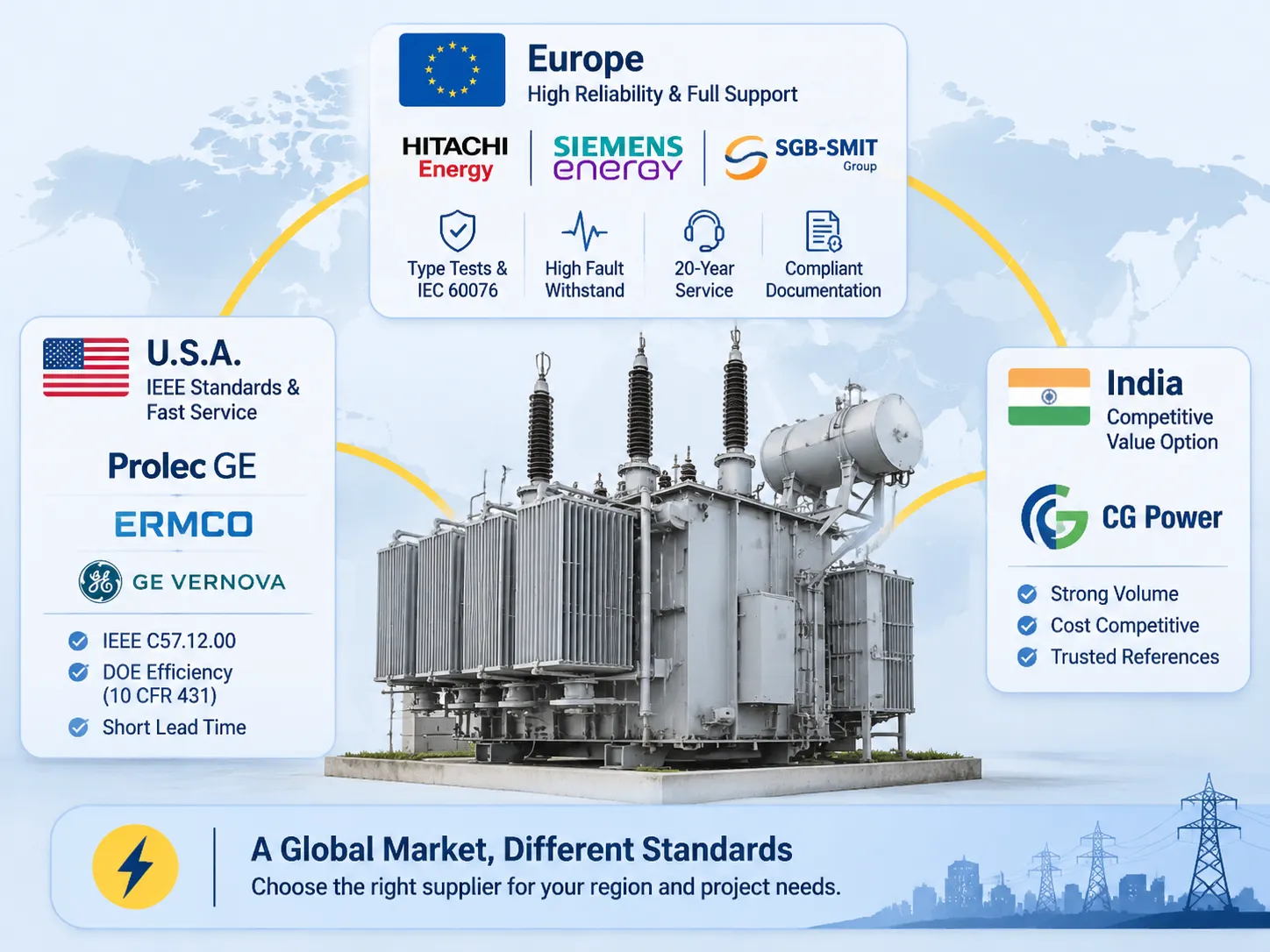
Hitachi Energy, Siemens Energy are the Top 2 companies that come up with almost all large-sized utility tenders, however their level of support is not about the iron and copper that makes the Transformer, but an overall level of support. In addition to the type test evidence, fault current withstand data, and acoustic guarantees, the twenty-year service organisation helps to back the product through its reliability. A utility that purchases a 200 MVA auto-transformer is essentially purchasing a utility grid asset; therefore, the additional cost accurately reflects this added value.
SGB-SMIT is the next largest supplier, which provides products that are more consistent with what is typically needed by the industrial market. Its lowest range starts at 50 kVA and extends to mid-range power (for example : Distribution level) and meets European efficiency levels defined by Ecodesign Regulation 548/2014. They also have production facilities in multiple countries, which allows for shorter delivery times into Europe than other suppliers.
The European group offers consistency through their documentation; for each transformer produced, there is a routine test report compliant with IEC 60076-1 and test documentation detailing the product’s compliance to the typical European test standards. Additionally, a third-party loss measurement can be performed. These documents are required by a lender/insurer and represent the area that a low-cost supplier would struggle to meet.
The American and Indian Position
The North American and Indian markets differ in terms of specification. In North America, transformers are manufactured to IEEE C57.12.00, and the American product standards, along with DOE efficiency requirements under 10 CFR 431. The physical design features (eg. Bushings, Mounting arrangements) for American manufactured transformers are not interchangeable with European manufactured transformers. In North America, Prolec GE and ERMCO would be the two most recognised distribution brands; GE Vernova (a subsidiary of General Electric Co) would represent the highest rating in the larger rating categories. Buyers based outside of North America typically find that it is not cost-effective for them to purchase a 1,000 kVA unit from a US factory. Typically, US-specified units do not conform to IEC standards, hence why the cost differential is substantial. However, for projects based in the US, purchasing from a US factory is generally appropriate even in instances where it entails a premium not associated with the cost of product, because the lead time and service response that accompany US manufacturers are part of what is being purchased.
CG Power (India) finds itself in a completely different position due to its volume and cost structure, allowing it to be competitive regarding distribution ratings throughout Asia and Africa. Furthermore, the references available (utility) give the tendering committee comfort in selecting this company. For projects in the Gulf and Southeast Asia, from 500 to 2,500 kVA, CG is often the value option when evaluating the (1) European premium or (2) the Chinese low-cost option.
What makes TBEA and China XD Group unique?
TBEA and China XD Group have a significant share of the global transformer market, but their go-to-market strategy significantly differs from that of European manufacturers since they sell to end-users purchasing their products via an EPC (engineering, procurement and construction) model. Typically, many of TBEA and China XD Group’s transformers are exported based upon secured financing to the destination buyer and built to the relevant standard (IEC or GB) specified by the buyer.
In conclusion, the quality perception has evolved. An IEC 60076 type test approved 1000 kVA distribution transformer manufactured in China is quite acceptable, and the shortfalls versus a European 1000 kva unit (at the same rating) are much smaller than the difference in pricing indicates. The difference lies in the quality of documentation and the correspondence of the shipment sample to the production run.
What separates smaller manufacturers from the above-mentioned two large manufacturers? If a company is considering a Chinese quotation, it must clarify the following three pieces of information: Is the transformer to the IEC or GB specifications? Are the losses guaranteed or are they typical? Is the Type Testing done on this specific family of transformers or just one like them? The answers to these three questions will distinguish the exporters who can assist in the project versus those who can assist only with the order.
What is the Cost of a Unit, By Rating?
The following prices are only indicative ranges (EXW) for the standard oil-filled distribution and power transformers and are subject to fluctuation based on copper and electrical steel prices, both of which are volatile. They should be used as a sanity test for a quotation and not as a budget.
| Rating | Typical Application | Type/Indicative Price | Typical End Use |
|---|---|---|---|
| 25 to 50 kVA | Pole Mounted, Single Phase | $3,000 – $7,000 | Rural Distribution and Small Clusters |
| 100 to 250 kVA | Pole or Pad Mounted | $6,000 – $14,000 | Residential Subdivisions and Small Commercial |
| 500 kVA | PAD Mounted, 3 Phase | $12,000 – $25,000 | Commercial Buildings and Light Industrial |
| 1,000 kVA | PAD Mounted or Station Type | $18,000 – $35,000 | Industrial Plants and Campuses |
| 2,500 kVA | Station Type, ONAN or ONAF | $40,000 – $80,000 | Process Plants and Substations |
| 10 MVA | Power Transformer, 33 – 132 kV | $250,000 – $600,000 | Substation Step Down |
| 50 MVA and Above | Power Transformer, 132 – 400 kV | $1.2 million – $4 million | Transmission and Generation Step Up |
Two Things Change a Price More Than the Rating Does
Impedance and Tap Range: A unit with a wider on load tap range and higher impedance have different designs, not larger units, therefore they have higher prices, irrespective of the actual kVA rating. Loss guarantees increase production costs because the use of more core steel and copper is required in making low loss designs, therefore a tender specifying loss limits can have an impact on the ranking of suppliers who respond to it.
Lead Times in 2027
Distributors who experienced the shortage beginning in 2021 have seen it ease at different rates. Distribution units with kVA ratings of between 100 and 1,000 are currently offered with lead times of 16 to 30 weeks from multiple manufacturers, which is approaching “normal” levels of availability. The timeline for delivery of large power transformers over 100 MVA continues to range from 18 to 30 months, due in large part to the moving of the supply bottleneck from the factory floor to skilled human resources and the testing bay at many facilities within the global electric utility industry.
Two main structural factors keep lead times for large power transformers very long, and neither of these is expected to change quickly. The first is that grain-oriented electrical steel, the core material for large power transformers, is manufactured by only a handful of steel manufacturers around the world. Therefore, any short-term spike in global demand cannot be resolved by simply adding manufacturers’ capacity.
Secondly, a transformer can take up to several days to test. As a consequence, the time spent testing each transformer limits the number of transformers that a manufacturer can produce, regardless of how many additional people a manufacturer may employ to build transformers.
As a result, for every electrical utility project, it is critical to identify the transformer lead time at the start of the project and not at the end of the project. A substation that is constructed in 12 months and that requires approximately nine months to order the transformer will be able to energise in 15 months after the order is placed, regardless of the number of workers on the job site.
In summary, while the delivery lead time for large power transformers remains a highly complex market issue, the manufacturing and delivery schedules are closely linked to the demand for transformers.
Including References for Standards and Efficiency in Specifications
Four basic references to be used in the specifications of oil-filled transformers are essential. The requirement to follow the standard design criteria for oil-filled transformers, as established by international electrical engineering organisations (e.g., IEC 60076 in most parts of the world; IEEE C57.12.00 and the product-specific C57.12.xx in North America). The requirement to use standards for efficiency, as specified in the Ecodesign Directive 548/2014 for Europe, and 10 CFR 431 for the United States, and equivalent rules established by the national standards organisation for other countries. In evaluating the loss, you must capitalise both the load loss and the no load loss when you want to make a comparison between two units, one being a less expensive unit and the other a more efficient unit. In performing this analysis, you must take into account routine testing on each unit, type testing of the family of units, and factory acceptance testing depending on the nature of the project.
The majority of the energy savings associated with the efficiency can be realised in the first 20 years of the life of the unit. An example would be a 1,000 kVA transformer operating at 60% Load factor with no load losses of 1.5 kW and load loss of 11 kW. This power transformer will consume approximately 48,000 kWh of losses annually. If you are able to reduce these losses by 20%, or 9,600 kWh, this will provide you a 10% additional return on your investment within a four to six year timeframe when using industrial rates.
The difference between a power transformer and distribution transformer is important as they are each designed for different workloads. The workloads of a distribution transformer vary based on time of day while the power transformer has a constant load moving from two points that have constant characteristics. Therefore, the load evaluations and impedance ranges are significantly different between these two transformer types.
Choosing by Application, Voltage and Budget
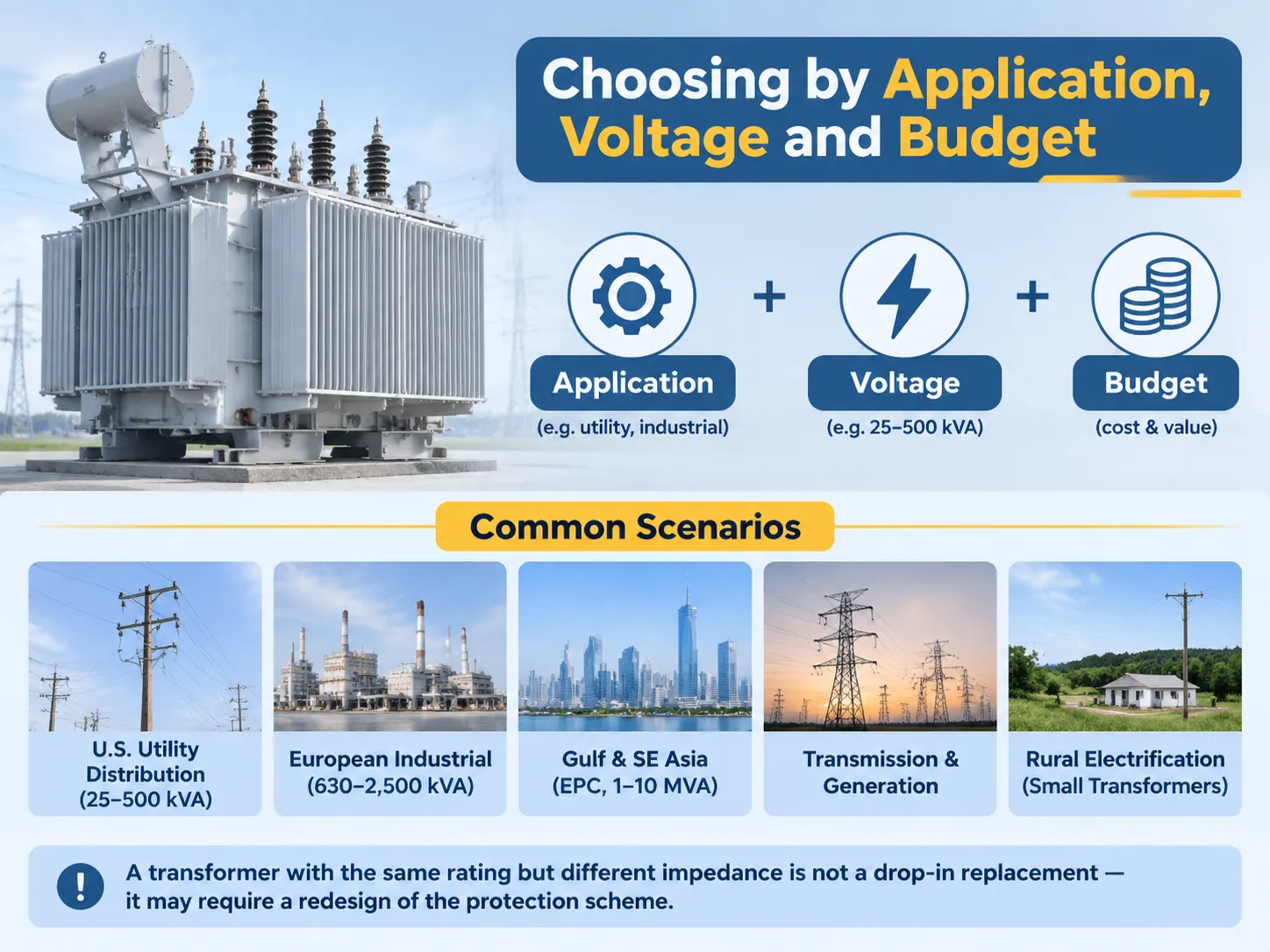
Selecting a transformer should be based on the specific application, voltage, and budget.
The table below captures the most practical approach through the ten choices. Each line provides a typical buying scenario, therefore listing out a group, not an individual company. A company may have a strong position in one size yet may not be as strong in another. It indicates where to find transformer products and what the selection criteria are, and covers the following categories:
| Situation | Where to buy | Why |
|---|---|---|
| U.S. utility distribution transformers (25 to 500 kVA) | Prolec GE, ERMCO and GE Vernova | Products that comply with IEEE and DOE requirements for U.S. service, and shorter lead times than other manufacturers due to being locally based |
| European industrial transformers (630 to 2,500 kVA) | SGB-SMIT and Siemens Energy | Products that meet the European Ecodesign regulations for loss grade, documentation that complies with IEC standards, and warranty support |
| Gulf and Southeast Asia EPC (1 to 10 MVA) | China XD and TBEA | Low pricing, meeting IEC manufacturing specifications, and established locations for export shipping |
| Transmission and generation step-up transformers | Hitachi Energy, Siemens Energy and Hyundai Electric | Type-approved large power ratings, and therefore the necessary utility acceptance |
| Rural electrification, small transformers | CG Power, plus Chinese and regional manufacturers | A credible supplier of small one-phase and pole-mounted transformers for rural electrification, on price and larger quantity volumes |
| Replacements | The original manufacturer first, then another manufacturer | A product that meets the physical sizing needs and impedance requirements of the incoming busbar |
| Budget constraints, IEC acceptance | SUBian, or others comparable to Chinese manufacturers | A similar standard and overall quality, with different overhead expense and delivery time |
A transformer rated the same but with a different impedance does not qualify as a replacement; it requires a redesign of the entire relay/protection scheme.
Where SUBian Goes
We make oil filled distribution transformers between 30 kVA – 5 MVA, which are the ratings the majority of commercial and industrial projects specify. Core and coils are manufactured in our facility, as opposed to being sourced elsewhere. 20 kV oil immersed distribution transformers are the top seller, with additional products available with 11, 22, and 33 kV primary connections in ONAN and ONAF cooling configurations.
While we provide explicit documentation and information on all products shipped, the distinction between a factory and trading company is apparent in the delivery of documents associated with our products. Each transformer is shipped with a routine test report in accordance with IEC 60076-1, loss measurements, oil test certificates and a nameplate photograph. We provide type test reports on common transformer families and advise customers that any third party witnessing of a transformer type test will be included in the offer price prior to receipt of any purchase order for transformers.
We do not offer grid-scale types of transformers. For example, Hitachi Energy or Siemens Energy would be quoting on a 200 MVA auto-transformer used by a utility company. If a project requires a compliant 500 kVA – 5 MVA distribution transformer to meet project timelines, that is the range of products that can fulfil those requirements.
Frequently Asked Questions
Who is the largest manufacturer of transformers in the United States?
GE Vernova is America’s largest transformer manufacturer by total revenue across all classes. GE Vernova has the largest share of the total revenue in the United States for all types of transformer manufacturers. In Distribution Ratings for the majority of utility investors’ purchases, Prolec GE, and ERMCO are the largest participants in the U.S. utility market, followed closely by Eaton and multiple regional plants supplying the outstanding participants for that market. The selection will vary with the definition of which meaning of the question appears (e.g., for transformers or in terms of distribution).
Who Makes Transformers in the USA?
The companies who make transformers in the United States are: GE Vernova, Prolec GE, ERMCO, Eaton, Niagara Transformer, Sunbelt Solomon, and many regional manufacturing plants that produce in accordance with IEEE standards. The majority of these suppliers concentrate their efforts on Distribution Units and Medium Power Rating Transformers because there is a limited number of manufacturers that support testing equipment for the construction of Very Large Power Transformers.
Who Is The Largest Transformer Manufacturer in The World?
By volume, the largest transformer manufacturers are TBEA and China XD. By revenue in the higher voltage classes, Hitachi Energy and Siemens Energy are the market leaders. The metric can vary, so it is more beneficial to create a List based on the ratings, and standards versus League Table rankings.
What Are Oil-Filled Transformers?
Oil-filled transformers include distribution transformers ranging from approximately 25 kVA to 2500 kVA; pad-mounted and pole-mounted transformers; Station Type Transformers up to Approximately 10 MVA and power transformers at transmission and distribution voltages. For conditions in which the use of oil is not possible, such as indoors and up to approximately 2500 kVA, dry-type transformers are the solution to use.
Why Are Oil-Filled Transformers Less Expensive Than Dry-Type?
Oil-filled transformers are typically built with lower amounts of copper, less core steel, and smaller enclosures because of the fact that oil is a superior dielectric and coolant versus air. However, the savings from a lower cost of raw material and labor are offset by bundling, fire separation, and vaulting for installations of oil-filled transformers (inside).
What Is the Lead Time for an Oil-Filled Transformer?
Lead time for 100-1000 kVA range distribution transformers will be 16 to 30 weeks, while for larger power transformers (greater than 100 MVA) the lead time will be 18 to 30 months. The bottlenecks for large units are test bay capacity and skilled winders, not steel.
References
- Hitachi Energy – Power & Distribution Transformers
- Siemens Energy – Transformer Portfolio and Grid Technology
- SGB-SMIT Group – Oil Filled Distribution Transformers
- U.S. Energy Information Administration – Electricity Infrastructure Data
- Electrical Engineering Portal – Transformer Selection and Loss Evaluation
Conclusion
The shortlist of manufacturers for 2027 must be determined by three questions only, none being based on Brand. The three determining questions are: What Standard(s) does the project conform to? What Rating Band is it in? What documentation does the Buyer require? Once these three questions have been answered, each project will fall into one of the three groups above, which will determine the groups’ prices.
The loss number is the one number to pay attention to, because it will continue to generate dollars through the life of the transformer. A transformer that is 10% less expensive and has 20% more losses will have a higher overall cost than a lower-loss transformer, and it will take approximately six years for the calculations and empirical data to validate this fact.