


If you pick up and go through any transformer specification sheet, you are bound to find information regarding what is referred to as Basic Insulation Level, or BIL for short — e.g. “BIL: 95 kV” or “BIL: 150 kV.” If you have had any query regarding these ratings or been puzzled by the fact that two similar transformers can have two different BIL ratings, this article is precisely for you. Basic insulation level is actually the most significant specification recording insulation coordination.
In brief, the term BIL or Basic Insulation Level refers to the insulation rating of a transformer defined against the maximum voltage of the lightning impulse wave and makes clear what BIL is. Ed to elaborately elaborate, the standard regulating BIL is introduced in IEC 60076-3 and IEEE/ANSI C57.12.00. BIL is expressed in kV (peak). In order to determine BIL a lightning impulse test is performed using a full wave implying that a lightning impulse wave of 1.2/50 μs is injected at the rated BIL level. A higher BIL should be adopted in case of severe lightning exposure, low insulation margin, major system voltage; though it should be remembered that BIL applies only to impulse withstand voltage and does not ensure protection against flash over or surge voltage.
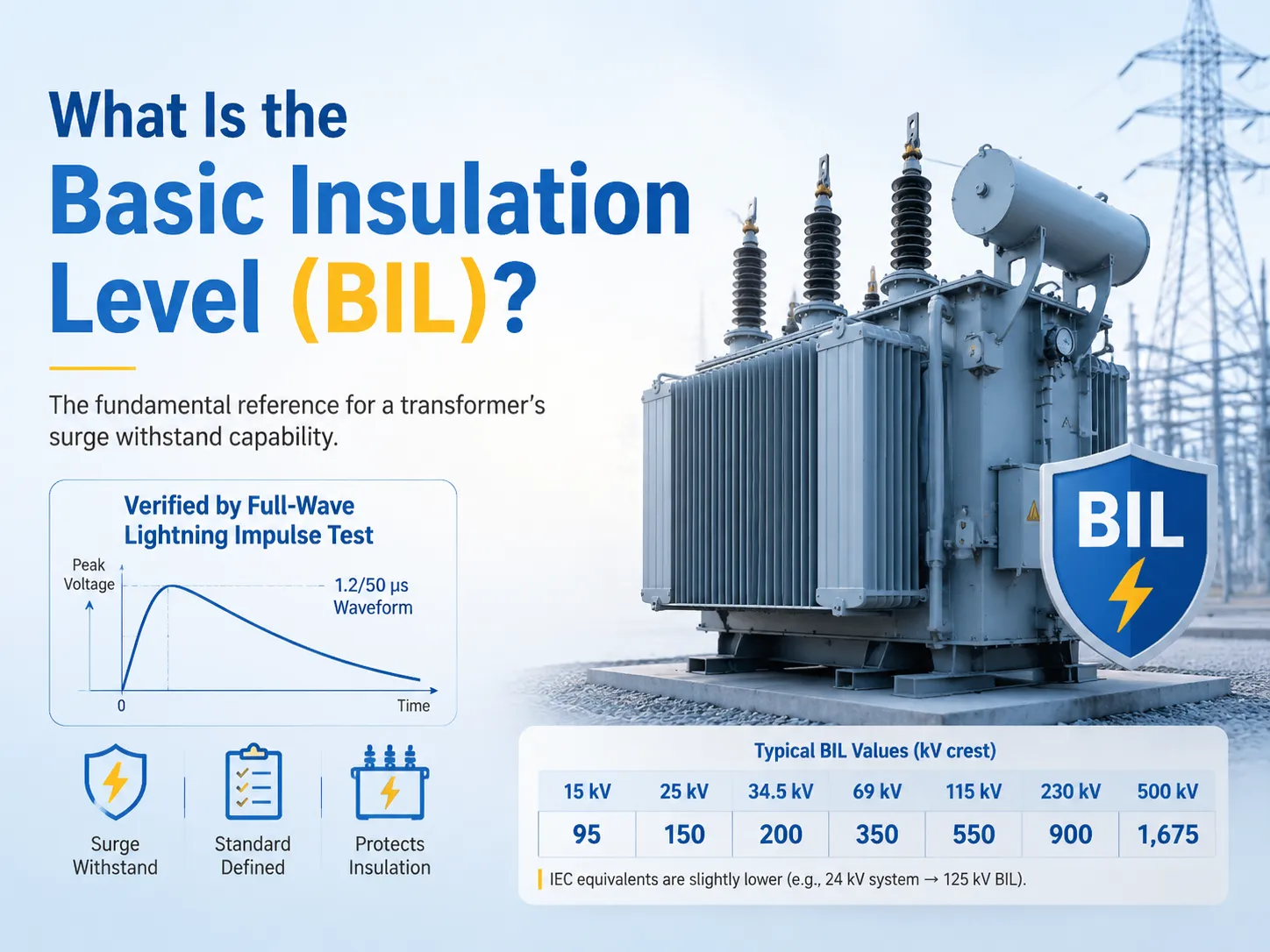
What BIL Means
The basic insulation level (BIL) refers to the maximum voltage that is defined by the lightning impulse. When lightning strikes the transmission lines or surge goes through the system, the electricity surge is generated, giving a voltage wave above the regular operating voltage in any system. The BIL is the value calculated by the transformers to handle that surge generated by the lightning without the insulation getting destroyed and can be expressed in kilovolts, such as 95 kilovolts.
BIL is particularly important because insulation failures can cause significant problems and may be very costly; any transformer that flashes internally cannot be repaired where it stands. BIL provides a common language for both designers and buyers — “this transformer rated at 15 kV can handle the voltage surge generated by a strike of 95 kV” — and therefore, it essentially brings all processes of insulation coordination into one panel, assigning the level of protection offered to the device. The transformer specifications guide explains where BIL sits among the other ratings on a nameplate and datasheet.
How BIL Is Measured and Tested
BIL is not a simple value obtained by estimation. It actually refers to a test level. Verification of BIL usually means conducting a full-wave lightning impulse test, according to IEEE C57.12.90 and IEC 60076-3:
- The test consists of applying a lightning impulse with a wave form of 1.2/50 µs – the rising time of the impulse is 1.2 µs with the decay of the wave taking 50 µs, and thus modeling the effect of a lightning strike.
- The peak of the wave matches the rated BIL (e.g., 95 kV for a 15 kV transformer).
- The transformer can withstand a minimum defined number of applications without flashover or failure of insulation.
- High-voltage transformers go through additional chopped-wave and switching-impulse tests, however, BIL is always defined by the full-wave lightning impulse withstand level.
In practical terms, BIL stands for the peak value that must be demonstrated during laboratory testing either on a sample of on production units.The complete acceptance test suite — including the impulse test — is covered in our transformer testing guide, because most insulation failures trace back to defects that factory testing exists to find before shipment.
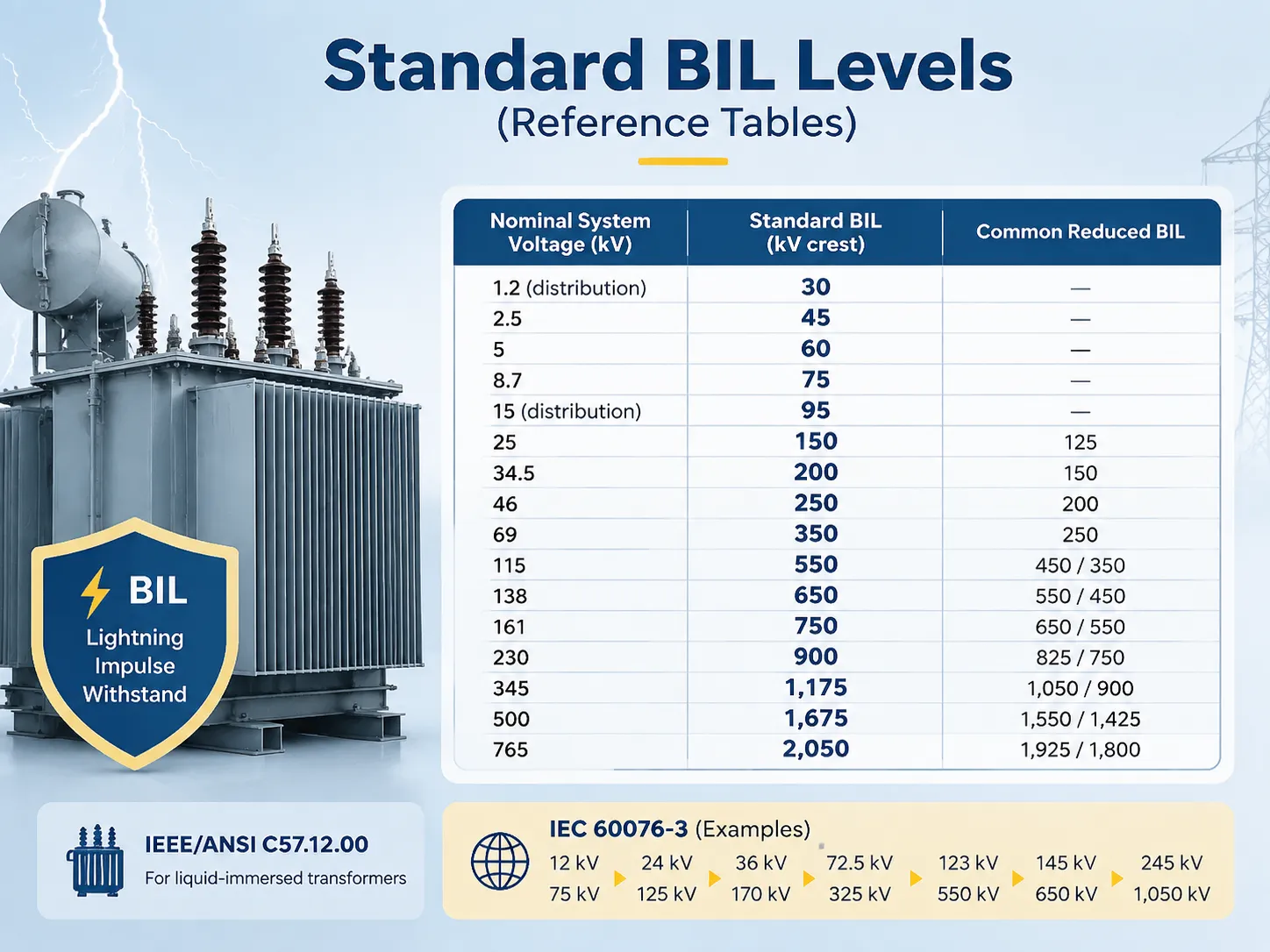
Standard BIL Levels (Reference Tables)
In IEEE/ANSI C57.12.00, normal BIL values are detailed for transformers immersed in oil. The BIL values marked in bold are standard ones for every voltage class:
| Nominal System Voltage (kV) | Standard BIL (kV crest) | Common Reduced BIL |
|---|---|---|
| 1.2 (distribution) | 30 | — |
| 2.5 | 45 | — |
| 5 | 60 | — |
| 8.7 | 75 | — |
| 15 (distribution) | 95 | — |
| 25 | 150 | 125 |
| 34.5 | 200 | 150 |
| 46 | 250 | 200 |
| 69 | 350 | 250 |
| 115 | 550 | 450 / 350 |
| 138 | 650 | 550 / 450 |
| 161 | 750 | 650 / 550 |
| 230 | 900 | 825 / 750 |
| 345 | 1,175 | 1,050 / 900 |
| 500 | 1,675 | 1,550 / 1,425 |
| 765 | 2,050 | 1,925 / 1,800 |
For dry-type transformers (IEEE C57.12.01), BIL values are lower for the same voltage levels; for instance, a 15 kV dry-type transformer’s BIL rating is usually 95, or 110 kV. IEC systems (IEC 60076-3) also have a table of BIL ratings: the BIL value calculated in accordance with the highest system voltage Um. For instance, a 12 kV system has a BIL value of 75 kV, 24 kV → 125 kV, 36 kV → 170 kV, 72.5 kV → 325 kV, 123 kV → 550 kV, 145 kV → 650 kV, 245 kV → 1,050 kV. Whichever standard governs your project, the specification process is the same — and the distribution transformer basics article shows how voltage class and BIL are selected together for utility and industrial duty.
When to Specify a Higher BIL
Standard BIL can be viewed as a baseline rather than an apex when there are four reasons for increasing the level:
- Sites with an elevated risk of lightning. Areas that are mountainous, places that are characterized by high keraunic activity (the number of thunderstorms that occur in a year), long exposed lines can be the reasons for using a higher BIL.
- Insufficient margins of protection. When there are limitations in the possibility of placement of arresters in the middle of high surge environment conditions, this higher level of protection may compensate for that distance and impedance.
- Units that are critical or hard to replace.
- Reduced level of protection. By specifying the Reduced BIL size, one can save money, however, this requires a careful coordination of arresters.
High levels of BIL will require the investment of a considerable amount of money to cover insulation and clearances issues expected to be present at the design phase. Thus, proper engineering always implies coordination studies. The grounding and arrester side of that study is covered in our transformer grounding basics article, since the grounding system determines how surge energy is actually dissipated.
What BIL Does Not Cover
There is one thing that is certain regarding BIL; that is the aspect of “impulse withstand”. However, the buyers who generalize it are in for surprises. BIL does not provide:
- The problem of flashover due to contamination. A contaminated bushing or insulator may flashover under normal working voltage before the arrival of any lightning strike; this means that it is a creepage distance and pollution class problem, and not a problem of BIL.
- Power frequency overvoltages. The reason for sustained the overvoltage, which is either due to the malfunction of regulator or ferroresonance, will put insulation under thermal and electrical stress; the period of the time of operation of a power transformer is not accounted for in the microsecond impulse testing.
- Internal weaknesses. BIL testing can catch weaknesses; however, the ingress of humidity, movement of coils and aging process of insulation will negatively affect it after a long period of time. That is why ongoing checks, such as the tests of oil and DGA are done besides the factory impulse testing.
- The lifespan from the mechanical point of view. Even when the transformer passes the impulse testing, it can get damaged by a short circuit, overloading, or insulation aging.
It is important to remember that BIL should be one of the elements of a coherent set that includes impedance level, arrester rating, creepage distance, grounding type, and a testing program and not the indicator of immortality.
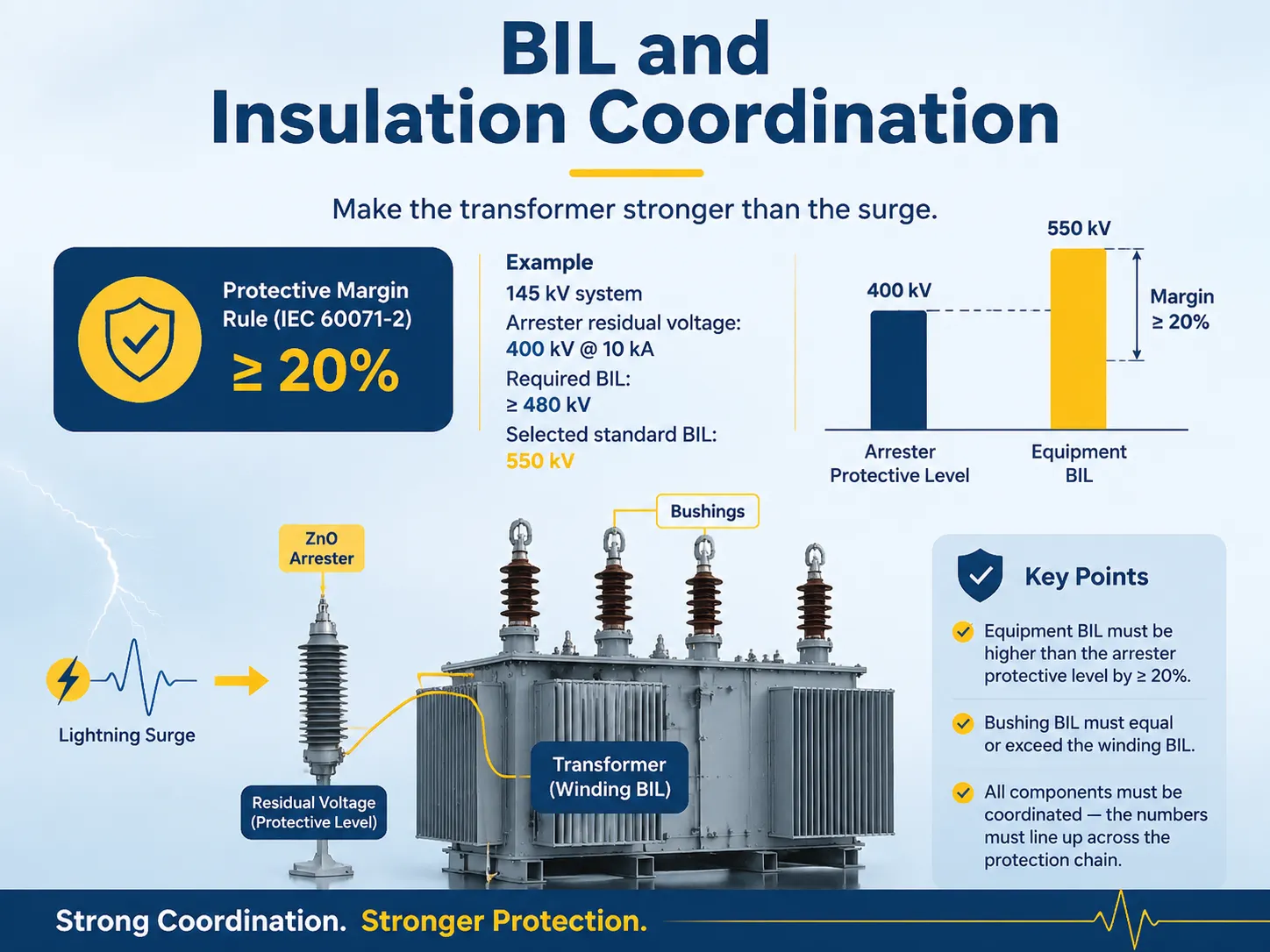
BIL and Insulation Coordination
The concept of insulation coordination can be defined as making sure that the transformer withstands the influence of the surge it receives. According to the conventional approach (IEC 60071-2), the insulation level of the equipment (BIL) must exceed the level of the protective device (arrester) by at least 20%. For instance, in case of a 145 kV installation and a residual voltage of 400 kV across ZnO arresters with rated current of 10 kA, it is necessary to have a BIL of the bushing (and equipment) of at least 480 kV, so a standard 550 kV level must be applied. If the level of insulation does not meet the requirements, it would be needed to either increase the value of BIL or bring the arrester closer to the equipment.
Bushings are also included in the same insulation coordination. The bushing BIL must be equal to or greater than the BIL of the winding it connects to, otherwise it becomes the weakest element of the entire chain. Hence all sheets for these devices (transformer, bushing, arrester) are required to include BIL, as the values of BIL must be equal for all equipment participating in the process.When you buy a transformer and its accessories, asking for the coordinated impulse levels on one document is the difference between a coordinated installation and a future failure — and the distribution transformer product range lists the standard BIL options available with each voltage class.
FAQ
What is the basic insulation level (BIL) of a transformer?
The BIL refers to the highest voltage of the standard impulse lightning of 1.2/50 µs, to which transformer insulation is obliged to resist without flashover. It is cited in kV peak, for example, for the distribution transformer of 15 kV the BIL is 95 kV, while for the transformer of 69 kV it would have to be 350 kV. Its definition/test is stated according to IEEE/ANSI C57.12.00/C57.12.90 (or IEC 60076-3).
What is the definition of Basic Insulation Level (BIL)?
The Basic Insulation Level is permittance at impulse voltage, as the highest voltage the insulation system has to withstand (the BIL level). It either refers to factory tests of the equipment or is a particular value in the list of insulation levels for the voltage class.
What is BIL and SIL?
BIL stands for impulse insulation level (lightning level) and implies its level in kV of its peak. In the context of transformers, SPL stands for the switching level because it is applicable for slow switching surges with a longer wavefront that usually occurs at electricity of HIGH voltage, from 345 kV upwards. Both terms are alike as they used for considering insulation coordination since they deal with different situations: BIL for high voltage spikes, and SIL for slow switching.
What is the minimum Megger value?
While there is no strict minimum, approximately 1 MΩ of insulation resistance is required per kV of nominal voltage for transformers in practice (or around 100 MΩ for distribution transformers which go under 2500V test voltage). The most important factor while measuring is trend in values rather than value itself.
References
- IEEE C57.12.00 Test Tables — Distribution and Power Transformer Insulation Levels
- Eaton — Substation Transformer Specification (Voltage and BIL Tables)
- Ziyao Power — Bushing Selection and BIL Coordination Guide
- IEEE C57 — Instrument Transformer BIL and Dielectric Test Tables
- IEC 60076-3 — Power Transformers: Insulation Levels, Dielectric Tests
Conclusion
The base insulation level includes the lightning and surge construction of a transformer, providing a specific maximum voltage value: for 15 kV-class construction – 95 kV, for the 69 kV-class – 350 kV, and for 500 kV-class construction – 1,675 kV; these values indicate how strong the insulation construction is. The essence of this notion is in coordination, meaning that we need to fit the BIL to the voltage class, evaluate the BIL of the transformer if there is a need for thick protective margins and lightning influence, and keep the protective margin above 20%. However, it should be noted that only impulse issue can be solved with the help of BIL.