


A procurement manager for a power distribution company from West Africa sits in his office in Lagos and stares blankly at a spreadsheet open in front of him with eleven empty rows. His company has received clearance to electrify four industrial zones this year and must execute turnkey delivery, i.e., the company must also be responsible for civil works, as well as transformer station, switchyards, protection panels, and metering. All solutions that he finds range from a simple transformer which does not allow commissioning in time by his crew to a highly engineered substation from Europe which costs over the budget established for that project.
This article describes the situation represented by that spreadsheet. The list below consists of ten recognized complete substations solutions for users from around the world from compact substations to full 110/35 kV turnkey substations with real descriptions, a range of prices, standards used, and red flags when buying from a Chinese substation manufacturer.
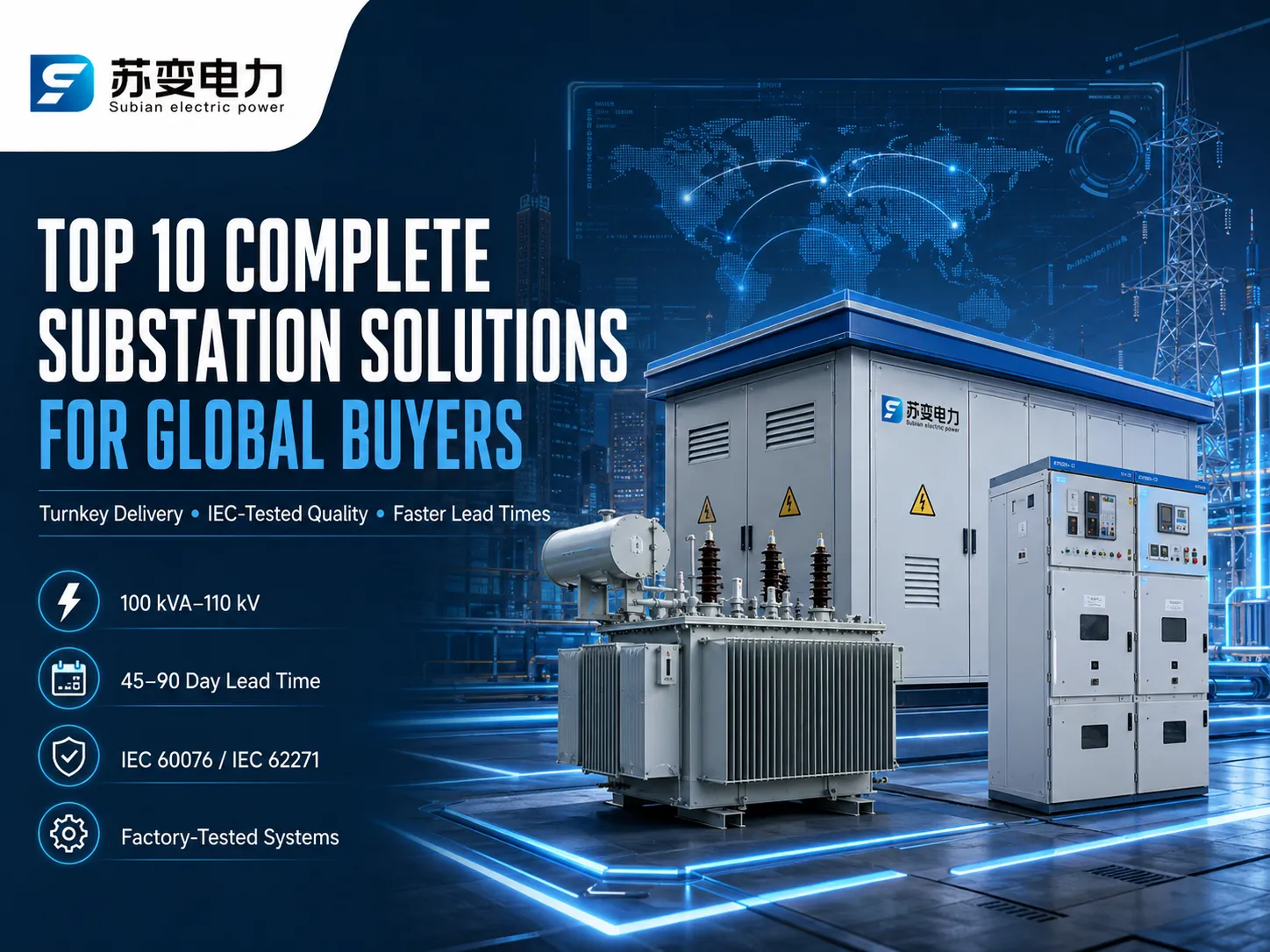
Complete Substation Solution
A complete substation solution is much more than simply a transformer with its casing. It is a key deliverable contract under which one manufacturer or EPC contractor undertakes the responsibility for the transformer, the high voltage and low voltage switchgear, protective and control panel, auxiliary power, grounding system, metering, and building or skid in the case of factory-built substations. Thus the customer will get a tested and commissioned unit ready for operation once connected to the network instead of a pile of individual components to be designed and assembled on the site.
The popularity of the packaging model has skyrocketed in the past 10 years due to the global shortage of experienced field engineers. In 2023 the International Energy Agency stated that the grid investment needs to increase twice, exceeding $600 billion per year up to 2030, to achieve electrification and renewable goals. Part of this money is being invested by utilities and private developers which currently lack enough internal capacities to manufacture every single component of each substation.
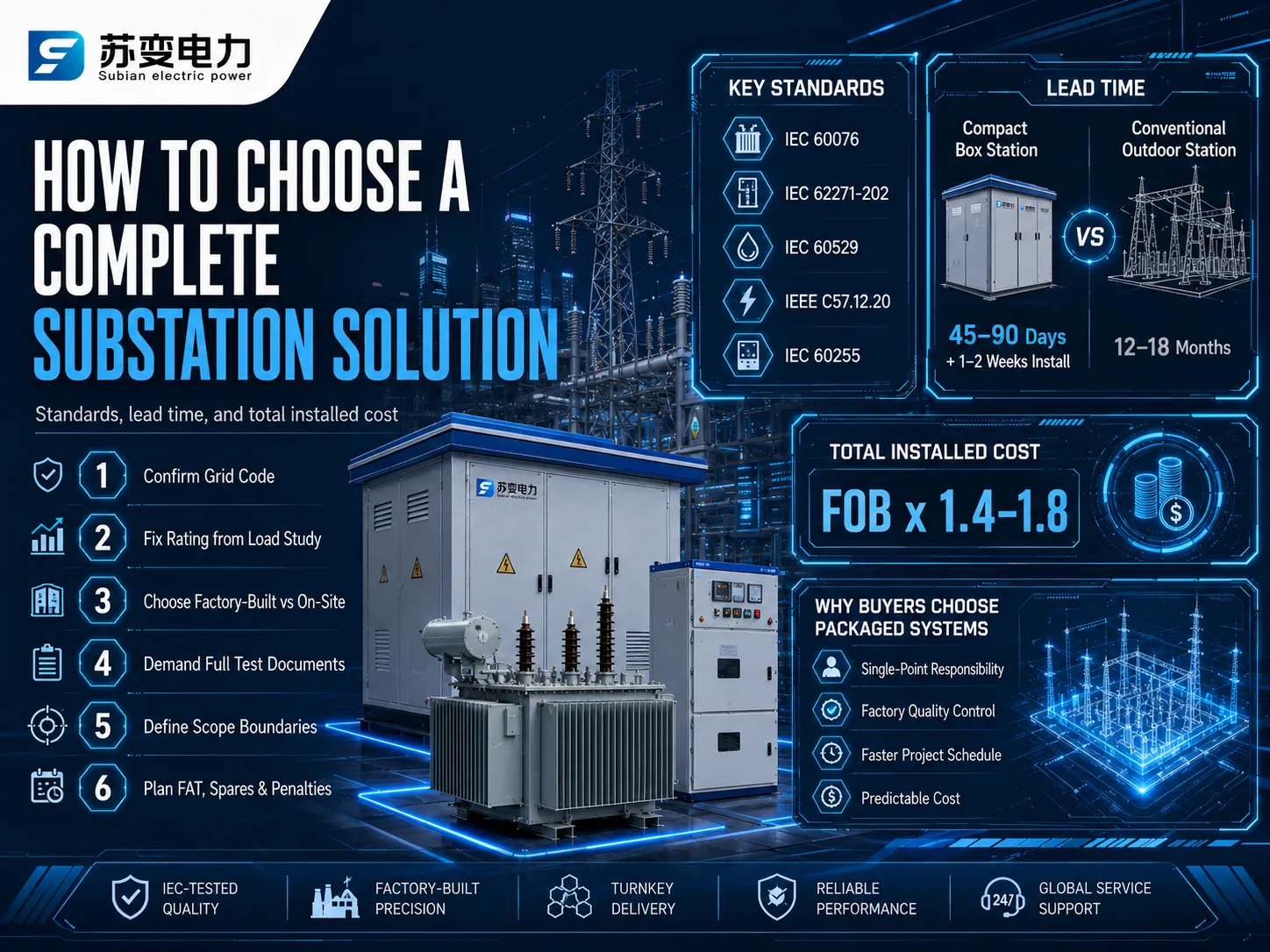
In addition, the factory-built substations reduce the lead time. While an ordinary outdoor substation with a voltage of 35 kV manufactured on site may take from 12 to 18 months from conceptualization to the start of operation, a comparable compact prefabricated substation, manufactured and tested in the same factory, can be delivered in only 45 to 90 days and be put into operation in a week after delivery.
Why Global Buyers Prefer Packaged Substations
The reasons for the trend towards packaged solution are the following measurable advantages:
Responsibility by a single entity. One vendor is responsible for design, production, testing, and commissioning. A situation where the relay does not properly coordinate with transformer differential protection requires only one phone call instead of a dispute involving four different subcontractors.
Factory quality control. The type test and routine tests in compliance with IEC 62271-202 and IEC 60076 are done in a controlled environment prior to shipment, the test reports accompany the equipment.
Fast project schedule. Parallel manufacturing of the transformer in a workshop, switchgear inside, and casing separately decreases the overall lead time considerably.
Predictable cost. The fixed quotation covers all the product components, eliminating any add-ons.
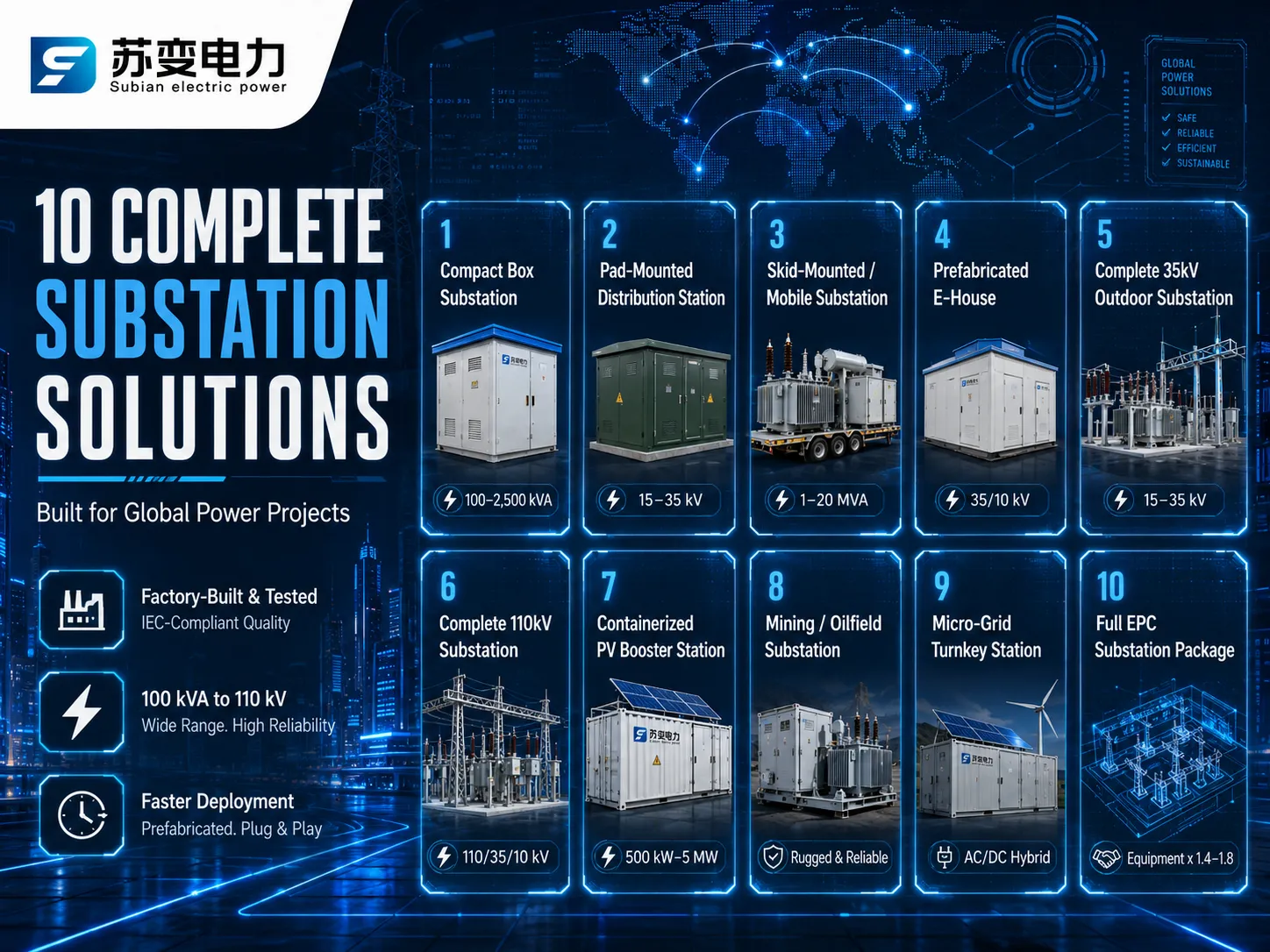
The 10 Complete Substation Solutions at a Glance
There is a vast range of sizes and styles within the terminology referred to as “complete substation.” The table below provides details of the ten most popular types including indicative factory gate prices from suppliers from China. Bear in mind that prices mentioned here are indicative and depend on manufacturer, attributes and protection limits of the equipment and price of shipping to regional destinations.
| # | Solution type | Typical rating | Voltage class | Typical price (FOB China) |
|---|---|---|---|---|
| 1 | Compact box substation (American/European style) | 100–2,500 kVA | 12/24/36 kV | $8,000–$65,000 |
| 2 | Pad-mounted distribution substation | 100–2,000 kVA | 15–35 kV | $6,000–$48,000 |
| 3 | Skid-mounted / mobile substation | 1–20 MVA | 35–110 kV | $90,000–$450,000 |
| 4 | Prefabricated E-House / modular room | — | Up to 170 kV equipment | $30,000–$220,000 |
| 5 | Complete 35kV outdoor substation | 2–31.5 MVA | 35/10 kV | $80,000–$380,000 |
| 6 | Complete 110kV substation | 10–63 MVA | 110/35/10 kV | $300,000–$1,200,000 |
| 7 | Containerized PV / solar boosting station | 1–6.3 MVA | 35 kV | $45,000–$180,000 |
| 8 | Mining / oilfield rugged substation | 315–10,000 kVA | 6.6–35 kV | $25,000–$300,000 |
| 9 | Micro-grid / remote village turnkey station | 50–1,000 kVA | 11/33 kV | $15,000–$90,000 |
| 10 | Full EPC substation package (design + civil + install) | Any | Any | Equipment cost × 1.4–1.8 |
First seven types of substations are produced in factories and are ready for testing prior to delivery. Types 8 to 10, on the contrary, are usually tailor-made so they take longer to produce but fit perfectly into site’s requirements.
Compact Box Substation vs Conventional Substation
The most common procurement decision for distribution-scale buyers is whether to buy a compact box substation (often called a pad-mounted or containerized unit) or to build a conventional brick-and-mortar substation on site. The comparison below reflects typical figures from recent tenders.
| Criteria | Compact box substation | Conventional outdoor substation |
|---|---|---|
| Footprint | 6–30 m² | 150–1,000 m² |
| Design-to-energize time | 45–90 days factory + 1–2 weeks install | 12–18 months |
| On-site civil works | Minimal (concrete pad only) | Full foundation, fencing, buildings |
| Engineering effort by buyer | Low — vendor does it | High — separate consultants needed |
| Relocatability | Yes (skid/container mounted) | No |
| Total installed cost (35kV/10kV, 5 MVA) | ≈ $180,000–$280,000 | ≈ $320,000–$520,000 |
| Maintenance access | Good for small units; tighter for HV bays | Excellent |
Box substations rarely make sense above 20 MVA, where cooling, busbar space, and breaker arc-extinguishing distances demand dedicated buildings. For the 100 kVA to 10 MVA range, however, they routinely save 30–50% of total installed cost and cut schedule by 60% or more.
Standards and Compliance to Specify
Whatever format you choose, the equipment inside must meet recognized international standards. The most important documents to reference in your tender are listed below, with the exact clauses that matter.
| Standard | Scope | Why it matters to buyers |
|---|---|---|
| IEC 60076 (parts 1–17) | Power transformers | Defines ratings, losses, impulse withstand, tap ranges |
| IEC 62271-200 / -202 | Prefabricated compact substations | Governing standard for box-type transformer stations |
| IEC 62271-1 / -100 | MV switchgear and breakers | Verification of breaking capacity and fault ratings |
| IEC 60529 | Enclosure ingress protection | IP54/IP65 ratings for outdoor weatherproofing |
| IEEE C57.12.20 | Pad-mounted transformers | Commonly required for US-market pad-mounts |
| IEC 60255 | Protection relays | Ensures relay coordination behavior is testable |
For US-bound projects, ANSI/IEEE C57.12 and NEMA TP-1 efficiency levels are often required alongside or instead of IEC. Specify one regime clearly in the tender; mixing them creates test and acceptance disputes later.
Key Specifications and Ratings
Every specification for a complete substation must include several data fields. Omission of any of the data fields will lead to confusion while executing the project, which will result in alteration orders.
Rated power, in kVA at rated voltage, and specification of the transformer required in continuous base load and overload conditions (ONAN/ONAF cooling).
Primary/secondary voltage, for example 35/10.5 kV or 33/0.4 kV. This includes tap ranges (usually ±2×2.5% or on-load OLTC).
Vector group. Examples include Dyn11, YNd11, or Yyn0, as appropriate for the grounding philosophy.
Rated short-circuit impedance (usually 6-10% according to the rating).
Protection scheme, including transformer differential (87T), overcurrent (50/51), restricted earth fault (64) and standby earth fault.
Environmental requirements, including site temperature, altitude (derating over 1000 m), humidity, and pollution class.
Enclosure class, including IP rating, materials, sound level, and cable entry types.
Metering and telemetry, including possible revenue metering, SCADA interfaces, or remote monitoring.
For a 35/10.5 kV compact substation and a 5 MVA transformer, the indicative specification could contain 170 kV impulse withstand transformer (LI class according to IEC 60076-3), 31.5 kA/4 s vacuum circuit breaker, and IP54 enclosure, with relay protection according to IEC 60255.
Application-Driven Substation Selection
The correct solution depends heavily on the application. The table below maps common project types to the preferred substation format.
| Application | Recommended format | Typical rating | Key consideration |
|---|---|---|---|
| Urban low-voltage network (400V) | Compact box substation | 315–1,000 kVA | Low noise, small footprint, IP54 |
| Rural electrification village supply | Pad-mounted / pole-mounted + kiosk | 50–315 kVA | Lowest first cost per household |
| Solar PV or wind plant collection | Containerized boosting station | 1–6.3 MVA | Inverter compatibility, harmonic duty |
| Mining site / remote camp | Skid-mounted mobile substation | 1–10 MVA | Relocatability, robust transport frame |
| Utility distribution (35kV) | Complete outdoor 35kV substation | 3.15–20 MVA | Reliability, redundancy, SCADA |
| Industrial plant with own supply | Pad-mount + E-House control room | 500–5,000 kVA | Arc-flash coordination, spare capacity |
Buyers frequently make one mistake here: choosing a format on price alone, then discovering the local grid code demands outdoor air-insulated switchgear or a separate metering room. Check your grid code and local utility interconnection rules before you finalize the format.
Top Substation Brands and Price Ranges
The world substation sector is dominated by a handful of major companies from Europe and the USA, and an increasing number of manufacturers from China and India. The prices shown below are for comparable factory-made compact substations at the 1MVA/12 kV level, and are shown on an FOB basis for guidance only.
| Brand | Country | Typical price (1 MVA, 12 kV) | Notes |
|---|---|---|---|
| ABB | Switzerland | $48,000–$85,000 | Full e-house and GIS expertise |
| Siemens | Germany | $50,000–$90,000 | Strong digital substation portfolio |
| Schneider Electric | France | $45,000–$80,000 | Excellent LV/MV integration |
| Hitachi Energy | Switzerland/Japan | $52,000–$92,000 | Premium transformer and HVDC heritage |
| Eaton | Ireland/USA | $40,000–$75,000 | Strong in pad-mounts and US markets |
| Toshiba / Hyundai | Japan / South Korea | $38,000–$70,000 | Established in Asia and Middle East |
| TBEA / China XD | China | $18,000–$35,000 | Large Chinese SOE manufacturers |
| Jiangsu Subian Electric Power | China | $14,000–$30,000 | Export-focused, IEC-tested solutions |
Global companies such as ABB, Siemens, Schneider Electric and Hitachi Energy offer excellent engineering, proven experience and local servicing, which really justifies their relatively high prices, between 1.5-2.5 times the cost of relevant Chinese quotations for similar performance testing.
For buyers who need IEC 60076-tested transformers, integrated switchgear, and factory test reports at a fraction of that premium, Jiangsu Subian Electric Power is worth a serious look. The company designs and manufactures distribution and power transformers, compact box substations, and complete station packages with routine and type test documentation, shipping to more than 40 countries across Africa, Southeast Asia, Latin America, and the Middle East. Subian also supports OEM/ODM configuration, allowing project developers to spec their own relay brands, bushing types, and vector groups while keeping the factory-built, single-vendor convenience.
How to Choose a Complete Substation Solution
Use this checklist when creating a list of suppliers and locking in your requirements before placing an order.
①.Determine the grid code and use it to obtain all relevant documents pertaining to interconnection by the utility, protection policies, and earthing rules.
②.Make sure that rating is derived from the load studies. Determine peak coincident loads, anticipated growth (common values are 15% – 25%), derating factors.
③.Identify the choice between factory or on-site build. If the capacity is under 10 MVA and time limits are significant, factory solution is more likely to be chosen.
④.Obtain all test certificates. Make sure that you have all test reports (IEC 60076-3 impulse test, IEC 62271-202 internal arc tests) and receive routine test certificates for each transformer unit.
⑤.Specify the scope boundary. Saying what is included in the order is crucial: transformer, switchgear, protection, battery & charger system, metering system, enclosure wiring, earthing kit, spare parts and tools.
⑥.Ask about FAT. Having your engineer during FAT inspection has helped to discover 80% of the commissioning issues before shipping.
⑦.Make arrangements of spare parts and consumables. Order a 10% amount of spare parts rather than counting only on the critical spare set for the first two years.
⑧.Negotiate penalties. Establish penalties starting from the time when the equipment is energized and not just from the fact of shipment.
Hidden Costs and Total Cost of Ownership
The FOB equipment price is usually less than half the story. Experienced buyers budget on total landed and installed cost:
| Cost component | Typical share of FOB price | Notes |
|---|---|---|
| Equipment (FOB) | 100% (baseline) | Includes factory testing |
| Ocean freight + insurance | 8–15% | 20-ft/40-ft container or breakbulk for 110kV units |
| Import duties & taxes | 5–30% | Country-dependent; verify HS codes and exemptions |
| Civil works and foundation | 10–25% | Even compact stations need a pad and cable trenches |
| Installation and commissioning | 8–20% | Higher where local skilled labor is scarce |
| Spares, tooling, training | 3–8% | Budget 2-year critical spares at ordering |
As a rule of thumb, multiply the FOB price by 1.4–1.8 to estimate full installed cost, and add a further 5–10% contingency for remote or logistically difficult sites. A $20,000 compact substation can realistically end up costing $30,000–$38,000 installed, so the cheap-looking bid is often not the cheapest solution overall.
Frequently Asked Questions
What is the cheapest complete substation solution?
Range of 100-630 kVA is the cheapest solution with a typical cost of $8,000-$25,000 exclusive of freight costs when it comes to manufacturers from China. For the systems of smaller than 100 kVA a pole or pad transformer with a small kiosk could have a lower price level of $3,000-$8,000 but would not necessarily be considered as a “complete substation.” For installations exceeding 2.5 MVA, the cost-effective option would be a traditional outdoor station or equipment, which will not be classified either as optional outdoor station.
How long does it take to get a complete substation from a Chinese manufacturer?
A standard compact box substation ships in 45–90 days from confirmed drawings. Larger 110kV stations and full EPC packages run 6–14 months because of design coordination and civil works. Factory acceptance testing usually adds 5–10 working days to the schedule and is strongly recommended before ocean freight is booked.
What tests should I require before shipment?
At minimum: winding resistance, turns ratio, insulation resistance, dielectric withstand, and a temperature-rise test per IEC 60076. For the switchgear, require breaker timing, contact resistance, and insulation tests. If the project justifies it, witness the type tests (lightning impulse per IEC 60076-3, internal arc per IEC 62271-202) at the factory or request certified copies from a recognized test lab.
Can a box substation be relocated later?
Yes. Skid-mounted and containerized units are designed for relocation with a crane and flatbed trailer. European-style compact stations in a steel enclosure can also be moved, though civil works at the new site (pad and cable trenches) still apply. If relocation is planned, specify lifting lugs, reinforced framing, and weatherproof terminal boxes in the original order.
Why are European substations so much more expensive than Chinese ones?
In general, European brands (ABB, Siemens, Schneider) charge higher rates for their services, carry out significant local R&D work, and possess developed engineering services. Juts the same IEC tests used by Chinese companies are also used by European manufacturers. The price difference is approximately between 1.5 and 2.5 times, which covers the cost of brand security, local representation, and many years of successful use of similar equipment. However, a common Chinese factory, Jiangsu Subian Electric Power, manages to considerably reduce this distance in the type of equipment they provide because they offer products, which passed all necessary IEC tests and are backed up with all required documentation.
References
- IEC (International Electrotechnical Commission) — Publisher of IEC 60076 transformer and IEC 62271 switchgear standards.
- IEEE — Source of IEEE C57.12 and C57.12.20 pad-mounted transformer standards for the Americas.
- International Energy Agency (IEA) — Grid investment and electrification outlook data cited above.
- Global Market Insights — Market research on the prefabricated substation market.
- NEMA (National Electrical Manufacturers Association) — TP-1 efficiency and distribution equipment standards.
- ABB — Reference product pages for compact substations and e-houses.
- Siemens — Reference for digital substation and prefabricated solutions.
- Jiangsu Subian Electric Power — Chinese manufacturer of transformers and complete substation packages.
Conclusion
Choosing a complete substation solution is a matter of matching format, rating, and scope to your site, grid code, and budget — not of buying the cheapest box on Alibaba. The ten formats covered above span from $8,000 compact units to multimillion-dollar 110kV stations, and the right answer depends on your load study, your schedule, and your in-house engineering strength.
- Factory-built compact stations save 30–50% of installed cost and 60% of schedule versus on-site builds for units below 10 MVA.
- Specify IEC 60076, IEC 62271-202, and IEC 60529 explicitly, and demand type test certificates.
- Budget total installed cost at 1.4–1.8× the FOB equipment price.
- Whether you choose ABB, Siemens, or Schneider for flagship projects or an export-focused Chinese manufacturer such as Jiangsu Subian Electric Power for cost-sensitive ones, insist on full factory test documentation and a single responsible vendor.