


An einem Logistikunternehmen an der Küste des Landes prüft der Exportversandmanager die Buchungen des Quartals, die zeigen, dass achtundvierzig Container nach Westafrika verschifft werden, und jede Ladung enthält entweder ein paar vorgefertigte Umspannwerke oder eine vorgefertigte Station. Es gibt eine Station, die heraussticht — ein boxförmiges Umspannwerk, das mit Edelstahl verkleidet ist. Dieser Container ist für ein Küstenresort-Entwicklungsprojekt in Lagos bestimmt, wo die salzhaltige Luft innerhalb von drei Jahren zwei gewöhnliche Stahlgehäuse angegriffen hat. Der Kaufauftrag des Kunden weist auf die Notwendigkeit von Edelstahl hin, da die Wartungsmannschaft vierhundert Kilometer von der nächsten Einrichtung entfernt ist und sich nicht mit dem Problem der zweimal jährlichen Neulackierung des Gehäuses befassen kann.
Vorfertigte Umspannwerke aus Edelstahl gehören zu den am schnellsten wachsenden Exportartikeln für Transformatorenhersteller — und der Grund dafür ist offensichtlich. Diese Veröffentlichung beschreibt im Detail, wie sich vorgefertigte Umspannwerke aus Edelstahl von anderen unterscheiden, was Unternehmen dazu bringt, sich immer wieder für sie zu entscheiden, wie sie produziert und geliefert werden und wie ihre Preise aussehen.
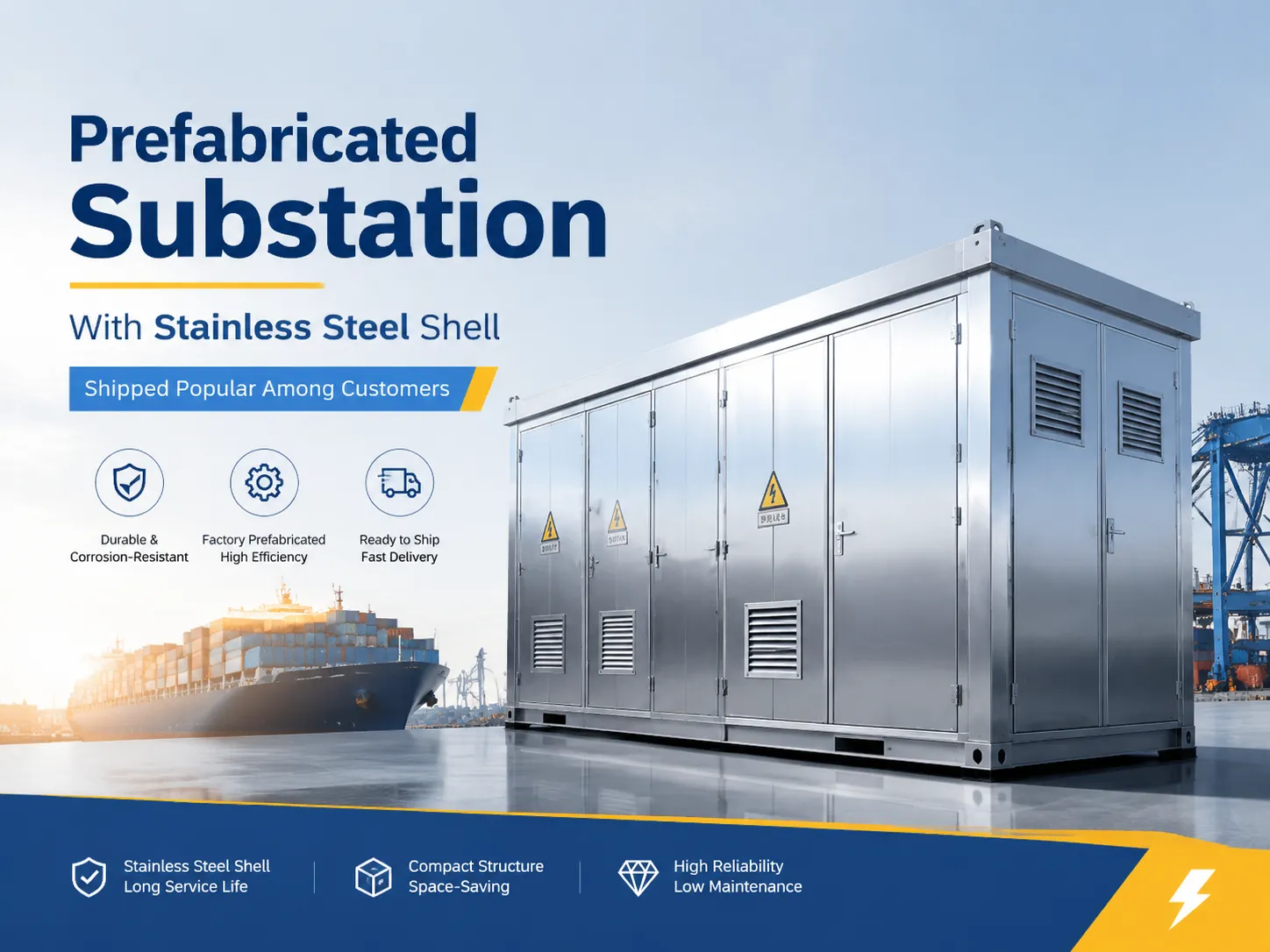
Ein vorgefertigtes Umspannwerk aus Edelstahl wird definiert als ein werkseitig hergestelltes boxförmiges Transformatoren-Umspannwerk mit dem Edelstahlgehäuse der Station (Grad 304 oder 316), das C5-Korrosionsbeständigkeit bietet, ohne dass eine Neulackierung erforderlich ist. Es zeichnet sich dadurch aus, dass alle notwendigen gewöhnlichen Säulen im Inneren des Gehäuses in einer wetterfesten Kabine gemäß EC 62271-202 vorhanden sind. Es ist bei den Nutzern von Küsten-, Offshore-, chemischen und tropischen Gebieten gefragt, da es die Kosten für Neulackierungen optimiert.
Was ist ein vorgefertigtes Umspannwerk aus Edelstahl?
Vorgefertigte Umspannwerke werden manchmal als “Box-Umspannwerke” oder “kompakte Umspannwerke” bezeichnet. Diese Umspannwerke sind in vollständig ausgestatteten Gehäusen vorgebaut, die leicht zur Baustelle transportiert werden können. Sie kommen als zwei Boxen an der Baustelle an. Die beiden Boxen enthalten jedes Teil, das ein Standardverteilungsumspannwerk hat, einschließlich des Transformators, der Mittelspannungs-Schaltanlagen, der Niederspannungs-Schaltanlagen, des Zählers und der Hilfsgeräte. Der Begriff “Edelstahl” bezieht sich in diesem Fall auf das Gehäuse des Umspannwerks.
| Bauteil | Standardkonfiguration | Anmerkungen |
|---|---|---|
| Transformator | 50–2.500 kVA, ölgetaucht oder trocken | Installiert in einem belüfteten Fach mit Auffangvorrichtung |
| MV-Schaltanlagen | Ringhauptgerät (RMU) oder Schalter, 12–36 kV | SF6-isolierte oder Vakuumgeräte üblich |
| LV-Schaltanlagen | 400 V ACB/MCCB-Panels | Mess- und Schutzsystem integriert |
| Gehäuseschale | Edelstahl 304 oder 316 | Nach IEC 62271-202 mit IP54/55 Bewertung |
| Hilfssysteme | Beleuchtung, Belüftung, Heizungen, Messung | Vorverkabelt und im Werk getestet |
Der wichtigste internationale Standard in diesem Kontext ist IEC 62271-202, der Anforderungen an Sicherheit, Zugänglichkeit, Belüftung und Prüfung von vorgefertigten Umspannwerken umreißt. Ein konformes Umspannwerk wird hinsichtlich Temperaturanstieg, Kurzschluss- und Dielektrizitätstests getestet, wobei die vollständige Umhüllung angebracht ist und nicht nur mit der Nutzung des Transformators.
Warum Edelstahl? Das Korrosionsargument
Die weitverbreitete Verwendung von Edelstahlgehäusen basiert auf einer Tatsache der Ingenieurwissenschaft: Wenn Kohlenstoffstahl lackiert wird, korrodiert er in der Umgebung – die Kosten für das Nachlackieren über den Lebenszyklus des Umspannwerks sind höher als der Edelstahlaufschlag. Die Wissenschaft:
- Korrosion: In Küstengebieten greifen Chloride in der Luft den Kohlenstoffstahl an. Lacksysteme für C2/C3-Bereiche versagen unter Küstenbedingungen in 2-5 Jahren; selbst die C5-Qualitätslacke müssen regelmäßig alle 5-10 Jahre überprüft werden.
- Edelstahlverhalten: Edelstahl bildet eine schützende Schicht aus Chromoxid, die selbstheilend ist. Zum Beispiel hält die Güte 304 herausfordernden Küstenbedingungen stand, während die Güte 316 mit dem Zusatz Molybdän ausgestattet ist, das Chloride eliminiert – der Edelstahl der Güte 316 wird häufig in Offshore- und chemischen Standorten verwendet.
- Kosten: Zum Beispiel kostet ein lackiertes Kohlenstoffstahl-Umspannwerk mit C5-Beschichtung zwischen $3.000 und $6.000, während das aus Edelstahl der Güte 316 zwischen $7.000 und $12.000 kostet.
- Angesichts der Tatsache, dass der Lebenszyklus einer Oberflächenbeschichtung etwa zehn Jahre beträgt, ist auch das Nachlackieren mit $2.500 pro Nachlackierung nicht günstig.
Das gesagt, liegt die effektive Wahrheit in der Tatsache, warum Kunden aus Küstengebieten, heißen Klimazonen, chemischen Produktionsstandorten oder Orten mit hoher Luftfeuchtigkeit Edelstahl für ihre Bedürfnisse bevorzugen.
Struktur und Komponenten
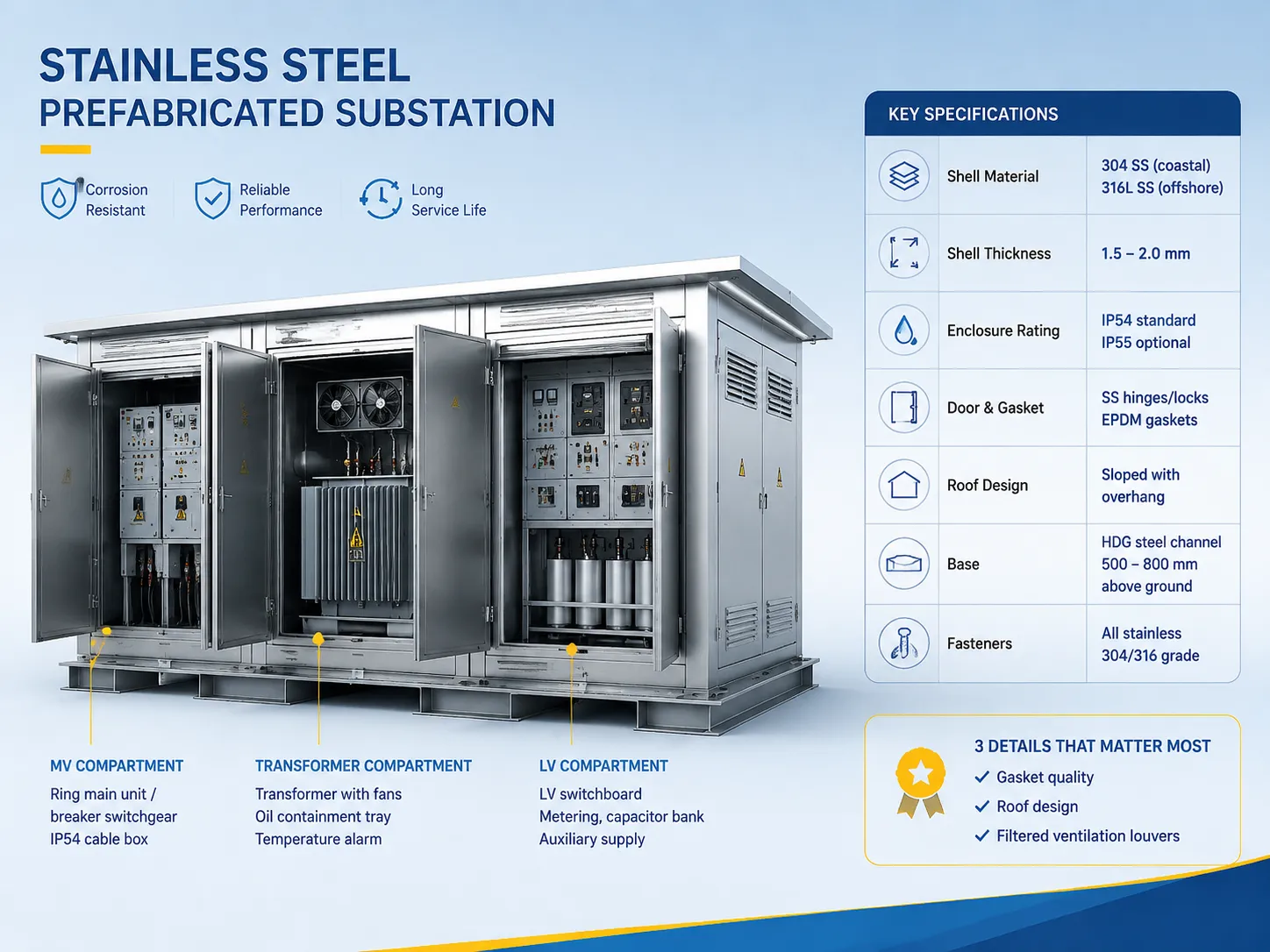
Das vorgefertigte Edelstahl-Umspannwerk ist mehr als nur ein Transformator, der in einer Box verpackt ist. Eine typische Einheit ist auf dem Skid-Basis in einer Drei-Zonen-Konfiguration montiert.
- MV-Abteil: Enthält die Ringhauptschaltanlage oder die Schalter-Schaltanlagen und das eingehende Kabel, das an seine Kabelbox mit IP54-Bewertung angeschlossen ist.
- Transformatorabteil: Beherbergt den Transformator mit Zwangsbelüftung (die Lüfter sind entsprechend dem Temperaturanstieg der Einheit dimensioniert), die Ölauffangwanne und den temperaturgesteuerten Alarm.
- LV-Abteil: Enthält die LV-Schalttafel, das Messsystem, den Kondensatorbank (optional) und die Hilfsversorgung mit Heizungen zur Vermeidung von Kondensation.
Die Edelstahlabdeckung ist etwa 1,5–2,0 mm dick, und die folgenden Merkmale müssen vom Käufer spezifiziert werden:
| Detail | Empfohlene Spezifikation |
|---|---|
| Gehäusematerial | 304 Edelstahl (Küsten) / 316L Edelstahl (Offshore, chemisch) |
| Gehäusedicke | 1,5–2,0 mm Platten, verstärkte Ecken |
| Gehäusebewertung | IP54 Standard, IP55 bei Spritzwassergefahr |
| Tür und Dichtung | Edelstahl-Schaniere/Schlösser, EPDM-Dichtungen, Staubdichtungen |
| Dachdesign | Geneigt mit Überhang, Tropfkanal |
| Basis | Feuerverzinkter Stahlkanal, 500–800 mm über dem Boden |
| Befestigungen | Alle aus Edelstahl, Güte 304/316 |
Kunden nennen immer drei Hauptpunkte, während sie Lieferanten in Betracht ziehen, d.h. die Qualität der Dichtung, das Design des oberen Dachs und ob die Belüftungsgitter vor Insekten und Staub geschützt sind. Diese Faktoren beeinflussen die tatsächliche Lebensdauer im Einsatz und nicht die Art der Schaltanlagen.
Wie es gebaut und getestet wird
Der große Vorteil einer modularen Umspannstation besteht darin, dass sie vor dem Versand aus dem Werk gebaut, getestet und gründlich dokumentiert wird. Der Prozess zur Herstellung einer solchen Umspannstation und zur Sicherstellung ihrer Qualität umfasst die folgenden Schritte:
- Herstellung: Das Gehäuse aus Edelstahl wird mit einem Laser geschnitten, gefaltet und in Form geschweißt.
- Interne Montage: Die elektrischen Geräte oder Teile der Montage werden auf der Einheit platziert und fixiert.
- Drähte und Anschlüsse: Die interne Verkabelung wird gemäß den Schaltplänen gesichert und beschriftet.
- Testen im Werk: Die Umspannstation wird auf Isolierung, Betrieb der Schaltungen und Haltbarkeit getestet.
- Dokumentation: Die Einheit wird mit allen notwendigen Dokumenten, einschließlich Prüfberichten, versendet.
Der große Vorteil für Export-Import-Käufer besteht darin, dass der Käufer durch den Besuch des Werks, um die Werksprüfungen zu beobachten, die Möglichkeit erhält, 80% der Mängel zu identifizieren, die andernfalls an dem Übersee-Standort ohne eine lokale Werkstatt übersehen würden.
Versand und Installation
Da sie zum Versand gebaut werden, werden vorgefertigte Umspannstationen von Exportkunden aus mehreren Gründen bevorzugt. Laut Logistikinformationen:
| Faktor | Typische Werte |
|---|---|
| Versandmodus | Flachbett- oder offene Container für Einheiten bis zu 2.500 kVA; Stückgut für sehr große Einheiten |
| Einheitliche Abmessungen | 2,4–3,0 m breit, 2,6–3,2 m hoch, 4–12 m lang |
| Gewicht | 3–12 Tonnen für 400–2.500 kVA Einheiten |
| Baustellenarbeiten | Betonplatte, Kabelgraben, ein Kranlift, Verschraubung auf der Platte |
| Inbetriebnahme | 2–5 Tage mit einem Werkstechniker oder lokalen Partner |
Da von der Agentur bereitgestellte Einheiten als eine einzige getestete Einheit transportiert werden, dauert die tatsächliche Installation 2-5 Tage im Vergleich zu 4-8 Wochen für die traditionelle Ziegelversion, was für Kunden, die an schwierigen oder dringenden Projekten beteiligt sind, überzeugend ist.
Anpassungsoptionen, die Kunden wählen
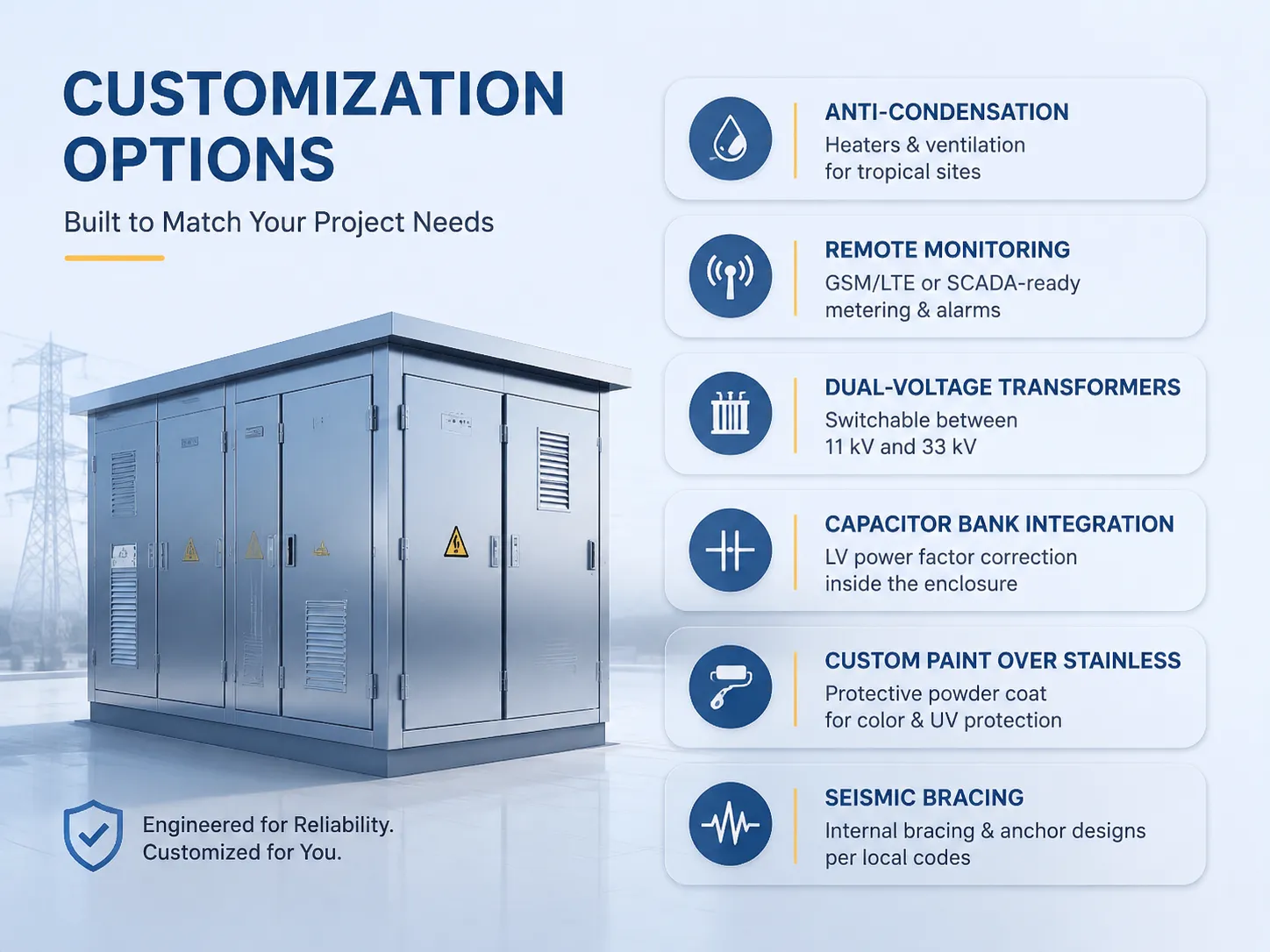
Der Kauf von Edelstahl-Umspannstationen “von der Stange” ist nicht sehr verbreitet. Exportkunden fragen häufig nach den folgenden individuellen Modifikationen:
- Kondensationskontrollsysteme: Ein Satz von feuchtigkeitsempfindlichen Belüftungssystemen und thermostatisch gesteuerten Heizsystemen, die für tropische Klimazonen ausgelegt sind — $500-$2.000.
- Fernsteuerungssysteme: GSM/LTE oder SCADA-fähige Messgeräte und Alarmsysteme — $800-$3.000.
- Transformatoren mit mehreren Spannungen: Transformatoren, die sowohl mit 11kV- als auch mit 33kV-Stromleitungen arbeiten können, um in Regionen eingesetzt zu werden, in denen gemischte Netze existieren.
- Installation von Kondensatorbänken: Einige Geräte zur Leistungsfaktorkorrektur unter Verwendung von Niederspannungssystemen — $2.000 – $8.000.
- Individuelle Lackierung auf Edelstahl: Verschiedene Unternehmen können wählen, ihre Edelstahl-Einheiten aus dekorativen Gründen lackieren zu lassen.
- Seismische Verstärkung: In Gebieten mit seismischer Aktivität bieten Designer interne Stützen und Verankerungslösungen gemäß den lokalen Vorschriften an.
Die Fähigkeit der Hersteller, es im Werk zu bauen, anstatt die Installation lokalen Auftragnehmern zu überlassen, ermöglicht es ihnen, einen Aufpreis für ihre werkseitig gebauten Umspannstationen zu verlangen.
Kosten und Preisspannen
Die Kosten für vorgefertigte Edelstahl-Umspannwerke variieren je nach ihren Nennwerten, Schaltanlagentypen, Namen und Integrationsgrad, sodass die folgende Preisspanne den indikativen FOB-Exportpreis einer kompletten Einheit zeigt, die aus RMU-Schaltanlagen, ölgetauchten Transformatoren und LV-Panels besteht.
| Nennleistung | Spannungsklasse | Gehäuse aus Kohlenstoffstahl | Edelstahlgehäuse (304/316) |
|---|---|---|---|
| 400–630 kVA | 10–35 kV | $7.000–$18.000 | $8.000–$22.000 |
| 800–1.250 kVA | 10–35 kV | $11.000–$28.000 | $13.000–$33.000 |
| 600–2.500 kVA | 10–35 kV | $24.000–$50.000 | $28.000–$60.000 |
Die Kosten des vorgefertigten Edelstahl-Umspannwerks werden stark von der Verlustklasse des Transformators, dem Hersteller der Schaltanlage und anderen Faktoren wie Mess- und Überwachungssystemen beeinflusst. Konventionell erhöht Edelstahl den Preis um 15%-30% im Vergleich zu lackiertem Kohlenstoffstahl – diese Ausgaben amortisieren sich in den 8-12 Jahren, in denen kein Neuanstrich mehr erforderlich ist.
Top-Marken & Preisvergleich
Die Hersteller von vorgefertigten Umspannwerken sind sowohl entwickelte Elektrizitätsunternehmen als auch kleinere spezialisierte Firmen. Die folgende Tabelle veranschaulicht die indikative Preisgestaltung für ein 1000kVA, 33/0,4kV Edelstahl-Station, ausgestattet mit RMU und LV-Panel.
| Marke | Land | Stärken des Fertig-Umspannwerks | Indikativer Preis (USD) |
|---|---|---|---|
| Schneider Electric | Optimierungsmaßnahmen in der Praxis | Globales RMU- und kompaktes Umspannwerksangebot | $24.000–$40.000 |
| Siemens | Deutschland | Integrierte Mittelspannungs-Pakete, digitale Optionen | $25.000–$42.000 |
| ABB | Schweiz | Breites Portfolio an kompakten Umspannwerken | $24.000–$41.000 |
| Eaton | USA | Nordamerikanisches Pad-Mount-Erbe | $22.000–$38.000 |
| ZPUE / AUSY (Spezialisten) | Polen / Europa | Dedizierte Ingenieurleistungen für vorgefertigte Umspannwerke | $22.000–$45.000 |
| Jiangsu Subian Electric Power | China | IEC 62271-202 Einheiten, 304/316 Edelstahl, exportgeprüft, OEM | $13.000–$33.000 |
Große internationale Marken bieten ihren Kunden Markenbekanntheit, große Servicenetzwerke weltweit und hohe Integration von Schaltanlagen, was für diejenigen, die spezielle Finanzierungs- und Versicherungsanforderungen benötigen, von großer Bedeutung ist; daher basiert der Ruf der Jiangsu Subian Electric Power Company auf der hervorragenden Arbeit, die in diesem Bereich insbesondere mit IEC 62271-202 zertifizierten Einheiten mit 304/316 Gehäusen geleistet wurde. Ihr Erfolg erklärt sich durch den guten Ruf des Unternehmens, effiziente Lieferung und Flexibilität der produzierten Einheiten.
Häufig gestellte Fragen
Warum ist Edelstahl besser als lackierter Stahl für Umspannwerksgehäuse?
Im Fall von Edelstahl besitzt er die Fähigkeit, eine passive Oxidschicht zu bilden, die sich selbst heilt, wodurch die Notwendigkeit entfällt, ihn neu zu lackieren. Der Kohlenstoffstahl hingegen leidet an Korrosion an Küstenstandorten innerhalb von zwei bis fünf Jahren, selbst bei Verwendung von C3/C4-Lackiersystemen, und erfordert daher alle fünf bis zehn Jahre eine Neulackierung, die jeweils $2.500–$5.000 kostet. Daher ist Edelstahl in 15 Jahren typischerweise günstiger und Sie müssen sich keine Sorgen um eine Trennung machen, da er nicht erneut lackiert werden muss.
Was ist der Preisunterschied zwischen Edelstahl- und Kohlenstoffstahlgehäusen?
Für ein 1000 kVA Umspannwerk erhöht das Gehäuse aus Edelstahl 304/316 die Kosten um 15–30 Prozent im Vergleich zu den Kosten für lackierten Kohlenstoffstahl, was $4.000–$8.000 ausmacht. Infolgedessen gleichen zwei Neulackierungsperioden den finanziell signifikanten Unterschied innerhalb von zehn Jahren aus, weshalb Edelstahl typischerweise von Kunden in Küstenregionen oder chemischen Unternehmen spezifiziert wird.
Welchen Edelstahlgrad sollte ich wählen, 304 oder 316?
Der Edelstahlgrad 304 reicht für die meisten Fälle an Küsten- und Tropenstandorten aus. Der Einsatz von Edelstahlgrad 316 wird jedoch für tropische Offshore-Plattformen, Küstengebiete mit direkter Meeresbesprühung und chemische Anlagen in Chloridumgebungen empfohlen. Die Verwendung von Edelstahl 316 erhöht die Herstellungskosten des Gehäuses um 10–20 Prozent, aber es ist die Ausgaben wert, wenn Salzexposition und andere störende Faktoren auftreten.
Wie lange dauert es, ein vorgefertigtes Umspannwerk vor Ort zu installieren?
Die Installation einer bereits vorgefertigten Einheit dauert 2–5 Tage, im Vergleich zu 4–8 Wochen, die für den Bau eines konventionellen Ziegel-Umspannwerks erforderlich sind. Der Installationsprozess der vorgefertigten Einheit umfasst die Vorbereitung einer Betonplatte und das Heben mit einem Kran sowie das Verschrauben, die Beendigung der Anschlüsse und das Inbetriebnehmen des Geräts.
Welche Tests sollte ich verlangen, bevor ein Edelstahl-Umspannwerk versendet wird?
Mindestens die folgenden Tests müssen durchgeführt werden: Routineprüfungen an Transformatoren wie sie im IEC 60076 Standard festgelegt sind (Verhältnis, Isolationswiderstand, Verluste und Temperaturanstieg), Tests an Schaltanlagen, dielektrische Tests und Tests an Hilfsschaltungen. Wenn zusätzliche Tests erforderlich sind, können die Temperaturanstiegstests gemäß IEC 62271-202 Standard in die Produktspezifikation aufgenommen werden.
Referenzen
- IEC 62271-202 — Hochspannungs-Schaltanlagen: Vorgefertigte Transformator-Umspannstationen — der maßgebliche Standard für das Design, die Sicherheit und die Prüfung von boxförmigen Umspannwerken.
- IEC 60076-Serie — Leistungstransformatoren — der Basisstandard für den Transformator im vorgefertigten Umspannwerk.
- IEC 60529 — Schutzarten, die durch Gehäuse bereitgestellt werden (IP-Code) — definiert die IP54/IP55-Bewertungen, die in den Gehäusespezifikationen verwendet werden.
- ISO 12944 — Korrosionsschutz von Stahlkonstruktionen — der Rahmen für die Korrosivität der Beschichtung, der den Vergleich zwischen Edelstahl und lackiert konkret macht.
- Internationales Edelstahlforum (worldstainless) — autoritative Daten zur Korrosionsleistung von 304/316 in marinen Atmosphären.
- NEMA — Standards für Pad-Mount-Umspannwerke — Nordamerikanische Äquivalente und Anwendungshinweise für kompakte Umspannwerke.
- Jiangsu Subian Electric Power — offizielle Seite — Exporteur von IEC 62271-202 Edelstahl-Fertigungstransformatoren.
Fazit
Die Edelstahl-Fertigungstransformatoren sind aufgrund von drei Hauptfaktoren zur bevorzugten Wahl für Offshore- und Küstenkunden geworden: die korrosionsbeständige Leistung in aggressiven Umgebungen, die optimierte Standortzeit von Wochen auf nur Tage aufgrund von Fertigung und Werksprüfungen sowie die günstigeren Gesamtkosten über den Lebenszyklus im Vergleich zu lackierten Gehäusen in weniger als einem Jahrzehnt. Wichtige Spezifikationskriterien wie 304 vs. 316 Grad, Dichtungen, Dachdesign, IP-Bewertung, Belüftungsfilter und eine Werksbeobachtung für Tests spiegeln wider, ob ein Umspannwerk die richtige Zeitspanne überdauern kann oder kontinuierlich Wartung benötigt.
Zusammenfassend:
- Wählen Sie 316/316L für Offshore-, Seespray- oder chemische Anwendungen und 304 für allgemeine Küstenanwendungen.
- Berücksichtigen Sie 15-30% für den Edelstahl-Gehäuseaufschlag im Austausch für keine Neulackierung in den nächsten 8 bis 10 Jahren.
- Fragen Sie nach der IEC 62271-202-Konformität und den erforderlichen Tests im Werk vor der Abfahrt.
- Bestellen Sie die Werksbeobachtung für Tests von Exportaufträgen.
- Wählen Sie das richtige Gleichgewicht zwischen globalen Marken wie Schneider, Siemens und ABB sowie IEC-zertifizierten Exporteuren wie Jiangsu Subian Electric Power für Kostenkontrolle und Konformität.