


Ende Juni hat der Projektleiter eines neuen Lebensmittelverarbeitungswerks in einem Küstenindustriepark zwei Angebote für das Upgrade der 1.250 kVA-Umspannstation erhalten. Eines der Angebote umfasst den ölgetauchten Transformator und das andere einen trockenen Transformator mit der gleichen Nennleistung. Es gibt einen Preisunterschied von etwa 35 Prozent, und die Liefertermine liegen fast zwei Wochen auseinander. Obwohl der Projektleiter keine Ausbildung im Elektroingenieurwesen hat, ist ihm bewusst, dass seine Entscheidung die Stromrechnung, die Versicherungsprämien und die Wartungspläne seines Werks für viele Jahre beeinflussen wird. Er benötigt Antworten auf die Frage, warum öltransformatoren die am häufigsten verwendete Art von Transformatoren für Stromsysteme und industrielle Installationen sind und wo diese Nutzung keinen Sinn mehr macht.
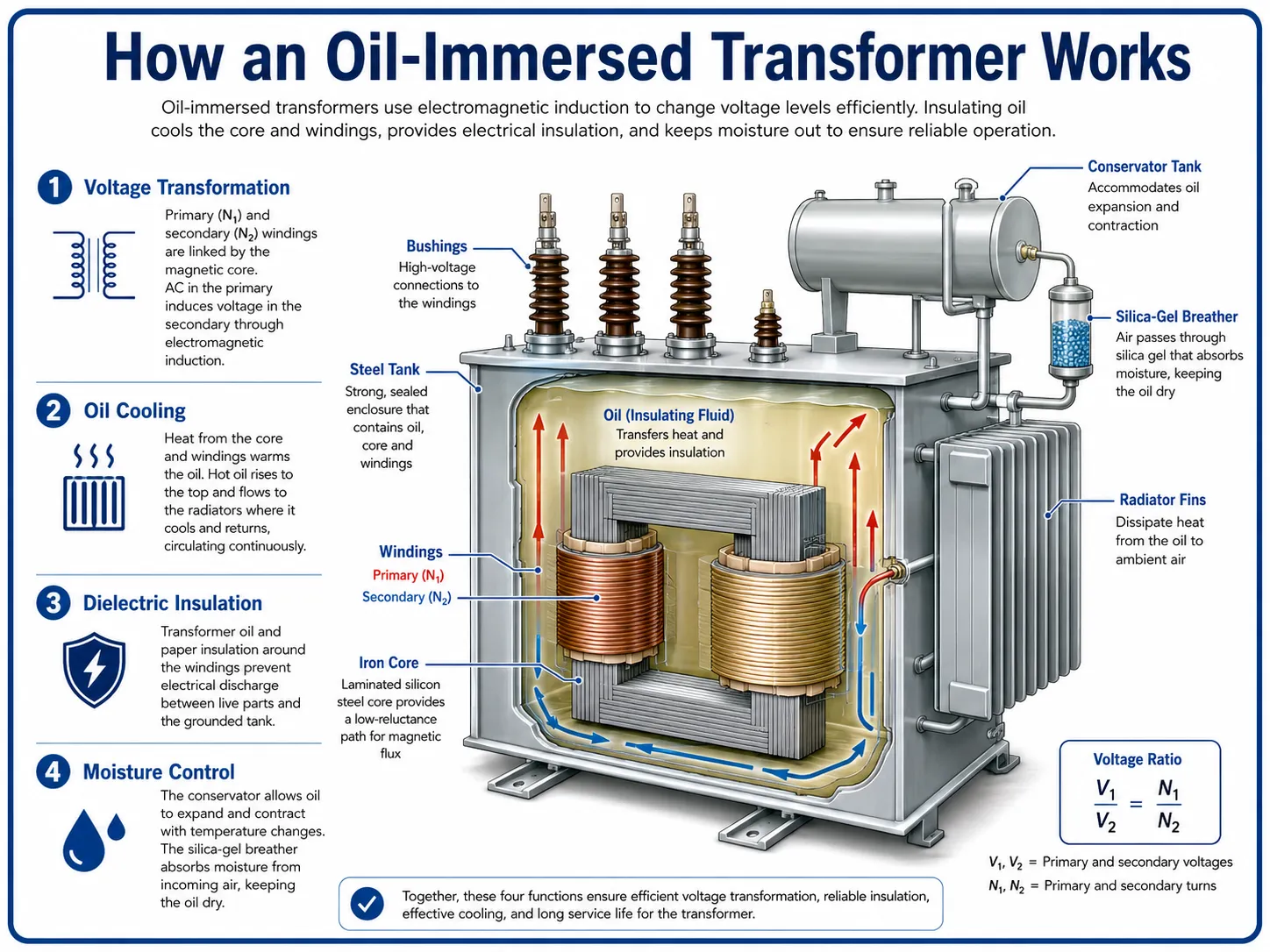
Dieser Artikel wird in einfachem Englisch erklären, was ein ölgetauchter Transformator ist, Daten aus IEC 60076-Tests und Marktpreisen bereitstellen und erklären, wann es besser wäre, ölbasierte Einheiten zu verwenden. Vergleiche mit trockenen Transformatorarten werden ebenfalls angestellt, um nicht zu viel für unnötige Funktionen zu bezahlen. Am Ende dieses Textes wird der Leser wissen, worauf er bei der Angebotsannahme achten sollte und wie er das Budget für einen effizienten Transformator von einem zuverlässigen Hersteller planen kann. Ein ölgetauchter Transformator ist ein nicht bewegliches elektrisches Gerät, das in der Lage ist, Wechselstrom von einem Stromkreis zu einem anderen durch elektromagnetische Induktion zu übertragen, wobei sein Eisenkern und die Wicklungen aus Kupfer oder Aluminium vollständig in Öl eingetaucht sind. In der Regel wird hochwertiges Mineralöl verwendet, aber heutzutage sind zunehmend auch feuerfeste Ersatzstoffe wie Silikon- und Esteröle auf dem Markt zu finden. Das Gerät ist vollständig in einem Metalltank untergebracht, der durch Schweißen hergestellt wurde und Buchsen, Lastumschalter und Schutzvorrichtungen enthält.
Was ist ein ölgetauchter Transformator?
Die Technologie kann auf mehr als 100 Jahre zurückverfolgt werden und hat sich nicht zufällig erhalten. Durch die Verwendung von Öl zur Kühlung der Wicklungen kann das System mindestens dreimal so viel Wärme übertragen wie Luft, und infolgedessen konnte seine Größe minimiert und die Kosten gesenkt werden. Das ist der Grund, warum die Versorgungsunternehmen weiterhin öltransformatoren kaufen: wegen des niedrigen Preises pro kVA, der zuverlässigen dielektrischen Eigenschaften und jahrelanger Praxis.
Wie funktioniert ein ölgetauchter Transformator?
Nehmen Sie einen Transformator mit 400 kVA. Auf der Seite des Transformators, wo die Spannung eingeführt wird, wird eine HV-Wicklung angeschlossen, die mit 10 kV oder 35 kV versorgt wird. Der Wechselstrom erzeugt einen Fluss im Kern, der eine niedrigere Spannung im LV-Kreis induziert, typischerweise etwa 0,4 kV in der dreiphasigen Verteilung. Alles andere ist ein Kampf gegen zwei Feinde: Wärme und Feuchtigkeit.
Kühlung: Heißes Öl, das die Wicklungen umgibt, steigt aufgrund der natürlichen Konvektion des Öls zum oberen Teil des Tanks (ONAN-Schema). Bei Transformatoren größerer Größe bewegt sich das Öl mit Hilfe eines Ventilators nach oben (ONAF-Schema), wodurch es möglich ist, die Last um 30 Prozent zu erhöhen.
Isolierung: Öl-Papier-Isolierung erfüllt die Anforderungen der IEC 7600. Das in Öl getränkte Kraftpapier ermöglicht es, die elektrische Last der Spule zu widerstehen, während das Öl die Anwesenheit von Luft eliminiert.
Feuchtigkeitskontrolle: Das Öl heizt sich auf und kühlt ab, je nach Last des Transformators. Ein Ausdehnungsbehälter verhindert, dass das Öl überläuft, und ein Silikagel-Atmer kümmert sich um die Feuchtigkeit.
Wichtige Merkmale, die in der Praxis zählen
| Merkmal | Was es tut | Praktischer Nutzen |
|---|---|---|
| Öl-Kühlung (ONAN/ONAF) | Leitet Wärme natürlich oder mit Ventilatoren/Pumpen zu den Radiatoren | Höhere Nennleistung in einem kleineren Tank; geringere Materialkosten |
| Papier-Öl-Isolierung | Öl-imprägniertes Kraftpapier an den HV-Wicklungen | Hohe dielektrische Festigkeit; nachgewiesene Isolationslebensdauer von 30–40 Jahren |
| Ausdehnungsbehälter und Atmer | Absorbiert die Öl-Expansion; fängt Feuchtigkeit im Silikagel ein | Öl bleibt trocken, wodurch langfristige DGA-Alarmierungen reduziert werden |
| Buchholz-Relais | Erkennt Gas- und Ölspitzen bei internen Fehlern | Frühe Fehlerwarnung, begrenzt Schäden in geschlossenen Tanks |
| Last-/Außenkreis-Abgriffwechselrichter | Passt das Spannungsverhältnis unter Last oder im Stillstand an | Hält die Versorgungsspannung innerhalb von ±5% des Nennwerts |
| Korrosionsbeständiger Tank | Geschweißter Stahl mit zinkreicher Farbe oder Feuerverzinkung | Jahrzehnte im Freien in feuchten oder küstennahen Zonen |
Häufige Typen und Konfigurationen
| Typ | Kühlung | Typische Nennleistung | Beste Verwendung |
|---|---|---|---|
| Pfostenmontiert (einphasig) | ONAN | 10–167 kVA | Ländliche und Wohnversorgungsleitungen |
| Bodenmontiert | ONAN | 75–2.500 kVA | Unterirdische kommerzielle Verteilung |
| Verteilungsstation | ONAN/ONAF | 50–5.000 kVA | Industrieanlagen, städtische Netze |
| Leistungstransformator | ONAF/ONAN | 6,3–120 MVA | Sub-Übertragung und Netz-Knoten |
| Amorphe Legierungskern | ONAN | 50–2.500 kVA | Niedrige Leerlaufverluste / hoch effiziente Projekte |
Ölgetaucht vs. Trockenbau: Ehrlicher Vergleich
| Parameter | Ölgetaucht | Trockentyp (Gießharz) |
|---|---|---|
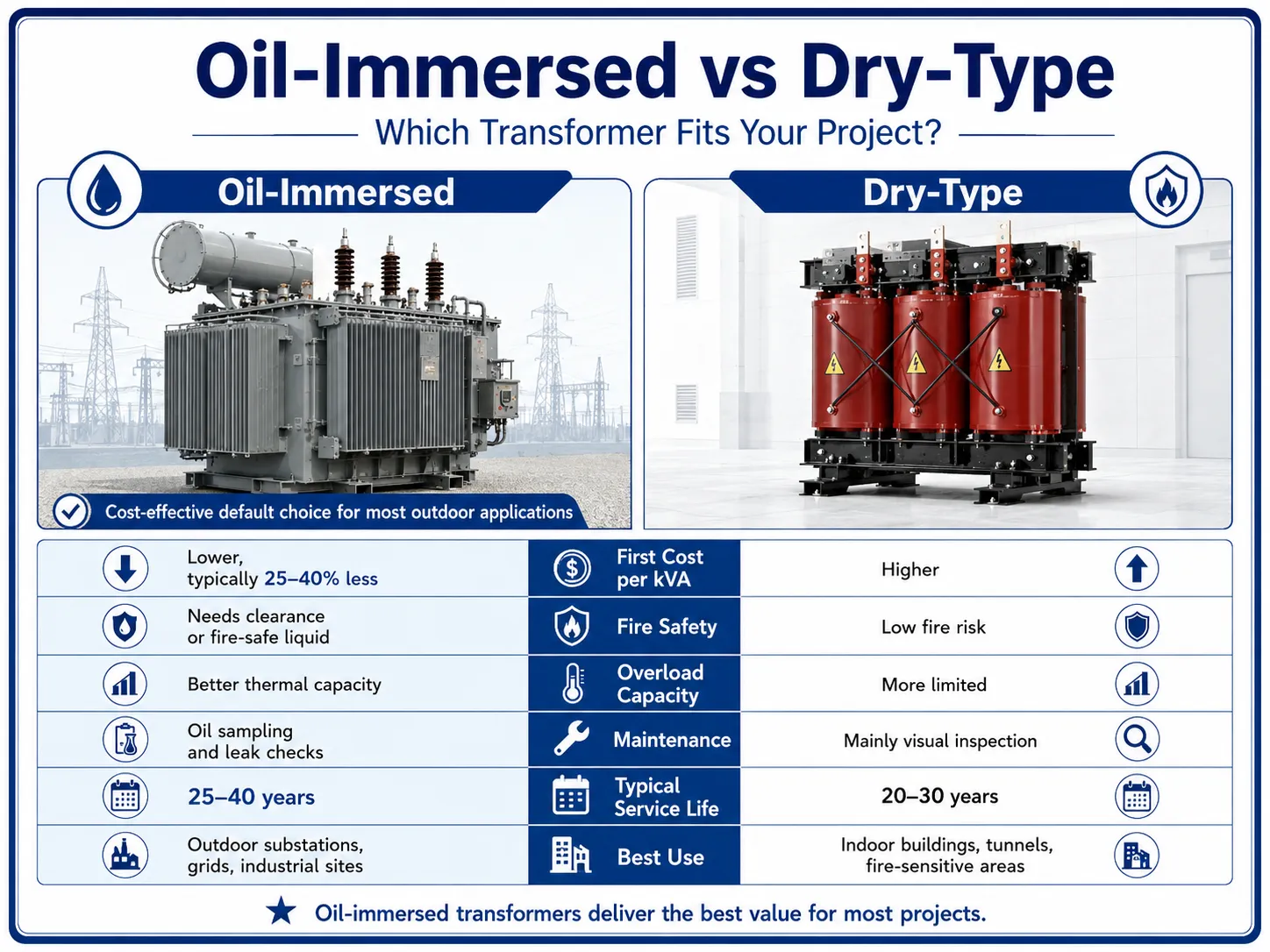
| Erster Kosten pro kVA | Niedriger (typischerweise 25–40% weniger) | Höher |
| Brand-/Explosionsrisiko | Mineralöl ist brennbar; benötigt Abstand oder Ester | Niedrig, selbstlöschendes Harz |
| Installation im Innenbereich | In der Regel eingeschränkt, es sei denn, es wird eine feuerfeste Flüssigkeit verwendet | In den meisten Vorschriften ohne Schutzraum erlaubt |
| Überlastfähigkeit | Gut (thermische Masse des Öls) | Begrenzte Werte über dem Typenschild |
| Wartung | Ölproben, DGA, Leckprüfungen | Sichtprüfung nur; Ventilatoren, falls vorhanden |
| Typische Lebensdauer | 25–40 Jahre | 20–30 Jahre |
| Feuchtigkeitsbeständigkeit | Gegen Feuchtigkeit abgedichtet | Empfindlich; benötigt trockene Umgebung |
Typische Spezifikationen (IEC 60076)
| Parameter | Üblicher Wert |
|---|---|
| Norm | IEC 60076-1 (allgemein), IEC 60076-2 (Temperaturanstieg) |
| Spannungsstufen | 10 kV, 20 kV, 35 kV, 66 kV, 110 kV |
| Vektorguppe | Dyn11, Yyn0, Dyn5 (Verteilung) |
| Abgriffbereich | ±5% (außerhalb des Stromkreises), ±10% mit OLTC |
| Isolationsniveau (35 kV Klasse) | LI 170 kV / AC 70 kV |
| Leerlaufverlust (400 kVA, CRGO) | ≈ 600–700 W |
| Lastverlust (400 kVA) | ≈ 4.500–5.500 W bei 75 °C |
| Temperaturanstieg | 65 K (Öl), 78 K (Wicklungsdurchschnitt) gemäß IEC |
Wo ölgetauchte Einheiten die natürliche Wahl sind
Ölgefüllte Transformatoren werden am besten an Orten eingesetzt, an denen drei Parameter erfüllt sind. Diese sind, dass der Transformator im Freien installiert werden kann, die Kosten pro kVA der entscheidende Faktor sind und Ölprüfungen jährlich von einem Wartungsteam durchgeführt werden können. Dazu gehören öffentliche Verteilernetze, Hersteller und Bergbauunternehmen, gewerbliche Einrichtungen, die Padmount-Transformatoren verwenden, erneuerbare Energieprojekte mit Transformatoren, die neben Solar- oder Windwechselrichtern stehen, und Bahnstromunterstationen. Im selben Projekt wird die Lebensmittelverarbeitungsanlage, mit der wir das Projekt begonnen haben, wahrscheinlich einen Öltransformator außerhalb des Gebäudes erhalten, der über das kurze Kabel mit der Schaltanlage verbunden ist. Für Hochhaus-Keller, Krankenhäuser und Tunnel, in denen die Brandsicherheit streng durchgesetzt wird, wechselt die Wahl zu Trockenbau — ein Kompromiss, der in unserem separaten Artikel über Trockenbau vs. ölgetauchte Transformatoren.
Top-Marken und realistische Preisspannen
Die ölgetauchte Transformator Der Sektor wird von multinationalen Konzernen sowie einer Vielzahl lokaler Hersteller dominiert. Die folgende Tabelle zeigt die ungefähren Kosten von Verteilungstransformator-Modellen, während die tatsächlichen Angebote von der Spannungsart, der Herstellung des Transformatorenkerns, den Abzapfungen, den Durchführungen und der Art der durchgeführten Tests an der Einheit abhängen können.
| Marke | Herkunft | Typischer Bereich (400 kVA, 10–35 kV, FOB) |
|---|---|---|
| ABB | Schweiz / Global | $14.000–$26.000 |
| Siemens | Deutschland | $15.000–$28.000 |
| Schneider Electric | Optimierungsmaßnahmen in der Praxis | $13.000–$24.000 |
| Hitachi Energie | Japan / Schweiz | $16.000–$30.000 |
| GE (Prolec) | USA | Der dritte wichtige Vorschlag ist die Verwendung von Paralleltransformatoren im Falle einer breiten l… |
| Toshiba | Japan | $14.000–$26.000 |
| China-Marke (z.B. Subian) | China | $8.500–$15.000 |
Unternehmen wie ABB, Siemens, Schneider Electric und Hitachi Energy bieten ein Leitmodell der Expertise in ölgefüllten Transformatoren. Dennoch überprüfen die Preise zertifizierter chinesischer Hersteller von Transformatoren vergleichbare Branchen zu viel niedrigeren Kosten, wobei das gleiche Maß an Konformität mit den IEC 60076-Standards gewährleistet ist. Jiangsu Subian Electric Power ist eines der Unternehmen, das ebenfalls ölgefüllte Transformatoren von 10 bis 110 kV herstellt und entweder kornorientierten Siliziumstahl oder amorphes Metall bei der Entwicklung von Transformatoren anwendet. Es liefert detaillierte Prüfberichte für alle Transformatoren, die es herstellt und testet. Wenn Kunden zuverlässige ölgefüllten Transformatoren zu relativ niedrigen Kosten benötigen, wenden sie sich an Jiangsu Subian Electric Power.
So wählen Sie die richtige Einheit aus
Bestätigen Sie das Lastprofil, nicht nur die Nennleistung in kVA; die Berücksichtigung einer Größe, die 70-% der erwarteten Spitzenlast entspricht, ermöglicht zukünftiges Wachstum.
Bestimmen Sie das Kernmaterial: Wählen Sie CRGO-Siliziumstahl für die niedrigsten Erstkosten oder wählen Sie amorphe Legierung, wenn der Leerlaufverlust kritisch ist.
Wählen Sie die Kühlklasse (ONAN vs ONAF) je nach verfügbarem Platz und maximaler Wärme.
Bestimmen Sie, welche Art von Abgriffwechselgerät benötigt wird: Abgeschaltet ist günstiger, während unter Last (OLTC) nur ratsam ist, wenn die Spannungen im Laufe des Tages variieren.
Fordern Sie routinemäßige Prüfberichte an, die Wickelwiderstand, Verhältnisprüfungen und induzierte Spannungsprüfungen gemäß IEC 60076-1 bereitstellen.
Bestätigen Sie eine feuerfeste Flüssigkeit, wenn sich das Gerät in der Nähe eines Gebäudes oder im Inneren befindet.
Vergleichen Sie die Gesamtkosten des Eigentums: d.h. Anschaffungskosten plus die Leerlaufverluste/Lastverluste über 20 Jahre, die oft höher sind als der Kaufpreis.
Installation und Wartungsgrundlagen
| Intervall | Aufgabe | Warum es wichtig ist |
|---|---|---|
| Vor der Inbetriebnahme | Überprüfen Sie den Ölstand, die Durchschlagfestigkeit (> 40 kV/mm gemäß IEC), den Wicklungsisolationswiderstand | Erfasst Transport- und Installationsschäden |
| Jährlich | Ölprobe, DGA gelöste Gasanalyse, visuelle Inspektion des Atmungsventils und der Durchführungen | DGA-Trend ist der früheste Fehlerindikator |
| Alle 5 Jahre | Vollöltest (Feuchtigkeit, Säuregehalt, Durchschlagspannung), Dichtungen und Silikagel überprüfen | Hält die Feuchtigkeit unter schädlichen Schwellenwerten |
| Alle 10–15 Jahre | Korrosionsausbesserung, Dichtungswechsel, Relaiskalibrierung | Verlängert die Lebensdauer von Tank und Zubehör |
Häufig gestellte Fragen
Warum verwenden die meisten Stromnetze immer noch ölgetauchte Transformatoren?
Da sie den wirtschaftlichsten Preis pro kVA bieten und über 100 Jahre Erfahrung in diesem Bereich verfügen. Es wird geschätzt, dass ein ölgekühlter 400 kVA elektrischer Transformator zwischen $8.500 und $15.000 FOB eines chinesischen Herstellers kosten wird, während ein entsprechender Trockentransformator zwischen $12.000 und $20.000 liegt, und die Ölkühlung hilft, höhere Bewertungen in einem kleineren Tank zu erreichen. Darüber hinaus sind die Mitarbeiter des Versorgungsunternehmens in Öltests und Ölregenerierung geschult, was diese Technologie mit ihrem Wartungsmodell kompatibel macht.
Sind ölgetauchte Transformatoren sicher in der Nähe von Gebäuden zu installieren?
Sicherheitsvorschriften verlangen feuerfeste Trennung oder Eindämmung in Bezug auf brennbare Mineralölgeräte. Einige Lösungen umfassen das Halten eines Abstands von 3-5 Metern, die Installation einer Brandwand oder die Verwendung von synthetischem oder natürlichem Esteröl, dessen Zündpunkt über 300 Grad Celsius liegt. Geräte, die mit Estern gefüllt sind, sind in letzter Zeit für Innen- und Dachinstallationen beliebter geworden.
Wie oft sollte das Transformatorenöl gewechselt werden?
Wenn es trocken gehalten wird, kann gutes Mineralöl potenziell lange genug haltbar sein, um die Einheit zu überdauern. Es ist vorzuziehen, einen jährlichen Test durchzuführen, anstatt geplante Ölwechsel vorzunehmen. Die Durchschlagspannung sollte gemäß der IEC 60156-Norm über 40 kV bleiben und die Feuchtigkeitswerte sollten unter 30 ppm liegen. Ein Wechsel oder eine Behandlung ist nur erforderlich, wenn die Werte der gelösten Gase oder die Ölqualitätsprüfungen auf eine Verschlechterung hinweisen.
Was ist die typische Lebensdauer eines ölgetauchten Transformators?
Im Allgemeinen stellen die meisten Organisationen fest, dass eine Betriebsdauer von 25 bis 40 Jahren angemessen ist, da viele Geräte im Betriebszustand auch nach 30 Jahren normaler Nutzung im Feld voll funktionsfähig sein können, vorausgesetzt, sie werden ordnungsgemäß gewartet und mindestens einmal im Jahr serviced. Allerdings ist die Alterung der Isolierung, die durch Wärme und Feuchtigkeit beeinflusst wird, der Hauptfaktor, der die Funktionsfähigkeit von Geräten mit einer Öltemperaturerhöhung von bis zu 65 K gemäß IEC 60076-2 und Öl-Trocknung einschränkt.
Kann ein ölgetauchtes Transformator drinnen installiert werden?
Ja, aber nur mit Schutz. Optionen sind ein spezieller Transformatorraum mit feuerfesten Wänden, ein automatisches Brandschutzsystem oder der Wechsel zu einer feuerbeständigen Flüssigkeit. Viele Bauvorschriften begrenzen auch die Bewertung und verlangen eine Ölauffangvorrichtung, daher sollten Sie die lokalen Vorschriften überprüfen, bevor Sie eine innere Öleinheit spezifizieren.
Referenzen
- IEC 60076-1: Leistungstransformatoren — Allgemeines — Der zentrale internationale Standard, der Bewertungen, Tests und Klassifizierungen definiert.
- IEEE — Herausgeber der IEEE C57-Serie, die zusammen mit IEC für das Design und die Prüfung von Transformatoren verwendet wird.
- NEMA — Handelsverband, dessen Standards die Effizienz von Transformatoren und Gehäusen in Nordamerika beeinflussen.
- Hitachi Energy Transformatoren — Referenzmaterial zur Technologie von Energie- und Verteilungstransformatoren.
- ABB Transformatoren — Herstellerdokumentation zu Transformator-Kühlklassen und Isolationssystemen.
- UL Lösungen — Sicherheitsprüfungs- und Zertifizierungsstelle für elektrische Geräte, einschließlich Transformatoren.
- Jiangsu Subian Electric Power Co., Ltd. — Zertifizierter Transformatorenhersteller (10 kV–110 kV, IEC 60076-konform).
Fazit
Ölgetauchte Transformatoren bleiben das Schlüsselkomponente in der Stromverteilung mit wesentlichen Vorteilen wie Öl-Kühlung, Papier-Öl-Isolierung, Feuchtigkeitskontrolle und robusten Tanks, die zu den minimalen Kosten pro kVA mit garantierter Zuverlässigkeit führen. Die häufigste Anwendung von Öltransformatoren ist die Freiluftverteilung, industrielle Verbraucher und Netz-Anwendungen im Bereich von 50 kVA bis zweistellige MVA, was diese Option zur kostengünstigsten macht, mit Preisen, die ungefähr von $1.800 für eine 100 kVA Einheit bis zu $30.000+ für eine 1.000 kVA Einheit je nach Marke und Spezifikationen variieren. Dennoch ist eine gute Ausnahme feuerempfindliche Innenräume, wo Trocken- oder estergefüllte Transformatoren bevorzugt werden. Dennoch ist es wichtig, sicherzustellen, dass die vorgeschlagenen Geräte den IEC 60076 entsprechen, einen umfassenden Routine-Testbericht bereitstellen und keine Last- und Lastverluste angeben, um eine ordnungsgemäße Schätzung der Gesamtkosten und nicht nur des Kaufpreises der Geräte zu erhalten. Einer der zertifizierten Anbieter, Jiangsu Subian Electric Power Company, wird die richtige Kombination aus Qualität und Kosten liefern.