


Drei Monate vor einer Fabrikerweiterung erhielt eine Einkaufsleiterin aus Nigeria ein Angebot per E-Mail, in dem stand: “1000 kVA ölgefüllter Transformator – 11.400 USD FOB”, zusammen mit null Standardnummern, keinen Verlustnummern oder Informationen zu Zubehör. Sie fand online einen niedrigeren Preis von 9.200 USD und ein höheres Angebot einer europäischen Marke von 31.000 USD. Dennoch hatte die Managerin, da kein technischer Referenzwert verfügbar war, keine Möglichkeit zu wissen, ob einer der angegebenen Preise überhaupt angemessen war oder ob das Gerät, das zum niedrigsten Preis verkauft wurde, bei der Lieferung den Öltetest bestehen würde. Darauf konzentriert sich der Leitfaden für Käufer von ölgefüllten Transformatoren.
Die Antwort ist einfach: Ölgefüllte Transformatoren sind im Grunde genommen Verteilungstransformatoren oder Transformatoren, die Mineralöl zur Kühlung und Isolation des Kerns und der Wicklung in einem geschlossenen Behälter verwenden. Die Hauptparameter für viele Kunden betreffen die Messung der Transformatorgröße von etwa 70 bis 85 Prozent der Lasterwartung, die Einhaltung der IEC 60076-Norm und den Vergleich der Leerlauf- und Lastverluste, anstatt sich nur auf die Kosten des Geräts zu konzentrieren. Stellen Sie immer sicher, dass Sie das detaillierte Angebot mit dem Bericht über die Standardtests angefordert haben und dass Sie die Kosten zusammen mit den Lieferterminen, Zahlungsmethoden und Garantiebedingungen überprüft haben.
Definitionen und Terminologie, die Sie kennen müssen
Transformatoren sprechen ihre eigene Sprache der Abkürzungen, und ein falscher Buchstabe kann Sie viel Geld kosten. Hier sind die fünf wichtigsten Punkte, die Sie überprüfen sollten, bevor Sie Angebote anfordern.
- kVA-Bewertung: Scheinleistung, die das Gerät bereitstellen kann. Im Falle von dreiphasigen Verteilungstransformatoren sind wichtige Größen 100, 160, 250, 315, 400, 500, 630, 800, 1.000, 1.250, 1.600, 2.000 und 2.500 kVA.
- Leerlaufverlust: Die Energie, die vom Kern verbraucht wird, wenn der Transformator eingeschaltet ist, obwohl keine Last anliegt. Dies ist die Zahl, die 24/7 über 30 Jahre arbeitet und somit den Lebenszeitpreis dominiert.
- Lastverlust: Die Energie, die in den Wicklungen während des Betriebs verbraucht wird, proportional zum Quadrat des Stroms. Dies ist am wichtigsten für Geräte, die unter schweren Lasten über längere Zeiträume betrieben werden.
- Impedanzspannung: Der prozentuale Spannungsabfall, wenn der Nennstrom durchfließt. Sie beträgt typischerweise 4% für kleinere Transformatoren und 6% für größere.
- Vektorguppe: Der Verbindungstyp, zum Beispiel Dyn11 (Delta HV und Stern LV mit 30 Grad Phasenverschiebung).
Stellen Sie sicher, dass Sie sich an diese fünf Merkmale erinnern; jeder Anbieter sollte Ihnen diese in seinem Datenblatt zur Verfügung stellen, und die Angebote müssen auch die beiden Verlustnummern angeben.
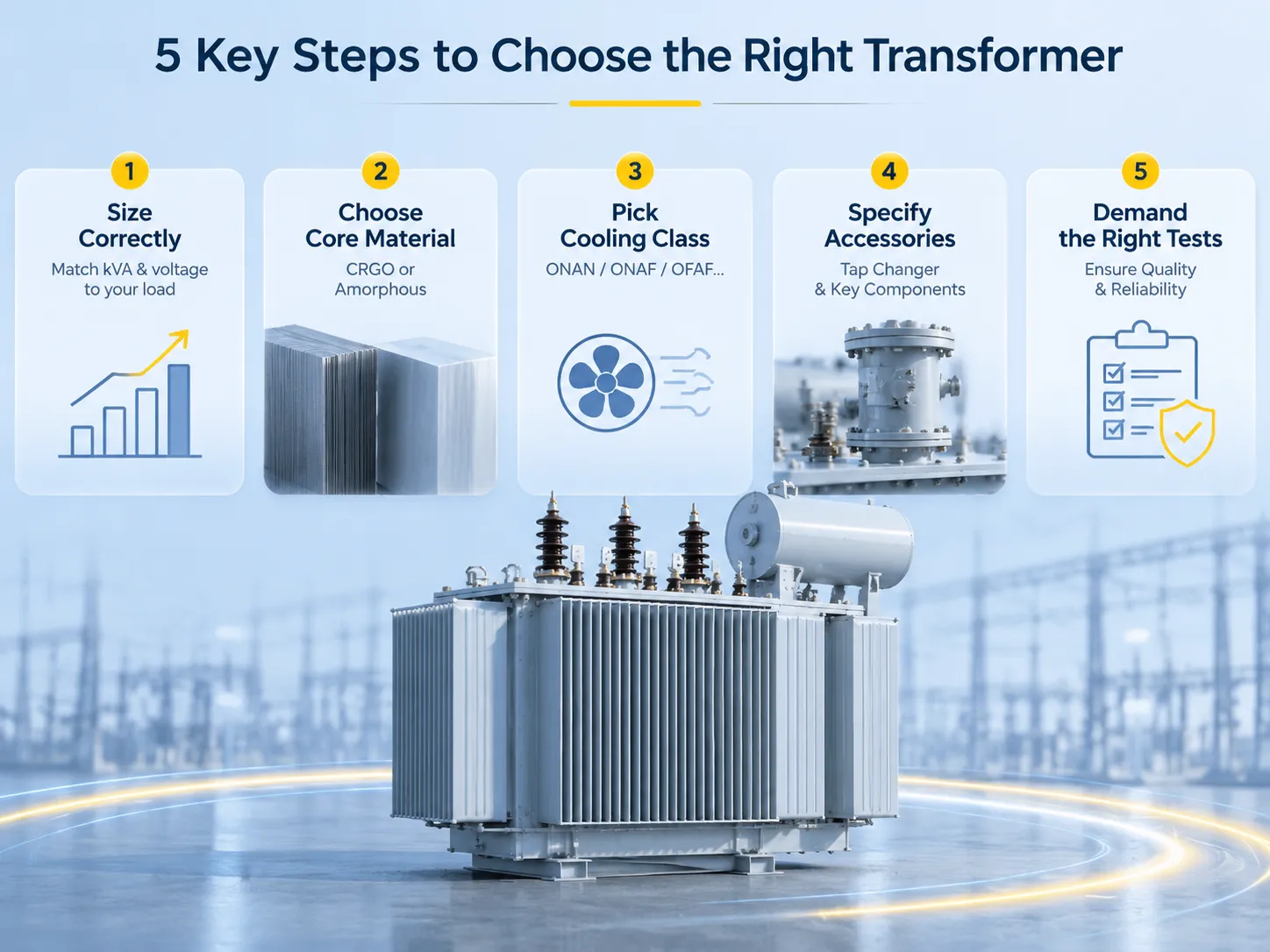
Schritt 1: Den Transformator korrekt dimensionieren
Eine Unterdimensionierung führt zu Überhitzung und beschleunigtem Isolationsversagen; eine Überdimensionierung ist kostspielig und erhöht die Leerlaufverluste. Die korrekte Dimensionierung beginnt mit der gemessenen Nachfrage und nicht mit den Nennwerten. Addieren Sie die angeschlossene Last, wenden Sie einen Diversitätsfaktor von typischerweise 0,6–0,8 für gemischte industrielle Lasten an und dimensionieren Sie für die erwartete Last auf 70–85% der Transformatorleistung.
| Angeschlossene Last (kW) | Diversitätsfaktor | Erwartete Spitze (kVA) | Empfohlene Nennleistung |
|---|---|---|---|
| 120 kW gemischt | 0.7 | ≈ 90–110 | 160 kVA |
| 250 kW gemischt | 0.7 | ≈ 190–220 | 250 kVA |
| 500 kW gemischt | 0.75 | ≈ 380–450 | 500 kVA |
| 900 kW gemischt | 0.75 | ≈ 680–820 | 800 kVA |
| 500 kW gemischt | 0.8 | ≈ 1.200–1.400 | 600 kVA |
Wenn Ihr Lastprofil aus gleichzeitigen Motoranforderungen besteht, sollte zusätzlicher Anlaufspielraum bereitgestellt werden; andernfalls folgen Sie der Tabelle und lassen Sie den Anbieter dies mit einer Lastflussnotiz bestätigen.
Schritt 2: Wählen Sie das Kernmaterial (CRGO vs Amorph)
Der Kern ist der Ort, an dem der langfristige Effizienzkampf gewonnen wird. Es gibt zwei gängige Optionen für ölgefüllte Verteilungstransformatoren:
| Kernmaterial | Leerlaufverlust (400 kVA) | Erstkosten | Am besten geeignet für |
|---|---|---|---|
| CRGO Siliziumstahl (30ZH110-Grad) | ≈ 600–700 W | Basislinie | Standardprojekte, niedrigste Investitionskosten |
| Amorphe Legierung (2605SA1) | ≈ 250–320 W | +25–40% | Hochdauerhafte Leichtlast, grüne Projekte |
Amorphe Legierungen können den Leerlaufverlust um 60-70% reduzieren, was vorteilhaft für Transformatoren ist, die den größten Teil des Tages im Leerlauf in leicht belasteten Anwendungen wie in ländlichen Umspannwerken oder Standorten, die nur am Wochenende betrieben werden, laufen. Wenn der Transformator jedoch in den meisten Fällen nahezu mit voller Last arbeiten soll, könnte der Lastverlust im Vergleich zum Leerlaufverlust viel wichtiger sein, und CRGO könnte eine sinnvolle Investition sein. Vergleichen Sie die beiden Arten von Verlusten in Bezug auf Lasten und Energietarife (weltweit durchschnittlich etwa $0,08-$0,20/kWh).
Schritt 3: Wählen Sie die Kühlklasse
Die Kühlklassifizierung wird mit einem vierbuchstabigen Code angegeben. In den meisten Situationen haben die Verbraucher die Wahl zwischen zwei Optionen, die sowohl die Erstkosten als auch die kontinuierliche Betriebskapazität beeinflussen.
| Kühlklasse | Wie es funktioniert | Kapazitätseffekt | Wartung |
|---|---|---|---|
| ONAN | Öl natürlich, Luft natürlich — keine Pumpen oder Lüfter | Basisbewertung | Keine (passiv) |
| ONAF | Öl natürlich, Luft gezwungen — Lüfter starten bei Temperaturgrenze | +25–33% kontinuierliche Kapazität | Lüfterlager, Kontaktoren, Thermostat |
| OFAF | Öl gezwungen, Luft gezwungen — Pumpe + Lüfter | Höchste Bewertung für Tankgröße | Pumpen- und Lüfterwartung |
Für einen 1.000 kVA Transformator spart die ONAN-Option etwa $2.000-3.000 im Kaufpreis im Vergleich zu einer ONAF-Option mit derselben Kapazität. Die ONAF-Option kann jedoch den nächsten Transformator-Kauf hinauszögern, wenn die Spitzenlast steigt. Berücksichtigen Sie daher die regelmäßigen Wartungsanforderungen des Lüftersystems und dessen kleinere Größe, bevor Sie entscheiden, welche Option Sie wählen möchten.
Schritt 4: Geben Sie Zubehör und Abzapfer an
Die Ausrüstung, die der Transformator umfasst, ist nur ein Teil der Informationen, da Hilfsgeräte bis zu 25 Prozent der Gesamtkosten des Transformators ausmachen können. Der typische Satz von Zubehörteilen umfasst Ölstandsanzeiger, Temperatursensoren für Öl und Wicklung, Sicherheitsventil, Buchholz-Relais (im Falle eines Tankgehäuses) und einen Konservator, der mit einem Silikagelgerät ausgestattet ist. Diese Entscheidungen sollten weise getroffen werden:
- Abgriffwechsel: Der abgetrennte, außerhalb des Stromkreises befindliche Abgriffwechsel ist die günstigste Option, während ein online Abgriffwechsel zusätzliche Kosten von $2.000 – $6.000 für einen 1.000 kVA Transformator verursacht und nur im Falle von Spannungsschwankungen während des Tages benötigt wird.
- Durchführungen: Sind sie aus Porzellan oder Verbundmaterial? Und sind sie einfach oder mit Stromwandlern zur Spannungsmessung ausgestattet?
- Überwachung: Eine der einfachsten Möglichkeiten, den Zustand des Transformators zu überwachen, besteht darin, entweder einen einfachen DGA- oder einen Online-Feuchtesensor zu kaufen, der $1.500 – $8.000 kostet, sich aber an den Hauptleitungen amortisiert.
Schritt 5: Fordern Sie die richtigen Tests an
Stellen Sie immer sicher, dass das Angebot, das Sie annehmen, den Prüfbericht für die Routineprüfungen enthält. Laut IEC 60076-1 sollten die durchzuführenden Routineprüfungen die Messung des Wicklungswiderstands, die Überprüfung des Spannungsverhältnisses und der Vektorguppe, die Messung des Leerlaufverlusts und des Stroms, die Messung des Lastverlusts und des Widerstands, die Durchschlagfestigkeit und den Durchführungs- und Lecktest umfassen. Wenn Ihr Transformator ölgefüllt ist, stellen Sie sicher, dass Sie auch auf das Ölprüfzertifikat bestehen, das eine Durchschlagspannung von mehr als 40 kV gemäß IEC 60156 sowie eine Feuchtigkeitsprüfung zeigt. Typprüfungen, wie Blitzimpuls (IEC 60076-4) und Temperaturanstieg (IEC 60076-2), werden normalerweise einmal für ein Design durchgeführt, und in solchen Fällen bitten Sie die Fabrik, das Zertifikat für alle Prüfergebnisse bereitzustellen, die zur gleichen Produktfamilie gehören.
| Test | Norm | Typisches Akzeptanzkriterium |
|---|---|---|
| Wicklungswiderstand | IEC 60076-1 | Phasenbalance innerhalb 2% |
| Spannungsverhältnis & Vektorgroup | IEC 60076-1 | ±0.5% an allen Abgriffen |
| Leerlaufverlust & Strom | IEC 60076-1 | Innerhalb des Datenblatts +15% |
| Lastverlust & Impedanz | IEC 60076-1 | Lastverlust innerhalb der Toleranz; Impedanz ±10% |
| Durchschlagfestigkeit | IEC 60076-3 | Kein Durchschlag |
| AC-Beständigkeit mit separater Quelle | IEC 60076-3 | Kein Durchschlag |
| Durchschlagspannung des Öls | IEC 60156 | > 40 kV |
So lesen Sie die Preise für ölgefüllte Transformatoren
Die Preise für Verteilungstransformatoren variieren je nach Kapazität des Transformators. Die folgenden sind die Bereiche von Standard-CRGO-, ONAN-, 10 -35 kV-Klasse-Transformatoren mit Standardprüfberichten. Ein Preisunterschied von 25-40 % sollte für amorphe Kerne und noch mehr für höhere Spannungsstufen erwartet werden.
| Nennleistung | Indikativer FOB-Bereich | Anmerkungen |
|---|---|---|
| 50 kVA | $1.200–$2.600 | Einphasen- oder kleine Dreiphasen |
| 100 kVA | $2.000–$4.500 | Häufige ländliche / kleine kommerzielle |
| 250 kVA | $4.500–$9.000 | Kleine Industrie |
| 400 kVA | $8.000–$16.000 | Beliebteste industrielle Größe |
| 630 kVA | $12.000–$22.000 | 35 kV-Klasse fügt ~15% hinzu |
| 000 kVA | $18.000–$38.000 | Amorph + OLTC drückt an die obere Grenze |
| 500 kVA | $40.000–$80.000 | Leistungsbereich; Preise variieren je nach Region |
Die Preise unterscheiden sich je nach Spezifikationen, Marke und Markt. Der Unterschied zwischen einem Angebot von einer Fabrik in China und einer Marke aus Europa für dasselbe kVA kann bis zu 30 bis 60% betragen; vergleichen Sie daher basierend auf den enthaltenen Artikeln und nicht auf einer Preisangabe.
Markenvergleich und woher die Preisunterschiede kommen
| Marke | Herkunft | Typische Position |
|---|---|---|
| ABB | Schweiz / Global | Premium; vollständige Typprüfdokumentation |
| Siemens | Deutschland | Premium; stark bei großen Leistungseinheiten |
| Schneider Electric | Optimierungsmaßnahmen in der Praxis | Premium; Verteilungsautomatisierungs-Ökosystem |
| Hitachi Energie | Japan / Schweiz | Premium; HVDC- und netztechnische Expertise |
| GE / Prolec | USA / Mexiko | Mittel-Premium; NEMA-fokussiertes Angebot |
| Hyosung, Hyundai (Korea) | Korea | Mittel-Premium; starke Versorgungsbilanz |
| Chinesische Hersteller (z.B. Subian) | China | Wert; IEC-konform mit Prüfberichten für Routineprüfungen |
Globale Marken wie ABB, Siemens, Schneider Electric und Hitachi Energy haben jahrzehntelange Ingenieurerfahrung und ihre Typprüfdokumentation ist makellos – das ist der Grund, warum sie hochpreisig sind. Der Preisunterschied ist tatsächlich vorhanden, aber es geht nicht nur um Qualität; der Preis umfasst Gemeinkosten, Markenprofit und lokale Inhaltsanforderungen. Käufer, die IEC 60076-Konformität, vollständigen Prüfbericht für Routineprüfungen und zuverlässige Lieferung zu 30–50% niedrigeren Kosten benötigen, werden ihren Lieferanten unter zertifizierten chinesischen Herstellern finden. Jiangsu Subian Electric Power stellt ölgefüllte Transformatoren mit verschiedenen Kapazitäten von 10 kV bis 110 kV mit CRGO oder amorphem Kern her und liefert mit jeder Sendung einen Prüfbericht für Routineprüfungen.
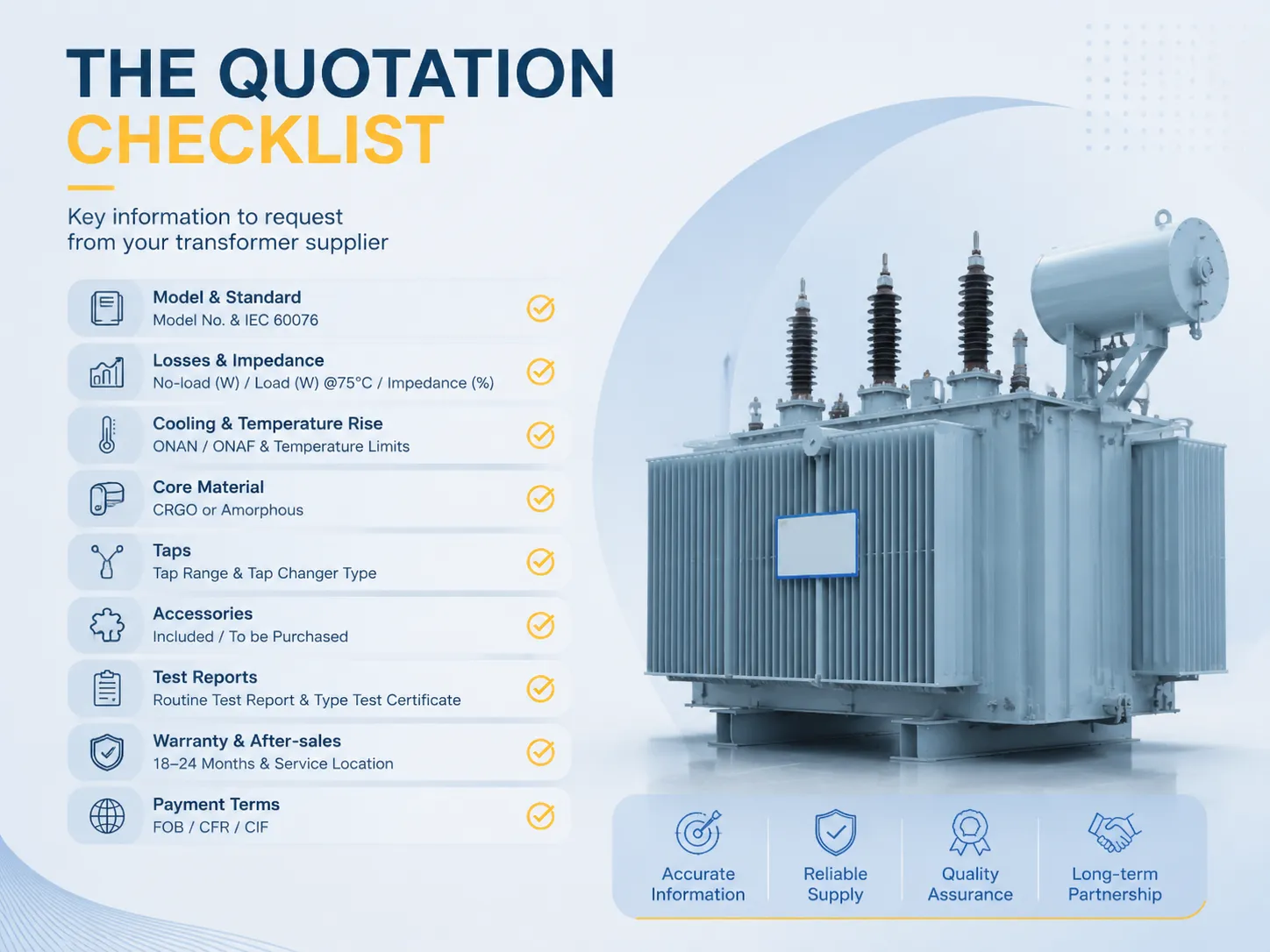
Die Angebotscheckliste
- Vollständige Modellnummer und IEC 60076-Standardreferenz.
- Detaillierte Verluste: Leerlaufverluste (W), Lastverluste (W) bei 75 °C und Impedanz (%).
- Kühlklassifikation (ONAN/ONAF) und Temperaturerhöhungsgrenzen.
- Art und Typ des verwendeten Kernmaterials (CRGO oder amorph).
- Bereich der Abgriffe und Art des Abgriffwechslers.
- Zubehör, das bereits enthalten ist oder das zusätzlich erworben werden muss.
- Verfügbarkeit des Routinetestberichts. Verfügbarkeit des Typprüfzertifikats für ein ähnliches Modell.
- Garantie (allgemein 18-24 Monate) und Ort, an dem der After-Sales-Service bereitgestellt wird.
- Zahlungsbedingungen (FOB/CFR/CIF).
Logistik, Zoll und Lieferung
Ein wasserfester Transformator ist ein sperriges Objekt und muss wie eine Flüssigkeit behandelt werden. Erkundigen Sie sich, ob das Lieferland den Eintritt von Öl verbietet, da es solche Länder gibt, die Öllieferungen ablehnen. Daher kann Ihr Produktionswerk den Transformator entweder ohne Öl oder mit einem aus Ester hergestellten Öl versenden. Sie müssen mit Lieferkosten von etwa 1500-6000 USD rechnen, abhängig von der gewählten Route. Planen Sie mit geschätzten Lieferzeiten von etwa dreißig bis sechzig Tagen und längeren Zeitrahmen im Falle von Leistungstests oder maßgeschneiderten Spannungswerten. Fragen Sie den Dienstleister, ob die Ausrüstung ohne Öl oder mit Stickstoff versendet werden kann.
Häufig gestellte Fragen
Wie viel kostet ein 1.000 kVA ölgefüllter Transformator?
Ungefähr $18.000 bis $38.000 FOB-Preis für einen Standard-ONAN-Transformator mit CRGO von 10 bis 35 kV mit einem Prüfzeugnis. Der Einsatz eines amorphen Kerns, eines Lastabgriffwechslers oder einer 35-kV-Isolierung erhöht die Kosten um 20 bis 40%. Europäische Marken liegen am oberen Ende der Skala, während chinesische Marken, die sich auf Kosten konzentrieren, am unteren Ende stehen. Die Kosten für Transformatoren variieren je nach Spezifikationsgrad, Marken und Standorten.
Wie lange hält ein ölgefüllter Transformator?
Eine ordnungsgemäße Belastung eines Transformators und die Durchführung von Öltests einmal pro Jahr machen eine Lebensdauer von 25–40 Jahren realistisch. Das Altern der Isolierung wird durch Temperatur und Feuchtigkeit beeinflusst, daher wäre die Isolierung geschützt, solange das Transformatorenöl trocken bleibt und der Feuchtigkeitsgehalt unter 30 ppm gehalten wird und es nicht über längere Zeit über die Temperaturerhöhungsgrenzen der IEC überlastet wird.
Was bedeutet “Leerlaufverlust” und warum ist es wichtig?
Der Leerlaufverlust bezieht sich auf die von einem Transformator verbrauchte Energie, wenn er unter Spannung steht. Zum Beispiel hat ein 400-kVA-CRGO-Transformator einen Leerlaufverlust von etwa 600 bis 700 Watt, während ein amorpher Transformator einen Leerlaufverlust von etwa 250 bis 320 W hat. Bei einem Preis von $0,12 pro kWh entspricht jeder 100 W Leerlaufverlust etwa $105, die in einem Jahr verbraucht werden, was bedeutet, dass der Energiebedarf von 350 W eines Transformators mit amorphem Kern ihn innerhalb von 3 bis 6 Jahren amortisiert, abhängig davon, wie leicht die Transformatoren belastet sind.
Kann ich einen gebrauchten ölgefüllten Transformator kaufen, um Geld zu sparen?
Sie können auf jeden Fall einen gebrauchten Transformator kaufen, sollten jedoch aus technischer Sicht ein Risiko in Betracht ziehen: Vor dem Kauf und dem Einschalten ist es am besten, die relevanten Tests (d.h. Verhältnisprüfung, Isolationswiderstandsmessung, Ergebnisse der Öl-Durchschlagspannung und DGA-Analyse) durchzuführen. Planen Sie, etwa 10-20% des Preises eines neuen Transformators für Laboruntersuchungen, Transformatorölanalysen und -behandlungen, Dichtungswechsel und möglicherweise den Austausch von Durchführungen einzuplanen.
Welche Dokumente sollte ich vom Lieferanten anfordern?
So viel wie möglich, stellen Sie sicher, dass Sie Folgendes erwerben: ein detailliertes Angebot und einen IEC 60076 Prüfbericht, ein Öltestzertifikat, ein Typprüfzertifikat, einen Anordnungs- und Installationsplan sowie ein Qualitätszertifikat. Für Exporte müssen Sie die folgenden Dokumente beschaffen: die Handelsrechnung, die Packliste, den Frachtbrief und das Originalzertifikat. Stellen Sie beim Verhandeln sicher, dass Sie alle diese Dokumente schriftlich haben, bevor Sie mit der Zahlung beginnen.
Referenzen
- IEC 60076-1: Leistungstransformatoren — Allgemeines — Der internationale Standard, der die Bewertungen, Verluste und Routineprüfungen abdeckt, auf die in diesem Leitfaden verwiesen wird.
- IEC 60156: Isolierflüssigkeiten — Durchschlagspannungsprüfung — Die Prüfmethodik hinter der 40 kV Ölannahmegrenze.
- IEEE — IEEE C57 Standards ergänzen IEC 60076 für das Design, die Prüfung und die Wartung von Transformatoren.
- NEMA — Nordamerikanische Effizienz- und Gehäusestandards für Verteilungstransformatoren.
- US DOE Effizienzstandards für Verteilungstransformatoren — Offizielle Effizienzvorschriften, die erklären, wie Verlustwerte die Wirtschaftlichkeit von Transformatoren beeinflussen.
- UL Lösungen — Sicherheitszertifizierungsstelle; relevant, wenn Transformatoren auch UL- oder CSA-Zulassungen für nordamerikanische Projekte erfüllen müssen.
- Jiangsu Subian Electric Power Co., Ltd. — Hersteller von ölgefüllten Transformatoren, die IEC 60076-konform sind, 10 kV–110 kV, mit Prüfberichten.
Fazit
Der Kauf eines ölgefüllten Transformators hängt von fünf Zahlen ab; nämlich der Nennleistung, dem Leerlaufverlust, dem Lastverlust, der Impedanz und den Gesamtkosten pro kVA. Wählen Sie die Größe des Transformators entsprechend der Spitzenlast bei 70–85% der maximalen Last und verwenden Sie wirtschaftlich wertvolle Kernmaterialien abhängig vom Lastfaktor und den Energiekosten. Fordern Sie Prüfberichte an und überprüfen Sie Angebote auf Einzelteilbasis anstelle des Endpreises, da die FOB-Preise von $2.000 für 100 kVA bis $80.000 für 2.500 kVA variieren, wobei eine große Lücke zwischen bekannten internationalen Herstellungsunternehmen und anderen Produzenten besteht. Beginnen Sie, indem Sie ein detailliertes Angebot von einem zertifizierten Anbieter wie Jiangsu Subian Electric Power, verwenden Sie die Checkliste dieses Leitfadens, um jede Zeile zu überprüfen, und Sie werden einen Transformator kaufen, der sich über Jahrzehnte durch zuverlässigen Service amortisiert.