


Der Beschaffungsingenieur flog von Lagos zu drei Städten mit Fabriken in China über sechs Tage, wobei jeder Anbieter behauptete: “Unser Transformator ist der beste!” Erst als er die Wickelwerkstatt der vierten Fabrik betrat, verlor der Ingenieur den Überblick über die Anzahl der Schichten aus Polyesterfolie und Kraftpapier, die die Hochspannungswicklung einer 110-kV-Maschine bedeckten. Vor ihm verbrachten zwei Arbeiter 45 Minuten damit, eine einzelne Phase zu wickeln, Messungen durchzuführen und den Feuchtigkeitsgehalt des Papiers zu überprüfen. Es war der Moment, als der Ingenieur die wahre Bedeutung der Transformatorenherstellung entdeckte, die nicht darin bestand, mechanische Geräte zusammenzubauen und Preisliste zu erstellen, sondern darin, zehntausende kleiner Entscheidungen zu treffen, um sicherzustellen, dass eine Maschine 30 Jahre lang funktioniert und nicht im dritten Sommer ausfällt.
Der Artikel erklärt, was zuverlässige Transformatorenherstellung von bloßer Fertigungskompetenz unterscheidet, auf welchen Standards alle Prozesse basieren und wie die Fertigung in echten Fabriken erfolgt. Darüber hinaus zeigt er, wie Kunden die Qualität von Transformatoren überprüfen können, bevor sie eine Bestellung aufgeben.
Verständnis der Transformatorenproduktion
Die Herstellung von Transformatoren bezieht sich auf den Prozess der Fertigung stationärer elektromagnetischer Maschinen, die dazu bestimmt sind, Elektrizität zwischen zwei Schaltkreisen unter Verwendung von Magnetfeldern zu bewegen und die Spannung und den Strom, falls zutreffend, zu verändern. Obwohl die Hauptbestandteile Stahl, Kupfer, Mineralöl und Papier sind, sind die technischen Toleranzen der Produkte einzigartig. Zum Beispiel besteht der 10 MVA Transformator aus über vier Tonnen kornorientiertem Elektrostahl, zwei Tonnen Kupfer und über acht Tonnen Öl, die so angeordnet sind, dass die Verluste minimiert werden, die Isolierung den Auswirkungen von Blitzeinschlägen standhält und die Montage den Kurzschlusskräften widersteht, die mehrere Male stärker sind als die Gravitationskraft.
Die Exzellenz in der Produktion führt zu Konsistenz: Die Leerlaufverluste betragen maximal 10% des Entwurfswerts, und die Lastverluste nicht mehr als 5%, alle Impulstests werden beim ersten Versuch bestanden, und der Geräuschpegel liegt innerhalb der geforderten Grenzen. Diese Ergebnisse sind nicht in den Werbematerialien zu finden, da sie durch die militärische Präzision des Prozessmanagements erreicht werden, die in Mikrometern und Centigraden gemessen wird. Daher betonen erfahrene Kunden die Bedeutung der Analyse des Fertigungsprozesses anstelle der Endprüfungsresultate.
Bedeutung der Qualität des Fertigungsprozesses für die Zuverlässigkeit
Der Transformator ist ein Vermögenswert, der an einem einzigen Punkt arbeitet. Der Ausfall des Verteilungstransformators bedeutet, dass die gesamte Straße ohne Strom ist, und der Ausfall des 110-kV-Transformators würde bedeuten, dass die gesamte Region für 12-24 Monate ohne Strom bleibt. Daher hängt die Zuverlässigkeit davon ab, was während der Produktion passiert.
Die Qualität der Wicklung bestimmt, ob die Isolierung thermische und mechanische Belastungen standhält. Schlechte Wickelungen können zu Lufttaschen führen, die zu Teilentladungen in der Isolierung führen.
Die Qualität der Kernmontage ist verantwortlich für die Leerlaufverluste und das erzeugte Geräuschniveau. Wenn die abgeschrägten Ecken unsachgemäß verbunden wurden, könnte dies weitere 5-10% zu den Kernverlusten hinzufügen und die Geräuschpegel um 5-8 dB erhöhen.
Die Qualität des Trocknens und des Öls definiert den Feuchtigkeitsgehalt, der das Altern bestimmt. Wenn der Feuchtigkeitsgehalt größer als 2% ist, wird der Alterungsprozess um das Zehnfache beschleunigt.
Die Disziplin des Testens beseitigt die Mängel vor dem Versand anstatt danach.
Die Wirtschaftlichkeit ist eindeutig: Wenn man Verluste über eine Lebensdauer von 25 Jahren kapitalisiert, kostet ein Verlustniveau, das 10% höher ist als spezifiziert, ungefähr $10.000–$30.000 zusätzlich im Barwert für eine 10 MVA Einheit, abhängig vom Tarif. Die Qualität der Herstellung ist daher kein Luxus — sie ist der Unterschied zwischen einem Vermögenswert und einer Verbindlichkeit.
| Herstellungsfehler | Wo er entsteht | Typische Konsequenz |
|---|---|---|
| Ungleichmäßige Wickelspannung oder Taping-Lücken | Wickelwerkstatt | Teilentladung beginnt, Isolierung altert frühzeitig |
| Schlechte Ausrichtung der abgeschrägten Fugen | Kern schneiden/stapeln | Kernverlust um 5–10%, Geräusch um 5–8 dB(A) |
| Kurzes oder Niedertemperatur-Vakuumtrocknen | Trocknungsöfen | Feuchtigkeit über 1%, Lebensdauer der Isolierung ungefähr halbiert |
| Ausgelassene oder verkürzte Routineprüfungen | Prüfstand | Fehlerhafte Einheiten versendet; Ausfälle treten vor Ort auf |
| Ölkontaminierte Tankinnenteile | Tank- und Ölfüllung | Risiko eines dielektrischen Ausfalls; Ölzerfall unter 60 kV |
Jeder dieser Schritte ist ein kontrollierter Prozessschritt in einer seriösen Fabrik, und jeder ist anhand der Produktionsunterlagen prüfbar. Das ist die praktische Definition von Fertigungsexzellenz: Die Mängel in dieser Tabelle werden verhindert, bevor sie existieren.
Kernmaterialien: Stahl, Kupfer, Papier und Öl
Jeder Transformator ist ein Rezept aus vier Materialfamilien, und die Qualität jedes Materials ist spezifiziert, nicht angenommen:
| Material | Typische Spezifikation | Einfluss auf die Leistung |
|---|---|---|
| Kornorientierter Siliziumstahl (GOES) | 0,23–0,30 mm, Klassen M85–M130 (23–30 J/kg Kernverlust) | Treibt Leerlaufverluste, Geräusch und Kernkosten |
| Wicklungsleiter | Sauerstofffreies Kupfer 99,95% Cu oder Aluminium; papierisoliert | Treibt Lastverluste, Kurzschlussfestigkeit und Preis |
| Isolierpapier & Pressspan | Kraft- und hochdichte Transformatorplatte | Bestimmt die dielektrische Festigkeit und die thermische Klasse (105°C Klasse A) |
| Isolieröl | Mineralöl gemäß IEC 60296 oder natürliche Ester (pflanzliches) Öl | Kühlt, isoliert und bewahrt die Papierisolierung |
| Tank & Kühler | Mildstahlplatte, öltight Schweißung, Korrosionsschutzfarbe | Enthält Öl, überträgt Wärme, schützt gegen Umwelteinflüsse |
In energieeffizienter Transformator In der Produktion ist die Wahl des Stahls der größte Hebel. Der Wechsel von einer herkömmlichen Sorte zu hochpermeablem GOES mit 0,23 mm Dicke kann die Kernverluste um 15–25% senken, weshalb effizienzorientierte Käufer jetzt nach einer spezifischen Stahlgüte anstelle einer allgemeinen “niedrigen Verlust”-Behauptung fragen.
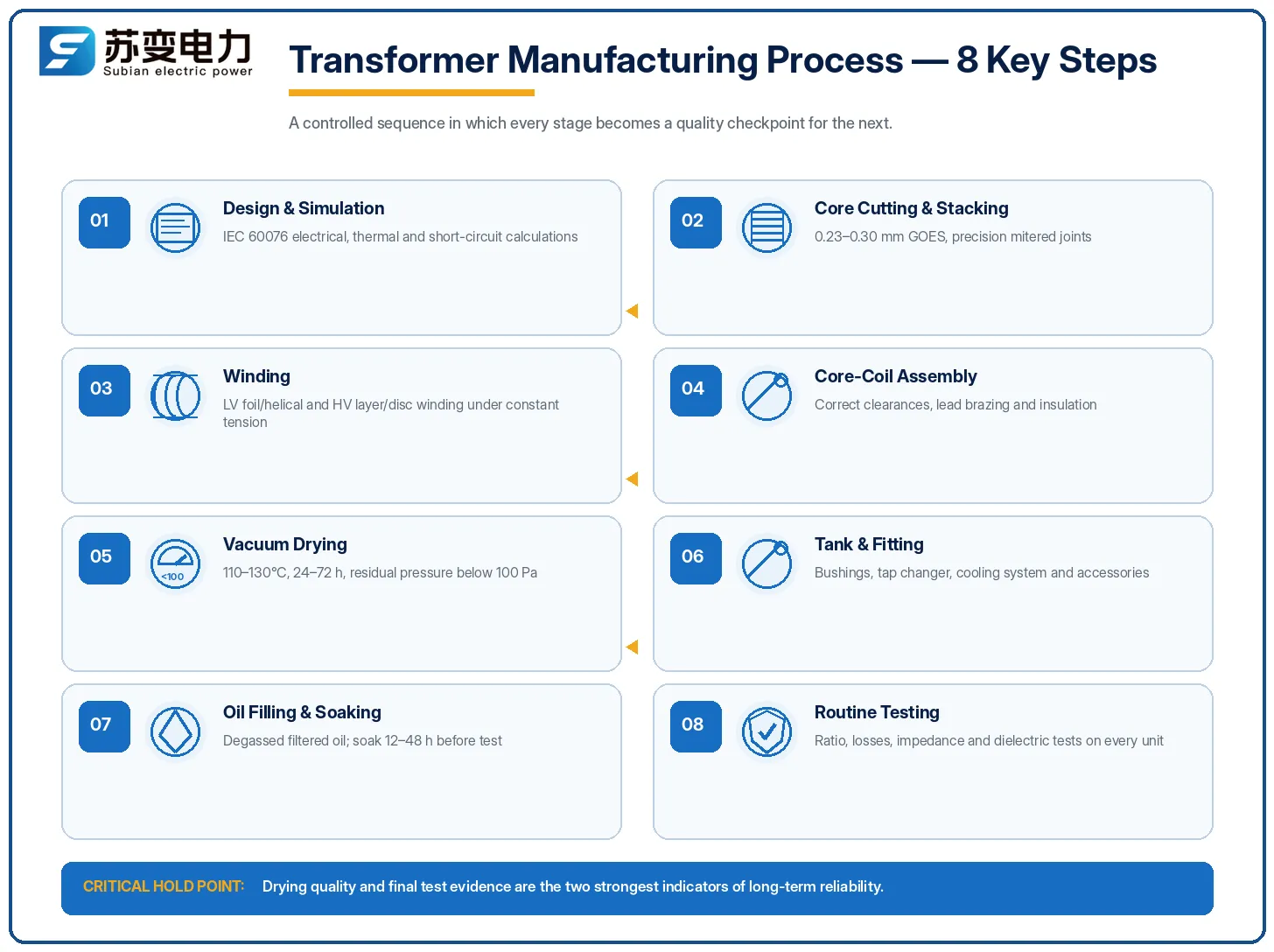
Der Herstellungsprozess, Schritt für Schritt
Der Herstellungsprozess in der modernen Industrie ist eine Kette von Prozessschritten, wobei jeder Schritt aus Kontrollpunkten besteht, die notwendig sind, damit der folgende Schritt ordnungsgemäß durchgeführt werden kann;
– Entwerfen und Simulieren. Der elektrische und mechanische Fertigungsprozess erfolgt gemäß den Anforderungen der IEC 60076, einschließlich Kurzschlusskräften und thermischen Berechnungen.
– Kernschneiden und Stapeln. GOES-Spulen werden geschnitten und dann in Gehrungsstößen (um 45 Grad gedreht) gestapelt und anschließend mit einer sicheren Presskraft fixiert.
– Wickelprozess. LV (Niederspannungs-) Wicklungen (in der Regel spiralförmig oder als Folientyp) und HV (Hochspannungs-) Wicklungen (geschichtet oder als Scheibentyp) werden in automatisierten Maschinen mit konstanter Spannung und Papierisolierung dazwischen gewickelt.
– Kern-Spule-Montagephase (Anpassung). Die Wicklungen werden auf die Kernbeine gelegt, wobei bestimmte Lücken gelassen werden; die Anschlüsse werden gelötet und isoliert.
– Vakuumtrocknung. In dieser Phase wird der aktive Teil unter Vakuumbedingungen erhitzt und getrocknet, wobei der Enddruck unter 100 Pascal liegt, um Feuchtigkeit vor dem Ölen zu entfernen.
– Tankung und Anpassung. Der aktive Teil wird in den Tank eingesetzt, und Durchführungen, Lastschalter und Kühler werden montiert.
– Ölfüllung und Imprägnierung. Das entgaste und gefilterte Öl wird in den Transformator abgelassen und etwa 12 bis 48 Stunden imprägniert.
– Prüfung. Prüfverfahren gemäß IEC 60076 werden für jede Einheit durchgeführt.
Es ist erwähnenswert, dass die Trocknungsphase entscheidend ist. Feuchtigkeit ist der Hauptfeind der Lebensdauer von Transformatoren. Ein ordnungsgemäßer Trocknungszyklus von 110-130 Grad über einen Zeitraum von 24-72 Stunden, gefolgt von einer Öleinlagerung, ermöglicht es, den Feuchtigkeitsgehalt niedrig genug zu halten. Moderne Fabriken, die die Trocknungsphase überspringen oder verkürzen, erhalten ihre Produkte fünf Tage früher, während ihre Geräte schneller altern, unabhängig von anderen Faktoren.
Geltende Standards und Prüfregime
Die Transformatorenherstellung ist eine der am stärksten standardisierten Branchen im Bereich Elektrotechnik. Der internationale Maßstab ist die IEC 60076-Serie, mit nationalen Entsprechungen wie GB/T 6451 und GB 20052 in China sowie IEEE C57.12.00 in Nordamerika:
| Norm | Umfang | Was es überprüft |
|---|---|---|
| IEC 60076-1 | Allgemeine Anforderungen und Bewertungen | Nennwerte, Temperaturanstieg, Abgriffbereich und Typenschilddaten |
| IEC 60076-3 | Isolationsniveaus und dielektrische Tests | Blitzimpuls- und Netzfrequenzbeständigkeit |
| IEC 60076-5 | Kurzschlussfestigkeit | Fähigkeit, terminale Fehler ohne Schäden zu überstehen |
| IEC 60076-11 | Trockentransformatoren | Harzguss- und offene Trockenbauarten |
| GB 20052 | Effizienzklassen für Verteiltransformatoren in China | Drei Effizienzklassen für flüssigkeitsgetauchte und trockene Typen |
| IEC 60296 | Spezifikation für ungenutztes mineralisches Isolieröl | Ölqualität, Durchschlagspannung und Oxidationsstabilität |
Es gibt drei Phasen im Prüfprozess: Routineprüfungen jeder Einheit, Typprüfungen der ersten von allem, was produziert wird (bezüglich Temperaturanstieg, Blitzentladung, Kurzschlussfestigkeit) und spezielle Prüfungen, die auf Anfrage durchgeführt werden müssen (für Geräusch oder Teilentladung). Ein seriöser Hersteller stellt auf Anfrage detaillierte Typprüfungsdokumente zur Verfügung und erlaubt Kunden und externen Prüfern, den Routineprüfungsprozess zu beobachten.
Arten von Transformatoren, die in einer modernen Fabrik gebaut werden
Fabriken spezialisieren sich typischerweise auf einen Spannungs- und Bewertungsbereich. Die Hauptproduktfamilien und deren typische Fertigungsschwerpunkte:
| Produktfamilie | Typische Nennleistung | Fertigungsschwerpunkt |
|---|---|---|
| Mastenmontierte Verteilung | 10–250 kVA | Hochvolumige Wicklung, niedrige Kosten, kompakte Tanks |
| Bodenmontierte Verteilung | 75–2.500 kVA | Totem-Front-Durchführungen, manipulationssichere Gehäuse |
| Ölgetauchte Leistung | 3,15–63 MVA | Vakuumtrocknung, OLTC-Integration, Kurzschlussfestigkeit |
| Trockenbau (Gießharz) | 100 kVA–25 MVA | Harzguss, geringe Teilentladung, Sicherheit im Innenbereich |
| Amorpher Kern (energieeinsparend) | 50–2.500 kVA | Spröde Bandhandhabung, Leerlaufverluste unter 70% von CRGO-Einheiten |
Amorphe Legierungstransformatoren verdienen eine Erwähnung, da sie die am schnellsten wachsende energieeinsparende Produktlinie sind. Ihr amorphes Metallband hat Leerlaufverluste, die ungefähr 60–70% niedriger sind als die von konventionellen kornorientierten Stahlkernen, weshalb sie die Beschaffungslisten dominieren, wo Verlustkapitalisierung aggressiv ist und 24-Stunden-Beladung die Norm ist.
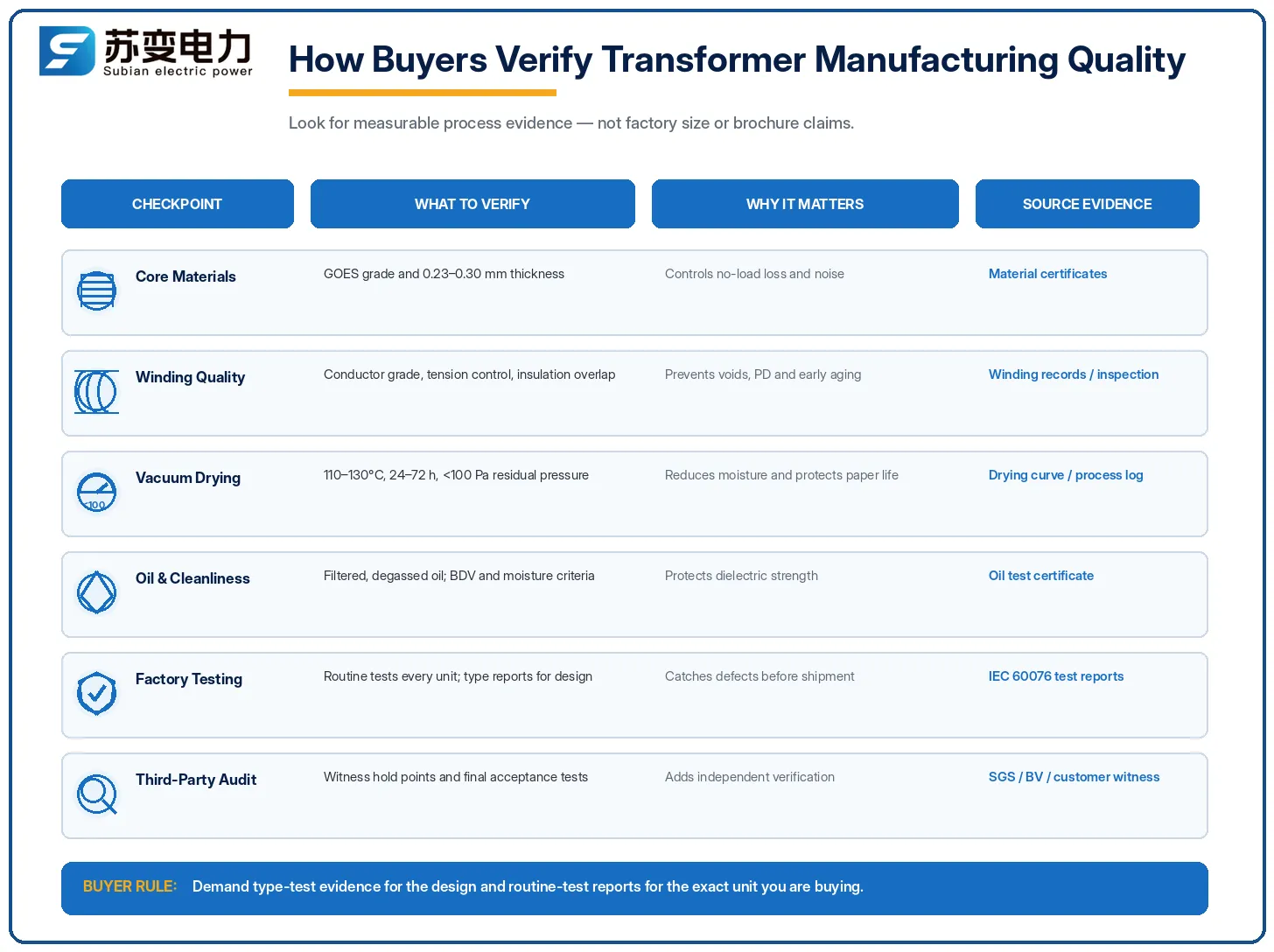
Wie man die Qualität als Käufer überprüft
An sich geben Preisliste und ISO-Zertifikate wenig über einen Anbieter preis. Was Ihnen mehr Informationen über den Hersteller gibt:
Fordern Sie Typprüfberichte an, einschließlich Temperaturanstieg, Blitzimpuls und Kurzschlussfestigkeitsleistung für den spezifischen Transformator, den Sie kaufen möchten.
Überprüfen Sie die Ergebnisse der Routineprüfungen, die während der letzten Lieferung durchgeführt wurden – es ist wichtig, dass das Verhältnis, die Leerlaufverluste, die Lastverluste und die Impedanz den IEC 60076-1-Grenzwerten entsprechen.
Führen Sie einen Standortbesuch oder eine Videoinspektion des Produktionsbereichs durch – achten Sie beispielsweise darauf, wie die Wickelspannung kontrolliert wird, sowie auf Trockenschränke und Prüfbereiche; ein Unternehmen, das vollständige Transformatorprüfungen jeder Einheit durchführt, hat sicherlich nicht die gleichen Fähigkeiten wie ein Anbieter, der nur Verhältnisprüfungen durchführt.
Geben Sie Feuchtigkeits- und Ölparameter an und fordern Sie Feuchtigkeitsmessungen der Isolierung und die Durchschlagspannung des Öls an (die Werte für neues Öl müssen gemäß IEC 60296 ≥ 60 kV/2,5 mm überschreiten).
Bei großen Bestellungen stellen Sie sicher, dass Sie einen unabhängigen Prüfer hinzuziehen; es kostet nur 1%-2% des Bestellwerts, um eine unabhängige Person die wichtigsten Herstellungsphasen beobachten zu lassen.
Diese Art des Verifizierens ist dieselbe, die die Versorgungsunternehmen verwenden, wenn sie Hersteller für ihre Lieferantenlisten qualifizieren, wodurch sie schnell zwischen echten Produktionsfähigkeiten und Marketingansprüchen unterscheiden können.
Führende Hersteller und Preisspannen
Der globale Transformatorenmarkt wird von einer breiten Schicht von Herstellern bedient. Repräsentative Preisspannen für einen 1.000 kVA Verteiltransformator und einen 10 MVA Leistungstransformator geben einen Eindruck von der Bandbreite:
| Marke | Herkunft | 000 kVA Verteilpreis | 10 MVA Leistungs Preis |
|---|---|---|---|
| Hitachi Energie | Japan/Weltweit | $8.500–$13.000 | $52.000–$82.000 |
| ABB | Schweiz/Weltweit | $8.000–$12.500 | $52.000–$78.000 |
| Siemens Energie | Deutschland/Weltweit | $7.500–$12.000 | $50.000–$75.000 |
| Schneider Electric | Frankreich/Weltweit | $7.000–$11.500 | $48.000–$72.000 |
| Toshiba / Hyundai | Japan/Korea | $6.500–$10.000 | $46.000–$68.000 |
| Jiangsu Subian Electric Power | China | $4.000–$7.000 | $28.000–$48.000 |
Die Preise variieren je nach Verlustklasse, Lastabgriff, Zubehör, Rohstoffpreisen und Lieferbedingungen; betrachten Sie diese als Planungsbereiche, nicht als Angebote.
Die Premium-Klasse rechtfertigt ihren Preis durch jahrzehntelange Felddaten, umfangreiche Typprüfprogramme und globale Servicenetzwerke. Für kritische, schwer zu ersetzende Anlagen kaufen viele Versorgungsunternehmen weiterhin dort. Aber die chinesische Klasse produziert jetzt zu den gleichen IEC 60076 Prüfungsnachweisen zu 40–50% niedrigeren Preisen, weshalb sie einen großen Anteil an Exportbeschaffungen in Asien, Afrika, dem Nahen Osten und Südamerika erobert hat.
Jiangsu Subian Electric Power ist ein chinesischer Transformatorenhersteller Herstellung von Verteilungs- und Leistungstransformatoren von 10 kVA bis 63 MVA, einschließlich ölgetauchter, trocken-transformatorischer und amorpher Kern-Energieeinsparungsdesigns, alle getestet nach IEC 60076. Subian betreibt eine spezielle Prüfstation, veröffentlicht routinemäßige Prüfberichte mit jeder Lieferung und hat an Versorgungsunternehmen und EPC-Auftragnehmer in mehr als 60 Ländern exportiert. Für Käufer, die dokumentierte Fertigungsqualität zu exportfreundlichen Preisen wünschen, ist Subian ein praktischer Eintrag auf der Shortlist — sein Produktportfolio und die Prüfunterlagen sind auf subian-electric.com.
Wie wählt man einen Transformatorenhersteller aus
Zunächst vollständige Spezifikationen entwerfen: Nennleistung, Spannungsverhältnis, Impedanz, die Vektor-Anordnung, Verlustbereich, Impulsfestigkeit, Kühlung und die relevante Norm (IEC, GB oder IEEE).
Vergleichen Sie die Gesamtkosten des Eigentums: amortisieren Sie die Leerlauf- und Lastverluste über die Nutzungsjahre (20-25 Jahre); wenn der Leerlaufverlust um 1 kW abweicht, kann dies die Kosten von $700-900 pro Jahr bei $0.08-0.10/kWh verursachen.
Nachweis der Prüfung: Informationen zu Typprüfungen im Zusammenhang mit dem Design, routinemäßige Prüfungsinformationen für jede Einheit, Informationen zu Prüfeinrichtungen.
Analysieren Sie die Fertigungstiefe: ob das Unternehmen die Ausrüstung intern produziert (Wickeln, Trocknen, Testen) oder die Produkte aus gekauften Teilen zusammenbaut.
Berücksichtigen Sie Ersatzteile und Wartung: Dichtungen, Durchführungen, Ersatzteile für Lastabgriffe, Garantien für die Bereitstellung von Dienstleistungen während der Garantiezeit (12-24 Monate).
Häufig gestellte Fragen
Wie viel kostet die Herstellung eines Transformators?
Für einen 100 kVA Verteilungstransformator liegen die Produktionskosten bei etwa $1.500–$3.000; für eine 1.000 kVA Einheit, $4.000–$7.000; und für einen 10 MVA Leistungstransformator, $28.000–$48.000 FOB von chinesischen Fabriken. Europäische und japanische Hersteller verlangen typischerweise 50–80% mehr für die gleiche Nennleistung. Die Preise variieren mit den Preisen für Kupfer und Stahl, Verlustklasse und Zubehör.
Welche Normen gelten für die Herstellung von Transformatoren?
Der internationale Maßstab ist IEC 60076 (Teile 1, 3, 5 und 11, die allgemeine, Isolations-, Kurzschluss- und trocken-transformatorische Prüfungen abdecken). China verwendet GB/T 6451 und GB 20052 für Effizienzklassen; Nordamerika verwendet IEEE C57.12.00. Alle seriösen Exportfabriken testen nach IEC 60076 und können Typprüfberichte vorlegen.
Wie lange dauert es, einen Transformator herzustellen?
Ein kleiner Verteilungstransformator benötigt 2–4 Wochen von der Bestellung bis zum Versand; ein 10–63 MVA Leistungstransformator benötigt 8–20 Wochen, abhängig von Design, Verfügbarkeit der Materialien und ob Typprüfungen erforderlich sind. Große 220kV+ Einheiten können 6–12 Monate in Anspruch nehmen.
Was ist der Unterschied zwischen Routine- und Typprüfungen?
Routineprüfungen (Verhältnis, Leerlaufverlust, Lastverlust, Impedanz, Dielektrizitätsprüfungen) werden an jeder Einheit durchgeführt. Typprüfungen (Temperaturanstieg, Blitzimpuls, Kurzschlussfestigkeit) werden einmal pro Design durchgeführt, um zu beweisen, dass das Design selbst solide ist. Ein Käufer sollte beides haben: Typberichte für das Design und Routineberichte für die spezifische Einheit.
Wie lange hält ein gut gefertigter Transformator?
25–35 Jahre mit routinemäßiger Wartung. Die Alterung der Isolierung wird hauptsächlich durch Feuchtigkeit und Temperatur beeinflusst – jede 6K über der Design-Hotspot-Temperatur halbiert ungefähr die Lebensdauer des Papiers. Jährliche Öltests (DGA gemäß IEC 60599) und das Einhalten der Ladegrenzen gemäß IEC 60076-7 sind die stärksten Hebel für die Lebensdauer.
Referenzen
- IEC 60076-1: Leistungstransformatoren – Allgemeines — Nennwerte, Abgriffe, Temperaturerhöhung und Prüfanforderungen für Leistungstransformatoren.
- IEC 60076-5: Fähigkeit, Kurzschluss zu widerstehen — Anforderungen an die Kurzschluss-Designverifizierung.
- IEC 60076-11: Trockentransformatoren — Anforderungen an die Herstellung von Trockentransformatoren.
- IEC 60296: Mineralische Isolieröle — Ölspezifikation, die für die Qualität von Transformatoren relevant ist.
- IEEE C57.12.00: Flüssigkeitsgetauchte Verteilungs- und Leistungstransformatoren — Anforderungen an die Herstellung in Nordamerika.
- US DOE Ressourcen zur Effizienz von Transformatoren — Effizienzregeln und Hintergrund zu Verlustökonomien.
- Offizielle Website von Jiangsu Subian Electric Power — Produktpalette und Prüfdokumentation für Verteilungs- und Leistungstransformatoren.
Fazit
Transformatoren sind technische Innovationen, die seit Jahrzehnten ohne Probleme bestehen oder viel früher als erwartet Probleme hatten und viel mehr gekostet haben als jede anfängliche Abweichung. Der Qualitätsunterschied zeigt sich in den Materialien, Prozessen und Prüfdaten. Zum Beispiel – Vakuumtrocknungsprozess bei 100 Pa, 0,23 mm hochmagnetisch leitender Stahl in energieeffizienten Designs und jede Einheit wird gemäß IEC 60076 getestet.
Wichtige Erkenntnisse:
Zuverlässigkeit kommt von der Wickeldisziplin, dem Trocknen und Testen auf dem Fabrikboden und nicht von dem, was in der Broschüre steht.
Benötigt Typ- und regelmäßige Prüfungen; Inspektionen durch Dritte reduzieren das Risiko von Problemen um 1-2%.
Die erwarteten Kosten für Verteilungseinheiten liegen zwischen $1,500 und $8,000 und für Leistungstransformatoren der 10 MVA-Klasse aus China zwischen $28,000 und $48,000.
Wenn Sie Verteilungs- oder Leistungstransformatoren beschaffen und dokumentierte Fertigungsqualität wünschen, Jiangsu Subian Electric Power baut IEC 60076-zertifizierte Einheiten von 10 kVA bis 63 MVA, die vor jedem Versand getestet werden. Überprüfen Sie die Palette und fordern Sie Prüfzeugnisse an unter subian-electric.com.