


Le responsable de l'établissement, qui a acheté un transformateur de distribution de 630 kVA pour $12,000 sur la base d'un devis reçu, a appris que six mois plus tard, il fonctionnait à une charge de 92% lors des journées chaudes, ce qui a entraîné l'absence de marge de surcharge, une augmentation des pertes et une réduction de la durée de vie de son appareil. Par conséquent, acheter le bon type de transformateur ne consiste pas à choisir le devis le moins cher, mais à faire correspondre les puissances motrices avec les pertes, les niveaux de tension, le type de système de refroidissement, ainsi que les exigences normatives.
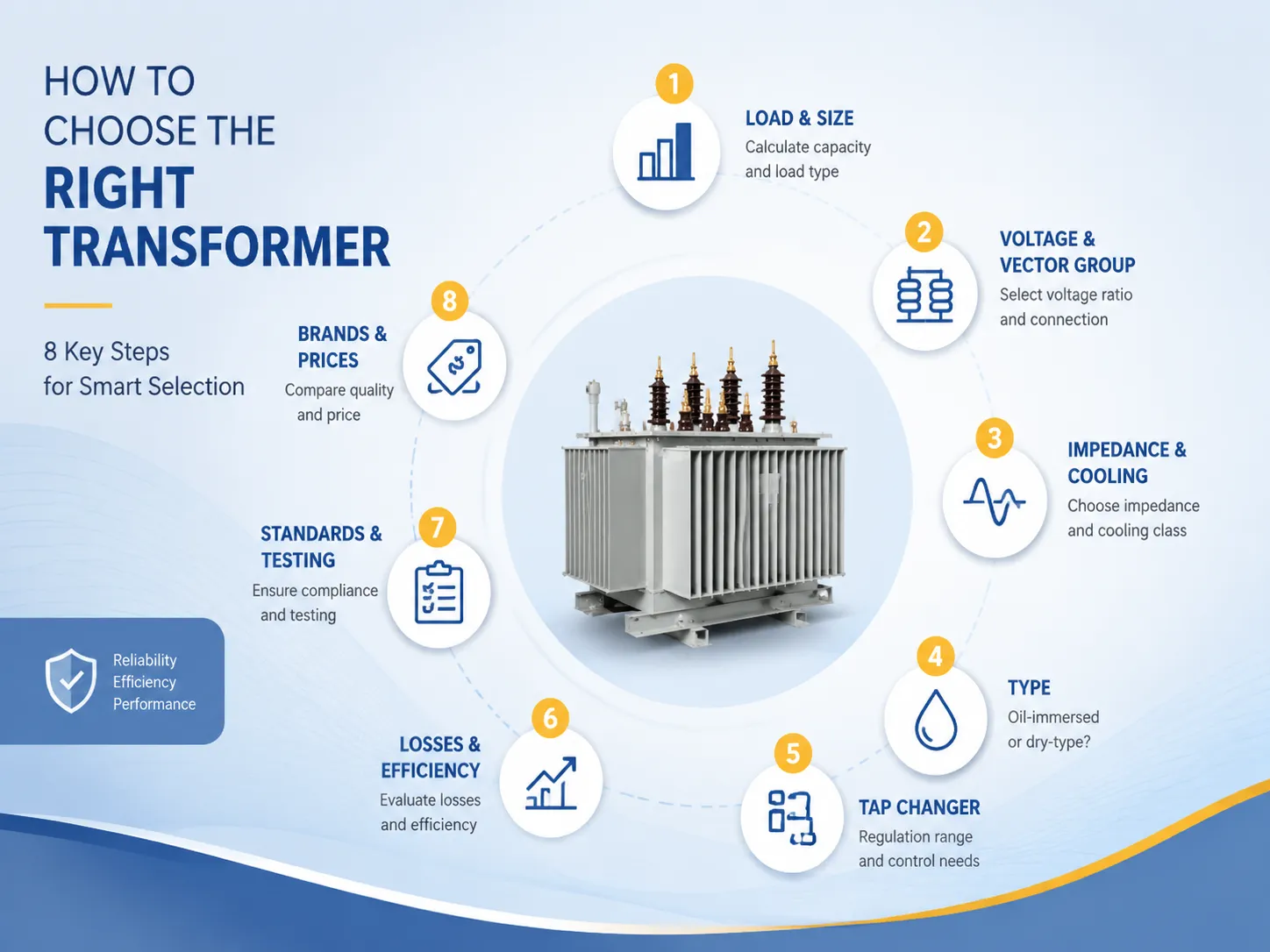
Le guide complet sur la façon de choisir un transformateur couvre toutes les étapes que chaque client doit suivre, dans l'ordre dans lequel l'ingénieur les effectuera.
En termes simples, si vous souhaitez sélectionner le type approprié de transformateur à acheter, vous devez déterminer la charge maximale dont vous aurez besoin en kVA, puis choisir une puissance de transformateur appropriée de sorte que la charge de pointe soit d'environ 60% à 80% de la capacité du transformateur. De plus, assurez-vous de verrouiller le rapport de tension des transformateurs, le groupe vectoriel, l'impédance, la classe de refroidissement et le type d'isolation. Après cela, recherchez des devis de fournisseurs pour le transformateur en tenant compte des pertes sans charge et pendant la charge pendant 20 ans en utilisant la méthode des pertes capitalisées.
Étape 1 : Définir la charge et calculer la taille
Lors du choix d'un transformateur, il faut d'abord déterminer la charge. Ne totalisez pas la puissance nominale de chaque machine, sinon vous vous retrouverez avec un transformateur très surdimensionné. Au lieu de cela, suivez l'approche professionnelle :
| Étape | Calcul | Résultat |
|---|---|---|
| Charge connectée | Somme de toutes les puissances des équipements | 1 200 kVA |
| Demande maximale | Appliquer le facteur de demande 0,7 | 840 kVA |
| Correction du facteur de puissance | Compenser à 0,95 | 884 kVA |
| Marge de croissance | Ajouter 20% | 1 061 kVA |
| Puissance sélectionnée | Taille standard la plus proche | 1,000 ou 1,250 kVA |
La règle d'or stipule que la taille de l'unité doit être telle que la charge de pointe normale se situe entre 60% et 80% de sa capacité. Par exemple, une unité de 1000 kVA a une charge de pointe normale de 750 kVA, ce qui signifie que l'unité fonctionne avec une efficacité optimale avec une certaine marge de capacité pour le démarrage. Le surdimensionnement d'une unité entraîne des coûts inutiles ainsi que des pertes au repos, tandis que le sous-dimensionnement conduit à un cycle de vie rapide de l'unité ainsi qu'à un risque de panne par temps chaud.
Étape 2 : Sélectionner le rapport de tension et le groupe vectoriel
Le rapport de tension doit correspondre aux unités de générateur et de consommateur. En général, pour les applications industrielles et commerciales, le primaire du transformateur de tension est d'environ 11 ou 20 kV et le secondaire 400/230. Sur le site de la sous-station, les rapports de tension courants sont 110/20 kV, 33/11 kV et 220 kV/110 kV. Le groupe vectoriel aide à déterminer comment les phases sont connectées et si le transformateur est mis à la terre ou non.
| Groupe vectoriel | Configuration | Application typique |
|---|---|---|
| Dyn11 | Primaire delta, secondaire étoile avec neutre | Distribution, 11/0,4 kV — le plus courant |
| YNd11 | Primaire étoile avec neutre, secondaire delta | Transformateurs de puissance de transmission et de sous-transmission |
| Yyn0 | Étoile-étoile, les deux neutres | Petite distribution, réseaux spécifiques |
| YNyn0 | Étoile-étoile avec les deux neutres | Systèmes interconnectés avec neutres mis à la terre |
Lors du parallélisme des transformateurs, il est nécessaire de s'assurer de la compatibilité avec le groupe vectoriel, l'impédance et le rapport. Un transformateur Dyn11 ne peut pas fonctionner en tandem avec un YNd11. En cas de doute, un transformateur Dyn11 peut être demandé pour votre distribution et vous pouvez toujours vérifier auprès du fournisseur la compatibilité de vos configurations.
Étape 3 : Choisir l'impédance et la classe de refroidissement
Les caractéristiques de la tension d'impédance (qui est généralement de 4 % à 6 % pour les transformateurs de distribution et typiquement de 8 % à 12 % pour les transformateurs de puissance) définissent le courant de court-circuit et le partage de puissance entre les systèmes parallèles. Une faible impédance permet un courant de défaut plus élevé, mais offre une meilleure régulation de la tension ; une haute impédance protège l'équipement électrique, mais entraîne une mauvaise régulation de la tension. La plupart des entreprises de services publics et des concepteurs industriels ont calculé ce chiffre sur la base de l'analyse de leurs réseaux ; ne supposez pas que l'usine le connaît.
La classe de refroidissement indique combien de charge l'unité peut accueillir et à quel prix :
| Code de refroidissement | Signification | Quand le choisir |
|---|---|---|
| ONAN | Huile naturelle, air naturel | Distribution, service extérieur simple |
| ONAN/ONAF | Ajoute des ventilateurs à air forcé | Unité de sous-station et unités industrielles avec service de pointe/surcharge |
| OFAF / ODAF | Huile forcée + air | Grandes unités au-dessus de ~50 MVA |
| Type sec (AN/AF) | Air naturel / forcé | Installations intérieures sensibles au feu |
Lorsque les ventilateurs sont activés, un transformateur de 20/28 MVA ONAN/ONAF fournit une capacité supérieure de 40%, une approche économique pour répondre aux charges de pointe estivales et autres contingences sans acheter un transformateur plus grand.
Étape 4 : Immergé dans l'huile ou type sec ?
Ce choix est principalement déterminé par l'emplacement et les codes de sécurité incendie :
| Facteur | Immergé dans l'huile | De type sec |
|---|---|---|
| Meilleur emplacement | Sous-stations extérieures | Intérieur, haute hauteur, maritime |
| Plage de puissance | 50 kVA–1 200 MVA | 100 VA–40 MVA |
| Coût relatif (1 MVA) | Base ($18k–$45k) | +40%–60% ($28k–$70k) |
| Risque d'incendie | Contention d'huile nécessaire | Ignifuge |
| Entretien | Test d'huile, DGA | Minimal, pas d'huile |
| Bruit | Généralement inférieur | Plus élevé pour résine coulée |
Si un transformateur est à l'extérieur ou dans une sous-station remplie d'huile, il doit être un transformateur rempli d'huile. Cependant, une fois à l'intérieur d'un bâtiment, de nombreux codes insistent sur des unités de type sec ou des transformateurs remplis d'esters.
Étape 5 : Besoins en changeur de prises et régulation
Vérifiez combien votre tension d'alimentation change. Si elle est stable dans ±5%, alors un simple interrupteur hors circuit avec 2 ou 3 positions (±2.5%, ±5%) fonctionnera bien. Si des fluctuations quotidiennes, des charges de pointe et hors pointe se produisent, l'interrupteur sous tension (OLTC) doit être utilisé :
- Les interrupteurs hors circuit peuvent être peu coûteux (3-5 positions). Cependant, ils doivent désactiver le transformateur pour régler la position, donc ils sont principalement utilisés sur des transformateurs de distribution.
- L'OLTC peut avoir diverses évaluations de ±10% à ±16% avec 13 à 17 itérations en mode de régulation automatique, c'est-à-dire qu'il maintient la tension de sortie dans ±2% ; cela est courant pour les transformateurs de transmission ou de sous-transmission.
- Lorsque vous considérez le coût de ces systèmes, un OLTC présente un coût supplémentaire d'environ $15,000–$60,000 en fonction de la puissance du transformateur ; par conséquent, vous devez le considérer comme un investissement pour la qualité de l'énergie.
Étape 6 : Évaluer les pertes et l'efficacité
Assurez-vous de faire des comparaisons basées sur le coût total de possession plutôt que de vous concentrer uniquement sur le prix de l'offre. Les transformateurs sont en fonctionnement en continu, ce qui signifie que des pertes se produisent en permanence. Demandez à chaque fournisseur des valeurs garanties pour les pertes à vide et en charge afin que vous puissiez compléter une comparaison des pertes capitalisées :
| Fournisseur | Pertes à vide | Pertes en charge | Est. Pertes d'énergie annuelles* | Valeur des pertes sur 20 ans** |
|---|---|---|---|---|
| A (standard) | 1 150 W | 10 500 W | ≈17 MWh | ≈$34 000 |
| B (basse perte) | 900 W | 9 500 W | ≈14 MWh | ≈$28 000 |
Le coût initial de l'appareil à basse perte est supérieur à la normale, cependant, dans la plupart des cas, l'argent économisé sur une période de temps (3-6 ans) couvre le coût de l'unité. C'est pourquoi des normes strictes de consommation d'énergie existent.
Étape 7 : Normes, certification et tests
Votre contrat doit exiger le respect de la norme IEC 60076-1 en général et des dispositions spécifiques IEC 60076 pertinentes pour votre application et, de plus, de la norme IEEE C57.12.00 pour l'Amérique du Nord. Insistez pour recevoir les documents suivants avant le paiement :
- Rapports d'essai de type – pour l'élévation de température, l'impulsion de foudre et les tests de résistance aux courts-circuits effectués sur un échantillon d'unité.
- Certificats d'essai de routine – pour le rapport, l'impédance, les pertes, le diélectrique et la résistance d'isolation déterminés sur votre unité spécifique.
- Certifications – si nécessaire, marquage CE, certificat de qualité ISO 9001 et IEC 60076-11 pour les transformateurs de type sec.
- Rapport d'inspection par un tiers – généralement par SGS ou Bureau Veritas, ou peut être fourni par votre propre expert supervisant les tests dans l'usine pour les commandes de prix pertinentes.
Il est également conseillé d'abandonner les fournisseurs qui refusent l'inspection indépendante ou ne possèdent pas de rapports d'essai de type, indépendamment de leur politique de prix, car les certificats et les dossiers d'examens sont la preuve de la qualité d'un produit.
Étape 8 : Comparer les marques et les prix
Les entreprises multinationales et l'industrie chinoise adhèrent aux normes IEC 60076 mais diffèrent en termes de prix, de délais de livraison et de services d'ingénierie. Les intervalles de niveau de planification pour les transformateurs immergés dans l'huile sont :
| Puissance | Usine chinoise (par exemple, Subian) | Marque européenne/US |
|---|---|---|
| 100 kVA | $1,500–$8,000 | $4,000–$12,000 |
| 1 MVA | $18 000–$45 000 | $35 000–$70 000 |
| 2,5–5 MVA | $35,000–$90,000 | $70,000–$200,000 |
| 20 MVA / 110 kV | $160,000–$300,000 | $430,000–$700,000 |
Les spécifications, les niveaux de perte et la localité dictent les prix. Si une entreprise nécessite un équipement conforme aux normes IEC 60076 à un prix direct d'usine, Jiangsu Subian Electric Power est un excellent choix : ce fabricant de transformateurs de distribution et de puissance (classes de 50 kVA à 220 kV, à la fois immergés dans l'huile et secs) possède également des spécifications en termes de rapports de tension, de regroupement vectoriel, de plage de prises et de certaines méthodes de refroidissement. Toutes les unités sont équipées de résultats d'essai de type et d'essai de routine, de certification selon les normes CE/ISO, et leurs prix sont bien inférieurs à ceux de leurs concurrents étrangers (la différence de prix varie entre 30% et 50%). De plus, l'usine est ouverte aux projets OEM/ODM et aux inspections par des tiers.
La liste de sélection complète
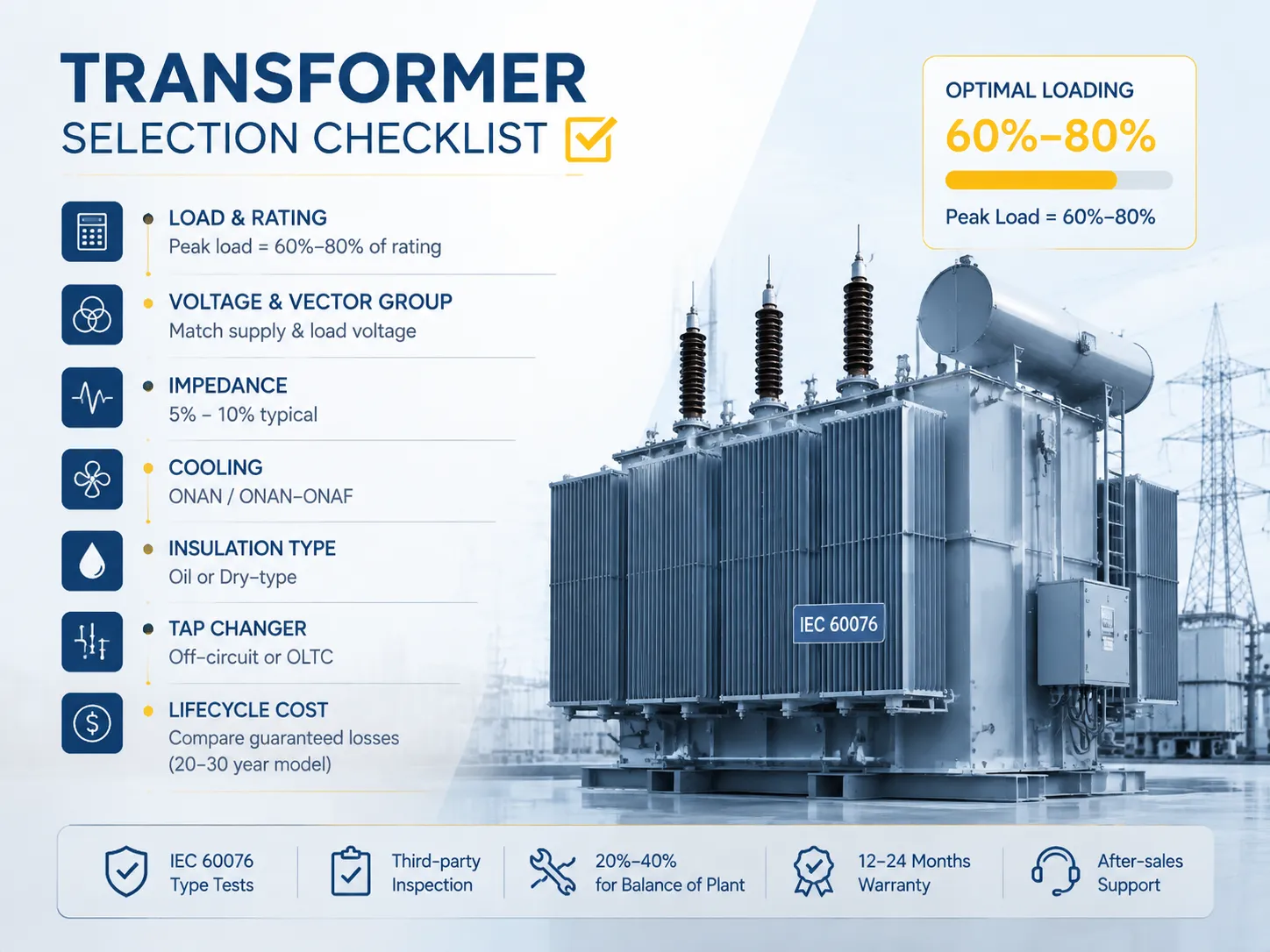
- Déterminez la charge de pointe à l'aide du facteur de demande et de la marge de croissance ; assurez-vous que la classification est choisie de manière à ce que la charge de pointe soit comprise entre 60% et 80%. Vérifiez les valeurs de tension pour l'alimentation et la charge et décidez à la fois du rapport et du groupe vectoriel.
- L'impédance doit être obtenue à partir de l'étude du réseau (5%-10% en moyenne).
- Choisissez un type de refroidissement : ONAN lors du fonctionnement sous des charges standard, ONAN/ONAF si une surcharge est prévue.
- Choisissez entre un transformateur immergé dans l'huile et un transformateur sec en fonction du lieu d'installation et des exigences du code de prévention des incendies.
- Choisissez le changeur de prises : hors circuit si la tension d'alimentation est stable, OLTC si une stabilité de tension plus précise est requise.
- Comparez les offres en fonction des pertes garanties en utilisant une étude de perte capitalisée sur 20-30 ans.
- Demandez les rapports d'essai de type selon IEC 60076 et l'inspection par des tiers.
- Prévoyez 20%-40% de coûts pour la protection, l'installation, les tests et les travaux de construction.
- Vérifiez le délai de livraison, la garantie (qui dure généralement de 12 à 24 mois) et le service après-vente.
Questions Fréquemment Posées
Comment puis-je calculer la taille de transformateur appropriée pour mon bâtiment ou mon usine ?
Déterminez la charge connectée, multipliez par le facteur de demande de 0,6-0,85, corrigez le facteur de puissance à 0,9-0,95, ajoutez tout ce qui est compris entre 15%-25% pour la croissance. Ensuite, sélectionnez la classification standard la plus proche afin que la charge de pointe normale soit égale à quelque chose entre 60%-80% de la capacité. Par exemple, si la charge connectée est égale à 1200 kVA, le facteur de demande est de 0,7, et la croissance est de 20%, le résultat sera quelque chose de proche de 1060 kVA. Dans ce cas, une unité avec une classification égale à 1000 ou 1250 kVA fera l'affaire.
Quelle est la différence entre un transformateur 11/0,4 kV et un transformateur 20/0,4 kV ?
Les deux unités ont la même fonction mais fonctionnent à des tensions différentes dans ce cas, où l'unité de 11 kV est adaptée aux lignes de moyenne tension de 11 kV et l'unité de 20 kV fonctionne dans des systèmes de 20 kV. Bien que les puissances en kVA puissent être les mêmes, l'unité haute tension a une isolation BIL plus élevée ainsi qu'une construction différente, et en général coûte légèrement plus cher.
Dois-je acheter un transformateur immergé dans l'huile ou un transformateur à sec ?
Dans certains cas, les transformateurs à sec sont utilisés dans des bâtiments occupés et des emplacements extérieurs. Les transformateurs à sec sont très bien classés et sans entretien. Le coût d'un transformateur à sec se situe dans une fourchette de $28000-$70000 et comparé à un transformateur immergé dans l'huile dans une fourchette de $18000-$45000.
Pourquoi les transformateurs avec la même puissance sont-ils tarifés si différemment ?
Garanties de perte, qualité de l'acier principal, matériau de bobinage (cuivre ou aluminium), marque du changeur de prises, classe de refroidissement, historique des tests de type et prime de marque. Faites toujours une comparaison des pertes capitalisées : une unité qui a de faibles pertes et coûte entre 5% et 10% est susceptible d'économiser plus en coûts d'énergie pendant 20 ans que toute sa différence de prix.
Quels documents devrais-je demander avant d'acheter un transformateur ?
Demandez le rapport de test de type (montée en température, impulsion de foudre, court-circuit), la certification de test de routine pour votre unité, la certification de qualité ISO 9001, le marquage CE si applicable, et la possibilité d'une inspection par un tiers. Selon la norme IEC 60076-1, la tolérance de rapport est de ±0.5%, vérifiez donc les résultats des tests avec votre spécification avant d'accepter la livraison.
Références
- IEC 60076-1 : Transformateurs de puissance — Général — La norme de base pour les puissances, tolérances et tests.
- IEC 60076-7 : Guide de chargement pour les transformateurs de puissance immergés dans l'huile — Capacité de surcharge et recommandations de charge pour le dimensionnement.
- IEEE C57.12.00 : Exigences générales pour les transformateurs immergés dans un liquide — Norme de sélection et d'application nord-américaine.
- US DOE : Normes d'efficacité des transformateurs — Réglementations sur l'efficacité qui façonnent les spécifications de perte.
- NFPA 70 : Code national de l'électricité — Exigences d'installation pour la sélection et le placement des transformateurs.
- Usine de machines Reinhausen (MR) — Référence pour la sélection du changeur de prises et la régulation de tension.
Conclusion
Le choix du transformateur approprié n'est pas simplement une question de prix, mais consiste en un processus de huit décisions d'ingénierie spécifiques. Cela signifie que le dimensionnement approprié en référence au profil de charge réel, le choix de la bonne tension (avec le bon groupe vectoriel), le type de refroidissement et l'isolation adaptée à la localité spécifique, l'évaluation des pertes au cours du cycle de vie de l'actif ainsi qu'une insistance stricte sur les preuves de test soutenues par des normes sont les facteurs qui font un bon achat plutôt qu'une erreur coûteuse.
- Le dimensionnement le plus général des transformateurs signifie le soi-disant pic normal = 60%−80% de la puissance du transformateur avec une marge de 15%−25% pour la croissance à considérer.
- Le rapport, le groupe vectoriel, l'impédance et le refroidissement doivent être prédéterminés avant la sélection du fournisseur.
- La comparaison doit être faite sur la base des pertes capitalisées qui peuvent être encourues pendant 20−30 ans par rapport au coût initial.
- Assurez-vous de recevoir les rapports d'essai de type ainsi que les références d'inspection par des tiers.
- Les prix sont estimés dans une fourchette de $1.5k−$8k (pour les transformateurs de 100 kVA), $18k−$45k (pour les transformateurs de 1 MVA), $160k−$300k (pour les transformateurs de 20 MVA) lorsqu'ils sont achetés directement auprès du fabricant.