


Dans une usine de transformation alimentaire dans le Midwest, l'un des ingénieurs a récemment installé un tout nouveau transformateur monté sur socle avec une capacité de 200 kVA destiné à soutenir l'expansion d'un congélateur. Cependant, dans un délai de trois semaines après l'installation, le transformateur a rencontré des déclenchements en raison d'une surcharge thermique pendant les heures de production et l'utilisateur s'est retrouvé avec des factures d'électricité excessives qui ont annulé tous les avantages anticipés que le transformateur était censé fournir. Le problème ne vient pas du transformateur lui-même mais plutôt du fait qu'avant l'installation, personne n'a vérifié si le transformateur avait la capacité appropriée pour la charge électrique, en particulier en termes de courant d'appel et de charges harmoniques, tout en tenant compte des futures expansions de charge. De telles situations se produisent quotidiennement, en fait chaque année, elles ont lieu dans des environnements industriels et commerciaux ainsi que dans les services publics.
Dans ce document, je fournirai des instructions étape par étape sur la détermination des exigences de charge auxquelles un transformateur doit faire face en utilisant les informations de sa plaque signalétique, les calculs de kVA, l'analyse du facteur de charge et des tests sur site.
Vous pouvez déterminer si un transformateur peut soutenir vos besoins en capacité en calculant d'abord la demande réelle : additionnez les valeurs de kVA de toutes les charges connectées, tenez compte du facteur de diversité de 0,7-0,85, et enfin multipliez le nombre atteint par une marge de croissance de 10-20 %. Comparez les résultats de faisabilité avec le kVA de la plaque signalétique du transformateur et utilisez le calcul du facteur de charge — les charges continues ne doivent pas dépasser plus de 80-90 % de la valeur nominale pour les transformateurs de type sec et 70-80 % pour ceux à huile.
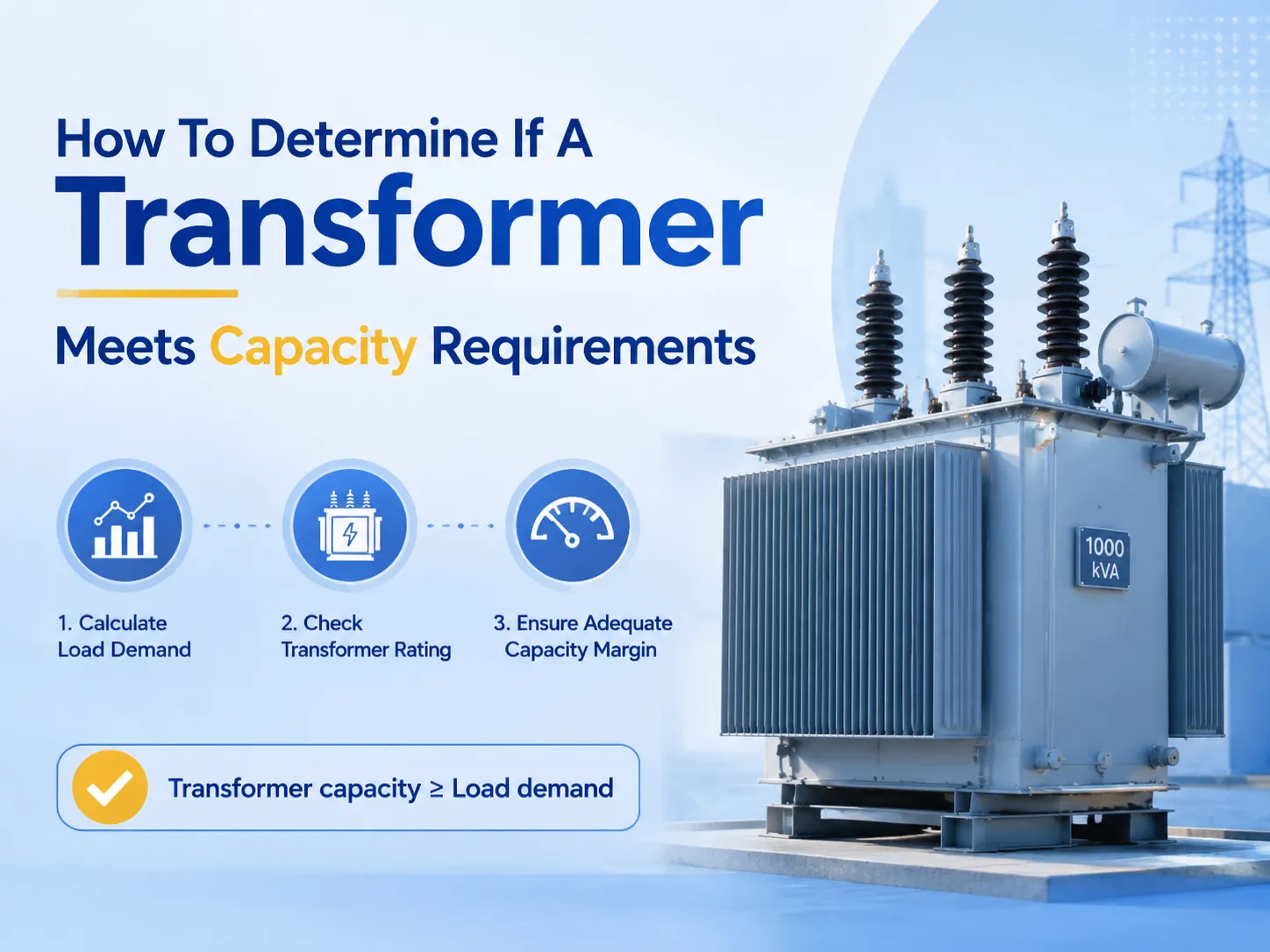
Que signifie “ exigences de capacité ” pour un transformateur ?
La capacité d'un transformateur est sa puissance apparente de sortie déclarée en kVA ou MVA dans des conditions de refroidissement spécifiques. Le fabricant fixe cette valeur selon la norme IEC 60076-1 ou IEEE C57.12.00, étant la plus haute puissance apparente de sortie de l'appareil qui peut être utilisée en continu sans dépasser les limites d'élévation de température — généralement 65 °C d'élévation moyenne des enroulements pour les transformateurs immergés dans l'huile et 100–150 °C pour les types secs selon la classe d'isolation correspondante.
En ce qui concerne le respect des “ exigences de capacité ”, cela signifie que le transformateur est capable de supporter la charge instantanée accrue à condition qu'il y ait suffisamment de marge pour trois paramètres que les ingénieurs doivent prendre en compte : le courant d'appel causé par le démarrage d'un moteur (cela pourrait atteindre 5–8 fois le courant nominal), les courants harmoniques apparaissant en raison des variateurs de fréquence et les perspectives d'augmentation future de la charge. Dans quelques années, le transformateur correctement calculé aujourd'hui pourrait facilement devenir mal dimensionné si une charge supplémentaire est ajoutée au fonctionnement de l'installation.
Il y a deux raisons pour lesquelles les incohérences mentionnées apparaissent. Tout d'abord, les acheteurs sont susceptibles de confondre kVA (puissance apparente) avec kW (puissance réelle), perdant ainsi de vue le fait que la charge fonctionnant avec un facteur de puissance de 0,8 nécessite 25% de kVA de plus par rapport au kW. De plus, les acheteurs peuvent additionner les valeurs nominales de chaque appareil sans appliquer le facteur de diversité nécessaire, ce qui les amène à surestimer la capacité du transformateur d'environ 30–50% sans avoir réellement besoin de payer pour des circuits qui pourraient ne pas être utilisés par la suite.
Étape 1 : Calculer la charge connectée réelle
Tout d'abord, il est nécessaire de dresser des listes de toutes les charges qui sont alimentées par le transformateur et de les regrouper. Une bonne classification est la suivante :
- Charges continues — éclairage, CVC et équipements de processus fonctionnant pendant une longue période.
- Charges intermittentes — pompes, compresseurs, grues qui s'allument et s'éteignent.
- Charges moteur — intensité de courant à pleine charge, courant de démarrage et si l'équipement utilise des démarreurs progressifs, des variateurs de fréquence ou non (combien de courants il utilise).
- Charges non linéaires — variateurs de fréquence, redresseurs et systèmes d'alimentation sans interruption qui ont un courant harmonique.
Maintenant, vous devez additionner les kVA de tous les types de charges. Ne calculez pas seulement les valeurs de kW pour chaque charge. Si vous n'avez que des kW et un facteur de puissance, trouvez les kVA en utilisant la formule ci-dessous. Une fois que vous avez les données brutes sous forme de somme de toutes les charges, vous devez appliquer le facteur de diversité.
| Catégorie de charge | Facteur de diversité typique | Marge de demande recommandée |
|---|---|---|
| Commercial général (vente au détail, bureau) | 0.60–0.75 | 10–15% |
| Usines de processus industriels | 0.70–0.85 | 10–20% |
| Hôpitaux, infrastructures critiques | 0.90–1.00 | 15–25% |
| Centres de données (haute densité) | 0.95–1.00 | 20–30% |
| Écoles, bâtiments municipaux | 0.50–0.70 | 10% |
Augmentez la demande diversifiée de 10% à 20%, car cette marge garantira que l'unité reste dans ses limites thermiques pendant les charges de pointe estivales et également après d'éventuelles rénovations futures. Cette marge est la forme d'assurance la plus rentable disponible au moment de la sélection.
Étape 2 : Appliquer les formules de calcul des kVA
Maintenant, convertissez tout en kVA afin de le comparer à la puissance nominale spécifiée. Trois équations sont nécessaires dans ce cas, qui sont formées sur la base des lois de la puissance AC.
Dans le cas d'un monophasé : kVA = (Volts × Amps) ÷ 1000
Dans le cas d'un triphasé : kVA = (√3 × Volts × Amps) ÷ 1000
Dans le cas de la conversion de kW en kVA : kVA = kW ÷ facteur de puissance
Exemple de calcul : Dans le cas d'une ligne triphasée fonctionnant à 480 V avec 240 A de courant, la demande est (1.732 × 480 × 240) ÷ 1000 = 199,5 kVA. En tenant compte d'un facteur de puissance égal à 0,85, cela signifie que l'énergie réellement consommée est égale à 170 kW.
| Tension nominale de ligne (V) | Courant à pleine charge (A) | Demande calculée (kVA) | Puissance nominale standard la plus proche (kVA) |
|---|---|---|---|
| 240 (monophasé) | 100 | 24.0 | 25 |
| 480 (triphasé) | 120 | 99.8 | 112.5 |
| 480 (triphasé) | 240 | 199.5 | 225 |
| 480 (triphasé) | 480 | 399.1 | 500 |
| 13 800 (triphasé) | 25 | 597.5 | 750 |
| 13 800 (triphasé) | 42 | 1003.8 | 1250 |
Toujours opter pour la norme IEC supérieure (25, 50, 100, 160, 250, 400, 500, 630, 800, 1000, 1250, 1600, 2000, 2500 kVA) plutôt que d'essayer d'obtenir la puissance minimale disponible. Cela est dû au fait que les normes IEC sont conçues pour s'adapter aux conceptions de transformateurs standard, aux tailles de noyaux et aux instruments de test ; des classifications spéciales coûteront plus cher — en fait, de 15 à 30 % de plus — et prendront plus de temps à livrer.
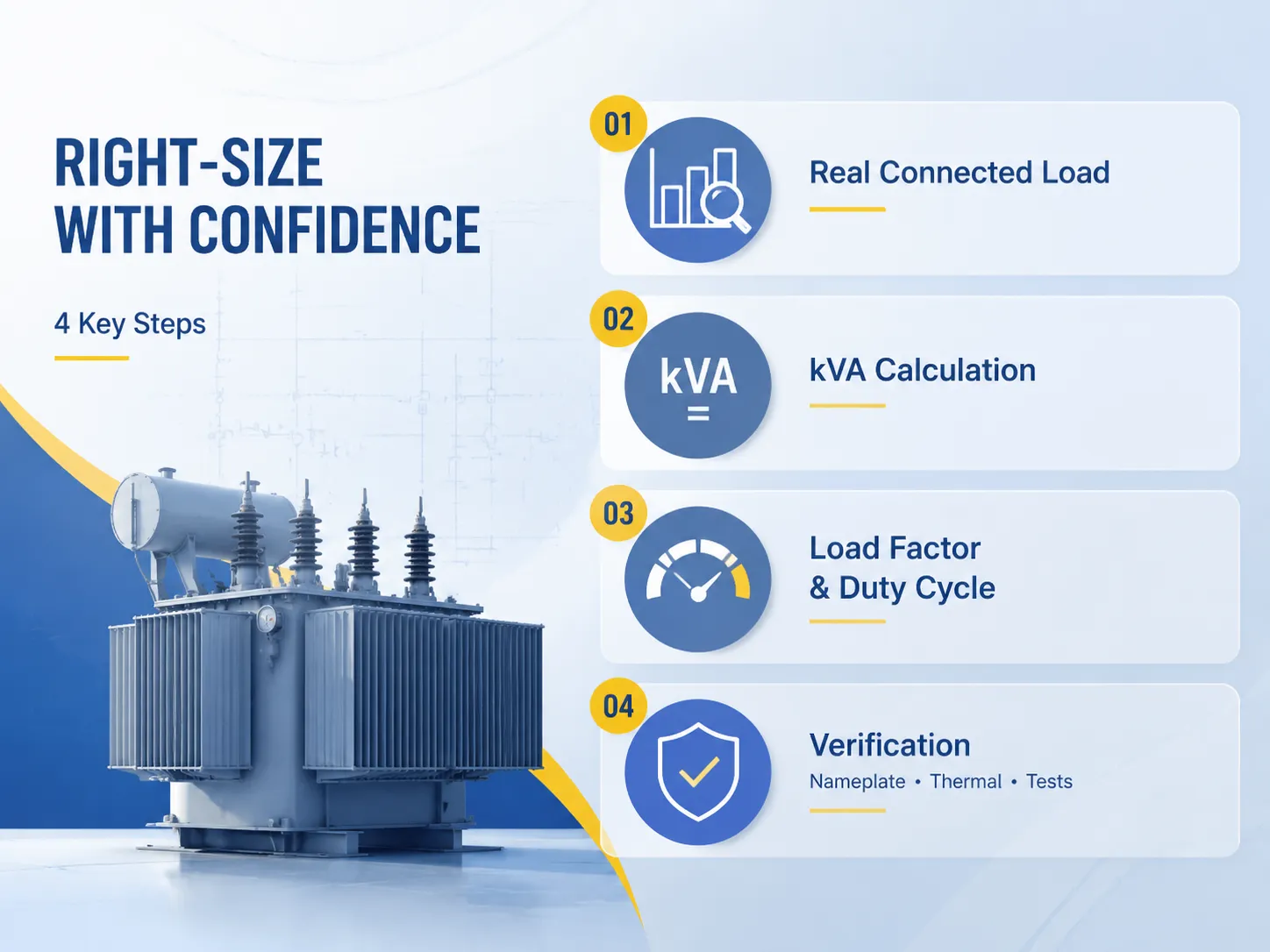
Étape 3 : Vérifier le facteur de charge et le cycle de service
La capacité globale est déterminée non seulement par le volume maximum mais aussi par la durée des opérations à haute tension. Ainsi, le facteur de charge est défini comme le rapport de la consommation moyenne à la consommation maximale à un certain moment dans la formule ci-dessous :
Facteur de charge = Consommation moyenne ÷ Consommation maximale
Une usine qui consomme 400 kVA pendant une demi-heure le matin seulement et a une consommation moyenne de 150 kVA a un facteur de charge d'environ 0,375. Cette situation est avantageuse pour l'utilisation d'un transformateur à faible inertie thermique, car un transformateur rempli d'huile peut supporter des surcharges temporaires de 1,3 à 1,5 fois la capacité nominale pendant plusieurs heures selon la norme IEC 60076-7 concernant les charges cycliques. D'autre part, un transformateur qui fonctionne sous une charge de 85% en continu souffre d'un vieillissement prématuré de l'isolation.
La durée de vie de l'isolation selon la loi d'Arrhenius est réduite de moitié pour chaque augmentation de 6-8°C dans un point haut fonctionnant en continu. Par exemple, lorsqu'un transformateur est chargé par 90% et a une élévation de moins de 65°C, la température du point chaud est supérieure à 105 C° pendant une période assez longue. C'est pourquoi le critère de charge 80% n'est pas juste un truc marketing.
Étape 4 : Méthodes de vérification (Plaque signalétique, Thermique, Tests)
Après que le transformateur a été installé, vous devez évaluer la capacité à trois niveaux différents. Tout d'abord, vous devez vérifier l'aspect administratif : vous devez vérifier la puissance de la plaque, le niveau d'impédance, le groupe vectoriel et la classe de refroidissement ONAN, ONAN/ONAF, AN/AF en utilisant les spécifications d'achat et l'étude de charge. Le deuxième aspect à vérifier est l'aspect opérationnel où vous devez vérifier le courant secondaire, la tension et la température de l'enroulement.
Il est important de demander au fabricant le rapport d'usine pour les nouveaux transformateurs. Selon la norme IEC 60076-1, des tests de routine doivent être effectués concernant la résistance des enroulements, le rapport, les pertes à vide, les pertes actives et les tests d'élévation de température. C'est la seule preuve basée en laboratoire sur laquelle vous pouvez compter pour prouver que le transformateur peut fonctionner à la puissance nominale kVA en continu sans dépasser la limite de température d'isolation.
| Méthode de vérification | Ce que cela confirme | Coût / Effort typique |
|---|---|---|
| Revue de la plaque signalétique vs. étude de charge | Correspondance de la puissance, de l'impédance, de la classe de refroidissement | Aucun coût, 1 heure |
| Enregistrement de la demande sur une semaine | kVA de pointe vs. puissance nominale sous charge réelle | $200–$600 (location de logger) |
| Thermographie infrarouge | Points chauds au niveau des bushing, du réservoir et des connexions de câble | $300–$800 par enquête |
| Analyse des gaz dissous (DGA) | Pannes thermiques/arcing précoces dans les unités à huile | $80–$200 par échantillon |
| Rapport de test de routine d'usine | Preuve de rapport, pertes, isolation, élévation de température | Inclus dans l'achat |
Pour les unités qui semblent être en surcharge, effectuez d'abord une DGA et une enquête de température, puis envisagez d'acheter autre chose. Souvent, le véritable problème est une mauvaise connexion ou un blocage des ailettes de refroidissement plutôt que le noyau lui-même ; remplacer ou améliorer ces éléments peut restaurer la pleine fonction à un coût inférieur à celui de l'achat d'un nouveau transformateur.
Capacités de puissance courantes et leurs limites de charge
Le tableau fourni indique les puissances nominales standard recommandées et la charge maximale soutenue pour toutes les technologies de refroidissement considérées, qui est basée sur des besoins diversifiés et des conditions climatiques normales de 30 degrés Celsius (température moyenne).
| kVA nominal | Classe de tension typique | Charge maximale soutenue — Type sec (AN) | Charge maximale soutenue — Immergé dans l'huile (ONAN) | Plage de prix typique (FOB Chine) |
|---|---|---|---|---|
| 100 | 4/0.4 kV, 11/0.4 kV | 80–90 kVA | 70–80 kVA | $2,500–$6,000 |
| 250 | 11/0,4 kV | 200–225 kVA | 175–200 kVA | $4,500–$11,000 |
| 500 | 11/0,4 kV, 33/0,4 kV | 400–450 kVA | 350–400 kVA | $8,000–$18,000 |
| 1000 | 10/0.4 kV, 35/10 kV | 800–900 kVA | 700–800 kVA | $15,000–$32,000 |
| 1600 | 35/10 kV, 33/0.4 kV | 1,280–1,440 kVA | 1,120–1,280 kVA | $24,000–$48,000 |
| 2500 | 35/10 kV | 2,000–2,250 kVA | 1,750–2,000 kVA | $38,000–$75,000 |
Il convient de souligner que les limites continues de fourniture supposées s'appliquent dans des conditions de fourniture propre et avec un facteur de puissance aux bornes du transformateur presque égal à un. Cependant, si l'on prend en compte les harmoniques, la situation devient tout à fait différente. Par exemple, une distorsion harmonique totale de 20-% du courant entraîne une augmentation de la charge thermique effective de 5 à 10%, et un appareil déjà en fonctionnement peut se retrouver en surcharge même si son kVA semble être dans des limites normales.
Spécifications qui affectent la capacité
En plus de la puissance kVA, plusieurs autres spécifications de la plaque signalétique affectent la capacité réelle fournie par le transformateur dans votre application :
- Classification de refroidissement (IEC 60076-2) : Un transformateur ONAN se refroidit de lui-même jusqu'à sa pleine puissance. Un transformateur ONAN/ONAF dispose de ventilateurs actifs supplémentaires, fournissant environ 20% à 30% de plus que sa puissance nominale standard.
- Augmentation de température (K) : Un transformateur classé pour 65 K a plus de capacité qu'un transformateur classé pour 55 K de la même taille, mais soumettra son isolation à plus d'usure.
- Tension d'impédance (uk%) : Elle est généralement d'environ quatre à dix pour cent pour les transformateurs de distribution. Une valeur d'impédance plus élevée réduit le courant de court-circuit mais a de pires caractéristiques de chute de tension.
- Groupe vectoriel (Dyn11, Yyn0, Yd11) : Doit convenir au système pour éviter les problèmes de courants circulants.
- Déclassement dû à l'altitude et à la température : À mesure que l'altitude dépasse 1000 m et que la température dépasse 40 °C, selon la norme IEC 60076-1, les transformateurs doivent être déclassés (généralement 0,5 % à 1 % chaque 100 m au-dessus de 1000 m).
- Matériau utilisé pour les enroulements : Les enroulements en cuivre ont environ 15% à 25% de capacité de court-circuit supérieure à celle des enroulements en aluminium, mais sont également environ 20% à 40% plus chers.
Marques et gammes de prix pour les unités classées par capacité
En ce qui concerne les produits étrangers, la validation de la capacité est d'une importance capitale, car la différence entre les spécifications de performance et la performance réelle augmente lorsque les clients ne peuvent pas examiner physiquement le produit à l'usine. Les marques internationales facturent plus pour leur capacité nominale, tandis que les producteurs chinois fournissent presque la même capacité validée à des prix beaucoup plus bas.
| Marque | Plage typique | Position notable | Prix indicatif (500 kVA) |
|---|---|---|---|
| ABB | Distribution à 50+ MVA | Leader mondial, réseau de services solide | $18,000–$30,000 |
| Siemens | Distribution à transmission | Options à noyau amorphe à haute efficacité | $18,000–$32,000 |
| Schneider Electric | Distribution de type sec | Intégration profonde basse tension | $15 000–$28 000 |
| Hitachi Energy | Utilitaire et industriel | Expertise en renforcement de réseau et HVDC | $17,000–$30,000 |
| Eaton | Distribution, montage sur socle | Forte empreinte en Amérique du Nord | $14,000 à $26,000 |
| CG Power, TBEA | Utilitaire et industriel | Fabricants de gros volumes | $10,000–$18,000 |
| Jiangsu Subian Electric Power | 10 kVA–100 MVA | Certifié IEC 60076, rapports d'essai complets en usine, enroulements en cuivre standard | $8,000–$16,000 |
Les prix ci-dessus ne sont que des estimations, basées sur FOB Chine / départ usine, pour l'unité de classe 500 kVA. Les variations de prix dépendront des exigences des clients et des cas d'utilisation. Les marques internationales énumérées ci-dessus ne sont qu'une sélection de nombreux concurrents sur le marché avec des années d'expérience. Qu'est-ce qui rend Jiangsu Subian Electric Power spécial pour quelqu'un ayant des exigences de capacité ? Toutes les unités sont accompagnées du rapport IEC 60076 pour les tests de routine ainsi que des enroulements en cuivre en standard. Essentiellement, un acheteur sait exactement ce qu'il/elle reçoit avec l'unité. Cette information facilite le processus de prise de décision, car les exigences de capacité sont présentées dans le rapport. En cas de doutes concernant les paramètres, le client peut toujours vérifier les chiffres du rapport d'usine par rapport au calcul dans cette étude.
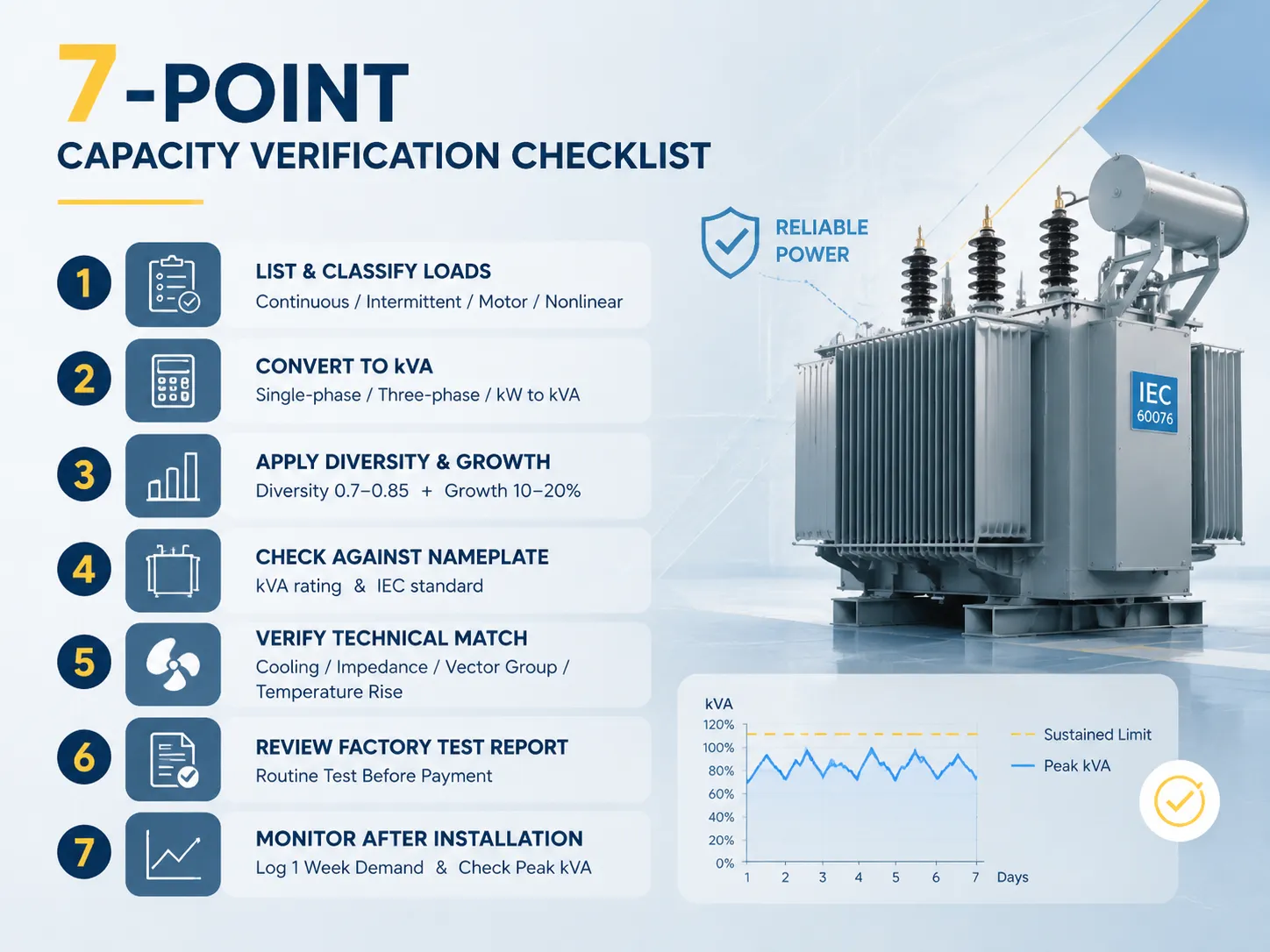
Une liste de vérification de validation de capacité en 7 points
- Vous devriez compiler une liste complète de toutes les charges et les regrouper en charges continues, intermittentes, moteurs ou non linéaires.
- Vous devez convertir chaque charge en kVA en fonction de la formule de conversion monophasée, triphasée ou kW en kVA.
- Vous devriez profiter d'un facteur de diversité (qui se situe généralement entre 0,7 et 0,85 pour les installations industrielles) et d'un facteur de croissance d'environ 10 à 20 pour cent.
- Une fois que vous avez obtenu ces chiffres, vous pouvez les vérifier par rapport à la puissance kVA de la plaque signalétique et vous assurer qu'ils se situent dans la plage des valeurs standard IEC.
- Assurez-vous de confirmer que la classe de refroidissement, l'impédance, le groupe vectoriel ainsi que l'augmentation de température sont conformes aux normes du système.
- Pour confirmer que tout est en ordre, vous devriez demander et lire les rapports d'essai de routine de l'usine avant de procéder à tout paiement.
- Après avoir installé le système, surveillez sa demande pendant une semaine et établissez que le kVA de pointe ne dépasse pas le niveau prescrit.
Questions Fréquemment Posées
Comment savoir si mon transformateur est en surcharge ?
Comparez la demande moyenne des 15 dernières minutes avec la capacité nominale du transformateur. Si la moyenne dépasse 80% de la capacité pour les transformateurs à huile ou 90% pour les types secs de manière constante, cela signifie que l'appareil est en effet en surcharge. Parmi les signes de surcharge qui peuvent être observés figurent la température de l'huile au-dessus de 90°C (on peut utiliser du papier de classe A), des relevés de points chauds dépassant 105°C, du bruit dans le réservoir et l'analyse de la composition des gaz comme l'hydrogène et l'éthylène. On pourrait résoudre le problème en rééquilibrant la charge, en le refroidissant ou en remplaçant le transformateur par le prochain niveau standard supérieur à l'actuel.
Quelle est la différence entre kW et kVA dans la capacité d'un transformateur ?
kW représente la puissance réelle, tandis que kVA représente la puissance apparente. kW peut être calculé en utilisant la formule kVA = kW ÷ facteur de puissance. Par exemple, lorsque le facteur de puissance est de 0,8, la puissance de 100 kW nécessite des transformateurs d'une capacité de 125 kVA. La plaque signalétique du transformateur est toujours en kVA car toute la capacité thermique du transformateur dépend de l'enroulement. Si le facteur de puissance est inférieur à un, le transformateur pourrait ne pas répondre aux exigences lorsqu'il est calculé uniquement à l'aide de kW.
Quel facteur de charge devrais-je utiliser lors du dimensionnement d'un transformateur ?
Utilisez le facteur de diversité réel des charges dans l'installation : 0,6–0,75 (pour les bureaux), 0,7–0,85 (pour les sites industriels), 0,9–1,0 (pour les hôpitaux ou les centres de données). Ne confondez pas ces facteurs — le facteur de diversité et le facteur de charge (moyenne ÷ demande de pointe). Si vous traitez avec une nouvelle installation, utilisez un facteur de menace de 0,75 avec une marge de croissance de 15–20%. Dans le cas où vous travaillez avec une installation existante et que vous avez toutes les factures de services publics des 12 derniers mois, vous devez simplement calculer votre facteur de charge.
Un transformateur peut-il fonctionner au-dessus de sa capacité kVA nominale temporairement ?
Oui, cela peut être fait, mais uniquement dans des circonstances strictes. Selon la norme IEC 60076-7, le transformateur immergé dans l'huile avec un système de refroidissement ONAN peut supporter jusqu'à 1,3 de sa charge électrique nominale à condition de ne pas dépasser 70% et que la température de chauffage reste en dessous de 120°C. Chaque heure d'utilisation en surcharge réduirait considérablement la durée de vie de l'isolation — par exemple, une isolation à une température de 110°C ne fonctionnerait que pendant quelques années au lieu de plusieurs décennies si elle est utilisée correctement.
Quel est le coût d'une marge de capacité supplémentaire de 10% ?
Si le transformateur a une capacité de 500 kVA, obtenir un nouveau transformateur avec une capacité de 630 kVA vous coûterait 15–25% de plus (ce qui représente environ $2,000–4,000). Si vous envisagez de remplacer le transformateur après qu'il ait échoué, vous devez être prêt à payer pour le nouvel appareil $8,000–18,000 et à attendre jusqu'à 1–4 semaines pour cela. Si vous pouvez éviter de couper la charge ne serait-ce qu'une fois en 20 ans, votre investissement dans une marge de 10–20% serait déjà rentabilisé.
Références
- IEC 60076-1 : Transformateurs de puissance — Général — la norme internationale définissant les classifications des transformateurs, la capacité et les exigences d'essai.
- IEC 60076-7 : Transformateurs de puissance — Guide de chargement pour les transformateurs immergés dans l'huile — le guide autoritaire pour les surcharges cycliques et les limites de température.
- IEEE C57.12.00 : Exigences générales pour les transformateurs de distribution, de puissance et de régulation immergés dans un liquide — cadre équivalent nord-américain pour la capacité et les tests.
- Electrical4U — Facteur de charge et efficacité des transformateurs — une explication claire du facteur de charge, de la diversité et des courbes d'efficacité.
- Eaton — Guide de dimensionnement des transformateurs — tableaux pratiques de calcul de kVA et exemples de dimensionnement utilisés dans l'industrie.
- Fluke — Imagerie thermique des transformateurs — conseils sur la vérification infrarouge de la charge et des connexions.
- Wikipedia — Transformateur — informations sur la théorie des transformateurs, les classifications de puissance et de refroidissement.
Conclusion
Savoir si la capacité de votre transformateur est suffisante n'est pas une question de conjecture spéculative sur la demande. Le processus implique quatre étapes simples : déterminer la demande de pointe, calculer la demande en kVA, déterminer le facteur de charge et vérifier les données de la plaque signalétique soutenues par les résultats de tests fournis par l'usine. Suivre la règle permettant une augmentation de 10–20% et maintenir le facteur de charge en dessous de 80% pour les transformateurs remplis d'huile est plutôt économique aujourd'hui et peut prévenir des pannes coûteuses à l'avenir.
- Effectuez les calculs en kVA et utilisez un facteur de diversité compris entre 0,7 et 0,85 pour les charges industrielles mixtes.
- Vérifiez la capacité avec le rapport IEC 60076 — c'est la seule preuve, pas le catalogue.
- Prévoyez une marge de 10-20% pour les besoins futurs — c'est la forme d'assurance la moins coûteuse au stade de l'approvisionnement.
- Choisissez le fournisseur en fonction de la capacité testée et du niveau de transparence, plutôt qu'en fonction du prix par kVA.