


Chaque ingénieur de production a vécu un après-midi comme celui-ci : une ligne de production qui ne peut pas s'arrêter, une vague de chaleur estivale, et un transformateur de sous-station fonctionnant à 112 pour cent de la capacité nominale parce qu'il n'a pas d'autre option. La question reste la même : qui peut lui dire combien de surcharge le transformateur peut supporter et pendant combien de temps, ainsi que combien cela coûtera en durée de vie. La capacité de surcharge n'est pas un chiffre immuable ; c'est plutôt le résultat de relations complexes – valeurs de charge antérieures, température ambiante, température du point le plus chaud, âge de l'isolation et état du système de refroidissement. Si vous comprenez le système, vous pouvez fonctionner efficacement à 120-130 pour cent de surcharge pendant des heures en cas d'urgence — ou brûler un transformateur pendant une saison si vous négligez la science.
En bref, la capacité de surcharge d'un transformateur fait référence à la capacité d'un transformateur à fonctionner au-delà de la capacité spécifiée sur sa plaque signalétique pendant une période donnée. La limitation découle de la température du point le plus chaud et du vieillissement des matériaux d'isolation, selon la norme IEC 60076-7 et l'IEEE C57.91. En pratique, un transformateur en bon état peut fonctionner à 120% de sa capacité nominale pendant plusieurs heures. Il existe des situations d'urgence où il peut fonctionner avec une capacité de 130-150% pendant une courte période.
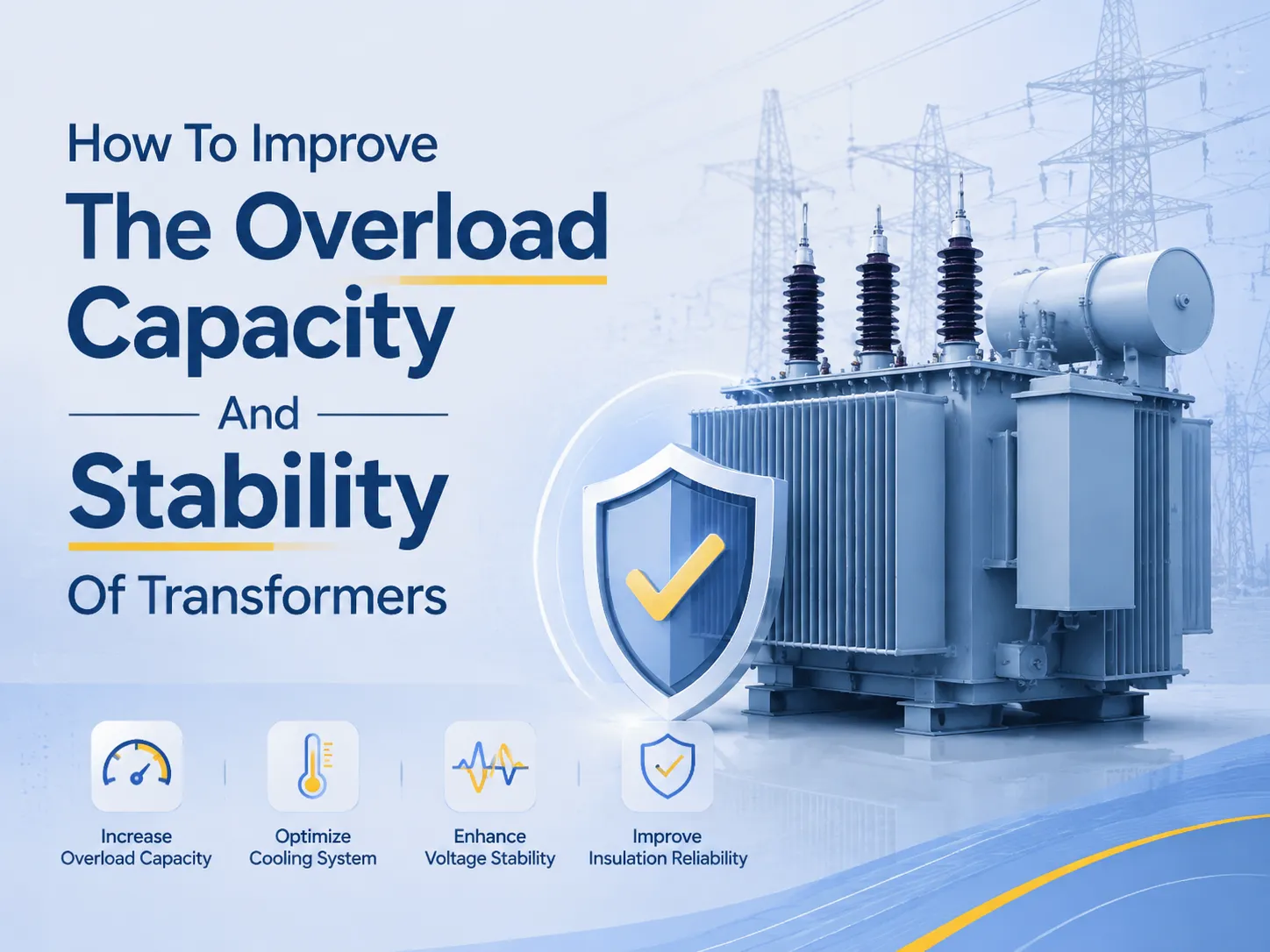
Qu'est-ce que la capacité de surcharge d'un transformateur ?
La capacité de surcharge du transformateur fait référence à la charge maximale, au-delà de sa valeur MVA nominale, que le transformateur peut supporter pendant une période établie sans dépasser les limites de température qui entraîneraient un vieillissement rapide de l'isolation. La capacité de surcharge n'est pas un chiffre fixe, mais elle varie en fonction de l'historique de charge du transformateur : un transformateur fonctionnant à une charge de 40% par une nuit fraîche a le potentiel de résister à une surcharge beaucoup plus importante que celui déjà en fonctionnement à 95% pendant un après-midi chaud. La capacité nominale est simplement la valeur maximale que le transformateur peut fournir sous pleine charge à une température nominale (généralement 40 °C, occasionnellement jusqu'à 55 °C en cas de conceptions non conventionnelles) et une température du point le plus chaud de 98 °C.
La question est importante en termes économiques, car les charges ne restent normalement pas inchangées. Les entreprises de production d'énergie et les utilisateurs industriels connaissent souvent des pics dans la plage de 105-125% pendant des heures par jour, ce qui rend la connaissance appropriée de la capacité de surcharge d'un transformateur indispensable pour un opérateur qualifié. L'utilisation des connaissances présentées ci-dessus pour dimensionner chaque transformateur pourrait conduire à de mauvaises conditions financières : un transformateur évalué pour sa charge nominale peut fonctionner à seulement 40% de charge pendant des années, consommant des pertes à vide excessives pour se protéger d'une surcharge survenant pendant quelques heures par mois.
La physique : Température du point le plus chaud et durée de vie de l'isolation
La question peut être exprimée par un chiffre : la température du point chaud, la température des enroulements peut augmenter en raison du chauffage I²R provoquant une augmentation de la température de l'huile, tandis que la température du point chaud détermine le taux de vieillissement de l'isolation. La règle de l'industrie, spécifiée à la fois dans la norme IEC 60076-7 et IEEE C57.91, stipule que pour une isolation en papier thermiquement améliorée, le taux de vieillissement double pour chaque augmentation de 6 °C au-dessus de la température de 98 °C, la “règle des 6 °C”, certaines sources affirment même qu'elle pourrait s'appliquer à un intervalle de température de 6 °C à 10 °C selon le type de matériau. Avec une température de point chaud à 110 °C, le taux de vieillissement est 4 à 8 fois plus élevé que la normale, tandis qu'avec une température de point chaud de 130 °C, il peut être de 30 à 100 fois, ce qui signifie que quelques heures à une telle température consomment plusieurs mois de vie de l'isolation.
La température augmente en raison de la charge, approximativement comme le carré du courant divisé par l'augmentation de la température des enroulements, plus l'augmentation plus lente de la température de l'huile. Les fluides de refroidissement — huile et système de ventilateur/radiateur — déterminent les constantes de temps, donc les modèles thermiques traitent la surcharge comme un processus transitoire avec des constantes de temps de dizaines de minutes à des heures. Un point important est le fait que la température du point chaud n'est pas égale à la température de l'huile supérieure. En effet, il existe un gradient de température entre les enroulements et l'huile qui est généralement de 5 à 15 K.
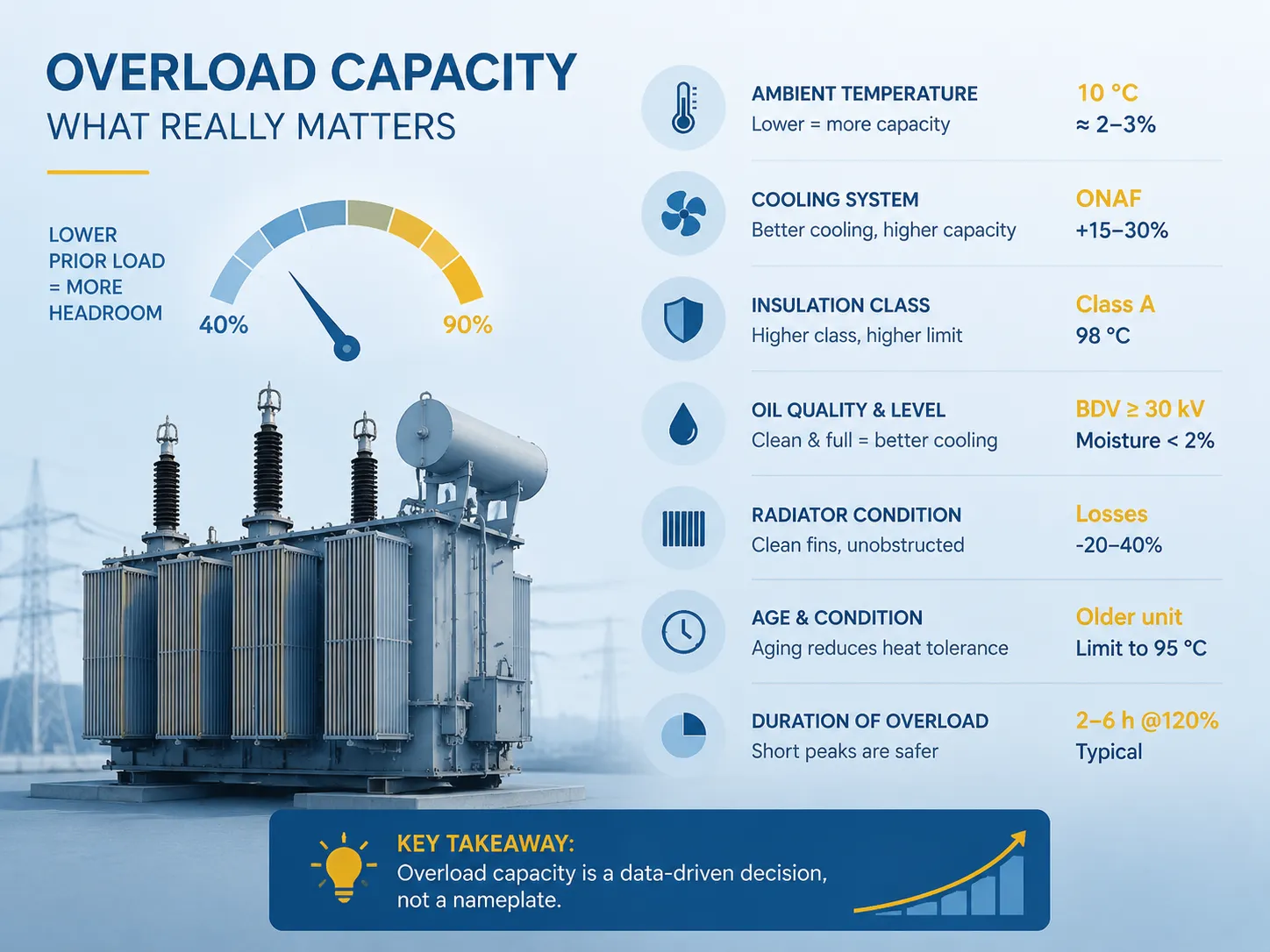
Facteurs qui déterminent la capacité de surcharge
| Facteur | Effet sur la capacité de surcharge | Valeurs typiques |
|---|---|---|
| Niveau de charge précédent | Charge précédente plus faible = plus de réserve thermique | Une charge précédente de 40% permet un pic plus important qu'une charge de 90% |
| Température ambiante | Une température ambiante plus basse ajoute de la marge directe | Chaque réduction de 10 °C de l'ambiance ajoute environ 2 à 3% de capacité |
| Système de refroidissement (ONAN/ONAF/ONAN→ONAF) | L'air/oil forcé augmente la dissipation des pertes | ONAF ajoute 15 à 30% de capacité par rapport à ONAN |
| Classe d'isolation | Les systèmes de classe supérieure tolèrent des points chauds plus chauds | Classe A : 98 °C ; aramide : classe 220 °C |
| Qualité et niveau d'huile | Une huile propre et pleine dissipe mieux la chaleur | BDV ≥ 30 kV, humidité < 2% |
| État du radiateur | Les ailettes bloquées et la poussière réduisent le refroidissement de 20 à 40% | Inspecter et nettoyer annuellement |
| Âge et état de l'isolation | L'isolation vieillie tolère moins d'exposition au point chaud | Les unités plus anciennes : réduire le point chaud autorisé à 95 °C |
| Durée de la surcharge | Les pics courts sont peu coûteux ; les surcharges soutenues sont coûteuses | 2 à 6 h à 120% typique ; 120% soutenu se dégrade rapidement |
Implication dans la vie réelle : lors de la détermination de la capacité de surcharge, il est préférable de se fier aux informations qui vous sont présentées plutôt qu'à la plaque signalétique. Un transformateur efficace, bien refroidi et légèrement chargé peut être exploité pendant quelques heures à 130%. En revanche, un transformateur ancien et poussiéreux, c'est-à-dire un transformateur âgé de 30 ans et chargé à 90%, doit être considéré comme n'ayant aucune capacité de surcharge.
Les normes : IEC 60076-7 vs. IEEE C57.91
| Aspect | IEC 60076-7 | IEEE C57.91 |
|---|---|---|
| Portée | Guide de chargement pour transformateurs de puissance immergés dans l'huile | Guide pour le chargement de transformateurs immergés dans l'huile minérale |
| Principe de base | Taux de vieillissement relatif vs. température du point chaud | Vie de l'isolation consommée vs. exposition à la température |
| Point chaud de référence | 98 °C pour papier thermiquement amélioré | 110 °C référence “par unité de vie” dans de nombreux tableaux |
| Approche | Modèles thermiques simplifiés et détaillés avec facteurs de charge | Modèle thermique complet, équations pour l'huile supérieure/inferieure et l'enroulement |
| Sorties | Tables et courbes de charge admissible vs. durée | Courbes de consommation de vie et de charge pour la planification |
| Meilleur usage par | Projets européens / internationaux | Services publics nord-américains et ingénieurs de planification |
Les deux codes aboutissent à des conclusions d'ingénierie identiques mais les formulent de différentes manières. L'IEC 60076-7 fournit des chiffres directs pour la charge cyclique ; l'IEEE C57.91 donne des formules pour la modélisation thermique personnalisée. Il faut savoir que les deux codes existent, utiliser celui qui convient à la zone et au contrat, et suivre l'exigence clé commune aux deux codes, à savoir que la température du point le plus chaud exposé doit être conforme à la durée de vie d'isolation requise.
Comment améliorer la capacité de surcharge : 8 méthodes
| Méthode | Comment ça fonctionne | Gain de capacité | Coût typique |
|---|---|---|---|
| Ajouter des ventilateurs de refroidissement (ONAN→ONAF) | L'air forcé augmente la dissipation du radiateur | +15–30% | $2,000–$8,000 |
| Ajouter des pompes à huile (ONAF→OFAF) | La circulation d'huile forcée améliore le transfert de chaleur | +10–20% par rapport à ONAF | $5,000–$15,000 |
| Nettoyer les radiateurs et réparer le système de refroidissement | Restaure la dissipation de conception | Restaure 20–40% de refroidissement perdu | $500–$3,000 |
| Ajouter ou agrandir les radiateurs | Plus de surface = plus de rejet de chaleur | +10–20% | $3,000–$12,000 |
| Installer un suivi de la température du point le plus chaud / de la charge | Permet une utilisation sûre et informée de la surcharge | Permet une utilisation complète de la capacité réelle | $15,000–$45,000 |
| Contrôle automatique des ventilateurs/pompes basé sur la charge | Le refroidissement fonctionne uniquement lorsque nécessaire, protège l'isolation | Utilise la capacité disponible avec précision | $3,000–$8,000 |
| Système d'isolation à température plus élevée (aramide/ester) | Point le plus chaud admissible plus élevé | +20–40 °C de marge pour le point chaud | +20–40% (nouvelle construction) |
| Ambiance réduite / ventilation améliorée | Air plus frais autour de l'unité | ~2–3% par 10 °C | Spécifique au site |
Les approches les moins coûteuses sont la première étape : des processus simples comme le nettoyage des radiateurs, la réparation des ventilateurs et les vérifications régulières du niveau d'huile peuvent restaurer jusqu'à 20-40% de refroidissement perdu pour moins de $3,000. Une autre avancée serait l'utilisation de ventilateurs et de pompes supplémentaires tout en gardant les investissements modestes. Cependant, le processus de surveillance lui-même ne peut pas augmenter la capacité, il peut seulement la rendre possible.
Maintenir le système stable sous surcharge
La capacité de surcharge ne sera efficace que si le système est capable de fonctionner correctement sous stress trouvé. Le point le plus significatif est la régulation de la tension : plus le transformateur est chargé, plus il perdra de tension, donc lorsque le transformateur fonctionne à 125% de la puissance nominale, il peut se retrouver dans une situation où la tension en aval sera inférieure à celle autorisée, spécifiquement à la fin de longs feeders. Vérifiez le réglage du point de prise et envisagez l'idée d'utiliser la régulation automatique de la tension. Dans la plupart des cas, il y a une chute de 5% de la tension au point de couplage commun après quoi il y aura une déviation dans le fonctionnement de la charge. Le deuxième point est la coordination de protection : les réglages des relais et les caractéristiques des relais de surcharge devraient permettre une surcharge sans déconnexion du réseau, cependant, il doit toujours fonctionner en cas de défauts. Examinez la courbe du relais par rapport à la courbe de limite thermique du transformateur afin de comprendre ce qui reste en dessous des dommages tout en étant sous des conditions de sécurité. Le troisième point est le partage de charge : dans le fonctionnement parallèle des transformateurs, l'un d'eux fonctionnera moins efficacement en raison d'une grande différence d'impédances.
En conclusion, la fiabilité du refroidissement, en période de surcharge, est extrêmement significative en termes de sécurité. Le refroidissement par assistance forcée et le refroidissement par huile forcée sont eux-mêmes des charges dans l'alimentation auxiliaire du site, et en cas de défaillance de l'alimentation auxiliaire aux heures de pointe, le transformateur éteindra les ventilateurs et les pompes au moment où cela est nécessaire.
| Pratique de stabilité | Ce que cela prévient | Coût typique | Priorité |
|---|---|---|---|
| Examiner les courbes de relais par rapport à la courbe de limite thermique | Déclenchements intempestifs et défauts de nettoyage manqués | Temps d'ingénierie | Élevé |
| Vérification de la chute de tension à la charge 125% | Sous-tension aux charges en aval | Étude de flux de charge | Élevé |
| Correction d'impédance/tap de transformateur parallèle | Partage de charge inégal, une unité en surcharge | $500–$3,000 | Moyen |
| Alimentation auxiliaire double alimentée / de secours | Perte de ventilateurs/pompes pendant les heures de pointe | $2 000–$15 000 | Moyen |
| Réduction automatique de charge en cas de défaillance de refroidissement | Dommages à l'isolation dus à une surcharge non refroidie | $3,000–$8,000 | Élevé |
| Transfert de charge / décalage de pointe | Surcharge soutenue au-delà de la fenêtre nominale | Opérationnel, faible | Élevé |
Applications : Quand la capacité de surcharge compte vraiment
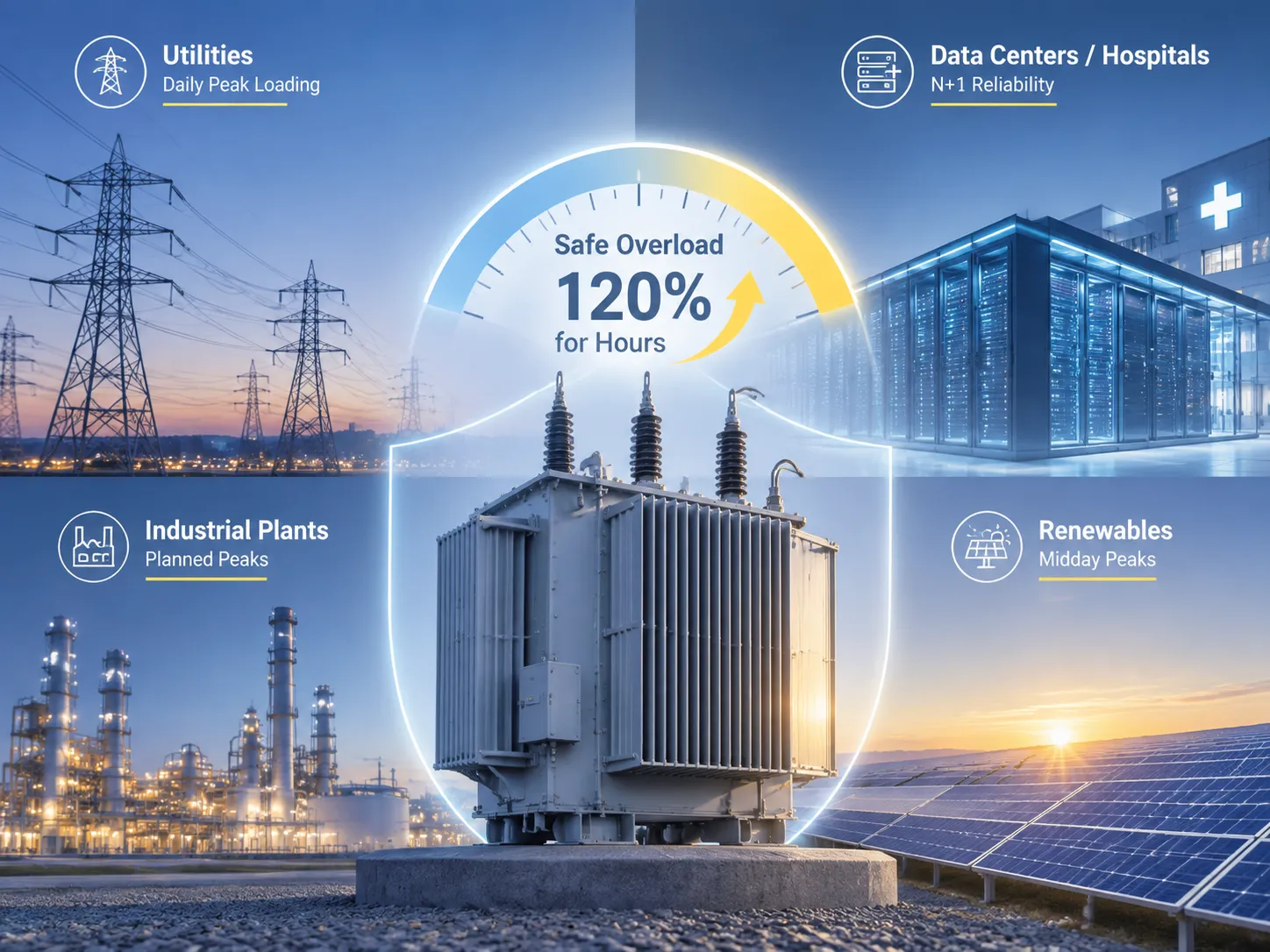
Diverses industries utilisent la capacité de surcharge différemment. Le secteur des services publics emploie des cycles quotidiennement ; les transformateurs de distribution prennent généralement en compte la charge maximale sur une base quotidienne, et la pratique de pouvoir fonctionner à une capacité de 120% pendant deux à trois heures durant la charge de pointe du soir sans compromettre le transformateur est bien connue. Les industries de processus par lots ont des pics réguliers de demande, comme lorsque un four démarre ou qu'une machine est mise en marche – pour ces processus, de courtes surcharges sont possibles tant que la capacité thermique de l'installation est comprise. D'autre part, les hôpitaux et les centres de données travaillent avec le concept N+1, ce qui signifie que la surcharge du transformateur est évitée dans des circonstances normales, même si, lorsque l'alimentation est commutée entre différents transformateurs, le processus de transfert crée des conditions de surcharge temporaires sur les transformateurs, et cette capacité de surcharge est considérée comme un avantage de sécurité dans le processus. Le concept de sources d'énergie renouvelables apporte également de nouveaux défis, les systèmes solaires créant des surcharges aux heures de pointe de midi et des sous-charges la nuit, tandis que le cyclage thermique contribue lui-même à des charges mécaniques sur les transformateurs – de nos jours, la technique utilisée est une isolation de haute qualité et un suivi.
Dans tous les cas, l'algorithme est le même : comprendre les caractéristiques de la courbe de durée de charge ; calculer la charge maximale dans le point le plus chaud ; déterminer l'état d'isolation de l'unité – de cette manière, les tableaux de surcharge ou un modèle thermique aideront à comprendre quel niveau est acceptable et sûr.
Équipement, Fournisseurs & Gammes de prix
| Équipement / Service | Fournisseurs représentatifs | Gamme de prix typique | Remarques |
|---|---|---|---|
| Ventilateurs de refroidissement de radiateur & contrôles | Kelvion, Plexus, OEM locaux | $2,000–$8,000 par transformateur | Comprend des ventilateurs motorisés et des contacteurs |
| Pompes à huile (circulation d'huile forcée) | Kelvion, OEM locaux | $5,000–$15,000 | Pour conversions OFAF/ODAF |
| Moniteurs de température de bobinage en ligne / point le plus chaud | Qualitrol, Doble, Maschinenfabrik Reinhausen (MR) | $15,000–$45,000 | Fibre optique ou basé sur modèle |
| Relais de surveillance et de contrôle de charge | Schneider Electric, ABB, GE | $1,500–$6,000 | Fonctions d'alarme/de contrôle de surcharge |
| Transformateurs haut de gamme à huile ester / aramide | Hitachi Energy, Siemens Energy, Jiangsu Subian Electric Power | $25,000–$60,000 (classe 2,000 kVA) | Isolation premium pour service de surcharge |
Les prix dépendent des spécifications et des régions, utilisez-les donc comme valeurs de référence. Les marques mondialement connues — Qualitrol et MR pour la surveillance, Kelvion pour le refroidissement et Schneider/ABB pour les contrôles — établissent la norme et ces prix reflètent ce fait. Les utilisateurs finaux peuvent acheter des transformateurs produits pour des applications à forte surcharge (avec un refroidissement amélioré, une isolation de premier ordre et des marges de conception maximales) auprès d'entreprises telles que Jiangsu Subian Electric Power qui respecte la norme IEC 60076 et conçoit des transformateurs de distribution et de puissance de haute qualité avec des systèmes de refroidissement et d'isolation adaptés aux processus intensifs — le prix peut être connu et différer de 20% à 40% par rapport à la moyenne européenne. Quel que soit l'achat, la spécification doit contenir des informations sur le profil de charge cyclique afin que le fabricant puisse intégrer ces données dans le calcul des marges de refroidissement et d'isolation qualitatives.
Questions Fréquemment Posées
Quelle surcharge un transformateur peut-il supporter en toute sécurité ?
La capacité maximale qu'un transformateur peut supporter varie en fonction de nombreux facteurs, tels que la charge nominale, le chauffage, le refroidissement et d'autres facteurs. Cependant, en règle générale, un transformateur typique classé ONAN peut fonctionner normalement à 120-130% de capacité nominale pendant deux à six heures dans des conditions normales. Dans le cas des transformateurs avec refroidissement par air (ONAF), ils ont une capacité supplémentaire de 15-30%. En moyenne, la limitation se situe au niveau de la température du point le plus chaud, qui ne doit pas dépasser 110 °C.
Quel effet la surcharge a-t-elle sur la durée de vie de l'isolation du transformateur ?
Selon la “règle des 6 degrés”, la durée de vie de l'isolation des transformateurs fabriqués à partir de papier thermiquement amélioré peut être calculée, car la durée de vie de l'isolation double pour chaque six degrés au-dessus de la température nominale (de 98 °C). Si la température monte à 110 °C, la durée de vie de l'isolation sera de 4 à 8 fois celle à 98 °C et à 130 °C – entre 30 et 100 fois. Dans ce cas, une surcharge modérée n'aura aucun effet sur la durée de vie du transformateur, mais une surcharge sévère réduira sa durée de vie.
Puis-je ajouter un refroidissement à un transformateur existant pour améliorer sa capacité de surcharge ?
En général, oui. C'est une solution rentable qui peut augmenter la capacité du transformateur en changeant son système de refroidissement d'ONAN à ONAF ou en nettoyant les radiateurs obstrués et en réparant les unités de refroidissement par ventilateur. D'autres options incluent l'installation d'un système de refroidissement à huile (OFAF). Il est important de clarifier les spécifications du transformateur et de conformer les modifications d'un point de vue technique avant d'apporter des changements au système de refroidissement.
Quelle est la différence entre le refroidissement ONAN, ONAF et OFAF ?
La différence entre ONAN, ONAF et OFAF est qu'il s'agit de désignations de refroidissement selon la norme IEC. ONAN crée un refroidissement naturel avec une circulation d'huile dans un transformateur ; ONAF ajoute un refroidissement artificiel par air et OFAF fournit un refroidissement forcé par huile. Plus la classe de refroidissement attribuée au transformateur est élevée, plus sa capacité en watts est importante.
Dois-je dimensionner un transformateur pour la charge de pointe ou la charge moyenne ?
Il est erroné de se concentrer principalement sur l'une ou l'autre de ces approches. Tout d'abord, il est important de déterminer dans quelle mesure la charge moyenne peut être autorisée en tenant compte de la quantité de pertes de tension générées par le transformateur. Par exemple, en tentant d'identifier la charge moyenne, il convient de noter que même si un transformateur fonctionne avec une charge moyenne, il peut toujours consommer la tension maximale à des moments spécifiques. Pour une identification fiable de la stratégie opérationnelle, il est conseillé d'utiliser des outils plus avancés, tels que les normes réglementaires IEC.
Références
- IEC 60076-7 : Transformateurs de puissance – Partie 7 : Guide de charge pour transformateurs de puissance immergés dans l'huile — la norme internationale pour la charge admissible et l'évaluation des surcharges cycliques.
- IEEE C57.91 : Guide de charge pour transformateurs immergés dans l'huile minérale — le guide nord-américain de charge avec modèles thermiques et méthodes de consommation de vie.
- IEC 60076-2 : Transformateurs de puissance – Partie 2 : Élévation de température — définit les limites d'élévation de température qui encadrent la capacité de surcharge.
- IEEE C57.140 : Évaluation et reconditionnement des transformateurs de puissance immergés dans un liquide — méthodologie de consommation de vie pour les décisions de charge basées sur l'état.
- IEC 60156 : Tension de claquage des liquides isolants — test de condition de l'huile pertinent pour l'intégrité thermique et électrique lors de surcharge.
- Usine de machines Reinhausen (MR) — fournisseur de changeurs de prises sous charge et d'équipements de surveillance pour l'exploitation des transformateurs chargés.
- Jiangsu Subian Electric Power — fabricant de transformateurs conforme à la norme IEC 60076 offrant des options améliorées de refroidissement et d'isolation pour des charges cycliques lourdes.
Conclusion
Ressource réelle et quantifiable, la capacité de surcharge des transformateurs est largement sous-utilisée par les opérateurs car ils ne peuvent pas identifier la température du point chaud. La science derrière cela est simple : la surcharge est limitée par la durée de vie de l'isolation qui est divisée par deux pour chaque augmentation de 6 °C à partir de la température du point chaud de 98 °C. La technologie est disponible : directives et normes de charge IEC 60076-7 et IEEE C57.91 ; mise à jour du système de refroidissement, isolation de meilleure qualité et systèmes de surveillance à distance. Le volet économique du problème favorise une utilisation informée : dépenser entre 2 000 et 8 000 sur les ventilateurs de refroidissement et entre 15 000 et 45 000 sur le système de surveillance à distance peut aider à éviter une dépense de 50 000 à 500 000 pour l'achat d'un transformateur.
- C'est la température du point chaud qui détermine la capacité de refroidissement que le transformateur peut supporter.
- Nettoyez d'abord les radiateurs et réparez les systèmes de refroidissement — c'est la manière la moins coûteuse d'augmenter la capacité.
- La conversion ONAN→ONAF fournit une capacité supplémentaire de 15–30% pour $2,000–$8,000.
- Utilisez les tableaux et modèles IEC 60076-7 / IEEE C57.91 avant de considérer la surcharge.
- Surveillez la température du point le plus chaud des transformateurs cruciaux et maintenez l'alimentation de refroidissement auxiliaire ferme.
- Définissez le profil de charge cyclique à l'avance — Jiangsu Subian Electric Power fabrique des unités conformes à la norme IEC.