


C'est mardi matin à 6h50 lorsque l'électricien de service d'une usine de taille moyenne réalise qu'un transformateur de 2 000 kVA bourdonne beaucoup plus fort que d'habitude. La fenêtre du relais Buchholz présente une petite poche de gaz, et le manomètre d'huile sur le conservateur indique un niveau inférieur à celui du mois dernier. Tout le monde connaît le dicton selon lequel les problèmes de transformateurs ne se résolvent pas d'eux-mêmes, même si personne ne veut encore l'appeler une urgence. Certaines des meilleures pratiques de maintenance quotidienne des transformateurs et des méthodes de dépannage des problèmes courants entrent en jeu.
Cet article vous fournira des informations pratiques sur la maintenance quotidienne et régulière des équipements des transformateurs immergés dans un liquide et des recommandations étape par étape sur la façon de dépanner les principales pannes, y compris le bruit soudain, les fuites d'huile, la température élevée de l'huile, le fonctionnement du relais Buchholz, une mauvaise isolation, etc. Vous trouverez des listes de contrôle, des valeurs d'alarme et normales, des estimations réalistes et des étapes d'investigation dans l'article.
En termes simples, cela signifie que la maintenance quotidienne des transformateurs est un processus simple. Pour être maintenu, il nécessite de vérifier la couleur et le niveau de l'huile, de prêter attention à tout bruit inhabituel, de vérifier la température, de vérifier les connexions des bushing et le relais Buchholz, et de noter toute alarme. Les problèmes courants des transformateurs et leurs solutions incluent la vérification de la température de l'huile, de l'alarme de gaz Buchholz, des fuites d'huile et de la faible résistance d'isolation.
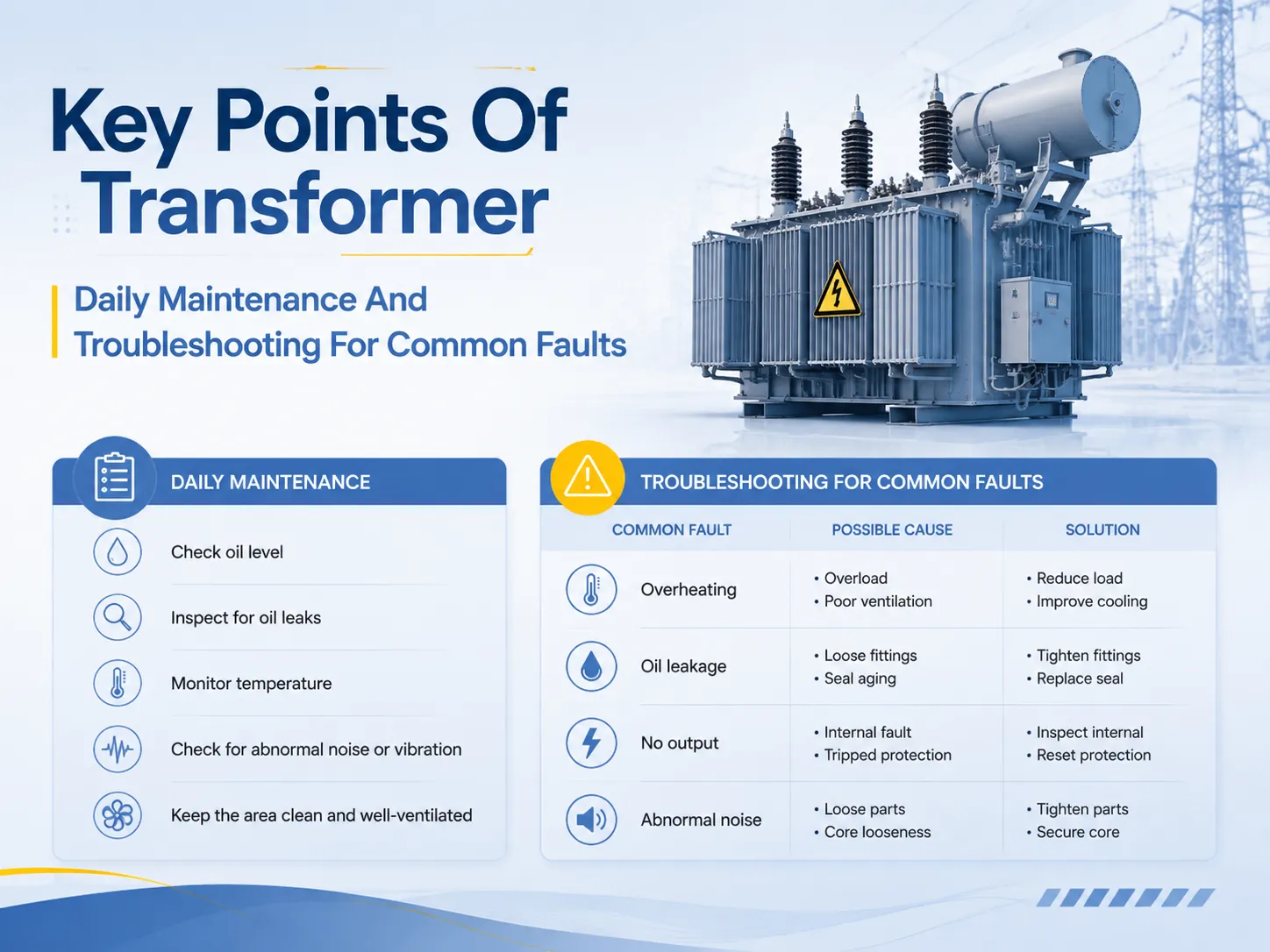
Pourquoi la maintenance quotidienne est importante
Les transformateurs peuvent tomber en panne de deux manières : brusquement en raison d'événements tels qu'un coup de foudre, des bushing explosant ou un court-circuit ; ou lentement en raison de la dégradation de l'isolation, de l'intrusion d'humidité à travers les transformateurs et du fonctionnement mécanique du transformateur. Les pannes lentes sont quelque chose que la maintenance préventive peut gérer car elles donnent des signes avant-coureurs des semaines ou des mois avant que la défaillance ne se produise : par exemple, un niveau d'huile plus bas dans le réservoir du transformateur, un changement dans le son du transformateur, une augmentation de la température du réservoir et des fuites d'huile insignifiantes.
Des recherches menées par des groupes de travail de l'IEEE et du CIGRÉ montrent que les données sur les pannes de transformateurs soutiennent la conclusion selon laquelle le système d'isolation et les changeurs de prises constituent le plus grand nombre des données totales de pannes de transformateurs, représentant 30 à 50 % du nombre total de pannes des transformateurs. Une inspection de cinq minutes chaque jour peut aider à identifier les causes des pannes d'isolation FIA, tandis qu'un échantillon d'huile annuel coûtant $300 peut confirmer ce qui se passe à l'intérieur du réservoir du transformateur. Le scénario inverse implique de découvrir la défaillance lorsque le dispositif de protection est activé, ce qui signifie que des travaux de réparation d'urgence doivent être effectués, ainsi que des heures supplémentaires et des coûts hérités nécessaires pour réaliser ces tâches, qui dépassent généralement les coûts de maintenance de 5 à 20 fois.
La liste de contrôle de l'inspection quotidienne
Une inspection quotidienne typique d'un transformateur rempli d'huile prend environ 5 à 10 minutes. Suivez les points ci-dessous tout en veillant à un enregistrement approprié :
- Niveau d'huile : vérifiez un indicateur de niveau d'huile manuel. Une diminution soudaine indique une fuite d'huile et des défauts possibles.
- État et arôme de l'huile : le verre de contrôle doit indiquer une huile propre et claire ; une huile trouble signifie de l'humidité ou une carbonisation, respectivement.
- Bruit : le transformateur ne doit produire qu'un bourdonnement doux ; tout bruit de bourdonnement indique des pièces desserrées, des problèmes de noyau ou une activité de décharge. Toute altération du son régulier doit susciter des soupçons.
- Températures : notez le niveau de température de l'huile supérieure et comparez-le à l'état chargé. Dans un transformateur de distribution entièrement actif, la température doit être proche de 60 à 75 °C par temps normal ; toute lecture supérieure à 85-90 °C doit être alarmante.
- Bagues : recherchez des fissures ou des traces.
- Déshydratateur : le gel de silice doit encore être bleu (indiquant un manque d'humidité) ; il doit être rose ou rougeâtre.
- Relais Buchholz : confirmez qu'il n'y a pas d'accumulation de gaz dans la fenêtre.
- Autre chose : considérez la présence d'huile sous le transformateur, des vibrations inhabituelles, des boulons desserrés, etc.
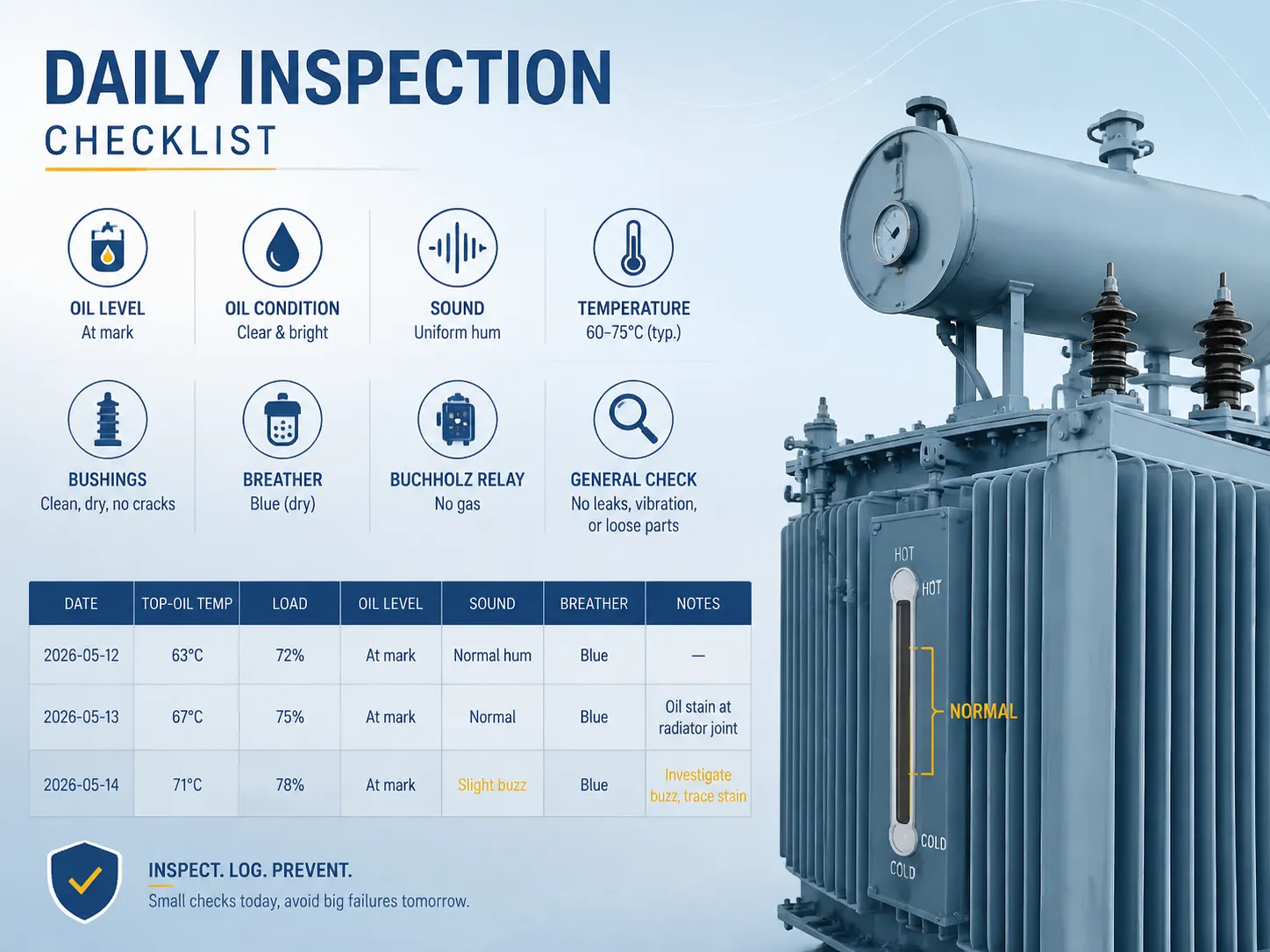
Toute activité inhabituelle est enregistrée et prise au sérieux, tandis que l'enregistrement quotidien fournit également des données de tendance utiles qui peuvent être utilisées pour des diagnostics futurs. Un carnet de bord standardisé et simple rempli à chaque occasion permet une vue rapide des tendances :
| Date | Température de l'huile supérieure | Charge | Niveau d'huile | Son | Déshydratateur | Remarques |
|---|---|---|---|---|---|---|
| 2026-05-12 | 63°C | 72% | À la marque | Bourdonnement normal | Bleu | — |
| 2026-05-13 | 67°C | 75% | À la marque | Normal | Bleu | Tache d'huile au joint du radiateur |
| 2026-05-14 | 71°C | 78% | À la marque | Léger bourdonnement | Bleu | Enquêter sur le bourdonnement, tracer la tache |
Tâches de routine hebdomadaires et mensuelles
Les inspections quotidiennes révèlent des signes immédiats de problèmes, tandis que les inspections hebdomadaires et mensuelles aident à détecter une détérioration plus longue :
| Fréquence | Tâche | Norme / Valeur typique |
|---|---|---|
| Hebdomadaire | Inspection visuelle de tous les accessoires, fonctionnement des ventilateurs de refroidissement, vérification des fuites d'huile | Pas de fuites, les ventilateurs fonctionnent sur thermostat |
| Mensuel | Vérifiez le niveau d'huile à température, inspectez les connexions de mise à la terre, nettoyez les surfaces des isolateurs | Résistance de mise à la terre < 1 Ω là où testé |
| Trimestriel | Test de résistance d'isolement (megger) sur les enroulements, vérifiez le fonctionnement du changeur de prises | Les valeurs IR sont des tendances, pas absolues ; 1 000 à 5 000 MΩ typiques sur des enroulements HV en bonne santé |
| Semi-annuel | Échantillonnage d'huile pour humidité et résistance diélectrique, échantillon d'huile OLTC | Tension de claquage > 30–40 kV selon IEC 60156 ; humidité < 20–30 ppm |
| Annuel | DGA complet, analyse de furanes, test de qualité de l'huile, test de relais de protection | Niveaux de gaz selon IEEE C57.104 condition 1 |
| Tous les 3–5 ans | Inspection approfondie, révision du conservateur et du filtre, inspection des contacts OLTC | Fabricant et directives IEC 60422 |
À quoi ressemble le “ Normal ” : Valeurs de référence
Le diagnostic commence par comprendre quelles sont les valeurs normales. Le tableau ci-dessous représente les plages de distribution pratiques pour les transformateurs de distribution immergés dans l'huile :
| Paramètre | Plage normale | Enquêter lorsque | Niveau d'alarme / d'action |
|---|---|---|---|
| Température de l'huile supérieure (chargée) | 50–75°C | > 80–85°C | > 90–95°C : réduire la charge, vérifier le refroidissement |
| Estimation du point chaud des enroulements | < 98°C selon le guide de chargement | Tendance à la hausse | > 110–120°C : vieillissement sérieux |
| Tension de claquage de l'huile | > 40–60 kV | 30–40 kV | < 30 kV : filtration / remplacement nécessaire |
| Humidité de l'huile | < 15–20 ppm | 20–30 ppm | > 30–40 ppm : assécher l'huile et enquêter |
| Résistance d'isolement (megger, enroulement HV) | > 1 000 MΩ | Tendance à la baisse entre les tests | < 100–500 MΩ : assécher et retester |
| Couleur du filtre à gel de silice | Bleu (sec) | Partiellement rose | Entièrement rose/rouge : régénérer ou remplacer |
| TDCG (gaz combustibles totaux) | < 720 ppm | 720–1 920 ppm | > 1 920 ppm : enquête détaillée selon IEEE C57.104 |
Soyez conscient que les tendances sont plus importantes que les mesures uniques : une température d'huile de 78°C est plus alarmante si elle augmente de 5°C par semaine que si elle reste stable avec une charge constante.
Dépannage des défauts les plus courants
S'il y a des indications de dysfonctionnement, effectuez une enquête ordonnée au lieu de faire des suppositions. Lors du dépannage des transformateurs, il peut être utile de consulter le tableau suivant des problèmes courants et des causes possibles, ainsi que les premiers tests que vous devriez effectuer :
| Symptôme | Causes les plus probables | Premières vérifications | Prochaine étape si non résolu |
|---|---|---|---|
| Bruit inhabituel / changement de bourdonnement | Serrage du noyau lâche, boulons de montage lâches, vibration de l'entraînement OLTC, décharge partielle, harmoniques de charge | Serrez les boulons, comparez le bruit au niveau de charge, écoutez les crépitements | Mesure PD, test de courant de mise à la terre du noyau |
| Niveau d'huile en baisse | Fuite au niveau des joints/embouts, défaut du respirateur, chute de température | Inspectez tous les joints, vérifiez la corrélation de température | Trouvez et réparez la fuite ; testez l'huile pour l'humidité |
| Température de l'huile élevée | Surcharge, ventilateurs de refroidissement non fonctionnels, radiateurs obstrués, niveau d'huile bas, haute température ambiante | Vérifiez la charge par rapport à la capacité, fonctionnement du ventilateur, circulation d'air du radiateur | Consultez le guide de chargement, nettoyez les refroidisseurs, DGA |
| Alarme de gaz Buchholz | Gaz mineur dû au vieillissement normal, à la surchauffe ou à un défaut interne | Collectez un échantillon de gaz, notez la quantité et l'odeur | DGA du gaz et de l'huile ; comparez avec la norme IEEE C57.104 |
| Déclenchement de Buchholz (soudain) | Défaut interne majeur, arc électrique, court-circuit | NE PAS réénergiser ; isoler et inspecter | Inspection interne complète, DGA, tests de bobinage |
| Faible résistance d'isolation | Humidité dans l'huile, bobinage humide, poussière et contamination | Test Megger, test d'humidité de l'huile | Processus de séchage, filtration de l'huile, retest |
| Surchauffe aux connexions | Bornes desserrées, cosses corrodées, conducteurs sous-dimensionnés | Thermographie des bornes et des barres omnibus | Resserrer au couple spécifié, remplacer les cosses |
Fonctionnement du relais de Buchholz : Ce qu'il vous indique
Le relais de Buchholz est positionné dans le tuyau reliant le réservoir du transformateur au conservateur, faisant partie d'un système de détection de défauts internes. Le relais dispose de deux flotteurs : le flotteur supérieur envoie un signal d'alarme lors de l'accumulation de gaz et le flotteur inférieur actionne le disjoncteur lorsque l'huile se déplace soudainement vers le conservateur et qu'un défaut significatif se produit. Lorsque le dispositif de Buchholz alerte :
- Il est nécessaire de noter la quantité de gaz libérée et si le relais a simplement donné un signal d'alerte ou a fonctionné pour couper le circuit électrique.
- Il est important de prélever un échantillon de gaz du robinet de Buchholz et de noter la quantité de gaz et son odeur. Une odeur désagréable peut être un indicateur d'arc électrique.
- Il est essentiel d'analyser le gaz recueilli : des quantités anormalement élevées d'hydrogène et d'acétylène révèlent la présence d'arcs électriques et de défauts graves, tandis qu'une composition d'air prédominante peut indiquer des problèmes avec le respirateur d'air.
- Il est nécessaire de prélever l'échantillon d'huile DGA en même temps et de comparer les concentrations de gaz avec les conditions décrites dans la norme IEEE C57.104.
- Il est nécessaire de prendre une décision : si la composition du gaz indique des phénomènes de surchauffe ou d'arc électrique – ne pas reconnecter l'unité jusqu'à l'inspection interne et les éventuels travaux de réparation. Si l'accumulation de gaz n'est pas statistiquement significative et n'indique pas de fonctionnement défectueux, l'unité peut continuer à fonctionner sans problème, mais des inspections continues doivent être effectuées pour s'assurer de l'absence de défauts.
L'événement d'accumulation de gaz doit être documenté et signalé à l'ingénieur pour permettre un suivi ultérieur de la formation de gaz.
Fuite d'huile : Causes et gestion
Le problème de maintenance le plus visible concernant les fuites d'huile est les fuites d'huile qui sont importantes pour trois raisons : la baisse du niveau d'huile (ce qui affecte l'efficacité des systèmes de refroidissement et d'isolation), l'entrée d'humidité et d'air par les fuites, et la création de problèmes environnementaux et de sécurité. Les fuites d'huile se produisent le plus souvent au niveau des joints entre le réservoir et le couvercle, à la base des douilles, aux joints des tuyaux des conservateurs, aux connexions du radiateur de refroidissement, et au niveau de la vanne de drainage.
Lors de la recherche d'une fuite d'huile, il est préférable de faire quelques inspections avec un chiffon propre ou, dans le cas d'une très petite fuite, de vérifier les joints la nuit avec une lampe de poche (des traces d'huile seraient visibles). Il est recommandé de serrer les boulons sur le flasque selon les instructions du fabricant et si cela ne suffit pas, de remplacer les joints par de nouveaux matériaux. Après toute réparation, l'huile doit être remplie à travers le conservateur à partir du même lot et après une semaine, un échantillon doit être vérifié pour l'humidité. Même de petites fuites d'huile peuvent entraîner de gros problèmes, car une unité fuyant 5-10 litres par mois commencera à aspirer de l'air humide par le respirateur.
Surchauffe et défauts de refroidissement
La surchauffe continue est le moyen le plus rapide de réduire la durée de vie d'un transformateur en raison du fait que le vieillissement de l'isolation est pratiquement doublé à chaque augmentation de 6-8 degrés K de la température. Dans le cas où la température de l'huile est élevée, prenez les mesures suivantes :
- Vérifiez si la charge correspond à la plaque signalétique et au pamphlet de chargement (IEC 60076-7). Si la charge dépasse la valeur de la plaque signalétique et qu'il n'y a pas de refroidissement par les ventilateurs, cela entraînera une surchauffe.
- Vérifiez l'état du ventilateur et de la pompe. Dans un transformateur ONAF, les ventilateurs fonctionnent automatiquement par le thermostat ; la défaillance du ventilateur ou des problèmes de circulation de l'air dans le radiateur peuvent entraîner une augmentation de la température de 10-20 degrés.
- Inspectez le radiateur pour vous assurer que les ailettes sont propres ; utilisez de l'air ou de l'eau mais n'utilisez pas de nettoyeur haute pression car cela pourrait endommager le radiateur.
- Vérifiez le niveau d'huile et la circulation. Un faible niveau d'huile peut entraîner une surchauffe en raison d'un refroidissement insuffisant et de points chauds près de l'enroulement.
- Découvrez s'il existe des causes internes du problème.
Défauts électriques : résistance d'isolation et mise à la terre
Le test de la résistance d'isolation (megger) est utilisé pour une évaluation typique de l'humidité et de la contamination. Chaque enroulement est testé à la fois à la terre et entre eux en utilisant une tension de 500 à 5 000 V selon le transformateur. La température pendant le test doit également être enregistrée. Le point critique n'est pas la mesure absolue de la résistance d'isolation, mais son évolution dans le temps, donc pour comparer avec les résultats de l'année précédente, il convient de mettre plus d'importance sur les évolutions des valeurs plutôt que sur les chiffres finaux. En cas de détection d'une faible résistance d'isolation, un test de l'huile pour l'humidité et la résistance diélectrique suit. Si l'huile est trouvée contaminée, le filtrage et/ou le changement de celle-ci est la prochaine étape, suivi d'un nouveau test. Dans les pires situations, le séchage du transformateur peut être nécessaire, en suivant les recommandations fournies sur le processus contrôlé de la procédure de séchage par les fabricants.
La mise à la terre est une procédure indépendante et très importante à réaliser quotidiennement. Le réservoir doit être mis à la terre avec toutes les parties métalliques non porteuses de courant ; la résistance de mise à la terre est généralement de 1 à 5 Ω selon le système. Si la mise à la terre échoue, le réservoir reste sous tension en cas de défaillance interne du transformateur. Une inspection visuelle doit être effectuée régulièrement sur les sangles polymériques utilisées pour la mise à la terre afin de vérifier leur corrosion, leur desserrage et leur état général.
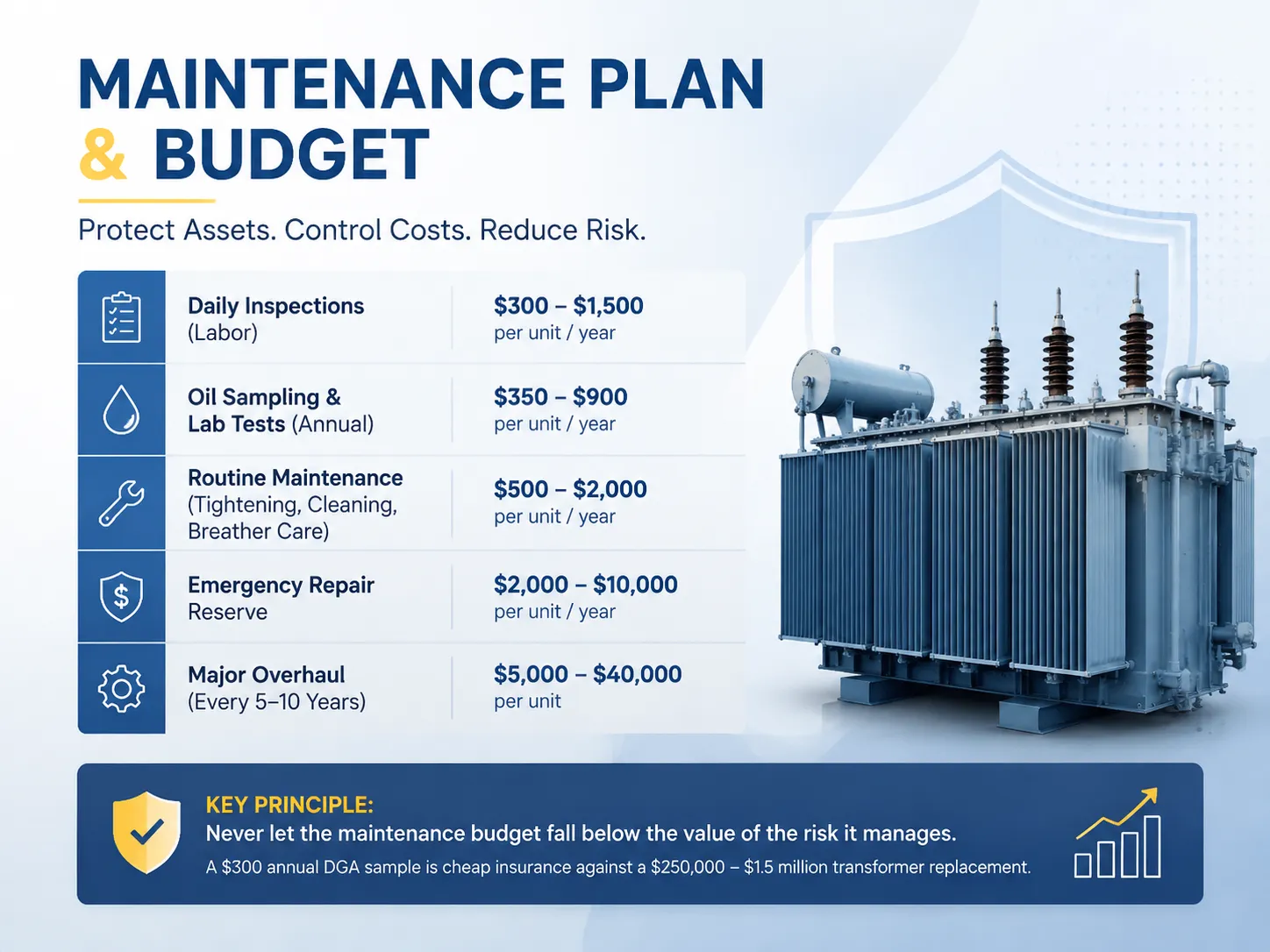
Élaboration d'un plan de maintenance et d'un budget
Développez des plans de maintenance écrits à partir de vos listes de contrôle, en assignant des rôles et des budgets aux employés concernés.
| Poste de coût | Coût annuel typique (par unité) | Remarques |
|---|---|---|
| Inspections quotidiennes (main-d'œuvre) | $300–$1,500 | 10 minutes/jour de temps de technicien |
| Échantillonnage d'huile et tests de laboratoire (annuels) | $200–$500 par échantillon DGA | Plus $150–$400 pour le package de qualité d'huile |
| Maintenance de routine (serrage, nettoyage, entretien du respirateur) | $500–$2,000 | Consommables et main-d'œuvre |
| Réserve de réparation d'urgence | $2,000–$10,000 par unité budgétisée | Kits de joints, huile, joints, ventilateurs |
| Révision majeure (tous les 5–10 ans) | $5 000–$40 000 | Inspection OLTC, filtration d'huile, joints |
Le principe principal du budget de maintenance est que le budget de maintenance ne doit jamais être inférieur au coût des risques potentiels. Un échantillon DGA annuel pour $300 est un bon investissement par rapport à une perte potentielle dans les coûts de transformateur entre $250,000 et $1,500,000.
Questions Fréquemment Posées
À quelle fréquence l'huile de transformateur doit-elle être échantillonnée ?
Pour les transformateurs en fonctionnement, prendre un échantillon une fois par an est une pratique normale. Dans le cas des transformateurs de distribution, l'échantillonnage d'huile doit être effectué une fois tous les un à trois ans en fonction du niveau d'importance du transformateur. Pour chaque alarme activée par le relais Buchholz, toute situation de surcharge, tout type de dysfonctionnement, ou s'il y a une production de gaz considérable, un échantillon doit être prélevé dès que possible (dans quelques semaines). En moyenne, les coûts pour un échantillon de DGA vont de $200 à $500 avec un rapport du laboratoire.
Quelle est la température de fonctionnement normale d'un transformateur ?
La température au sommet de l'huile dans un transformateur à huile actif doit être comprise entre 60°C et 75°C dans des conditions climatiques tempérées. Si la température dépasse 85°C pendant une longue période, il est nécessaire de vérifier la situation. Si la température du point chaud dépasse 98°C, le processus de vieillissement de l'isolation est en cours.
Que signifie une alarme de relais Buchholz ?
L'accumulation de gaz dans le tuyau de conservateur est ce qui déclenche l'alarme du relais Buchholz. Le gaz peut être soit de l'air produit lors de la défaillance du respirateur, soit des gaz produits lors de surchauffes et d'arc dans le réservoir. Par conséquent, le gaz doit être échantillonné, et un DGA doit être effectué pour tirer une conclusion.
Comment gérer un transformateur avec une faible résistance d'isolation ?
Tout d'abord, vous devez vérifier l'huile, la saturation et la résistance diélectrique de l'huile. Il est très probable que l'huile soit humide. L'huile doit être filtrée ou remplacée si la saturation est supérieure à 20-30 ppm. Dans le cas où l'enroulement du transformateur est humide, une procédure de séchage contrôlé doit être effectuée selon les instructions données par le fabricant.
Que dois-je faire lorsque le transformateur se déclenche sur le relais Buchholz ?
Avant de remettre le transformateur sous tension, assurez-vous d'isoler l'unité de transformateur et de prélever des échantillons de gaz et d'huile pour le DGA. Après que le relais Buchholz a été déclenché, il est essentiel de vérifier le relais et le conservateur.
Références
- IEEE C57.104 : Guide pour l'interprétation des gaz générés dans les transformateurs immergés dans l'huile — La référence pour l'interprétation DGA et les niveaux d'alarme lors du dépannage.
- IEC 60422 : Guide de supervision et de maintenance pour les huiles isolantes minérales — Définit les limites de qualité de l'huile et les pratiques de maintenance.
- IEC 60076-7 : Guide de chargement pour les transformateurs de puissance immergés dans l'huile — La référence pour les limites de température et le chargement cyclique/d'urgence.
- IEC 60156 : Liquides isolants — Détermination de la tension de claquage — Norme d'essai pour la résistance diélectrique de l'huile utilisée dans l'entretien courant.
- IEC 60599 : Guide d'interprétation du DGA dans les équipements à huile minérale imprégnée — Cadre international pour l'interprétation des gaz.
- CIGRÉ — Publie des brochures techniques sur l'entretien des transformateurs, les statistiques de pannes et l'évaluation de l'état.
- Jiangsu Subian Electric Power — Fabricant de transformateurs conforme à la norme IEC 60076 fournissant de la documentation d'entretien et un support technique.
Conclusion
L'entretien quotidien des transformateurs est très facile, peu coûteux et constitue l'une des meilleures initiatives axées sur la valeur dans tout programme d'actifs électriques. Une brève inspection préliminaire de cinq minutes, une inspection de routine mensuelle et un échantillon annuel d'enquête DGA aideront facilement à détecter des défauts critiques menant à des événements ingérables et à les transformer en entretien planifié. En général, chaque fois qu'une anomalie survient, l'algorithme de dépannage doit être initié pour une exclusion efficace des problèmes : d'abord, vérifier les variables évidentes, puis collecter les échantillons d'huile, et enfin, les interpréter selon les normes et prendre des mesures au lieu d'attendre que la protection s'active elle-même.
- Mettez en œuvre la liste de contrôle quotidienne et enregistrez les relevés.
- Prenez des échantillons d'huile pour DGA au moins une fois par an, et après l'événement de Buchholz.
- Enquêtez sur les changements de température, de bruit et de niveau au lieu de les accepter.
- Ne réénergisez jamais après un événement de Buchholz sans vérifications.
- Considérez un prix de $200–$500 pour un échantillon DGA par rapport à plus de $250,000 pour le remplacement de la machine électrique.