


Si vous êtes dans un centre commercial ou un centre de données, à quelques pieds du câblage, vous passerez devant deux types majeurs de transformateurs — l'équipement monté sur socle qui alimente le bâtiment et les transformateurs de type sec convertissant 11 kV en 400 kV — sans même vous en rendre compte. Tout ce qui fonctionne à l'électricité doit son fonctionnement à un transformateur, lui permettant d'exécuter l'une de ses fonctions les plus importantes — celle de transformer les tensions.
Dans cet article, nous expliquerons le fonctionnement des transformateurs de manière simple et claire, tout en fournissant des chiffres adéquats concernant des processus tels que la transformation de tension, l'isolation, l'adaptation d'impédance et la régulation, démontrant ainsi que la connaissance des transformateurs peut nous aider à maintenir les besoins électriques de diverses industries.
Qu'est-ce qu'un transformateur et que fait-il réellement ?
Les transformateurs sont des dispositifs statiques avec un certain nombre de bobines (souvent appelées enroulements) logées autour d'un noyau magnétique partagé. Essentiellement, le principal objectif d'un transformateur est de transférer l'énergie du courant alternatif (CA) d'un circuit à un autre tout en changeant le niveau de tension et d'intensité et en maintenant la fréquence constante. Ainsi, les transformateurs sont des dispositifs électriques très fiables car ils n'ont pas de composants mobiles pendant leur fonctionnement.
Le nom du transformateur vient de son fonctionnement, qui est de transformer la tension. En général, les transformateurs de type élévateur permettent d'augmenter la tension dans le but d'une fourniture d'électricité efficace à longue distance et les transformateurs de type abaisseur aident à réduire la tension. Cependant, changer la tension n'est qu'une petite partie de ce que les transformateurs peuvent faire – ils agissent également comme des isolateurs de circuit, des dispositifs d'adaptation d'impédance, des bloqueurs de courant continu, des méthodes de contrôle de l'alimentation, et bien d'autres.
Comment fonctionnent les transformateurs : L'induction en un diagramme vaut mille mots
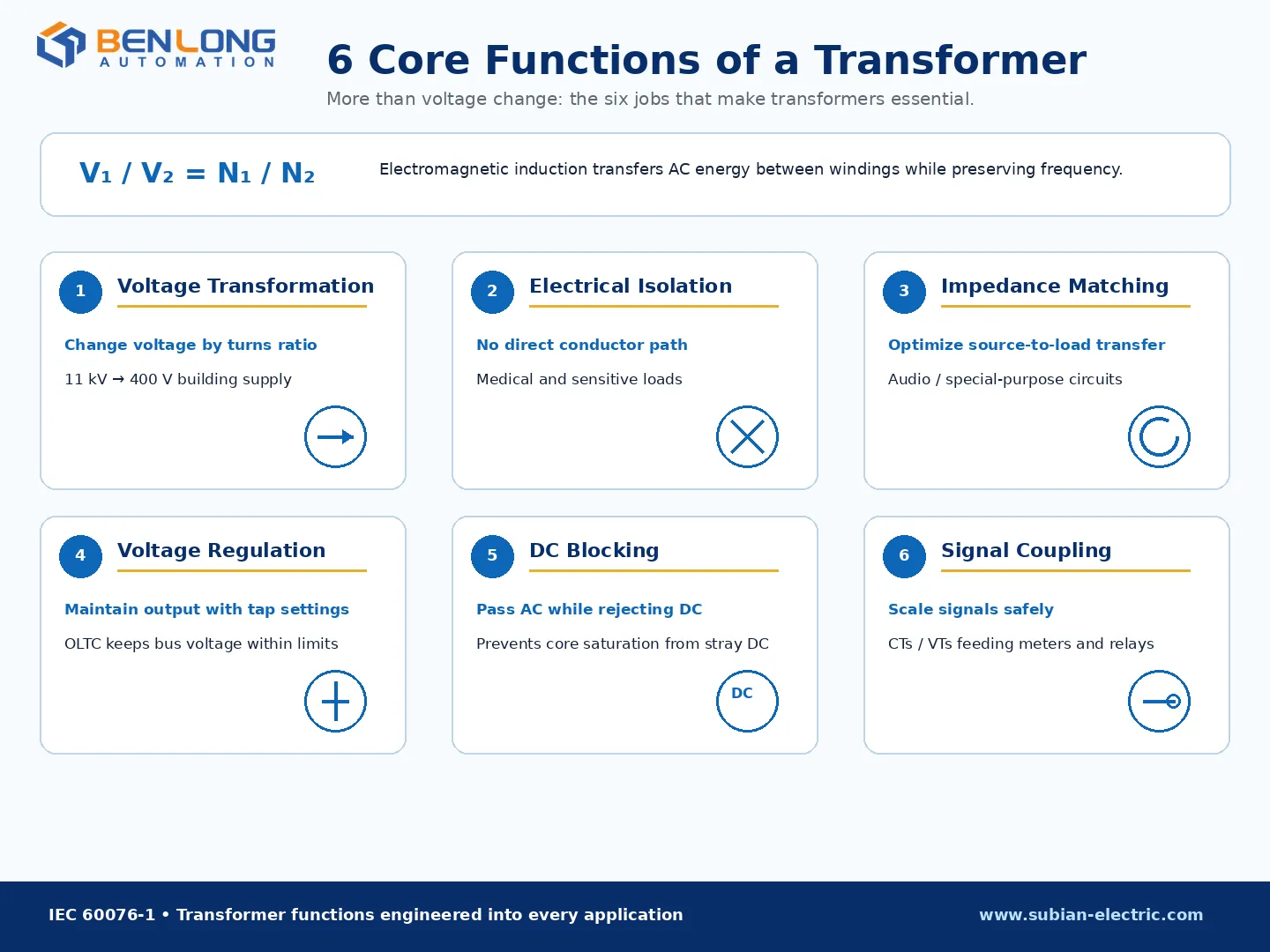
Le principe de fonctionnement repose sur la loi d'induction de Faraday. Un courant dans l'enroulement primaire génère un champ magnétique variable qui passe à travers le noyau en acier laminé. Le champ magnétique variable induit un courant dans la bobine secondaire. Le rapport de la tension secondaire à la tension primaire est selon le rapport des tours :
V1 / V2 = N1 / N2, et idéalement V1 × I1 = V2 × I2.
Puisque le courant ne circule que dans le circuit primaire (une connexion existe par induction, mais le circuit secondaire n'est pas directement électrisé), un transformateur maintient les deux circuits isolés. En pratique, un transformateur de distribution de 100 kVA à 11/0,4 kV transporterait environ 9 A dans le primaire à pleine charge, tandis que la charge au secondaire serait d'environ 144 A.
Les six fonctions d'un transformateur
| Fonction | Ce qu'elle fait | Exemple concret |
|---|---|---|
| Transformation de tension | Change le niveau de tension via le rapport des tours | 11 kV → 400 V pour une alimentation de bâtiment |
| Isolation électrique | Sépare les circuits ; pas de chemin conducteur direct | Isoler une salle d'imagerie médicale des défauts du réseau |
| Adaptation d'impédance | Optimise le transfert d'énergie entre la source et la charge | Correspondance de la sortie de l'amplificateur à un haut-parleur (transformateurs audio) |
| Régulation de la tension | Maintient la sortie dans les limites via des changeurs de prises | OLTC maintenant un bus de 20 kV à ±2% |
| Blocage DC | Passe l'AC, bloque le DC | Prévention du DC errant saturant les noyaux de distribution |
| Couplage de signal | Transfère des signaux tout en isolant les niveaux | Transformateurs d'instrument alimentant des relais de protection |
La plupart des gens ne pensent qu'à la première ligne, mais l'isolation, la régulation et le blocage DC sont exactement ce qui maintient les équipements sensibles en vie pendant les perturbations du réseau.
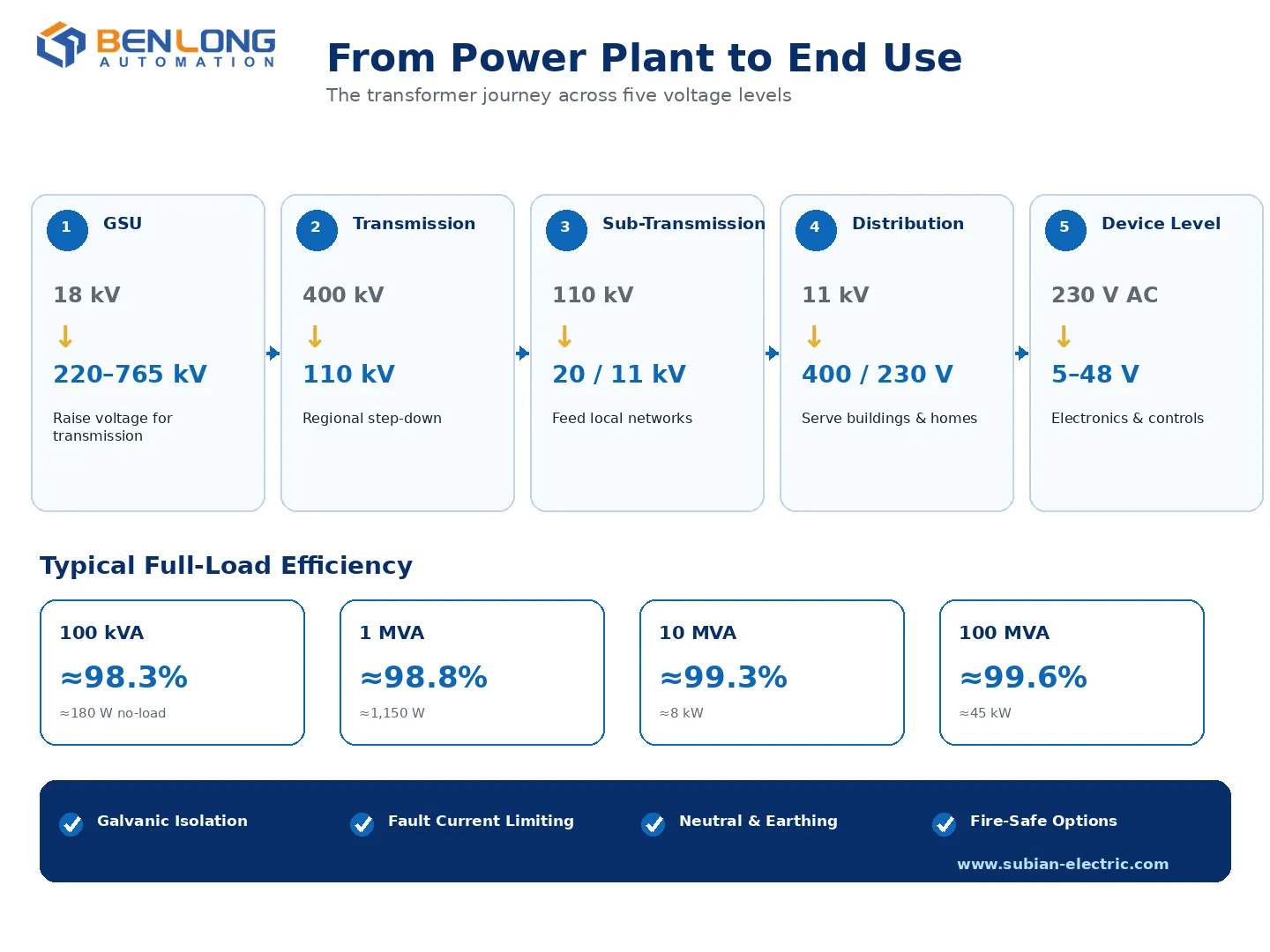
Le Voyage du Transformateur : De la Centrale Électrique à Votre Maison
Le processus d'éclairage dans vos maisons est composé d'une multitude de transformateurs. Considérons ceux que nous pouvons trouver dans une chaîne de transformateurs utilisés à cet effet :
Transformateur GSU – la tension de sortie du générateur de 18 kV est élevée au niveau de 220–765 kV.
Transformateur de réduction de transmission – réduit la tension de 400 kV au niveau de 110 kV dans les sous-stations régionales.
Transformateur de sous-transmission – réduit l'entrée de 110 kV à 20/11 kV.
Transformateur de distribution – réduit la tension de 11 kV qui atteint le transformateur de poteau ou de montage au sol devant votre maison à 400/230 V.
Transformateurs de niveau appareil – les chargeurs et autres sources d'alimentation réduisent encore la tension à 5–48 V de puissance requise pour le fonctionnement de différents appareils électriques.
De cette manière, nous pouvons facilement comprendre qu'entre la centrale et le chargeur de téléphone portable, nous avons 4-6 transformateurs entre les deux.
Types de Transformateurs & Leurs Fonctions
| Taper | Plage de Tension | Focus sur la Fonction | Utilisation Typique |
|---|---|---|---|
| Transformateur de puissance | 33–765 kV | Transfert en vrac, régulation | Sous-stations, centrales |
| Transformateur de distribution | 4–35 kV | Étape finale de réduction, efficacité | Montages sur poteau/plateforme, bâtiments |
| Type sec / résine coulée | Jusqu'à 35 kV | Sécurité incendie, usage intérieur | Grands immeubles, hôpitaux, marine |
| Transformateur d'isolement | Tout | Séparation galvanique, bruit | Médical, laboratoires, centres de données |
| Auto-transformateur | Réseau HV | Couplage économique | Interconnexions 220/110 kV |
| Transformateur d'instrumentation | Tout | Échelle de mesure et de protection | Relais, compteurs, surveillance |
Notez le chevauchement : un “ transformateur de puissance ” et un “ transformateur de distribution ” remplissent la même fonction fondamentale mais sont conçus pour des cycles de service différents — l'un pour une charge élevée continue, l'autre pour une charge partielle variable. Cette seule différence influence la plupart des décisions de spécification.
Efficacité, Pertes & Factures d'Énergie
L'efficacité des transformateurs est élevée mais n'est pas gratuite. Les pertes se divisent en pertes à vide (fer) qui fonctionnent 24 heures sur 24 chaque fois que l'unité est alimentée, et pertes en charge (cuivre) qui augmentent avec le carré du courant. Valeurs typiques :
| Puissance | Pertes à vide | Pertes en charge | Efficacité à pleine charge |
|---|---|---|---|
| 100 kVA | ≈180 W | ≈1 500 W | ≈98,3% |
| 1 MVA | ≈1 150 W | ≈10 500 W | ≈98,8% |
| 10 MVA | ≈8 kW | ≈55 kW | ≈99,3% |
| 100 MVA | ≈45 kW | ≈320 kW | ≈99,6% |
Étant donné que les transformateurs fonctionnent en continu, les coûts causés par les pertes sont importants. Le transformateur de distribution avec une capacité de 1 MVA ayant des pertes d'environ 1.5% peut gaspiller environ 10 à 15 MWh d'énergie électrique pendant l'année, ce qui peut coûter plusieurs milliers de dollars par an aux prix habituels de l'électricité commerciale. Les opérateurs doivent garder à l'esprit que s'il y a des milliers d'unités dans la flotte, les normes d'efficacité (par exemple, la norme GB 20052 de la Chine et le Règlement 548/2014 de l'UE) auront une signification économique pour le pays.
Fonctions de Sécurité : Isolation, Mise à la Terre & Protection
Les transformateurs sont utilisés pour des tâches critiques en matière de sécurité qui incluent :
Isolation Galvanique : Il n'y a pas de connexion conductrice entre les enroulements primaire et secondaire afin qu'aucun défaut survenant du côté de la charge ne puisse revenir dans le circuit d'alimentation.
Limitation de Défaut : L'impédance d'un transformateur (typiquement entre 5 et 10%) limite le courant de court-circuit qui empêche d'endommager les équipements de commutation et les dispositifs de protection dans les sections suivantes du circuit électrique.
Mise à la Terre Neutre : Le type et la configuration de l'enroulement du transformateur définissent le schéma de mise à la terre neutre qui fournit des informations concernant la tension de contact et la manière dont le transformateur est protégé.
Sécurité Incendie : Les transformateurs de type sec et remplis d'esters sont considérés comme plus sûrs que les équipements remplis d'huile car les normes NFPA 70 et IEC 60076-11 favorisent leurs applications intérieures en raison de leur risque d'incendie plus faible dans les bâtiments.
Séparation Fiable des Tensions : Les bushing isolés à l'huile et d'autres conceptions d'isolation des transformateurs interrompent tout accès aux zones de tension dangereuses.
Cette liste fournit des informations concernant les raisons pour lesquelles les réglementations ont classé l'installation de transformateurs comme une activité d'ingénierie nécessitant des connaissances sur des aspects tels que les exigences de distance, la rétention d'huile, etc.
Spécifications & Tableau des Classes de Transformateurs
| Paramètre | Valeur Typique (1 MVA, 11/0.4 kV) |
|---|---|
| Puissance nominale | 1 000 kVA |
| Rapport de tension | 11 000 / 400 V |
| Groupe vectoriel | Dyn11 |
| Tension d'impédance | 6% |
| Refroidissement | ONAN |
| Niveau d'isolation | 75 kV BIL primaire |
| Pertes à vide | ≈1 150 W |
| Pertes en charge | ≈10 500 W |
| Norme | IEC 60076-1 |
Ces dix chiffres définissent l'ensemble du contrat fonctionnel de l'appareil. Lorsque les acheteurs comparent des transformateurs, ils comparent ces chiffres — et les garanties qui les sous-tendent.
Applications dans les bâtiments, l'industrie et les infrastructures
- Entités commerciales — alimentations de 11 kilovolts transformées en 400 et 230 volts.
Établissements de santé — transformateurs d'isolement utilisés pour protéger les dispositifs médicaux sensibles.
Centres de données — systèmes de moyenne tension et unités de distribution et de réduction de l'alimentation sans interruption installés.
Sites de fabrication — des transformateurs sont utilisés pour réduire la tension de 33 kilovolts à 11 kilovolts.
Énergie renouvelable éolienne et solaire — les sous-stations sont utilisées à l'envers pour transformer la production d'énergies renouvelables de basse tension en tension de réseau.
Travaux opérationnels ferroviaires — transformateurs de sous-station transmettant de l'énergie à une tension de 25 kV.
Prix réalistes & Meilleures marques
Les transformateurs sont tarifés par puissance, spécification et marque. Plages de niveau de planification (FOB, immergés dans l'huile, pertes standard) :
| Marque / Type | 1 MVA | 20 MVA / 110 kV |
|---|---|---|
| Hitachi Energy / Siemens | $35 000–$70 000 | $430,000–$700,000 |
| Schneider Electric | $30,000–$55,000 | $280,000–$450,000 |
| TBEA (Chine) | $18,000–$35,000 | $180,000–$320,000 |
| Jiangsu Subian Electric Power (Chine) | $16,000 à $30,000 | $160,000–$300,000 |
Les prix varient selon la spécification, le niveau de perte et la région. Pour les projets nécessitant l'ensemble complet des fonctions — transformation, isolation, régulation et sécurité — sans la prime de marque européenne, Jiangsu Subian Electric Power fabrique des transformateurs de distribution et de puissance de 50 kVA à 220 kV, immergés dans l'huile et de type sec, avec des rapports d'essai de type IEC 60076, personnalisation OEM/ODM, et des prix directs d'usine généralement 30%–50% en dessous des équivalents occidentaux. Leurs ingénieurs spécifient le groupe vectoriel, les prises et l'interface de protection pour correspondre exactement à votre installation.
Questions Fréquemment Posées
Quelle est la fonction principale d'un transformateur dans une maison ?
Un transformateur de poteau électrique ou monté sur socle réduit la tension de distribution d'environ 11 kV à 400 / 230 V. En plus de cette réduction, le transformateur fournit une isolation (qui empêche toute défaillance du côté de l'alimentation d'affecter le circuit domestique), et un redimensionnement du courant (qui permet à l'appareil de fournir environ 144 A sur 400 V à une puissance de 100 kVA au lieu d'environ 9 A à 11 kV). Après le transformateur discret, le chargeur réduit encore la tension à 5-48 V DC.
Pourquoi un transformateur n'a-t-il pas de pièces mobiles ?
Parce que sa fonction est électromagnétique, pas mécanique : le courant alternatif dans le primaire crée un flux magnétique variable dans le noyau, qui induit une tension dans le secondaire. Il n'y a rien à faire tourner ou à faire osciller, c'est pourquoi les transformateurs durent généralement 30 à 40 ans avec un entretien limité à des tests d'huile, au remplacement de joints et à l'entretien des changeurs de prises.
Quelle est l'efficacité des transformateurs en fonctionnement réel ?
Les transformateurs de distribution fonctionnent à environ 98%–99% et les grands transformateurs de puissance à 99.0%–99.7% à pleine charge. L'efficacité atteint son maximum à charge partielle (typiquement 40%–75% de la puissance), c'est pourquoi les ingénieurs dimensionnent les transformateurs pour que la charge normale se situe dans cette plage. Les pertes sont continues, donc les garanties d'efficacité et de perte dominent le coût d'exploitation à long terme.
Quelle est la différence entre un transformateur élévateur et un transformateur abaisseur ?
Physique fonctionnellement identique, direction opposée : un transformateur élévateur a plus de tours sur le secondaire (V2 > V1) et est utilisé dans les centrales électriques pour augmenter la tension pour la transmission ; un transformateur abaisseur a plus de tours sur le primaire (V2 < V1) et alimente la distribution et les utilisateurs finaux. Le même transformateur physique peut même être utilisé dans les deux rôles selon quel enroulement est le côté d'alimentation.
Combien coûte un transformateur pour un bâtiment ou une usine ?
Une unité de 100 kVA coûte environ $1 500–$8 000, une unité de 1 MVA $18 000–$45 000 (huile) ou $28 000–$70 000 (type sec), et un transformateur de puissance de 20 MVA / 110 kV $160 000–$700 000 selon la marque et la spécification. Demandez toujours des devis sur des spécifications identiques, et tenez compte des coûts d'installation, de protection et de test, qui peuvent ajouter 20%–40% au prix de l'équipement.
Références
- IEC 60076-1 : Transformateurs de puissance — Général — La norme internationale pour les classifications, tolérances et tests.
- IEC 60076-11 : Transformateurs à sec — Exigences spécifiques aux transformateurs de type sec et en résine coulée.
- IEEE C57.12.00 : Exigences générales pour les transformateurs immergés dans un liquide — Norme compagnon nord-américaine.
- NFPA 70 : Code national de l'électricité — Exigences d'installation et de sécurité pour les transformateurs dans les bâtiments.
- US EPA : Efficacité des transformateurs — Pourquoi l'efficacité des transformateurs est importante pour la politique énergétique et climatique.
- Transformateurs Siemens Energy — Référence de référence pour l'ingénierie moderne des transformateurs.
Conclusion
La fonction des transformateurs est l'épine dorsale silencieuse de la vie moderne : transformation de la tension, isolation, adaptation d'impédance, régulation, blocage de courant continu et couplage de signal, le tout sans pièces mobiles et avec des rendements supérieurs à 98%. Du GSU dans une centrale électrique à l'unité de montage au sol devant votre bâtiment, chaque étape de la chaîne électrique dépend de cet appareil.
- Les transformateurs changent la tension par rapport au rapport de tours tout en isolant les circuits et en limitant les défauts.
- Une efficacité de 98%–99,7% coûte toujours de l'argent à grande échelle — les garanties de perte comptent.
- Les fonctions de sécurité (isolation, mise à la terre, impédance) sont conçues, pas optionnelles.
- Prévoyez $1,5k–$8k pour 100 kVA, $18k–$45k pour 1 MVA, $160k–$700k pour la classe 20 MVA.
Si vous spécifiez un transformateur pour un bâtiment, une usine ou un projet de service public, Jiangsu Subian Electric Power fournit des transformateurs de distribution et de puissance de 50 kVA à 220 kV avec certification IEC 60076 et support technique pour chaque étape de votre projet.