


Un responsable des installations dans un centre commercial en banlieue de Dallas a vu deux travailleurs des services publics ouvrir une boîte en acier vert près du parking, examiner le bushing, et la refermer immédiatement, le tout en moins d'un quart d'heure. Ce cabinet — connu sous le nom de transformateur monté sur socle — avait fourni de l'énergie aux trois grands magasins composant le centre commercial, à la cour de restauration, et au système de climatisation pendant neuf ans sans provoquer de coupures à l'emplacement. Il n'y avait pas de clôture, pas de câblage aérien, et rien n'indiquait la présence d'équipements haute tension. L'ensemble du transformateur était caché derrière un boîtier en acier résistant aux manipulations, qui était boulonné à une fondation en béton et installé sous terre.
L'article fournit quelques lignes directrices pour effectuer de bons achats de transformateurs montés sur socle. Il inclut des informations spécifiques sur les caractéristiques qui distinguent un produit de qualité de ceux de moindre qualité, les normes, et les tests prouvant la qualité de l'unité, ce qu'il faut vérifier avant de payer, ainsi que le prix d'une unité de bonne qualité.
En résumé, un transformateur monté sur socle est défini comme un transformateur résistant aux manipulations construit au sol sur un socle en béton, garantissant que toutes les connexions d'alimentation et de livraison sont installées sous terre à l'aide de connecteurs à façade morte. Les appareils de première qualité sont construits conformément à l'IEEE C57.12.27 (intégrité de l'enveloppe), à l'IEEE C57.12.00 (exigences générales), et à l'IEEE C57.12.90 (méthodes d'essai), avec une capacité de 75 à 5 000 kVA et une tension d'alimentation de 15 à 35 kV.
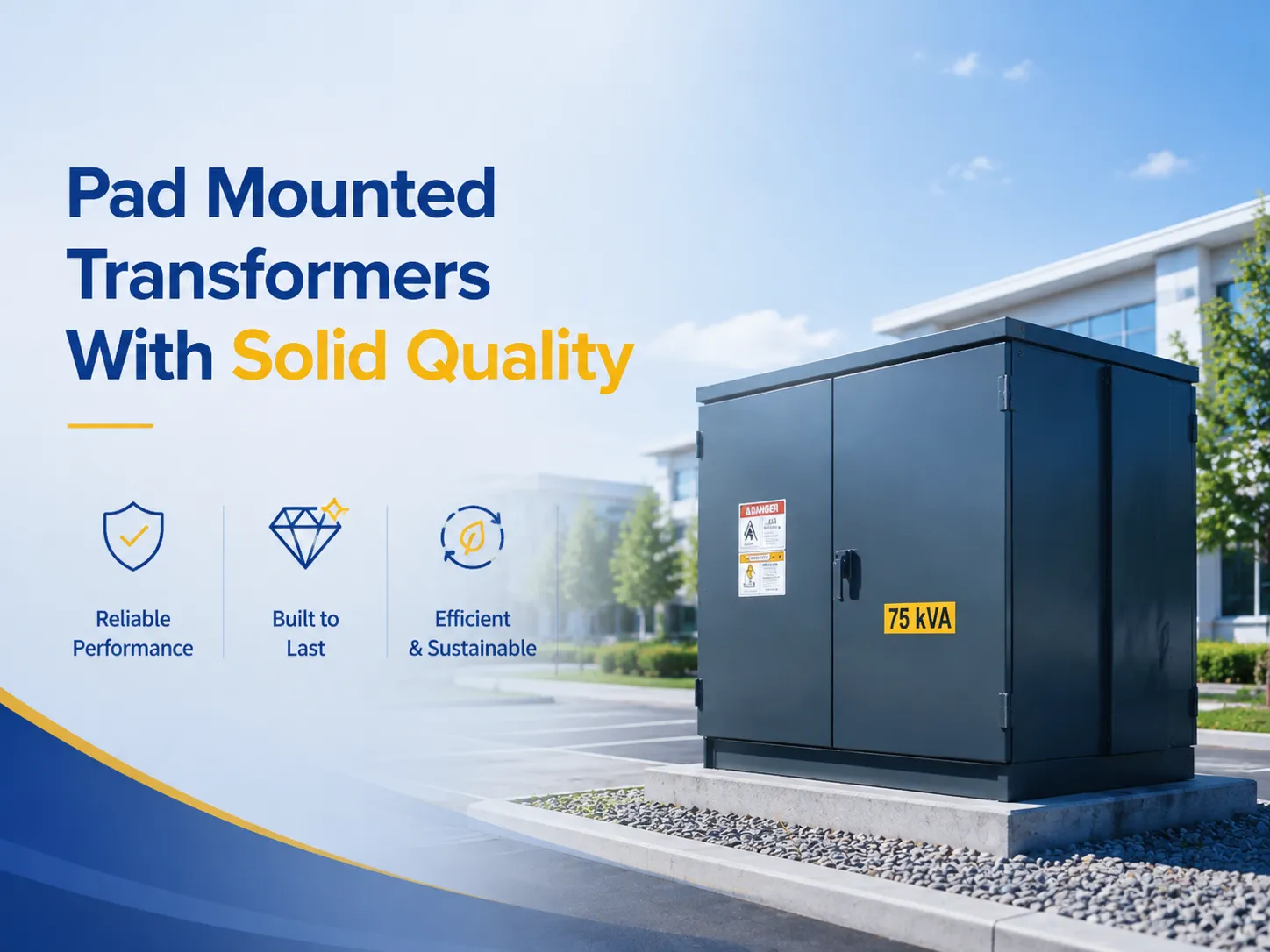
Qu'est-ce qu'un transformateur monté sur socle ?
Un transformateur monté sur socle représente un transformateur de distribution soigneusement enfermé dans un cabinet en acier mis à la terre qui repose sur une base en béton au niveau du sol. C'est une méthode préférable qui est conventionnelle dans les systèmes de distribution souterrains en Amérique du Nord et a été de plus en plus utilisée au Moyen-Orient, en Amérique latine, et en Asie du Sud-Est, où les entreprises de services publics et les promoteurs préfèrent dissimuler les équipements de distribution afin que les équipements montés sur poteau ne posent plus de risques pour la sécurité.
Cette famille de produits est définie par deux éléments – le premier est connu sous le nom de “ conception à façade morte ”, ce qui signifie une extrémité sous tension à l'autre extrémité du câblage à l'intérieur d'un connecteur isolé et protégé, ce qui, à son tour, signifie qu'il n'y a pas de points sous tension exposés même en cas d'ouverture de la porte du cabinet. Deuxièmement, la conception résistante aux manipulations implique que l'enveloppe doit être fabriquée de manière à garantir qu'une ouverture sans autorisation n'expose pas des composants sous tension, ce qui est spécifié par l'IEEE C57.12.27. Le transformateur est ordinairement à huile, monophasé ou triphasé ; sa capacité varie de 75 kVA à 5000 kVA, en fonction des exigences du secteur des services publics.
Le terme “ monté sur socle ” fait référence à l'installation plutôt qu'à la tension où les principales classes de tension primaire sont 15 kV, 25 kV, et 35 kV, avec des configurations de prises standard ayant une tension secondaire de 240/120 V monophasé et 480Y/277 V triphasé.
Que signifie réellement “ qualité solide ” ?
“La ”qualité solide“ est simplement un terme de marché à moins qu'il ne soit appliqué à des critères mesurables. Dans le secteur des transformateurs montés sur socle, la ”qualité solide" signifie cinq choses mesurables :
- Conception certifiée : L'équipement est conçu et testé conformément à l'IEEE C57.12.00 (spécifications générales), à l'IEEE C57.12.90 (normes de test) et à l'IEEE C57.12.27 (intégrité de la boîte) avec un rapport de test de type valide.
- Pertes mesurables : Les pertes à vide et en charge de l'unité ne sont pas seulement citées à partir de la spécification de conception mais mesurées physiquement sur chaque unité. Un transformateur monté sur socle de 500 kVA avec une qualité solide a typiquement une perte à vide d'environ 0,8 à 1,2 kW et une perte en charge d'environ 5,5 à 8,5 kW à 85 degrés Celsius.
- Isolation testée : Le transformateur passe des tests d'impulsion en onde complète et en onde coupée, des tests de tension et de tension induite, ainsi que des mesures du facteur de puissance d'isolation.
- Protection réelle de la boîte : Le boîtier répond aux exigences de l'IEEE C57.12.27 en matière de résistance au sabotage, de verrouillage et de circulation d'air et possède un joint de type IP54 avec un compartiment de câble entièrement scellé.
- Matériaux traçables : L'acier du noyau, le fil de cuivre ou d'aluminium et l'huile isolante sont documentés et peuvent être certifiés sur demande.
Si un client demande “est-ce un transformateur monté sur socle de qualité solide ?”, la bonne réponse n'est pas une phrase accrocheuse mais un dossier contenant un rapport de test de type, des certificats de tests de routine, des certificats de matériaux et des normes de contrôle de qualité du site de fabrication. Tout fournisseur incapable de fournir la documentation mentionnée ci-dessus ne vend pas de qualité mais des affirmations.
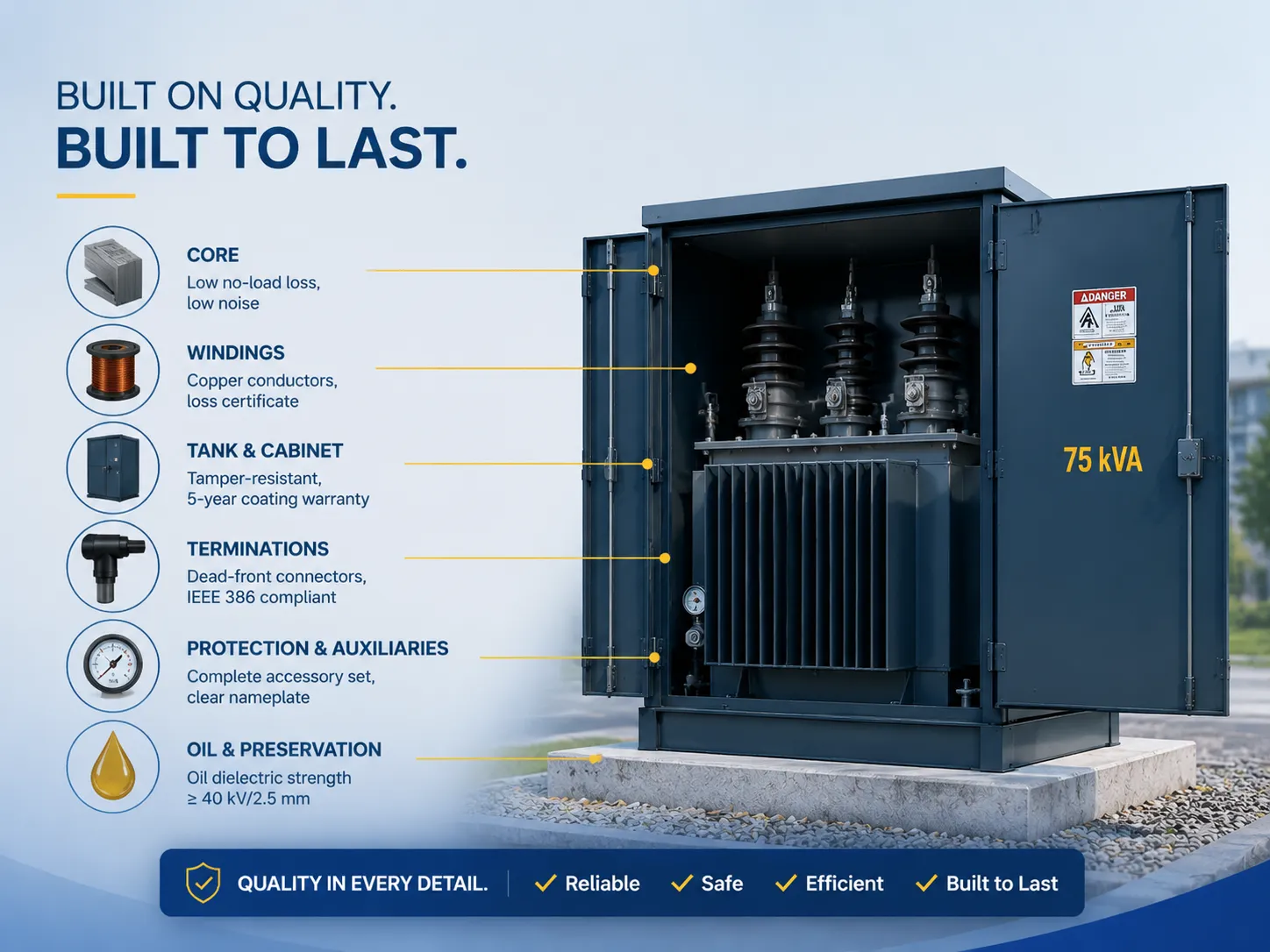
Construction et composants clés
Le transformateur monté sur socle est composé de plusieurs ensembles qui peuvent être bien définis par des facteurs de qualité.
| Assemblage | Composants principaux | Indicateurs de qualité |
|---|---|---|
| Noyau | Feuilles de silicium orientées grain (par exemple, 23ZH085/27ZH095), joints à pas | Faible perte à vide, faible bruit (≤55 dB(A) à 1 m) |
| Enroulements | Conducteurs en cuivre ou en aluminium, enroulement en couche ou en disque, isolation en papier traité | Matériau conducteur documenté, certificat de perte |
| Réservoir et armoire | Enveloppe en acier galvanisé à chaud ou en acier de 14 gauge, verrouillage, charnières internes | Test de résistance au sabotage de l'IEEE C57.12.27, garantie de revêtement de 5 ans |
| Terminaisons | Connecteurs à coude à façade morte, manchons de rupture de charge ou de rupture à vide, supports de stationnement | Répond aux exigences de connecteur de l'IEEE 386 |
| Protection et auxiliaires | Dispositif de décharge de pression, jauge de niveau d'huile, vanne de drainage, plaque signalétique, plaques de mise à la terre | Ensemble complet d'accessoires de fonctionnement, plaque signalétique claire selon l'IEEE C57.12.00 |
| Huile et préservation | Huile minérale (ou huile végétale FR3), conservateur ou réservoir scellé, respirateur dessicant | Force diélectrique de l'huile ≥40 kV/2,5 mm avant expédition |
Les acheteurs potentiels devraient se renseigner sur trois choses. Premièrement, le grade de l'acier du noyau. Deuxièmement, quel type d'enroulements est utilisé (cuivre ou aluminium, et quel est le poids du cuivre ou la conductivité électrique) ? Enfin, le réservoir passe-t-il le test de résistance au sabotage décrit dans la norme IEEE C57.12.27 ?
Types et classifications
| Taper | Plage de classification | Application typique |
|---|---|---|
| Transformateur monté sur socle monophasé | 75–333 kVA | Sous-divisions résidentielles, petits commerces, distribution souterraine rurale |
| Transformateur monté sur socle triphasé | 300–2 500 kVA | Bâtiments commerciaux, écoles, parcs industriels, distribution de campus |
| Grand pad-mount triphasé | 2 500–5 000 kVA | Grands feeders industriels, centres de données, hôpitaux |
| Live-front (ancien style) | 75–2 000 kVA | Installations héritées ; remplacées par dead-front pour la sécurité |
| Dead-front (norme actuelle) | 75–5 000 kVA | Toutes les nouvelles installations selon IEEE C57.12.27 |
Les catégories de tension au niveau primaire incluent la classe 15 kV (en termes de tension maximale de 15,0 kV), la classe 25 kV (en termes de tension maximale de 25,0 kV) et la classe 35 kV (en termes de tension maximale de 34,5 kV). Les configurations de tension secondaire peuvent inclure 240/120 V (pour la conversion monophasée), 480Y/277 V, 208Y/120 V et classe 600 V pour des caractéristiques spéciales. En ce qui concerne l'impédance, la caractéristique est normalement dans la plage de 1,4-5,75%, selon la taille et le design.
Comment cela fonctionne et pourquoi c'est sûr
La procédure est simplement la physique classique des transformateurs – la circulation magnétique induit un courant dans l'enroulement secondaire selon les rapports dictés par le nombre de tours – mais le design est sûr pour les personnes. L'énergie provient du câble haute tension souterrain qui se connecte au coude dead front allant au bushing. Le bushing est isolé et mis à la terre en conséquence, donc aucun élément de courant ne peut être atteint même si la porte du cabinet est ouverte. Le transformateur fonctionne selon le principe de réduction de la tension à un niveau utilisable, et des fils basse tension sortent par le bas du cabinet vers le compteur ou le panneau de service.
Il y a trois couches dans le système de sécurité : le système de connecteurs dead front (IEEE 386), un cabinet inviolable et verrouillé (IEEE C57.12.27), et la mise à la terre du cabinet et du neutre. Ensemble, ils garantissent que peu importe si une personne touche les cabinets, les portes ou les enceintes, elle ne risque pas d'être électrocutée même si le cabinet est attaqué.
Transformateur monté sur socle vs. autres montages de transformateurs
| Facteur | Monté sur socle | Monté sur poteau | Sous-station préfabriquée (type boîte) |
|---|---|---|---|
| Emplacement | Sol, dalle en béton | Poteau utilitaire | Sol, enceinte plus grande |
| Puissance typique | 75–5 000 kVA | Jusqu'à ~167 kVA | 50–2 500 kVA |
| Terminaisons | Dead-front, souterrain | En plein air, aérien | Enclos, câble ou barre omnibus |
| Norme de sécurité | IEEE C57.12.27 | Design ouvert, règles de dégagement | IEC 62271-202 |
| Temps d'installation | 1–2 jours | Heures (équipe de poteaux) | 2 à 5 jours |
| Impact visuel | Bas (cabinet au niveau du sol) | Haut (poteau + fils) | Modéré |
| Meilleur pour | Distribution souterraine, urbaine/suburbaine | Lignes rurales aériennes | Besoins en commutation MV/LV + transformateur |
La considération prise par les distributeurs détermine la préférence : les systèmes aériens utilisent toujours des poteaux, les systèmes souterrains utilisent toujours des montages sur socle et partout où des équipements de commutation MV, de comptage et de protection doivent être installés au même endroit, la sous-station préfabriquée est un choix. Partout où l'esthétique, la sécurité contre le sabotage et l'alimentation électrique souterraine sont importantes, les montages sur socle sont plus avantageux que les autres.
Normes et tests
| Norme | Portée | Exigence clé |
|---|---|---|
| IEEE C57.12.00 | Exigences générales pour les transformateurs de distribution immergés dans un liquide | Évaluations, impédance, accessoires, plaque signalétique |
| IEEE C57.12.90 | Procédures de test pour les transformateurs de distribution | Tests de perte, d'impédance, diélectriques, d'impulsion |
| IEEE C57.12.27 | Intégrité de l'enceinte de l'équipement monté sur socle | Avant mort, résistance au sabotage, verrouillage |
| IEEE 386 | Systèmes de connecteurs isolés séparables | Exigences des connecteurs coudés à avant mort |
| IEC 60076 (pour les unités d'exportation) | Transformateurs de puissance | Base de test internationale alternative |
| Efficacité DOE 2016 (Amérique du Nord) | Efficacité des transformateurs de distribution | Niveaux d'efficacité minimum obligatoires |
Des tests de fonctionnalité standard sont effectués sur chaque unité. Des tests tels que le rapport et le groupe vectoriel, la résistance des enroulements, les pertes à vide et en charge, la tension d'impédance, la résistance diélectrique (tension appliquée et induite), la résistance d'isolement et les tests de pression/vacuum du réservoir sont réalisés. Les tests de type ou d'endurance (impulsion, élévation de température, résistance au court-circuit) ne sont effectués qu'une seule fois par famille. Aux États-Unis, les normes minimales d'efficacité (adoptées en 2016, appliquées en 2019) limitent les pertes et interdisent tout acier de noyau à faible efficacité.
Coûts et fourchettes de prix
Les prix des transformateurs montés sur socle de bonne qualité (triphasés, avant mort, 15–35 kV, 480Y/277 V secondaire, enroulements en cuivre) sont indiqués ci-dessous.
| Puissance | Classe de tension | Prix typique (USD) | Délai de livraison |
|---|---|---|---|
| 75–150 kVA (monophasé) | 15–25 kV | $1,800–$3,500 | 8–16 semaines |
| 300–500 kVA | 15–25 kV | $4,500–$9,000 | 10–20 semaines |
| 750–1,000 kVA | 25–35 kV | $8,500–$16,000 | 12–22 semaines |
| 1,500–2,500 kVA | 25–35 kV | $12,000–$30,000 | 14–28 semaines |
| 3 000–5 000 kVA | 35 kV | $25 000–$60 000 | 16–32 semaines |
Augmentez le prix de 5–10% pour la classe de 35 kV au lieu de 15 kV, de 5–8% pour la classe d'acier de noyau à plus haute efficacité, et de $300–$1500 pour des options supplémentaires (protecteurs de surtension, coudes à rupture de charge ou huile végétale). Les prix ci-dessus sont indiqués Ex Works et varient en fonction des spécifications, des marques et des régions. Le délai d'attente pour la livraison des transformateurs est très long, donc les acheteurs doivent vérifier la disponibilité des appareils à l'avance.
Meilleures marques et comparaison des prix
| Marque | Pays | Force | Prix indicatif — 500 kVA (USD) |
|---|---|---|---|
| Prolec GE | USA/Mexique | Leader du marché nord-américain, base de référence des services publics | $6,500–$12,000 |
| Hitachi Energy (ABB) | Suisse | Ingénierie mondiale, large portefeuille de transformateurs | $7,000–$13,000 |
| Siemens | Allemagne | Options numériques, couverture des normes internationales | $7,000–$12,500 |
| Schneider Electric | France | Solutions de distribution, réseau de services mondial | $6,800–$12,000 |
| Eaton | États-Unis | Large gamme de transformateurs montés sur socle pour le commercial et les services publics | $6,500–$11,500 |
| Jiangsu Subian Electric Power | Chine | Transformateurs montés sur socle conformes aux normes IEEE/IEC, enroulements en cuivre, OEM | $4,500–$9,000 |
Les meilleurs producteurs nord-américains peuvent garantir une qualification réussie pour les entreprises de services publics, des livraisons immédiates et un service après-vente. Jiangsu Subian Electric Power a commencé à produire des transformateurs montés sur socle selon les normes IEEE C57.12 avec des enroulements en cuivre, une terminaison à l'avant mort et un certificat de test de pertes à un prix minimal – environ 30–45% inférieur à celui des entreprises occidentales. Subian peut offrir des tests certifiés, une documentation concernant les pertes réalisées et le coût des transformateurs, ce qui fait de l'entreprise un bon candidat pour entrer dans la liste finale restreinte pour fournir ce type d'équipement avec des entreprises occidentales.
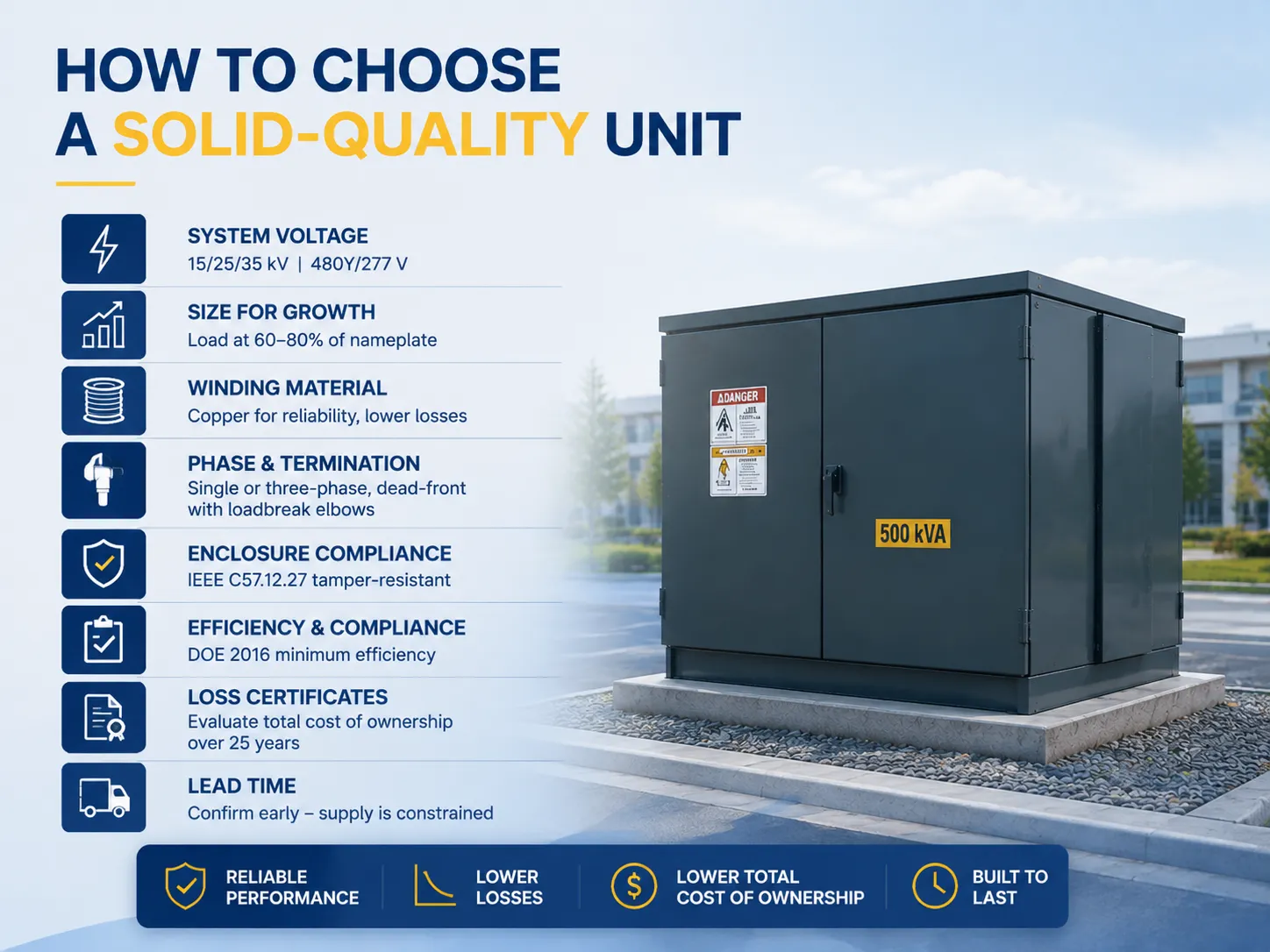
Comment choisir une unité de qualité solide
- Confirmer la tension dans le système — classe de tension primaire (15/25/35 kV) et tension secondaire précise (par exemple, 480Y/277 V).
- Dimensionner pour la croissance de la charge — sélectionner le kVA pour la charge de pointe 60–80% de la plaque signalétique ; une unité de 500 kVA servant 400 kVA de pointe laissera de la place pour la croissance.
- Choisir le matériau d'enroulement judicieusement, en considérant le cuivre pour une fiabilité maximale et des pertes réduites, tandis que l'aluminium est moins cher mais ses pertes doivent être examinées.
- Choisir la phase et la terminaison et décider du type de phase, à l'avant mort ou autre, où les coudes à l'avant mort et à rupture de charge sont utilisés pour des commutations fréquentes.
- Exiger la conformité à la norme IEEE C57.12.27 et examiner le mécanisme de verrouillage pour vos locaux.
- Vérifier la classe de pertes et vérifier la conformité avec les directives du DOE. Dans ce cas, veuillez prêter attention à l'efficacité minimale du DOE 2016 aux États-Unis.
- Obtenir un certificat de pertes pour chaque unité, puis calculer le coût total de possession sur 25 ans (TCO) après avoir corrigé vos hypothèses.
Liste de contrôle d'inspection avant livraison
- La plaque signalétique correspond à la spécification en termes de puissance kVA, de tension, de valeur d'impédance, de vectorisation de groupe et de prises.
- Les résultats des tests incluent le rapport, les pertes, les valeurs d'impédance, la résistance diélectrique et d'isolation.
- L'intégrité de l'enceinte a été vérifiée : un cambriolage peut être effectué par des portes ouvertes ; les charnières fonctionnent correctement et les joints sont intacts.
- Les accessoires du réacteur nucléaire sont propres, et le type de connecteur correspond à la norme IEEE 386.
- Propriétés de l'huile : le niveau de tension de rupture total ne doit pas être inférieur à 40 kV/2,5 mm ; le niveau d'huile est visible de l'extérieur, et il n'y a pas de fuites visibles aux joints du réservoir et aux vannes.
- Les accessoires du réservoir sont présents, tels que le dispositif de décharge de pression, la vanne de drainage et les plaques de mise à la terre.
- La documentation est complète : documentation IEC et IEEE, certificat des matériaux, rapport de contrôle qualité.
Questions Fréquemment Posées
Combien coûte un transformateur monté sur socle ?
En général, les transformateurs montés sur socle peuvent varier en prix en fonction de leur classe de tension nominale. Le prix d'un transformateur monophasé de 75-150 kVA peut aller de $1,800 à $3,500. D'autre part, un transformateur triphasé monté sur socle de 500 kVA peut varier de $4,500 à $9,000 et un grand transformateur monté sur socle de 1500-2500 kVA coûte généralement autour de $12,000 à $30,000. D'autres facteurs tels que les accessoires supplémentaires, le type d'enroulements et la classe d'efficacité ajoutent généralement 5-20% au prix. Notez que tous les prix mentionnés ci-dessus sont des prix indicatifs FOB qui peuvent varier selon la marque, la région et les spécifications.
Quelle est la différence entre les transformateurs montés sur socle à façade morte et à façade vivante ?
La différence fondamentale entre les deux types de transformateurs concerne les unités à façade morte. Ces types de transformateurs sont des unités isolées et blindées à façade morte sans parties sous tension présentes, même lorsque la porte du coffret est ouverte. Les transformateurs à façade morte respectent les normes IEEE C57.12.27 pour toutes les nouvelles installations. Quant aux transformateurs à façade vivante, les problèmes de sécurité qu'ils peuvent engendrer en raison des traversées sous tension exposées sont les raisons pour lesquelles ils sont devenus obsolètes il y a plusieurs décennies. Notez que les unités à façade morte présentent plus d'avantages que celles à façade vivante.
Quelle est la durée de vie d'un transformateur monté sur socle ?
En général, les transformateurs peuvent durer jusqu'à 25-40 ans s'ils sont correctement entretenus et fabriqués. Plusieurs aspects déterminent la durée de vie prévue des transformateurs, notamment l'âge de l'isolation jusqu'au moment de la défaillance (qui dépend de la température et des niveaux d'humidité), l'état de l'huile utilisée dans un transformateur et l'historique de fonctionnement de l'équipement. C'est la raison pour laquelle les opérateurs prélèvent généralement des échantillons d'huile tous les deux à cinq ans pour surveiller les niveaux d'humidité, les niveaux de gaz dissous (DGA) et la résistance électrique.
Les transformateurs montés sur socle ont-ils besoin d'une clôture ?
Le principal avantage des transformateurs montés sur socle réside dans le fait qu'il n'est pas nécessaire de construire une clôture supplémentaire autour du transformateur. En raison des dispositions de sécurité anti-sabotage auxquelles ces transformateurs se conforment selon la norme IEEE C57.12.27, il n'est pas nécessaire de protéger les transformateurs par une clôture environnante ou d'autres solutions de sécurité. De plus, les transformateurs sur socle sont généralement positionnés à proximité de nombreux objets importants autour des terrains de jeux, des trottoirs et même des entrées.
Quel est le délai de livraison pour les transformateurs montés sur socle ?
Le délai de livraison prévu pour les transformateurs dépend généralement de leur capacité et de la charge de travail de l'usine. Les transformateurs triphasés standard nécessitent environ 10-22 semaines pour le processus de fabrication tandis que les transformateurs plus grands (avec une capacité de 3000-5000 kVA) peuvent être produits en 16-32 semaines. Le délai de livraison aux États-Unis a augmenté à plus de 30 semaines en raison des pénuries actuelles d'équipements et les créneaux de production doivent être réservés à l'avance.
Références
-
-
- IEEE C57.12.00 — Exigences générales pour les transformateurs de distribution immergés dans un liquide — la conception de base et la norme de classification pour les transformateurs montés sur socle.
- IEEE C57.12.90 — Procédures d'essai pour les transformateurs de distribution — la base d'essai pour les pertes, la performance diélectrique et d'impulsion.
- IEEE C57.12.27 — Intégrité de l'enceinte des équipements montés sur socle — l'exigence de façade morte et de résistance à la manipulation définissant la qualité de l'enceinte solide.
- IEEE 386 — Systèmes de connecteurs isolés séparables — exigences pour les connecteurs coudés à façade morte.
- U.S. DOE — Normes d'efficacité des transformateurs de distribution — niveaux d'efficacité minimum obligatoires pour les unités vendues aux États-Unis.
- NEMA — Guide d'application pour les transformateurs de distribution — guide d'application et de classification pour le marché nord-américain.
- Jiangsu Subian Electric Power — site officiel — fabricant et exportateur de transformateurs montés sur socle conformes à l'IEEE.
-
Conclusion
La qualité extensive des transformateurs montés sur socle n'est pas simplement une déclaration marketing ; c'est une combinaison d'un processus certifié, de pertes vérifiées, d'une isolation testée, de couvercles infranchissables et de matériaux traçables. Tous les clients capables de vérifier ces cinq facteurs par écrit, d'inspecter visuellement le produit avant paiement et de comparer les pertes testées se protégeront des problèmes d'importations de mauvaise qualité.
- Exiger la conformité aux normes IEEE C57.12.00/.27/.90 et des rapports d'essai réguliers pour tous les appareils.
- Commandez des appareils pour au moins 60-80% de la valeur nominale de la charge et indiquez des solutions à face avant morte en cuivre où la fiabilité est requise.
- Comparez les offres en fonction des pertes évaluées sur 25 ans au lieu de ne considérer que le prix initial et estimez le délai d'exécution à l'avance.
- Assurez-vous d'inspecter l'enceinte, les connexions, l'huile et la documentation avant d'accepter la livraison finale.
- Prenez en compte les principales entreprises nord-américaines, par exemple Prolec GE, Eaton, ainsi que celles certifiées IEC/IEEE comme Jiangsu Subian Electric Power.