


I tempi di consegna dei trasformatori hanno raggiunto il picco nel 2023/primi mesi del 2024, ma sono migliorati dalla fine del 2025, anche se non sono ancora tornati ai tradizionali tempi di consegna da due a quattro mesi per i trasformatori di distribuzione standard del 2019. Il mercato dei trasformatori è diviso in due parti distinte: 1) Unità di distribuzione standard disponibili in mesi; e 2) Unità grandi o personalizzate che ancora presentano tempi di consegna di anni.
Risposta rapida: I tempi di consegna per i trasformatori di distribuzione standard sono generalmente da 16 a 30 settimane dall’ordine alla consegna per unità che vanno da 50 kVA a 2.500 kVA, in forte diminuzione rispetto ai tempi di consegna da 50 a 80 settimane nel picco del 2023. Tipicamente, le unità a secco in media tensione hanno un tempo di consegna da 12 a 24 settimane. Allo stesso tempo, tuttavia, i grandi trasformatori di potenza superiori a 100 MVA generalmente presentano ancora tempi di consegna da 18 a 30 mesi, mentre i trasformatori di salita per generatori possono avere tempi di consegna superiori a 30 mesi o più. Inoltre, le specifiche personalizzate per grandi unità aggiungono tipicamente da 8 a 16 settimane per le approvazioni di progetto e i test di tipo. I prezzi dei trasformatori sono aumentati tra il 60 e il 90 percento dal 2020. I prezzi si sono anche stabilizzati e ora sono a un livello simile a quello di quattro anni fa.
Nelle sezioni seguenti: gamme di trasformatori attualmente disponibili, motivi della continua carenza di trasformatori sul mercato; suddivisione dei tempi di consegna dei trasformatori per prodotto; descrizione degli elementi che influenzano i tempi di consegna dei trasformatori; confronto tra trasformatori standard e personalizzati; descrizione delle caratteristiche offerte dai vari produttori, incluso il nostro; illustrazione delle strategie per proteggere un programma; spiegazione di come è strutturato un tempo di consegna quotato; elenco di domande da porre prima di effettuare un ordine.
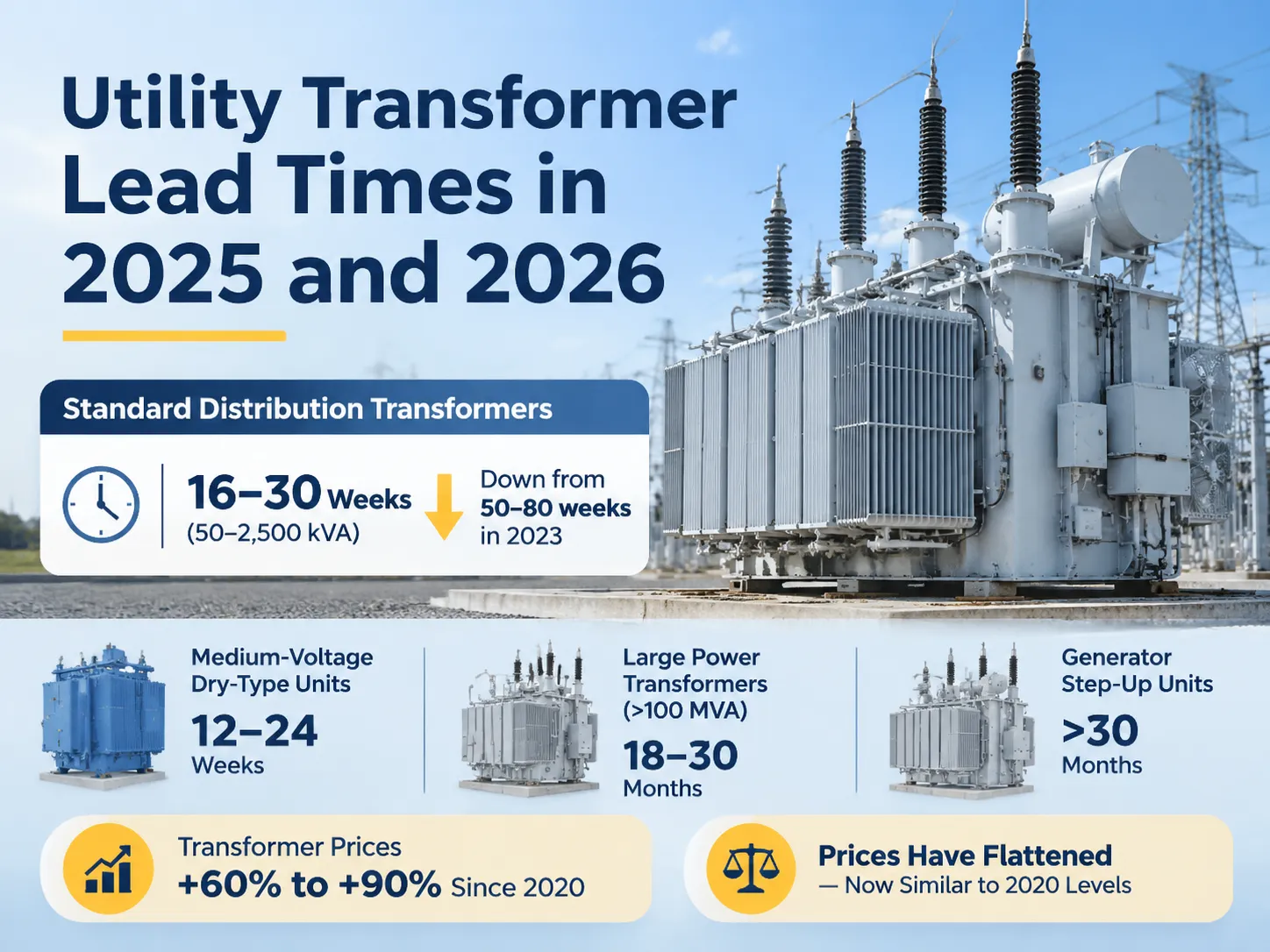
Per riassumere i tempi di consegna dei trasformatori nel 2025 e 2026
Punto di massimo strozzamento: 2023 fino ai primi mesi del 2024 e oltre. Le utility hanno iniziato a ordinare in anticipo rispetto alla crescita della domanda e a mettere in esercizio progetti rinnovabili, mentre le fabbriche che producono acciaio elettrico orientato a grani non sono riuscite ad espandersi allo stesso ritmo. Nel 2023 un’unità montata su basamento da 500 kVA veniva quotata a 70 settimane; ora viene quotata tra 20 e 26 settimane.
La ripresa non è distribuita in modo uniforme. La ripresa dipende dal tipo di prodotto prodotto. Un’unità di distribuzione da catalogo basata su design standard di nucleo e bobina può essere prodotta in mesi. Tuttavia, se l’unità richiede un nuovo design del serbatoio, un’impedenza non standard o un test di tipo, la tempistica di produzione varierà con ritardi sia in fabbrica che negli uffici di ingegneria.
La ripresa del settore dei grandi trasformatori di potenza è la meno migliorata rispetto alle altre categorie di trasformatori. In questo caso, il collo di bottiglia non è l’acciaio ma il banco di prova e gli avvolgitori qualificati. La capacità di entrambi non può essere aumentata entro un anno. Un’unità da 200 MVA ordinata nel 2026 deve essere prevista come disponibile nel 2028.
Perché l’industria rimane indietro
Ci sono tre ostacoli alla ripresa nel settore. Nessuno di questi è attribuibile agli arretrati di ordini.
Un numero molto limitato di acciaierie nel mondo produce acciaio elettrico orientato al grano e non può rapidamente mettere in funzione nuove linee di ricottura e rivestimento per produrre acciaio elettrico orientato al grano. La costruzione di una nuova linea di produzione è una spesa in conto capitale pluriennale e ci vorranno diversi anni per assorbire lo shock della domanda. È per questo che i materiali del nucleo—non il rame o la manodopera—determinano il tono della carenza di approvvigionamento.
Gli avvolgitori qualificati richiedono tempo per essere formati. Sebbene l’avvolgimento di un trasformatore di distribuzione sia un processo ripetibile e possa essere facilmente eseguito da chiunque, un’unità da 100 MVA è qualcosa di completamente diverso e, a causa della forza lavoro disponibile che si sta riducendo e invecchiando, rimane solo un piccolo numero di persone qualificate in ogni mercato.
Indipendentemente dal numero totale di unità assemblate all’interno di un impianto, la capacità della camera di prova per trasformatori di potenza di grandi dimensioni è ciò che limita la produttività complessiva di qualsiasi fabbrica. Un singolo trasformatore di potenza di grandi dimensioni può trascorrere diversi giorni in una camera di prova, il che rende l’area della camera di prova all’interno di un impianto di produzione il metro quadrato più costoso di gran lunga. Negli ultimi dieci anni ci sono stati cambiamenti minimi a livello globale in termini di capacità delle camere di prova.
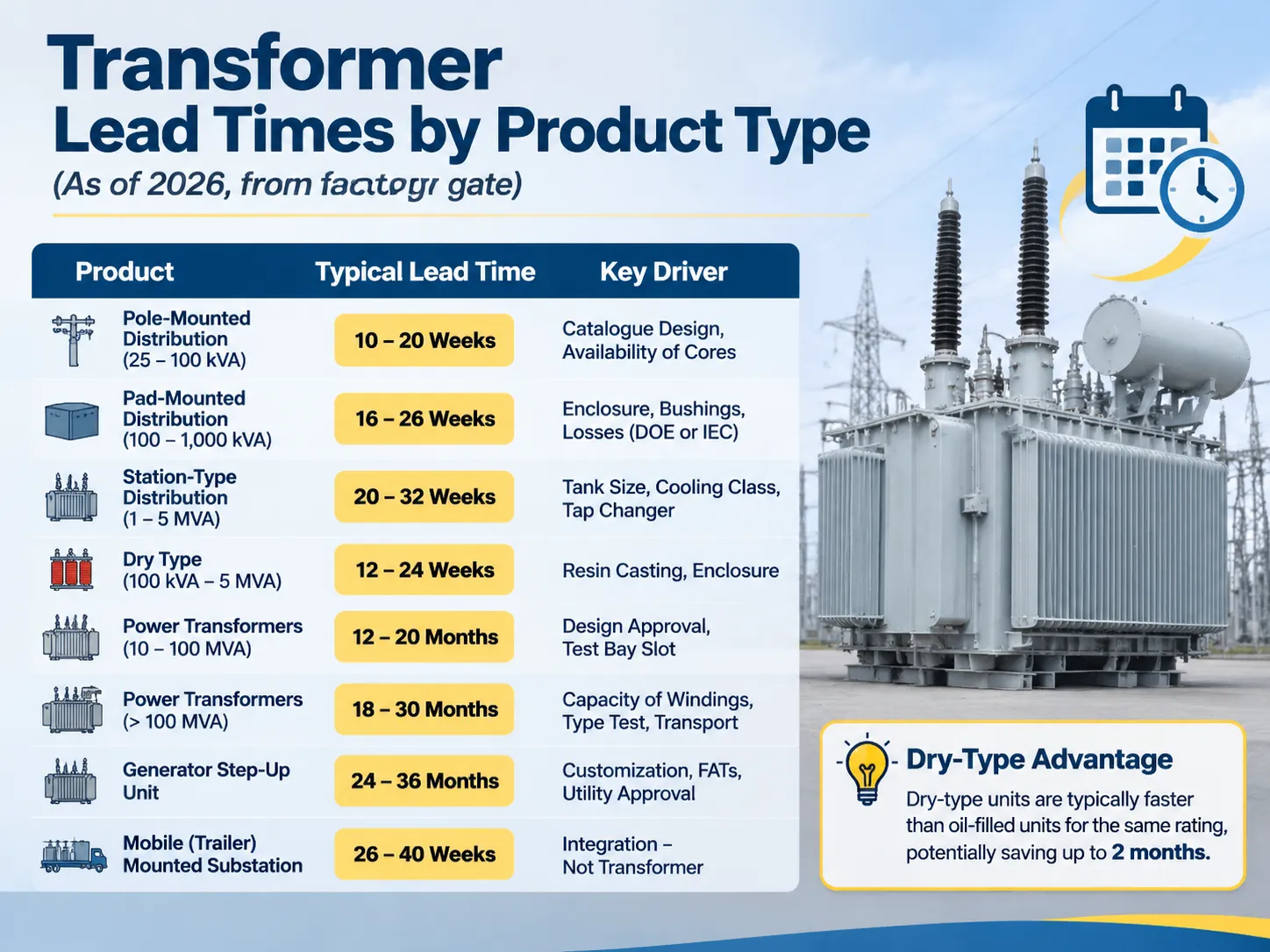
Tempi di Consegna per Tipo di Prodotto
La tabella sottostante rappresenta l’intervallo di tempi indicati per la consegna di nuovi ordini di trasformatori dalla porta della fabbrica a partire dal 2026. Inoltre, si prega di tenere presente che il trasporto e i lavori in cantiere si aggiungono a questo totale.
| Prodotto | Tempi di Consegna Tipici | Fattore Determinante |
|---|---|---|
| Distribuzione su Palo (25 a 100 kVA) | 10 a 20 Settimane | Design da Catalogo, Disponibilità dei Nuclei |
| Distribuzione su Basamento (100 a 1.000 kVA) | 16 a 26 Settimane | Tipo di Involucro, Passacavi, Perdite (DOE o IEC) |
| Distribuzione Tipo Stazione (1 a 5 MVA) | 20 a 32 Settimane | Dimensione del Serbatoio, Classe di Raffreddamento, Cambiatap |
| Tipo a Secco (100 kVA a 5 MVA) | 12 a 24 Settimane | Capacità di Colata della Resina, Involucro |
| Trasformatori di Potenza (10 a 100 MVA) | 12 a 20 Mesi | Approvazione del Progetto, Slot in Camera di Prova |
| Trasformatori di Potenza (Oltre 100 MVA) | 18 a 30 Mesi | Capacità degli Avvolgimenti, Prova di Tipo, Trasporto |
| Unità di Incremento Generatore | 24 a 36 Mesi | Personalizzazione, FAT, Approvazione Utility |
| Sottostazione Mobile (Rimorchio) | 26 a 40 Settimane | Integrazione – Non Trasformatore |
Nota: Le unità a secco sono di interesse perché sono tipicamente più veloci rispetto alle unità riempite d’olio per la stessa potenza nominale. Poiché un’unità in resina colata non richiede un serbatoio né la lavorazione dell’olio, la sequenza di produzione è più breve, il che può consentire a un progetto di risparmiare fino a due mesi se si accetta un tipo a secco da interno.
Il prezzo e la consegna per un’unità da 100 kVA rappresentano un buon punto di riferimento poiché questa è la dimensione del mercato di volume e qui si è verificata la maggior parte del recupero dei tempi di consegna.
Cosa Può Cambiare: Dimensione, Tensione e Specifica
La dimensione è la variabile più evidente e non segue una progressione lineare. Raddoppiare la potenza nominale di un trasformatore praticamente raddoppia la quantità di materiali necessari e comporta un aumento significativo della complessità nei punti di transizione della classe di raffreddamento, nei livelli di tensione quando l’isolamento diventa un problema nel progetto, e nelle dimensioni complessive che non rientrano nelle modalità tipiche di spedizione.
L’isolamento ha una connessione diretta con la tensione del trasformatore installato. Ad esempio, un trasformatore da 33 kV (dal punto di vista del progetto e della produzione) è una tensione nominale comune. L’unità da 132 kV richiederà boccole, distanze di sicurezza e prove di impulso, che comporteranno la costruzione e lo stoccaggio del trasformatore in un diverso stabilimento e il suo inserimento in una linea di completamento differente.
As the voltage of the transformer continues to increase, the number of companies that produce transformers above approximately 145 kV (as a guide) decreases significantly. For this reason, it can be expected that the lead times for these types of products will grow faster than the electrical rating of the product.
Thirdly, specification: an example of a compliant distribution transformer from the DOE (Department of Energy) with a standard impedance would be considered a catalogue product. However, the same rating but with non-standard impedance for parallel, a specific tap range, an assured low level of noise, or a specific vector group would constitute as an engineered order and, because of the requirement for engineering approval, could take up to six weeks.
The oil-immersed distribution transformer in the 20 kV voltage class serves as a good example. The factory builds the units to the various ratings of the product based on the catalogue of standard builds for each of those ratings, while the 20 kV insulation class establishes the design family to which the transformer belongs.
Custom vs. Standard – Two Timing Clocks
As mentioned before, a standard unit runs by means of a production clock, where the processes of receipt of material, winding, assembling, testing, painting, and shipping overlap; therefore, the factory will be able to forecast the lead time of all of these steps because the design for the standard unit will always be available.
A custom transformer may have the same structure as a standard transformer but have 2 timing clocks operating on the same order. The design clock will start with the day the customer orders and will conclude when the engineering and the utility approve the drawing. Once a project starts producing, the production clock begins counting down. So, estimating 10 weeks of production time (from the manufacturer) + 20 weeks for the project delivery to arrive = 30 weeks total time frame from “start to finish.” This is why projects that are anticipating using catalogue estimates fall behind schedule.
By removing the specification approval process for early-stage design and accepting a generic design early on, it is possible to compress the length of time required for the production process. Most non-standard impedances have a standard because the study that was conducted assumed a value of the impedance; there is no specific reason why that impedance type is needed for a particular project.
A Manufacturer’s Review of Expectations
Grid-scale manufacturers, including both Hitachi Energy and Siemens Energy, cite longer quotes than their competitors and typically hold to their dates more closely than others. A manufacturer that provides a 24 month quote for large power transformer manufacturing facilities has a more reliable delivery date than one that provides a 14 month quote for smaller power transformer manufacturing facilities. Large manufacturers have their own testing bays and have greater control over winding capacity than do smaller manufacturers.
The European Mid-Market, (represented by SGB-SMIT), is in the middle of the pack: they manufacture distribution and medium power units with delivery times ranging from 16 weeks to 30 weeks, with an advantage over non-European manufacturers due to access to European documentation and shorter shipping distances.
North American distribution manufacturers, including Prolec GE and ERCO, represent an expedited route for North American projects; they estimate 16-30 weeks for delivery, build to meet the project specifications (there is no adaptation of the IEC design to meet project specifications), therefore they are able to provide faster turnaround than overseas manufacturers.
The Chinese manufacturers, such as TBEA and China XD, are price competitive and can provide a completed distribution unit in a very short time frame of between 12 and 20 weeks, plus delivery time, and are frequently the quickest source of power transformer units for African and Southeast Asian regions. The only thing limiting the production of transformers is the documentation and approvals at the receiving end; however at SUBIAN we have complete control over the time it takes to manufacture both cores and windings for all of our transformers.
Timeframe Expectations
The construction lead times for our oil-filled and dry-type distribution transformers are based on the size of the transformer you would like to order, but also on whether the transformer involves a configuration with unique impedances, enclosures, substation packages, etc. The standard timeframe for ordering an oil-filled distribution transformer is generally between 12 and 20 weeks, and between 10 and 16 weeks for the dry-type distribution transformers. If you have a standard rated transformer in stock, it will qualify for the shortest quoted timeframe (12 to 20 weeks) for manufacturing & delivery. Any timeframes given that exceed those for the least costly method to manufacture & deliver the transformer (12 to 20 weeks), are based on unique specifications.
Unlike other manufacturing facilities that manufacture their own winding, our facility builds all of our own tanks and windings in-house. This offers SUBIAN a manufacturer lead-time advantage compared with those manufacturers who must purchase their windings or tanks and have limited control over their speedy production.
SUBIAN will always provide you with an ordered slot for your order rather than just an estimated time frame. For us, when we have our own winding department, tank building facility and testing bay; we will be able to guarantee your ordered lead-time. Whenever we quote transformer or substation prices, we will always list the lead-times for the ordering slot in the quotation.
The only limiting factor in the overall manufacture of your requested transformer is the length of time required to obtain Utility Approval. While the Utility Approval process is an integral part of our construction timeframe, the Utility Approval timelines fall outside of SUBIAN’s manufacturing construction timetable. Therefore, if your order requires an industry witness acceptance test, approved third-party type test, or Utility specification review, those timelines must be accounted for.
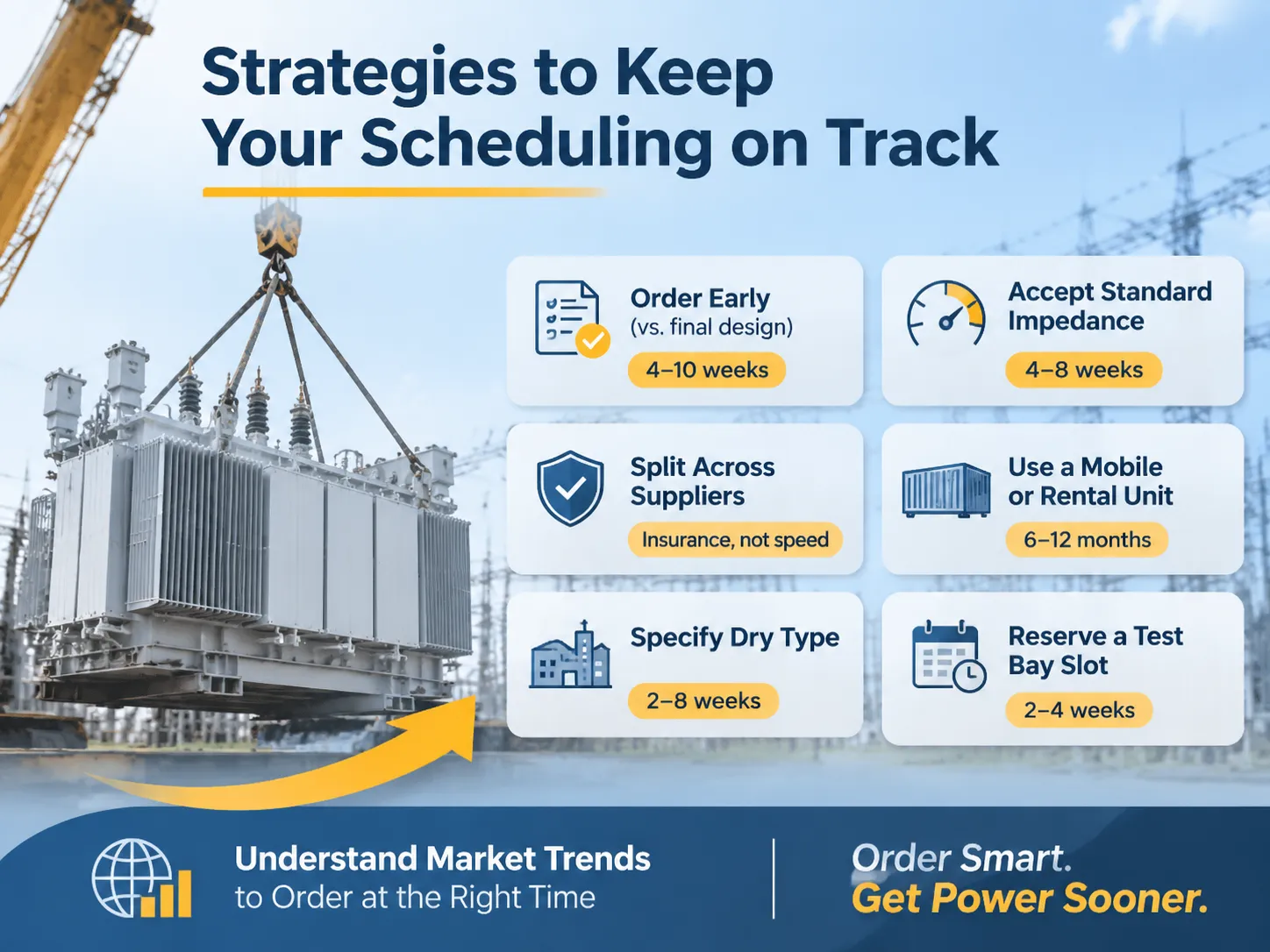
Strategies to Keep Your Scheduling on Track
| Tactic | What it buys | When to use it |
|---|---|---|
| Order before the design is frozen, against a performance spec | 4 to 10 weeks | Any project with a hard energisation date |
| Accept a standard impedance and tap range | 4 to 8 weeks | Where the study allows it |
| Split the order across two suppliers | Insurance, not speed | Multi-unit projects |
| Use a mobile or rental unit as an interim | Bridges 6 to 12 months | Replacements and emergency capacity |
| Specify dry type where the building allows | 2 to 8 weeks | Indoor commercial and industrial |
| Pay for a reserved test bay slot | 2 to 4 weeks | Large power units with a fixed date |
Thanks to that row, the entire project can occur much faster than it would normally. By ordering a transformer based on the performance specification prior to finalizing the single line diagram, it allows for a transformer to go to production sooner and to be changed later in the event that the calculated impedance changes; while a project that waits for the fully approved drawing will have already spent approval time twice.
When analyzing the global transformer market, it provides the backdrop for understanding the reasons for ordering in a certain time frame, thus making ordering today to take advantage of the seasonal demand.
Definition of “Lead Time”
A lead time is the amount of time between a signed order with a deposit and notice of dispatch readiness. The lead time does not count freight shipping time, customs clearance time, site delivery time, installation time, or commissioning time; there are variations that can add anywhere from four to sixteen weeks depending on routing.
Typically, three factors are excluded and frequently overlooked. Most large manufacturers usually count the approval of the order separately from the approval of the drawings and some don’t even include the approval of material for production until all approvals are received, at which point it will have to be produced on a scheduled basis.
Factory acceptance tests often require a witness and a slot of time to conduct. Spare part delivery is commonly shipped after the main unit.
The best way to determine the lead time for your product is to request a schedule rather than just a single number. The schedule should list all of the important milestones in the order fulfillment process, such as the date the order was placed, the date all drawings were approved, the date all materials were released, the date all windings began, the date the unit was test conducted, and the date the unit was shipped.
If a supplier can provide you with a detailed schedule, it is likely he/she has planned to complete the order and the supplier who only provides a single date has not.

Some Questions to Ask Your Supplier
- Is the quoted lead time based on the date the order was placed or the date the drawings were approved?
- If you need to approve the drawings, what is the average number of weeks required to get approval?
- Does the supplier include factory acceptance testing as part of the above lead time?
- Are any of the components for the transformer purchased from third-party vendors, and what are their respective lead times?
- What is the current lead time to manufacture a transformer of the same rating for another customer (note: this question differs from the previously requested standard lead time)?
- If the specifications change after the drawing release, what will be the additional number of weeks and cost to produce the revised product?
- Does the factory have a reserved production slot for the order, and is there a provision in the contract for its use?
- What is the penalty/credit to the vendor if the equipment is not delivered on time?
- What will be included with the shipped unit, and does this include routine test reports and material certificates?
- What is the lead time for ordering spare bushings, tap changers and oil? A transformer that has a two-year lead time for a spare bushing presents a potential two-year outage risk. Typically, spare parts for substations fall under the category of substation components, as they are included in the same package with the main unit (i.e., when ordered together, not separately later).
Domande frequenti
What is the 80 percent rule on transformers?
This is an industry standard and not a requirement of the National Electrical Code (NEC). It is common for transformers to be designed to carry continuous loads at no more than about 80 percent of their nameplate rating, because prolonged operation with loads exceeding that shortens the life of the insulation and does not allow for future load growth. For example, NEC requires that overcurrent protective devices are sized at 125 percent to provide an equivalent margin from the opposite side.
Once the transformer is finally ordered, how long does it take to get a new one?
The timeframe for receiving a transformer can vary greatly based on size and design from a few weeks (12 weeks or more) for smaller dry-type standard models, three years for a custom generator step-up transformer, up to and including also having to wait for a type test. The main factors that determine delivery time are rating, voltage class, existing design, and the type of test required to complete the transformer.
Why does it still take so long to get a lead time for a transformer?
There are three major factors that contribute to this: The availability of grain-oriented electrical steel is highly limited to a small number of mills, skilled winders need years of training, and the available test bay capacity limits the number of large units that can be completed by a factory at any given time; therefore, none of these factors can be easily increased.
Will I be able to get a transformer in a shorter time frame if I pay more?
This depends; it may be possible to purchase a reserved slot on the production schedule for a large transformer or purchase air freight to expedite delivery for a smaller transformer. However, it would not be possible to purchase steel that is not ready for rolling or to procure winding skills not available in the workforce.
Riferimenti
- Hitachi Energy: Transformer Delivery and Project Capability
- Siemens Energy: Power Transformer Manufacturing
- SGB-SMIT Group: Distribution and Power Transformer Range
- U.S. Energy Information Administration: Grid and Capacity Data
- Electrical Engineering Portal: Transformer Procurement and Specification
Conclusione
The question of lead time has been split into two sections. Distribution-type transformers will be available again in months, while large power transformers will continue to take at least two years from order to delivery. If a project is planning on purchasing a distribution transformer, yet attempts to place an order for a large power transformer, they will most likely miss their required delivery date.
To protect a project schedule, it is recommended to order against a performance specification before the drawing has been finalised. Always ask the supplier for a confirmed schedule, rather than a specific date. Suppliers that are able to confirm their estimated approved order date, estimated winding date, and estimated test date have planned their order, and their plan is worth far more than the commitment of weeks from that date.