


北米における三相電力の配電に使用される標準kVA定格は112.5 kVAです。この数値と乾式設置に関する国家電気規則の要件を考慮すると、その普及が理解しやすくなります。これは意外な事実かもしれませんが、同じkVAおよび電圧比を持つ2つの変圧器は、体積や重量が数百ポンド異なるなど、多くの特性で大きく異なる可能性があります。この記事では、正確な仕様を提供し、変圧器のサイズに大きな影響を与える要因を探ります。.
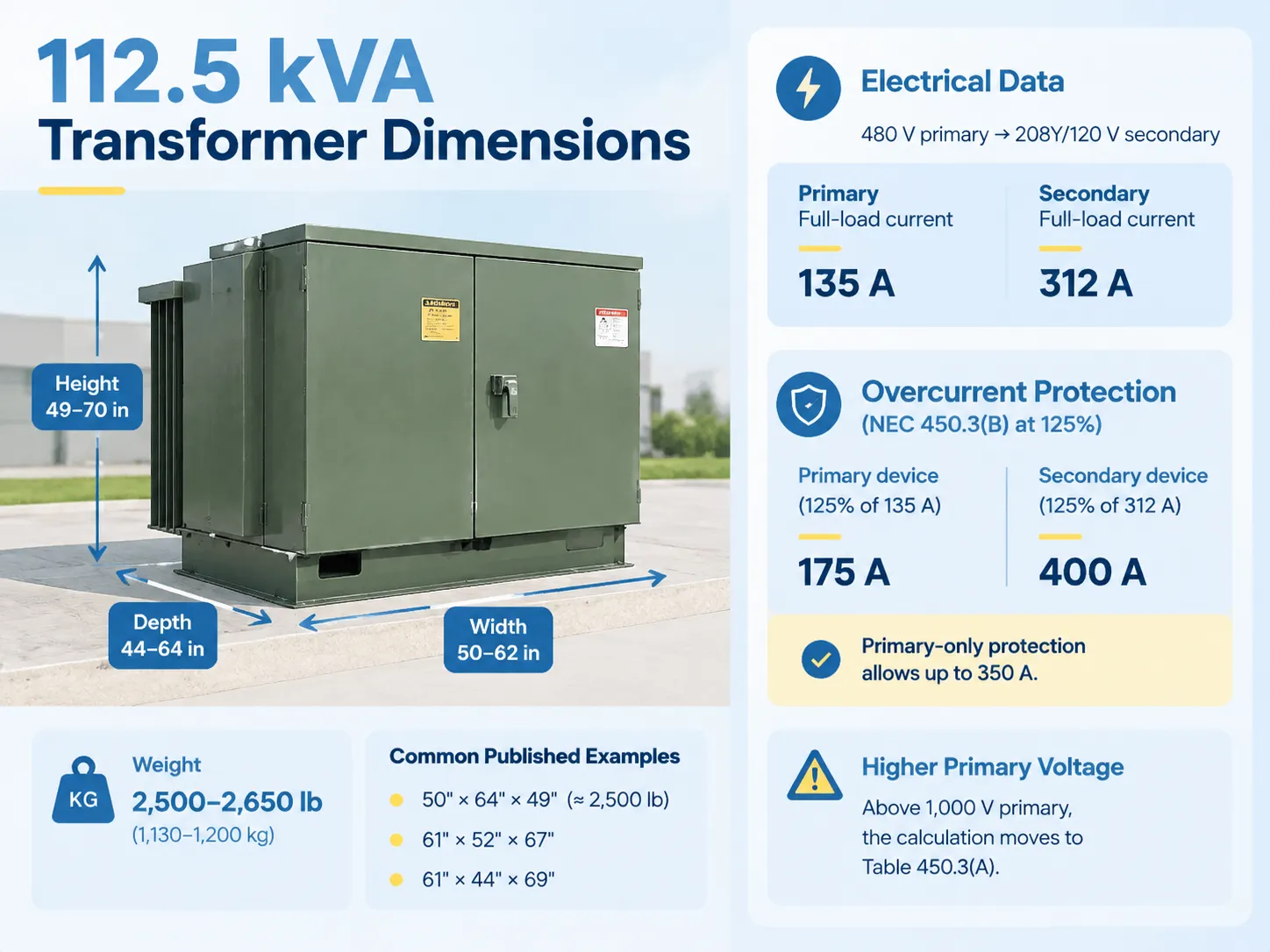
簡単に言えば、112.5 kVAの定格を持つ三相変圧器は、幅が約50〜62インチ、奥行きが44〜64インチ、高さが49〜70インチで、重量は約2,500〜2,650 lb(1,130〜1,200 kg)です。例えば、この変圧器の公表された寸法は50″ × 64″ × 49″で、約2,500 lb、61″ × 52″ × 67″、および61″ × 44″ × 69″です。容量に関しては、480Vが208Y/120Vを供給する一次電圧の場合、一次フルロードスケールは135A、二次フルロード電流は312Aを示します。したがって、一次ユニット175Aおよび二次ユニット400Aは、国家電気規則450.3 (B)に従って十分な保護を提供します。.
5 kVAが実際に意味すること
5 kVAは一般的なANSI配電シリーズに属します。標準定格は15-30-45-75-112.5-150-225-300-500-750-1000およびそれ以上にわたります。これは75と150の間に位置する数値であり、商業ビルにとって好まれる数値です。なぜなら、75 kVAが正当化できる負荷レベルを超えることを許可し、150 kVAプラントの不必要な容量に対して支払う必要がないからです。.
この数値は、規則にとっても閾値として機能します。112.5 kVA以下の乾式変圧器は、NEC 450.21(A)に従って、バルトなしで屋外に設置できます。ただし、可燃物から少なくとも1フィートの間隔を空ける必要があります。絶縁バリアまたは完全に閉じた変圧器(換気口を除く)を使用する場合を除きます。112.5を超える容量の場合、屋内に設置された乾式装置は、火災抵抗要件を満たす変圧器室に配置する必要がありますが、クラス155の絶縁材料またはそれ以上を使用した設置には免除が適用されます。したがって、112.5 kVA範囲から150 kVA範囲に移行することは、建設しなければならない部屋の特性を変更する可能性があり、購入する機器の種類だけでなくなります。.
kVAが電気的な観点から何を表すかを理解することが重要です。なぜなら、kWと等しくないからです。定格容量112.5 kVAの変圧器は、純粋な抵抗負荷に対して112.5 kWを生成するだけです。実際には、巻線が全体のkVA量を消費するにもかかわらず、実際のワット出力はそれよりも低くなります。この関係と、仮定された負荷ではなく、実際に接続された負荷に対してサイズを決定する方法は、以下の説明に示されています。 kVA変圧器定格とは何か.
計画すべき寸法
提供された数値は、完全に自己冷却された112.5 kVA三相パッドマウントユニットから得られた元データに基づいており、温度上昇は65 °Cで、DOE 2016基準およびANSI/IEEE C57.12基準に従って60 Hzの周波数で動作します。.
| 構成 | 幅 | 深さ | 高さ | 重量 |
|---|---|---|---|---|
| 21,600Y/12,470 V → 208Y/120 V、デッドフロント、ループフィード、アルミニウム巻き | 50 インチ | 64 インチ | 49 インチ | ±2,500 ポンド |
| 4,160 V → 480Y/277 V、銅巻き | 61 インチ | 52 インチ | 67 インチ | — |
| 13,200 V → 480Y/277 V、銅巻き | 61 インチ | 44 インチ | 69 インチ | — |
| 一般的な三相パッドマウントファミリー、幅広い電圧オプション | — | — | — | 2,640 ポンド |
仕様の作業範囲に変換されました:
| パラメータ | 計画範囲 |
|---|---|
| 幅 | 50–62 インチ (1,270–1,575 mm) |
| 深さ | 44–64 インチ (1,120–1,625 mm) |
| 高さ | 49–70 インチ (1,245–1,780 mm) |
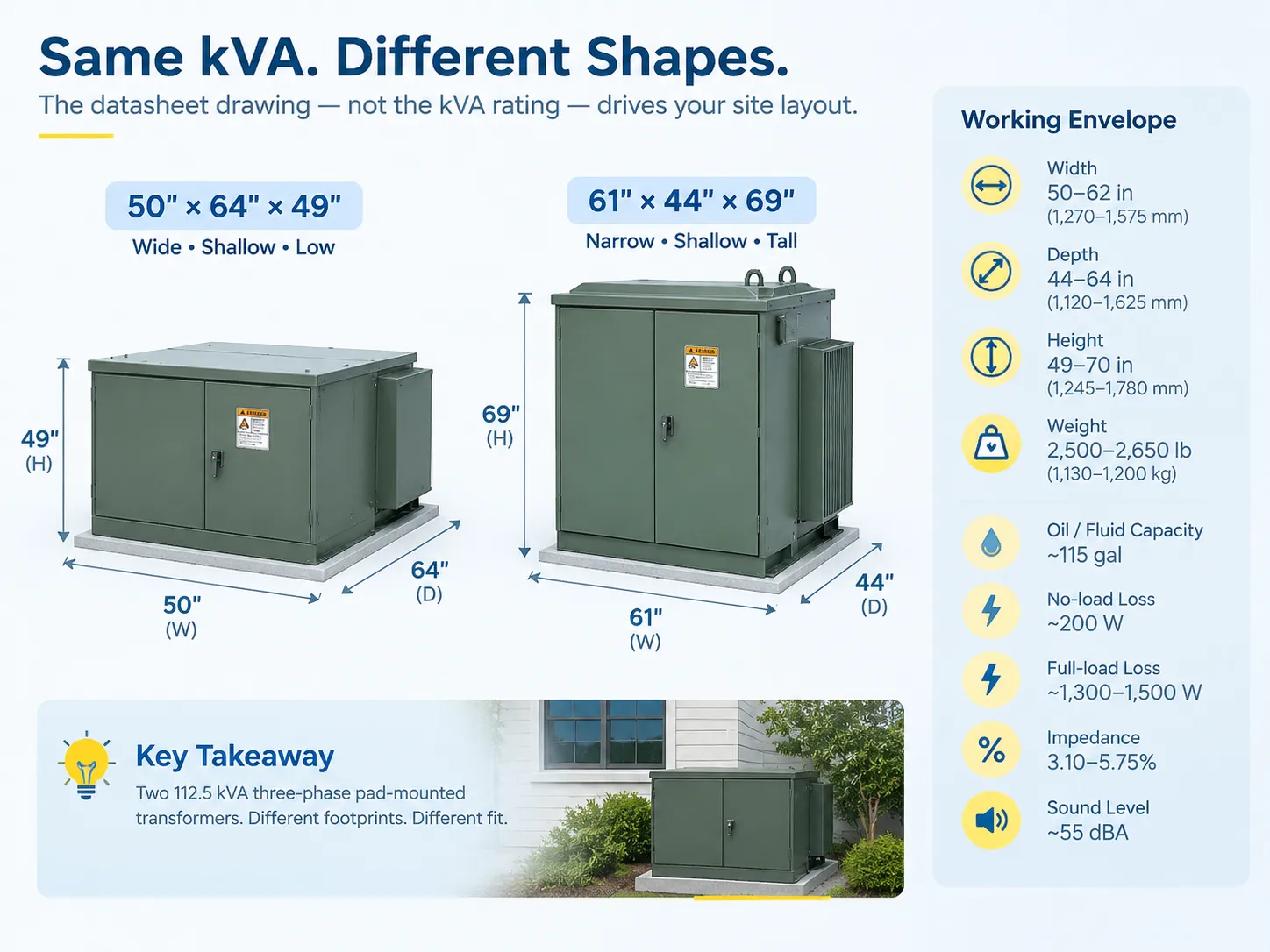
| 重量 | 2,500–2,650 ポンド (1,130–1,200 kg) |
| 油または流体容量 | 密閉タンク設計で約115 US gal |
| 無負荷損失 | 約200 W |
| 定格負荷損失 | 約1,300–1,500 W |
| インピーダンス | 3.10–5.75% |
| 音レベル | 約55 dBA |
トランスの寸法を比較する際は、数値よりも形状に注意を払うべきです。幅50インチ、長さ64インチ、高さ49インチのトランスは、幅広で低い形状を持ち、長さ61インチ、幅44インチ、高さ69インチのトランスは、狭くて高い形状を持っています。kVA定格は112.5で同じですが、1つは窓の下に置けるのに対し、もう1つは置けません。したがって、サイトレイアウトのプロセスはkVA定格ではなく、データシートの図面によって推進されるべきです。.
数字を動かす6つの変数
数値の分布を理解することで、見積もりが来る前に金額を推定できます。.
- 主電圧とBIL。4160ボルトの主電圧は中程度の絶縁を必要とし、21600ボルトの接地ワイ主電圧は95 kVのBILを持っています。BILの増加は、タンク内のクリアランスの増加、ブッシングの高さの増加、深いエンクロージャを引き起こします。4.16 kVトランスは52インチの長さですが、もう1つのトランスは64インチの高さを持っています。.
- デッドフロントトランスとライブフロントトランス。デッドフロント設計は絶縁された高電圧端子とエルボ接続を組み込んでおり、より大きなコンパートメントが必要です。現代のトランスが1990年代のアナログよりも大きくなっている理由は、デッドフロント機器の現代の仕様を満たす必要があるからです。.
- 銅トランス巻きはアルミニウムトランス巻きと対立します。銅巻きはアルミニウムよりもスペースを取らず、したがって銅巻きを使用するとトランスの全体的なサイズが小さくなります。この要因は、製造業者がトランスのパッドフットプリントを決定しようとする際に特に重要です。.
- 巻き方:ループフィード対ラジアルフィード。ループフィード巻き方は、より多くの接続ポイントと追加の技術開発を必要とし、したがってトランスの寸法が増加します。そのため、「同じ」設計の2つのトランスが異なる巻き方で製造されると、異なるパラメータを持つことになります。.
- 冷却クラス。冷却クラスが増加するにつれて、冷却の温度も上昇します。したがって、KNAF冷却クラスはKNANよりも大きくなりますが、トランスのパラメータは変わりません。例として、65 °Cの上昇を持つトランスは、55 °Cの上昇を持つトランスよりも大きくなると言えます。.
- 効率クラス。2016年に製造業者に課せられた効率要件に関する10 CFR Part 431に従い、それ以来業界に影響を与えてきたため、これらの制限の前後で製造されたトランスのサイズは異なり、中古機器の価格は正確な数字を提供しません。.
トランスの種類による寸法
5 kVAの定格は、複数の製品ファミリーに現れ、ファミリーは同じ形状ではありません。.
| タイプ | 一般的なフットプリントの特徴 | 使用される場所 |
|---|---|---|
| 三相パッドマウント、油-filled | コンクリートパッド上の広くて低い、改ざん防止のエンクロージャ | 商業および住宅開発、屋外配電 |
| 三相乾式、換気型 | 高くて狭い、換気クリアランスと空気の流れのためのスペースが必要 | 屋内電気室、480 Vから208Y/120 Vへの降圧 |
| 三相乾式、キャストレジン | 換気型と似たフットプリントですが、呼吸クリアランスはありません | 病院、データセンター、および油が歓迎されない屋内の場所 |
| ポールマウント単相 | 小型タンク、上部に取り付け、異なる定格シリーズ | 上部配電;単相シリーズは112.5ではなく、5、10、15、25、37.5、50、75、100、167、250 kVAを運転します |
| ユニット変電所 / コンパクト | 変圧器、一次スイッチ、二次ボードが1つのエンクロージャに収められています | 一つの組み立てブロックが好まれる工業プラントおよびユーティリティ設置 |
提供された表から、考慮すべき2つの実用的なポイントが生じます。まず、プロジェクトが480 Vから208Y/120 Vへの降圧を必要とする場合、プロジェクト用のユニットは通常、パッドマウントまたは乾式三相変圧器が必要であり、ポールマウントのものではありません。112.5は三相シリーズの値を指します。次に、パッドマウント変圧器と乾式変圧器の比較がある場合、それは広くて低い屋外ボックスと高くて狭い屋内ボックスの違いを示唆しています。両方のファミリーは パッドマウント三相変圧器の範囲に含まれています.
パッドサイズと作業クリアランス、ボックスだけではない
変圧器のサイズはほんの小さな側面です。しかし、実際に必要なスペースは重要であり、これは現場計画が通常失敗する理由の一つです。.
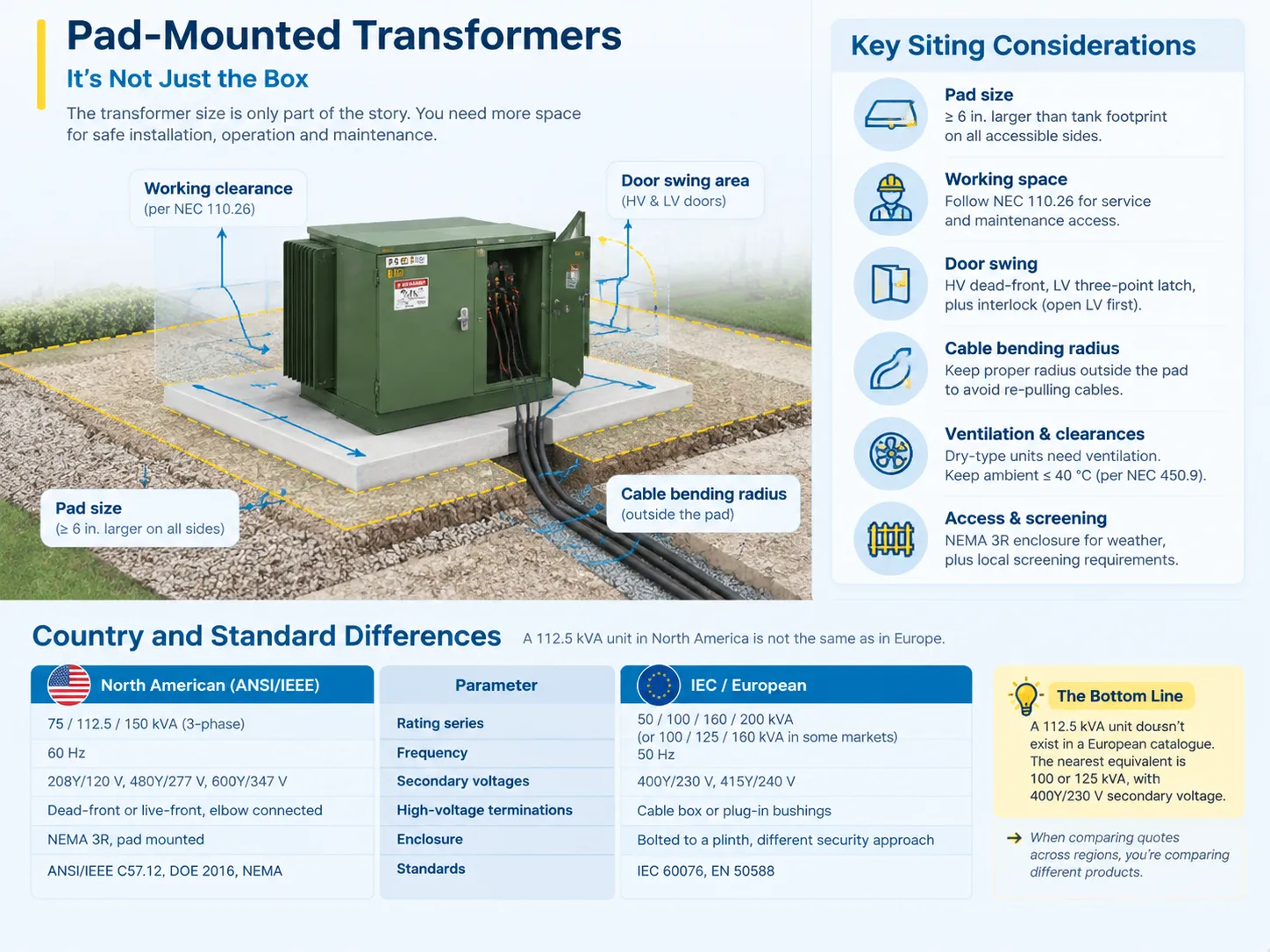
- パッドのサイズ。コンクリートパッドは、露出した側のタンクフットプリントよりも少なくとも6インチ大きく設計されるべきであり、導管とケーブルトレンチの位置に対応します。.
- アクセス可能なエリア。NECの第110.26条は、サービス可能な機器の作業スペースクリアランス規則を概説しており、パッドマウント変圧器が作業される場合、各高圧および低圧ドアの周りに十分なクリアランスがあることを確認する必要があります。.
- ドアのスイング。デッドフロント高圧ドアと三点ラッチ付き低圧ドアの場合、ユニットの前で掃除される必要があるエリアも考慮することが重要です。.
- ケーブルの曲げ半径。変圧器の構造内にはケーブル用のスペースがあります。しかし、パッドの隣に廃棄する際に膝を曲げないようにするために、ケーブルにも十分な曲げ半径が必要です。.
- 換気とクリアランス。Vegiperユニットは、可燃物の存在に依存しない適切な操作のための空気源を持つべきです。.
- 配置。通常、耐改ざんケースは明らかに仕事をこなしますが、地域の規則によっては、電気機器をスクリーニングする役割を果たす構造物や、このエンクロージャーへの接続を行う必要があるかもしれません。.
開発が1つのパッドではなく複数のパッドを配置する場合、クリアランスの規律がプロットプランを変えることが、変圧器の選択よりも重要です。住宅または商業開発において実際に重要な配置の考慮事項は、以下の内容でカバーされています。 現代のコミュニティ向けのパッドマウント変圧器.
国と標準の違い
IEC基準に基づいてヨーロッパに設置された112.5 kVA定格ユニットは、そのANSI対応物とは同じものではなく、寸法もそれを反映しています。.
| パラメータ | 北米(ANSI/IEEE) | IEC / ヨーロッパ |
|---|---|---|
| 定格シリーズ | 三相用の75 / 112.5 / 150 kVA | 一部の市場では50 / 100 / 160 / 200 kVA、または100 / 125 / 160 kVA |
| 周波数 | 60 Hz | 50 Hz |
| 二次電圧 | 208Y/120 V、480Y/277 V、600Y/347 V | 400Y/230 V、415Y/240 V |
| 高電圧端子 | デッドフロントまたはライブフロント、エルボ接続 | よくケーブルボックスまたはプラグインブッシング |
| エンクロージャ | 耐改ざん、NEMA 3R、パッドマウント | よくプランクにボルトで固定され、異なるセキュリティアプローチ |
| 規格 | ANSI/IEEE C57.12シリーズ、DOE 2016、NEMA | IEC 60076シリーズ、EN 50588効率 |
結果として、112.5 kVAモデルはヨーロッパのカタログには見つかりません。次に良いIECの同等仕様は100または125 kVAであり、その二次電圧は208Y/120 Vではなく400Y/230 Vです。地域間の入札比較を行う際には、同じ価格帯に属する異なる2つの製品を比較していることになります。国境を越えた調達の前に読む価値のある完全な比較が、以下の内容で示されています。 アメリカとヨーロッパの変圧器の主な違い.
ブランドは異なるのか?
電圧クラスはプロバイダーによって異なる影響を与えますが、機器の物理的な違いには期待されるほど関係がありません。実際には、北米の風景において112.5 kVAユニットを製造するパッドマウント変圧器メーカーを見てみると、同じ一次、二次、冷却クラスおよびフィードを持つものは、ほぼ同じサイズの寸法を持っています:寸法間にわずかなインチの違いが見られます。認識される「ブランド」の違いは単に真実ではなく、企業は95 kV BILのループフィードや、より低いBILのラジアルフィードを扱うことができ、名前の違いを全く異なる機器に帰することができます。.
There are, however, three tangible differences among the products. Winding material choice plays a role but is rather a function of specification than brand characteristic. Efficiency tiers are important to consider, given that in 2016, the DOE regulations segmented products into pre-and post-2016 designs, meaning that a transformer used in 2012 will occupy less volume than the work of both years. Finally, it is enclosure design that really shows up competition among manufacturers. Enclosure that falls into the utility’s standard dimensions without variances gives one a commercial advantage.
What is ultimately required is to stop comparing brands and comparing transformer dimensions with the pad one has instead. Brand differences among inch dimensions between suppliers are negligible; for instance, a 12-inch depth gap between a 12.47 kV transformer and a 4.16 kV transformer is significant.
Breaker and Conductor Sizing for a 112.5 kVA Unit
This is the question that follows the dimension question, and the arithmetic is straightforward once you fix the voltages.
| 構成 | Primary FLA | Primary OCPD at 125% (next size up) | Secondary FLA | Secondary OCPD at 125% (next size up) |
|---|---|---|---|---|
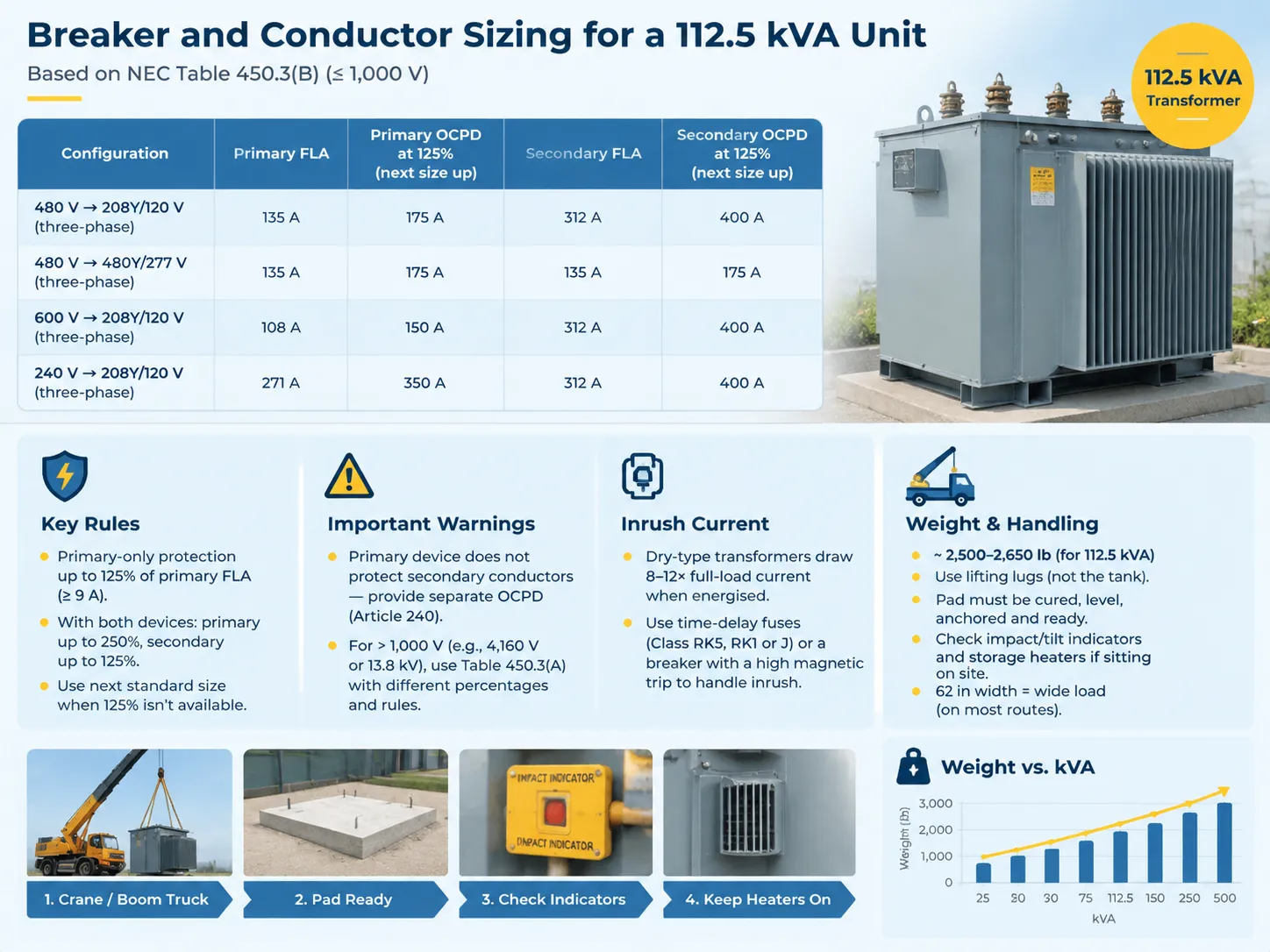
| 480 V → 208Y/120 V, three-phase | 135 A | 175 A | 312 A | 400 A |
| 480 V → 480Y/277 V, three-phase | 135 A | 175 A | 135 A | 175 A |
| 600 V → 208Y/120 V, three-phase | 108 A | 150 A | 312 A | 400 A |
| 240 V → 208Y/120 V, three-phase | 271 A | 350 A | 312 A | 400 A |
The guidelines for those data are found in Table 450.3(B), which is valid for transformers with a voltage rating up to 1,000 V. For transformers with a primary current of 9 A and more, primary only protection is allowed; the minimum value for this device is 125% of the full-load current (FLC). If 125% cannot be achieved with the help of the available number of values, the nearest value can be used instead. In case both primary and secondary devices are used, the ratio for the primary device can be 250% of the FLC and for the secondary device – 125% of the SLC. For instance, in case of a 112.5 kVA transformer connected to a primary voltage of 480 V, such a transformer can have a primary protection rated for 350 A when a secondary protection is provided.
However, there are two warnings with this table. First, the primary device does not protect any secondary conductors, for which separate overcurrent protection should be applied according to Article 240. One should also keep in mind that the table is valid for voltages lower than 1,000 V. For a 112.5 kVA transformer with a primary voltage of either 4,160 V or 13.8 kV, Table 450.3(A) should be used instead.
The second size consideration is inrush. Dry-type transformers consume 8 to 12 times of the rated or FLC for a very limited period of time when becoming operational. For this reason, a fuse with a rating of 125% must be used, which will burn off on activation. Instead, a time delay fuse (Class RK5, RK1 or J) or magnetic circuit breaker has to be used in order for inrush currents not to create problems in case there is a fault in an electrical circuit.
Weight, Handling and Delivery
Weight is a factor in the cost of the project since moving a unit weighing 2500-2650 lbs is something that a small team cannot do manually and not every type of transport can deliver such a unit.
- Crane or boom truck. There must be a plan describing which area will be used for lifting the unit and where it will be put after the lifting. The rigging needs to be connected to the tank lifting lugs instead of the tank.
- Pad readiness. Before the unit’s arrival the pad has to be leveled, cured, and tested for anchoring and the conduit stubs must be installed. The transformer cannot be left on a truck if the pad is not ready.
- Impact and tilt indicators. The unit must have been delivered with all necessary indicators; if one of the indicators was triggered it means it is necessary to carry out an internal inspection before the unit is energized.
- Storage. If the unit stays on site for weeks prior to installation its heaters must be energized so that no moisture gets into the insulation.
- Transport clearance. A unit of 62 inches in width is a wide load and so it may require special permits and have specific time limitations on the transport route.
How the weight and loss figures scale with rating is worth understanding before you decide between 112.5 kVA and its neighbours, and the trend across the distribution series is illustrated in this study of 500 kVA transformer weight. The short version: weight rises roughly with kVA but not exactly linearly, because the enclosure, tank and accessories form a fixed component that stops growing once it is big enough to hold the core and coils.
よくある質問
What are the dimensions of a 112.5 kVA transformer?
50 in. to about 62 in. in width, about 44 in. to 64 in. in depth, and from about 49 in. to approximately 70 in. in height, while weighing around 2,500 lb (1,130 kg to 1,200 kg). Some published examples include a specification of 50 in. × 64 in. × 49 in. with a weight of about 2,500 lb, and others 61 in. × 52 in. × 67 in. and 61 in. × 44 in. × 69 in. All dry-type indoor units with the same capacity usually have a narrower profile, but different size in the depth is expected in the very case of ventilation requirements, rather than simply enclosures of the units.
What size breaker for an 112.5 kVA transformer?
The voltages dictate the regulations. For a primary voltage of 480 V to supply a 208Y/120 V circuit, the typical full-load primary current would equal 135 A, while concerning the secondary it would be equal to 312 A. If both the primary and the secondary protection schemes are used, according to NEC Table 450.3(B) it would be allowed to use a primary device with the rating of 125% of the current to be equal to 169 A, it would be rounded to the next standard size which is 175 A, and concerning the secondary protection it should not be more than 125% of the current which is 312 A, that would give the rating of 390 A rounded to 400 A. If only the primary protection scheme is implemented, the primary device should be rated how much could be 250% of the primary current which would give 338 A rounded to 350 A. In case there are primary voltages above 1,000 V NEC Table 450.3(A) shall be used. It’s recommended to use time delay fuses or trip high-magnetic breaker to protect the device from damaging due to magnetizing inrush.
What are the dimensions of a 100 kVA transformer?
The voltages serve as a guiding factor for the laws. In the case where the primary voltage of 480 V has been utilized in the circuit of 208Y/120 V, the full-load primary current’s value would be up to 135 A and the full-load current of the secondary power source would be 312 A. It would allow for the use of the primary device rated at 125% of the proposed current which would be equal to 169 A if both of the primary and the secondary protection schemes have been used according to the provided information from NEC Table 450.3(B) and it would be rounded to the nearest available size equal to 175 A. It should be mentioned that the secondary power source device must not exceed 125% of its full-load capacity meaning not more than 312 A and the final rounding procedure would give the result in the form of 400 A from 390 A. If only the primary protection mechanism has been employed, the device must be rated at 250% of its current that would provide a result of 338 A which should be rounded to 350 A. For the primary voltages in excess of 1000 volts the standard presented in NEC Table 450.3(A) must be referenced. Time delay or high-magnetic circuit breakers are recommended for the situation where magnetizing inrush may occur.
What is the size of a kVA transformer?
kVA mentions capacity; physical size is not mentioned. The physical size of the transformer depends on kVA and four more parameters: voltage class and impulse power, cooling class, winding material, and type of enclosure. As a rough guide, a three-phase oil-immersed pad-mounted transformer varies from about 75 kVA (about 30″ wide) to over 2,500 kVA (more than 100″), but for dry-type indoor designs, the same kVA will be in a completely different shape. Therefore, always ask for dimensional drawings with kVA.
Do 112.5 kVA transformers differ between brands?
In almost all cases, the difference between two units is due to configuration instead of popularity. If two machines have the same specifications concerning primary, secondary, cooling class, arrangement of feed, and efficiency, their sizes will be practically the same, regardless of the manufacturer. If the specifications provided bring about the change in the size of the machine, it is usually due to the use of a different specification, e.g., looping and radial feeds, the application of higher BIL for the primary winding or the use of another winding material, but not due to the brand’s differences.
Is 112.5 kVA relevant to the electrical code?
Yes, it is indeed a threshold value. NEC 450.21(A) allows the installation of dry-type transformers rated at 112.5 kVA or lower in the open without a vault, provided it is kept 12 in away from combustibles, unless a fire-resistant heat-insulating barrier is used, or unless the unit is enclosed with the exception of ventilating openings. Above 112.5 kVA, dry-type transformers usually need to be installed in a fire-resistant transformer room, except in the case of insulation systems with the Class of 155 or higher. The surpassing of the value may alter the room, and not only the equipment.
参考文献
- IEEE Standards Association — ANSI/IEEE C57.12 series, distribution transformer standards
- NFPA — NFPA 70, 国家電気規則 (記事450, トランス)
- UL Solutions — transformer testing and certification services
- UL Standards & Engagement — UL 1562, トランス, 配電, 乾式
- International Electrotechnical Commission — IEC 60076 series, power transformers
結論
The response to the question “how significant is a 112.5 kVA transformer?” is not easy and the ones who provide an answer generally reference and depend on their own catalogues. The right answer to this question is a range, approximately 50 to 62 inches in width, about 44 to 64 inches in depth, between 49-70 inches (high) in height, and from 2500 to 2650 pounds for a three-phase pad-mounted model.
Three steps can be taken in relation to this knowledge. First, before purchasing the pad, obtain the creation drawing as well as the weight; depth is where the voltage class comes into focus. Secondly, ensure that the model and type are checked before starting a comparison of the prices since it is the four reasons that cause price differences which people connect with the brands. Finally, do not forget that the 112.5 kVA transformer is the number in NEC 450.21 meaning it is the limit that you need to focus on.