

見積もりをリクエスト
ニュース

Analysis of Key Points in Transformer Selection under Different Working Conditions in the Industrial Field

In a cement plant located in the Middle East that experienced setbacks nine months after the setup of a 1,250 kVA transformer, the investigators arrived at an explanation for the failure. It was concluded that the transformer was chosen for a clean indoor electrical room, yet it ended up in an open room which made fine cement dust block the cooling ribs and conditions that surround the transformer are hot, rising up to 52°C in summer while the upper boundary alleged by the de-rating curve was 40°C. Consequently, due to being subjected to such high temperatures, the insulation wore ten times faster than intended and no overload protection was able to detect the problem as the current levels seemed to be perfectly normal. No one bothered to take into account the specifics of the industrial working conditions to which the transformer would be exposed, namely, dust, temperature, humidity, vibrations and harmonic loadings.

In this article, we would have a closer look at some basic aspects concerning transformer selection for different types of industrial operating conditions, including environmental factors that contribute to either ten-year or ten-month service life.

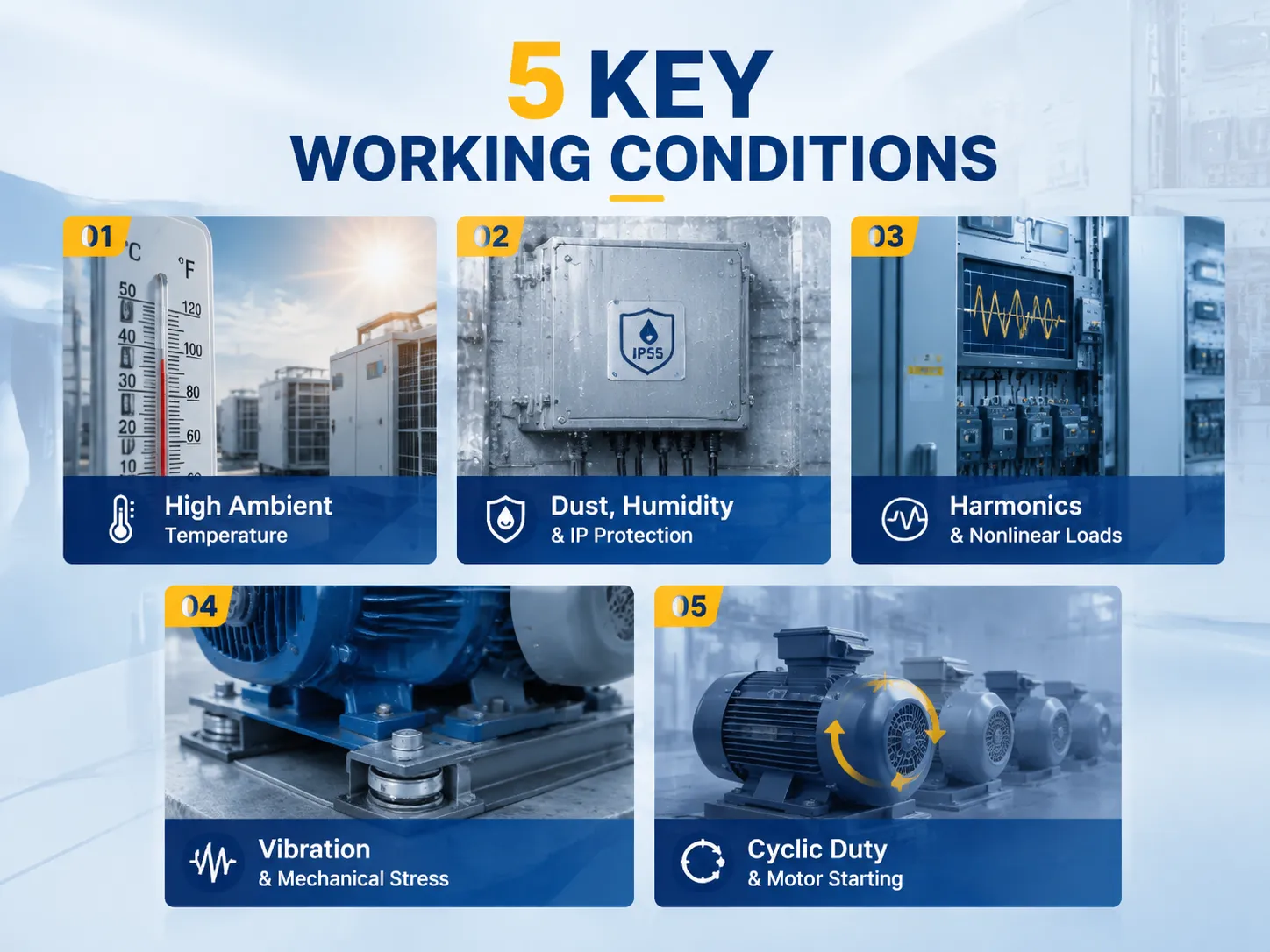
Industrial transformer selection is won or lost in five factors related to working conditions. These are (1) ambient temperature — decreasing about 1.5% for every degree above 40°C; (2) dust and moisture — use IP44–IP56 for extreme conditions. (3) Harmonics from VFDs make 5-10% more heat load with 20% of THD in the current. (4) Vibration and shock of surrounding places causing crushing or pressing. (5) Cyclic operations requiring stator motor start-up.

Analysis Of Key Points In Transformer Selection Under Different Working Conditions In The Industrial Field


What Makes Industrial Transformer Selection Different

Industrial transformers have a much tougher job than utility transformers. A utility transformer is in a controlled yard and operates under moderate load, but an industrial transformer is next to a crusher, furnace, or painting booth where the load varies all the time. The working environment brings in stresses that are never considered in the usual kVA calculation.

  • Ambient temperature: process plants operate between 45° to 55°C next to furnaces, ovens, and compressors.
  • Contamination: dust from cement, flour, fibers from textiles, fumes from chemicals, and salt — all of these do harm to the insulating materials and obstructions for cooling.
  • Harmonics: as all the VFDs and rectifiers inject 15-40% of the harmonic current in transformers.
  • Mechanical loads: vibrations coming from crushers and presses as well as railway operation lead to loosing connections and damaging of the core.
  • Cycling load: all the batch processes involve the operation of the unit in the load range from 30% to 120% in a matter of minutes.

Each of these parameters shifts the specification in a different way. The engineering task is to find out the most important working condition for the precise application and to let it decide the design, otherwise it will be something like a cement plant’s problematic experience when using a clean-room transformer in the dust storm.

Working Condition 1: High Ambient Temperature

The transformer specifications indicate an assumed standard ambient — in adherence to IEC 60076-1, the determined yearly average is understood to be 30°C and the maximum is accepted to be at 40°C. If the temperate increases above this value, the cooling capacity of the transformer drops, and the resultant temperature increase shall be added directly to the hottest-spot temperature. Practical de-rating shall be about 1–1.5% of the rated kVA for every degree above the 40°C ambient temperature. This means that at 50°C ambient temperature, for a 1,000 kVA transformer it shall lose about 10–15% of its power (effectively functioning as the transformer with the 850–900 kVA power).

From the thermal physics point of view, the insulation life reduces to half at the increase of hot-spot temperature by 6–8°C (according to Arrhenius model). The hottest spot of the transformer with 65 K temperature rise in 50°C ambient shall reach the level of about 115–125°C in being heated, which causes the reduction of life of the paper insulation from decades to a few years. In the case of hot weather, it is necessary to choose a transformer of a higher insulation class (F-class dry-type insulation — 155°C) or a unit with lower temperature rise rated at 55 K instead of 65 K and check that the manufacturing company used a proper ambient in the design calculations.

Ambient Temperature De-rating (typical) 1,000 kVA Unit Effective Capacity Recommended Action
30°C (design) None 1,000 kVA
40°C None 1,000 kVA
45°C ~5–8% 920–950 kVA Upgrade one rating or improve ventilation
50°C ~10–15% 850–900 kVA Specify 55 K rise / F-class insulation
55°C ~15–22% 780–850 kVA Consider forced cooling (ONAF) or relocation

The most cost-effective solution is typically not a larger transformer but improved ventilation. The enclosure can be fitted with forced-air cooling, sunshades, and positioned away from process heater to increase the efficiency by between 5 and 15% for a couple of hundred dollars.

Working Condition 2: Dust, Humidity, and IP Protection

Dirt can do two things to a transformer. First, it blocks cooling surfaces. Second, if it gets wet, it can become conductive. It can track over bushings and insulators until flashover occurs. There are IP ratings that let you know what kind of protection is provided according to IEC 60529. The ratings fit into different industrial environments.

  • IP21–IP23 are for clean electrical indoor rooms, office space, and light production.
  • IP44 is for dusty places indoors, with the risk of spray offs, with regular production.
  • IP54 is for outdoor units and covers most cases.
  • IP56 applies at coastal places and in washing places, and also applies for food industry washing places.

The IP rating covers the parts of the unit for oil-filled transformers (including bushings, gauges, and conservator) since the tank is sealed.
For dry type transformers, the IP rating is important because the windings sit in the ambient air. A resin transformer with IP23 will accumulate conductive dust on the surface during the years in a dusty hall, so IP44 is recommended. Also check the breather and conservator since a silica gel breather should be serviced in humid climates, while the gas-sealed conservator eliminates the need for such servicing.

Working Condition 3: Harmonics and Nonlinear Loads

Variable frequency drives, rectifiers, and arc furnaces draw power in pulses, thus producing harmonic currents with frequencies of approximately 5th, 7th, 11th and 13th orders. Harmonic currents increase the RMS power consumed by transformer; increase eddy-current losses in windings (the losses increase with frequency squared); and increase current flowing through a neutral conductor in wye-coupled systems. IEC 60076-1 and IEEE C57.110 specify how de-rating should be performed: a unit that produces 20% of total harmonic distortion (THD) should be de-rated by 5% to 10%.

What does it mean in practice? The power transformer rated at 1000 kVA supplying the line with VFD and having THD of 25% behaves as 900-950 kVA transformer. Choose the transformer’s K-factor (IEEE C57.110) in case you have to deal with heavy nonlinear loads; a unit with K-13 or K-20 rating is capable of withstanding excessive heating caused by eddy currents, while one with lower rating will suffer from de-rating. Instead, you can install the harmonic filter or use transformer with higher K-factor.

Current THD Recommended De-rating Suitable Transformer Design
< 5% None Standard unit
5–15% 3–8% Standard unit, watch loading
15–30% 8–15% K-13 rated or add filters
30–50% 15–25% K-20 rated plus filters
> 50% (arc furnaces) Special design Dedicated furnace transformer

Working Condition 1-5

Working Condition 4: Vibration and Mechanical Stress

Machines such as crushers, presses, and stamping lines send out continuous vibrations and occasional shocks to transformers. The effects of these vibrations are cumulative: mounting bolts loosen, bushing connections wear out, tap changer parts wear out, and the core laminations loosen over the years, thus increasing losses and noise when the transformer is not in service. For places close to the machinery, reinforced tank construction and vibration isolation mounts should be considered, thus reducing the noise by 5–10 dB in the end.

Secondly, noise becomes a concern. According to IEC 60076-10 standard, the noise level is millions of decibels depending on the rating forces. In a work area, the noise limit is 85 dB according to standards. However different types of transformers that operate at the same power do cause different noise levels, namely dry types function quieter than the others by 10 dB.

Working Condition 5: Cyclic Duty and Motor Starting

Batch processes exhibit the most extreme loading profile; they operate nearly idle for one hour, followed by then loading at 110% for some 20 minutes. Two factors should be considered. The first point is to confirm that the transformer can support this cycle – IEC 60076-7 gives the loading information; the properly sized oil-immersed transformer can withstand significant overloads for short periods if the average load does not exceed 80% in the course of the day. The second point is motor starting: the DOL motor with a current draw that can be as much as six times higher than its normal usage may lead to reaching the thermal limit of the transformer. In plants with frequent start cycles, it is advised to oversize the transformer by one standard size or to use soft starters/VFDs.

Oil-immersed transformers have more tolerance towards cyclic overloads compared to dry-types due to the fact that the thermal mass of oil can absorb the transient thermal energy, while the design temperature rise of 65 degrees K provides that on top of it. Dry-type transformers, with a lower thermal mass and a greater rise (100 degrees K), react more quickly to the change in loads and have less tolerance to cyclic loading. If the process itself can be definitively categorized as batch-related, then the necessary operating condition index speaks in favor of choosing oil-immersed design regardless of the installation atmosphere.

Industry-by-Industry Selection Guide

Industry Dominant Working Condition Key Specification
Cement, mining Dust, high ambient, vibration IP54–IP56, reinforced tank, 55 K rise
Food & beverage Washdown humidity, moisture IP56, stainless fittings, sealed bushings
Textile Lint, high humidity IP44+ dry-type or sealed oil type
Chemical & petrochemical Corrosive fumes, fire zones Coated surfaces, oil-free options, zoning
Automotive & stamping Vibration, shock, cyclic loads Anti-vibration mounts, oversize rating
Pharmaceutical Cleanroom, strict fire code Cast-resin dry-type, IP44, quiet
Steel & foundry Heat, harmonics, heavy cyclic K-factor rating, forced cooling, high temp class
Data center / electronics Clean indoor, continuity Dry-type N+1, low loss, low noise

Take the table as the initial matrix, afterward, confirm it with your own field measurements and evaluate the surroundings for dust and water sources, measure the harmonic ratio at the site using a power quality analyzer. The guidelines will follow the data obtained.

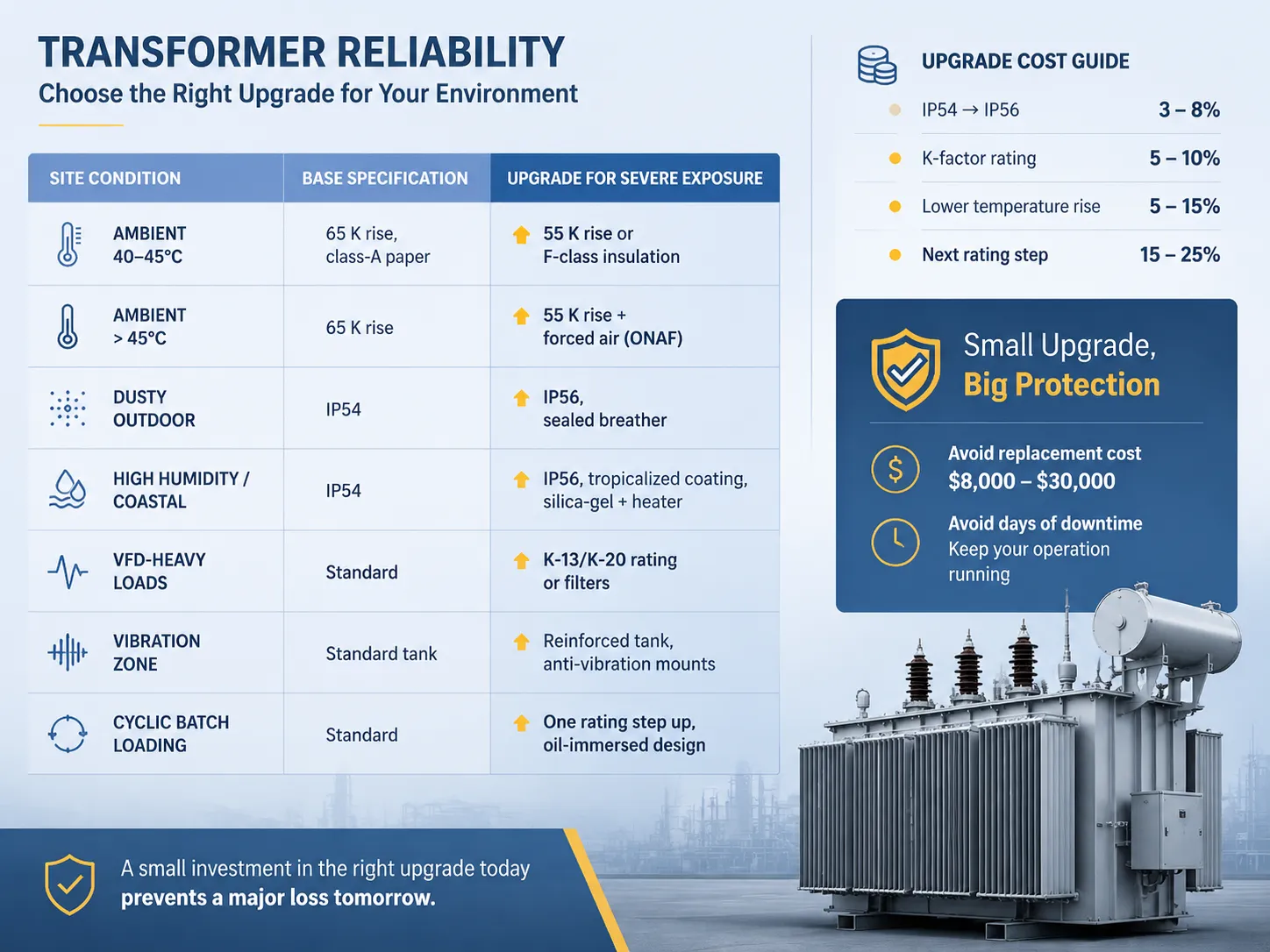
Working Conditions vs Specifications

Working Conditions vs. Specifications

Site Condition Base Specification Upgrade For Severe Exposure
Ambient 40–45°C 65 K rise, class-A paper 55 K rise or F-class insulation
Ambient > 45°C 65 K rise 55 K rise + forced air (ONAF)
Dusty outdoor IP54 IP56, sealed breather
High humidity / coastal IP54 IP56, tropicalized coating, silica-gel + heater
VFD-heavy loads 標準 K-13/K-20 rating or filters
Vibration zone Standard tank Reinforced tank, anti-vibration mounts
Cyclic batch loading 標準 One rating step up, oil-immersed design

Every upgrade comes at a cost: about 3 to 8% for IP54→IP56 upgrades, 5 to 10% for k factor rating upgrades, 5 to 15% for lower temperature rise upgrades, and 15 to 25% for moving to the next rating. But when compared to the price of a faulty transformer — the cost of replacement of $8,000 to $30,000 and days of downtime — the upgrades become the cheapest expense in the entire project.

Brands and Prices for Industrial-Grade Units

The industrial market is driven by the need for quality products offered with quality support. Importantly, international business principles are applied in critical industrial supplies; however, IEC-certified Chinese manufacturing companies are able to provide the same environmental technologies at much lower costs.

ブランド Industrial Strength 500 kVA Price 1,000 kVA Price
ABB Full range, global service, digital diagnostics $18,000–$30,000 $25,000–$42,000
シーメンス High-efficiency, monitoring integration $18,000–$32,000 $25,000–$45,000
シュナイダーエレクトリック Dry-type strength, LV integration $15,000–$28,000 $22,000–$38,000
日立エナジー Heavy industrial and grid units $17,000–$30,000 $24,000–$42,000
イートン North America compliance, pad-mounts $14,000–$26,000 $20,000–$36,000
CG Power / TBEA High volume, industrial range $10,000–$18,000 $14,000–$24,000
江蘇省蘇辺電力 IEC 60076, environmental options, test reports $8,000–$16,000 $12,000–$22,000

The prices shown are CIF China for oil-cooled industrial transformers and depend on manufacturing options, brand names, and locations. Above-mentioned brands have been successful for 100 years in carrying industrial loads and all of their support center networks are reference points now. What companies like Jiangsu Subian Electric Power do is quite different: they produce IEC 60076-compliant units and offer the green options covered in this article: IP56, 55K rise, K-factor, tropicalization, etc. This means that for a plant needing ten transformers for its operations in three countries the difference in price – as between $12000 and $28000 – would mean purchasing one substation instead of three, while documentation would mean that the confirmed characteristics are verified after delivery, not just claimed before it.

よくある質問

How does high ambient temperature affect transformer capacity?

According to the rating of a transformer, the ambient does not exceed 40°C (IEC 60076-1) with a yearly average of 30°C. Whenever temperatures exceed 40°C, the phase-out is approximately 1–1.5% for each degree Celsius. At the temperature corresponding to an ambient of 50°C, a 1,000 kVA transformer will operate at only about 850–900 kVA. If its position cannot be altered or ventilated properly, either 55 K temperature rise or F-class insulation should be chosen rather than 65 K/class-A.

What IP rating do I need for an industrial transformer?

Pair the casing with the pollutant. IP21–IP23 for pure indoor environments; IP44 for dusty indoor rooms; IP54 for outdoor industry fields (default); IP56 for coast, wash or food products. Keep in mind that dry-style winding is exposed to airflow so the IP rating of dry-style will always be higher than that of oil-drenched in the same location.

How do VFD harmonics affect transformer sizing?

The presence of harmonic currents in the currents increases the RMS current and the losses due to eddy currents. When the THD of the current is 20%, the transformer must be derated 5-10%; when the THD is between 30-50%, the derating must reach 15-25% or a K-rated transformer can be used (K-13, K-20 as per IEEE C57.110). The filters and 12 pulse drives eliminate the harmonics at the source and can provide saving of one complete rating step.

Should I oversize the transformer for a batch process with heavy starts?

Please provide a quantitative estimation of it. For instance, if the process fluctuates between 30% and 110% load with substantial motor starts, you would need to check the pattern with reference to IEC 60076-7 loading recommendations. Oil-insulated devices perform well when it comes to absorbing cycling overloads due to the oil mass that keeps heat. Dry-types don’t perform that well. A higher rating (about 15-25% more expensive) is usually appropriate for a truly batch-oriented production facility.

How much more does an industrial-grade transformer cost than a standard one?

Its price consitutes 10 to 35 % of the standard price for the industrial hardening process of an equipment unit; it includes 3 to 8 % for the specification of IP56 protection rate, 5 to 10 % for the K-factor rating, and also between 5 and 15 % for the lower temperature rise. Therefore, for the unit rated 500kVA, the budget will have to be up to 1000-5000 dollars; quite pocket-friendly compared to 8000-30000-dollar costs of replacing the regular equipment unit operating at the same site.

参考文献

結論

Selecting industrial transformers involves matching specific conditions with the environment this information does not take into account: high ambient temperature (50°C), cement dust, and harmonics & vibrations due to the use of crushers and harsh cycles of operation. Every component has a corresponding answer (derating tables and rating criteria) and only accurate measuring will ensure correct transformer specification.

  • Determine ambient conditions, level of cement dust, humidity, level of harmonics, and duty cycle before making the selection.
  • Derate parameters (1-1.5% for each °C above 50°C, and 5-15% for harmonics with 15-30% THD).
  • Select IP54 through IP56 for extreme outside environments, K-rated or dry-type transformers for environments with excessive use of VFDs.
  • Confirm all the parameters listed in the factory report rather than the catalog.