


In an electroplating plant, the maintenance supervisor is confronted with a concerning problem. The plant has been facing failure due to a diode malfunction in a 2000A rectifier and the production manager is urging the need for a more efficient solution. When accusations were being thrown around, one of the engineers suggested replacing the rectifier with the transformer, making the others in the room agree with him, as everybody understands that transformers help in lowering the voltage. However, after being involved in the workings of both devices for 15 years, the supervisor knows that a transformer and a rectifier are different and one cannot be substituted for another, as it will have a negative impact on the operation.
Through this article, the author discusses the principal difference between transformers and rectifiers, which includes the difference in the way they function, the difference in how much do they cost, and whether they can be used together or not.
Briefly stated: A transformer is a passive electromagnetic machine that functions at line frequencies (50/60 Hz) and is capable of performing a voltage transformation (e.g. from 11 kV to 400 V) although it is not capable of changing AC into DC. The function of a rectifier, which is either electronic or solid-state unit, is to convert AC to DC (conducting the conversion process from 230 V AC to 12 V DC or creating a 2,000 A DC bus used for plating), using semiconductor diodes or thyristors while its features do not include the ability to change voltage level independently of the transformer.
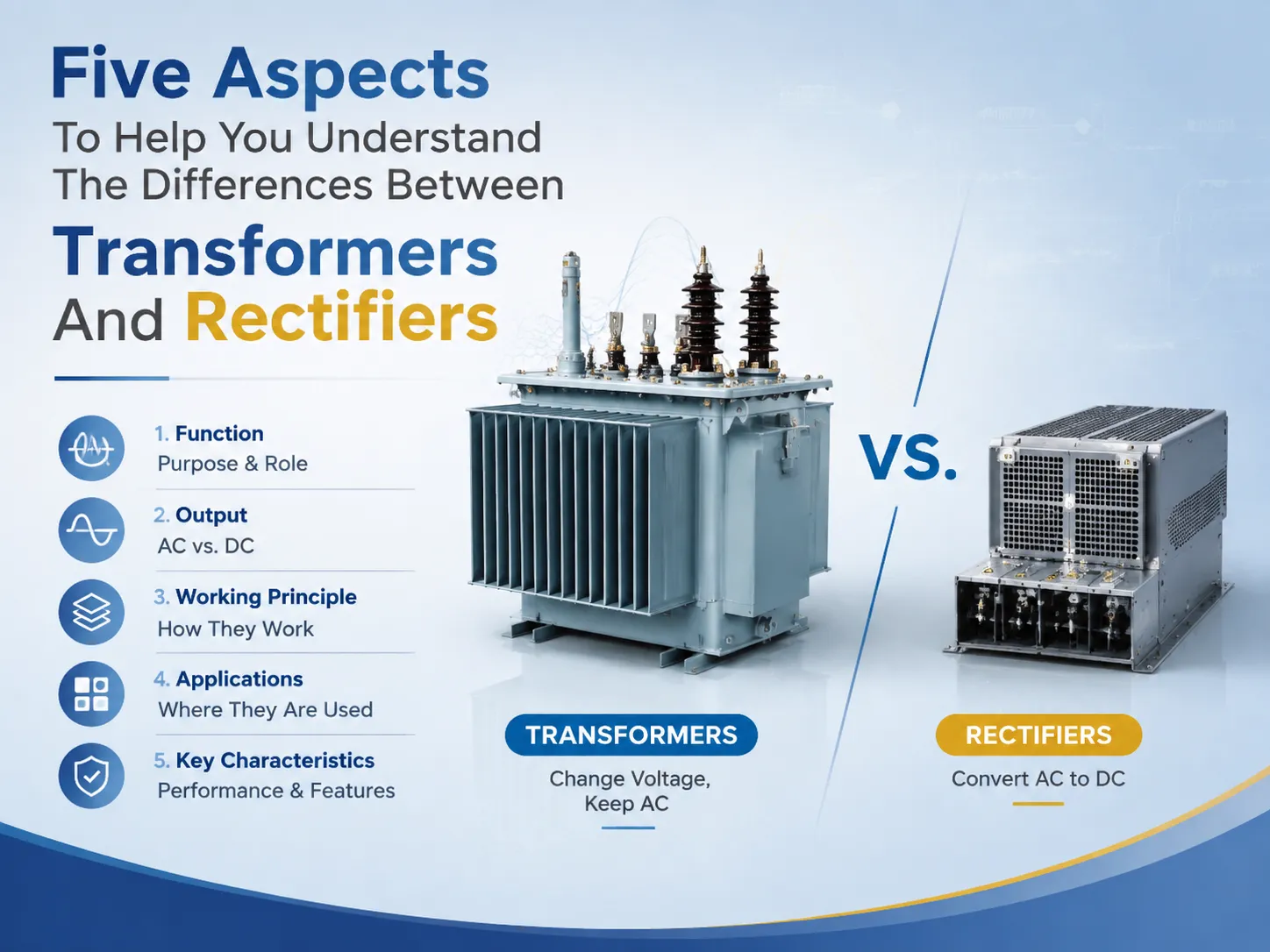
Why Transformers and Rectifiers Get Confused
There is much confusion about this issue because both devices are located in the circuit of electric energy and also because both of them are commonly named as “converters”. According to the structure of a welding machine, its power supply consists of a transformer and a rectifier, and a novice electrical engineer can’t choose which device plays what role. Even the catalogs use mixing terminology: all units containing both a transformer and a rectifier are defined under the term “transformer rectifier unit”.
It should be noted that a transformer changes the size of alternating current (increased or decreased), while a rectifier changes the type of electric current (from AC to DC) but cannot change the size of the current.
Definitions: Transformer vs Rectifier
Essentially, the transformer is a stationary electrical machine comprising two or more coils on a magnetic core, converting electrical energy from one circuit to another through mutual induction at supply frequency. It changes the level of voltage and current inversely (not considering losses), without changing the total energy or frequency of the electrical energy in the circuit. It operates without movement and does not incorporate any semiconducting elements. The distribution transformers (IEC 60076) are used from 6.6 to 35 kV for power supply devices with 400/230 V. Furthermore, less powerful control transformers work with step-down voltages of 230, 24, and 12 V.
Rectifier refers to an electronic mechanism converting AC into DC. Essentially, it is more than one diode or thyristor acting in a half-wave, full-wave, or three-phase bridge configuration and letting current flow in one direction only. With its help, the current goes through a constant wave form of DC. The industrial rectifiers are in use since antiquity in plating, anodizing, and charging equipment and range from small single-phase to large three-phase installations using thousands of amps.
Difference 1: Function — Voltage Change vs AC-to-DC Conversion
This is what makes a big difference and impacts very many things.
The transformer performs a specific function of changing the voltage. You input AC in a different form. The transformer reenters AC in a different part of the network. The ratio of winding numbers will determine the voltage ratio. For example, when the 11 kV enters the transformer giving 10:1 ratio, the output is approximately 1.1 kV, whereas in a case with a 27.5:1 ration, the output is approximately 400 V. Thus, the transformer generates AC only.
The rectifier has the only one function of obtaining the DC from AC. You might acquire the rectifier and compare it to the voltage generator. The input voltage can be arbitrary; the output voltage may vary from 0.9 to 1.4 times of the input voltage depending on the type of rectifier. The process going through here is not “stepping,” but this voltage is created as a result of the voltage provided in an input.
As a result, if you need 24 V AC for the valve or for the lighting transformer, you apply the transformer. If you seek for the input device that requires 24 V DC for the sensor or relay, buy the rectifier (normally, it will be an SMPS). In a case you need 12 V DC with 2000 A from the 11 kV line, you will get the transformer first, and then apply to the rectifier which follows.
Difference 2: Operating Principle — Magnetic vs Semiconductor
The transformer is based on the principle of electromagnetic induction discovered by Faraday. When there is an alternating current flowing through the primary winding, there is an alternating magnetic flux in the laminated silicon-steel core which results in the generation of induction voltage in the secondary coil. In the operation of a transformer, there is no active loss. However, its losses are either from iron (hysteresis and eddy current) or copper loss (I²R). This results in an efficiency of 96-99% at full load.
The rectifier works on principles of semiconductor physics. The diode allows current to flow under a forward bias condition whereas the diode blocks the current flow when the reverse bias is applied. In addition, the thyristor (SCR) has a gate that delays the conduction process so that a controlled DC output can be obtained. The three-phase bridge rectifier is made to conduct using 12 different pulses thus obtaining DC of low ripple value that is perfect for the sensitive plating processes. The losses incurred during the operation of the rectifier are due to the forward drop in voltage when conducting using semiconductor devices – about 0.7-1.2 V per diode drop for the diode and less for the large stack of thyristors.
| Aspect | Transformer | Rectifier |
|---|---|---|
| Physics | Electromagnetic induction | Semiconductor conduction |
| Active components | None (passive) | Diodes / thyristors / IGBTs |
| Loss mechanism | Iron + copper (I²R) | Forward drop + switching |
| Typical efficiency | 96–99% (full load) | 92–98% (three-phase, large) |
| Failure mode | Insulation, winding, oil | Diode/thyristor stack, cooling |
| Service life | 25–35 years | 10–20 years (electronics) |
The difference leads to maintenance: the transformer dies gradually and infrequently (ageing of the insulation) while semiconductors and capacitors of a rectifier fail due to thermal cycling, which is why the anodising line in our opening scene kept losing stacks of diodes.
Difference 3: Output — AC vs DC
Output type is the key difference for all applications.
The output of a transformer is AC, which is a sine wave with frequency between 50 to 60 Hz and voltage determined by the turns ratio. That is the type of electricity that the grid provides, which can be used by motors and various loads, as well as be transformed into other forms of energy or transmitted.
Rectifier output is DC which can be divided into unregulated (diodes bridge, ripple caused by smoothing) and regulated (controlled rectifiers or SMPS with 1–5% ripple). That type of electricity is required for electronics, batteries, magnets, electrolysis, and plating. Moreover, that is where a lot of interesting design work takes place: ripple factor, technology for regulation from load disturbances, SCR units with output control from 0 to 100%.
If you happen to feed DC into a transformer intended for AC — it is a common mistake in the field — the transformer core will saturate, huge current will go through it, and it will burn out in a couple of minutes. Again, if you feed AC into a DC load, the equipment will either not work or be damaged. Getting the type of output wrong is not just a performance issue; it is an issue of destruction.
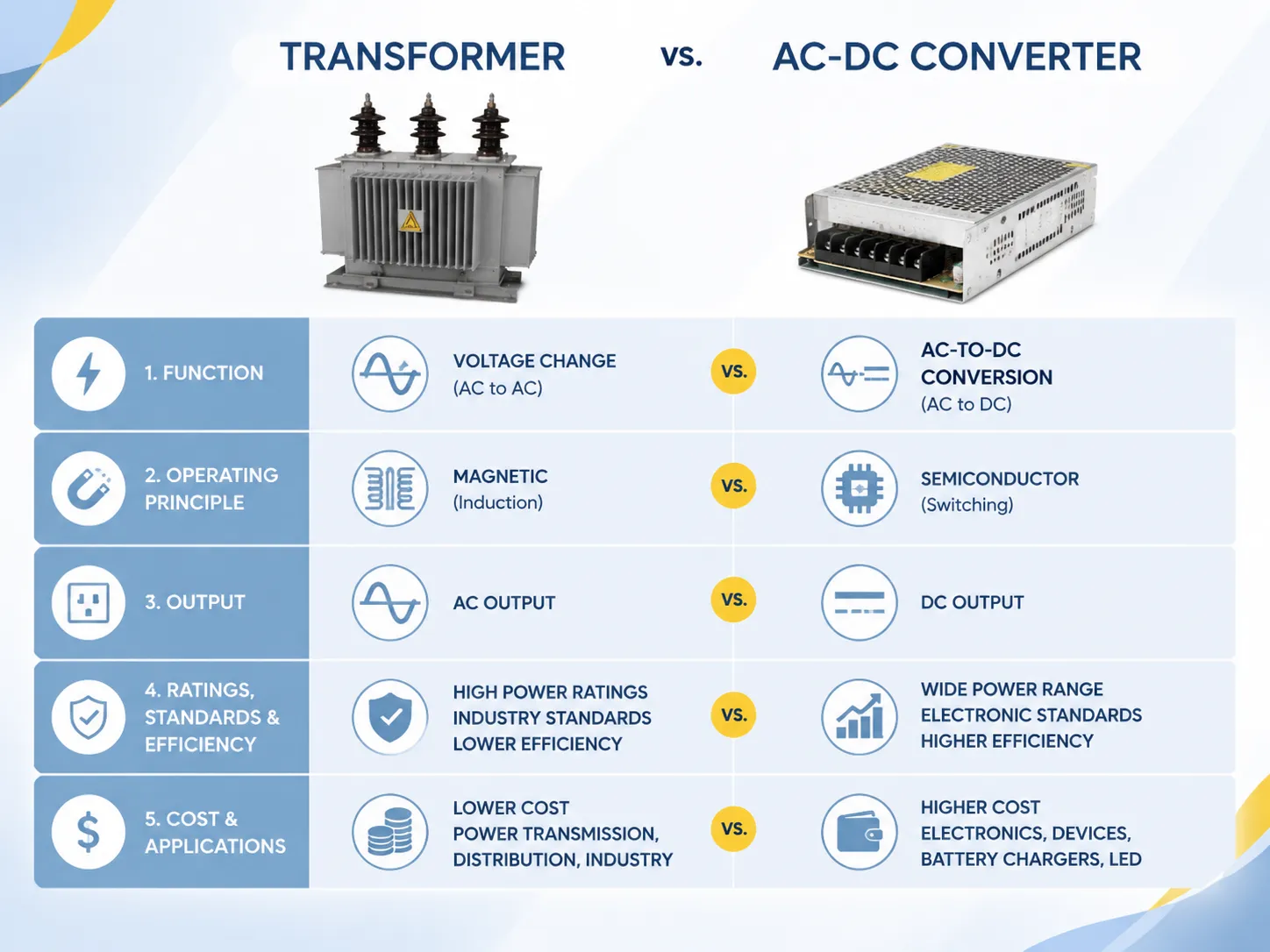
Difference 4: Ratings, Standards, and Efficiency
The specifications of these devices are given in different languages, which confuses potential clients comparing the two products.
When it comes to transformers, they are rated in kVA (apparent power) using specified voltage and frequency conducted according to IEC 60076 guidelines (or IEEE C57.12 NEMA TP-1 in the USA). Nameplates include no-load losses, load losses, impedance, and vector group along with its insulation class. Efficiency is provided at 50% and 100% loads.
As for rectifiers, they are rated according to output voltage and amperage (i.e.: “2,000 A / 12 V” for plating and “100 A / 24 V” for charging). Efficiency varies according to input power (measured in kV) and the ripple percentage.
| Rating basis | Transformer | Rectifier |
|---|---|---|
| Unit of rating | kVA | A + V (output DC) |
| Primary standard | IEC 60076 | IEC 62477, UL 508 |
| Efficiency quoted at | 50–100% load | Specific load points |
| Key loss number | No-load loss (W) | Forward drop / ripple |
| Protection features | Oil, gaskets, relief valve | OVP, OCP, OTP, soft-start |
In practical terms, whenever the manufacturer refers to the power stage as “2,000 A, 12 V rectifier” it means around 24 kW DC power stage; if it is powered from an 11 kV line then the transformer has to have at least 30–35 kVA to ensure that all losses in the rectifier and the power factor are covered and not just to follow them 1:1.
Difference 5: Cost and Typical Applications
The financial side of things has a completely different scale depending on the technology. The costs of transformers vary according to the mass of copper and steel, while rectifiers depend on the size of the semiconductor die and its cooling requirements.
| Application | Transformer (typical price) | Rectifier (typical price) |
|---|---|---|
| 100 kVA distribution (11 kV to 400 V) | $1,400–$2,400 FOB China | N/A |
| 630 kVA distribution (11 kV to 400 V) | $5,000–$10,000 FOB China | N/A |
| Small 24 V / 2 A battery charger | N/A | $15–$80 |
| Industrial 100 A / 12 V plating or charging | N/A | $150–$600 |
| Large 2,000 A / 12 V plating rectifier | N/A | $8,000–$25,000 |
| High-power rectifier transformer (e.g., 2,000 kVA) feeding a rectifier | $18,000–$35,000 | — |
Usual usages demonstrate categorization. Transformers: distribution by utility companies, provision of electricity to buildings, supply to motors, and separation of devices sensitive to voltage. Rectifiers: plating by electricity, anodizing, recharging of batteries, and supply of voltage to welders.
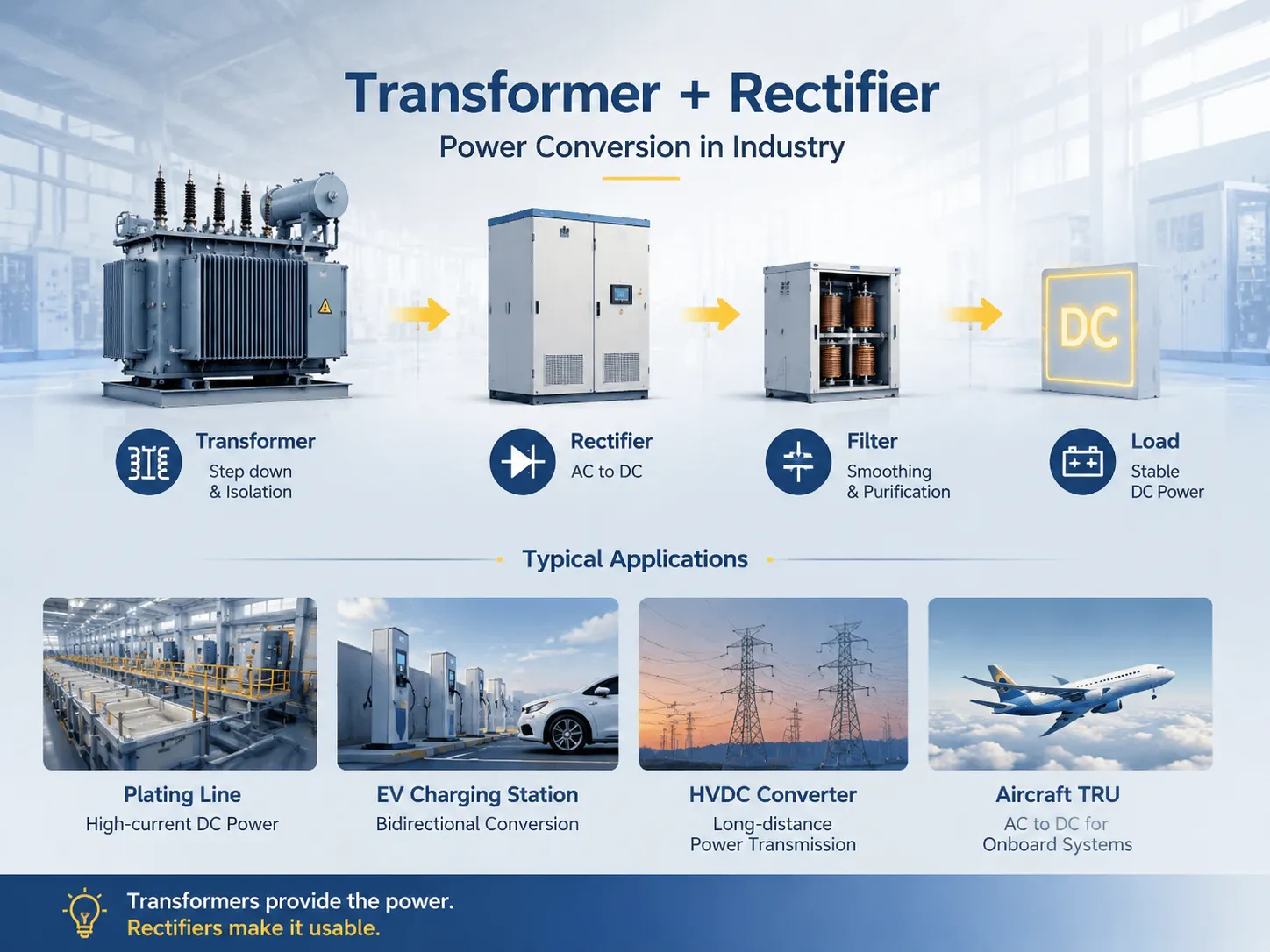
How They Work Together: Transformer + Rectifier
In manufacturing environment, these two are a perfect combination. The textbook example is: transformer (step down and isolation) → rectifier (switch to DC) → filter (purify) → load. This couple exists everywhere:
- Plating line: 11 kV/0.4 kV transformer feeding 400 V; thyristor rectifier is providing 2,000 A of DC power at 6–24 V to the bath.
- Charging station for electric vehicles: medium-frequency transformer in switching mode power supply, with rectifier stages on both sides,
- HVDC converter: powerful transformers are feeding hall of valves where thyristor rectifiers are converting AC to DC for transmitting power.
- TRU in airplane: transformer is changing voltage from 115 V to about 12 V; afterward, rectifier is providing stabilized 28 V DC for the system.
- Conclusion: when there is a rectifier in the industrial manufacturing, it is taking something from above as the transformer usually supplies it with power.
Full Comparison Table
| Criterion | Transformer | Rectifier |
|---|---|---|
| Function | Changes AC voltage level | Converts AC to DC |
| Output | AC (same frequency) | DC (pulsing or smoothed) |
| Technology | Magnetic (windings + core) | Semiconductor (diodes/SCR/IGBT) |
| Can it change frequency? | No | No (frequency is rectified away) |
| Can it step voltage? | Yes (by turns ratio) | Only indirectly (via input and topology) |
| Rating unit | kVA | A + V (DC output) |
| Standards | IEC 60076 / IEEE C57.12 | IEC 62477 / UL 508 |
| Typical life | 25–35 years | 10–20 years |
| Example price | $1,400–$2,400 (100 kVA) | $150–$600 (100 A/12 V) |
| Typical use | Grid distribution, isolation | Plating, charging, electronics |
Brands and Price Ranges
Every equipment has its separate brand territory. In case of transformers, well-known companies engaged in power; in case of rectifiers, those who do it well belong to both the world of power electronics and the transformers’ manufacturers.
| Device | Brand | Representative price | Notes |
|---|---|---|---|
| 100 kVA distribution transformer | ABB | $4,200–$6,500 FOB | Premium international brand |
| 100 kVA distribution transformer | Siemens | $4,000–$6,800 FOB | Global utility reference base |
| 100 kVA distribution transformer | Schneider Electric | $3,800–$6,200 FOB | Integrated MV/LV portfolio |
| 100 kVA distribution transformer | Jiangsu Subian Electric Power | $1,400–$2,400 FOB | IEC 60076-tested, export-focused |
| 100 A / 12 V industrial rectifier | Mean Well (Taiwan) | $150–$400 | Industrial power supply workhorse |
| 2,000 A / 12 V plating rectifier | Dynapower / Spang (USA) | $12,000–$25,000 | Plating-industry specialists |
| 2,000 A / 12 V plating rectifier | Chinese OEM rectifier makers | $8,000–$18,000 | Cost-competitive, check ripple spec |
On the transformer front, the reasoning is the same as for all projects — famous names like ABB, Siemens, and Schneider Electric guarantee dependability at a higher price, while Jiangsu Subian Electric Power offers IEC 60076-compliant distribution and power transformers from 5 kVA to 2,500 kVA of both oil-immersed and dry-type, including custom rectifier transformers and the needed winding and impedance. When installing the rectifier system, the transformer that supplies it should have as high engineering scrutiny as the rectifier.
Frequently Asked Questions
Can a transformer turn AC into DC?
Of course, it’s clear that a transformer is liable for altering the AC voltage, but it does not switch an AC signal into a direct current (DC). For DC current, a rectifying system should follow the transformer. This is why any power supply consists of both elements; the transformer lowers or increases the voltage and the rectifier transforms the AC into DC. One cannot perform DC loads using only a transformer.
Can a rectifier step voltage down like a transformer?
By itself it does not. A rectifier produces a DC output voltage depending on the AC voltage and the topology of the circuit. For instance, using a full-wave bridge rectifier with a 230 V AC makes 207 V average DC, and it’s not a “stepped” voltage that we obtain from other means. If we want 24 V DC from 230 V AC, we first need to reduce the voltage with the help of the transformer (or use the SMPS with the internal high-frequency transformer) and only then rectify it. This is why we are talking about transformer + rectifier units.
Which is more expensive: a transformer or a rectifier?
The cost per unit is influenced by the level of power being utilized; for example, 100kVA transformers cost between $1,400 and $2,400 if bought FOB China, while small rectifiers that deliver 100A and 12V would cost about $150-$600. However, larger rectifiers that produce 2000A and 12 would cost between $8,000 and $25,000. In fact, both cost units are classified as heavy capital expenditures at the utility level, but a transformer has a longer useful life and lower maintenance needs.
Why do rectifiers fail more often than transformers?
The rectifyers have semiconductors and capacitors which change with heat and electrical stress. The usual lifetime of devices is between 10 to 20 years. The most frequent malfunction is by diode or SCR stack failure. Transformers, unlike rectifiers, have passive nature, which makes them unable to fail from excessive heat. The other reasons of their malfunction are aging of insulation, electric overload or lightning, which means that transformers last from 25 to 35 years.
Do I need a transformer if I already have a rectifier?
The answer is generally affirmative when the source used is the AC mains. The rectifier is responsible for the conversion of AC voltage to DC voltage but does not provide the right input voltage nor any galvanic isolation. Hence a large rectifier requires heavy-duty transformer that exceeds its DC output rating by 15-20% so that all the inherent losses and the power factor could be factored in. But in cases where the source is battery or low DC voltage buses there is no need for a transformer, though a DC-DC converter might be useful.
References
- IEC — Publisher of IEC 60076 (transformers) and IEC 62477 (power electronic converter systems).
- IEEE — Source of IEEE C57.12 transformer standards and power electronics literature.
- NEMA — Distribution transformer efficiency and equipment standards.
- UL — UL 508 industrial control and power conversion equipment certification.
- U.S. Department of Energy — Efficiency and reliability data for distribution transformers.
- Dynapower — Manufacturer reference for industrial rectifiers used in plating and anodizing.
- Jiangsu Subian Electric Power — Manufacturer of distribution and rectifier-fed transformers for industrial projects.
Conclusion
Transformers differ from rectifiers in that a transformer alters the voltage of the power supply while the rectifier transforms the form of electricity. The transformer functions as a passive device and is characterized in terms of capacity in kVA, complying with IEC 60076 standards; while the rectifier is an active electrical device and is characterized in amps and volts, complying with IEC 62477 or UL 508 standards in construction. The two devices cannot be used interchangeably; they must be used together in the vast majority of industrial DC applications.
- In order to get AC of a different voltage, transformers are used. To obtain DC, the rectifier is applied. To get low-voltage DC from the electricity grid, both of them are utilized.
- It is essential to pay attention to the fact that DC voltage shouldn’t be introduced into the AC transformer core, nor should the AC voltage be used for the DC-distributed loads.
- It is advised that the transformer should be chosen preferably 15-20% higher than the rectifier DC value in terms of power capabilities to account for losses and the power factor.