


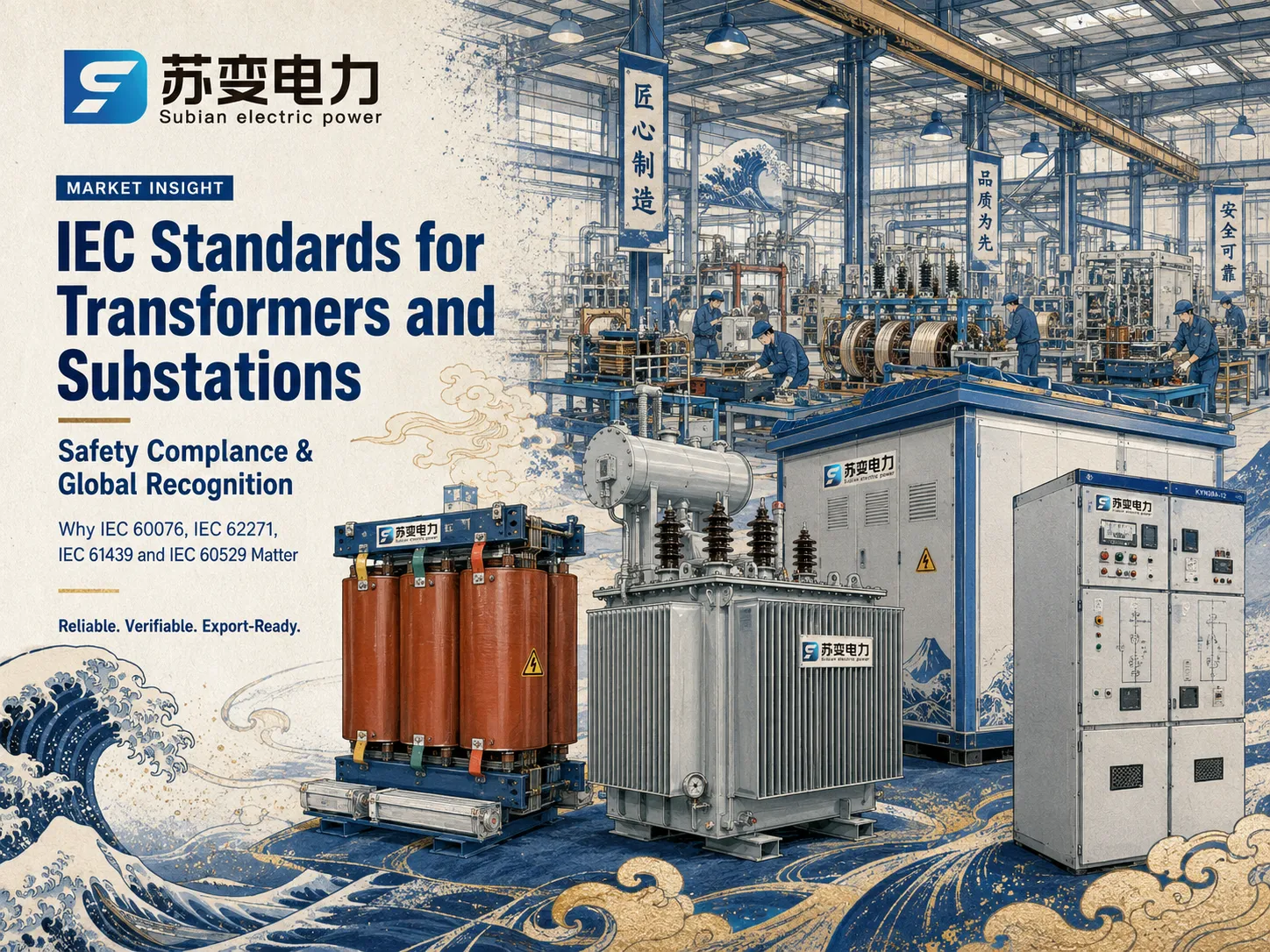
Be underestimated. Buyers, utilities, EPC contractors, and financiers often turn to the same question before accepting a product: whether it adheres to the recognized international IEC standards. In this second part of the ultimate guide, we will examine what these standards are, what their safety implications are, and how compliance with IEC standards functions as a passport granting global acknowledgment to transformers and substations manufactured in China.
Understanding IEC standards when sourcing power equipment abroad is of utmost importance. They are responsible for determining the possibility of a product successfully connecting to the grid, acquiring an insurance policy, receiving financing, and getting constantly operated. This guide describes the way manufacturers like Subian Electric are able to demonstrate compliance with the IEC standards when delivering their products.
What Are IEC Standards?
The International Electrotechnical Commission (IEC) is an international organization responsible for setting electrical, electronic and related technology standards. Its reports are issued by specialized international committees comprising experts from different countries, which is exactly the reason IEC standards are regarded as the technical language common for the entire power sector. IEC standards are not limited by the laws of any specific country and establish unified benchmarks.
Since the IEC standards enjoy worldwide reputation, they are widely used to lay down the foundation for the national standards in different countries. The standards in question are often cited in technical specifications, grid codes, and contract documents. Thus, a product being designed and manufactured in accordance with IEC standards has the trust level unattainable for specifications prepared by local designers and engineers.
The Importance of IEC Compliance with Transformers and Switchgear
Electrical devices may fail in various ways, each of which can lead to accidents, damages, and interruptions of services. The purpose of complying with IEC standards is to minimize those risks to an acceptable level which can be measured. Thus, with regard to electrical transformers, it presupposes the presence of the proper insulation, temperature rise limits, and resistance to short circuit. As for switchgear, it refers to safe functioning, reliable interruption of short circuits, and protection of operators near the active panel.
However, compliance is not only important from the safety point of view. As it is clear from the previous examples, many organizations will refuse to operate equipment proving non-compliance with standards, while those financing some projects will require proof of compliance as one of the conditions for investment.
Thus, choosing IEC compliant transformer is advantageous from different angles: achieving safety and obtaining approval from regulatory bodies and assurances from financial institutions.
Main IEC Standards That Are Used with Transformers and Electrical Equipment
One project involves the use of numerous documents, but there are only several key standards that can be used for most transformer and substation equipment. Understanding what they cover makes it easier to read specifications and test reports or other documents.
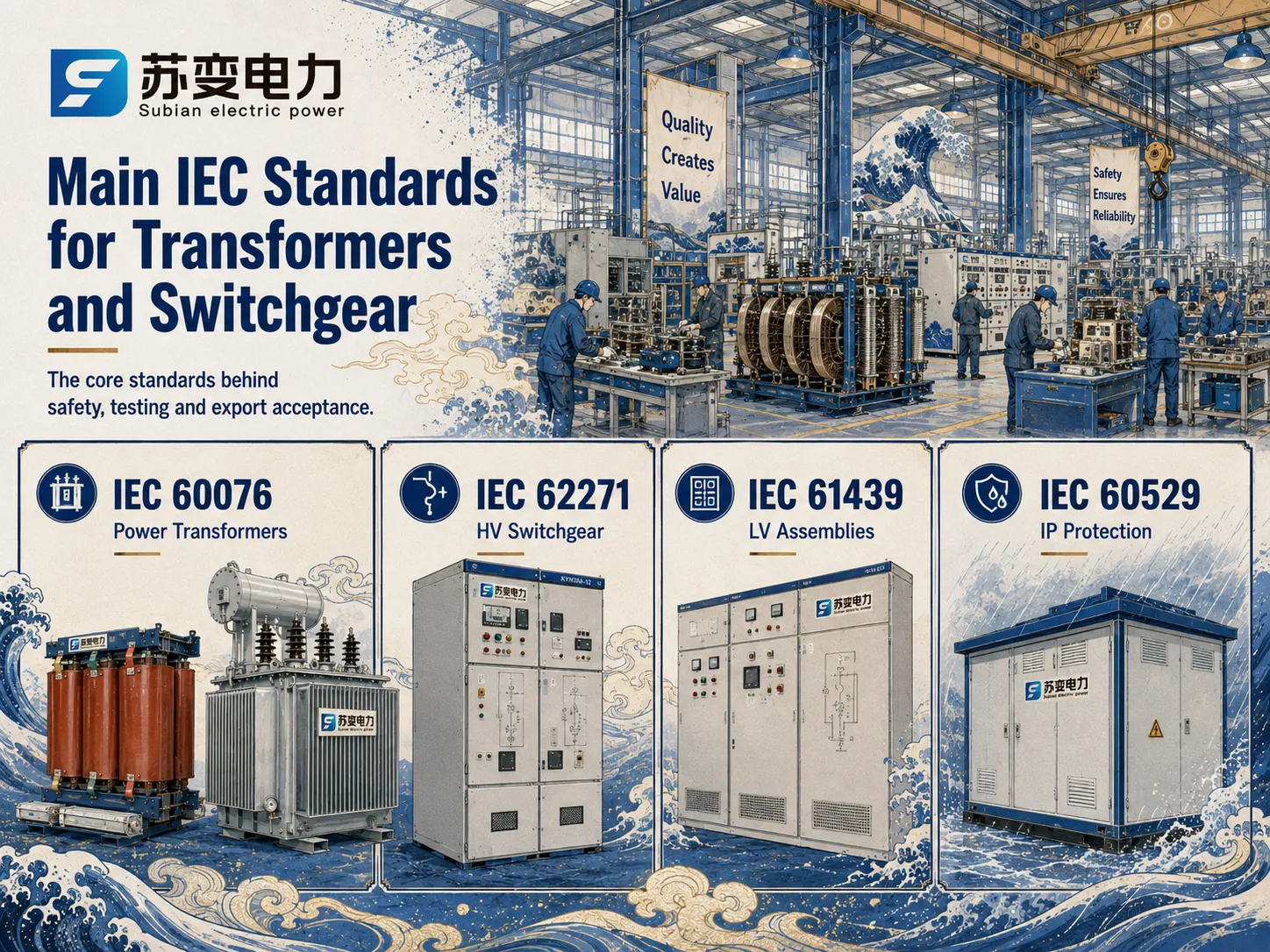
IEC 60076 — Power Transformers
A series of standards related to power transformers is defined by the IEC 60076. This standard is the only source that can be referred to for standards that govern transformers. The standards are divided into several parts — with each part dealing with a particular aspect of design, testing, etc. The first part describes the general requirements, ratings and the tests performed during the regular maintenance. The second part defines temperature rise for liquid-filled transformers to ensure they can operate without going outside their thermal limits at full load. The electrical strength of the transformer is addressed in the third part, which deals with insulation level, dielectric tests and external clearance. The fifth part of the standard describes the capacity of the transformer in terms of resistance against short circuit, one of the harshest tests any transformer must pass. The tenth part deals with the determination of noise level, which is important for the equipment that is operated close to residential areas.
For dry-type transformers, the only relevant document that has to be used is IEC 60076-11. The version of the standard from 2018 has expanded it up to 72,5 kV, introduced more precise environmental, climatic and fire classes as well as seismic class and requirements applicable to the construction of transformers made from amorphous materials.
IEC 62271 — High-Voltage Switchgear and Controlgear
Medium- and high-voltage switchgear is governed by the IEC 62271 series. The common specifications sit in Part 1, circuit-breaker requirements in Part 100, and Part 200 covers AC metal-enclosed switchgear for rated voltages above 1 kV up to and including 52 kV — the class that most ring-main units and indoor switchgear cabinets fall into. Compliance here assures fault-interruption capability, internal-arc considerations and safe access for operators, all of which are central to safety compliance in a substation.
IEC 61439 — Low-Voltage Switchgear Assemblies
IEC 61439 covers the low-voltage side and outlines the standards for switchgear and controlgear assemblies. The standard necessitates design and routine verification of the entire switchgear and controlgear assemblies instead of checking each of the components. The standard deals with the correct performance of low voltage switchgear and draw-out cabinets thus ensuring reliability of the switchgears distributing power after a transformer.
IEC 60529 — Degrees of Protection (IP Code)
IEC 60529 defines the IP code — the two-digit rating that describes how well an enclosure resists solid objects and water. For outdoor pad-mounted transformers, prefabricated substations and weatherproof switchgear, the IP rating is a plain-language summary of environmental protection, and it appears on nameplates precisely because it is part of the shared vocabulary of international electrical standards.
IEC, IEEE and National Standards: How They Fit Together
Customers often inquire if IEC is in conflict with various other standards. The situation is that they coexist peacefully, since the IEC is dominant in many regions, including Europe, Middle East, Africa, Central Asia, Southeast Asia, and most of Latin America and the IEEE and ANSI has mostly been used in the USA while the Chinese GB standard has mostly been synchronized with IEC. Well-experienced manufacturers comply with all the mentioned standards and sometimes with more than one standard at a time because of the invariable nature of the physics behind insulating and heating process regardless of geographic location of the manufacturing plant.
What matters for an international buyer is knowing which document a quotation actually references. Two transformers can look identical on a datasheet yet be tested to different rules. Anchoring a purchase to explicit IEC standards removes that ambiguity: it fixes the test methods, the acceptance limits and the reporting format, so equipment sourced from different suppliers can be compared on equal terms. That common baseline is a large part of why IEC standards for transformers have become the default reference in cross-border tenders.
How IEC Standards Turn Into Real Safety
Standards only matter if they change what happens on site, and the tests behind IEC standards are designed to do exactly that. Dielectric and insulation tests confirm that a transformer can withstand both normal operating voltage and the transient surges that travel along a network — lightning impulses and switching events that would otherwise puncture weak insulation. Temperature-rise limits ensure that windings and oil never exceed values that would age the insulation prematurely, directly protecting the equipment’s decades-long service life.
The standards also distinguish between routine tests, applied to every single unit before it leaves the factory, and type tests, which prove that a particular design meets the requirements. This two-layer approach is important for buyers: a routine-test report confirms the specific transformer you are receiving was checked, while a type-test report confirms the design itself is sound. Together they close the gap between a good design on paper and a good unit on the truck, which is the essence of dependable IEC compliance.
Short-circuit withstand testing may be the clearest example. When a fault occurs, enormous mechanical forces try to tear the windings apart in a fraction of a second. A transformer built and verified to the short-circuit part of IEC 60076 is engineered to hold together under that stress, preventing catastrophic failure. On the switchgear side, verified fault-interruption and internal-arc performance protect the people who operate and maintain the installation. In every case, the standard translates an abstract promise of quality into a measured, repeatable result — which is the whole point of IEC standards compliance.
IEC Standards and Global Market Recognition
The effectiveness of standards comes from the fact that they are accepted not only in the country of production. The IEC system of conformity assessment, including the IECEE CB Scheme, allows one country to use the test results of a member state. This interchangeability is crucial for export businesses, as it determines whether their merchandise will be stuck at the customs and grid connection or go through.
The recognition does not end with the sale. Equipment made according to the IEC standards will be easier to maintain and insure because technical maintenance documentation will be available in the right technological language. The same applies to cases when the factory goes through expansion or other operations. In short, compliance has permanent value.
IEC connections and recognition are therefore strictly correlated. Manufacturers and buyers in the Middle East, Africa, Central Asia and Latin America can identify a transformer based on the known IEC papers and get the reports that will allow their engineers to sign off on equipment installation with confidence. Therefore, an IEC compliant manufacturer is arguably the safest choice.
How to Verify a Manufacturer’s IEC Compliance
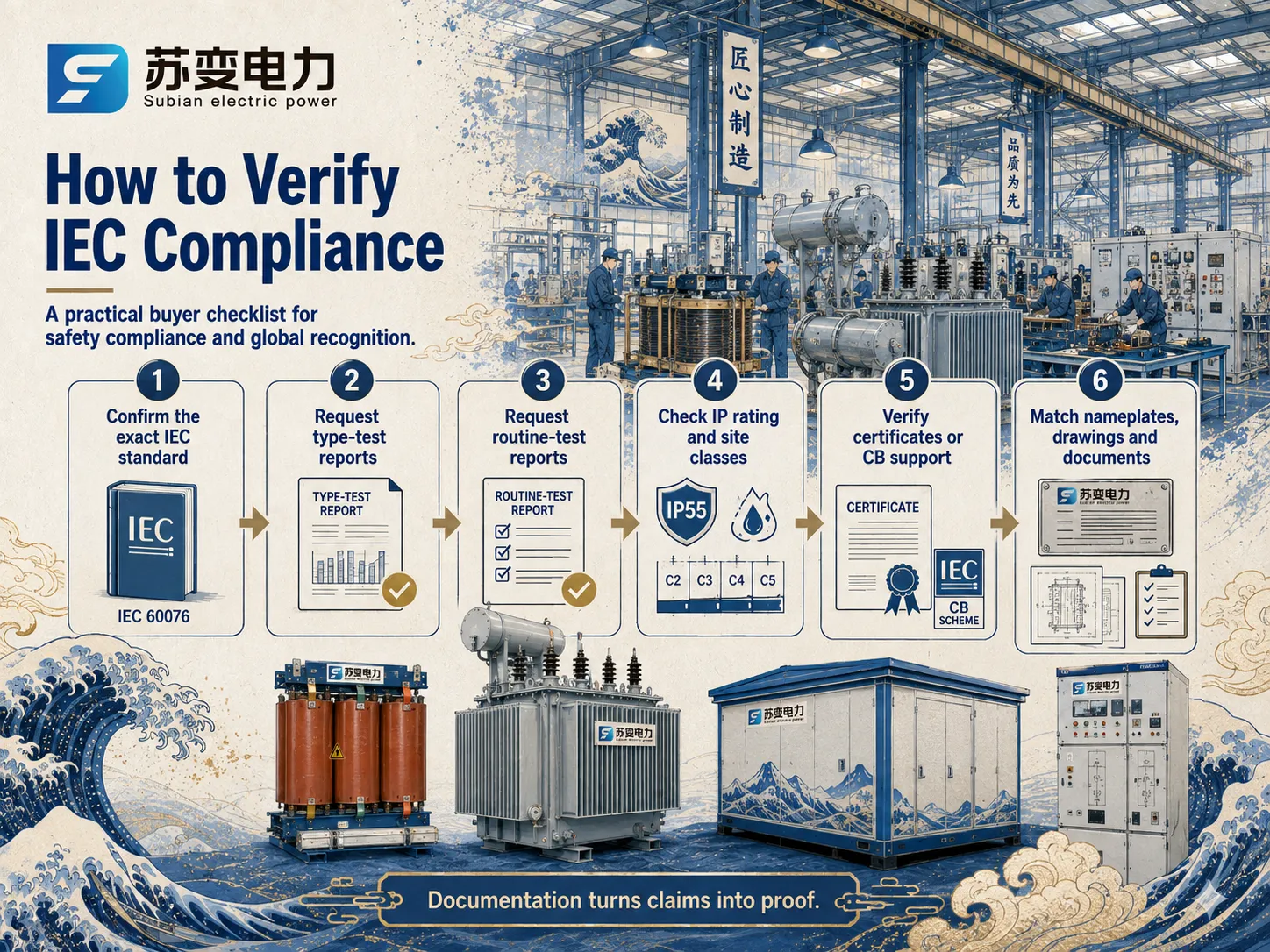
Marketing communication is quite straightforward, unlike technical documentation. Ensure you run a quick verification test on your supplier before becoming their customer.
Make sure you ask what regulations of IEC they are following when manufacturing their products. Asking in vague terms whether their products comply with IEC requirements will not yield results.
Get a routine test report on the equipment that is being supplied and the type test report that applies to the design.
For dry-type transformers, check the environmental, fire and climate class applicable in IEC 60076-11 and matching the installation.
Verify the IP rating as per IEC 60529 in comparison with the actual conditions at the installation site, particularly for outdoor or coastal applications.
Establish whether there is any independent certificate or CB scheme document that can substantiate the test results provided by the manufacturer.
Make sure that the information published on drawings and nameplates correlates with the requirements laid down in the standards applied in the offer.
If they can successfully answer all of the above questions, you may safely say that you are dealing with a genuine supplier. Professing deep knowledge with regard to the IEC standards does not mean that the supplier complies with these regulations.
Subian Electric: Equipment Built Around IEC Standards
Jiangsu Subian Electric Power Equipment Co., Ltd., based in Xuzhou, Jiangsu, designs and manufactures 110 kV-and-below power transformers, prefabricated substations, photovoltaic step-up substations and high- and low-voltage complete equipment — product families that map directly onto the standards described above. Its transformer range is engineered to the requirements of the IEC 60076 series, spanning SCB and SCBH-series dry-type units, including amorphous-alloy low-loss designs suited to the environmental and fire-behaviour classes of IEC 60076-11, and oil-immersed distribution and power transformers up to the 110 kV–132 kV class.
On the switching side, Subian’s medium-voltage products — such as the KYN28A-12 withdrawable metal-enclosed switchgear and HXGN15-12 ring-main units — align with the IEC 62271 family, while its low-voltage GCS, GGD and MNS assemblies correspond to the design philosophy of IEC 61439. Outdoor and pad-mounted equipment, including ZGS combined substations and YBM-series photovoltaic step-up substations, is built with IP-rated enclosures to IEC 60529 for real-world site protection. Backed by strict quality control from material selection through final inspection, this alignment makes Subian a practical example of how an IEC certified transformer manufacturer supports export projects with equipment buyers can specify against familiar documents.
With supply and project experience across more than twenty countries, Subian shows how consistent safety compliance and clear documentation combine to give Chinese-built power equipment credible global recognition in demanding international markets.
Frequently Asked Questions
What does IEC stand for?
IEC stands for the International Electrotechnical Commission, the global organization that develops consensus-based international electrical standards for electrical and electronic equipment, including transformers, switchgear and substations.
Which IEC standard applies to power transformers?
The core standard is IEC 60076, a multi-part series covering general requirements, temperature rise, insulation and dielectric tests, short-circuit withstand, sound levels and, in Part 11, dry-type transformers. It is the primary reference for IEC standards for transformers.
Why is IEC compliance important when buying transformers?
Because IEC compliance provides tested, internationally recognized proof of safety and performance. It is often required by grid operators for connection and by lenders for financing, so IEC compliant transformers are easier to approve, insure and operate across different markets.
Do IEC standards give equipment global recognition?
Yes. Because IEC documents are recognized in most countries and support mutual conformity-assessment schemes, equipment built to them enjoys strong global recognition, allowing test evidence produced in one market to be accepted in others.
Is there a separate IEC standard for dry-type transformers?
Yes. Dry-type units are covered by Part 11 of the IEC 60076 series. Its current edition applies up to 72.5 kV and defines environmental, climatic and fire-behaviour classes, plus a seismic class and guidance for amorphous-core designs, so buyers can match a cast-resin or amorphous transformer to the exact conditions of an indoor, commercial or renewable installation.
How can I confirm a manufacturer really meets IEC standards?
Ask for the specific standard numbers each product is built to, request type-test and routine-test reports, and check that nameplates and drawings match those documents. Genuine IEC standards compliance is always backed by verifiable test evidence rather than a general statement. A reputable IEC certified transformer manufacturer will provide this documentation before shipment.
Conclusion: Compliance That Travels With Your Project
From the insulation strength defined in IEC 60076 to the enclosure protection of IEC 60529, the standards covered in this guide share a single purpose: turning engineering quality into safety that can be tested, documented and trusted anywhere in the world. For international buyers, insisting on genuine IEC standards compliance is the clearest way to secure both on-site safety and smooth global recognition.
If you are specifying transformers, switchgear or a complete substation for a project, Subian Electric can help match your voltage class, capacity and site conditions to the right IEC-aligned equipment and supporting documentation. Share your requirements with Subian’s engineering team to request a quotation and build your project on power equipment designed for verifiable safety compliance.