


The procurements manager of a European electrical distribution firm faced a new challenge when he got entrusted with sourcing 200 cast-resin transformers for a hospital construction project. However, he had never sourced transformers from China before. He had an extensive experience dealing with European manufacturers and was fully aware of lead times, prices, and certification packages. He spent six weeks qualifying the suppliers, performing factory visits, analyzing type test results, and negotiating terms. The order for 200 units, ranging from 100 kVA to 1,000 kVA and made of cast-coil with Class F insulation compliant with IEC 60076 was delivered within 10 weeks and at around 60% of the European price. The conclusion is that the cost and lead time benefits of ordering cast transformers from China are real, although attainable through a structured and systematic procurement process. The presented guide summarizes such process in ten useful tips concerning formulation of specification, supplier qualification, logistics management, and after-sales support.
Summary: Obtaining cast‑resin transformers from China has many benefits in terms of fabricating costs and time of delivery, but to attain success, one needs to have a systematic approach to procurement.
Tip 1: Define Every Technical Parameter Before You Contact a Single Supplier
The biggest error that new buyers make when ordering a cast transformer is sending out the same vague request like the one mentioned above to multiple Chinese manufacturers at once. All the suppliers will give varying rates from each other in terms of prices, quotes, and technical proposals since each manufacturer is filling in the gaps in the specification according their view. For instance, one manufacturer will quote for a cast coil transformer which has copper coils and specified rise of temperature of 80°С. While the second party will give a quote for a VPI unit with aluminum coils and the temperature rise of 150°С, where the VPI is labelled cast-resin only because of the varnish which has resin in its composition. Thus, two mentioned types are totally different devices with different prices. A smart buyer should figure out a detailed specification upfront and only after contacting any provider. A proper specification should contain kVA rating, primary and secondary voltage, vector group, impedance rate, insulation class, temperature rise, winding materials, a cooling method, the case type, environmental class, applicable standard, necessary taps, functionalities, and documents and test which the product has to be delivered.For a comprehensive framework for writing a transformer specification, our article on the best basic electrical transformer buyer guide covers every parameter that should be defined.
Tip 2: Insist on Genuine Cast‑Coil Technology, Not VPI
The Chinese transformer market sometimes uses the term “cast-resin” frivolously. A true cast-coil transformer has its high-voltage coils fully covered with epoxy resin that is injected under vacuum in a special mold and then cured in an oven. As a result, it has a solid insulation system with no voids, which is unaffected by moisture, dust, and chemicals and that has high strength and resistance to partial discharges compared with other dry transformers. The windings of a VPI (vacuum pressure impregnated) transformer, on the other hand, are dipped into varnish containing resin under vacuum and then cured. The VPI method is cheaper than the cast-coil method and the resulting winding is not completely encapsulated; it is coated, not solid. VPI transformers are acceptable for indoor situations where the environment is clean and dry, but they cannot be used for rough outdoor locations. A person who needs a cast-coil transformer for such applications as data centers, hospitals, subway tunnels, chemical plants, and outdoor installations should check whether the manufacturer is using the right technology (cast-coil). The key point is the partial discharge report which indicates that the PD level in a properly manufactured cast-coil transformer can be up to 10 picocoulombs under 1.5 times the power supply voltage. If the transformer is VPI or it has been manufactured poorly, the PD level will be higher. The manufacturer may not also provide a PD report. Thus, a PD report should be obtained for every coil and the indicated values should be checked against the limits established by IEC or IEEE standards. If the supplier does not provide the report, he cannot be considered a reliable manufacturer of cast-coil transformers.
Tip 3: Verify the Factory’s Certifications and Type‑Test Reports
It is very important for any cast-transformation manufacturer from China to possess at least an ISO 9001 certificate, preferably also ISO 14001 and ISO 45001 certification. The transformer model being purchased must have a relevant type test document produced by an independent ILAC-accredited laboratory — KEMA, CESI, UL, or any laboratory in China, for example the China Electric Power Research Institute. The type test documents must include temperature rise test, lightning impulse test, and short circuit test that is relevant to a transformer with a particular kVA or voltage rating being ordered. Any type test document must not be about a transformer model with either different rating or design. The document must be not older than five years since the manufacturing and standards evolve and, thus, it may not reflect the latest design. If a manufacturer is unable to provide relevant type tests document, it is not a reliable supplier regardless of their price, lead time and the sales pitch.
Tip 4: Audit the Factory, or Hire a Third‑Party Inspector
Walking through a factory is the best way to learn about its production abilities. Buyers need to observe critical factors, such as the core cutting and stacking areas, winding machines, and curing ovens. They should also ask essential questions to determine whether the factory is equipped with the necessary facilities. For example, is the casting hall properly heated? How are the epoxies stored and mixed? Other points of inquiry include whether machines are working properly without any disturbances, whether tests are conducted in the test lab, etc. If checking if the factory runs properly is not viable, one can always hire a third-party inspection agency for an audit. Although doing so entails spending $3000 or more, it pays off if the audited factory turns out to produce spare parts of faulty quality.
Tip 5: Request Material Test Reports for the Core Steel and the Winding Conductor
The efficiency of a transformer depends on the quality of the materials used in its manufacture. The core steel must be of the appropriate grade, thickness and specific loss (in watts per kg at the rated flux density) in order to achieve the no-load loss specified. The winding conductor, be it copper or aluminum, has to be of the right purity and insulation class in order to achieve the specified load loss and operating life. The manufacturer has to issue a material test report (MTR) for the core steel and the winding conductor that would trace the steel back to the mill heat number and confirm chemical, mechanical and electrical properties of the conducted material. If a manufacturer is unable to provide those MTRs, they do not have control over their supply chain, the quality of the transformer cannot be assured. It is essential for the buyer to verify the MTRs before the shipment takes place and check that the values are in accordance with specifications.
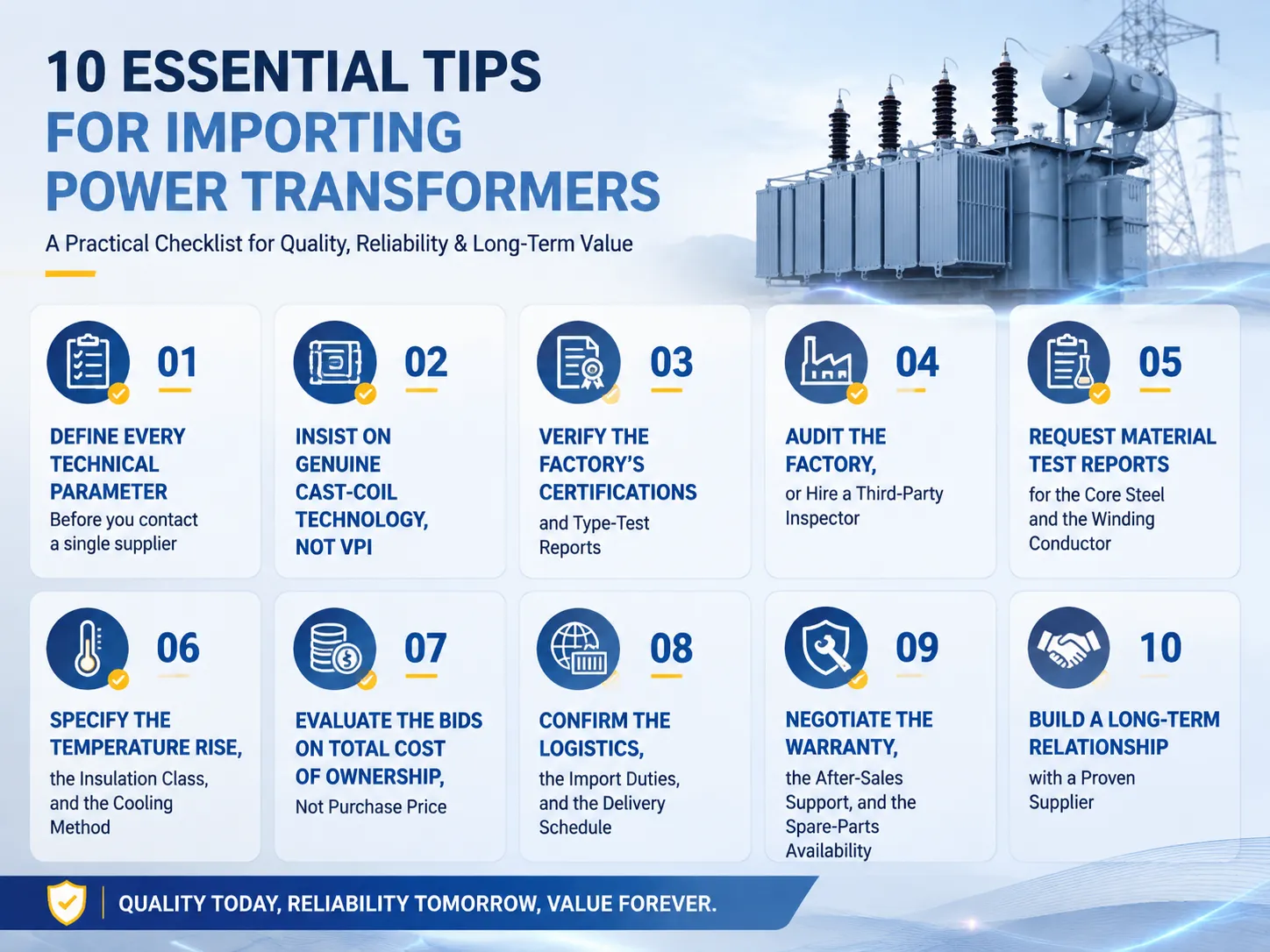
Tip 6: Specify the Temperature Rise, the Insulation Class, and the Cooling Method
The purpose of the thermal design of a cast-resin transformer is to ensure the optimal service life of the unit as well as its tolerance regarding overloads, as well as the appropriate operating conditions. There are three important factors that should be indicated by the buyer: the insulation rating (Class F means that the maximum temperature will be 155 degrees Celsius with respect to the point of highest heat buildup, while Class H allows for the highest temperature of 180 degrees Celsius), the number of degrees of the temperature rise (that is, how high the temperature of the windings will be as compared to the temperature of the environment; rise of 80 degrees Celsius means more insulation service life, and better tolerance to overloads than temperature rise of 115 degrees Celsius or 150 degrees Celsius, however, it will mean physical changes in dimension and cost of the unit), and the method of cooling. The standard method of cooling for horizontal installation is the cooling by air convection (AN). The cooling with forced air (AF) may result in increase of kVA by 25 to 33 %, however, this method requires purchase of additional equipment and provides consumption of additional energy. For a transformer that will be installed in a hot environment like Southeast Asia, Middle East or desert area, and in the room with no/poor ventilation, Class F insulation and 80 degrees Celsius will provide the necessary thermal margin, while for an installation in a cold well-ventilated area, 115 degrees Celsius may be enough and even provide better purchase price.
Tip 7: Evaluate the Bids on Total Cost of Ownership, Not Purchase Price
This type of transformer consumes energy all the time while producing no-load loss and load loss depending on whether it is energized or not. The transformer can consume energy in a quantity that is two to five times its purchase price over the period of 30 years. It means that although a low-cost transformer may seem appealing, it may not provide savings during its operational lifetime. The energy consumption of two transformers should be compared in order to see the difference in operational cost. One must use the so-called total cost of ownership method for the purposes of evaluating several alternatives. There is a special loss-capitalization formula to evaluate offered products. This formula is given by the following expression: Total Evaluated Cost of the Transformer = Purchase Price of the Transformer + (A x No-load Losses of the Transformer in Watts) + (B x Load Losses of the Transformer in Watts), where A and B are loss-capitalization factors expressed in dollars per watt. The factor A represents the cost of the energy that is constantly consumed while factor B refers to the cost of the energy consumed by the device when it operates. The buyer must use both A and B factors in evaluating different bids and must select the transformer with the most favorable total cost.The U.S. Department of Energy publishes the standard loss‑capitalisation methodology and the factors for different types of facilities.
Tip 8: Confirm the Logistics, the Import Duties, and the Delivery Schedule
The transformer price is a part of the total cost of acquiring it. The the shipping from the factory to the port, the ocean freight, the insurance, the import duties, the port handling charges, and the inland transport to the final site can increase the total cost by 10-30% depending on the country of receipt, the size of the transformer and the shipping path. The buyer should get a detailed quotation of logistics form the supplier or a freight forwarder before placing the order and including the logistics cost in the overall cost analysis. The import duty rate for cast resin transformers varies across countries and it depends on the HS code of the product. The buyer should check the rate in the local customs office and ensure that the supplier will provide all the necessary documentation, namely the commercial invoice, the packing list, the bill of lading, and the certificate of origin to clear the goods through customs. The delivery schedule has to be real with some possibility of unforeseen events like port congestion, customs delays or slow shipments. A transformer that arrives late for two weeks and is a part of the project with a stringent commissioning deadline is a transformer that prices itself not in dollars but in the missed revenue from the delayed project.
Tip 9: Negotiate the Warranty, the After‑Sales Support, and the Spare‑Parts Availability
Cast resin transformer is an asset that lasts for a duration of 30 years and the warranty, along with the after-sales assistance provided by the manufacturer, is equally essential as the transformer. The warranty should be properly defined and in the case of a common industrial transformer, it should be two years following the commissioning date or 18 months after shipment, whichever occurs earlier, while for customized or high-cost transformers the period would be longer. The warranty needs to provide coverage for both the workmanship and the materials used and the process of making a warranty claim should be clearly defined and clarified by the time the order is placed. The manufacturer needs to be asked by the buyer to check for the existence of the crucial spare parts, along with the time required for delivering them to the buyer’s country. The newly obtained manufacturer’s warranty needs to have a local service partner or distributor in the buyer’s country providing better service than those who do not have. In addition, it would be good to ask for a commissioning procedure from the manufacturer, as well as for a commissioning engineer to assist with the equipment energisation (if required) which is crucial for a heavy-duty customized transformer. The expense for the support may be low compared to a cost of a faulty transformer.
Tip 10: Build a Long‑Term Relationship with a Proven Supplier
For each project, the best way to source cast transformers is not to bring forth a new tender to several unknown manufacturers. Rather, the best practice is to develop a relation with a select few trusted suppliers that have been thoroughly vetted and whose plants have been inspected, type tests have been checked, transformers passed tested properly before and who have proper knowledge of the provider’s required specifications and quality standards. Forming a long-term partnership helps save on transaction costs of subsequent orders. Good suppliers do know what to expect and buyers are aware of their suppliers’ qualifications, saving time on negotiations and dealing with suppliers while forming trusting relations. The buyer who finds a good reliable supplier and builds a long-lasting partnership with them wins the race against other buyers looking for the cheapest bid. Subian Electric is one of the Chinese producers that has built a successful export business with the help of long-term relations with international customers. Our cast-resin transformers that can go from 100 kVA to above 10,000 kVA and are manufactured utilizing Class F insulation and Class H insulation and copper or aluminum wire has undergone necessary certifications and is suitable for use in harsh environments where it is not possible for a transformer to work improperly. The factory located in Zhejiang province welcomes buyers for an audit.For an introduction to our full range of cast‑resin and dry‑type transformers, visit Subian Electric.
Frequently Asked Questions
What is the difference between a cast‑coil transformer and a VPI transformer?
A cast coil transformer is such a transformer where the high voltage windings are completely covered in an epoxy resin. It is done by pouring the resin in a vacuum chamber followed by baking it in a controlled oven. On the other hand, the VPI (Vacuum Pressure Impregnated) transformers are those ones made by dipping the windings in varnish in vacuum. Cast-Coil transformers are better at resisting moisture and also have better mechanical strength performance compared to the VPI transformers and hence are preferred for rough, wet or outdoor locations.
How do I verify that a Chinese cast‑transformer manufacturer is reliable?
If you want to check the reliability of a Chinese manufacturer, ask for the ISO 9001 certificate and an independent lab test report on the type and model of the transformer that you are buying. Audit the facility — either personally or through a third party. Check the production machines, the casting section, and the test bay. Ask for the test reports for the raw material for the core and for the conductor used for windings, and verify with past users of the type of transformer being bought. A reliable manufacturer is one that can provide all of this information without hesitation.
What is a partial‑discharge test, and why is it important for a cast‑resin transformer?
Partial discharge (PD) testing involves the identification of very small electrical discharges occurring within voids, cracks, or defects located in the solid insulating material of a cast-coil transformer. If significant PDs are discovered, hence, there is a manufacturing defect that will lead to the breakdown of insulation at some stage. A quality cast-coil transformer should have a PD of not more than 10 picocoulombs tested at 1.5 times its rated voltage level. PD testing is regarded as the most crucial quality check in manufacturing cast resin transformers. It is recommended that a buyer should ask for the PD report of the winding.
How much does a cast‑resin transformer from China cost compared with a European or a North American equivalent?
An identical cast-resin transformer produced in China may be around 40–60% cheaper than one made in Europe or North America, provided both have the same kVA rating, voltage class, and are built to the same IEC or IEEE standard. This price advantage of Chinese transformers can be attributed to the country’s low wage rates and its local vertically integrated supply chain for core steel, winding wire, and epoxy resin, as well as to the Chinese transformer sector’s high-volume manufacturing process. In addition, the buyer must include in the FOB price the freight charges, import duties, and logistics costs to arrive at the total cost of shipment and assess offers based on the total cost of ownership, which means taking into account any potential losses.
References
- IEC 60076‑11 — Power Transformers — Part 11: Dry‑Type Transformers. The international standard that defines the design, testing, and performance requirements for cast‑resin and VPI dry‑type transformers, including the partial‑discharge test limits.
- U.S. Department of Energy — Loss‑Capitalisation Methodology for Transformer Evaluation. The standard methodology for evaluating transformer bids on a total‑cost‑of‑ownership basis, including the A and B loss‑capitalisation factors.
- SGS — Third‑Party Factory Audit and Inspection Services for Electrical Equipment. A global inspection, verification, testing, and certification company that provides factory audits and pre‑shipment inspection for transformers and other electrical equipment.
- KEMA Laboratories — Transformer Type‑Test Certification. An independent high‑voltage test laboratory that provides type‑test certification for distribution and power transformers to IEC and IEEE standards.
Buying cast‑coil transformers made in China is an effective way to keep costs and lead times down for an important electrical device, provided the buyer adheres to an effective buying procedure. Formulate the specification thoroughly before approaching any vendor. Insist on the use of real cast‑coil technology as opposed to VPI. Check the factory’s certifications and type test and material test reports. Evaluate the bids by means of the total cost of ownership, not the selling price. Pay attention to logistics and import duties. Try to establish a long‑term partnership with a supplier who is transparent, technically qualified, and accountable across all shipments. By obeying the following ten tricks, a buyer will get a transformer that will correspond to the specification, function properly for decades, and be cheaper on the whole during the service life of the product. Subian Electric is a manufacturer of equipment for cast‑coil transformers for the global market which meets all the necessary international standards including testing and transparency that are essential for a professional buyer.