


In the year 1886, Great Barrington, Massachusetts claims to be the first place in the world to use alternating current in power plants through transformers. This event is considered a great event in electricity history, as a 500 V generator powered a transformer that lowered voltage for incandescent lamps allowing electricity to be produced, converted, and supplied to customers. After about 140 years, the principle of this wonderful event is used in every factory, airport, hospital, and data center around the globe.
The article provides detailed information concerning the basic principles that make transformers the engine of progress: voltage transformation, losses in transmission, galvanic isolation, and power routing in complex networks. Also, one will find the figures measuring efficiency, losses, voltage classes, and costs, and learned about the role of transformers in all electrification movements, starting from the boom of streetcars in the 1890s to modern charging stations for electric vehicles.
How Transformers Drove Historical Progress
In the past, electricity was generated next to the point of consumption due to the inherent limits of direct current (DC) in terms of voltage transformation. But because of it, each power plant could serve the area only within a radius of one or two miles. The invention of transformers changed that situation. With the alternating current (AC), a generator can generate electricity with a voltage of 20 kV and transfer it through the transformers to the voltage of 100 kV or even higher, allowing long distance transmission of electricity. In the 1890s, for example, it became possible for the power plants producing electricity using water energy—like, for instance, the one located in Niagara Falls—to supply power to the cities located 30-40 km away from the plant.
The issues of rural electrification, which lasted from the 1930s to the 1950s, could not be solved without cheap distribution transformers; the industrialization period after the end of the Second World War required huge power transformers in every industrial plant; the digital revolution brought dry-type transformers to all buildings; and now we can observe the transformation of the energy sector using transformers.
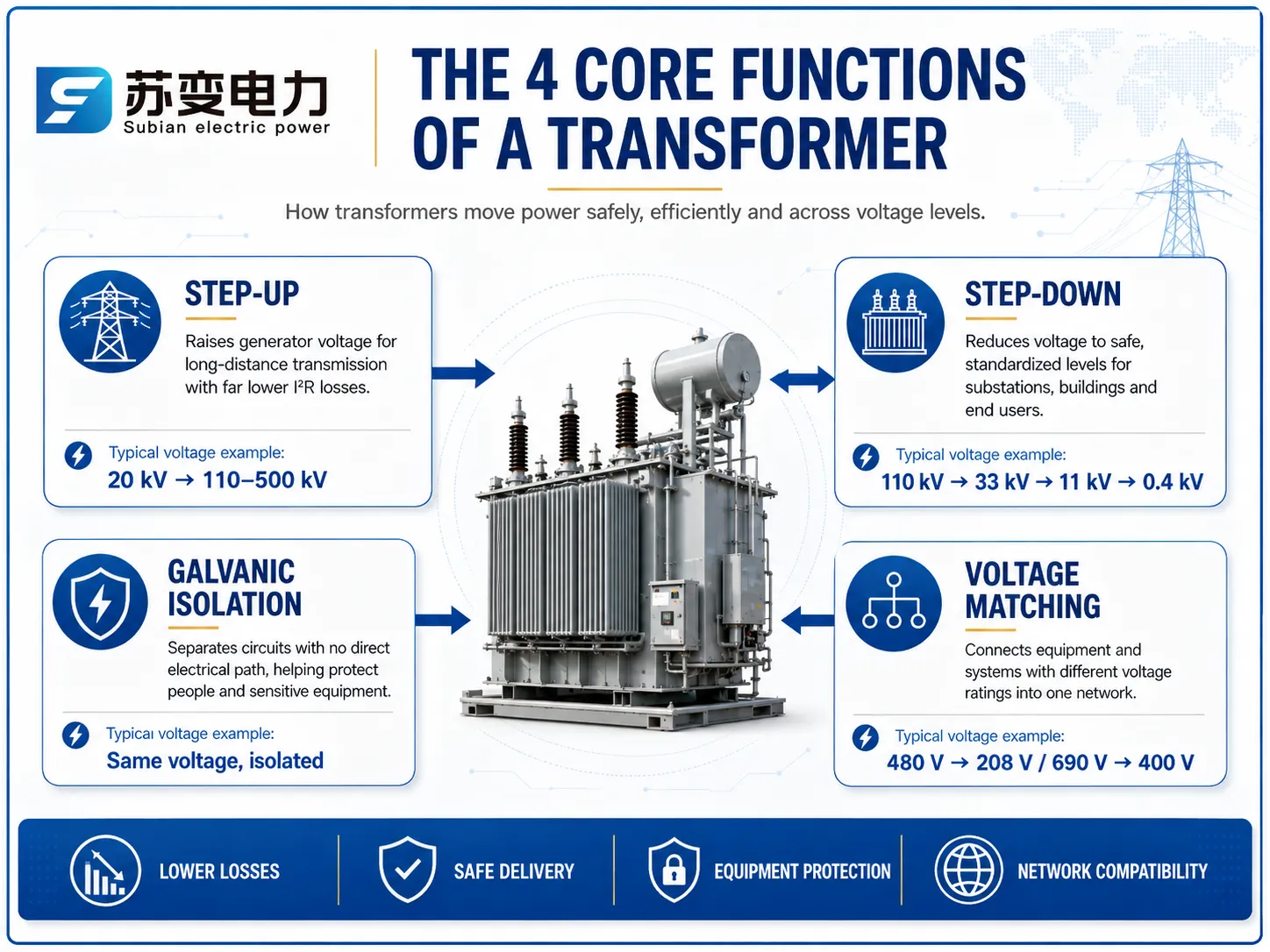
The 4 Core Functions
| Function | What It Delivers | Typical Voltage Change |
|---|---|---|
| Step-up | High-voltage transmission with low line losses | 20 kV → 110–500 kV |
| Step-down | Safe, standardized supply for users | 110 kV → 33 kV → 11 kV → 0.4 kV |
| Galvanic isolation | No direct electrical path between circuits | Same voltage, isolated |
| Voltage matching | Connects equipment of different ratings | E.g. 480 V → 208 V, 690 V → 400 V |
These four functions combine in every network. A hospital, for instance, takes 11 kV from the street, steps down to 400 V for the building, isolates critical circuits for medical equipment, and matches the generator voltage to the switchboard during outages.
The Physics: Electromagnetic Induction
The concept behind the workings of a transformer is based upon electromagnetic induction, which was first elaborated on by Faraday and quantified by Lenz. When the primary stream of electric current travels through a transformer, the laminated iron core becomes magnetized, and the alternating flux created in the process of this magnetization causes the generation of an electric voltage in the secondary coil of the transformer. If the transformation ratio was calculated beforehand, then we can expect the transformation ratios to be equal.
The two types of loss that affect efficiency are hysteresis loss, which refers to the process of repeated switching of magnetic domains of the core, and eddy-current loss, which is the current induced within the core material. Each of the two types of losses can be minimized by inventing grain-oriented silicon steel, creating thin laminated plates of steel and applying new laser technology. Copper loss occurs with the square of load current and hence the transformers operate most efficiently when their actual loading will reach only 50-70% of the rated.
Why Efficiency Is the Real Engine
The most important figure in a transformer’s life is efficiency. The electricity that passes through a distribution transformer loses about 1 to 3 percent, and since this equipment operates constantly, this reflects 3–5 percent of the total electric power produced by all countries in the world. Reducing the losses by one percentage point of the total electricity distributed by all transformers used would provide more electricity than is consumed in most countries.
| Rating | Typical Efficiency | Annual Loss Energy (kWh) | Loss Cost @$0.10/kWh |
|---|---|---|---|
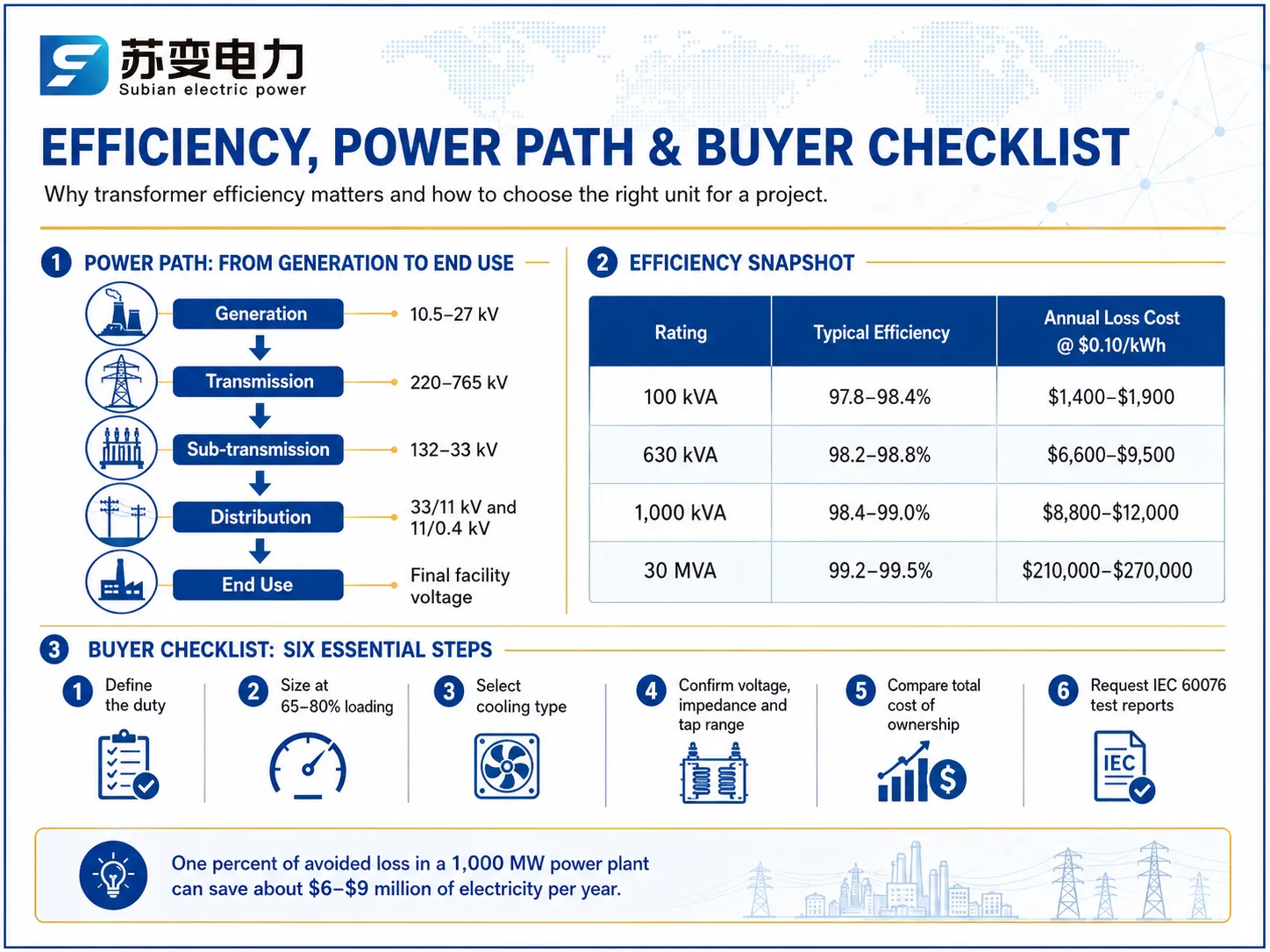
| 100 kVA | 97.8–98.4% | 14,000–19,000 | $1,400–$1,900 |
| 630 kVA | 98.2–98.8% | 66,000–95,000 | $6,600–$9,500 |
| 1,000 kVA | 98.4–99.0% | 88,000–120,000 | $8,800–$12,000 |
| 30 MVA | 99.2–99.5% | 2,100,000–2,700,000 | $210,000–$270,000 |
Because the annual loss cost exceeds the price of many small transformers within a few years, efficiency-based procurement—using a loss evaluation of $3,000–$8,000 per kW—is standard practice among utilities and sophisticated industrial buyers.
Types by Function
| Type | Primary Function | Typical Application |
|---|---|---|
| Generator step-up (GSU) | Raise generator voltage to grid level | Power plants, wind, solar farms |
| Transmission transformer | Interconnect HV networks | 400/220/132 kV substations |
| Distribution transformer | Step down to end-use voltage | Poles, pad-mounts, building vaults |
| Isolation transformer | Galvanic separation | Medical, IT, industrial control |
| Autotransformer | Voltage adjustment with one winding | Interconnecting 132/66 kV systems |
| Instrument transformer | Scale down for metering/protection | CTs and VTs in every substation |
The Transformer’s Path in the Power System
①.Generation: GSU transformer units takes generator voltage in subject line GSU transformers takes voltage of generators from the range of 10.5–27 kV to levels of 110–500 kV.
②.Transmission: EHV transformers connect long-distance grid with usually 220–765 kV transmission.
③.Sub-transmission: 132–33 kV transformer gateways facilitate regional substation supply.
④.Distribution: 33/11 kV or 11/0.4 kV transformer systems supply transportation feeder lines.
⑤.End use: dry-type or oil-immersed units are needed inside plants.
The concept of loss of each transformer stage is not an arithmetic sum, as each stage has its loss profile. So the cumulative loss is determined not by summing arithmetic losses but accounting for losses at each single stage.
Modern Applications Driving Growth
- Renewable energy: all wind turbines and solar inverters use step-up transformers and globally, renewable energies will add many hundreds of GW of new capacities annually, with each MW requiring around 1.5-2 MVA of transformer capacity.
Electric vehicle charging: rapid chargers at 150-350 kW need dedicated transformers, usually around 500-1,000 kVA for every site.
Data centers: hyperscale campuses with a capacity between 50 and 150 MW use thousands of dry transformers every year.
Grid modernization: smart grid, HVDC and battery storage developments all rely on transformers being available that is one of the reasons why waiting times increased to 30-50 weeks in the years 2022-2024.
Urbanization: tall buildings, subways, and airports keep consuming dry-type and distribution transformers.
Representative Specifications and Losses
| Rating | Voltage | No-Load Loss | Load Loss | Impedance |
|---|---|---|---|---|
| 100 kVA | 11/0.4 kV | 200–330 W | 1,300–2,000 W | 4% |
| 630 kVA | 11/0.4 kV | 900–1,400 W | 6,000–8,500 W | 4.5–6% |
| 2,000 kVA | 11/0.4 kV | 2,400–3,400 W | 15,500–21,000 W | 6–8% |
| 30 MVA | 110/33 kV | 20,000–30,000 W | 110,000–160,000 W | 10–12% |
Brands and Price Ranges
| Brand | Country | 630 kVA | 30 MVA (110 kV) | Strength |
|---|---|---|---|---|
| Hitachi Energy | Switzerland/Japan | $9,000–$15,000 | $380,000–$560,000 | Grid-scale engineering |
| Siemens | Germany | $8,500–$14,500 | $360,000–$540,000 | European reference base |
| ABB | Switzerland | $8,500–$14,000 | $360,000–$530,000 | Global service network |
| Schneider Electric | France | $8,000–$13,500 | On request | Distribution eco-design |
| TBEA / China XD | China | $5,500–$9,500 | $230,000–$380,000 | High-volume power transformers |
| Jiangsu Subian Electric Power | China | $4,800–$9,500 | $220,000–$360,000 | IEC 60076 tested, OEM/ODM, export |
Companies like Hitachi Energy, Siemens, ABB, and Schneider Electric set the quality benchmark, and their localized offerings justify their pricing for key equipment. However, both companies perform identical functions: voltage step-down with electromagnetic induction, the core design of which defines the degree of efficiency. Currently, Chinese manufacturers are dominating the industry – Jiangsu Subian Electric Power produces up to 110 kV distribution and power transformers compliant with IEC 60076, provides third-party witnessed testing services, branding, and export, generally at a discount of 25-45% to the European list price. For standardized ratings of transformers, one can usually find a lower-cost supplier in China.
How to Choose for Your Project
- Define the duty: continuous, cyclic or emergency loading; this sets thermal margin requirements.
- Calculate load in kVA at 65–80% loading to sit near the efficiency peak.
- Select cooling: oil-immersed outdoor, dry type indoor, with fire-code input.
- Specify voltage, impedance and tap range, and confirm short-circuit level at the site.
- Add loss evaluation and compare total cost of ownership across 15–25 years.
- Request IEC 60076 routine test reports and a factory inspection slot before ordering.
Frequently Asked Questions
What are the core functions of a transformer in the power system?
Four functions: stepping voltage up for efficient transmission, stepping it down for safe consumption, isolating circuits galvanically, and matching voltages between different systems. Every generator-to-socket power path uses all four at least once, and typically crosses five or more transformer stages.
How much energy do transformers lose?
Distribution transformers lose roughly 1–3% of the energy passing through them; large power transformers lose 0.3–0.8%. Total transformer losses worldwide equal about 3–5% of global electricity generation, motivating efficiency standards like NEMA TP-1 and U.S. DOE 10 CFR 431 that mandate minimum efficiency levels.
Why do we step voltage up for transmission?
Because line losses are proportional to current squared. Doubling voltage halves current and quarters losses. Stepping 20 kV up to 400 kV reduces the current by a factor of 20, cutting I²R losses by roughly 400× for the same power, which makes long-distance transmission economically possible.
What does a transformer cost?
A 50 kVA pole transformer costs $1,000–$2,500; 250 kVA runs $2,500–$6,000; 1,000 kVA $9,000–$18,000; and a 30 MVA, 110 kV power transformer $250,000–$450,000. Freight, accessories and installation add 10–20%. Prices vary by brand, losses, voltage and region.
How does transformer efficiency affect electricity bills?
Directly. A 1,000 kVA transformer losing 100,000 kWh per year costs about $9,000–$12,000 in losses at typical rates. Since a transformer runs for 25–35 years, a 0.5% efficiency difference between two offers is worth tens of thousands of dollars over its life—always compare efficiency, not just purchase price.
References
- Encyclopaedia Britannica: Transformer — history and physics of the device that enabled the AC age.
- IEC 60076-1: Power Transformers – General Requirements — global baseline for ratings, tolerances and testing.
- IEA World Energy Outlook — grid and transformer demand outlook for the energy transition.
- U.S. DOE: Distribution Transformer Efficiency — efficiency regulations and loss evaluation guidance.
- NEMA TP-1 — North American efficiency benchmark for distribution transformers.
- IEEE C57.12.00 — North American requirements for liquid-immersed transformers.
- Jiangsu Subian Electric Power — IEC 60076-compliant transformer manufacturer for distribution, power and dry-type applications.
Conclusion
Transformers have powered progress for 140 years because their four core functions—step-up, step-down, isolation and voltage matching—solve the fundamental problem of moving electricity efficiently and safely. Their efficiency, which compounds across five or more stages in every power path, makes them one of the highest-value technologies in the electrical world.
Step-up transmission cuts losses by up to 400× compared with transmitting at generator voltage.
Transformer losses equal 3–5% of global generation, so efficiency standards matter.
Size at 65–80% loading and compare offers on total cost of ownership, not price alone.
Whether you are expanding a plant, building a solar farm or upgrading a substation, your transformer choice decides your efficiency for the next three decades. Compare suppliers—from global leaders like Hitachi Energy and Siemens to direct-factory manufacturers like Jiangsu Subian Electric Power—on test reports, losses and warranty, and you will be investing in the machine that keeps progress moving.