


O gerente da instalação, que comprou um transformador de distribuição de 630 kVA para $12.000 com base em um orçamento recebido, descobriu que seis meses depois ele operava a 92% de carga em dias quentes, o que resultou em nenhuma margem de sobrecarga, aumento de perdas e redução da vida útil do seu dispositivo. Portanto, comprar o tipo certo de transformador não se trata de um orçamento ser o mais barato, mas de combinar as classificações de motorização com as perdas, níveis de tensão, tipo de sistema de refrigeração, bem como requisitos de normas.
O guia completo sobre como escolher um transformador cobre todas as etapas que cada cliente precisa seguir, na ordem em que o engenheiro as realizará.
Em termos simples, se você deseja selecionar o tipo apropriado de transformador para comprar, precisa calcular a carga máxima que precisará em kVA e, em seguida, escolher a classificação de transformador apropriada de modo que a carga de pico esteja em torno de 60% a 80% da capacidade do transformador. Além disso, certifique-se de travar a relação de tensão dos transformadores, grupo vetorial, impedância, classe de refrigeração e tipo de isolamento. Depois disso, procure cotações de fornecedores para o transformador considerando perdas sem carga e durante a carga por 20 anos usando o método de perda capitalizada.
Passo 1: Defina a Carga & Calcule o Tamanho
Ao escolher um transformador, deve-se primeiro determinar a carga. Não some a classificação de placa de cada máquina individual, ou você acabará com um transformador altamente superdimensionado. Em vez disso, siga a abordagem profissional:
| Passo | Cálculo | Resultado |
|---|---|---|
| Carga conectada | Soma de todas as classificações de equipamentos | 200 kVA |
| Demanda máxima | Aplique o fator de demanda 0,7 | 840 kVA |
| Correção do fator de potência | Compensar para 0,95 | 884 kVA |
| Margem de crescimento | Adicione 20% | 061 kVA |
| Classificação selecionada | Tamanho padrão mais próximo | 000 ou 1.250 kVA |
A regra de ouro afirma que o tamanho da unidade deve ser tal que a carga de pico normal fique entre 60% e 80% de sua capacidade. Por exemplo, uma unidade de 1000 kVA tem uma carga de pico normal de 750 kVA, o que significaria que a unidade está operando com eficiência ideal com alguma margem de capacidade de carga para partida. Superdimensionar uma unidade resulta em custos desnecessários, bem como perdas ociosas, enquanto subdimensioná-la leva a um ciclo de vida rápido da unidade, além do risco de falha em clima quente.
Passo 2: Selecione a Relação de Tensão & Grupo Vetorial
A relação de tensão deve corresponder às unidades do gerador e do consumidor. Geralmente, para aplicações industriais e comerciais, o transformador de tensão primário é em torno de 11 ou 20 kV e secundário 400/230. No local da subestação, as relações de tensão comuns são 110/20 kV, 33/11 kV e 220 kV/110 kV. O grupo vetorial ajuda a determinar como as fases estão conectadas e se o transformador está aterrado ou não.
| Grupo Vetorial | Configuração | Aplicação Típica |
|---|---|---|
| Dyn11 | Primário delta, secundário estrela com neutro | Distribuição, 11/0,4 kV — o mais comum |
| YNd11 | Primário estrela com neutro, secundário delta | Transformadores de potência de transmissão e subtransmissão |
| Yyn0 | Estrela-estrela, ambos os neutros | Pequena distribuição, redes específicas |
| YNyn0 | Estrela-estrela com ambos os neutros | Sistemas interconectados com neutros aterrados |
Ao paralelizar transformadores, é necessário garantir a compatibilidade com o grupo vetorial, impedância e relação. Um transformador Dyn11 não pode funcionar em conjunto com YNd11. Quando em dúvida, um transformador Dyn11 pode ser solicitado para sua distribuição e você sempre pode verificar com o fornecedor sobre a adequação de suas configurações.
Passo 3: Escolha da Impedância e Classe de Resfriamento
As características da tensão de impedância (que geralmente é de 4% a 6% para transformadores de distribuição e tipicamente de 8% a 12% para transformadores de potência) definem a corrente de curto-circuito e a distribuição de potência entre sistemas paralelos. Baixa impedância permite uma corrente de falha mais alta, mas tem melhor regulação de tensão; alta impedância protege os equipamentos elétricos, mas traz uma má regulação de tensão. A maioria das empresas de utilidade e projetistas industriais calcularam esse número com base na análise de suas redes; não assuma que a fábrica sabe disso.
A classe de resfriamento indica quanto de carga a unidade pode acomodar e a que preço:
| Código de Resfriamento | Significado | Quando Escolhê-lo |
|---|---|---|
| ONAN | Óleo natural, ar natural | Distribuição, serviço externo simples |
| ONAN/ONAF | Adiciona ventiladores de ar forçado | Unidades de subestação e industriais com duty de pico/sobrecarga |
| OFAF / ODAF | Óleo forçado + ar | Grandes unidades acima de ~50 MVA |
| Tipo seco (AN/AF) | Ar natural / forçado | Instalações internas sensíveis ao fogo |
Quando os ventiladores são ativados, um transformador classificado em 20/28 MVA ONAN/ONAF fornece 40% de capacidade maior, uma abordagem econômica para atender às cargas de pico no verão e outras contingências sem a necessidade de adquirir um transformador maior.
Passo 4: Transformador imerso em óleo ou tipo seco?
Esta escolha é impulsionada principalmente pela localização e códigos de incêndio:
| Fator | Óleo Imerso | Seco |
|---|---|---|
| Melhor localização | Subestações ao ar livre | Interno, alto, marinho |
| Faixa de classificação | 50 kVA–1.200 MVA | 100 VA–40 MVA |
| Custo relativo (1 MVA) | Base ($18k–$45k) | +40%–60% ($28k–$70k) |
| Risco de incêndio | Contenção de óleo necessária | Retardante de chama |
| Manutenção | Teste de óleo, DGA | Mínimo, sem óleo |
| Ruído | Geralmente mais baixo | Mais alto para resina fundida |
Se um transformador estiver do lado de fora ou em uma subestação cheia de óleo, ele deve ser um transformador imerso em óleo. No entanto, uma vez dentro de um edifício, muitos códigos insistem em unidades do tipo seco ou transformador preenchido com éster.
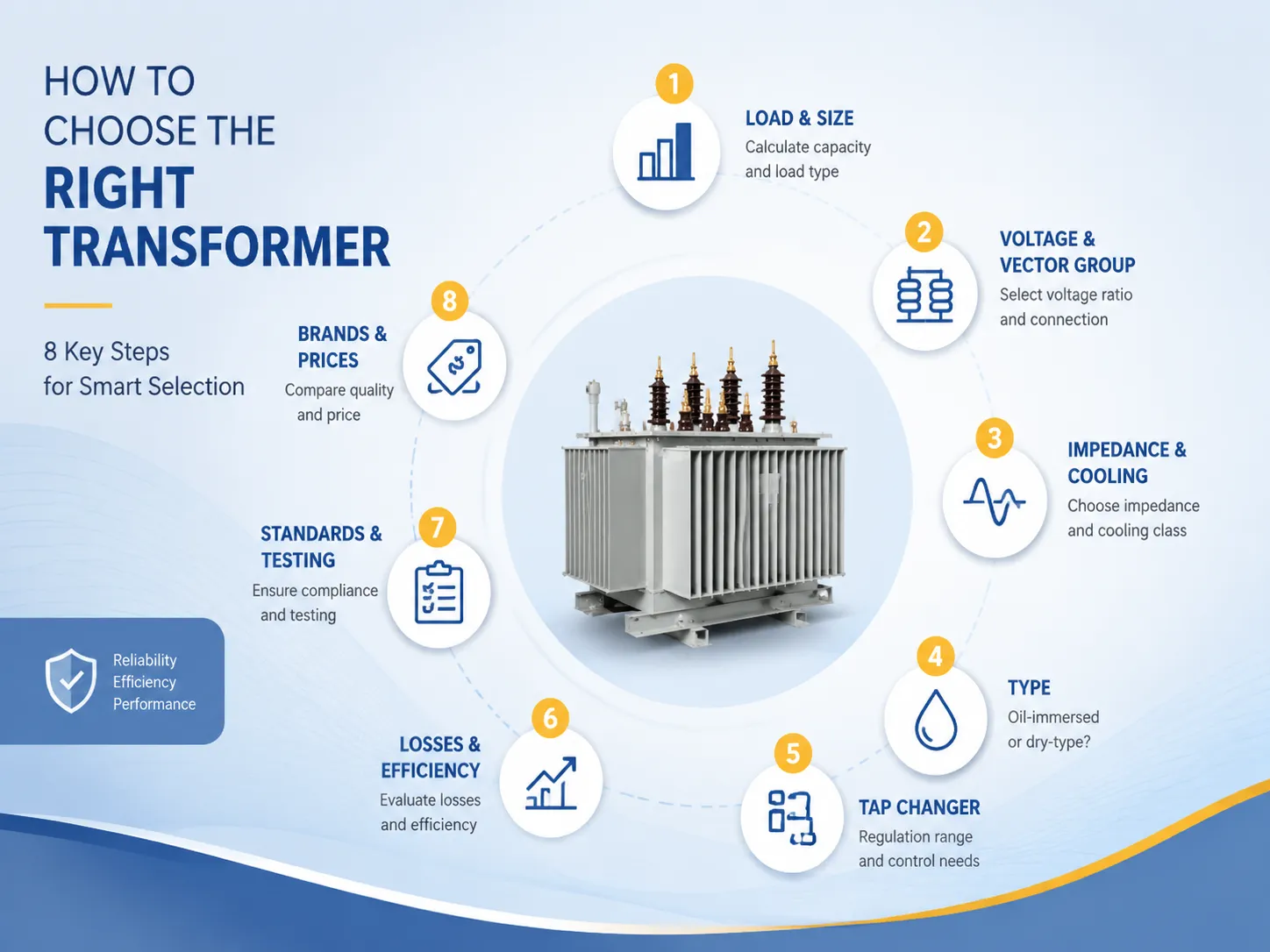
Passo 5: Necessidades de Mudança de Tap e Regulação
Verifique quanto a tensão de fornecimento muda. Se for estável dentro de ±5%, então um simples interruptor fora de circuito com 2 ou 3 posições (±2.5%, ±5%) funcionará bem. Se ocorrerem flutuações diárias, cargas de pico e fora de pico, o interruptor sob carga (OLTC) deve ser utilizado:
- Interruptores fora de circuito podem ser baratos (3-5 posições). No entanto, eles devem desenergizar o transformador para definir a posição, portanto, são usados principalmente em transformadores de distribuição.
- OLTC pode ter várias classificações de ±10% a ±16% com 13 a 17 iterações em modo de regulação automática, ou seja, mantém a tensão de saída dentro de ±2%; Isso é comum para transformadores de transmissão ou sub-transmissão.
- Quando você considera o custo desses sistemas, um OLTC apresenta um custo adicional de cerca de $15,000–$60,000 com base na classificação do transformador; portanto, você deve tratá-lo como um investimento para a qualidade da energia.
Passo 6: Avaliar Perdas e Eficiência
Certifique-se de fazer comparações com base no custo total de propriedade, em vez de se concentrar apenas nos preços de licitação. Transformadores estão em operação continuamente, o que significa que as perdas estão ocorrendo permanentemente. Solicite a cada fornecedor valores garantidos para perdas em vazio e sob carga para que você possa completar uma comparação de perdas capitalizadas:
| Fornecedor | Perda em Vazio | Perda de Carga | Est. Perda de Energia Anual* | Valor de Perda em 20 Anos** |
|---|---|---|---|---|
| A (padrão) | 150 W | 500 W | ≈17 MWh | ≈$34.000 |
| B (baixa perda) | 900 W | 500 W | ≈14 MWh | ≈$28.000 |
O custo inicial do aparelho de baixa perda é maior que o normal, no entanto, na maioria das instâncias, o dinheiro economizado ao longo de um período de tempo (3-6 anos) paga pela unidade. É por isso que existem padrões rigorosos de consumo de energia.
Passo 7: Normas, Certificação e Testes
Seu contrato deve exigir conformidade com a norma IEC 60076-1 em geral e com as disposições específicas da IEC 60076 relevantes para sua aplicação e, adicionalmente, a norma IEEE C57.12.00 para a América do Norte. Insista em receber os seguintes documentos antes do pagamento:
- Relatórios de Teste de Tipo – para o aumento de temperatura, impulso de relâmpago e testes de resistência a curto-circuito realizados em uma unidade amostral.
- Certificados de Teste de Rotina – para a relação, impedância, perdas, dielétrico e resistência de isolamento determinados em sua unidade específica.
- Certificações – se necessário, marca CE, certificado de qualidade ISO 9001 e IEC 60076-11 para transformadores de tipo seco.
- Relatório de Inspeção de Terceiros – geralmente por SGS ou Bureau Veritas, ou pode ser fornecido pelo seu próprio especialista supervisionando testes na fábrica para pedidos de preço relevantes.
Também é aconselhável abandonar fornecedores que se recusam à inspeção independente ou não possuem relatórios de teste de tipo, independentemente de sua política de preços, pois certificados e registros de exames são a prova da qualidade de um produto.
Passo 8: Compare Marcas e Preços
Tanto as empresas multinacionais quanto a indústria chinesa aderem aos padrões IEC 60076, mas diferem em termos de preço, prazo de entrega e serviços de engenharia. Os intervalos de nível de planejamento para transformadores imersos em óleo são:
| Classificação | Fábrica Chinesa (por exemplo, Subian) | Marca Europeia/EUA |
|---|---|---|
| Tipo Seco (típico) | $1.500–$8.000 | $4.000–$12.000 |
| 1 MVA | $18.000–$45.000 | $35.000–$70.000 |
| 2,5–5 MVA | $35.000–$90.000 | $70.000–$200.000 |
| 20 MVA / 110 kV | $160.000–$300.000 | $430.000–$700.000 |
Especificações, níveis de perda e localidade ditam os preços. Se uma empresa requer equipamentos que atendam aos padrões IEC 60076 por um preço direto de fábrica, a Jiangsu Subian Electric Power é uma excelente escolha: este fabricante de transformadores de distribuição e potência (classes de 50 kVA–220 kV, tanto imersos em óleo quanto secos) também possui especificações em termos de relações de tensão, agrupamento vetorial, faixa de derivação e alguns métodos de resfriamento. Todas as unidades são equipadas com resultados de teste de tipo e teste de rotina, certificação de acordo com os padrões CE/ISO, e seus preços são muito mais baixos do que os de seus concorrentes estrangeiros (a diferença de preço varia entre 30% e 50%). Além disso, a fábrica está aberta para projetos OEM/ODM e inspeções de terceiros.
A Lista Completa de Seleção
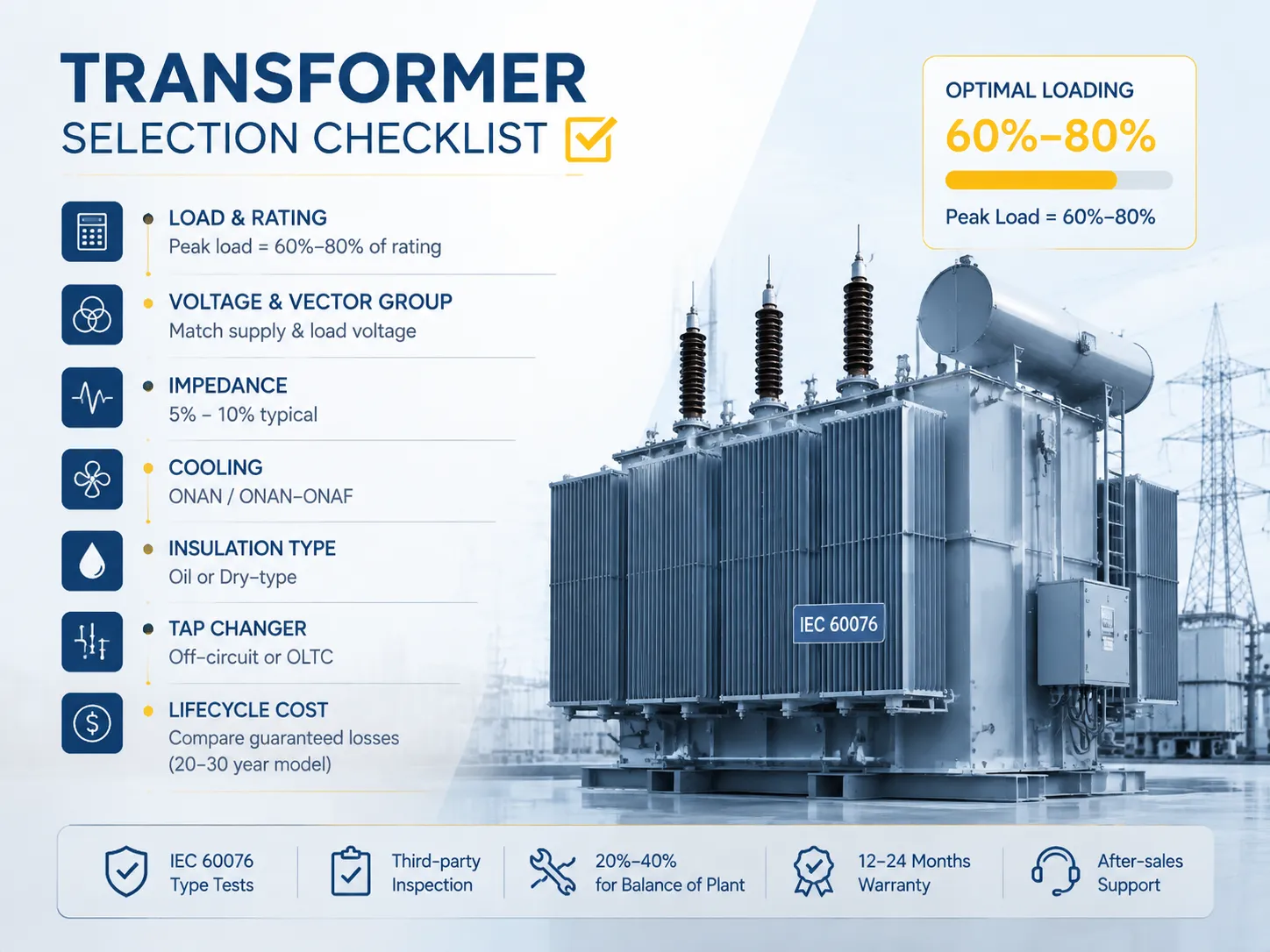
- Determine a carga de pico com a ajuda do fator de demanda e margem de crescimento; assegure-se de que a classificação seja escolhida de forma que a carga de pico esteja entre 60% e 80%. Verifique os valores de tensão para fornecimento e carga e decida tanto sobre a relação quanto sobre o grupo vetorial.
- A impedância deve ser adquirida do estudo de rede (5%-10% em média).
- Escolha um tipo de resfriamento: ONAN ao trabalhar sob cargas padrão, ONAN/ONAF se sobrecarga for esperada.
- Escolha entre tipo óleo e seco com base no local de instalação e nos requisitos do código de incêndio.
- Escolha o comutador de derivação: fora de circuito se a tensão de fornecimento for estável, OLTC se uma estabilidade de tensão mais precisa for necessária.
- Compare ofertas com base nas perdas garantidas usando um estudo de perda capitalizada para 20-30 anos.
- Solicite os relatórios de teste de tipo de acordo com IEC 60076 e inspeção de terceiros.
- Orce de 20%-40% de custos para proteção, instalação, testes e obras de construção.
- Verifique o prazo de entrega, garantia (que geralmente dura de 12 a 24 meses) e serviço pós-venda.
Perguntas Frequentes
Como calculo o tamanho certo do transformador para meu prédio ou fábrica?
Determine a carga conectada, multiplique pelo fator de demanda de 0,6-0,85, corrija o fator de potência para 0,9-0,95, adicione qualquer coisa de 15%-25% para crescimento a isso. Em seguida, selecione a classificação padrão mais próxima para que a carga de pico normal seja igual a algo entre 60%-80% da capacidade. Por exemplo, se a carga conectada for igual a 1200 kVA, o fator de demanda for 0,7 e o crescimento for 20%, o resultado será algo próximo a 1060 kVA. Nesse caso, uma unidade com classificação igual a 1000 ou 1250 kVA servirá.
Qual é a diferença entre um transformador 11/0,4 kV e um 20/0,4 kV?
Ambas as unidades têm a mesma função, mas operam em tensões diferentes neste caso, onde a unidade de 11 kV é adequada para linhas de média tensão de 11 kV e a unidade de 20 kV opera em sistemas de 20 kV. Embora as classificações em kVA possam ser as mesmas, a unidade de alta tensão possui isolamento BIL mais alto, bem como construção diferente, e, em geral, custa um pouco mais.
Devo comprar um transformador imerso em óleo ou um transformador do tipo seco?
Em alguns casos, transformadores do tipo seco são usados em edifícios ocupados e locais externos. Os transformadores do tipo seco são muito bem classificados e isentos de manutenção. O custo do transformador do tipo seco varia de $28000 a $70000 e comparado ao transformador imerso em óleo, que varia de $18000 a $45000.
Por que transformadores com a mesma classificação têm preços tão diferentes?
Garantias de perda, qualidade do aço principal, material do enrolamento (cobre ou alumínio), marca do comutador de derivação, classe de resfriamento, histórico de testes de tipo e prêmio da marca. Sempre faça uma comparação de perdas capitalizadas: uma unidade que tem baixas perdas e custa de 5% a 10% provavelmente economizará mais em custos de energia durante 20 anos do que toda a sua diferença de preço.
Que documentação devo solicitar antes de comprar um transformador?
Peça o relatório de teste de tipo (subida de temperatura, impulso de relâmpago, curto-circuito), certificação de testes de rotina para sua unidade, certificação de qualidade ISO 9001, marcação CE, se aplicável, e a possibilidade de inspeção por terceiros. De acordo com a IEC 60076-1, a tolerância de relação é ±0.5%, portanto, verifique os resultados dos testes com sua especificação antes de aceitar a entrega.
Referências
- IEC 60076-1: Transformadores de Potência — Geral — O padrão base para classificações, tolerâncias e testes.
- IEC 60076-7: Guia de Carga para Transformadores de Potência Imersos em Óleo — Capacidade de sobrecarga e recomendações de carga para dimensionamento.
- IEEE C57.12.00: Requisitos Gerais para Transformadores Imersos em Líquido — Padrão de seleção e aplicação da América do Norte.
- US DOE: Padrões de Eficiência de Transformadores — Regulamentações de eficiência que moldam as especificações de perda.
- NFPA 70: Código Elétrico Nacional — Requisitos de instalação para seleção e colocação de transformadores.
- Fábrica de Máquinas Reinhausen (MR) — Referência para seleção de comutador de derivação e regulação de tensão.
Conclusão
A escolha do transformador apropriado não é simplesmente uma questão de preço, mas consiste em um processo de oito decisões de engenharia específicas. Isso significa que o dimensionamento adequado em relação ao perfil de carga real, escolha da tensão correta (com o grupo vetorial certo), tipo de resfriamento e o isolamento adequado para a localidade específica, avaliação das perdas ao longo do ciclo de vida do ativo, bem como a insistência rigorosa nas evidências de teste que são apoiadas por normas, são os fatores que tornam uma boa compra em vez de um erro caro.
- O dimensionamento mais geral de transformadores significa o chamado pico normal = 60%−80% da classificação do transformador com uma margem de 15%−25% para crescimento a ser considerada.
- A relação, grupo vetorial, impedância e resfriamento devem ser determinados antes da seleção do fornecedor.
- A comparação deve ser feita com base nas perdas capitalizadas que podem ser incorridas durante 20−30 anos em oposição ao custo inicial.
- Assegure-se de receber os relatórios de teste de tipo, bem como referências de inspeção de terceiros.
- Os preços são estimados em uma faixa de $1.5k−$8k (para transformadores de 100 kVA), $18k−$45k (para transformadores de 1 MVA), $160k−$300k (para transformadores de 20 MVA) quando adquiridos diretamente do fabricante.