


Um proprietário de fazenda na Califórnia foi apresentado a três produtos pelo empreiteiro elétrico local para a operação de cinco bombas de irrigação e um armazém de armazenamento a frio: um transformador montado em poste de 50 kVA, um montado em base de 75 kVA, ou para estar absolutamente seguro, um transformador de 100 kVA. A diferença de custo entre esses dois transformadores foi de $3.200. As bombas operam no nível de tensão de 460 volts em configuração trifásica e a concessionária oferece apenas o serviço de 480 volts. Um amigo alertou o proprietário contra cometer o mesmo erro que ele fez ao comprar um transformador subdimensionado e passar seis meses superando os problemas relacionados a cintilação e superaquecimento. A resposta à pergunta de como escolher o transformador adequado depende de uma série de fatores, como carga, tensão, localização e crescimento, e este guia prático descreve o processo de seleção do transformador certo, fornecendo os cálculos necessários.
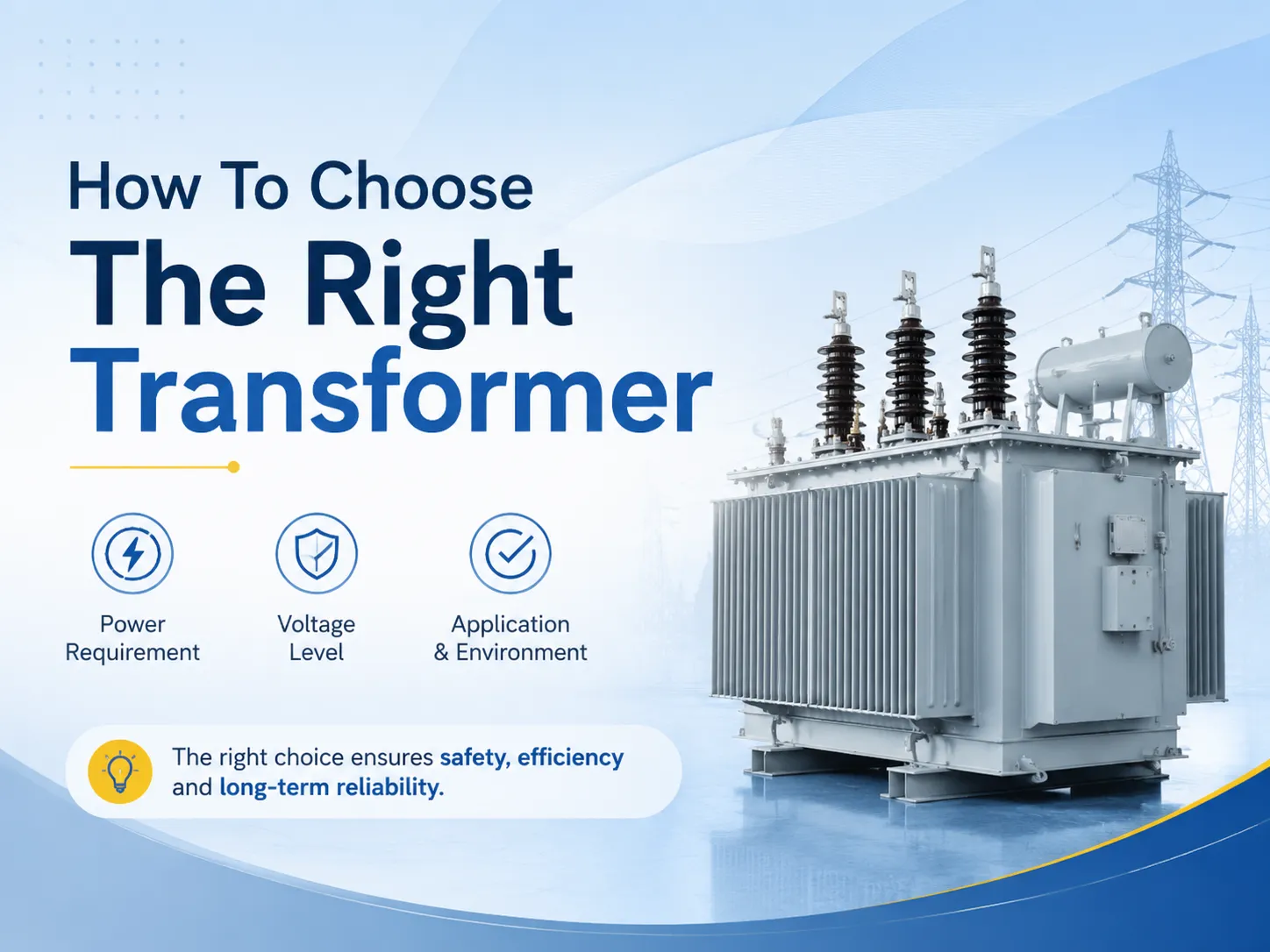
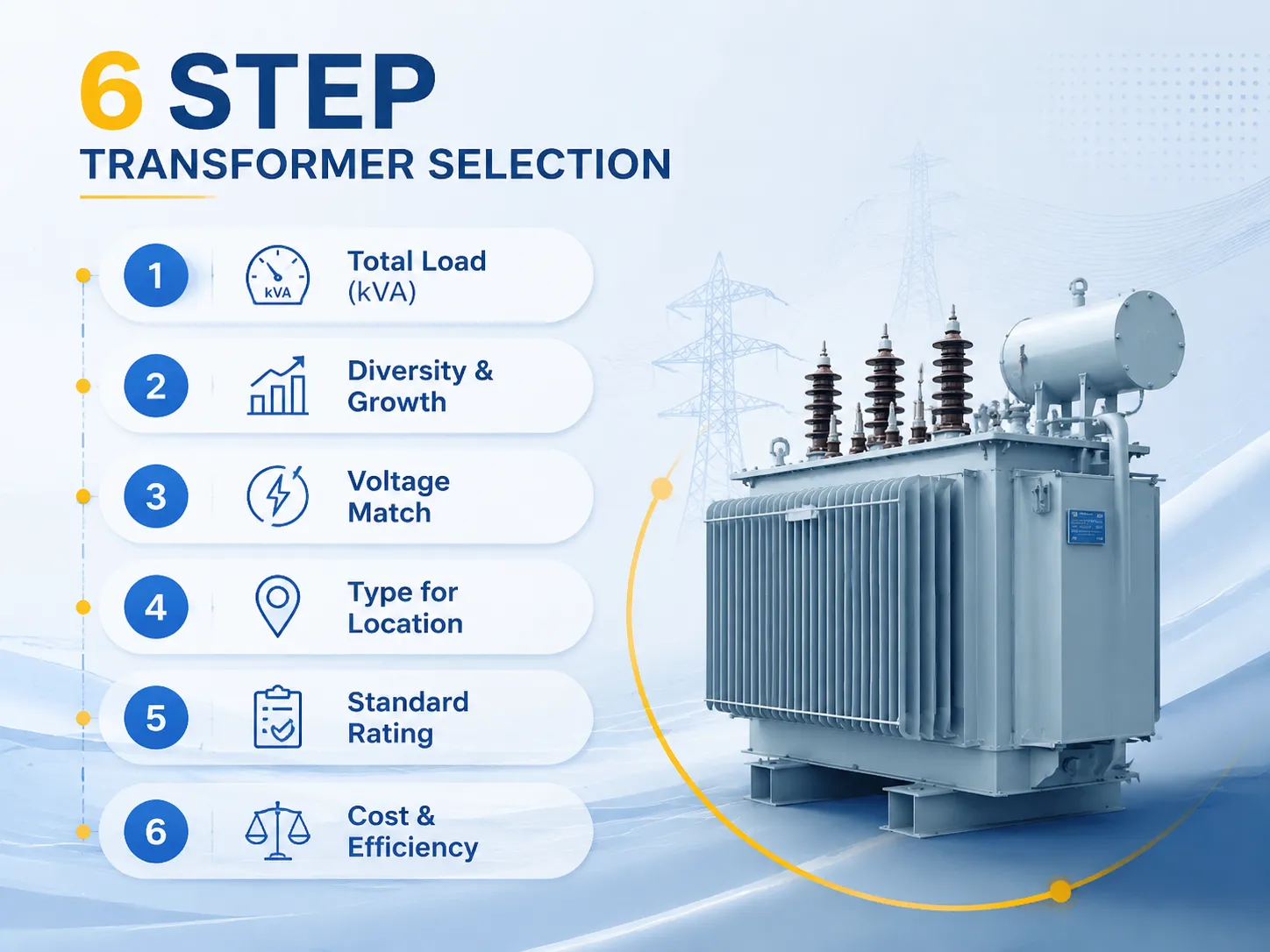
Para selecionar o transformador apropriado, deve-se passar por várias etapas que são as seguintes: (1) Calcular os requisitos totais de potência em kVA; (2) usar um fator de diversidade de cerca de 0,7–0,85 quando houver cargas mistas presentes; (3) considerar 15-20% de crescimento futuro; (4) combinar a tensão de fornecimento com seus transformadores; (5) selecionar um transformador adequado para a aplicação; (6) escolher uma classificação padrão IEC 60076 apropriada.
Passo 1: Totalize Sua Carga em kVA
Cada dispositivo que você pretende conectar possui uma placa de identificação específica que você deve ler e registrar em relação a kW ou, de preferência, kW e tensão. Você deve usar kVA, que é a potência aparente, para determinar o tamanho do seu transformador, pois os enrolamentos geram calor devido à corrente que flui através deles, independentemente do fator de potência do dispositivo. O cálculo é simples: kVA = kW/fator de potência (monofásico), ou para carga trifásica podemos dizer que kVA = (√3 * volts * amps) ÷ 1000
Por exemplo, 5 bombas de irrigação classificadas em 10 kW com um fator de potência de 0,85 requerem 15 ÷ 0,85 = 11,76 kVA cada, totalizando 59 kVA. O compressor do armazém de armazenamento a frio adiciona 6 kVA, e a iluminação adiciona mais 4 kVA, totalizando aproximadamente 69 kVA, que é o ponto de partida e já é maior que o valor inicial de kW.
| Equipamento | kW | Fator de Potência | kVA Cada |
|---|---|---|---|
| Bomba de irrigação (×5) | 10 | 0.85 | 11.8 |
| Compressor de armazém de armazenamento a frio | 5 | 0.82 | 6.1 |
| Iluminação e controles | 3.8 | 0.95 | 4.0 |
| Ferramentas de oficina (ocasional) | 4 | 0.80 | 5.0 |
Não dependa apenas da quantidade total de “quilowatts” da memória. Você pode deixar de fora alguns itens da lista, além disso, de maneira geral, a correção do fator de potência em si significa que kVA é maior que a soma dos pesos individuais de kW em cerca de 10-25%.
Passo 2: Aplique Diversidade e Crescimento
Acreditar que todos os dispositivos estão funcionando na carga máxima ao mesmo tempo é irrealista – é por isso que devemos considerar o fator de diversidade. Para fazendas ou pequenas oficinas, bombas que são ligadas e desligadas junto com outros dispositivos geram um fator de diversidade de cerca de 0,8. Assim, no nosso caso, 69 kVA × 0,8 = 55 kVA. Em seguida, precisamos adicionar a margem para crescimento: 15-20% é a regra prática nesta indústria. Portanto, 55 × 1,18 = 65 kVA (aproximadamente).
Assim, vemos que enquanto a demanda “total” ingênua parece ser 69 kVA, a demanda corretamente calculada – levando em consideração os fatores de diversidade e crescimento – será em torno de 65 kVA, que está bem dentro dos limites de uma unidade de 75 kVA. Se ignorarmos tanto os fatores de diversidade quanto de crescimento – acabaremos comprando 100 kVA e pagando um extra de $1.500-2.500 enquanto perdemos potência adicional. Se apenas a correção do fator de potência for ignorada, teremos a falha de uma unidade de 50 kVA.
Passo 3: Combine a Tensão
A adequação da tensão é essencial e é a razão mais prevalente para a ocorrência de “transformador errado”. As duas tensões são:
- Tensão primária – via fornecimento de utilidade: geralmente uma fase única de 7200 V em áreas agrícolas da América do Norte, 12,47 kV/13,2 kV, ou 11 kV/22 kV/33 kV em outras regiões.
- Tensão secundária – de acordo com os requisitos do dispositivo eletrônico que pode ser 120/240 V para fase única, 240 V para trifásico, ou de 380 a 480 V para trifásico dependendo da localização e do equipamento.
Antes de fazer um pedido, lembre-se de confirmar a tensão da utilidade por escrito. Sempre se refira ao fato de que as distribuições elétricas diferem dependendo da área em que você está presente; portanto, um transformador projetado para 11 kV não funcionará bem com 12,47 kV.
Passo 4: Escolha o Tipo para a Localização
A localização do transformador influencia muito o tipo de transformador fabricado. Para instalações menores e de médio porte, as opções disponíveis são:
| Tipo | Melhor Para | Faixa Típica | Observações |
|---|---|---|---|
| Montado em poste | Rural, fazendas, pequenas cargas | 5–167 kVA | Mais barato por kVA, estilo de propriedade da utilidade |
| Montado em base | Comercial externo, subdivisões | 25–2.500 kVA | Nível do solo, à prova de violação, fácil acesso |
| Tipo seco (interno) | Edifícios, oficinas, escritórios | 3–1.000 kVA | À prova de fogo, sem óleo, mais silencioso |
| Tipo seco de resina fundida | Prédios altos, túneis, centros de dados | 100–3.150 kVA | Melhor desempenho contra fogo, baixa manutenção |
| Imerso em óleo (estação) | Subestações, locais industriais | 50 kVA–100 MVA | Melhor tolerância a sobrecargas, necessita de poço de óleo |
No caso do cenário da fazenda, um transformador montado em base de 75 kVA seria vantajoso devido ao fato de que opera externamente e se conecta diretamente às cargas, exigindo assim mínima manutenção. Quando o equipamento está localizado dentro de um edifício, um transformador tipo seco é necessário por motivos de segurança.
Passo 5: Selecione uma Classificação Padrão
As classificações de tamanho do transformador aparecem em configurações padrão; especificamente, tamanhos de 25, 37,5, 50, 75, 100, 150, 167 e 250 kVA serão utilizados na América do Norte, enquanto os mercados IEC utilizam os seguintes tamanhos: 25, 50, 100, 160, 250, 315, 400 e 500 kVA. A menor classificação que pode acomodar a carga de projeto deve ser selecionada; dado que o valor de projeto é 65 kVA, a seleção deve ser 75 kVA.
Uma cautela: sempre que houver um motor grande conectado a um transformador, deve-se considerar a corrente de partida desse motor. Por exemplo, uma bomba controladora de 25 kW pode criar um resultado de partida de até 6 vezes mais do que sua saída comum (a saída da bomba de 25 kW cria aproximadamente 35 kVA), causando um aumento momentâneo na capacidade de energia e até mesmo potencialmente uma sobrecarga de energia se outras bombas forem acionadas logo após a primeira. E se pelo menos duas bombas forem acionadas simultaneamente, a capacidade instantânea excederá a nominal.
Passo 6: Compare Custo e Eficiência
O custo é apenas uma parte da equação. Um transformador incorre em perdas durante todo o ciclo de vida da unidade. Um transformador tem perda a vazio o dia todo, mesmo quando não há carga conectada. Por exemplo, com um custo de $0,12/kWh, um transformador classificado para 75 kVA produz uma perda a vazio de cerca de 250 W e incorre em uma perda ociosa de $262 em um ano — e isso soma $5.240 após 20 anos, que é até mais do que o custo original do transformador. Sempre lembre-se de pedir os valores de perda a vazio e de carga ao avaliar as ofertas recebidas.
| Classificação | Perda Típica em Vazio (W) | Perda Típica em Carga (W) | Custo de Perda em 20 Anos a $0,12/kWh (com carga de 75%) |
|---|---|---|---|
| 50 kVA | 130–200 | 1,100–1,500 | $24.000–$33.000 |
| 75 kVA | 180–280 | 1,500–2,100 | $34.000–$47.000 |
| Tipo Seco (típico) | 220–350 | 1,900–2,700 | $44.000–$61.000 |
| 250 kVA | 450–700 | 3,900–5,500 | $92.000–$127.000 |
A mensagem aqui é clara o suficiente: diferenças na eficiência entre fornecedores do mesmo kVA podem levar a variações no custo total de milhares de dólares. Máquinas com núcleo amorfo têm uma perda em vazio que é reduzida em 50–70% e, apesar de um excesso de preço de 10–20%, acabam sendo mais favoráveis na análise de custo de 20 anos.
Tabela de Referência Rápida para Dimensionamento
Esta é uma análise inicial para instalações típicas de unidades de distribuição (assumindo que o fator de potência típico é igual a 0,85, a diversidade é igual a 0,8, e o crescimento é igual a 15%).
| Carga Conectada (kW) | kVA Aproximado em Funcionamento | Demanda de Projeto | Classificação Recomendada | Faixa de Preço (FOB China) |
|---|---|---|---|---|
| 20 | 24 | 22 | 25 | $1.200–$3.000 |
| 40 | 47 | 43 | 50 | $1.800–$4.500 |
| 60 | 71 | 65 | 75 | $2.400–$5.500 |
| 80 | 94 | 86 | 100 | $2.500–$6.000 |
| 150 | 176 | 162 | 160–250 | $4.500–$11.000 |
| 350 | 412 | 379 | 400–500 | $8.000–$16.000 |
Os preços são indicativos para as unidades imersas em óleo e variam dependendo da especificação, marca e localização. Caso a leitura fique abaixo de um valor limite, é aconselhável considerar o valor mais alto, uma vez que as despesas para atualização são de 15-25% e os custos de instalação da unidade inadequada levariam a uma frequência de operação do transformador falha.
Os Três Erros Mais Comuns
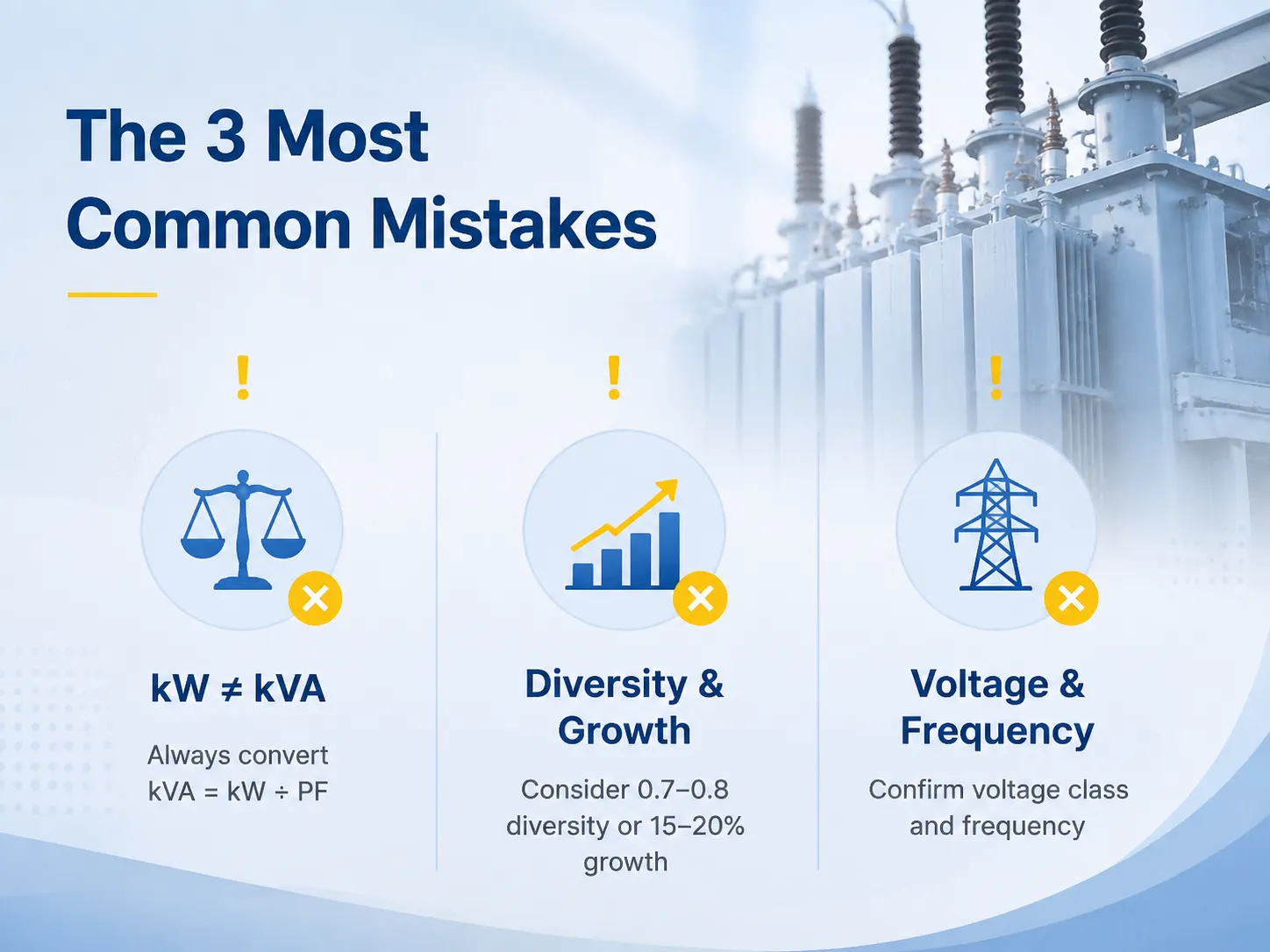
- Usar kW em vez de kVA. Adicionar kW da placa de identificação ignora o fator de potência, resultando em uma unidade que é menor do que o necessário em 15–25%. Sempre converta kVA = kW ÷ PF antes de comparar tamanhos.
- Ignorar diversidade e crescimento. Obter o tamanho da “soma total” desperdiça dinheiro enquanto produz uma perda em vazio e adquirir apenas a demanda atual não deixa espaço para expansão no próximo ano. Considere aplicar 0,7–8 de diversidade ou 15-20% de crescimento.
- Classe de tensão ou frequência incorreta. Um transformador de 11 kV conectado a um alimentador de 12,47 kV é inoperável; um transformador projetado para 50 Hz e usado em um sistema de 60 Hz irá saturar e superaquecer. Confirme a tensão e a frequência por escrito antes da compra.
Mais um erro: evitar a avaliação de eficiência e confiar apenas no preço indicado na fatura como seu preço padrão. As perdas incorridas na operação afetam o custo da maquinaria a longo prazo.
Marcas e Faixas de Preço
No caso de instalações pequenas e médias, a seleção da marca é um compromisso entre custo, suporte e documentação. Todos os fornecedores de boa reputação cumprem com a IEC 60076, mas variam em cada uma de suas redes de serviço, tempo de entrega e disponibilidade de dados de teste.
| Marca | Posição | 50 kVA | Tipo Seco (típico) | 250 kVA |
|---|---|---|---|---|
| ABB | Suporte global, gama completa | $3.500–$7.000 | $5.500–$10.000 | $12.000–$20.000 |
| Siemens | Eficiência, opções digitais | $3.500–$7.500 | $5.500–$11.000 | $12.000–$22.000 |
| Schneider Electric | Resistência de tipo seco | $3.000–$6.500 | $5.000–$9.500 | $11.000–$18.000 |
| Eaton | Conformidade na América do Norte | $2.800–$6.000 | $4.500–$9.000 | $10.000–$17.000 |
| CG Power / TBEA | Preços por volume | $2.000–$4.500 | $3.000–$6.500 | $7.000–$12.000 |
| Jiangsu Subian Electric Power | IEC 60076, cobre, relatórios de teste | $1.800–$4.000 | $2.500–$5.500 | $4.500–$11.000 |
Nomes estabelecidos são confiáveis nos dias modernos e continuam sendo o padrão para qualquer empreendimento onde o serviço local é crucial. Por outro lado, o guia prático se destaca em termos de valor, em particular a Jiangsu Subian Electric Power produz transformadores certificados pela IEC 60076 na faixa de capacidade de 10 kVA até 100 MVA, fornece enrolamentos de cobre como padrão e fornece o relatório de teste de fábrica com cada pedido, o que significa que os números de eficiência comparados por você na Etapa 6 vêm com confirmação verificada. Para uma pequena fábrica, fazenda ou oficina que requer dois ou três transformadores, é possível recuperar os custos dos fios através do fato de que isso economizará à empresa de $3,000 a $8,000 em cada um dos dispositivos. O método de seleção permanece idêntico para outros fornecedores; a única diferença é que, em nosso caso, você tem uma prova de conformidade com as especificações associadas ao equipamento considerado.
Perguntas Frequentes
Como sei qual tamanho de transformador eu preciso?
Some o kVA de todas as cargas – kW / fator de potência para cada carga. Use um fator de diversidade, que é de 0,7 a 0,85. Adicione de 15 a 20 por cento para contabilizar o crescimento da demanda futura. Por exemplo, se a carga total for igual a 60 kW com um fator de potência de 0,85, isso é igual a 71 kVA. Em seguida, aplique a diversidade e o crescimento da demanda futura, o que traz para 65 kVA. Assim, deve-se escolher uma unidade de 75 kVA.
Que tamanho de transformador eu preciso para uma casa?
Comumente, casas modernas requerem 25-50 kVA de serviço elétrico (para carregamento de EV, bombas de calor ou ar condicionado). No entanto, em algumas localidades, casas aquecidas apenas com gás podem precisar de apenas 10-15 kVA. Normalmente, as empresas de utilidade possuem e escolhem o transformador usado para tal serviço. Assim, a melhor coisa a fazer é consultar sua empresa de utilidade antes de fazer qualquer compra.
Devo comprar um transformador maior do que preciso?
Almeje uma meta de crescimento entre 15% e 20%, pois qualquer meta mais alta impactará negativamente o preço de compra em cerca de 15% a 25% por ciclo adicional, ao mesmo tempo, criando perdas não produtivas no processo.
Qual é a diferença entre um transformador montado em base e um transformador montado em poste?
Unidades montadas no poste (5–167 kVA) têm a capacidade de serem posicionadas em postes de utilidade no caso de aplicações de pequena potência ou rurais. Unidades montadas em base (25–2,500 kVA) podem se destacar orgulhosamente em uma laje de concreto ao nível do solo. As considerações ao escolher entre os dois são baseadas principalmente nas necessidades de potência e na conveniência de manutenção no futuro, uma vez que unidades montadas em base são geralmente melhores tanto em termos de segurança quanto de manutenibilidade.
Quanto custa um transformador de 75 kVA?
O custo de um transformador de distribuição de 75 kVA varia de $2.400 a $5.500 FOB de fabricantes chineses certificados pela IEC e varia de $3.500 a $7.500 para marcas globais, dependendo da marca, especificações e regiões. O valor total a ser pago inclui frete e instalação cobrados geralmente entre 20 e 40 por cento e as perdas incorridas ao longo de 20 anos totalizando $34.000 – $47.000 à taxa de $0,12/kWh.
Referências
- IEC 60076-1: Transformadores de Potência — Geral — a norma internacional para classificações e testes.
- IEEE C57.12.00: Requisitos Gerais para Transformadores Imersos em Líquido — estrutura de classificação e teste da América do Norte.
- NFPA 70: Código Elétrico Nacional — a referência da América do Norte para instalação de transformadores e proteção contra sobrecorrente.
- Electrical4U — Transformador — explicações claras sobre dimensionamento em kVA, perdas e tipos de transformadores.
- Eaton — Consultor de Transformadores — calculadoras de dimensionamento e orientações de seleção para instalações práticas.
- Wikipedia — Transformador de Distribuição — informações sobre tipos de transformadores de montagem em poste, montagem em base e distribuição.
Conclusão
O processo de seleção de um transformador adequado é composto por seis etapas simples — determinar o total em kVA, considerar a diversidade e o crescimento, determinar a compatibilidade de tensão e frequência, escolher o tipo de instalação, selecionar um tamanho padrão e avaliar eficiência e preço. O estudo de caso da fazenda ilustrou todo o processo na prática e explicou por que a resposta ingênua de “apenas somar kW” estava errada em dois aspectos — era muito grande porque a diversidade foi ignorada e muito pequena porque o fator de potência foi ignorado.
- Dimensionamento completo em kVA, incluindo a correção do fator de potência realizada, diversidade estimada (0,7 a 0,85) e crescimento levado em conta (15-20%).
- Verifique a tensão e a frequência da empresa fornecedora de energia elétrica por escrito antes de solicitar o transformador.
- Avalie o custo total de propriedade (as perdas excederão o preço em 20 anos).
- Verifique os resultados dos testes do fornecedor e os parâmetros de eficiência.