


Uma instalação de processamento de alimentos na Tailândia escolheu a classificação IP23 para seus novos transformadores a seco porque eles seriam instalados dentro de uma sala elétrica com ar-condicionado. O que não foi revelado ao comprador foi o fato de que o HVAC dessa sala seria desligado todas as noites para economizar energia, assim como a equipe de limpeza noturna lavaria o chão a dois metros do invólucro. O resultado foi o rastreamento de umidade que levou à falha da isolação do primeiro transformador em oito meses. O principal erro em relação às especificações não dizia respeito à tensão de transformação, uma vez que isso foi atendido; o principal erro ocorreu em relação à classificação IP, uma vez que o IP23 é considerado inadequado quando há água no local.
As classificações IP são a melhor opção para obter especificações de isolamento confiáveis. Isso fornece as definições de cada dígito no código associado aos níveis IP, bem como como determinar qual nível de IP é necessário para cada ambiente.
Para simplificar, a classificação IP consiste em dois dígitos: o primeiro número (0 a 6) denota o nível de proteção sólida, onde 4 indica que o dispositivo é protegido contra poeira, e 6 significa que está completamente protegido contra poeira; o segundo número (0–8) mostra o nível de proteção contra água: 3 indica que o dispositivo é protegido contra água gotejante, 5 – contra spray, 6 – contra jatos poderosos de água; e 7 – contra imersão em água por um curto período. Ao selecionar transformadores, enquanto IP21-IP23 é adequado para salas elétricas internas, IP44 é bom para áreas empoeiradas, e IP54 é usado para aplicações industriais ao ar livre.
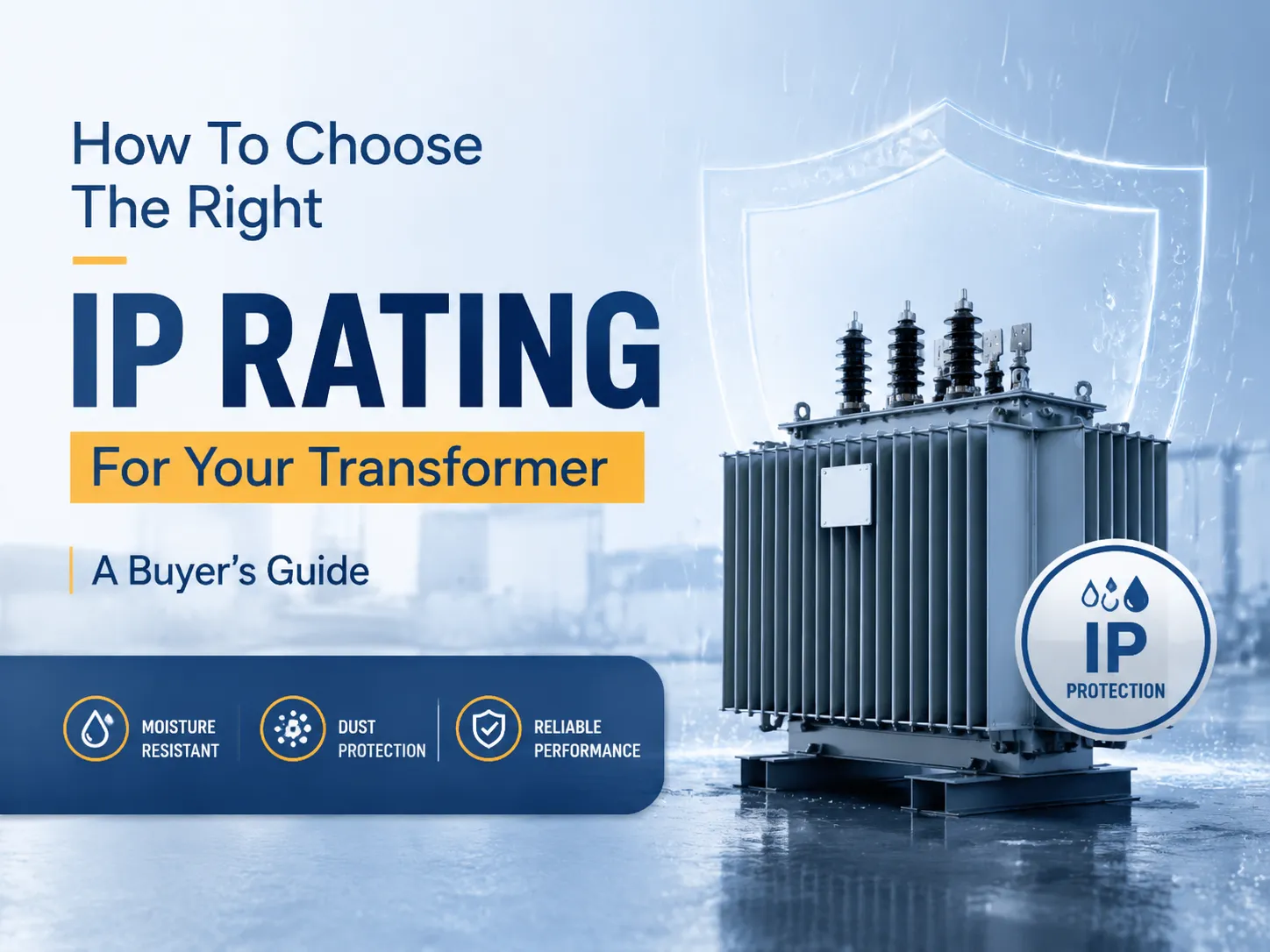
O que o Código IP realmente significa
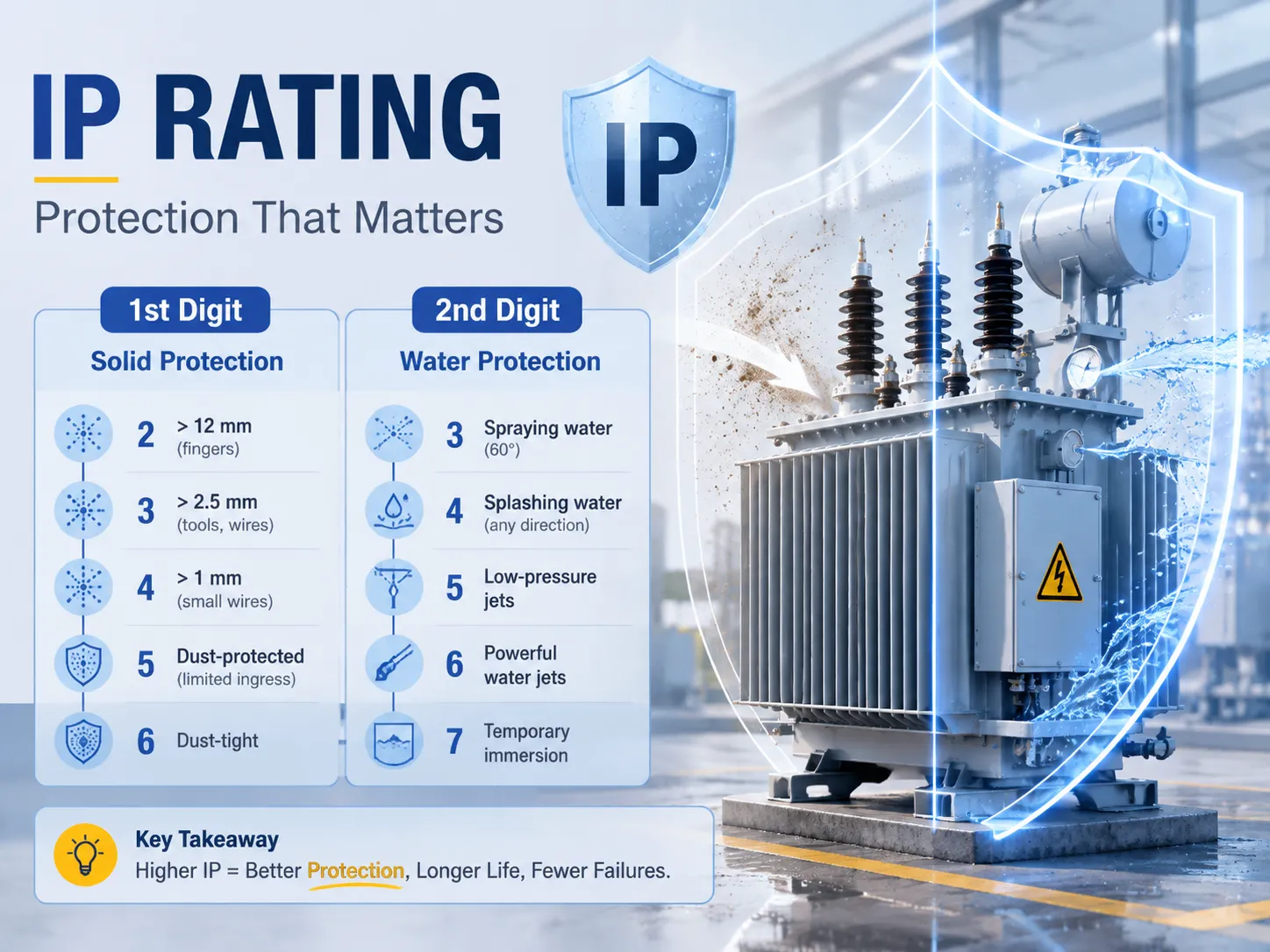
Uma classificação de invólucro IP consiste em IP seguido por dois números, como IP54, IP56 e IP65. O primeiro dígito indica a quantidade de proteção contra objetos sólidos (poeira, dedos, etc.) variando de 0 (sem proteção) a 6 (à prova de poeira). O segundo dígito indica a proteção contra água, com a mesma escala de valores de 0 (sem resistência) a 8 (imersão completa). Esta classificação é estabelecida e verificada de acordo com a Norma IEC 60529, o que significa que uma classificação IP é uma certificação válida.
A classificação para transformadores especifica o tipo de invólucro que protege as partes energizadas na estrutura, nomeadamente o tanque e suas partes para transformadores a óleo e o gabinete com bobinas de transformadores a seco. Assim que a classificação IP adequada deve ser escolhida em relação a fornecer o melhor nível de proteção sem pagar a mais por isso.
Primeiro Dígito: Proteção contra Partículas Sólidas
A faixa do primeiro dígito para a prática de transformadores é de 2 a 6:
| Primeiro Dígito | Proteção Contra | Uso de Transformadores |
|---|---|---|
| 0 | Sem proteção | Não utilizado para transformadores |
| 1 | Objetos > 50 mm (mãos) | Áreas de bucha expostas |
| 2 | Objetos > 12 mm (dedos) | Proteção básica interna |
| 3 | Objetos > 2,5 mm (ferramentas, fios) | Invólucros internos a seco |
| 4 | Objetos > 1 mm (fios pequenos) | Protegido contra poeira — corredores internos empoeirados |
| 5 | Protegido contra poeira (ingresso limitado) | Padrão industrial externo (com IP5x) |
| 6 | À prova de poeira | Poeira severa (minas, cimento, grãos) |
Vale a pena notar a distinção entre os níveis 5 e 6: IP5x é “protegido contra poeira”, onde alguma poeira pode entrar, mas não interfere no funcionamento; enquanto IP6x significa que este tipo é à prova de poeira. Use o nível 5 para a maioria das operações industriais ao ar livre, mas para processamento mineral, manuseio de grãos e metalurgia aplique o nível 6.
Segundo Dígito: Proteção contra Água
O segundo dígito é onde ocorrem a maioria dos erros de especificação, porque a diferença entre 3, 5 e 7 é física:
| Segundo Dígito | Proteção Contra | Uso Típico |
|---|---|---|
| 0 | Nenhum | — |
| 1 | Água gotejante vertical | — |
| 2 | Gotejamento a 15° de inclinação | — |
| 3 | Água pulverizada (60° da vertical) | Tipo seco interno, proteção básica contra lavagem |
| 4 | Água respingando de qualquer direção | IP44 para halls internos empoeirados/úmidos |
| 5 | Jatos de água de baixa pressão | IP54 padrão industrial externo |
| 6 | Jatos de água poderosos | IP56 lavagem, alimentos, costeira |
| 7 | Imersão temporária (1 m, 30 min) | Subestações propensas a inundações |
| 8 | Imersão contínua | Equipamento submersível |
A falha da planta de alimentos anteriormente foi um erro típico de IP23 vs IP44/54: se a água é pulverizada de distâncias próximas acima (5—6), é um jato (5—6), não um spray (3). Quando há equipes de limpeza usando mangueiras nas proximidades, o segundo dígito deve ser 5 ou 6, não importa como a sala aparece quando as luzes estão apagadas.
Correspondendo as Classificações IP aos Ambientes
A matriz de seleção prática para transformadores, com base no ambiente físico:
| Ambiente | IP Recomendado | Justificativa |
|---|---|---|
| Sala elétrica interna limpa | IP21–IP23 | Sem fontes de poeira ou água; ventilação é importante |
| Hall interno empoeirado (fabricação) | IP44 | Ingressos de partículas pequenas bloqueados; respingos tolerados |
| Geral industrial externo | IP54 | Protegido contra poeira + jato de água; o padrão industrial |
| Exposição costeira / marinha | IP56 | Spray de sal e chuva forte |
| Processamento de alimentos / lavagem | IP56 | Limpeza de alta pressão é um jato, não um respingo |
| Mineração / cimento / grãos | IP65–IP66 | À prova de poeira mais jato de água |
| Áreas propensas a inundações | IP67 (tanque) | Imersão temporária por um período definido |
É uma prática valiosa visitar o local de trabalho no seu pior momento — não ao meio-dia em uma terça-feira ensolarada. Água e poeira podem chegar ao local por mangueiras, tempestades, membros da equipe limpando o local e vazamentos de processo. As condições do local devem garantir que a embalagem funcione bem no momento em que estiver chovendo intensamente, em vez de em um dia seco como o retratado no desenho do arquiteto.
Requisitos de IP para imersão em óleo vs. tipo seco
O tipo de construção determina o que exatamente a classificação IP protege. O tanque de um transformador imerso em óleo é hermeticamente selado, e como as bobinas estão imersas em óleo, a embalagem protege apenas o equipamento: os isoladores, os manômetros, o conservador e o gabinete do comutador. As bobinas de um transformador de tipo seco dependem do ar para resfriamento e não estão completamente protegidas do ambiente — assim, a embalagem atua como a primeira linha de proteção.
| Aspecto | Óleo Imerso | Seco |
|---|---|---|
| O que o IP protege | Isoladores, manômetros, acessórios | As bobinas em si |
| IP típico interno | IP23–IP44 | IP21–IP44 |
| IP típico externo | IP54–IP56 | IP54 (com embalagem) |
| Bobinas expostas ao ar | Não | Sim — IP mais alto necessário em poeira |
| Risco de inundação | Flutua? — ancore-o | Gabinete selado ou base elevada |
O resultado prático é que em um hall empoeirado, equipamentos de tipo seco requerem pelo menos uma classificação IP44 porque a poeira se acumula nas bobinas energizadas. Enquanto isso, uma máquina preenchida com óleo pode funcionar com um nível de proteção mais baixo, uma vez que as bobinas estão imersas em óleo. Assim, clientes que utilizam o nível de proteção IP de sistemas preenchidos com óleo para equipamentos secos estarão se colocando em risco de subproteção.
Erros comuns na especificação de IP
- IP21/IP23 apenas afirma que um dispositivo pode ser operado em áreas onde há risco de respingos de água. Na verdade, a pressão da água mostra os limites do IP23.
- Não se adaptar a nenhuma das condições internas, como temperatura e umidade, com sistemas de automação. Problemas de HVAC, fechamento de portas de salas e tarefas de limpeza criam condições que não são discutidas usando o termo “sala limpa”.
- Cometer o erro de pensar que IP54 significa à prova d'água. IP54 apenas significa resistência à água, mas não dá nenhuma garantia se algo pode ser submerso na água.
- Considerar a classificação IP de equipamentos em áreas com alta umidade. Umidade não é igual à pressão da água, mas a umidade pode, de fato, ser prejudicial para qualquer equipamento.
- Confundir IP65 com sendo a melhor opção disponível. O fechamento total criará problemas de calor para transformadores secos.
Além do IP: Extras de embalagem que valem a pena especificar
A classificação de proteção contra ingressos lida principalmente com ingressos, no entanto, outras características complementares são cruciais em condições extremas. Essas características incluem o seguinte:
- Aquecedores de condensação são instalados para garantir que a umidade não exceda o nível de orvalho em áreas tropicais e costeiras – é econômico e requer de 100W a 500W dependendo do tamanho da caixa.
- Desumidificadores de gel de sílica ou conservadores selados a gás em unidades imersas em óleo não permitem que a umidade seja puxada para o tanque com óleo de resfriamento.
- Revestimento resistente à corrosão (seja galvanização a quente ou tinta de grau marinho em caso de instalações costeiras) eleva o preço da caixa em 2-5%.
- Portas com travamento e à prova de violação são obrigatórias para dispositivos montados em base instalados em locais públicos; elas são necessárias não apenas para segurança, mas também para fins de segurança.
- Elevação da base e sistema de drenagem é a maneira mais barata de evitar inundações (300 mm de folga e a inclinação de drenagem necessária custará quase nada).
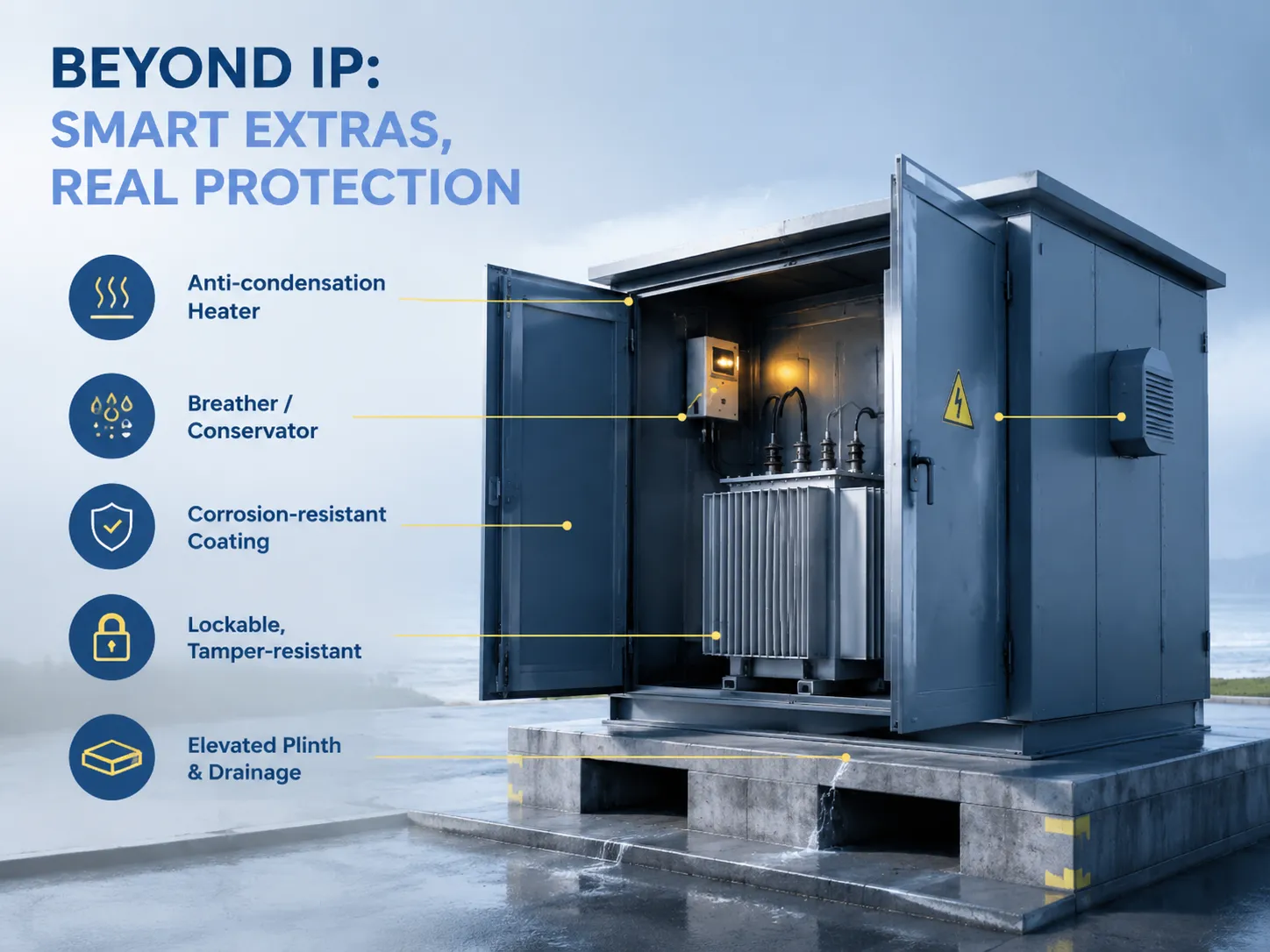
Tabela de Custo de Atualização de IP
A proteção custa dinheiro, mas os incrementos são modestos em comparação com o próprio transformador — e triviais em relação a uma falha:
| Atualização de IP | Impacto no Preço | Exemplo (500 kVA) |
|---|---|---|
| IP21 → IP23 | +1–2% | +$100–$300 |
| IP23 → IP44 | +2–4% | +$200–$600 |
| IP44 → IP54 | +3–6% | +$300–$900 |
| IP54 → IP56 | +2–4% | +$200–$700 |
| Adicionar aquecedor anti-condensação | +$150–$400 (fixo) | +$150–$400 |
| Revestimento de grau marinho | +2–5% | +$200–$800 |
Uma unidade de 500 kVA totalmente endurecida – como no IP56, aquecedores, revestimento marinho – custa aproximadamente $9.500 a $19.000, o que varia dependendo do fabricante e do mercado. Compare isso com uma falha devido à umidade que custa $8.000-$30.000 mais tempo de inatividade adicional. O invólucro é a forma mais barata de proteção de acordo com a especificação.
Marcas e Preços por Nível de IP
Dependendo do preço, as classificações de IP estão disponíveis. Fabricantes internacionais vendem invólucros a seus preços altos regulares, enquanto empresas chinesas certificadas pela IEC estão vendendo os mesmos produtos a preços muito mais baixos e recebendo os mesmos resultados de teste conforme especificado na IEC 60529.
| Marca | Posição | 500 kVA IP54 | 500 kVA IP56 |
|---|---|---|---|
| ABB | Suporte global, gama completa | $18.000–$30.000 | $19.000–$33.000 |
| Siemens | Eficiência, opções digitais | $18.000–$32.000 | $19.000–$35.000 |
| Schneider Electric | Resistência de tipo seco | $15.000–$28.000 | $16.000–$30.000 |
| Hitachi Energy | Rede e industrial | $17.000–$30.000 | $18.000–$32.000 |
| Eaton | Conformidade na América do Norte | $14.000–$26.000 | $15.000–$28.000 |
| Jiangsu Subian Electric Power | IEC 60076, cobre, relatórios de teste | $8.000–$16.000 | $9.000–$17.000 |
Os preços mostrados são em termos FOB China e são influenciados pelas especificações e pela marca escolhida. As marcas internacionais acima são o padrão para qualidade e serviço de invólucros. A Jiangsu Subian Electric Power tem a característica útil de levar as classificações de IP a sério, ao contrário de apenas pintá-las nos transformadores - ou seja, a empresa fabrica transformadores em conformidade com a IEC 60076 equipados com invólucros IP54/IP56, aquecedores anti-condensação e revestimentos de grau marinho como opções padrão, enquanto a classificação de IP é testada e verificada de acordo com a IEC 60529. Ao comprar uma unidade endurecida, pode-se ver a diferença entre um IP56 medido e um IP56 declarado em uma planta de alimentos que teve um ano de chuvas intensas e lavagem. Ao ter testes documentados realizados, um fornecedor garante que a especificação será fornecida com certeza.
Perguntas Frequentes
Que classificação de IP um transformador deve ter ao ar livre?
IP54 é o padrão para transformadores adequados para instalações externas, pois oferecem proteção contra poeira e jatos de água de baixa pressão, não hesite em usar a classificação IP56 se o transformador estiver instalado em áreas próximas ao mar, sendo lavado ou enfrentando chuvas fortes. O segundo dígito é o mais importante: 4 é água de respingo, 5 são jatos e 6 são jatos fortes, então verifique qual pressão de água estará presente no local.
IP65 é melhor que IP54 para um transformador?
Deve-se notar que a classificação IP65 não é sinônimo de proteção automática. Embora garanta resistência tanto à poeira quanto à água, um invólucro selado implicaria em confinamento de calor interno. Como resultado, nos verões, uma instância IP65 não ventilada pode operar em um nível de temperatura mais alto do que uma IP44 ventilada, levando a uma diminuição na vida útil da isolação. Portanto, certifique-se de que a classificação IP de um equipamento corresponda às condições em que será aplicado, tomando – se possível – todas as medidas para eliminar a geração excessiva de calor dentro do invólucro.
A classificação IP se aplica da mesma forma a transformadores imersos em óleo e a transformadores do tipo seco?
Não. Nos transformadores imersos em óleo, os enrolamentos são mantidos em óleo, garantindo que o IP contribua para a proteção do equipamento. No caso dos transformadores do tipo seco, os enrolamentos estão em contato com o ar, tornando o invólucro a primeira linha de defesa. Em um ambiente empoeirado, o transformador seco exigiria maior proteção.
Qual é a diferença de custo entre transformadores IP23 e IP56?
Aproximadamente 5-12% do preço de custo. Para um transformador maior de 500 kVA, a faixa de IP23 a IP56 variaria de $500 a $1,800, enquanto IP56 mais os aquecedores e tinta marinha custariam um adicional de $1,000 a $2,800. Considerando que os danos relacionados à umidade custam entre $8,000 a $30,000 e resultam em tempo de inatividade, a atualização se torna uma apólice de seguro acessível.
A classificação IP de um transformador pode ser atualizada após a entrega?
É muito incomum e nunca simples. O custo de reconstruir uma carcaça, fornecer sistemas de aquecimento ou recobrir após o envio varia de 15 a 40 por cento do custo da unidade e anula a certificação original. A classificação IP deve ser determinada antes de fazer um pedido, uma vez que corresponder ao ambiente desde o início é a única opção viável financeiramente.
Referências
- IEC 60529: Graus de Proteção Fornecidos por Invólucros (Código IP) — o padrão regulador para classificações IP e métodos de teste.
- IEC 60076-1: Transformadores de Potência — Geral — classificações, suposições ambientais e requisitos de invólucro para transformadores de potência.
- IEEE C57.12.00: Requisitos Gerais para Transformadores Imersos em Líquido — requisitos de invólucro e teste da América do Norte.
- Electrical4U — Guia de Classificação IP — uma referência clara para definições e exemplos de códigos IP.
- NFPA 70: Código Elétrico Nacional — regras de instalação da América do Norte para locais de transformadores e requisitos de invólucro.
- Wikipedia — Código IP — a definição e a história do código de Proteção de Ingressos.
Conclusão
O processo que envolve a seleção da classificação IP (Proteção de Ingressos) para transformadores envolve correlacionar o invólucro às condições circundantes em que irá operar. As condições incluem a entrada de água e poeira, limpeza em áreas molhadas e inundações – não condições como dias ensolarados. O código numérico consiste em dois dígitos: o primeiro indica o nível de proteção contra a entrada de sólidos, enquanto o segundo fornece informações sobre a entrada de água de acordo com a IEC 60529.
- Use IP21 a IP23 em áreas internas limpas e ventiladas, IP44 em locais empoeirados, IP54 onde operações industriais ao ar livre são realizadas, e IP56 em locais com procedimentos de lavagem frequentes, sazonalmente, ou em áreas costeiras.
- Deve-se ter em mente que, ao contrário dos transformadores a óleo, os transformadores a seco expõem suas bobinas e, portanto, o IP dos primeiros geralmente deve ser maior do que para os últimos.
- Considere usar aquecedores adicionais para a prevenção de condensação contrária em partes tropicais, costeiras ou cíclicas de sistemas HVAC.
- Também é necessário entender a importância das etapas anteriores do processo de produção no trabalho de fiação e nas práticas de monitoramento dos procedimentos de teste de classificação IP.