

A food-processing facility in Thailand chose the IP23 rating for its new dry-type transformers because they were set to be installed inside an air-conditioned electrical room. What was not revealed to the purchaser was the fact that this room’s HVAC would shut down nightly to conserve energy as well as that the late-night cleaning crew would wash the floor two meters away from the enclosure. The outcome was compound moisture tracking that led to the demise of the first transformer’s insulation in eight months’ time. The main mistake with respect to specifications was not regarding transformation voltage since that was met; the main error occurred in relation to the IP rating since IP23 is considered inadequate when there is water in the premise.
IP ratings are the best option for obtaining reliable insulation specifications. This provides the definitions of each digit in the associated code on IP levels as well as how to determine what level of IP is required for each environment.
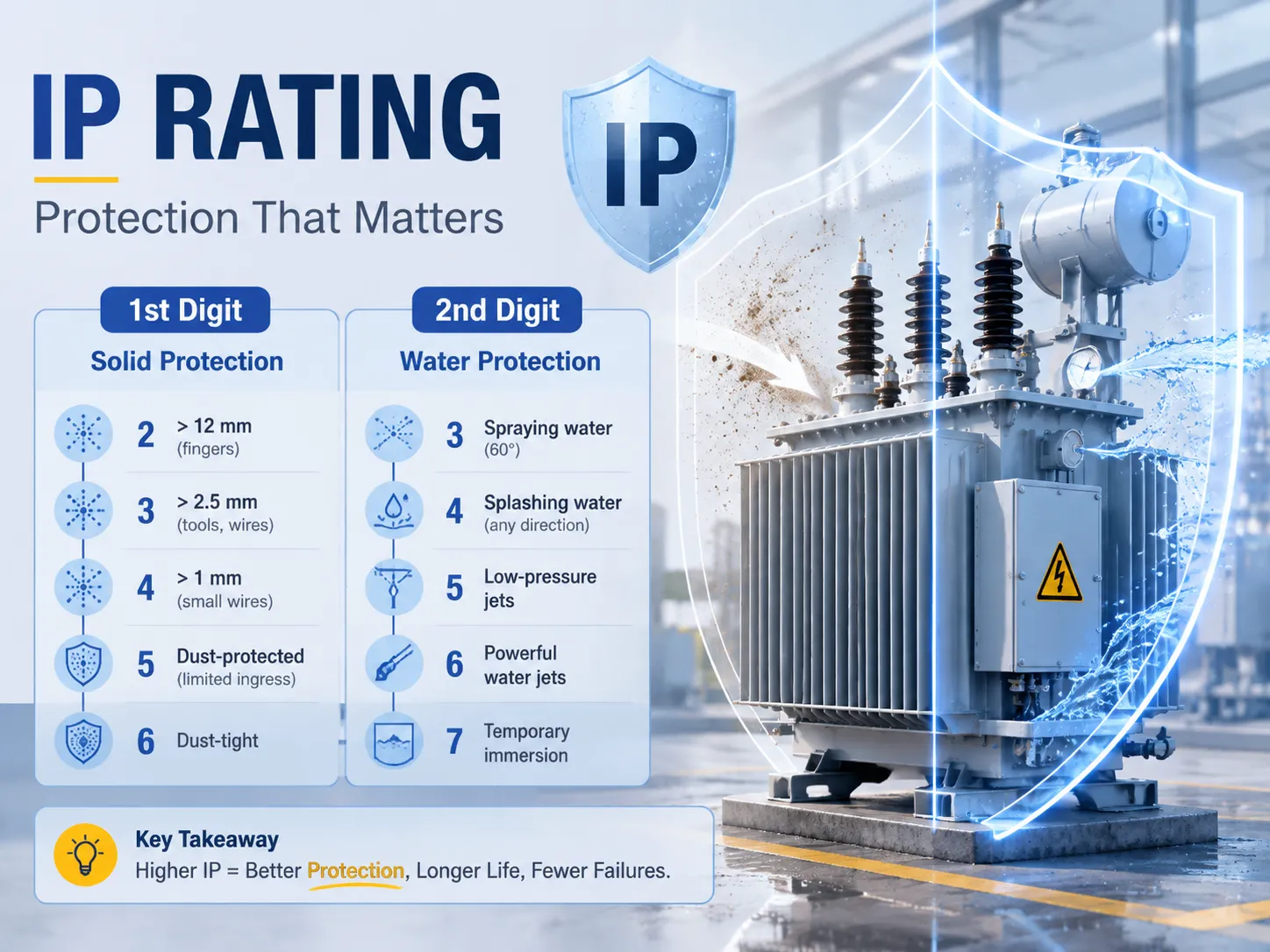
To put it simply, the IP rating consists of two digits: the first number (0 to 6) denotes the level of solid protection, where 4 indicates the device is dust-protected, and 6 means that it is completely protected against dust; the second number (0–8) shows the level of water protection: 3 indicates that the device is protected against dripping water, 5 – against spray, 6 – against powerful jets of water; and 7 – against being immersed in water in a short period. In selecting transformers, while IP21-IP23 is apt for indoor electrical rooms, IP44 is good for dusty areas, and IP54 is used for industrial outdoor applications.

What the IP Code Actually Means
An enclosure IP rating consists of IP followed by two numbers such as IP54, IP56, and IP65. The first digit indicates the amount of protection from solid objects (dust, fingers, etc.) ranging from 0 (no protection) to 6 (dust-tight). The second digit indicates the protection from water, with the same scale of values from 0 (no resistance) to 8 (complete immersion). This classification is set and verified according to the IEC Standard 60529 which means that an IP rating is a valid certification.
The rating for transformers specifies the type of enclosure protecting the live parts in the structure, namely the tank and its parts for oil transformers and the cabinet with coils of dry transformers. As soon as the proper IP rating should be chosen with regard to providing the best level of protection without overpaying for it.
First Digit: Solid Particle Protection
The first digit range for transformer practice is 2 to 6:
| First Digit | Protection Against | Transformer Use |
|---|---|---|
| 0 | No protection | Not used for transformers |
| 1 | Objects > 50 mm (hands) | Bare bushing areas |
| 2 | Objects > 12 mm (fingers) | Basic indoor protection |
| 3 | Objects > 2.5 mm (tools, wires) | Indoor dry-type enclosures |
| 4 | Objects > 1 mm (small wires) | Dust-protected — dusty indoor halls |
| 5 | Dust-protected (limited ingress) | Outdoor industrial default (with IP5x) |
| 6 | Dust-tight | Severe dust (mines, cement, grain) |
It is worth noticing the distinction between levels 5 and 6: IP5x is “dust-protected,” where some dust can get in but it does interfere with functioning; whereas IP6x means that this type is dust-tight. Use level 5 for most industrial operations outdoors but for mineral processing, grain handling, and metallurgy apply level 6.

Second Digit: Water Protection
The second digit is where most specification errors happen, because the difference between 3, 5, and 7 is physical:
| Second Digit | Protection Against | 一般的な使用 |
|---|---|---|
| 0 | None | — |
| 1 | Vertical dripping water | — |
| 2 | Dripping at 15° tilt | — |
| 3 | Spraying water (60° from vertical) | Indoor dry-type, basic washdown protection |
| 4 | Splashing water from any direction | IP44 for dusty/moist indoor halls |
| 5 | Low-pressure water jets | IP54 outdoor industrial default |
| 6 | Powerful water jets | IP56 washdown, food, coastal |
| 7 | Temporary immersion (1 m, 30 min) | Flood-prone substations |
| 8 | Continuous immersion | Submersible equipment |
The malfunction of the food plant previously was a typical wrongdoing of IP23 vs IP44/54: if the water is sprayed from close distances above (5—6), it is a jet (5—6), not a spray (3). When there are cleaning crews using hoses in the vicinity, the second digit should be either 5 or 6 no matter how the room appears when lights are down.
Matching IP Ratings to Environments
The practical selection matrix for transformers, based on the physical environment:
| Environment | Recommended IP | Rationale |
|---|---|---|
| Clean indoor electrical room | IP21–IP23 | No dust or water sources; ventilation matters |
| Dusty indoor hall (manufacturing) | IP44 | Small-particle ingress blocked; splash tolerated |
| Outdoor general industrial | IP54 | Dust-protected + jet water; the industrial default |
| Coastal / marine exposure | IP56 | Salt spray and driven rain |
| Food processing / washdown | IP56 | High-pressure cleaning is a jet, not a splash |
| Mining / cement / grain | IP65–IP66 | Dust-tight plus jet water |
| Flood-prone areas | IP67 (tank) | Temporary immersion for a defined period |
It is a valuable practice to visit the job site at your worst time — not at midday on a sunny Tuesday. Water and dust can get to the site from hoses, storms, crew members cleaning the site, and from process leaks. The site conditions must ensure that the enclosure should operate well at the time when it is raining massively rather than in a dry day depicted in the architect’s drawing.
Oil-Immersed vs. Dry-Type IP Requirements
The type of construction determines what exactly the IP rating safeguards. The tank of an oil-immersed transformer is hermetically sealed, and as the windings are immersed in oil, the enclosure protects the equipment only: the bushings, the gauges, the conservator, and the tap-changer cabinet. The windings of a dry-type transformer rely on air for cooling and are not completely shielded from the environment — thus, the enclosure acts as the first line of protection.
| 視点 | 油浸型 | Dry-Type |
|---|---|---|
| What IP protects | Bushings, gauges, accessories | The windings themselves |
| Typical indoor IP | IP23–IP44 | IP21–IP44 |
| Typical outdoor IP | IP54–IP56 | IP54 (with enclosure) |
| Windings exposed to air | No | Yes — higher IP needed in dust |
| Flood risk | Tank floats? — anchor it | Sealed cabinet or elevated base |
The practical result is that in a dusty hall, dry-type equipment requires at least an IP44 rating because dust gathers on the live coils. Meanwhile, an oil-filled machine can do with a lower protection level since the coils are immersed in oil. Thus, customers using the IP protection level of oil-filled systems for dry equipment will be placing themselves at risk of under-protection.
Common IP Specification Mistakes
- IP21/IP23 only states that a device can be operated in areas where there is a risk of water splashing by the water. In fact, water pressure shows the limits of IP23.
- Not adapting to any of the indoor conditions such as temperature and humidity with automation systems. HVAC issues, room doors closure and cleaning tasks create conditions that are not discussed using the term “clean room”.
- Making the mistake of thinking that IP54 means waterproof. IP54 only means water resistance but does not give any assurance if something can be submerged in the water.
- Considering the IP rating of equipment in areas with high humidity. Humidity is not equal to water pressure but humidity can, in fact, be damaging for any equipment.
- Confusing IP65 with being the best option there is. Total closure will create heat problems for dry transformers.
Beyond IP: Enclosure Extras Worth Specifying
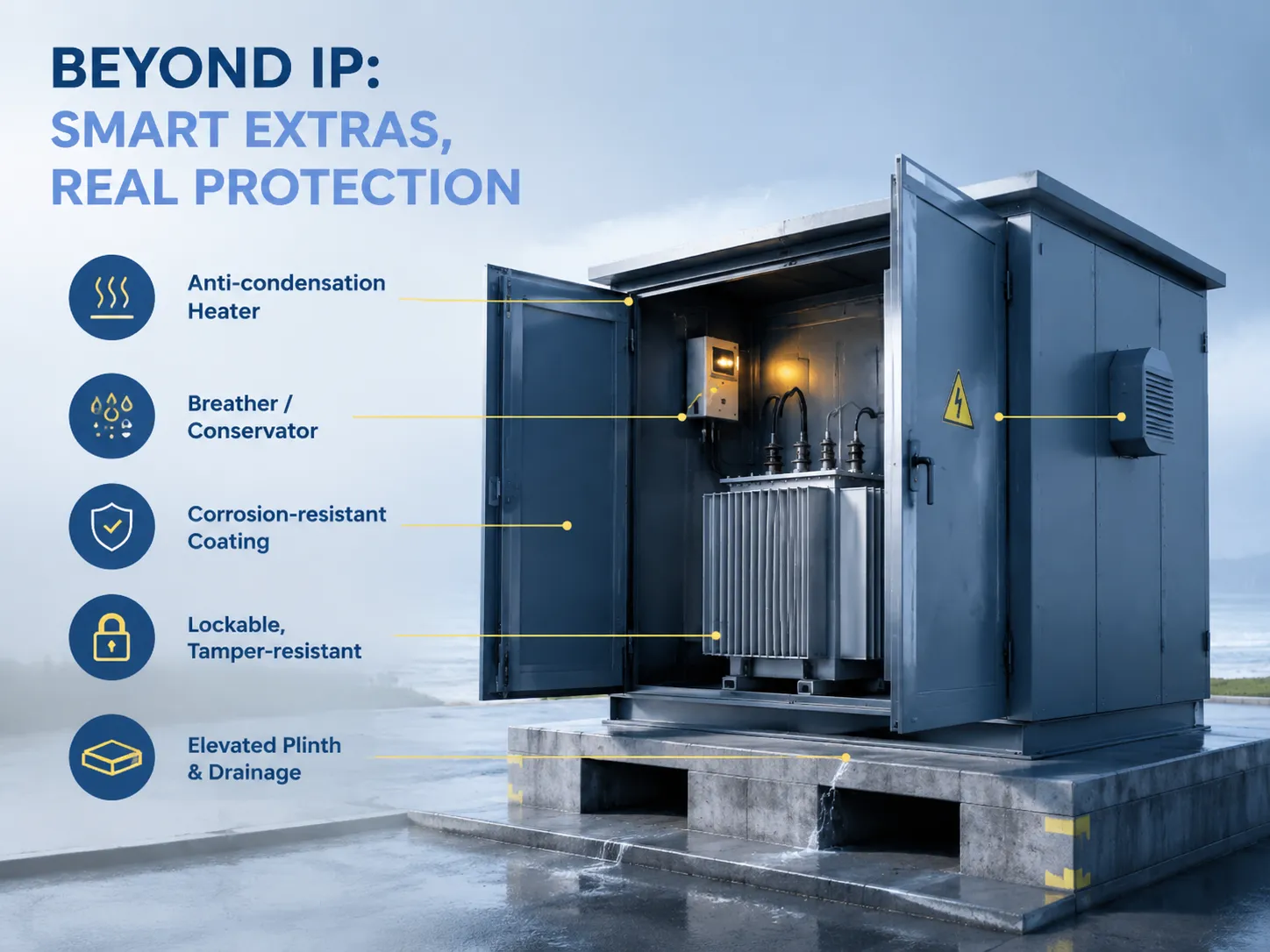
The ingress protection rating mainly deals with ingress, yet other complementary features are crucial in the extreme conditions. These features include the following:
- Condensation heaters are fitted to ensure humidity does not exceed dew level in tropical and coastal areas – it is inexpensive and requires from 100W to 500W depending on the size of the enclosure.
- Silica gel breathers or gas-sealed conservators in oil-immersed units do not allow moisture to be drawn into the tank with cooling oil.
- Corrosion-resistant coating (either hot-dip galvanization or marine-grade paint in case of coastal installations) raises the price of the enclosure by 2-5%.
- Locking and tamper-proof doors are obligatory for pad-mounted devices installed in public places; they are needed not only to secure but also for safety purposes.
- Raising of the base and drainage system is the cheapest way to avoid flooding (300 mm clearance and necessary drainage slope will cost almost nothing).

IP Upgrade Cost Table
Protection costs money, but the increments are modest compared with the transformer itself — and trivial against a failure:
| IP Upgrade | Price Impact | Example (500 kVA) |
|---|---|---|
| IP21 → IP23 | +1–2% | +$100–$300 |
| IP23 → IP44 | +2–4% | +$200–$600 |
| IP44 → IP54 | +3–6% | +$300–$900 |
| IP54 → IP56 | +2–4% | +$200–$700 |
| Add anti-condensation heater | +$150–$400 (fixed) | +$150–$400 |
| Marine-grade coating | +2–5% | +$200–$800 |
A fully hardened 500 kVA unit – as in IP56, heaters, marine coating – costs approximately $9,500 to $19,000, which varies depending on the manufacturer and market. Compare that with one failure due to moisture that costs $8,000-$30,000 plus additional downtime. The enclosure is the cheapest form of protection according to specification.
Brands and Prices by IP Level
Depending on the price, IP ratings are available. International manufacturers sell enclosures at their regular high prices, while Chinese companies certified by IEC are selling the same products at much lower prices and receiving the same test results as specified in IEC 60529.
| ブランド | Position | 500 kVA IP54 | 500 kVA IP56 |
|---|---|---|---|
| ABB | Global support, full range | $18,000–$30,000 | $19,000–$33,000 |
| Siemens | Efficiency, digital options | $18,000–$32,000 | $19,000–$35,000 |
| シュナイダーエレクトリック | Dry-type strength | $15,000–$28,000 | $16,000–$30,000 |
| 日立エナジー | Grid and industrial | $17,000–$30,000 | $18,000–$32,000 |
| Eaton | North America compliance | $14,000–$26,000 | $15,000–$28,000 |
| 江蘇省蘇辺電力 | IEC 60076, copper, test reports | $8,000–$16,000 | $9,000–$17,000 |
Prices shown are on FOB China terms and are influenced by the specifications and brand chosen. The international brands above are the touchstone for quality and service for enclosures. Jiangsu Subian Electric Power has the helpful feature of taking the IP ratings seriously as opposed to just painting them on the transformers- that is, the company manufactures IEC 60076-compliant transformers equipped with IP54/IP56 enclosures, anti-condensation heaters, and marine-grade coatings as standard options while IP rating is tested and verified in accordance with IEC 60529. When buying a hardened unit, one can see the difference between a measured IP56 and a claimed IP56 in a food plant that had one year of pouring rains and hosing. By having documented tests done, a supplier ensures that the specification will be provided with certainty.
よくある質問
What IP rating should a transformer have outdoors?
IP54 is the standard for transformers suitable for outdoor installations since they provide protection against dust and low-pressure water jets, don’t hesitate to use the IP56 rating if the transformer is installed in areas close to the sea, being washed down or facing heavy rain. The second digit is the most important one: 4 is splash water, 5 is jets and 6 is strong jets, so check what water pressure will be present on site.
Is IP65 better than IP54 for a transformer?
It should be noted that IP65 rating is not synonymous with automatic protection. Even though it ensures both resistance to dust and water, a sealed enclosure would imply internal heat confinement. As a result, in the summers, an IP65 non-ventilated instance may work at a higher temperature level than an IP44 ventilated one, leading to a decrease in the service life of the insulation. Hence, make sure that the IP rating of a piece of equipment matches the conditions where it is applied, taking – if possible – all measures to get rid of excess heat generation within the enclosure.
Does the IP rating apply the same way to oil-immersed and dry-type transformers?
No. In oil-immersed transformers, the windings are kept in oil, ensuring that the IP contributes to the protection of the equipment. In the case of dry-type transformers, the windings are in contact with air, making the enclosure the first line of defense. In the dusty environment, the dry transformer would require greater protection.
What is the cost difference between IP23 and IP56 transformers?
Approximately 5-12% of the cost price. For a larger 500 kVA transformer, IP23 to IP56 would range from $500 to $1,800 whereas IP56 plus the heaters and marine paint would cost an additional $1,000 to $2,800. When considering that moisture-related damage costs anywhere from $8,000 to $30,000 and results in downtime, the upgrade becomes an affordable insurance policy.
Can a transformer IP rating be upgraded after delivery?
It’s very unusual, and never simple. The expense of reconstructing a housing, supplying heating systems, or recoating after shipment ranges from 15 to 40 percent of the unit cost and nullifies the original certification. The IP rating must be determined prior to placing an order since matching the environment at the outset is the only viable option financially.
参考文献
- IEC 60529: Degrees of Protection Provided by Enclosures (IP Code) — the governing standard for IP ratings and test methods.
- IEC 60076-1: Power Transformers — General — ratings, ambient assumptions, and enclosure requirements for power transformers.
- IEEE C57.12.00: General Requirements for Liquid-Immersed Transformers — North American enclosure and testing requirements.
- Electrical4U — IP Rating Guide — a clear reference for IP code definitions and examples.
- NFPA 70: National Electrical Code — North American installation rules for transformer locations and enclosure requirements.
- Wikipedia — IP Code — the definition and history of the Ingress Protection code.
結論
The process involving the selection of the IP (Ingress Protection) rating for transformers entails correlating the enclosure to the surrounding conditions in which it will operate. Conditions include water and dust ingress, wet area cleaning, and floods – not conditions like sunny days. The numerical code consists of two digits: the first indicates the level of protection from solid ingress while the second one provides the information about water ingress according to IEC 60529.
- Use IP21 to IP23 in clean and ventilated indoor areas, IP44 in dusty places, IP54 where industrial outdoor operations are done, and IP56 in places with frequent washing procedures, seasonally, or in coastal areas.
- It should be kept in mind that unlike oil transformers the dry-type transformers expose their windings and thus the IP of the former has to usually be higher than for the latter.
- Consider using additional heaters for the prevention of counter condensation in tropical, coastal, or cyclic parts of HVAC systems.
- It is also necessary to understand the importance of the previous stages of the production process in the wiring work and monitoring practices of the IP rating testing procedures.