


Na sua tentativa de atualizar o plano de capital de cinco anos da concessionária do Sudeste Asiático, a diretora de sustentabilidade recebeu uma mensagem importante de seus analistas: cerca de 6% da eletricidade transmitida pela concessionária foi perdida em seus próprios transformadores, sendo a maior parte proveniente de transformadores instalados antes de 2005. Assim, substituir ou atualizar transformadores não era um caso de caridade, mas simplesmente a eletricidade mais barata que a concessionária poderia adquirir. Ao mesmo tempo, a diretora de sustentabilidade do fornecedor estatal de rede da China estava lendo sobre os mesmos desenvolvimentos, mas de um ângulo diferente: ao fazer licitações de compras, os fatores ambientais foram considerados e todas as fábricas que não puderam fornecer prova de que seus processos de fabricação eram “livres de carbono” desapareceram da lista de licitantes. Assim, ambas as mulheres estavam vivendo a mesma transformação global, e esses são os objetivos de carbono duplo que afetam o trabalho de toda a indústria de transformadores.
O que são os Objetivos de Carbono Duplo
Os objetivos de carbono duplo são os compromissos climáticos mais importantes da China: o pico das emissões de dióxido de carbono até 2030 e a realização da neutralidade de carbono até 2060. Anunciados em setembro de 2020, esses objetivos assumiram o papel de princípios orientadores das indústrias de manufatura, produção de energia e exportação do país. O desenvolvido quadro de políticas “1+N” conecta as metas nacionais com metas específicas para indústrias como produção de energia, manufatura verde, eficiência energética e outros mecanismos, como preços de carbono e certificados de energia verde.
No que diz respeito à indústria de transformadores, os objetivos de carbono duplo não representam uma noção abstrata. Cada etapa da cadeia de processo deve medir e limitar as emissões que gera: o aço e o cobre usados para fabricar um transformador já contêm carbono incorporado; a fábrica usa energia; além disso, um transformador utiliza sua parte de cada megawatt processado por ele.
| Marco | Data | Consequência da indústria de transformadores |
|---|---|---|
| Objetivos de carbono duplo anunciados | Setembro de 2020 | Quadro estabelecido; planos setoriais começam |
| Classes de eficiência GB 20052 em vigor | 2020–2021 | A Classe 2 se torna a base para transformadores de distribuição |
| Meta de pico de carbono | Antes de 2030 | Redução de perdas na rede acelerada; compras verdes se expandem |
| Meta de neutralidade de carbono | Antes de 2060 | Núcleos amorfos e fábricas verdes se tornam padrão |
As datas são importantes porque as decisões de compra feitas agora ainda vinculam por 25–35 anos — um transformador encomendado hoje ainda estará operando em direção ao horizonte de neutralidade de carbono.
Por que os Transformadores Estão no Centro do Problema
Os transformadores desempenham um papel fundamental na maioria dos processos dentro do sistema elétrico — desde a geração, passando pela transmissão e distribuição até o uso final. Os sistemas de rede nacional empregam centenas de milhares de transformadores, cada um com suas ineficiências que resultam em perdas no uso de eletricidade.
Investigações sobre as perdas em equipamentos de transformadores mostram que as perdas na transmissão de eletricidade atingem cerca de 5-8%. Isso também significa que as perdas dos transformadores representam uma parte significativa desse valor.
Essas perdas são significativas por duas razões. Em primeiro lugar, é eletricidade desperdiçada no sistema, o que não pode ser permitido pelo sistema de baixo carbono, já que qualquer watt de eletricidade é produzido, transmitido e pago. Em segundo lugar, é uma fonte de perda concentrada e detectável, pois não há problemas em encontrar e reparar transformadores, ao contrário de outros tipos de perdas no sistema elétrico. É por isso que a eficiência dos transformadores é uma das questões mais comuns consideradas em várias estratégias voltadas para a eficiência energética e a redução de carbono, como o Ecodesign da UE e o sistema de classificação da China.
O Inventário de Perdas: Onde as Emissões dos Transformadores Vivem
As perdas dos transformadores se dividem em duas famílias, e a contabilidade de carbono as trata de maneira diferente:
| Tipo de perda | Causa | Quando ocorre | Impacto de carbono |
|---|---|---|---|
| Perda sem carga (núcleo) | Magnetização do núcleo de aço | 24 horas por dia enquanto energizado | Dominante em redes levemente carregadas; emissões constantes |
| Perda de carga (cobre) | Corrente através das bobinas | Escala com o quadrado da carga | Dominante em fator de carga alto |
| Carbono incorporado | Produção de aço, cobre, óleo | Na fabricação | Uma vez; 5–15% de emissões do ciclo de vida para uma unidade de longa duração |
| Fim de vida útil | Descarte de óleo, reciclagem | Na desativação | Reduzido por óleo de éster e designs recicláveis |
O que fica claro a partir disso é que, na maioria dos casos, o carbono emitido durante o ciclo de vida dos transformadores se deve a perdas sem carga, uma vez que os transformadores são alimentados com eletricidade continuamente, mas raramente são utilizados em plena capacidade. Por exemplo, um transformador classificado em 400 kVA operando com uma carga média de 30% consumirá mais energia devido às perdas através de seu núcleo do que devido às perdas através de suas bobinas durante a maioria dos meses. É exatamente por isso que o primeiro conjunto de regulamentações na área de transformadores energeticamente eficientes se concentrou nas perdas do núcleo.
Alavancas Tecnológicas: Núcleos, Óleos e Design
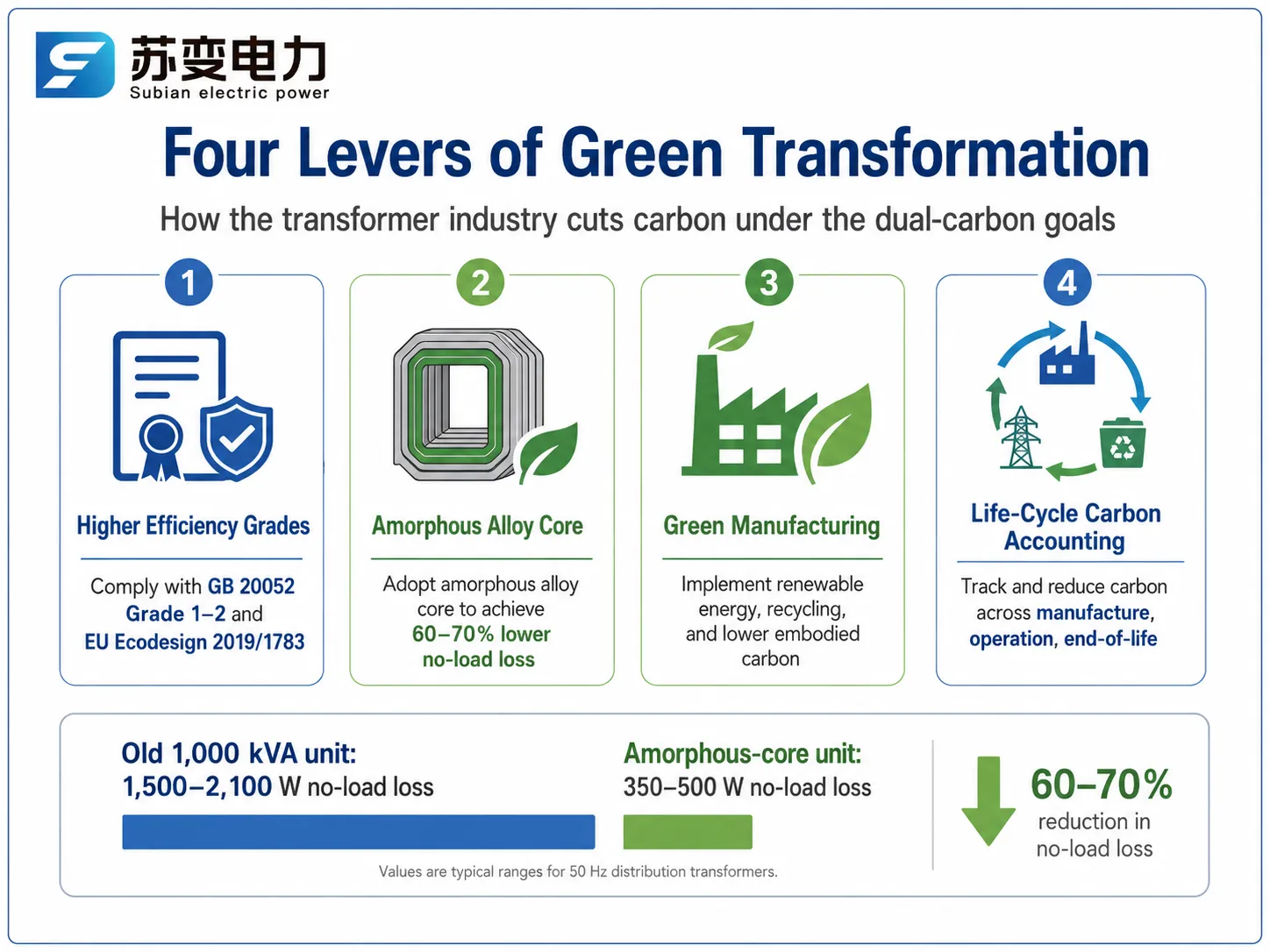
A tecnologia é onde a transformação verde da indústria de transformadores é conquistada. Quatro alavancas, em ordem aproximada de impacto nas perdas sem carga:
| Tecnologia | Efeito sobre a perda sem carga | Efeito do custo inicial | Justificativa de carbono |
|---|---|---|---|
| GOES de alta permeabilidade, 0,23–0,27 mm | 15–25% inferior à classificação padrão | +3–6% | Menor perda de aço por kWh entregue |
| Núcleo de metal amorfo | 60–70% inferior ao convencional | +20–40% | Maior alavanca única para operação 24/7 |
| Óleo de éster natural (vegetal) | Neutro eletricamente | +10–15% | Biodegradável, menor risco de incêndio, menor carbono incorporado em comparação ao óleo mineral |
| Bobinagem de baixa perda (condutor maior) | Perda de carga reduzida em 10–20% | +2–5% | Relevante para transformadores com alta carga |
A liga amorfa é a tecnologia de destaque da era de carbono duplo em transformadores de distribuição. Como a perda em vazio da fita é dramaticamente menor, uma unidade de 1.000 kVA com núcleo amorfo economiza aproximadamente 500–700 W em comparação a uma unidade de alta eficiência convencional — cerca de $440–$610/ano a $0,10/kWh, ou $5.000–$7.000 em valor presente ao longo de 15 anos. É a tecnologia mais consistentemente mencionada em programas de incentivo na China e a mais propensa a se tornar obrigatória à medida que os padrões de grau 1 se tornam mais rigorosos.
Fabricação Verde: A Pegada da Fábrica
O objetivo de carbono duplo se estende ao processo de produção. O sistema de fabricação verde avalia as fábricas com base em seu consumo de energia por produção, bem como na quantidade de energia renovável utilizada e no uso eficiente de recursos como água, reciclagem de resíduos e emissões de poluentes. Os fabricantes estão buscando essa certificação não apenas por causa do rótulo que isso lhes confere, mas também porque a aquisição pela rede estatal e utilitários prefere fornecedores que possuem a certificação.
As medidas que estão sendo tomadas no nível da fábrica são as seguintes:
Fornos de secagem de energia e pisos de teste operando com energia de fontes renováveis, o que reduz as emissões no escopo um e escopo dois.
Reciclagem e reutilização de óleo, sobras de aço e sucata de cobre das operações de bobinagem e núcleo.
Instalação de máquinas de medição para medir o consumo de energia ao longo do processo de produção e obter informações sobre emissões antes que a empresa envie um relatório anual.
Utilização de óleos éster ecológicos tanto nas oficinas quanto como uma opção de construção para os produtos.
As operações listadas influenciam o grau de emissões produzidas durante a fabricação de transformadores — o que constitui 5-15% de suas emissões totais de ciclo de vida, sendo assim insignificante para uma única peça, mas notável para a produção anual de milhares de transformadores e se tornando cada vez mais um requisito para os fornecedores que se candidatam a licitações verdes.
Alavancas de Política: Graus, Licitações e Subsídios
A tradução da tecnologia em status de mercado ocorre com a ajuda de políticas. Os principais motores do processo consistem em:
Classificações de eficiência: classificações GB 20052 que variam de 1 a 3 para transformadores de distribuição, onde o padrão mínimo de eficiência é o grau 2, enquanto já em muitos programas de aquisição pública, a classe de eficiência máxima, ou seja, grau 1 (tipo amorfo) é ou um requisito ou qualifica para apoio financeiro.
Padrões mínimos de eficiência no comércio: o padrão de Ecodesign da UE 2019/1783 é um importante ato legislativo que regula a eficiência mínima para lâmpadas de rua (o padrão entrará em vigor a partir de meados de julho de 2024), enquanto sob as regulamentações do DOE, atender aos requisitos garantirá a entrada no mercado.
Pontuação de compras verdes: em licitações, as empresas de distribuição de eletricidade ponderam a classificação de eficiência, o tipo de óleo utilizado e a certificação da fábrica, o que constitui aproximadamente 5-10% da pontuação total.
Mercados de carbono e certificados: a eficiência dos certificados verdes e possíveis mecanismos de precificação de carbono aumenta a eficácia das perdas evitadas com o passar do tempo.
O efeito de catraca ocorre com as atualizações atuais do padrão de classificações elevando a base, enquanto a operação de incentivos impulsiona tecnologias de eficiência máxima na produção em massa, o que reduz seu preço e torna o próximo aperto acessível.
Um Roteiro para a Transformação Verde
Para uma organização que possui uma frota de transformadores, a transformação verde segue uma sequência prática:
| Categoria da frota | Condição típica | Ação recomendada |
|---|---|---|
| Unidades pré-2000, alta perda em vazio | 500–2.100 W por 1.000 kVA | Substituir primeiro — melhor perda e retorno de carbono |
| Unidades de 2000–2010, perda moderada | Dentro dos padrões mais antigos | Substituir ou reaproveitar; priorizar pelo fator de carga |
| Unidades de grau 2 modernas | 700–1.100 W por 1.000 kVA | Manter; otimizar tomadas e operação em paralelo |
| Unidades de grau 1 / núcleo amorfo | 350–500 W por 1.000 kVA | Manter e monitorar; referenciar como melhor prática |
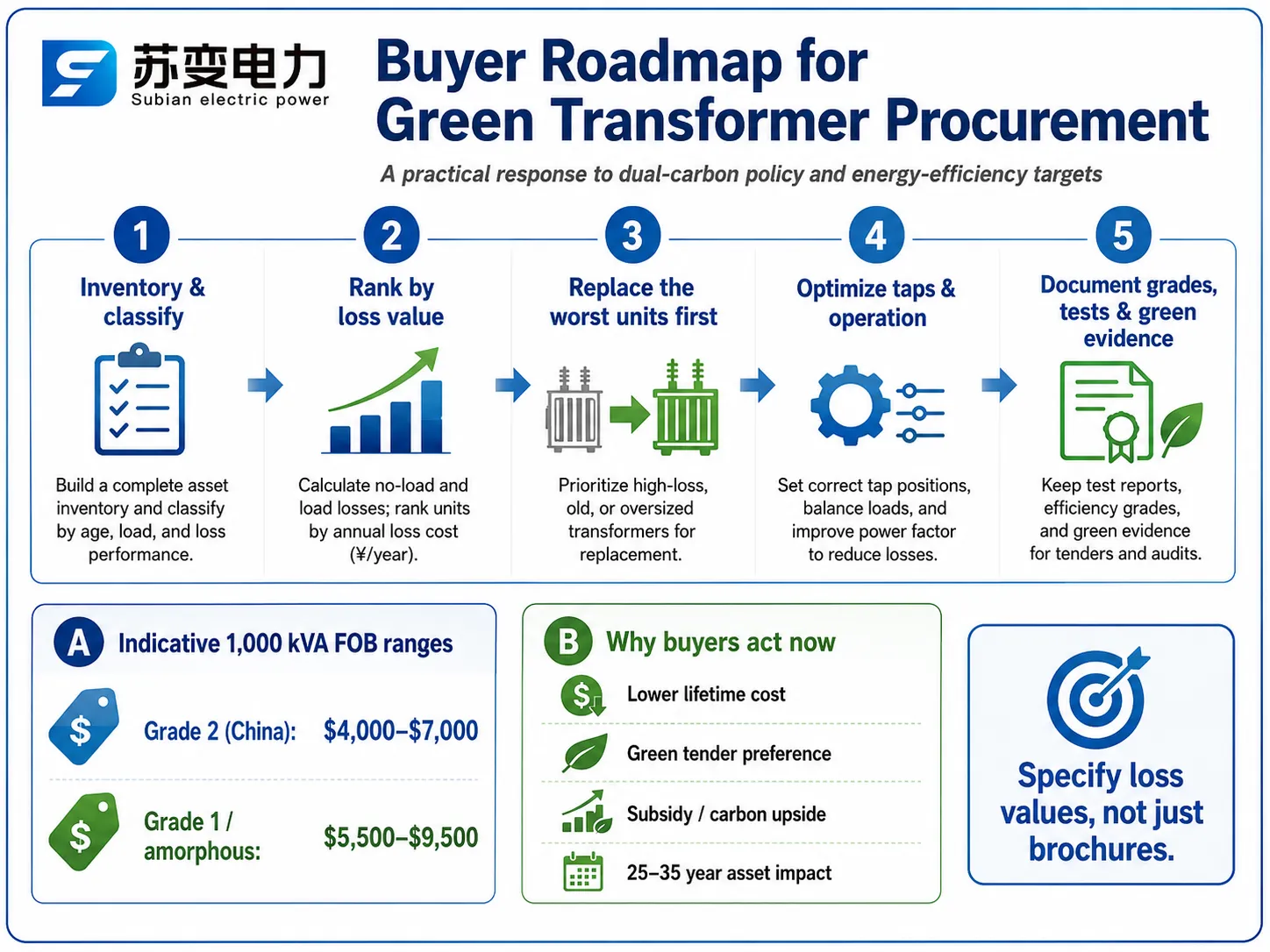
Fazer inventário e categorizar a partir do banco de dados de transformadores todas as especificações dos transformadores, incluindo placa de identificação, idade, perdas, características de carga e localização.
Aplicar classificação de perdas para priorização: aplicar metodologia de capitalização de perdas para avaliar unidades com custo anual de perda em vazio mais perda em carga; geralmente, as unidades menos 20% representam 50% ou mais das perdas totais da frota.
Substituir os mais ineficientes primeiro: a substituição de transformadores da década de 1990 e início dos anos 2000 é focada em substituições de nível “A” utilizando núcleos amorfos em casos em que são justificadas pela carga e horas de operação.
Realizar otimização operacional: re-tomadas, reequilíbrio das unidades conectadas em escolas e dimensionamento cuidadoso das unidades implicarão custo mínimo e proporcionarão resultados e efeitos muito rápidos.
Coletar e reivindicar: manter relatórios de testes de rotina, evidências de classe de eficiência e quaisquer subsídios verdes ou preferências de compras elegíveis fornecidos por subsídios federais que sejam aplicáveis.
Opções e Preços de Transformadores Verdes
Preços indicativos para um transformador de distribuição de 1.000 kVA 10/0,4 kV com economia de energia, FOB por marca e tecnologia:
| Marca | Origem | Grau 2 (GOES) | Grau 1 / núcleo amorfo |
|---|---|---|---|
| Hitachi Energy | Japão/Global | $9.000–$12.500 | $12.500–$18.000 |
| ABB | Suíça/Global | $8.500–$12.000 | $12.000–$17.000 |
| Siemens Energy | Alemanha/Global | $8.000–$11.500 | $11.500–$16.500 |
| Schneider Electric | França/Global | $7.500–$11.000 | $11.000–$15.500 |
| Jiangsu Subian Electric Power | China | $4.000–$7.000 | $5.500–$9.500 |
Os preços variam com a classe de perda, trocador de tomadas, opção de óleo éster, preços do cobre e termos de entrega; trate esses como faixas de planejamento, não cotações firmes.
Marcas globais ancoram o nível premium com redes de serviço profundas e extensos programas de teste de tipo. A história competitiva da manufatura chinesa sob o regime de dupla carbono é que os mesmos graus de eficiência e credenciais verdes chegam a 40–50% de custo inicial mais baixo, o que encurta cada cálculo de retorno sobre investimento. Jiangsu Subian Electric Power é um fabricante chinês transformador verde fabricante e de transformadores certificado como uma fábrica verde, produzindo transformadores imersos em líquido de grau 1–2 GB 20052, tipo seco e de núcleo amorfo de 10 kVA a 63 MVA, testados de acordo com a IEC 60076 e enviados com relatórios de teste de rotina. A Subian forneceu frotas de economia de energia para concessionárias e parques industriais na Ásia, África, Oriente Médio e América do Sul, e sua linha verde está documentada em subian-electric.com.
Como os Compradores Devem Responder
A trajetória de carbono dupla deve ser considerada pelos compradores como uma parte essencial da aquisição, em vez de mencionada como uma estratégia de marketing:
Mencione o grau em vez do documento de marketing: inclua o grau GB 20052 ou o nível da UE na consulta e assegure que tanto os números de perda em vazio quanto os de carga sejam oferecidos em resposta.
Calcule a perda de valor cada vez que um equipamento é adquirido, de modo que uma versão “barata” de alta perda não consiga competir com versões “caras” de baixa perda devido ao menor custo total de propriedade.
Opte por núcleos amorfos e óleo de éster em casos onde o fator de carga, risco de incêndio ou relatórios de sustentabilidade justifiquem seu uso.
Solicite prova ambiental: agora a produção, a participação de energia verde e os documentos de carbono também contarão.
Programe substituições de acordo com as regulamentações: substituir equipamentos que se tornarão não conformes na próxima data de atualização ajuda a evitar a aquisição de ativos não conformes.
Organizações que seguem esse processo obtêm três coisas principais: menor custo de operação, conformidade mais fácil e uma história de sustentabilidade prática.
Perguntas Frequentes
Quais são exatamente as metas de carbono duplo da China?
A China se comprometeu a atingir o pico de suas emissões de dióxido de carbono antes de 2030 e a alcançar a neutralidade de carbono até 2060. Os objetivos impulsionam a política setorial através de uma abordagem “1 + N” que abrange energia, indústria, transporte e fabricação verde, com medidas como classificações de eficiência de transformadores, certificação de fábrica verde e abordagens de mercado de carbono.
Quanto de energia um transformador ineficiente desperdiça?
Um transformador de 1.000 kVA da década de 1990 normalmente desperdiça 1.500–2.100 W em vazio — cerca de 13.000–18.000 kWh por ano, valendo $1.050–$1.800 a $0.08–$0.10/kWh. Uma unidade moderna de grau 2 reduz isso pela metade e uma unidade de núcleo amorfo corta para 350–500 W, cerca de um quarto do original.
Um transformador de núcleo amorfo vale o prêmio?
Em aplicações com carga contínua, sim. O prêmio de custo inicial de 20–40% é recuperado através de 60–70% de menor perda em vazio em 4–8 anos nas tarifas industriais típicas, e a economia se acumula ao longo de 25–35 anos de vida. Em locais sazonalmente carregados, uma unidade GOES de grau 2 é frequentemente a melhor opção de valor.
Quanto custam os transformadores verdes?
Uma unidade de grau 2 de 1.000 kVA custa cerca de $4.000–$7.000 FOB de fabricantes chineses; versões de núcleo amorfo de grau 1 custam $5.500–$9.500. Marcas europeias e japonesas premium geralmente custam 50–80% a mais. Os preços variam com acessórios, opção de óleo de éster e preços do cobre.
O que é uma fábrica verde na indústria de transformadores?
Uma fábrica verde é um local de fabricação certificado sob o sistema de fabricação verde da China para baixo consumo de energia por unidade de produção, participação de energia renovável, gestão de água e resíduos, e reciclagem. Para os compradores de transformadores, um certificado de fábrica verde sinaliza menor carbono incorporado e é cada vez mais considerado em licitações de utilidades e do governo.
Referências
- Programa de trabalho de carbono duplo da China (CN) — A estrutura política oficial para metas de pico e neutralidade.
- GB 20052: Classes de eficiência energética para transformadores de potência — O padrão de grau de eficiência no centro da política de transformadores da China.
- Regulamento de Ecodesign da UE 2019/1783 — Requisitos de eficiência de transformadores da UE alinhados com a mesma direção.
- IEC 60076-1: Transformadores de potência – Geral — Linha de base de testes internacionais para desempenho de transformadores.
- Programa de eficiência energética da IEA — Dados sobre perdas na rede e política de eficiência de transformadores.
- Sistema de fabricação verde do MIIT — Estrutura de avaliação e certificação de fábricas verdes da China.
- Site oficial da Jiangsu Subian Electric Power — Certificação de fábrica verde e gama de transformadores economizadores de energia.
Conclusão
enrolamento carbono duplo as metas dão à indústria de transformadores um destino claro e um cronograma rigoroso. O caminho da transformação verde é concreto: reduzir perdas em vazio com núcleos melhores, cortar carbono incorporado com fábricas mais verdes, e deixar a política — graus de eficiência, compras verdes, mercados de carbono — fazer a economia funcionar. A tecnologia existe, o retorno é documentado, e a direção é unidirecional.
Principais conclusões:
- As perdas de transformadores são uma parte concentrada e abordável das perdas na rede — alvos ideais iniciais para redução de carbono.
- Núcleos amorfos reduzem a perda em vazio em 60–70%; a certificação de fábrica verde corta o carbono incorporado na fonte.
- Retornos de 3–8 anos em substituições de grau 1–2, além de subsídios e vantagens de preferência de compras.
- Os compradores devem especificar graus de eficiência, calcular a capitalização de perdas, e solicitar evidências verdes.
Se sua frota está pronta para uma atualização de eficiência, Jiangsu Subian Electric Power — uma fábrica verde certificada — fornece transformadores GB 20052 grau 1–2 e núcleos amorfos testados de acordo com a IEC 60076 a preços amigáveis para exportação. Revise a gama em subian-electric.com.