


Na Nigéria, um engenheiro de compras que trabalha para uma empresa de utilidade pública foi informado sobre uma nova política do governo chinês que retira milhares de transformadores de distribuição obsoletos do mercado. A empresa de utilidade do engenheiro ainda opera várias unidades de S7, que foram produzidas na década de 1980, enquanto a empresa está considerando o uso de transformadores reformados do exterior e quer saber se a marca S7 que está sendo vista no mercado vale a pena comprar ou pode ser problemática.
Neste artigo, ilustrarei como a China eliminou gradualmente os transformadores de distribuição S7 e mais antigos, por que tal política foi introduzida, o que as notícias significariam para os clientes que compram transformadores novos e usados, e finalmente como entender os valores de perda, categorias de eficiência e sinais de preços na indústria atualmente.
A China formalizou sua política de transformadores energeticamente eficientes através da introdução do “Plano de Melhoria da Eficiência Energética de Transformadores (2015–2020)” e um novo padrão de classificação (GB 20052) que exigia que os transformadores da classe S7 – que são construídos de acordo com o antigo design S7 e projetados para ter altas perdas em vazio – fossem eliminados porque desperdiçam 1–2% da energia que conduzem durante todo o período de uso. O plano estipulou que as empresas de utilidade chinesas substituiriam os transformadores existentes da classe S7/S8 (e posteriormente os da classe S9 também) por modelos modernos energeticamente eficientes S11, S13 ou S15, que reduziriam as perdas em vazio em 30–60%.
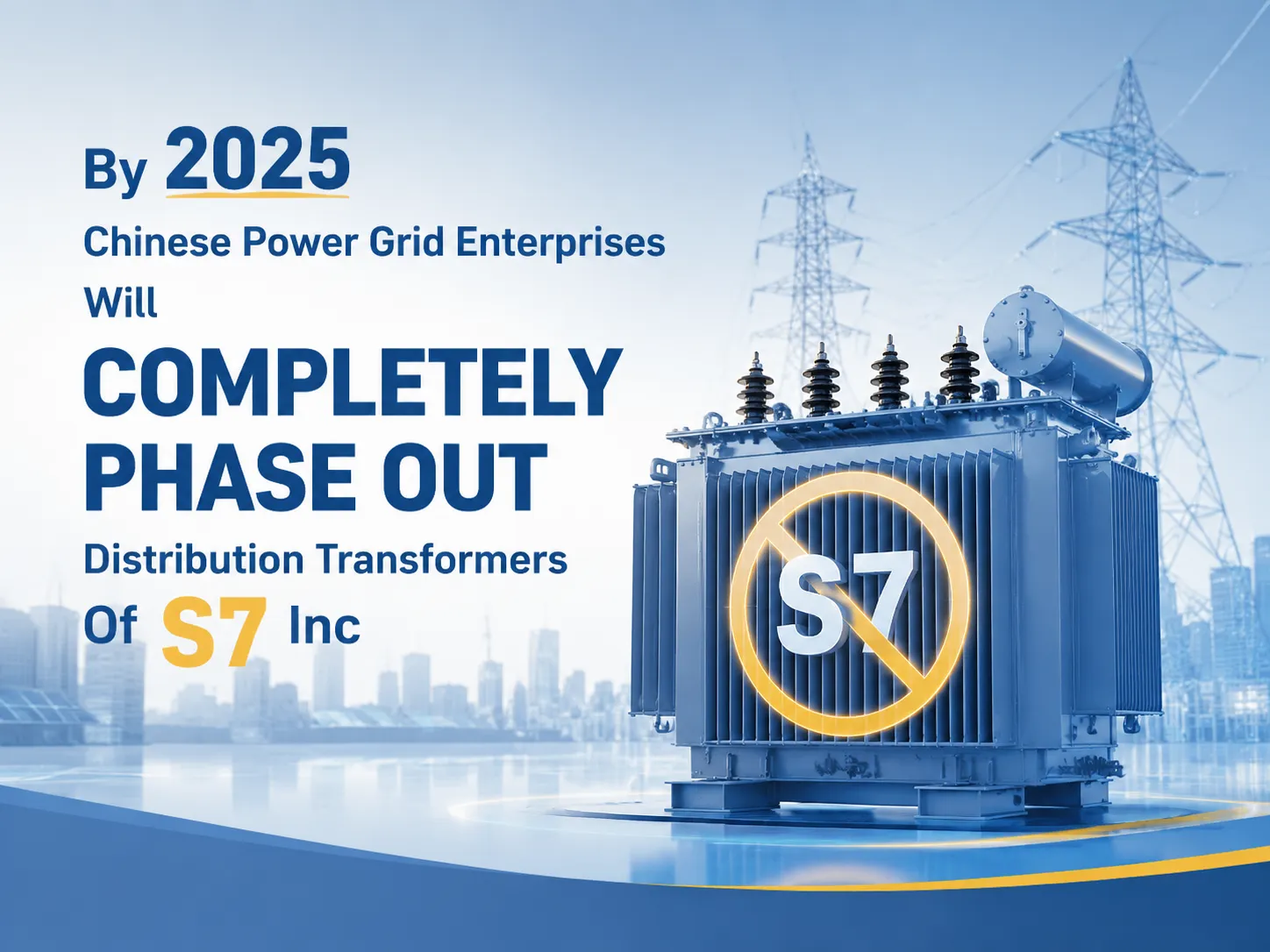
O Contexto: Por que a China Eliminou os Transformadores S7
Com o crescimento mais rápido entre todos os sistemas de rede elétrica da história, a China tinha um número significativo de transformadores de distribuição que foram projetados de acordo com o modelo S7 durante as décadas de 1980 e 1990. Apesar de serem baratos na época, a tecnologia S7 apresentava um nível relativamente alto de perdas em vazio (ferro) em comparação com os padrões modernos. Como os transformadores de distribuição funcionam quase constantemente durante todo o ano operacional de 8.760 horas, as perdas de ferro ocorrem continuamente, independentemente da energia fornecida pelo transformador.
Pesquisas realizadas na China afirmaram que a série S7 estava consumindo uma quantidade significativa de eletricidade no país. De acordo com os cálculos da Comissão Nacional de Desenvolvimento e Reforma (NDRC) e do Ministério da Indústria, substituir todos os transformadores por novos modelos poderia permitir que o país economizasse aproximadamente 25-40 TWh de energia por ano, o que equivale à produção anual de eletricidade de muitas grandes instalações de energia. Assim, todo o processo se torna não apenas uma medida econômica, mas também uma medida de segurança energética.
Em 2015, o lançamento do “Plano de Melhoria da Transformação” desencadeou o processo de aposentadoria em massa, pelo qual as organizações foram obrigadas a aposentar modelos mais antigos de transformadores, incluindo os tipos S9, em áreas com altas perdas de energia dos transformadores. Como resultado, no início da década de 2020, quase todas as unidades S7 foram aposentadas do sistema elétrico do país, com poucas unidades permanecendo em serviço.
A Linha do Tempo e Cobertura da Política
A desativação não foi um decreto único e repentino; foi uma sequência de mandatos crescentes. Os principais marcos:
| Ano | Política / marco | Escopo |
|---|---|---|
| 1998 | S9 introduzido como substituto do S7 | Novas instalações passam para o design S9 |
| 2010 | Classes de eficiência GB 20052-2013 elaboradas | Define níveis de eficiência energética 1–3 |
| 2015 | Plano de Melhoria da Eficiência do Transformador (2015–2020) | Empresas de rede devem desativar S7/S8; S9 alvo posteriormente |
| 2017–2019 | Avisos da NDRC e mandatos provinciais | Prazos de aposentadoria do S7 aplicados; subsídios para S13/amorfos |
| 2020 | Período do plano termina; S7 efetivamente eliminado das frotas de rede | Participação de núcleo amorfo nas novas compras aumenta acentuadamente |
| 2021–2025 | Revisão GB 20052-2020 aperta as classes de eficiência | Eficiência mínima elevada; S9/S11 cada vez mais desativados |
A mensagem recebida pelos compradores não pode ser mal interpretada: cada novo requisito de eficiência serve como um novo nível mínimo. A melhor tecnologia de 1985 é declarada obsoleta até 2020, como acontece em outros lugares; a única diferença são as datas em que vários países implementam suas regulamentações — na Europa, tem sido a diretiva Eurcode e nos EUA existem mandatos estaduais e californianos, entre muitos outros também.
O que “S7” Realmente Significa em uma Placa de Identificação
O nome “S7” é derivado da série original de transformadores na China. A primeira letra “S” significa trifásico (san xiang), enquanto o número indica a geração do design: S5, S7, S9, S11, S13 e S15 (amorfos). Cada geração é projetada para reduzir as perdas. Desde o início da década de 1980 até meados da década de 1990, a série S7 foi o tipo de transformador primário utilizado na rede de distribuição na China.
O desperdício do S7 é causado pelo aço do núcleo. Ele é feito de aço silício orientado a grão, laminado a quente ou laminado a frio, com um alto valor de perda específica. Além disso, o design não otimizou a geometria do núcleo da maneira que os designs posteriores fazem — e, como resultado, um transformador S7 comum de 100 kBA tem perdas em vazio em torno de 320-350 W, enquanto para o S9 as perdas são quase duas vezes menores, e para o S11 são iguais a cerca de 145-180 W.
Deve-se notar que o termo “S7” não é um termo oficial da IEC ou IEEE. Portanto, o termo pode ser raramente utilizado fora da China. No entanto, as perdas em vazio dos antigos designs de transformadores em todo o mundo são as mesmas que para os transformadores S7 encontrados nos EUA, Japão e Europa.
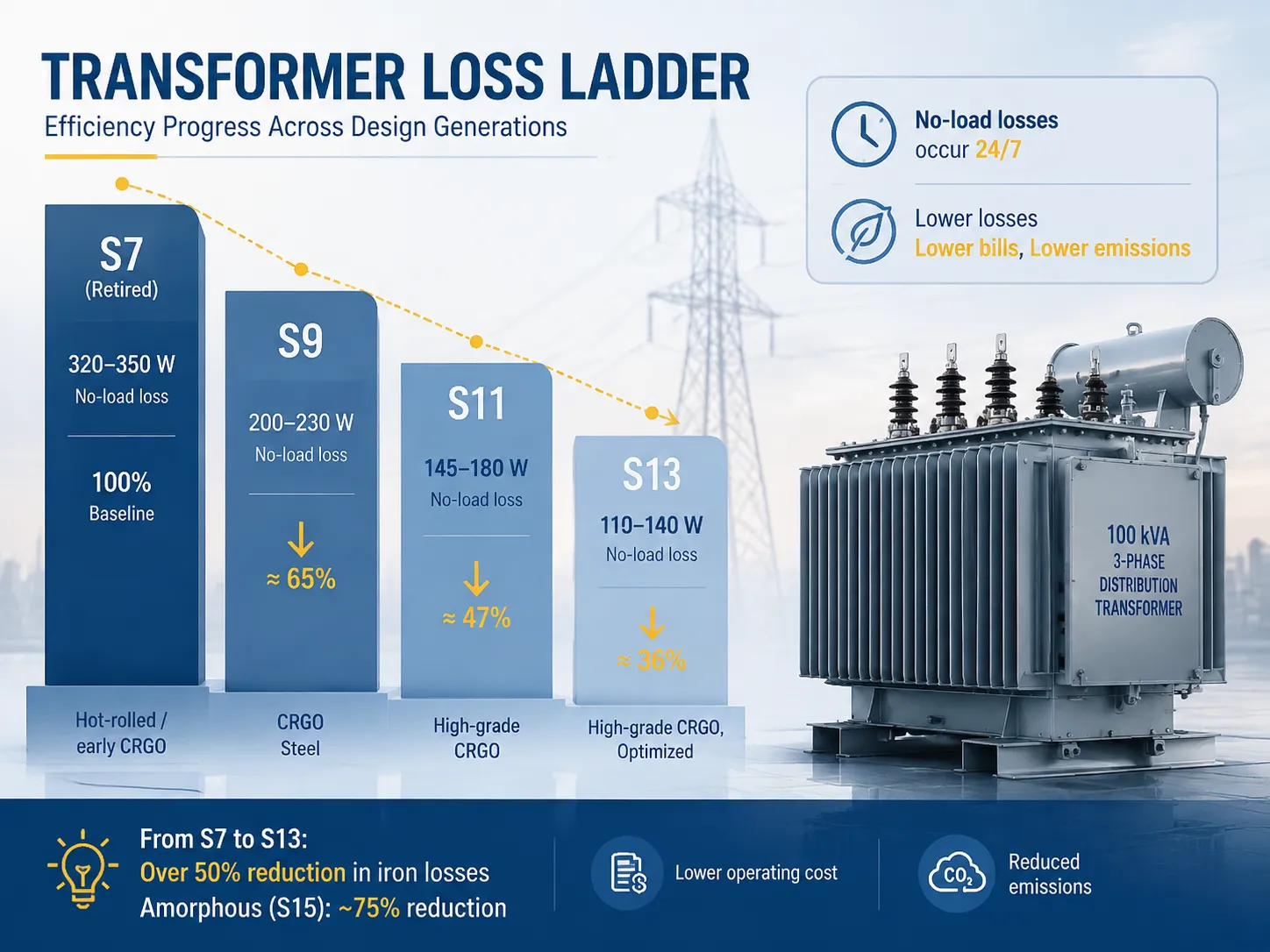
Níveis de Perda: S7 vs S9 vs S11 vs S13
O tema técnico chave relaciona-se ao conceito da escada de perdas. A tabela mostrada tem como objetivo comparar as perdas a vazio e as perdas sob carga do transformador de distribuição trifásico de 100 kVA em termos de gerações de design usando dados exemplares na literatura.
| Geração de design | Tipo de núcleo | Perda a vazio (100 kVA) | Perda sob carga @75°C | Perda relativa de ferro |
|---|---|---|---|---|
| S7 (descontinuado) | Aço laminado a quente / CRGO inicial | 320–350 W | ≈ 1.750–1.950 W | 100% (base) |
| S9 | Aço CRGO | 200–230 W | ≈ 1.500–1.650 W | ≈ 65% |
| S11 | CRGO de alta qualidade | 145–180 W | ≈ 1,400–1,550 W | ≈ 47% |
| S13 | High-grade CRGO, optimized | 110–140 W | ≈ 1,350–1,500 W | ≈ 36% |
| S15 (amorphous) | Amorphous metal ribbon | 70–90 W | ≈ 1,300–1,500 W | ≈ 24% |
As stated above, upgrading from S7 to S11 or S13 eliminates over half of the iron losses and changing to an amorphous core cuts the losses byaround 75%. Since no-load losses occur non-stop all day long, the differences immediately reflect in power bills and emissions.
GB 20052 Efficiency Grades Explained
China’s efficiency grading can be found in GB 20052, “Minimum allowable values of energy efficiency and energy efficiency grades of power transformers.” There are three possible grades in this standard:
- Grade 3 is the minimum energy efficiency; it is almost equal to the level of old S9/S11.
- Grade 2 is the energy saving level; it is approximately equal to S13 losses.
- Grade 1 is the maximum efficiency level; in fact, it has almost comparable performance to the use of the amorphous core (S15).
In 2020, GB 20052-2020 was amended such that the sale of transformers of lower than grade 3 was prohibited in China. It also demands that any new transformers bought for the grid should conform to grade 2 or more. The standard limits no-load loss for a 100 kVA transformer at 170 W for grade 3, 150 W for grade 2, and 120 W for grade 1 as against the S7’s 320-350 W.
| Efficiency grade | 100 kVA no-load loss cap | Roughly equivalent design | Status in China |
|---|---|---|---|
| Grade 3 (minimum) | ≈ 170 W | S11-class CRGO | Minimum allowable for sale |
| Grade 2 (energy-saving) | ≈ 150 W | S13-class CRGO | Required for grid-funded purchases |
| Grade 1 (highest) | ≈ 120 W | Amorphous core (S15-class) | Preferred under efficiency subsidies |
| S7 reference (retired) | 320–350 W | Aço laminado a quente / CRGO inicial | Phased out from grid service |
Across the globe, a similar notion is visible in the form of either the EU’s Ecodesign Regulation 548/2014 (as revised by 2019/1783) or the DOE 2016 standards set up by US authorities. For the purpose of ease of comparison of transformer prices across the globe, buyers should convert losses incurred into the same unit for accurate estimates, which is especially important since a unit with small purchase costs but high losses is hardly ever cheap enough over the course of 20 years.
The Operating-Cost Mathematics of an Old Transformer
Economics is not favorable in a case of S7. Let’s take a 100kVA transformer that has a modest average load of 40%, works for 8760 hours, and the energy cost is $0.10 per kWh.
| Cost item | S7 unit | S11 replacement | Annual difference |
|---|---|---|---|
| No-load energy (annual) | ≈ 3,066 kWh | ≈ 1,445 kWh | −1,621 kWh |
| Load energy (annual, 40% LF) | ≈ 2,805 kWh | ≈ 2,349 kWh | −456 kWh |
| Total energy cost / year | ≈ $587 | ≈ $379 | −$208 / year |
| Over 15 remaining years | — | — | ≈ $3,120 saved |
The discrepancy for one piece of equipment amounts to a few hundred dollars per year, which is not significant. However, if a company has around 10,000 outdated pieces of equipment, it ends up costing them more than $2 million per year in unnecessary costs associated with the electricity bill. This is why the Chinese power system abandoned the whole fleet of S7 units and why power regulators are tightening their policies constantly.
The second financial aspect is the problem of reliability. S7 units are from 30 to 40 years old now. The processes of wear and tear of insulation materials, oil, and gaskets cause the deterioration of units and reduce the remaining lifespan of the system. One mid-life distribution transformer will cost around $1000 to $3000 to repair and from $2000 to $6000 to replace.
What This Means for the Secondary Market
This is the trap for customers. The Chinese phase-out has resulted in the removal of S7/S8/S9 devices from the grid – all of which, in many cases, have appeared on the market under labels of “reconditioned” or “overhauled.” On initial inspection, the price seems attractive: a 100 kVA S7 could be priced from $400 to $900 compared to $1,400 to $2400 for a new S11-equivalent from China. However, one has to account for the costs below.
- Operational Problems: A used device can cause you an extra loss from $150 to $250 per annum compared to a new energy-efficient device.
- Useable Lifespan: A transformer 30 years old is estimated to last 5-15 years instead of 25-30.
- Obscure Condition: “Reconditioned” could mean anything from proper refurbishment to just repainting with new gaskets. In the absence of test findings and load history, the risk is unmeasurable.
- Nonstandard Status: S7 devices do not comply with current efficiency regulations, which can lead to a ban of reincorporation in regulated markets or fines.
Wise purchasers view reconditioned S7/S8 units as an emergency solution only and require that oil tests (dielectric, moisture, acidity), winding resistance, ratio, and megger tests be conducted prior to purchase, and set aside the funds for replacement within the following five years.
Replacement Options, Brands, and Prices
If you are intending to buy new transformers instead of S7 transformers, the question is which energy-efficient design you want to buy. Below is the table with indicative costs of a replacement 100 kVA three-phase transformer from different suppliers, quoted on a FOB basis.
| Brand / source | Design | 100 kVA price (FOB) | Perda em vazio | Observações |
|---|---|---|---|---|
| ABB | S11-class / custom | $4,200–$6,500 | ≈ 150–180 W | Premium brand, global service |
| Siemens | S11-class / custom | $4,000–$6,800 | ≈ 150–180 W | Strong utility track record |
| Schneider Electric | S11-class / custom | $3,800–$6,200 | ≈ 150–180 W | Integrated LV ecosystem |
| Hitachi Energy | S11-class / custom | $4,500–$7,000 | ≈ 150–180 W | Utility-grade reputation |
| Eaton | S11-class / custom | $3,500–$5,800 | ≈ 150–180 W | Americas distribution strength |
| TBEA / China XD | S13 / amorphous available | $1,700–$3,000 | ≈ 110–170 W | State-backed, volume manufacturing |
| Jiangsu Subian Electric Power | S11 / S13 / amorphous | $1,500–$2,600 | ≈ 110–180 W | Export-focused, IEC 60076 tested |
In projects where certification, local presence, and financing recognition are valued more than initial cost, international brands like ABB, Siemens, Schneider Electric, and Hitachi Energy would be the given option since their products equal or exceed the GR 20052 grade 2-3 standards and provide proper backing for this.
In the case of replacement programs where thousands of products will run, Jiangsu Subian Electrical Power would be a cost-effective solution. The company produces S11, S13, and amorphous-core transformers from 5 kVA to 2,500 kVA tested in accordance with IEC 60076 and GR 20052, and also applies conformity certificates to every transformer and optionally third-party review. Buying a brand-new energy-saving transformer at the factory price will usually cost less over its life cycle than buying a discounted S7 transformer that will incur losses for 10 years.
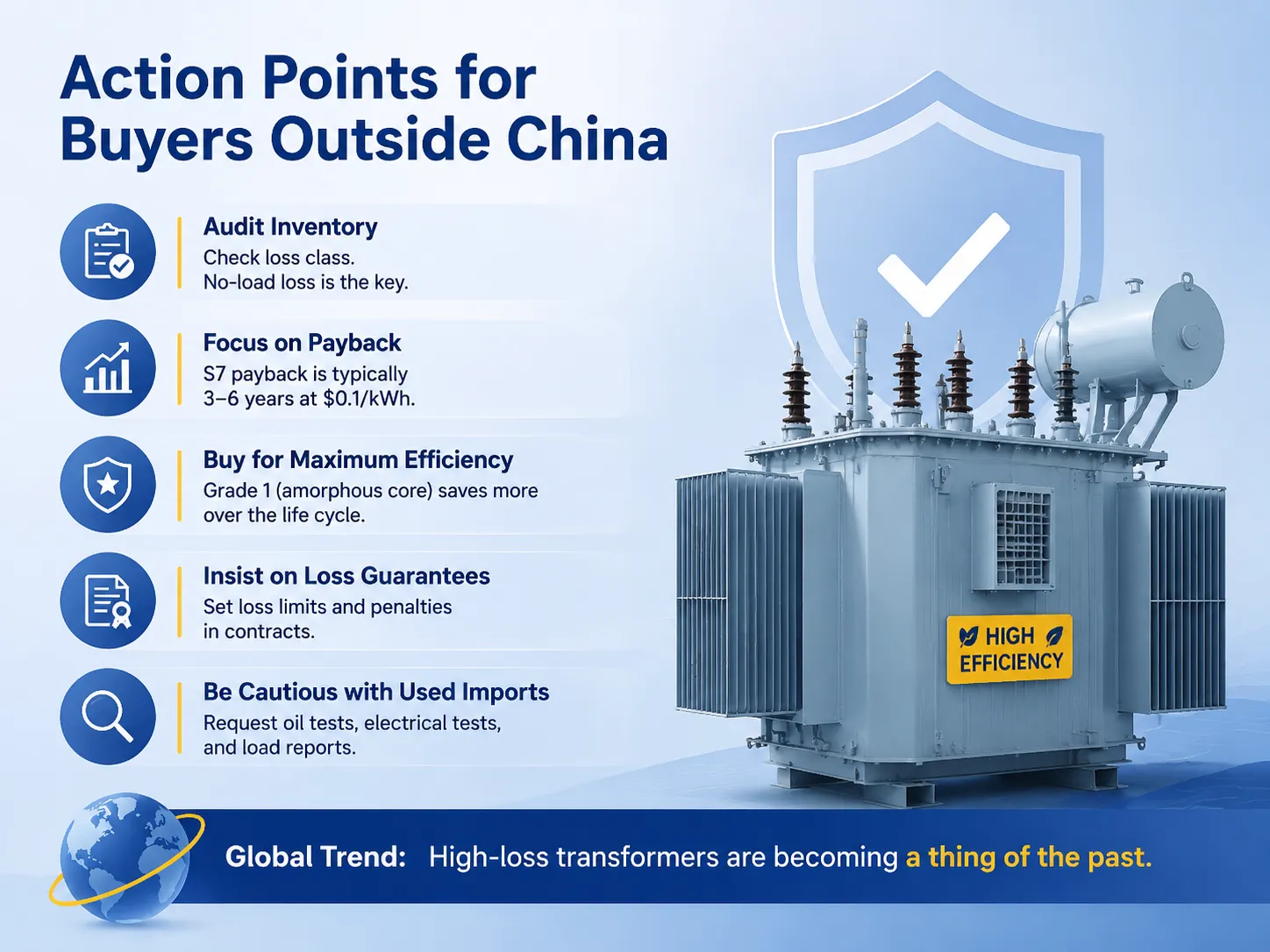
Action Points for Buyers Outside China
The Chinese decommissioning brings important lessons for any operator not using low-loss transformers:
- Audit your inventory according to loss class. The nameplate no-load loss is the best single indicator of replacement necessity.
- Look at the payback and not the price. Replacement payback for S7 transformer at $0.1/kWh is usually three to six years; payback period is smaller at higher electricity tariffs.
- Buy according to the maximum allowable efficiency standard. If amorphous core transformer (Grade 1) is only 15-25% more expensive than the S11 transformer, the savings during the life cycle warrant the investment.
- Insist on loss guarantees in contracts. By introducing no-load and load losses limits and penalties in the contracts you can protect your budget.
- Be very caution while buying imported used transformers. Ask for oil test results, electrical tests, and load reports.
Also remember that all major markets share the same trend – high-loss transformers are becoming a thing of the past.
Perguntas Frequentes
What is the difference between S7 and S9 transformers?
The S7 and S9 are two generations of distribution transformers that have been made in China. The S9 was developed around 1998. Although the materials used to build the S9 transformers include cold-rolled grain-oriented silicon steel and optimized geometry of the core, they still consume 30-40% less energy compared to the S7 transformers. Thus, a 100kVA transformer loses 200-230W of electricity instead of 320-350W consumed by the S7 transformer. In dollar terms, this translates into $60-$100 savings on electricity bills.
Can I still buy S7 transformers in China?
The introduction of S7 and other below-Grade-3 models is virtually prohibited under GB 20052-2020 in China, which has led the grid utilities to dispose of their fleets. S7 devices are still available on the secondary markets as used or “refurbished” devices at low prices. Unless you get an offer that is compelling enough as a temporary solution, the new S11/S13 machine priced between $1,500 and $2,600 (100 kVA, FOB China) is a better option.
Are S11 and S13 transformers worth the extra cost?
Generally speaking, yes. An S13 transformer will cost about 5-15% more than a similar S11 transformer and will reduce no-load losses by an additional 20-25%. Based on the assumption of 10 cents/kWh and 8760 hours of operation per year, there is a loss reduction of about 50-90 dollars a year for a 100 kVA transformer which gives a payback of 3-7 years and continues to save money for over 20 years. The higher the rates and utilization factors, the shorter the payback term.
What does GB 20052 mean for imported transformers?
GB 20052 defines the standards regarding the efficiency of transformers sold in and used within the borders of China. All transformers imported into China must comply with the minimum requirement of Grade 3, while the cases of grid-funded projects need compliance with Grade 2 or above. Apart from that, GB 20052 is still of use for foreign buyers as a reference point in terms of loss ratings of transformers produced in China.
How do I calculate the payback of replacing an old transformer?
Multiply the difference in no-load losses (kW) by 8,760 hours, add the difference in load losses multiplied by the square of the average load factor (example: 0.4² = 0.16 at 40% load) multiplied by 8,760 hours, and multiply the total by your tariff to compare the result with the replacement cost. Example: 0.13 kW lower no-load losses multiplied by 8,760 hours gives 1,139 kWh per year saving at $0.10 per kWh which corresponds to $114 per year saving — for replacing the appliance costing about $2,000 payback period due to losses accounts for 17 years of operation without maintenance and other benefits related to new appliances.
Referências
- National Development and Reform Commission (NDRC) — Issued China’s Transformer Energy Efficiency Improvement Plan (2015–2020).
- IEC — Publisher of IEC 60076, the international transformer testing standard used for replacement units.
- International Energy Agency (IEA) — Analysis of distribution transformer losses and efficiency policy worldwide.
- Departamento de Energia dos EUA — Distribution transformer efficiency standards and market impact assessments.
- European Commission — Ecodesign regulation 548/2014 and 2019/1783 for transformers.
- Energy Star — Reference for energy-efficiency benchmarking and savings calculators.
- Jiangsu Subian Electric Power — Manufacturer of S11, S13, and amorphous-core distribution transformers.
Conclusão
The fact that China decided to ban S7 and older transformer technologies has been based on pure numbers because a continuously operating transformer with high no-load losses incurs unnecessary costs and wasted energy all its life. As a result of this initiative, tens of millions of devices were decommissioned. Also, the efficiency rating employed in this approach (GB20052) is consistent with the EU Ecodesign requirements and the US DOE standards.
- Regard any S7 standard or inefficient transformer as an effective liability. Annual loss costs incurred by their operation do exist and remain constant.
- Usually, payback period for a unit replacement is between 3 and 6 years at average tariffs but can be shorter when the electricity cost is high.
- Choose only the most modern effective equipment available in the market and insert ceilings for losses in the contract. Be it ABB or Siemens or Schneider or Jiangsu Subian Electric
- Power, you will still have the benefit of using new highly efficient equipment instead of a discounted legacy device in its normal operating mode.