


A maintenance supervisor gazes at a smoking motor starter compartment on a production line operating non-stop. Fixed-mounted switchgear means “turn the whole board off for a few hours and pray the replacements are the same.” With modern low-voltage drawer-type switchgear, the answer is a three-minute replacement: remove the faulty drawer, put in a spare one and the production line is up and running even before the shift supervisor completes the report. This gap in operational efficiency is the exact reason why drawer-type MCCs have gone from luxury items to industry standard in continuous-process manufacturing.
The article describes the idea behind low-voltage drawer-type switchgear and its benefits: modular and removable units, standardized systems, smart monitoring, arc fault limiting, and shorter mean-time-to-repair (MTTR). You will learn about the difference between drawer units and fixed mount boards, what makes them more expensive, who the major players are, and how to choose the right equipment in order to really gain the advantage of the uptime and not just get a nice cabinet. The article provides pricing in realistic ranges for 2004 so that any quotation can be compared with the reality.
What is drawer-type switchgear?
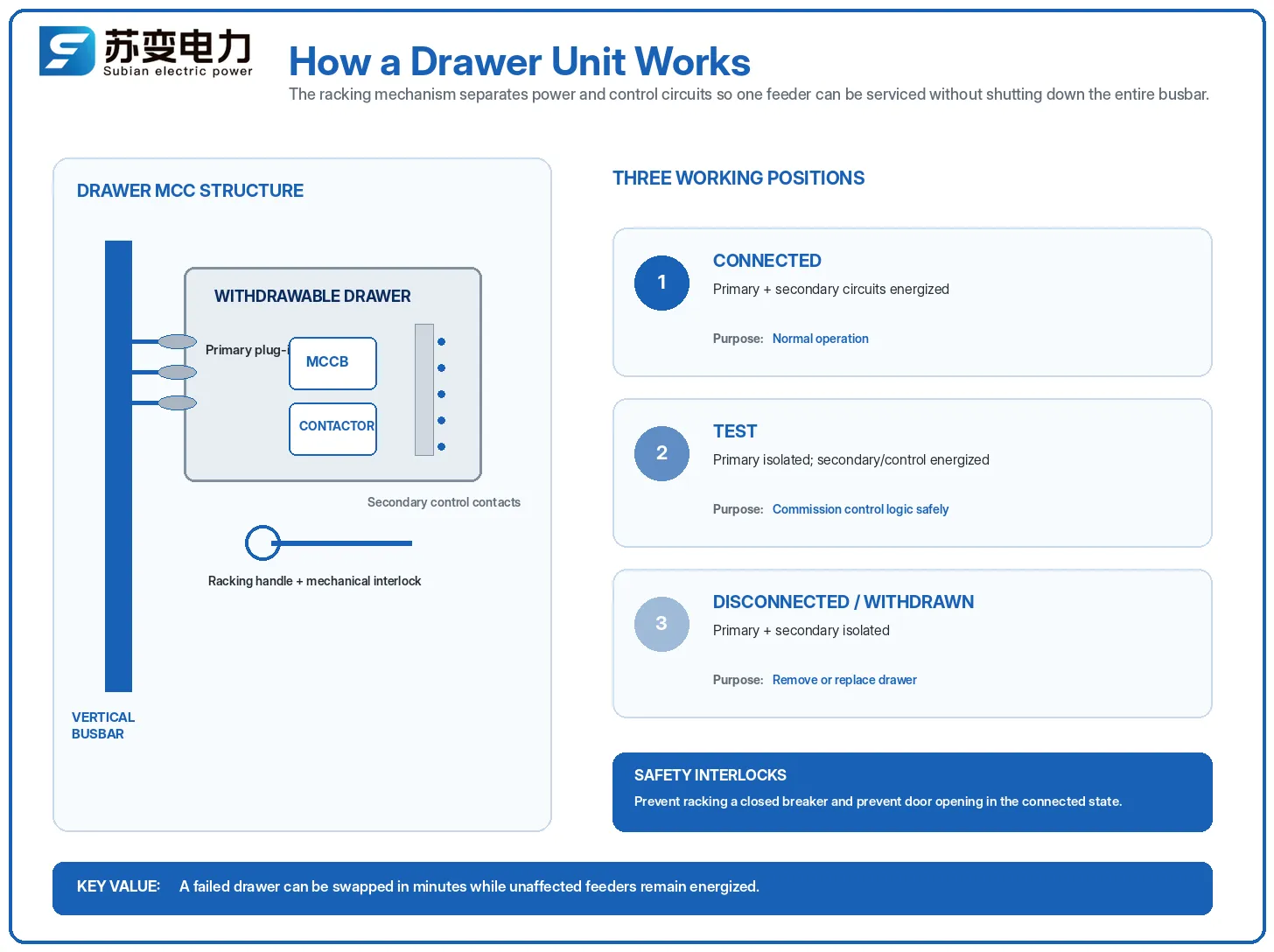
Low-voltage drawer-type switchgear is an infrastructure whereby every outgoing circuit uses a metal drawer that fits into the vertical busbar system via an racking arrangement. The drawer has the switch gear, the protection, the transformers for current, and control wiring for the circuit. As the drawer can be shifted into the “test” position, completely detached, and swapped without shutting down the circuit, operators can achieve a high level of convenience that is impossible with a switchgear that is fixed mounted.
The device is manufactured according to the same principles as all LV assembly varieties: the board has undergone quality verification corresponding to IEC 61439-2, the breakers, and contactors are according to IEC 60947, and the housing provides a Form 3b or 4b separation of circuits so the problem in one drawer does not flow into the other drawers. The equivalent category of products in North America is MCC that is manufactured according to UL 845, using the same principle of withdrawable units.
The drawer-type switchgear consists of three types: the fixed current draw types where the breaker moves, motor starter drawers that operate with contactor overload modules, and the VFD/soft-starter bays where the drawer is the operation area for the drive and its bypass. The system works in the majority of cases with the quick-disconnect interface: the electrical contacts, the guides, the device for racking and the test with disconnection stages.
How drawer units operate
Each drawer unit has a plug-in contact at the back of the drawer, which connects it to the vertical busbar and a secondary disconnecting contact allows connection with the control circuit. By turning the racking system’s handle, the drawer is moved to three operational positions which are the connected position when both primary and secondary circuits are powered, the test position when the secondary circuit is active, but the primary circuit is off so the control logic can be tested, and the withdrawn/disconnected mode in which the circuit is either off or disconnected.
Interlocks will not allow the operator racking the closed breaker into the position or opening the door when connected. Thanks to the mechanical locking system, drawer switchgear can be operated safely in a live busbar setting, which is one of the requirements for design verification under IEC 61439-2. Usually, isolating contacts are silver-plated and spring-loaded, and their capabilities are regulated so that they can withstand the normal working conditions of the drawer for 200-500 cycles before inspection is recommended.
The new design of the vertical busbar system for the modern MCC guarantees the correspondence with the recommended temperature limits, usually 105 K for busbars according to IEC 61439-1. The drawer makes use of the busbar with the multiple protection systems, which allows to trip only the respective drawer breaker in case fault in the cabling after one particular drawer occurs without shutting down the incoming ACB.
Innovations Driving the Category
In the past ten years, drawer MCC has integrated many technological changes:
Smart drawer monitoring. New drawers have found space for voltage transformers, temperature sensors, and communication modules like Modbus RTU/TCP and Profinet which allow control system to analyze motor current, thermal state, and life of contact without opening the drawer door.
Arc-fault containment. Internal arc classification introduced by IEC 61439-2 and IEC TR 61641 ensures that during an arc, energy is being removed from the drawer through special hatches and protecting the person who is installing the adjacent drawer.
Diminutive elements. Compact circuit breakers and contactors have permitted switchgear manufacturers to use more starters in one switchgear unit as the electrical equipment that required a 100 mm frame now takes up only 50 mm.
Unified modular platform. Maker’s companies produce drawer MCCs based on the system of components where all possibilities are guaranteed, which leads to shorter time of the engineering process.
Plug-in bays for variable frequency drives. There are quick-disconnect power and controlling plugs in VFD drawers instead of a wired drive, which allows the installation of a faulty drive within a few minutes and keeps the safety bypass switch in the same drawer.
These innovations change the value calculation. Drawer MCC still costs more than traditional boards per feeder, but the process of analyzing the monitoring data and fast replacement will make a difference in budgeting and maintenance expenditure.
Application Value: Downtime, Safety, Flexibility
The business case for drawer type switchgear rests on four measurable values:
| Value Driver | Drawer-Type MCC | Fixed-Mounted Board |
|---|---|---|
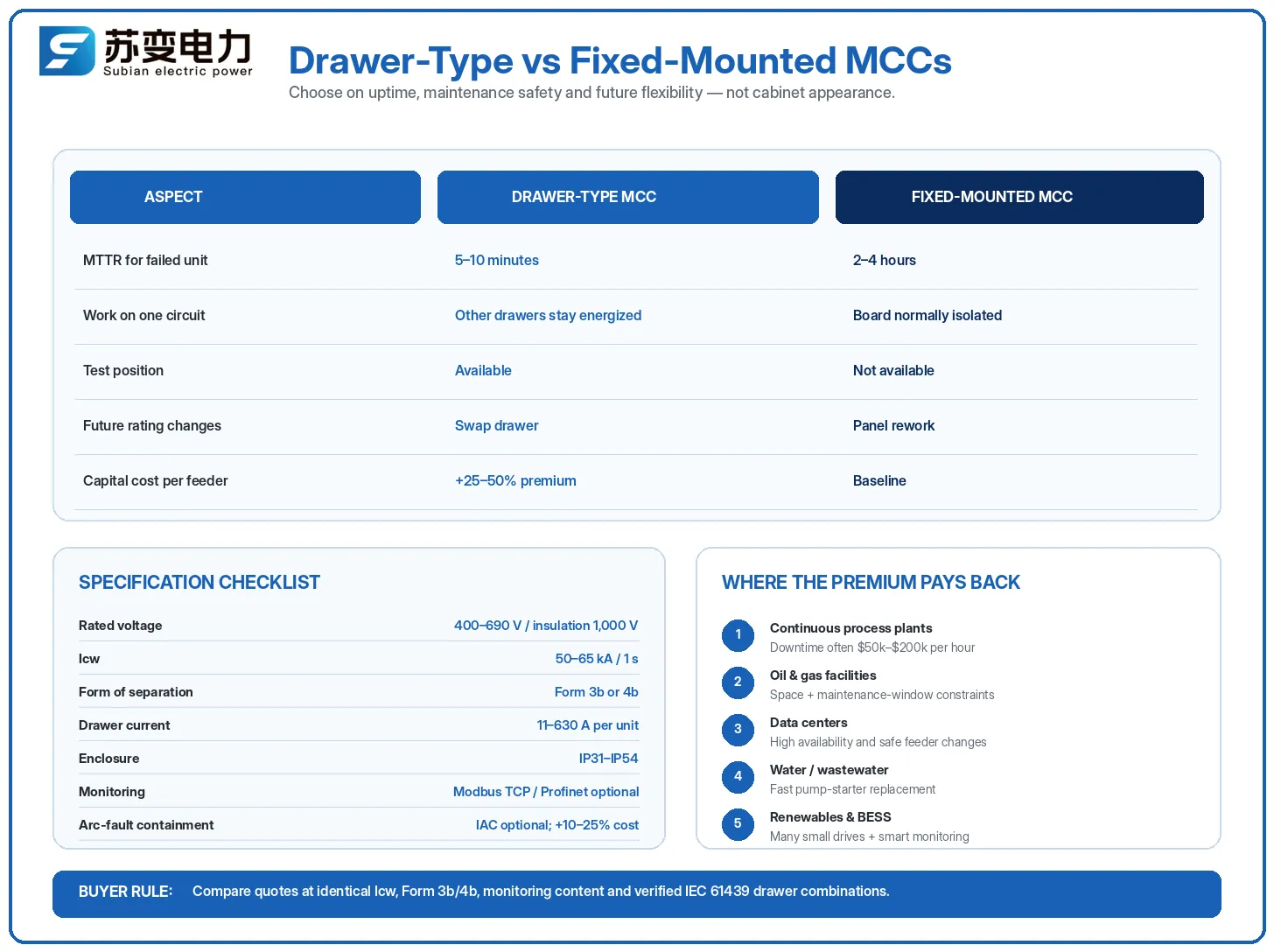
| MTTR for a failed unit | 5-10 minutes (spare drawer swap) | 2-4 hours (de-energize, rewire) |
| Work on one circuit live | Yes, other drawers stay energized | No, board must be isolated |
| Test position for commissioning | Full control-logic testing without power | Not available |
| Future load changes | Swap drawer rating without rework | Panel rewiring required |
| Capital cost per feeder | +25-50% vs fixed | Baseline |
For industries experiencing losses in the range of $50,000-$200,000 each hour of downtime, the savings attributed to 10 minutes vs. 3 hours of repair time can often cover the initial extra cost of a device. For safety purposes, the test position and racking interlocks prevent both of the major causes of arc flash accidents related to MCC: testing while the power is on, and opening compartments while under load.
Drawer-Type vs. Fixed-Mounted MCCs
Choosing between the two is not about which is “better,” but about which matches your operation. The comparison below summarizes the trade-offs.
| Aspect | Drawer-Type MCC | Fixed-Mounted MCC |
|---|---|---|
| Cost per feeder | $600-$3,000 | $400-$1,800 |
| Downtime per unit fault | 10-30 minutes | 2-6 hours |
| Safety of maintenance | High (interlocks, test position) | Moderate (full isolation needed) |
| Space efficiency | Higher (compact modules) | Lower |
| Flexibility to change ratings | High | Low |
| Spare parts management | Stock one spare per drawer type | Stock per-unit components |
A pragmatic rule: if your plant has more than 10 motors above 11 kW, runs continuous shifts, or has a single-digit-minute cost of downtime, drawer-type is the defensible choice. For small buildings, pumps, and low-duty circuits with plenty of scheduled outage windows, a fixed board saves 25-35% and is entirely adequate.
Drawer MCC Specifications
Here is the specification sheet you should standardize when comparing drawer MCC quotations:
| Parameter | Typical Value | Drives Cost? |
|---|---|---|
| Rated voltage / insulation voltage | 400-690 V / 1,000 V | Minor |
| Short-circuit withstand (Icw) | 50-65 kA / 1 s | Major |
| Form of separation | 3b or 4b | Major |
| Drawer ratings | 11-630 A per unit | Per-feeder cost |
| Racking positions | Connected / test / disconnected | Standard |
| Enclosure IP | IP31-IP54 | +5-15% |
| Monitoring / comms | Modbus TCP or Profinet | +5-15% |
| IAC arc-fault rating | Optional, 0.3-1 s | +10-25% |
Ask specifically for the type test certificate covering the exact drawer combination you intend to buy. Under IEC 61439, substituting a non-verified drawer type invalidates the assembly verification, so a supplier that freely “mixes and matches” is signaling either ignorance of the standard or an intent to skip testing.
Where Drawer MCCs Deliver the Most Value
The advanced switchgear system is useful in four application sectors:
Continuous applications – chemical, pharmaceutical, food, pulp, cement, among others where if one starter fails all operation comes to a standstill. In practice, the number of starter drawers varies from 30 to 200.
Oil and gas applications – offshore facilities and terminals where accommodation space is limited and maintenance works depend on climatic conditions, while drawer monitoring is integrated into the asset management system.
Data centers – low-voltage recognition, current monitoring, and uninterrupted availability; drawer design allows for distribution of load banks and uninterrupted operation of backup systems.
Water and waste projects – pumping stations, where reserves of drawers stand ready for immediate replacement in storms, and testing positions are used prior to the season.
Renewables and energy storage plants – auxiliary power and photovoltaic control stations where the total number of small drives is large and a low-light or wind situation is of little importance.
Top Brands & Price Ranges
The drawer MCC market is led by the same global names that dominate all low-voltage switchgear, with price positioning that reflects engineering support depth and brand premium.
| Brand | Product Line | Positioning | Price per 20-Feeder MCC |
|---|---|---|---|
| ABB | MNS-MCC | Premium | $25,000-$60,000 |
| Siemens | Sivacon S8 MCC | Premium | $25,000-$60,000 |
| Schneider Electric | TeSys / Blokset MCC | Premium | $22,000-$55,000 |
| Eaton | xEnergy MCC | Mid-high | $18,000-$45,000 |
| LS Electric | Susol MCC | Mid | $15,000-$35,000 |
| Chint Electric | NMNS drawer system | Mid | $14,000-$32,000 |
| Jiangsu Subian Electric Power | Drawer LV MCC packages | Competitive | $12,000-$28,000 |
Dwelling on foreign firms that have helped set the standards of type-testing records, arc-fault ratings, and international support infrastructure, we have ABB, Siemens, and Schneider, which are quite reliable for critical infrastructure installations. As for Eaton and LS Electric, they can be regarded as good average players with good value for money in the middle of the market. The customers who are interested in buying drawer MCC along with an upstream transformer from one entity should know that Jiangsu Subian Electric Power is engaged in the manufacturing of drawer MCCs that comply with IEC 61439 together with its IEC 60076-certified transformers, which is a good option for those projects where interface coordination is a bigger factor than the cost of components.
How to Choose and Specify a Drawer MCC
In this sequence, it is necessary to determine the specifications for a drawer MCC that is able to provide its promised benefits:
1. List every motor and feeder with its rated current, starting method (direct online, star-delta, soft starter, variable frequency drive), and importance. This allows to interpret the composition of the drawer and the required number of cabinets.
2. Make sure to check the fault level at the board; the impedance of a transformer of 1,000 kVA means approximately 29 kA; so, the Icw should be calculated with some reserves of 50 kA, or even 65 kA if the network is stiff.
3.Determine the separation form. Form 3b should be chosen as the minimum for industrial purposes, while Form 4b is used only if unit terminals must be divided for safety purposes.
4.Decide on the type of monitoring – basic (breaker status and current) if you don’t have any asset management team to use the received data, or advanced (power quality, thermal imaging) if such team is available.
5.Define the strategy for spare drawers – one spare drawer of each popular type should be prepared and maintained with plug-in contacts so that MTTR would amount to a few minutes.
6.Ask for type test dossier for all drawers you need and factory acceptance test you can attend.
7. Discuss the specification, not the heading and compare prices based on feeder price by taking the same Icw, form and monitoring contents into consideration.
Installation & Maintenance Best Practices
Even the best drawer MCC fails fast if installed or maintained carelessly:
| Activity | Frequency | What to Check |
|---|---|---|
| Drawer racking test | At commissioning | Full travel, interlock function, contact alignment |
| Contact temperature scan | Every 6 months | IR scan of plug-in contacts at full load |
| Torque check on busbar joints | Annually | Retorque to spec, check for discoloration |
| Drawer operation count | Per maintenance log | Replace isolating contacts after 200-500 cycles |
| Arc-fault flaps / vents | Annually | Flaps free, no blockage, labels intact |
Document the racking procedure and keep one maintenance technician trained on every drawer type. The greatest hidden cost of drawer switchgear is not the hardware but the operations team that never learned to use the test position or to swap a spare correctly.
Frequently Asked Questions
How much does a drawer-type MCC cost per feeder?
A basic motor starter drawer runs $300-$900, a breaker feeder drawer $500-$1,500, and a VFD or soft-starter bay $2,000-$6,000. A complete 20-feeder MCC cabinet typically lands between $15,000 and $60,000 depending on Icw rating (50-65 kA), form of separation (3b or 4b), and whether monitoring and arc-fault containment are included.
What is the main advantage of drawer switchgear over fixed-mounted?
The decisive advantage is mean time to repair. A failed unit swaps out in 5-10 minutes with the busbar live, versus 2-4 hours to de-energize and rewire a fixed board. The test position also lets you commission control logic without energizing the power circuit, which removes a leading cause of arc-flash incidents. The trade-off is a 25-50% capital premium per feeder.
Is drawer switchgear compliant with IEC 61439?
Yes, provided the assembly and each drawer combination are design-verified to IEC 61439-2, with components certified to IEC 60947. The type test must cover the exact drawer types, busbar rating, and Icw. Ask the supplier for the accredited type test report before ordering; “certified components” alone is not enough, because the assembly itself is the tested product.
Can a drawer MCC handle VFDs and soft starters?
Yes. Modern drawer systems offer plug-in VFD bays where the drive, bypass contactor, and protection sit in one drawer with quick-disconnect power and control plugs. Ratings typically cover 0.75-160 kW per drawer, and the drive’s heat must be accounted for in the enclosure thermal design, so specify the ventilation class correctly.
What maintenance do drawer units need?
Six-monthly thermal scanning of plug-in contacts, annual torque checks on busbar joints, and replacement of isolating contacts after roughly 200-500 racking operations. Arc-fault flaps and vents should be checked annually for free movement. With this regimen, drawer contacts typically last 10-15 years without significant wear.
References
- IEC 61439-1 and IEC 61439-2 – General rules and requirements for power switchgear and controlgear assemblies, including design verification of drawer-type units.
- IEC 60947 series – Component standards for the breakers, contactors, and switches installed in drawer units.
- IEC TR 61641: Enclosed low-voltage switchgear assemblies under conditions of internal arcing – The test method for arc-fault containment performance.
- UL 845: Motor Control Centers – The North American standard governing withdrawable-unit MCCs.
- NFPA 70E – Electrical safety standard covering arc-flash risk and safe work on energized equipment.
- NEMA – Application guidance for motor control and LV distribution equipment.
- Jiangsu Subian Electric Power – Supplier of IEC 61439 drawer-type LV switchgear and IEC 60076-certified transformers for integrated power packages.
Conclusion
The low-voltage type drawer switchgear can reduce downtime which now takes hours to just a matter of minutes. The device contains the arc fault and allows the operator to test in a safe manner that is impossible to do with the fixed boards. The cost for the device is from 25 to 50 percent higher as compared to other types but for facilities with continuous production, data centers or any other sites where the time of production is more valuable than the price, it is still the best option. Make sure that you consider the IEC 61439-2 test for drawer and make sure that your specification meets the requirements of the standard.
Jiangsu Subian Electric Power can provide fully proved IEC 61439 drawer together with the transformer for the overall project if you are in the process of evaluation of the drawer MCCs for your industrial or infrastructure project.