


As the project director for an EPC firm, you have landed a EPC contract for a 100 MW solar and storage project in the Gansu province. However, the technical review team from the owner has raised a crucial issue regarding the height of the site (1800 m) which has extreme seasonal variations from -25 degrees Centigrade to +45 degrees Centigrade. In addition, the grid connection code states that the station should be able to withstand voltage dips as low as 20% of nominal for 625 ms. Your transformer supplier who has a long-standing association of ten years with you has provided you with a standard quote for a 35 kV box-type transformer; however, the project engineer has also mentioned that the design of the transformer is modern and is suitable for a normal grid environment and not for an area at such heights.
Thus, this is precisely the subject this article has taken up. It deals with how the design and use of transformers differ when they are used for renewable energy projects from conventional grid applications.
Quick Answer: A renewable energy transformer is an ordinary transformer used in western power stations that are improved to be used in solar/wind/storage plants. The main improvements are: derating for elevations higher than 1,000m, harmonic windings for inverter power, bi-directional capability for storage loading, and larger temperature range.
Why New Energy Scenarios Stress Transformers Differently
New energy facilities put transformers in circumstances that grid-following distribution transformers were never designed for. There are four physical differences that lead to the majority of transformations:
| Stress Factor | Conventional Grid Duty | Renewable Plant Duty | Consequence |
|---|---|---|---|
| Load direction | One-way, utility to consumer | Bidirectional (charging/discharging, export/import) | Tap changer and winding design must handle reverse flow |
| Load shape | Predictable daily curve | Variable with weather; rapid ramps of 50–80% in minutes | Higher cyclic and thermal stress on windings |
| Waveform | Near-sinusoidal | Distorted by inverter harmonics (3rd–50th order) | Additional heating; need harmonic-rated core and windings |
| Environment | Often temperate, sheltered | High altitude, desert heat, coastal salt, cold extremes | Derating and material selection changes |
As for an EPC or plant owner, the outcome is straightforward: you cannot use a transformer intended for urban distribution in a 100 MW inverter station without re-specifying at least five parameters such as altitude adjustment, winding temperature margin, tap range, harmonic capability and enclosure protection. Any unacceptable parameters will become apparent afterwards through premature aging, annoying trips or warranty failure.
Key Transformer Adaptations for Renewable Plants
The five modifications listed below are the heart of any specification for a new energy transformer. All have an established engineering basis and a quantitative cost.
| Adaptation | Engineering Basis | Typical Impact | Cost Premium |
|---|---|---|---|
| High-altitude derating | Lower air density reduces cooling; IEC 60076-1 recommends derating above 1,000 m | −1.0% rated power per 100 m above 1,000 m, or re-design cooling | $800–$3,500 |
| Harmonic-rated windings | Inverter harmonics add eddy-current losses | Specify K-factor or non-sinusoidal load capability | $1,000–$4,000 |
| Wider ambient range | −25 °C to +45 °C swings common at renewable sites | Special oil, low-temperature materials, wider design margins | $500–$2,000 |
| Bidirectional design | Storage and some solar operate in both quadrants | Symmetric winding design, OLTC suited to reverse flow | $1,500–$5,000 |
| Enhanced protection & monitoring | Remote sites, low staffing, harsh weather | IP55 enclosures, online monitoring, DGA-ready | $1,000–$4,000 |
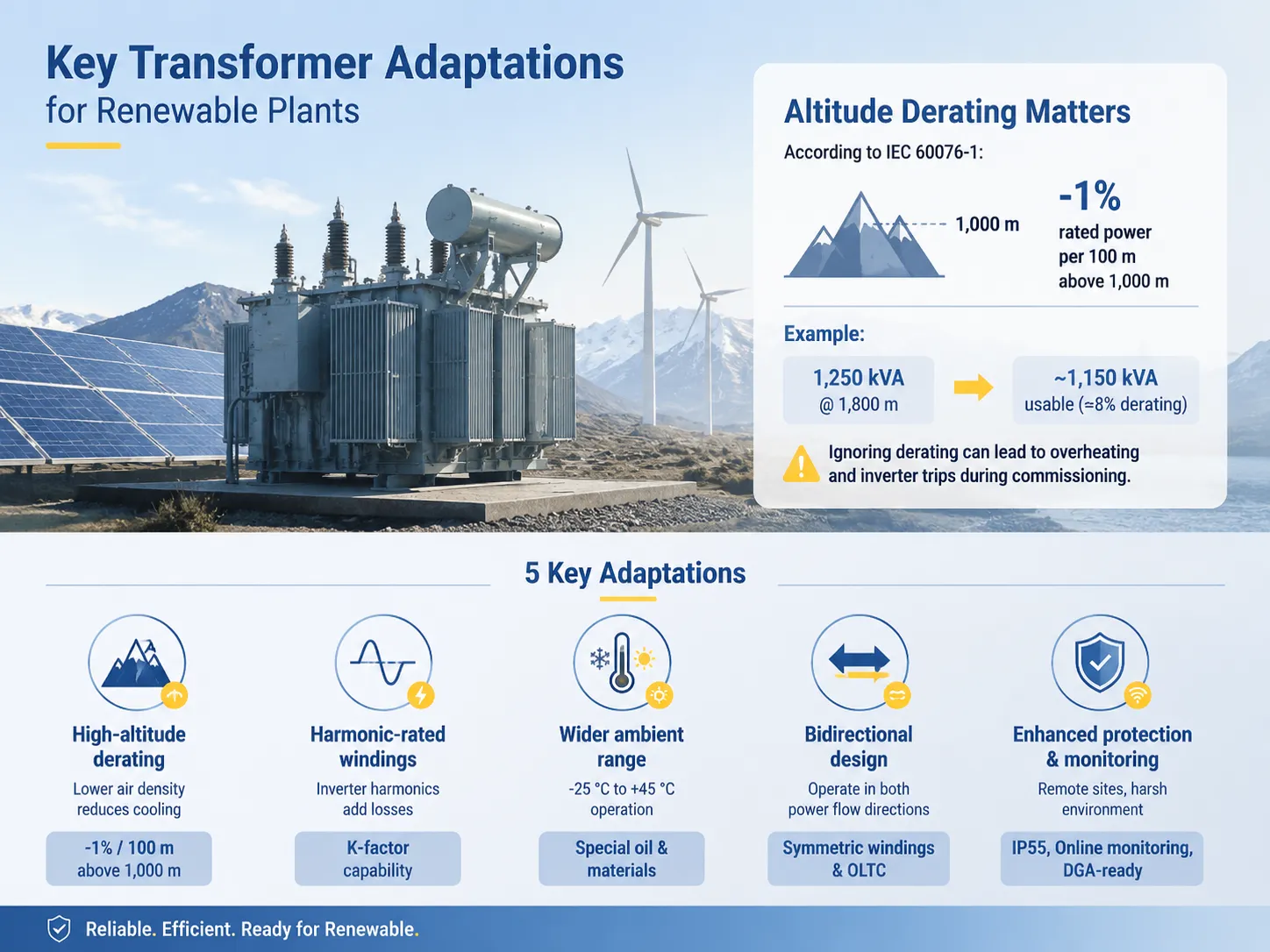
It is important to point out that altitude derating is often misunderstood. According to IEC 60076-1, if a rated power output should be derated by 1% for every 100 m over 1,000 m, then the cooling system must also be enhanced. As a result of these two aspects, for example, a machine rated at 1,250 kVA at an altitude of 1,800 can operate at around 1,150 kVA or suffer 8% deration, which is something that EPC companies often fail to take into account until commissioning and the inverter string trips because of overheating occur.
Solar PV Applications
A different kind of transformer design is present in solar power stations. As for the majority of commercial power generation systems, the electrical energy switches from direct current (DC) to alternating current (AC) inverters. After this, the transformer simply increases the AC electricity received by the collection and distribution system.There are two common approaches to transformer construction and usage in solar power plants:
- Centralized transformers: in this case, the transformer serves only one or two larger power sources, connecting them to the electricity collection and distribution system in the medium voltage area.
- String/block transformer: smaller power transformers are included into ready units with inverters, meaning that each inverter unit has its own power transformer.
A typical 100 MW solar energy project has 30-40 transformers of 3150 keys delivering their power. To sum up, here are the main characteristics of transformers for solar energy projects:
- The ability to endure harmonics. Most solar inverters generate non-sinusoidal current characterized by the 11th, 13th, and 23rd-25th harmonics, so transformers should withstand the influence of these harmonics.
- The capability to adjust to voltage fluctuations. During the passage of clouds, the ramp rates equal 30-60% of the rating of the power plant and happen during 1-2 minutes, and transformers and their introducers should be able to suffer from various changes in load.
- Outdoor usability. This means that if the solar plant is situated in the desert, the transportation unit must have IP55 or better material, UV-resistant color, and oil class of at least 100 degrees being used if the temperature exceeds this value.
The cost of solar transformers shows where a 1000 kW transformer of 35/0.4 kW cost lies within $9000-$18000 and a transformer with 3150 volts goes up to $50000.
Wind Farm Applications
In the renewable sector, it is only the wind turbine that has the heaviest transformer responsibilities due to three reasons. One, wind turbine transformers (which are generally in the range of 1,000-4,500 kVA, 35 kV/0.69 kV) are located in a compact nacelle or tower base containing less cooling. Two, wind yield varies very quickly, with a wind gust causing a spontaneous drop of 20-40% within a few seconds. Three, the offshore sector is dictated by salt air, vibrations, and poor accessibility.
| Wind Application | Rating | Special Requirements | Typical Price (USD) |
|---|---|---|---|
| Onshore turbine tower transformer | 1,000–2,500 kVA | Compact size, vibration resistance, IP54+ | $10,000–$22,000 |
| Offshore turbine transformer | 1,600–4,500 kVA | Corrosion protection, sealed tank, high reliability | $28,000–$65,000 |
| Wind farm substation transformer | 10–60 MVA | OLTC, DGA monitoring, grid code compliance | $120,000–$500,000 |
Compliance with the grid code is a vital prerequisite for Wind Transformers: many operators in Europe and Asia require LVRT (low-voltage ride-through) and FRT (fault ride-through) characteristics up to 0-20% of the nominal voltage for a period of 150-625 ms, during which time the device must remain operational without tripping any of the protective equipment or suffering damage to the winding. Such capabilities are more related to insulation and thermal design requirements, therefore they need to be clearly specified in the tender instead of being assumed.
Energy Storage Applications
Battery energy storage systems (BESS), which are expanding quickly in the transformer industry, require the transformers to be applied in a completely different manner by means of genuine bidirectional functionality. Power is poured into the storage system when the battery is charged, whereas it is transferred back when the battery discharges.The following practical characteristics should be taken into account:
- Winding symmetry: The transformer must have windings and taps capable of receiving or emitting power.
- Rapid switching: A battery storage unit may be fully charged and then fully discharged several times a day. Therefore, it is important for the transformer to be capable of withstanding cyclic loading and not producing significant partial discharges.
- Fire safety: Many of BESS specifications include the requirement of flameproof design and improved containment, hence sway towards use of dry-type transformers again running up the costs.
As an example, three to six 25–40 MVA transformers may be used at the interconnection point for a standard 2h 100 MW/200 MWh BESS. In addition to that, it uses 1,250–3,150 kVA container transformers for PCS. The prices may vary in the range of $12,000–35,000 for transformer containers and $150,000–450,000 for medium voltage transformers depending on whether they include OLTC and DGA monitoring.
Hybrid Solar-Storage-Wind Systems
In hybrid power plants, the ability of the transformer to adapt to changing situations can be best appreciated. A hybrid unit of generation merges the technology for solar, battery energy storage systems, and sometimes wind generation under one interconnection, meaning that operators can smooth out the generation profile, move around the energy and give auxiliary services. The transformer sees a combined generation profile, consisting of a solar bell curve during the day, fast variations brought by storage, and uncertainty caused by wind. It is recommended that the following points be considered when planning the operation of hybrid units:
- Choose the transformer size based on the highest possible combined output rather than the total nameplate capacities of the components, which is normally around 80-95% of the overall inverter capacity.
- Use OLTC technology in situations when the grid weaknesses lead to volatility of the voltage level and require reactive power.
- Make DGA and temperature monitoring mandatory, since hybrid cycling has an adverse effect on insulation.
- Choose the loss test appropriate for the hybrid cycle rather than flat 100% load, as the actual load factor in practice is 25-45%.
It is useful to mention that hybrid plant transformers are often designed with 10-15% higher capacity compared to transformers needed for a single-source plant of similar inverter capacity because the output patterns are overlapped and cause more peak currents through the windings.
Standards and Design Codes
A new energy transformer tender should reference these standards so that adaptations are verifiable, not just asserted:
| Standard | Relevance to New Energy Duty |
|---|---|
| IEC 60076-1 | General requirements; defines altitude derating and non-sinusoidal load rules |
| IEC 60076-11 | Dry-type transformers; fire safety for BESS containers |
| IEEE C57.12.90 | Test code for distribution and power transformers used in commissioning |
| IEC 62271-202 | Prefabricated (box-type) transformer substations common in solar plants |
| IEEE 1547 | Interconnection of distributed resources; inverter-based DER behavior |
| IEC 60068 | Environmental testing for altitude, humidity, and temperature extremes |
Two of these rules demand special consideration. Specifically, the importance of IEC 60076-1 lies in its provision of the altitude correction formula and the guidance on non-sinusoidal load which are paramount to the specification of every renewable transformer. Also, IEC 62271-202 stipulates requirements for the prefabricated construction within which the majority of solar power and several storage transformers are delivered.
Specification Checklist
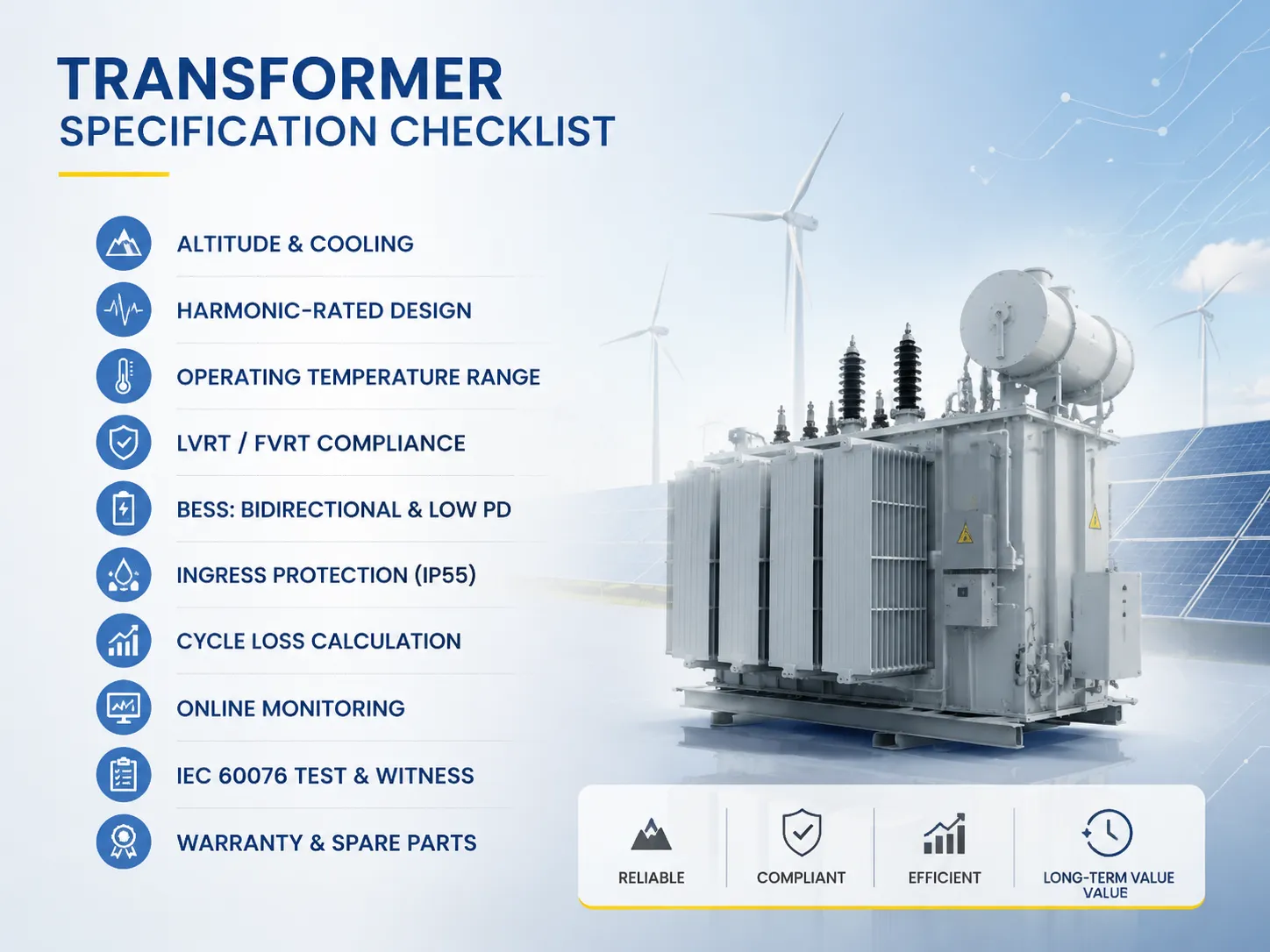
When drafting the transformer tender for any renewable energy project, keep this checklist in mind:
- Indicate the altitude of the site and require the manufacturer to use IEC 60076-1 altitude de-rating or to improve the cooling.
- Provide the harmonic spectrum from the inverter (or indicate the expected THD) and require harmonic-rated winding design.
- Indicate the range of the ambient temperature based on the historical data from the site and not on the national average.
- Require compliance with LVRT/FVRT grid codes for the appropriate interconnection point.
- For the BESS, require clear bidirectional rating plus low partial discharge (< 10 pC for the dry-type units).
- Require either IP55 (for outdoor usage) or required ingress protection and UV protective coverings.
- Request for a cycle loss calculation with the actual dispatch profile of the plant.
- Ensure online monitoring is in place (DGA for transformer filled with oil and temperature for all).
- Inquire about the existing test certificate according to IEC 60076 and also about possibility to witness factory test.
- Require a warranty for the transformer of at least 5 years with the spare part price list.
Top Brands & Price Comparison
The renewable transformer market is being dominated by big players from all around the world as well as increasingly present certified manufacturers from China. The chart shows representative costs of solar transformers for a capacity of 1,250 kVA, 35 kV/0.4 kV class, adapted to altitude and harmonics, while real prices depend on altitude, harmonics, brand name, and order size.
| Brand | Country | Renewable Portfolio Strength | Indicative Price (USD) |
|---|---|---|---|
| Hitachi Energy | Japan/Switzerland | Large wind and solar power transformers, strong grid code expertise | $14,000–$26,000 |
| Siemens | Germany | EnergyIP monitoring, hybrid plant references | $13,000–$25,000 |
| ABB | Switzerland | Broad inverter-to-transformer integration portfolio | $13,000–$24,000 |
| Schneider Electric | France | Box-type and dry-type strength for BESS containers | $12,000–$23,000 |
| Prolec GE / GE Vernova | USA | Utility-scale solar and wind references in the Americas | $13,000–$27,000 |
| Jiangsu Subian Electric Power | China | IEC 60076-tested units with altitude, harmonic, and box-type options | $9,000–$18,000 |
Well-established international corporations offer advanced grid-code engineering, years of meaningful project accomplishments, and international service processes. This combination means that even for high-profile offshore wind or big utility projects, their experience and local presence could easily help to price them higher. However, Jiangsu Subian Electric Power is strong in the middle-scale premium solar and storage segment. The company produces IEC60076-compliant transformers that meet the specifics of the project (i.e. height, harmonics, and environment) at prices equal to about 45 to 60% of similar European or American products. In practice, engineering companies that buy 30-40 transformers for a single 100 MW installation are happy with their local partner’s OEM/ODM flexibility (the provider manufactures according to the customized specification) and the opportunity to see tests conducted at the factory before shipping.
Frequently Asked Questions
Why do transformers need special design for high-altitude solar plants?
At high altitudes, air loses its density; therefore, natural cooling becomes less effective. According to IEC 60076-1, the output must be reduced by 1% for every 100 meters above 1000 meters unless the cooling system is modified. A 1250 kVA rating of the transformer will be about 1150 kVA at 1800 meters, which equals about an 8% reduction in power without redesigning the transformer. A bigger cooling system or a higher-rated transformer must be used. This will cost $800 to $3,500 more.
How much more does a renewable-rated transformer cost than a standard one?
When it comes to a 1,250 kVA unit, the total cost of the combined premium paid to adapt for various factors such as altitude, harmonics, large ambient range, and monitoring is usually around $1,500–$6,000, or 10–20% more than what is charged for a normal transformer. Basically, the total cost of the adapted unit ranges somewhere between $9,000-$28,000, depending on the manufacturing specifications and brand. It is wise to include these requirements in the tenders because this is the most economical way of purchasing transformers needed.
What is the difference between a solar transformer and a normal distribution transformer?
Solar transformer design and construction is for inverter output power. It has windings rated for harmonics (especially the 11th, 13th, 23rd to 25th harmonics) and ample ambient conditions including typically IP55 outdoor construction and ability to meet the grid codes of the facilities including LVRT. In contrast, a regular distribution transformer is designed for oneway nearly sinusoidal loads and must operate in a relatively stable environment.
How long do renewable plant transformers actually last?
Units that have been properly defined can function for 20 to 30 years. Units that are selected without altitude and harmonic adjustments in extreme environments can fail after four to six years due to insulation wear caused by harmonic heating or excessive temperatures at high altitudes. The condition of the units can be largely established before they are dispatched from the manufacturer, because this is determined by the specification, not by the maintenance team.
Do I need OLTC for a solar or storage plant transformer?
The fixed taps at around ±2.5% seem to work efficiently in case of a strong grid. However, if the grid is weak, OLTC (an additional expense of $6,000 — $18,000) is warranted when the generator needs to provide reactive power or the voltage at the delivery point changes by more than ±5% during the day, which is becoming more common with hybrid and battery projects.
References
- IEC 60076-1 — Power transformers: General — the authoritative source for altitude derating and non-sinusoidal load rules used throughout this article.
- IEC 60076-11 — Dry-type power transformers — design and fire-safety requirements relevant to BESS container transformers.
- IEEE C57.12.90 — Standard Test Code for Liquid-Immersed Distribution, Power, and Regulating Transformers — commissioning and test procedures referenced in renewable tenders.
- IEC 62271-202 — High-voltage switchgear: Prefabricated transformer substations — governs the box-type substation enclosures used in solar plants.
- IEEE 1547 — Standard for Interconnection of Distributed Energy Resources — inverter-based DER interconnection behavior including voltage ride-through.
- IRENA — International Renewable Energy Agency — publishes renewable capacity statistics and technology cost benchmarks used in project economics.
- Jiangsu Subian Electric Power — official site — manufacturer of IEC 60076-compliant transformers with altitude, harmonic, and renewable-duty options.
Conclusion
The reason why some renewable plants last for 25 years while others spend their entire lifetime on repairs is transformer adaptability. These adaptations are measurable: altitude derating according to IEC 60076-1, special windings for inverter loads, bidirectional design for storage, wider ambient specifications, and improved monitoring system. All of these adaptations have a measurable price, usually between $1,500 and $6,000 for each turbine of average size, and they are cheaper to include when preparing the tender rather than after commissioning.The main points are as follows:
- Apply altitude derating method (1% per every 100 meters higher than 1,000 m) or install better cooling.
- The windings should be selected according to the existing inverter harmonic frequency.
- LVRT compliance should be required at the grid code level and, explicit bidirectional rating should be requested from BESS.
- It is necessary to assess the duty cycle loss according to real dispatch parameters.
- Compare such worldwide leaders in the field of energy engineering as Hitachi Energy, Siemens, ABB with IEC-certified companies like Jiangsu Subian Electric Power to get a compromise between quality and price.