


In Vietnam, the solar power plant produces 400 Voltage on its output terminals, and the electricity connecting company requires it in 22 kV. In the US, the workshop operates a motor that runs at 208 Volts while requiring 480 Volts. The electrician working with it proposes other customers of other powers to buy a step-up transformer without naming kVA, vector group, or insulation class. The problem arises for customers every day: they produce one voltage and the electricity company and the machine they use requires the genset to work in another voltage.
The buyer’s guide published in 2026 offers all the necessary aspects of buying and purchasing a step-up transformer, including the explanation of the turns ratio and the existing price ranges, whether it follows the IEC 60076 standard, and how to avoid mistakes causing losses for importers.
Briefly, a step-up transformer increases voltage from the primary side to the secondary side; that is, if 400 V goes to 22 kV or 208 V goes to 480 V, then there are more turns in the secondary coil than that in the primary coil. In doing this, one can transmit the current over long distances, and it is important for solar, for wind projects, for industrial motor circuits, and for any electrical system.
What Is a Step-Up Transformer?
The step-up transformer is a type of transformer where there is the number of turns in the secondary winding is greater than it is in the primary one. As a result, the voltage produced by the secondary winding is greater than the one supplied to the primary winding. The step-up transformer transforms low-voltage power with high current into high-voltage power with low current without the change of frequency according to the following formula:
V sec = V pr × (N sec / N pr)
For instance, the voltage ratio of 400 V/22 kV is 55:1. The principle of operation of the step-up transformer is based on the preservation of power (considering some losses), which means that while the voltage grows the current reduces in value. High voltage transmission is efficient for the reason that using high voltage allows making low current, which results in low loss due to power in the conductors.
How a Step-Up Transformer Works
Electromagnetic induction is the basis of physical process: in the primary winding alternating current creates a magnetic field in a laminated silicon steel core and the voltage arises in the secondary winding due to magnetic flux changes.There are three realities of engineering that define step-up transformer designing:
- Insulation stress – in the secondary winding insulation the full output voltage should be taken into consideration with possible occurrences of surges. In the case of a step-up transformer with a high voltage of 22 kV, the insulation of windings and bushings complies with the requirements of high voltage circuits and therefore causes the highest expenses.
- Losses – no-load losses of transformers occur because of the magnetic core, while load losses depend on the current.
- Impedance – determination of %Z shows voltage regulation and fault current thus enabling decisions about number of %Z for the particular transformer type, its value for distribution class transformers being 4-8%.
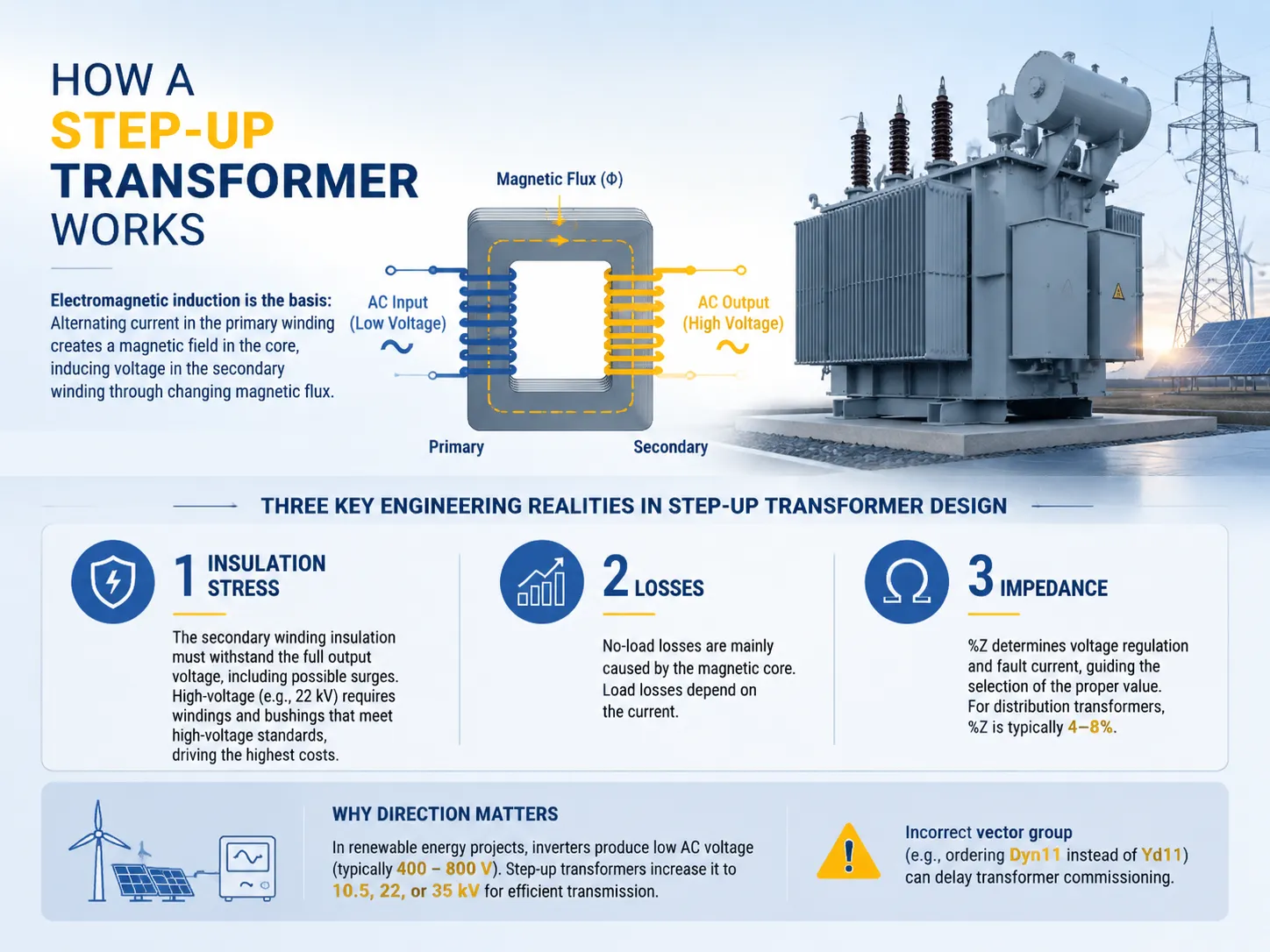
In renewable energy projects the concept of direction means a lot because the AC voltage produced by solar or wind inverters is low (usually 400 – 800V) and step-up transformer increases its voltage up to 10.5, 22 or 35 kV. If the vector group data is incorrect, for instance if the Dyn11 transformer has been ordered instead of Yd11, commissioning of the transformer will be postponed.
Types of Step-Up Transformers
| Type | Rating Range | Voltage Class | Typical 2026 FOB Price |
|---|---|---|---|
| Single-phase dry-type | 1 – 25 kVA | Up to 1 kV | $150 – $1,800 |
| Three-phase dry-type | 15 – 2,500 kVA | Up to 36 kV | $1,800 – $35,000 |
| Oil-immersed pad-mount | 50 – 2,500 kVA | Up to 36 kV | $5,000 – $45,000 |
| Solar / wind grid-tie unit | 500 – 5,000 kVA | 10.5 – 35 kV | $12,000 – $80,000 |
| Autotransformer | 0.5 – 500 kVA | Up to 11 kV | $100 – $15,000 |
In most parts of the world, three-phase dry-type transformers fulfill industrial requirements and oil-filled transformers rule solar and wind power plants. Autotransformers are best suited for lower voltage ratios (e.g., between 208 V and 240 V) where isolation is not necessary and they are 20%-40% less expensive than an equivalent two-winding unit.
Where Step-Up Transformers Are Used
The voltage set-up of transformers is mandatory for voltage increase in the following areas:
- Solar & wind farms: The voltage of inverter is made into a collector voltage and then into a transmission voltage by the transformer of sub-station.
- Industrial sites: The 208V or 220V voltages are transformed into 480V, 575V or 600V for electric motors and other great consumers of energy.
- Long distance power transmission: The voltage generated by the producer is transmitted for a long distance by high voltage.
- Marine and island power systems: The electricity produced on a vessel is transformed into power voltage for shabby devices of shore.
- Testing labs: High voltage transformer is employed for testing purposes.
- HVAC and mining operations: The powerful engines shall be actuated by the high voltage transformers.
By 2026, distributed solar generation shall be the most dynamically developing sectors of energy sector. Average ground-mounted solar project of 1 megawatt size shall use 1250 kV transformer at 400V/22kV cost anywhere between $14,000 and $25,000, according to Chinese manufacturers, which has to be included into any business plan of an investor.
Every sector has its specific features. This is the ground for your request for proposals.
| Application | Input Voltage | Output Voltage | Typical Rating | Vector Group |
|---|---|---|---|---|
| Small motor / equipment boost | 208 V | 480 V | 5 – 100 kVA | Dd0 / Dyn11 |
| Solar inverter to collector line | 400 V | 22 kV | 1,250 – 3,150 kVA | Dyn11 / Yd11 |
| Wind turbine step-up | 690 V | 33 kV | 3,000 – 6,000 kVA | Dyn11 / Yd11 |
| Test laboratory HV supply | 400 V | 10 – 100 kV | 5 – 500 kVA | Yyn0 / single-phase |
| Marine genset to shore feed | 400 V | 6.6 kV | 500 – 2,500 kVA | Dyn11 |
Critical Specifications and Standards
| Specification | Typical Values | Selection Guidance |
|---|---|---|
| Rated power | 1 kVA – 5 MVA | Size to peak inverter/load output + margin |
| Voltage ratio | 400/22 kV, 208/480 V, 11/33 kV | State both sides exactly in the RFQ |
| Vector group | Dyn11, Yd11, Yyn0 | Must match utility and protection design |
| Frequency | 50 Hz or 60 Hz | Dual-frequency for multi-market equipment |
| Impedance | 4 – 8% | Higher %Z limits fault current but raises voltage drop |
| Cooling | AN, ONAN, ONAF | AN for small dry, ONAF for large oil units |
| Standards | IEC 60076, IEEE C57.12 | Match the test-report regime to your market |
The standard that governs the operations is IEC 60076. The first part of the standard includes general specifications. The third part gives information about the dielectric tests and insulation levels. The 5th part is concerned with withstand capability. In the event that products are shipped to North America, the standards IEEE C57.12 and NEMA shall be applicable. In cases when your shipment arrives in the EU, the best option will be to use CE-marked units built in accordance with the IEC 60076.
Step-Up vs. Step-Down vs. Autotransformer
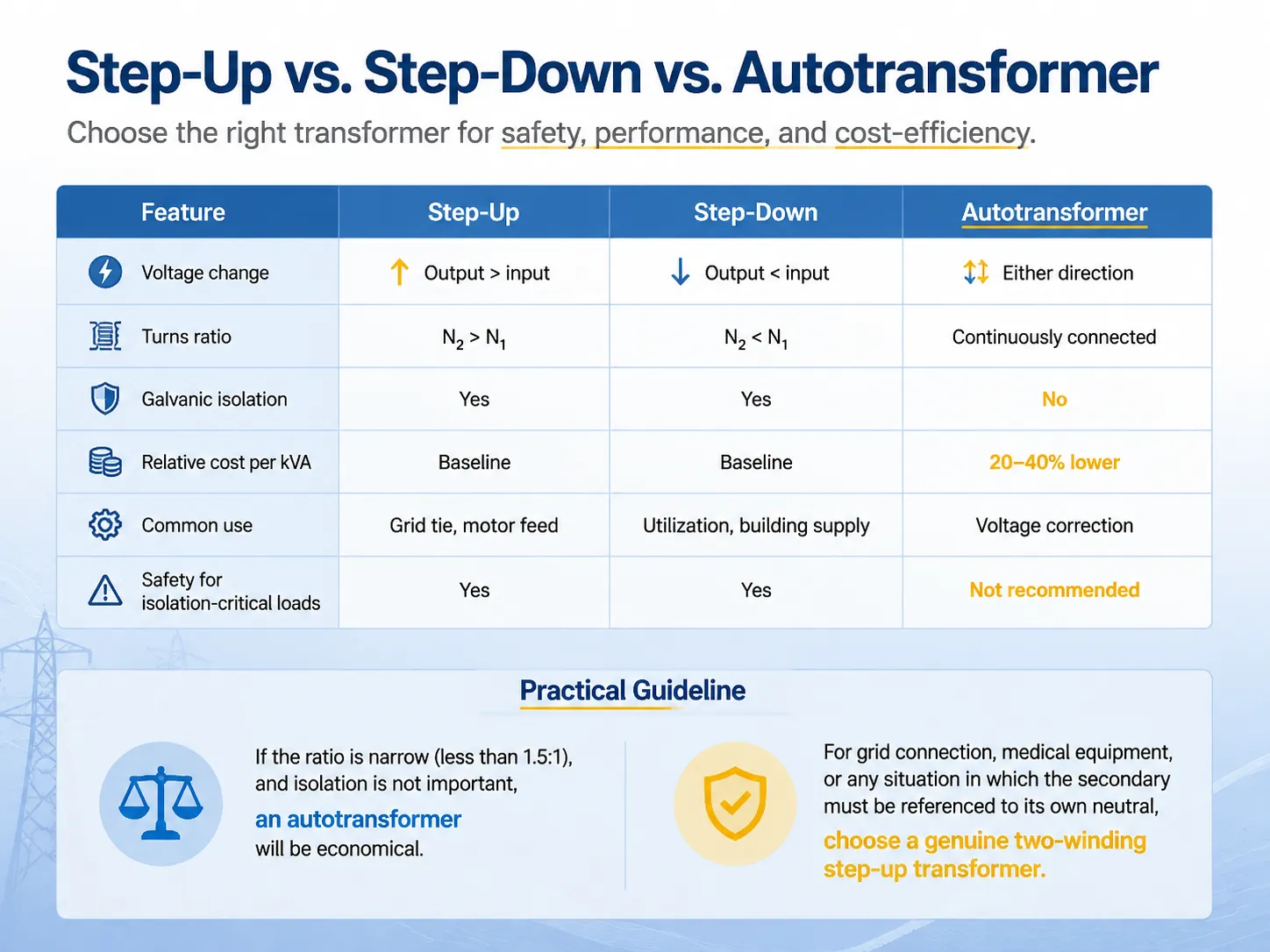
Buying guides are often misleading and lead consumers to purchase step-up transformers where a step down transformer is more suitable. The comparison table below clarifies things.
| Feature | Step-Up | Step-Down | Autotransformer |
|---|---|---|---|
| Voltage change | Output > input | Output < input | Either direction |
| Turns ratio | N2 > N1 | N2 < N1 | Continuously connected |
| Galvanic isolation | Yes | Yes | No |
| Relative cost per kVA | Baseline | Baseline | 20–40% lower |
| Common use | Grid tie, motor feed | Utilization, building supply | Voltage correction |
| Safety for isolation-critical loads | Yes | Yes | Not recommended |
As a practical principle, if the ratio is narrow (less than 1.5:1), and isolation is not important, an autotransformer will be economical. However, for the grid connection or medical equipment, or any situation in which the secondary must be referenced to its own neutral, one should pick a genuine two-winding step-up transformer.
How to Size and Select One
The following six steps should be followed for resolving the kVA query:
- Identifying peak demand. To get the solar data, we need to take max output given by the inverter. For motors, we will use the starting current which is 6-8 times the running current for around 2 to 5 seconds.
- Including a safety margin. One must use 110-125% of the peak demand while going for continuous kVA figure. For instance 1,000kW inverter at 0.95 power factor gives an output of roughly 1,053 kVA which means that 1,250kVA transformer is required.
- Checking for voltage and frequency. It is necessary to make it clear what voltage and frequency is required. Usually the standard message would read “400 V delta → 22 kV wye, 50 Hz”.
- Choosing the vector group. The most standard configuration for grid connection would be Dyn11 or Dyn5.
- Deciding on insulation and cooling material. Class F/H could be used for dry transformers while ONAN and ONAF are widely used for oil transformers above 500kVA.
- Finalizing various tests and regulations. One must obtain the type test report and routine test certificates before conducting any payment.
2026 Price Ranges by Rating
These ranges represent actual prices from Chinese producers at the start of 2026; variations depend on copper or aluminum, grade of the core, housing and type of tap changer.
| Rating | Dry-Type (FOB) | Oil-Immersed (FOB) |
|---|---|---|
| 25 kVA | $1,600 – $3,500 | $2,500 – $4,500 |
| 100 kVA | $3,500 – $7,000 | $5,000 – $9,500 |
| 250 kVA | $6,500 – $13,000 | $9,000 – $18,000 |
| 630 kVA | $13,000 – $25,000 | $18,000 – $32,000 |
| 1,250 kVA (solar) | $20,000 – $38,000 | $24,000 – $42,000 |
| 2,500 kVA | $32,000 – $55,000 | $40,000 – $70,000 |
Copper windings make for a more expensive product, due to a 15-35% increase compared to aluminum windings. An on-load tap changer increases the cost by 20-60%. Similarly, adding a welded outdoor enclosure in stainless steel would add 10-25% to the final cost. As far as transportation goes, budget $3,000 to $7,000 per shipment, and allow 2-4 months for the manufacturing of custom products.
Top Brands and Supplier Considerations
According to the international step-up transformer market, while ABB and Siemens are leaders in utility projects, Hitachi Energy is exceptionally good at the renewable connection to the grid, Schneider Electric and Eaton are dominating in industrial distribution, as well as GE has its traditional position retained in the North American market. Those companies provide both extensive type-test data storage, local servicing, and many years of experience at 1.5-2.5 times the pricing of a Chinese product.
In 2026, the best solution for customers from abroad is to be in contact with the certified manufacturer from China that already has experience exporting its products. Jiangsu Subian Electric Power is manufacturing step-up transformers for a wide range of applications from single-phase low power units to 2500 kVA oil-immersed transformers which comply with IEC 60076. The transformers can be produced with copper or aluminum windings. They can operate with dual frequency, i.e. the frequency can be either 50 or 60 Hz. Besides, the company offers connection to the grid of wind farms and solar plants as the standard feature of their products. The engineers confirm the groups of transformers for the production as well as the impedance values before assembling the product. They send the test protocols with every shipment and provide their clients with confidence in that their product is safe and effective for solar project development.
Installation and Testing Essentials
Proper commissioning of step-up transformer can be done while avoiding any premature failures:
- Use Megger and check insulation resistance before energizing. Insulation resistance has to be more than 1 MΩ per kV of rated voltage. In case the insulation resistance is less, dry out the transformer (applying low voltage allows circulating current and removing moisture from the transformer).
- Verify the vector group on the commissioning site. Prior to connecting to the grid it is essential to carry out the phase sequence and polarity check to avoid being charged $100,000 for the wrong vector group.
- Check step-up transformer ratio when connected to load. Make the secondary voltage measurement under 25% rated load.
- Torque and re-torque. After 48 hours when the transformer is loaded it is necessary to re-torque all bushings and cables because loose joints and connections result in more than 20% of field failures.
- Perform thermography regularly, at least once annually.
Frequently Asked Questions
What size step-up transformer do I need for a 1 MW solar inverter?
Divide the nominal power output of the inverter by the power factor, and then add a 10% to 25% safety margin. If, for example, you have a 1000 kW inverter operating at 0.95 PF, this would be equal to 1,053 kVA, so the recommended transformer size will be 1,250 kVA as a standard practice. In case the inverter might be continuously working at 10% overload, you will have to size it to 1,500 kVA.
Can I use a step-down transformer in reverse as a step-up transformer?
Yes, in technical terms, transformers are reversible but using the lower winding of a step-down transformer with the lower voltage for the high voltage is incorrect because it imposes excessive mechanical stress on the insulation system and decreases its rated capacity. They can operate in emergency situations but are proved not advisable for continuous operation. So it is advisable to order the unit in the correct conformation.
Why do solar step-up transformers need a specific vector group?
The vector group indicates the alignment between primary and secondary phases and whether or not a neutral connection is present. Most grid-connected systems use either Dyn11 or Yd11 vector groups to allow for a neutral connection and meeting the requirements of the utility company’s protection scheme. Incorrect vector groups can cause issues such as circulating currents, misoperation of protection devices, or even rejection at the time of connection approval; hence, it is always good practice to verify the vector group with the inverter specifications and utility requirements.
What is the difference between a step-up transformer and a booster?
Step-up transformer increases voltage in fixed ratio according to turns ratio of its own primary and secondary coils. Booster (or buck-boost) transformers are small auto-transformer configurations that add or subtract small voltage to an existing supply – for example by raising the voltage from 208 V by 10% to 229 V. Booster transformers provide inexpensive means of achieving small corrections; step-up transformers provide full voltage change.
How long does it take to get a custom step-up transformer from China?
The standard delivery period of dry-type units is between 20 to 40 days from the date of deposit payment. The delivery time of oil-filled units of up to 2,500 kVA capacity can be between 45 to 90 days. The time period for grid-connected units with custom vector categories can extend from 60 to 120 days.
In addition, sea transportation takes another 30 to 45 days to reach European or US destination ports. Customs clearance takes around 2-4 weeks.
References
- IEC 60076-1: Power Transformers — General Requirements — the international standard governing step-up transformer ratings and testing.
- IEEE C57.12.00 — North American performance and test requirements for distribution transformers.
- NEMA Standards — US transformer ratings, efficiency classes, and testing guidance.
- ABB Transformers — industry reference for transformer technology and grid-connection applications.
- Hitachi Energy Transformers — reference for renewables grid-connection transformer design.
- US DOE Solar Energy Technologies Office — background on solar inverter and transformer system integration.
- UL Solutions — certification reference for dry-type transformer safety in North America.
Conclusion
A step-up transformer is responsible for converting low-voltage electricity into usable energy that can be transmitted efficiently. In the year 2026, renewable energy sources as well as industrial companies will have to follow major principles while procuring transformer units, including finding the right vector group, using good-quality copper, and acquiring trustworthy test records.
- Select the transformer with the maximum demand plus an additional 10–25 percent margin.
- Make sure to check the voltage ratio, frequency, and vector group in writing.
- Allocate a budget of $400–$80,000 depending on the type and rating of the transformer.
- Choose from units tested according to IEC 60076 and provided with all the necessary reports.
- Buy from a certified Chinese manufacturer to save 30–50%.
When it comes to industrial, grid-tie, or laboratory applications, Jiangsu Subian Electric Power offers IEC 60076-compliant transformers with the required vector groups for renewable projects.Send your inverter output voltage and utility connection voltage for a spec-matched quote. Visit the Subian Electric website to start.