


A photovoltaic developer giving you the one-line drawing for a 50 MW solar park often misses the most crucial part of the system: the solar transformer that acts between the inverters and the 33 kV collection grid. The function of the solar transformer is to utilize the low voltage from the inverter and increase it to the voltage which is suitable for the grid connection. The design of the transformer affects the amount of energy available to transfer to the grid, how to connect the solar park to the earth, and if the utility will approve of the connection or not. The article discusses the definition and working principles of the solar transformer, as well as its disparities with the usual distribution transformer and the costs on plant of various scales.
What Is a Solar Transformer?
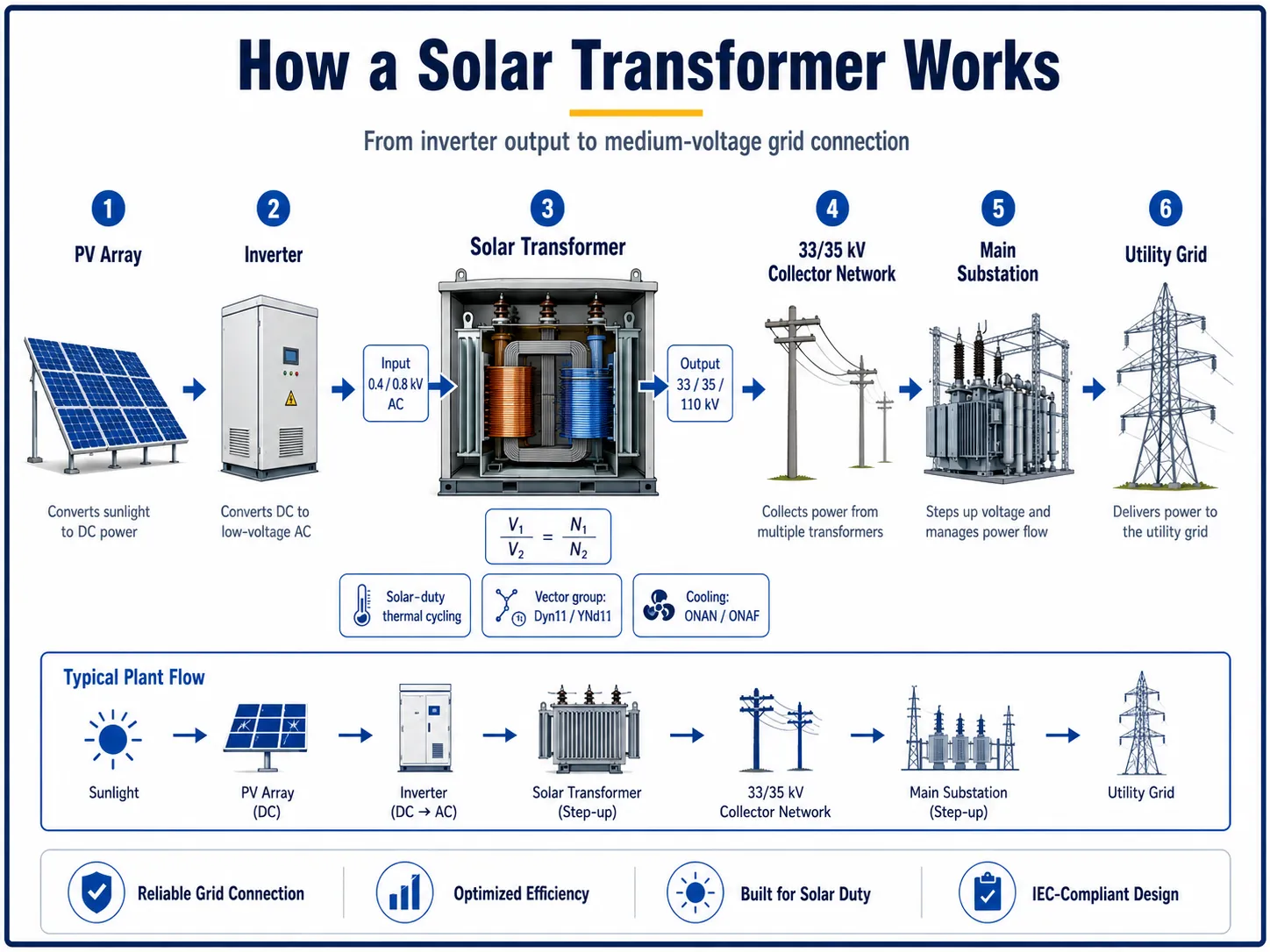
A solar transformer is a special transformer for solar energy plants. The alternating current is produced by photovoltaic inverters with low voltage, usually at 0.4 kV (400 V), in case of string photovoltaic inverters, and at 0.8–1 kV in case of central inverters. The point of connection to the grid works at different voltage levels, normally at 33 kV, 35 kV, 66 kV, or 110 kV. The purpose of the solar transformer is similar to that of a step-up transformer since it converts the voltage of the outgoing current from low to medium, following the engineering decisions of installation of the solar power plant. It is known under names of PV transformer, solar power transformer, or inverter transformer. Unlike the distribution transformer that is used to connect to variable loads, the solar transformer connects to a constant turns ratio while connecting to the intermittent load only.
How a Solar Transformer Works
The operating mechanism is typical transformer physics: the low-voltage AC current from the inverter gets into the primary winding and induces an alternating flux in the laminated core, producing voltage in the secondary winding in accordance with the turns ratio. If the inverter gives the output of 0.8 kV and the collector voltage is equal to 33 kV, the turns ratio is around 1 to 41, and the secondary line current is approximately 1/41 of the primary current. The kVA rating of the transformer is based on the inverter cluster capacity: 2 MW inverter stations usually go with 2-2.5 MVA transformers (in order to consider the overload margin and losses). The installation works only during the daytime, with its output varying from zero to the maximum value and back as time passes, so the core flux, insulation and cooling are created based on this profile as opposed to steady-state duty reactor for utilities distribution.
Why Solar Duty Differs from Distribution Duty
| Aspect | Solar (PV) transformer | Conventional distribution transformer |
|---|---|---|
| Power flow direction | Unidirectional (LV to HV) | Bidirectional or load-following |
| Load profile | Intermittent, sun-following, daily cycling | Continuous with seasonal peaks |
| Switching cycles | Daily inverter connect/disconnect | Infrequent |
| Overload duty | Midday peaks near full load in high ambient heat | Occasional, specified by design |
| Harmonics | Moderate, from inverter switching | Generally low |
| Typical vector group | Dyn11, YNd11 (grid-code dependent) | Dyn11, Dyn5 |
| Integration | Often skid/box-type with MV switchgear | Standalone unit |
The unit must be able to endure daily thermal cycling without causing any damage to the insulation, withstand temperature peaks in desert-like conditions, and be connected in accordance with grid requirements. Various grid codes specify that the LV winding should be delta-connected and the HV winding wye-connected with a grounded neutral (vector group like YNd11), which dictates the requirements for grounding of the collector network as a whole.
Types of Solar Transformers
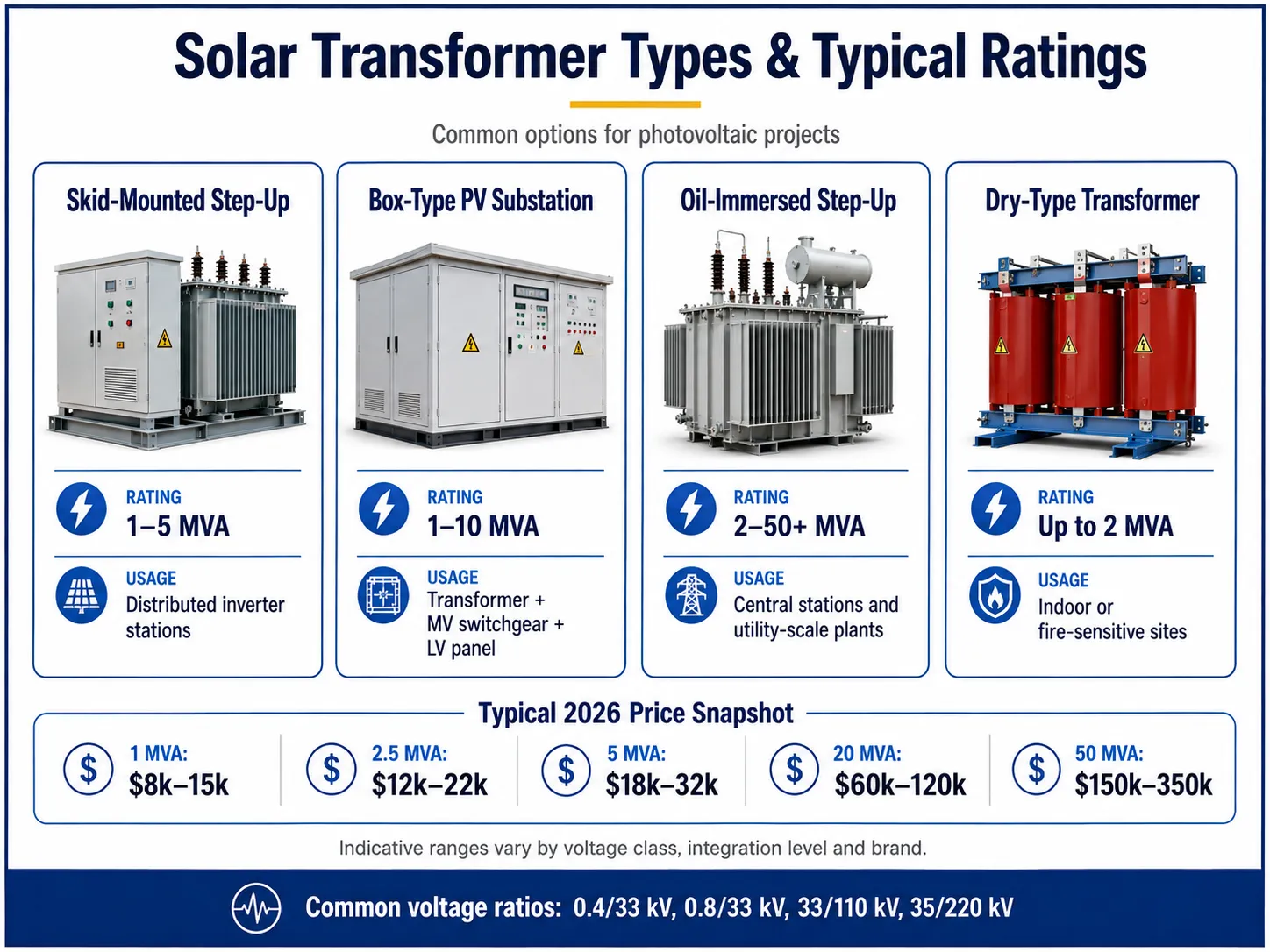
- Step-up transformers which are mounted on pads or skid and used for dispersed inverter stations ranging of 1 to 5 MVA capacity and are installed in combination with MV switchgears.
Container type photovoltaic substations also called containerized units are made out of box shaped transformers, MV switchgears, LV panels and monitoring systems, in a single case for quick installation in the area of usage.
Oil immersed step-up transformers used in main power plants and utility scale applications, with a capacity ranging between 2 to more than 50 MVA including 66 to 110 kV kind of transformers.
Dry type transformers for use in areas where fire hazard exists and low-cost commercial installations.
Service transformers located in the PV substations to provide energy for the necessary equipment such as lighting, monitoring system.
| Type | Rating | Form | Typical application |
|---|---|---|---|
| Pad-mounted / skid step-up | 1–5 MVA | Skid with MV switchgear | Distributed inverter stations |
| Box-type PV substation | 1–10 MVA | Container/skid integrated | Fast field installation |
| Oil-immersed step-up | 2–50+ MVA | Standalone or banked | Central stations, 66–220 kV |
| Dry-type | Up to 2 MVA | Cast resin, indoor | Rooftop, indoor commercial |
| Station service | 50–500 kVA | Oil or dry-type | Plant auxiliaries |
PV Plant Architecture: Where the Transformer Sits
A regular utility-scale plant usually has string inverters supplying a collector network. If we consider the distributed layout, an inverter station of 1-3 MW has an individual step-up transformer, which raises the voltage from 0.4-0.8 kV to 33 kV. After reaching 33 kV, the collector goes to the main substation where there is a large step-up transformer (or bank), which brings the voltage to the level of either 110 kV or 220 kV. The central-station layout implies that all inverters supply the low-voltage busbars from the same place while one big transformer performs the step-up operation. The location of a transformer defines its rating, vector group, and protection because the transformer is secured by means of transformer level protections (overcurrent and differential protection for large machines, temperature and gas relays) as well as inverter protection according to the requirements of the grid operator.
| Plant size | Inverter station | Skid units needed | Main station transformer |
|---|---|---|---|
| 5 MW | 2× 2.5 MVA | 2 | 5 MVA, 33/110 kV (optional) |
| 20 MW | 8× 2.5 MVA | 8 | 20 MVA, 33/110 kV |
| 50 MW | 20× 2.5 MVA | 20 | 50 MVA, 35/220 kV (or 33/110 kV) |
| 100 MW | 40× 2.5 MVA | 40 | 2× 60 MVA, 35/220 kV |
Vector Groups and Grounding in Solar Plants Typical Specifications
The vector group is determined by the combination of grid code and earthing philosophy, it is not due to experience or custom. For the inverter part, the LV winding is usually connected as delta so as to avoid circulating currents and create a clear path for harmonics, the MV/HV winding — as wye with the neutral taken to the ground providing a firm connection for the grid. The standard groups are Dyn11 (LV delta, MV wye with the neutral) and YNd11 (HV wye with the neutral, LV delta) depending on the side that connects to the grid. The neutral earthing related to the grid can be solid, by using an earthing transformer or through the neutral earthing resistor, according to the fault-current practices in the respective electric utility. Verify grid code obligations before ordering the equipment — wrong vector group leads to failure of grid-connection study and may cause months-long delays in commissioning or issues with equipment.
| Rating (MVA) | Voltage ratio | Vector group | Impedance | Cooling |
|---|---|---|---|---|
| 1 | 0.4 / 33 kV | Dyn11 | 6% | ONAN |
| 2.5 | 0.8 / 33 kV | Dyn11 | 6–8% | ONAN/ONAF |
| 5 | 0.8 / 35 kV | Dyn11 or YNd11 | 8% | ONAF |
| 20 | 33 / 110 kV | YNd11 | 10–12% | ONAN/ONAF |
| 50 | 35 / 220 kV | YNd11 | 12–14% | ONAF/ODAF |
Design criteria commonly involve conditions of 40-55°C for ambient temperatures (de-rated for hot sites), baseline at 1,000 m altitude and lifespan of 25 years in accordance with the anticipated operation life of PV plant. Make sure to double-check temperature rise calculation on your site’s most challenging month in advance.
Costs: Transformer, Skid, and Delivery
The transformer generally constitutes 1-3% of a solar project CAPEX, but it is an important part of the commissioning process. The indicative price ranges in 2026 for different models of transformers are: 1 MVA 0.4/33 kV transformer – $8,000 – $15,000; 2.5 MVA transformer – $12,000 – $22,000; 5 MVA transformer – $18,000 – $32,000; 20 MVA transformer 110 kV class – $60,000 – $120,000; 50 MVA transformer 220 kV class – $150,000 – $350,000. If one wants a complete box-type PV substation which includes a transformer plus different parts such as MV switchgear, LV panel and monitoring, the price will be up to 30-60 % higher than the price of the transformer alone and the installation time will be less. Also, the cost for transportation of large transformers is very high and the schedule must be arranged in advance due to the strict time limits of solar projects.
| Cost item | Indicative value | Notes |
|---|---|---|
| Transformer as share of CAPEX | 1–3% | Small but critical-path item |
| Skid/box-type premium | +30–60% over bare unit | Includes switchgear, LV panel, monitoring |
| Ocean freight (mid-size) | 5–15% of FOB | Port-to-port, 2–6 weeks |
| Site installation saving | Days to weeks | Factory-tested skids reduce field work |
| Transformer losses over 25 years | $50k–$200k typical plant | Capitalize losses in the vendor comparison |
How to Choose a Solar Transformer
1.Repair the construction of voltage installations. In terms of inverter current, level of voltage generated by collector, point of grid connection, there will be mentioned amount and kVA per station.
2.Calculate voltage rating. Make sure to match transformer power rating to that of cluster of inverters with margin of 10%-30% to account losses, climatic conditions, and upgrades. Please note that ratings of LV switchboards and cables should correspond to those of transformers.
3.Double-check vector group and grounding. Make sure to research applicable grid code to find out the details regarding the conception of voltage generation and neutral earthing.
4.Analyze climatic conditions at the site. If the ambient temperature and altitude require derating, make sure to implement respective recommendations. For instance, 50-degree temperature in desert should lead to much cooler rating than at ground level.
5.Determine method of integration. In case of need for fast installation with factory testing choose skirt/box type; standalone constructions can be used if required by the plant layout or local content laws.
6.Conduct IEC 60076 compliance check. Make sure to verify insulation levels, acceptable temperature increase, losses, and ability to withstand short circuit as well as to ask for complete test report.
Finish the planning of delivery time. Decide upon the time necessary for delivery prior to plant power supply master delivery.
Top Brands and Price Ranges
| Brand | Country | Solar product focus | Indicative price range (US$) |
|---|---|---|---|
| ABB | Switzerland/Sweden | PV step-up and skid transformers | $10,000–$350,000 |
| Siemens | Germany | Utility-scale solar transformers | $9,000–$320,000 |
| Schneider Electric | France | Box-type PV substations | $8,000–$150,000 |
| Hitachi Energy | Switzerland | Large power transformers for solar | $15,000–$400,000 |
| Eaton | USA | Distributed PV step-up units | $8,000–$60,000 |
| Jiangsu Subian Electric Power | China | Solar transformers and box-type PV substations | $8,000–$120,000 |
Prices shown may vary depending on the classification, voltage range, amount of integration, and brand. ABB, Siemens, Schneider Electric, Hitachi Energy, and Eaton have sent their products to some of the biggest solar parks in the world having a great track of their projects. Small developers who require the same certification via IEC60076 in a cheaper managing way can buy solar step-up transformers manufactured by Jiangsu Subian Electric Power Co., Ltd., as well as whole box-type solar substations, where types or ratings can be adjusted to fit in line with inverter and grid specifications. Subian is known for supplying renewable energy products to various markets worldwide. Explore the solar product range on the Subian Electric website.
Frequently Asked Questions
Is a solar transformer just a normal step-up transformer?
Although its concept is the same electrically, the design has been accomplished for functioning in solar: operation involving intermittent loading by sun-following, daily switch-on/switch-off cycles, elevated ambient temperature, and inverters providing harmonic distortion and vector group specifications defined by alternate sources of energy. A regular boost transformer may be appropriate for the photovoltaic plant, but the parameters and cooling technology will not be adapted and fine-tuned for that application, resulting in loss of equipment life or necessitating higher specifications than needed.
What voltage ratio is typical for a solar transformer?
Common voltage combinations in inverter stations include 0.4/33 kV, 0.4/35 kV, and 0.8/33 kV for distributed inverter plants and common voltage ratios for central inverter plants are 33/110 kV and 35/220 kV. The exact ratio may vary depending on the structure of the plant and the point of attachment to the grid; the larger plants can also have an intermediate collector voltage level.
Do I need a separate transformer for a solar plant?
Yes. The output voltage produced by inverters is low, while the voltage of the grid connection is medium or high. Therefore, a step-up transformer is needed. In the case of distributed plants, a transformer is required for every inverter station, whereas, in the case of central-station designs, one transformer is sufficient for the whole plant. The transformer gives the grounding reference as required by the grid code.
How much does a solar transformer cost?
It is advisable to say that prices for 1–2.5 MVA skid units tend to be between US $8,000–$22,000, while a 5 MVA unit costs between US $18,000–32,000. Prices for a more powerful 20 MVA 110 kV unit rise to $60,000–$120,000; with 50 MVA 220 kV units costing $150,000–$350,000. A box-type solar power station will add 30–60% for all integrated switching and monitoring equipment, but it would help in reducing installation costs on site. Use this useful data to request a quote customized for your particular project.
Can Subian deliver a complete PV substation?
Yes. Jiangsu Subian Electric Power has solar step-up transformers and finished box-type solar power substations made up of the transformer, MV switchgear, LV panels, and monitoring all together on one factory-tested skid and quickly installable. The company is responsible for third-party inspection and shipping to the site of the project.
References
- IEC 60076-1 — Power Transformers: General — the governing standard for solar transformer rating and testing.
- IEC 60076-3 — Insulation Levels and Dielectric Tests — defines insulation levels for the collector and transmission voltage classes.
- IEC 60076-5 — Ability to Withstand Short Circuit — short-circuit verification for the step-up windings.
- IEC 62271-212 — Compact Equipment Assemblies (GIS and GIL) — relevant to box-type and skid-integrated PV substations.
- IEA — Solar Energy — global context for PV deployment and equipment demand.
- Hitachi Energy — Transformer Products — reference documentation for large solar power transformers.
Conclusion
The solar transformer is the indispensable link between the inverter and the grid: it steps the plant’s low-voltage output up to the collector or transmission voltage, provides the grounding reference the grid code demands, and must survive a duty cycle — intermittent, daily-cycling, hot — that a conventional distribution transformer never sees. The right specification starts with the voltage architecture and inverter cluster rating, then fixes the vector group and earthing to the grid code, de-rates for the site climate, chooses the integration form, and locks a delivery schedule that matches the energization date. Jiangsu Subian Electric Power offers IEC 60076-compliant solar transformers and box-type PV substations at competitive prices, backed by export experience and full factory testing. Submit your plant’s single-line diagram and load data through the official website to receive a specification-matched proposal for your next solar project.