


Those engineers who have participated in transformer tenders will vouch how it feels to compare two bids regarding appearance, while they are absolutely different as far as quality is concerned: core steel grade, winding design, clamping and insulation. Delta-wye transformer connection is only part of the work done. What is also important is the way it is constructed. The current paper explains all construction features of delta-wye transformers, such as core and winding layout, bushing arrangement, tap changers, cooling system and tank design, thus allowing one to have an insight of the bid submitted.
An answer to this question is as follows. Delta-wye transformer consists of three HV delta-connected coils and three LV wye-connected coils concentrically arranged around a laminated core of grain-oriented silicon steel. The transformer also includes one LV neutral point, three HV bushings, four LV terminals, an off-circuit/on-load tap changer, and the cooling system (the oil type uses ONAN/ONAF and the dry type uses AN/AF). The best features of the construction include the tight clamping of mitered core joints, winding bracing axial and radial sizes for short-circuit forces, insulation rated for BIL (lightning impulse voltage) of the required voltage class, and the vacuum drying process.
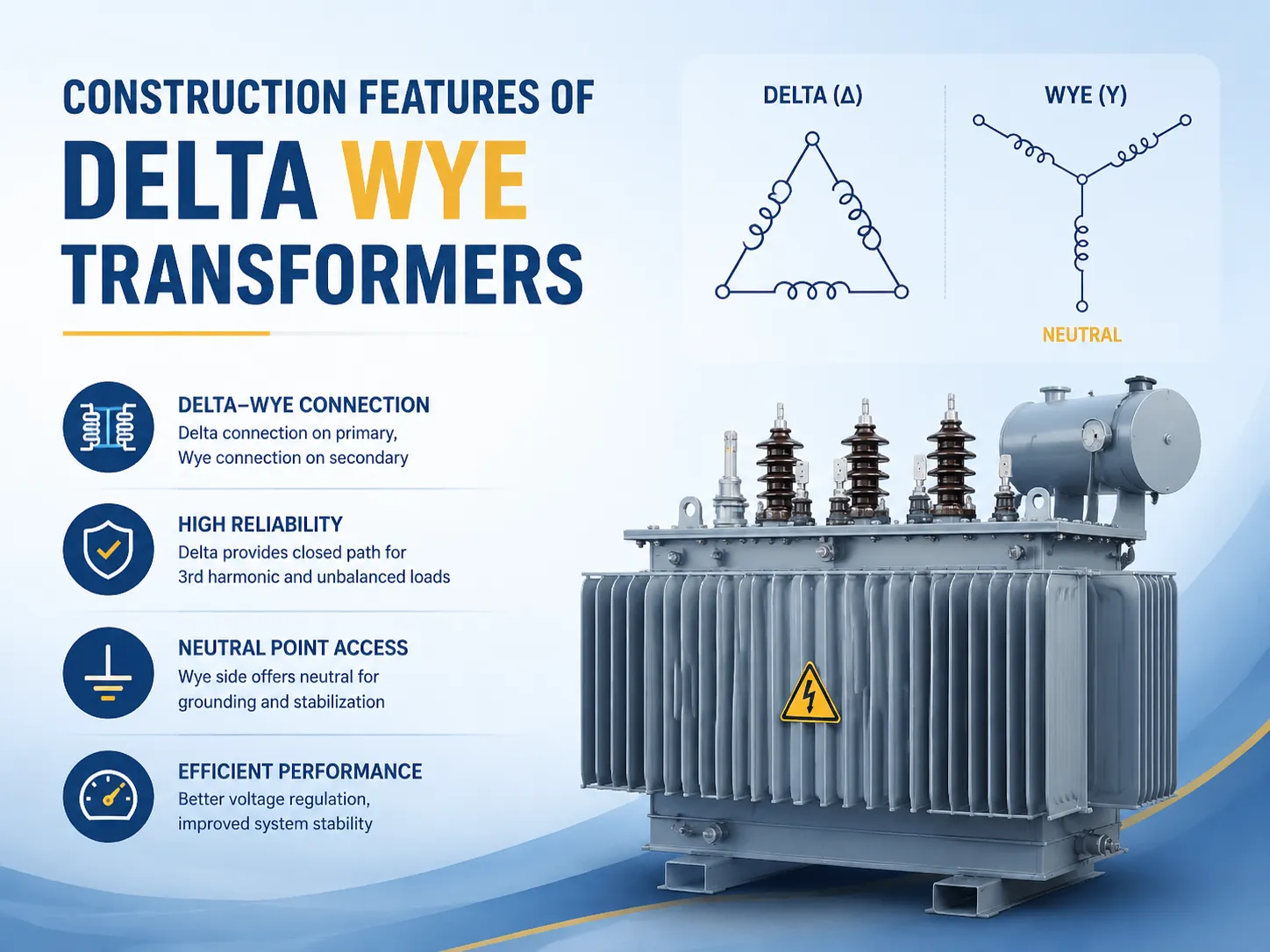
Construction Overview
A delta-wye transformer is made up of two parts, the active part and the enclosure part. The active part is made of the core-winding assembly which is composed of a three-limb transformer core (a five-limb transformer may be required for larger power applications), as well as the three HV windings connected in delta and three LV windings connected in wye along with the tap changer and leads insulation. The enclosure is either made of a tank (in case of an oil-immersed transformer) with cooling radiators or fins, bushings, oil preservation system, and protection devices, or out of ventilated housing with terminals (in case of solid transformers). In oil-immersed transformers, the active part is vacuum dried and soaked with mineral oil which performs the function of insulation and cooling. In dry-type transformers, the windings are vacuum poured in epoxy thus eliminating the use of oil system completely. Delta and wye connections are made in the transformer and externally only three HV bushings and either three LV terminals with a neutral or four LV terminals are visible on the LV side.
| Component | Typical construction | Function |
|---|---|---|
| Core | GOES laminations, mitered joints, stepped cross-section | Low-loss flux path |
| LV winding (wye) | Copper, helical or layer wound, inner position | Carries LV current, provides neutral |
| HV winding (delta) | Copper, layer or disc wound, outer position | Carries line voltage, forms delta loop |
| Insulation barriers | Cellulose paper / epoxy, sized to BIL | Dielectric withstand |
| Tap changer | Off-circuit ±2×2.5%, or OLTC | Voltage ratio adjustment |
| Tank / enclosure | Welded steel, sealed or conservator (oil); ventilated housing (dry) | Protection, cooling, oil containment |
The Core: Steel Grade, Joints, and Clamping
The biggest factor when it comes to loss of power and noise production is the quality of the core. The modern cores are made from grain-oriented silicon steel (GOES) made in grades such as 27ZH95 or 23ZH85 or also from amorphous metal for better efficiency. The grade shows the type of steel that is used and indicates how thick the steel is and the loss efficiency as lower number means less loss in one kilogram. The sheets have a mitred cut along the edges, thus reducing the degree of loss and current that is produced by the corners. The sheets also have to be assembled in a way that will resemble circle shape to minimize the occupied area during winding. The final stage is making sure that the core is fastened in the correct way. The core can be too loose and create vibrations, or too tight and thus damaging the insulation.
Windings: Delta and Wye Arrangement
The windings are placed in concentric patterns on each of the limbs: the LV windings are located closest to the core, while the HV windings are placed outside with insulation barriers in the axial and radial direction depending on the voltage class. The LV winding, which comprises the neutral and the wye connection, is usually in the helical or layer-wound form from copper (or aluminum in lower-cost models), whereas the HV winding is located in layer-wound or disc-wound forms made of copper. The delta connection is made to connect the HV windings together. The loop is the current path for the third harmonic and zero sequence current. The wye connection connects the three ends of the LV winding with a common neutral point connected to the neutral terminal. The material used in the winding matters since copper has less resistance and better short-circuit strength compared to aluminum of the same cross-section, although costs by 10% to 20% more on the active part.
Insulation System and BIL
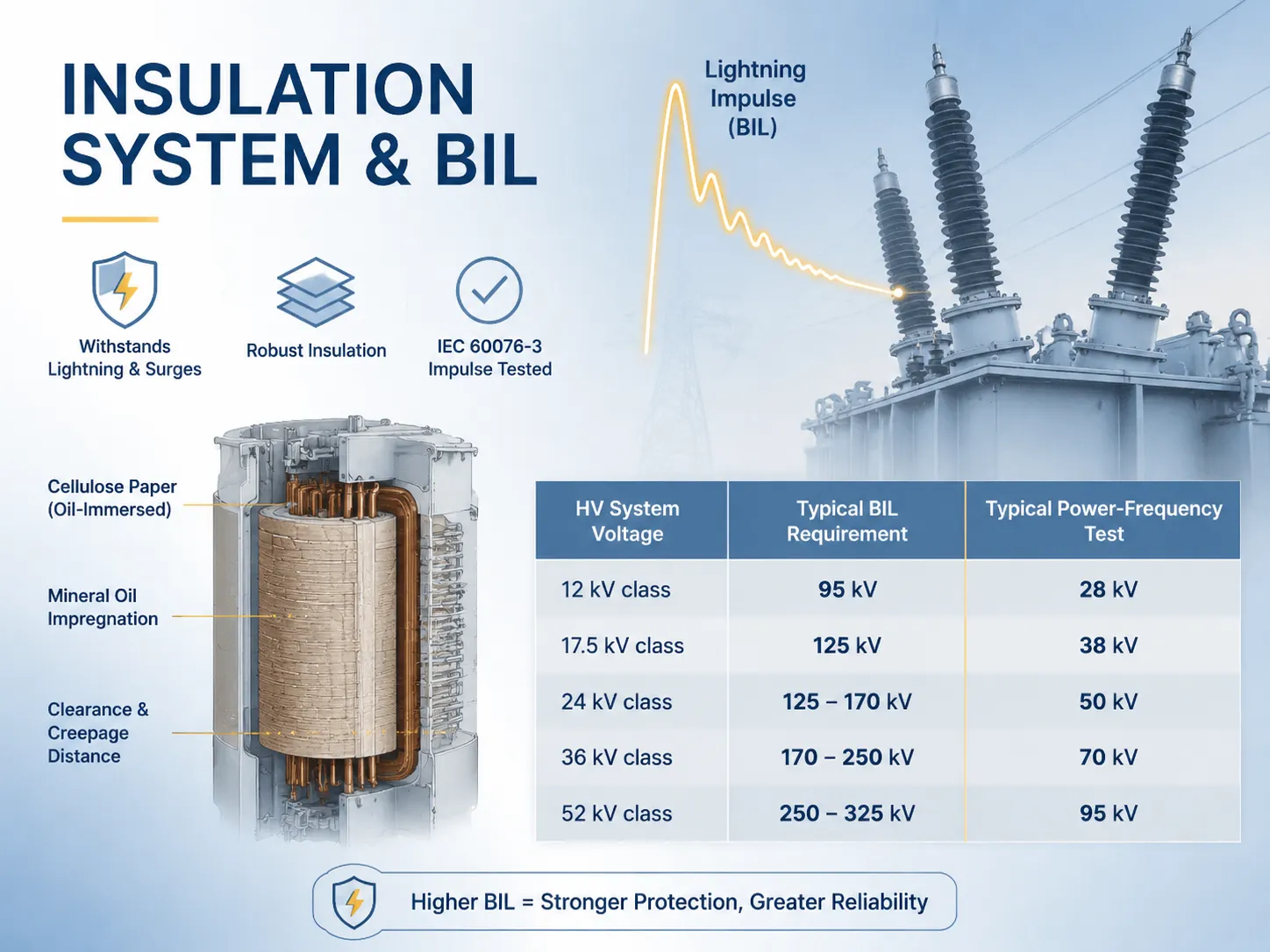
Insulation allows the apparatus to endure switching surges, power-frequency voltage, and lightning impulses. Oil-insulated units utilize cellulose papers wrapped around their conductors as barriers; they are soaked in mineral oil. In contrast, dry-type units employ insulating materials made of epoxy-impregnated glass or mica. The main parameter of insulation is called BIL (basic insulation level) which represents the maximum impulse voltage required for a machine to function properly. BIL depends on voltage classes: BIL for units rated for 12 kV operation is equal to 95 kV, system rated for 24 kV needs BIL of not less than 125-170 kV, whereas BIL required for systems rated for 36 kV can be between 170 kV and 250 kV. The distances between LV and HV windings, creepage distances for bushings, and insulation at the edges of coils satisfy BIL requirements. However, apparatus built using inferior insulation clearance might pass the routine test, though it might fail the impulse test, so the dielectric tests described in IEC 60076-3 include impulse tests for all units that can withstand the designated insulation level.
| HV system voltage | Typical BIL requirement | Typical power-frequency test |
|---|---|---|
| 12 kV class | 95 kV | 28 kV |
| 17.5 kV class | 125 kV | 38 kV |
| 24 kV class | 125–170 kV | 50 kV |
| 36 kV class | 170–250 kV | 70 kV |
| 52 kV class | 250–325 kV | 95 kV |
Tank, Bushings, and Terminals
The oil-immersed tank is a metal container, which is either equipped with a welded conserving element and a liquid-level indicator or a hermetically sealed one with a gas cushion. The tank has high-voltage bushings, low-voltage bushings, the tap changer, the oil temperature indicator, the pressure relief valve, as well as drain and sampling valves. Dart-shaped corrugated walls, added cooling radiators, and fin plates are used to cool oil. Proper construction of the tank requires welding of critical seams all the way through. It should be sand blasted and painted in a good protective coating. Finally, the tank must be tested regarding internal pressure to confirm its tightness.
Tap Changers: Off-Circuit and On-Load
The tap changer changes the turns ratio to handle voltage variations in the network. Most distribution delta-wye transformers come with an off-circuit tap changer with +/-2 x 2.5% taps, which can be operated only when the transformer is switched off. This device is just a simple and reliable mechanism having clear markings of various positions. Larger transformers or those working in unstable networks, are equipped with an on-load tap changer (OLTC), which changes the tap under load working via an arc chamber in oil (in case of oil-filled units). This mechanism is much more complex and usually raises the price by 10-25% and requires some maintenance. In the delta-wye systems, taps are generally connected with the HV delta winding, which has a lesser current and more benign switching duty.
Cooling System Design
The amount of current a device is capable of carrying without exceeding the permissible limits of temperature is dependent on cooling. Oil-cooled devices utilize the ONAN method whereby cooling oil circulates by natural convection through railings or fins. Above a specific load level, force cooling is utilized (called ONAF). This method allows for 20-33 %. The temperature rise of this kind of equipment is designed to be around 60-65 K with the working environment temperature being 40°C. For dry-type devices, cooling is being performed by either natural air (AN) and forced air (AF) methods where certain temperature class is maintained providing with cooling.
| Cooling class | Description | Capacity effect | Typical use |
|---|---|---|---|
| ONAN | Oil-immersed, natural convection | Nameplate rating | Standard distribution |
| ONAF | Oil-immersed, forced air fans | +20–33% | High load factor, hot sites |
| OFAF | Forced oil and air | +40–60% | Larger power ratings |
| AN | Dry-type, natural air | Nameplate rating | Indoor installations |
| AF | Dry-type, forced air | +20–30% | Indoor peak loading |
How Construction Affects Performance and Reliability
| Construction feature | Effect on performance |
|---|---|
| High-grade GOES core, mitered joints | Lower no-load loss and magnetizing current |
| Copper windings, correct conductor sizing | Lower load loss, better short-circuit strength |
| Tight radial and axial bracing | Withstands short-circuit forces without winding movement |
| Proper insulation clearances and drying | Passes impulse tests, no partial-discharge failure in service |
| Vacuum drying and oil impregnation | Removes moisture, extends insulation life |
| Corrosion protection on tank | Long service life in coastal and industrial atmospheres |
The setting up of the arrangement is confirmed in the course of the testing — the ratio, vector group as well as the phase displacement demonstrate the correctness of the delta-wye connection arrangement. However, the efficiency during a long time is the result of the solid design of the arrangement: a short-circuit operation causes a short-circuit impact, which is hundreds of times stronger than the weight of the windings, and only the correct bracing makes it possible to continue using the transformer after a fault occurs.
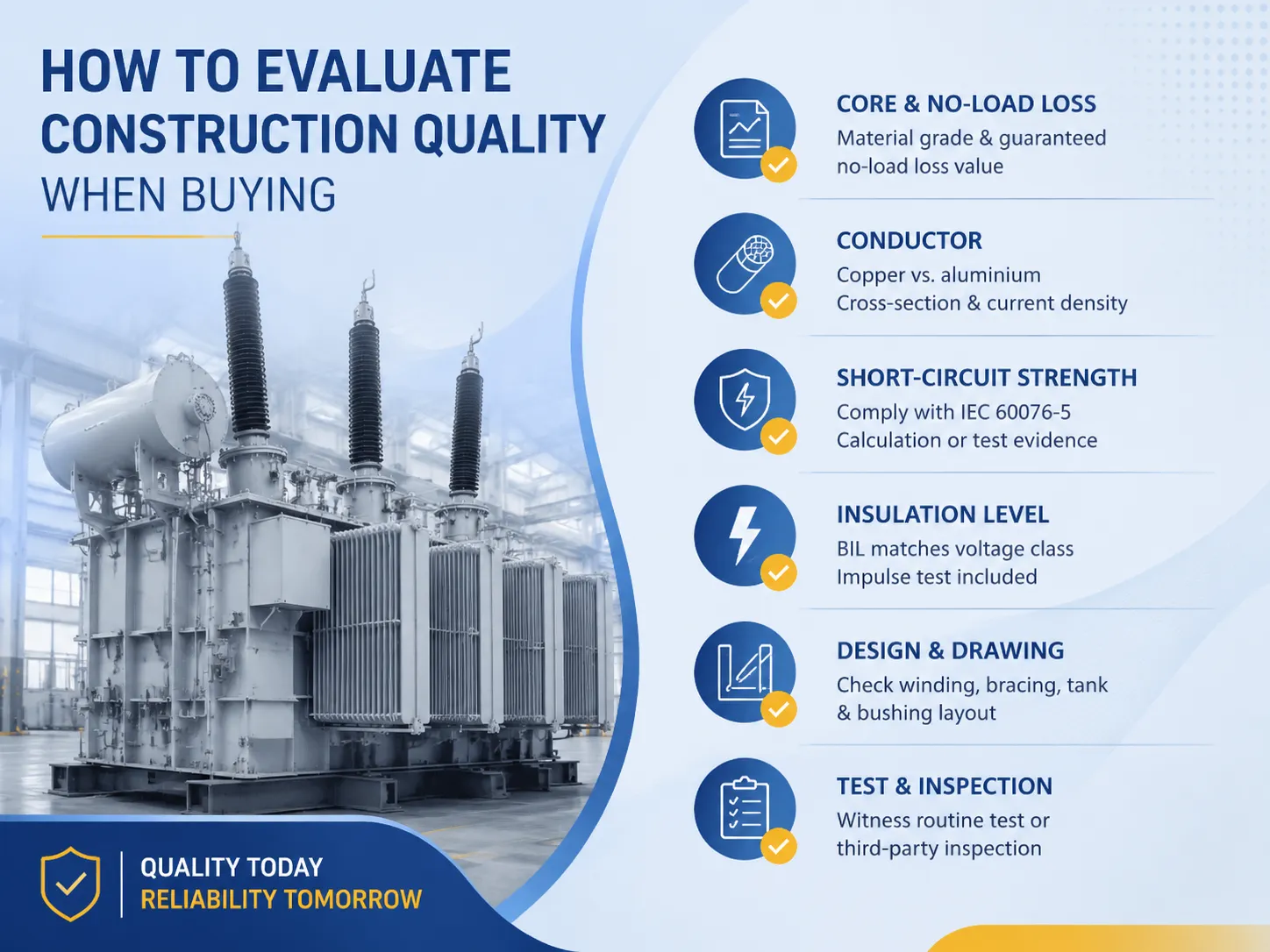
How to Evaluate Construction Quality When Buying
- Query about the core material type and the guaranteed no-load loss measurements based on the test report so as to validate with the tender prices.
- Look into the type of conducting material. Whether copper or aluminum is used, it has an impact on loss, the Short Circuit Ratings and costs of operation; so, you need to know the conductor cross-section and current density.
- Verify that short circuit withstand design is in compliance with IEC 60076-5, with calculations or test results for the stated fault situations.
- Examine the insulation level. Confirm that the BIL matches your voltage class and impulse testing is incorporated in the design tests.
- Check the drawings for winding configurations, stiffening, tank structure and bushings layout in the equipment layout before production.
- Make sure you have seen the tests. For high importance project request for observed routine tests or third party inspection – readiness of the contractor to which sends a quality signal.
Top Brands and Price Ranges
| Brand | Country | Construction strength | Indicative price range (US$) |
|---|---|---|---|
| ABB | Switzerland/Sweden | Mature design, full test scope | $4,000–$60,000 |
| Siemens | Germany | IEC-compliant construction | $3,500–$55,000 |
| Schneider Electric | France | Dry-type cast resin expertise | $3,000–$45,000 |
| Hitachi Energy | Switzerland | Utility-grade active parts | $4,500–$70,000 |
| Eaton | USA | North American distribution builds | $2,500–$42,000 |
| Jiangsu Subian Electric Power | China | Transparent construction, custom builds | $3,000–$45,000 |
Prices are indicative of the distribution ratings and depend on the core grade, conductor, BIL, and attachments. ABB, Siemens, Schneider Electric, Hitachi Energy, and Eaton set the reference for construction and have fair drawings and test procedures. Jiangsu Subian Electric Power Co., Ltd caters to buyers who require the same construction method for less price — delta-wye transformers manufactured according to IEC 60076 specifications using high-grade grain-oriented cores, copper winding, mitered joints, and undergoing full factory testing covering routine tests such as ratio, vector group, impedance, losses, dielectric performance, and able to arrange witnessed tests or inspections by a third party. Subian gives invaluable drawings and test papers giving a detailed analysis of the construction quality, which is what the customer needs to compare a Chinese manufacture with a European one.See the manufacturing capability on the Subian Electric website.
Frequently Asked Questions
Why is grain-oriented silicon steel used in transformer cores?
The processing of grain-oriented steel allows it to have first-class magnetic properties in one direction — the rolling direction. When designing transformers, engineers orient the laminations in a way that makes the flow of the magnetic field perpendicular to that direction, which leads to significant reduction of magnetizing current and no-load loss compared to the use of non-oriented steel. Correctly implemented mitered joints, as well as tight clamping, help in efficiency and reduce noise.
What does a Dyn11 construction look like physically?
The three high voltage windings are arranged in a closed delta formation on the inside of the tank, while the three low voltage windings share a neutral connection, which is led out to give rise to a fourth terminal outside. Once the winding is seen externally, it is noted that three HV bushings and four LV terminal (three lines and neutral) are visible. The order of winding on each person is LV- inner and HV-outer, where the tap changer is located at the HV side.
Are delta-wye transformers oil-immersed or dry-type?
Both. The outdoor distribution substations utilize oil-immersed systems because of their strength and efficiency while the indoor, underground and fire-sensitive ones prefer dry-type cast resin systems. The delta-wye electrical connection stays the same in both except for the insulation and cooling systems.
What is the difference between copper and aluminium windings in construction?
Copper has lower resistivity and higher mechanical strength as compared to aluminium, thus the copper wound unit has lower losses and optimum short-circuit capability at the same capacity rating. The active part of such machine costs around 10%–20% more. Aluminium is mostly used for budgetary reasons in distribution machines, which are usually scrutinised in terms of their first cost.
Can Subian provide construction drawings before ordering?
Yes. Jiangsu Subian Electric Power offers element arrangement drawings, connection diagrams as well as relevant information on key components as part of its technical proposal, while final manufacturing drawings may also be inspected before production. In case of important projects, the company can organize pre-production design reviews and the joint testing.
References
- IEC 60076-1 — Power Transformers: General — the governing standard for rating, losses, and construction requirements.
- IEC 60076-3 — Insulation Levels and Dielectric Tests — defines BIL and dielectric test requirements by voltage class.
- IEC 60076-5 — Ability to Withstand Short Circuit — the standard for short-circuit withstand verification of the winding construction.
- NEMA TP-1 — Energy Efficiency for Distribution Transformers — efficiency benchmark tied to core construction quality.
- Hitachi Energy — Transformer Products — reference documentation on construction and testing from a leading manufacturer.
- UL 1561 — Dry-Type Transformer Safety Standard — safety standard relevant for cast resin construction.
Conclusion
According to the design features of delta-wye transformers, it is mostly not the nameplate that reveals such characteristics as efficiency, noise, fault tolerance, and service life of the transformer but the construction features of such transformer, which include core steel grade, mitered joints, winding conductor and arrangement, insulation clearances, bracing, tank, tap changer, and cooling. When reading a tender with these parameters taken into account and entering the tendering process, the bids become comparable, not in terms of price, but with respect to merit. One needs to follow the principle of requesting IEC 60076 test evidence and, if necessary, a witnessed test. Delta-wye transformers by Jiangsu Subian Electric Power are constructed from transparent materials and meet all standards.Review construction drawings and test data with the team through the official website before you commit to your next project.