


A resident of a thriving neighborhood sees workers creating concrete foundations down the road. His locality grew from 40 to 400 homes in three years and the 100 kVA transformer placed on a pole in the corner works more than it used to as all houses run air conditioners and cooking appliances. The neighborhood suffered two power outages this summer. The utility finally sends specialists to deliver a new transformer and the engineer wonders what importance Transformers have in regard to residential power supply.
To clarify, the transformer serves as a key element for the proper residential power supply. The equipment taking medium voltage from the neighborhood line and converting it into 230 (or 120) volts necessary for all devices. The following article aims at explaining the principles of the transformer functioning, causes of transformer failure and overload, estimated power supply needs needed for the proper functioning.
In short, a distribution transformer is located between the medium voltage line (usually between 11 kV and 33 kV) and the low voltage power supply (230/400 V for three phase and 120/240 V for a single-phase power). Generally, the ratings for the distribution transformer designed for the residential purpose lie between 25 kVA for the small number of houses and 1,000 kVA for a dense area of apartments, with the typical rating of a suburban transformer being between 100 and 315 kVA. A 100 kVA transformer can supply around 60-120 houses, while a 315 kVA transformer can feed around 200-400 houses, depending on the diversity and load. Most often, the transformers break down due to overload, lightning strike, or insulation age; the latter being a common reason for pole transformer failures during storms.
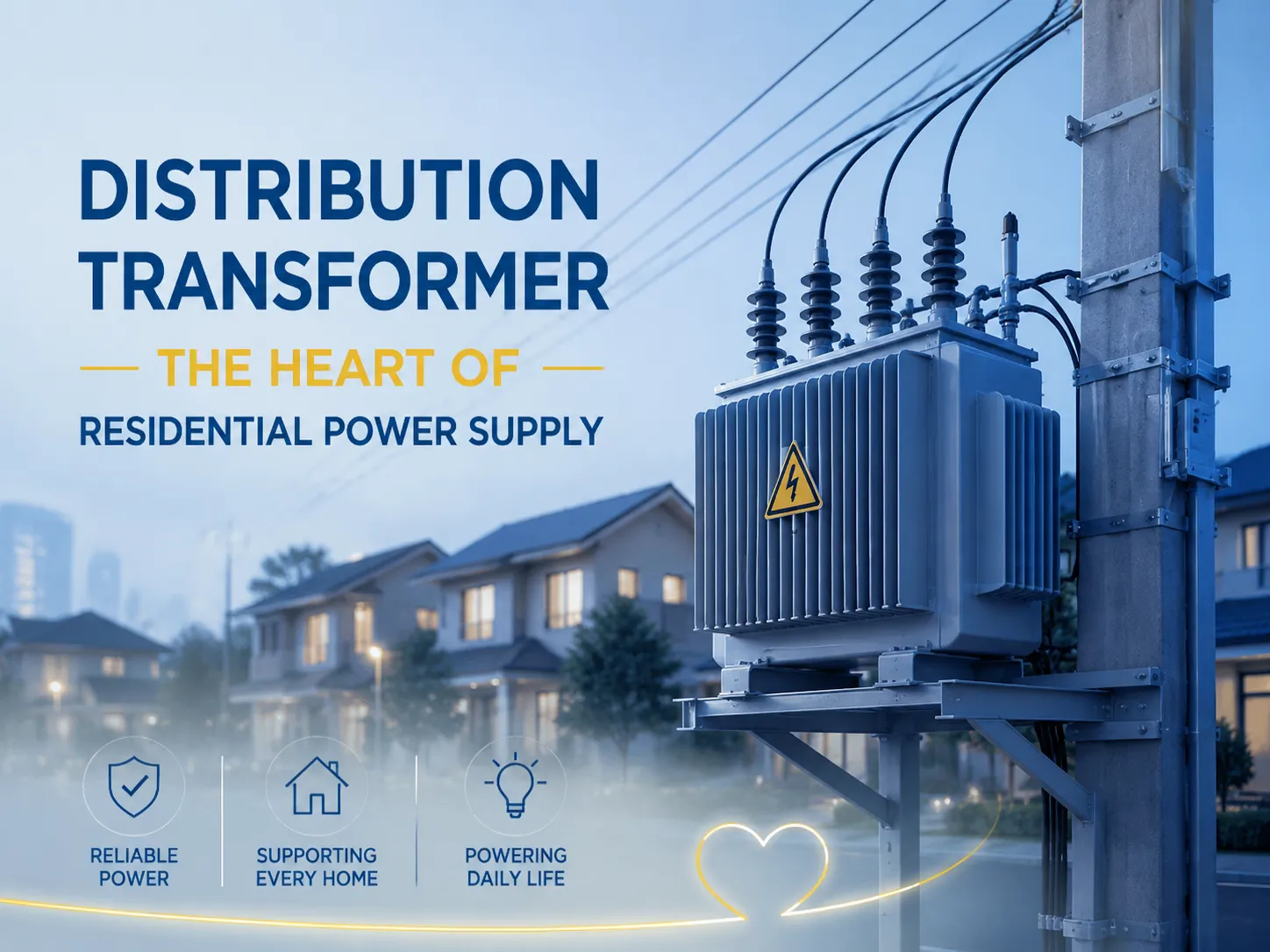
Why the Distribution Transformer Is the “Heart” of Residential Supply
Every heartbeat of residential power supply passes through a distribution transformer. The bulk transmission system runs at voltages greater than or equal to 110 kV to 220 kV, as utilizing high voltage enables efficient long-distance transmission of electricity. However, homes only utilize 230 V or 120 V, which is why the distribution transformer is needed to convert from a medium voltage to the required voltage supplied to the socket.
The following three features make it the heart of the system instead of just being one of the components:
- Continuity: Distribution transformers provide around-the-clock service and do not have a standby mode; if they stop functioning then everything down the line stops working too.
- Concentration: Distribution transformers handle the full load of their service area; in case of malfunction of one single transformer rated at 315 kVA about 300-400 homes would lose power until the transformer is repaired or replaced.
- Losses: Constant energy consumption leads to unaccounted power consumption, meaning that utility companies are looking to install energy-efficient distribution transformers without loss of functionality and flexibility in the future.
This concentration is the key factor as the supply reliability depends on the quality of the last distribution transformer in the chain. Reliability statistics demonstrates that in well-developed distribution networks the disruptions in electricity supply originate downstream, not upstream.
How a Residential Distribution Transformer Works
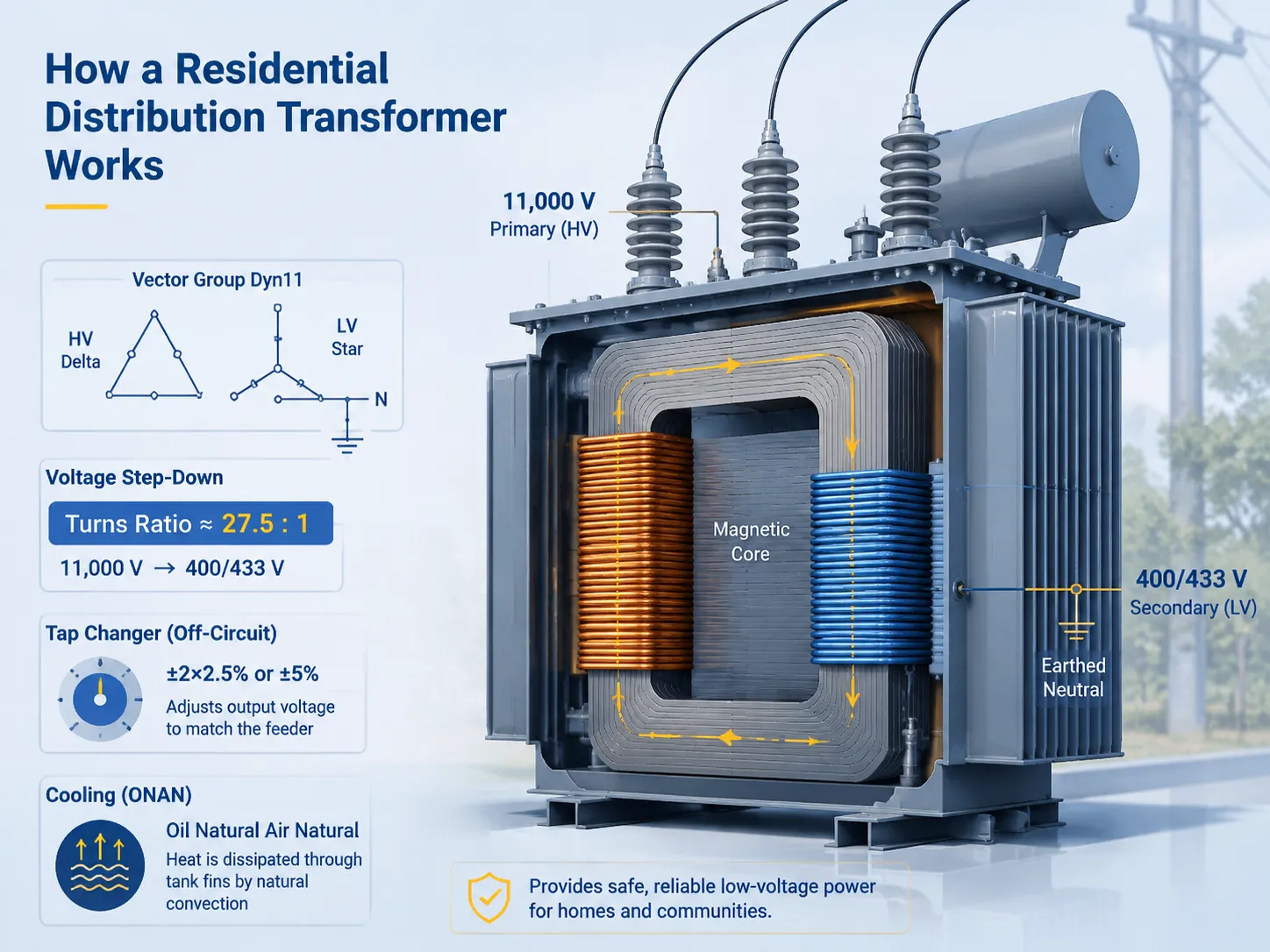
Within the well-known gray or green tank is conglomerate silicon-steel core that possesses two sets of windings; primary winding, which is linked with the medium voltage feeder, and the second windings, which is linked with the low-voltage lines of the street. The alternating current flowing in the primary winding produces electromagnetic force at the core resulting in generation of electric voltage at the secondary.The voltage of the transformer is determined by the ratio between the turns of the two windings( the example here is 11,000/400-433V; in this case, the ratio is 27.5:1). The secondary winding is made to produce 433 volts at no load and around 400 volts when the circuit is fully loaded.
Three important details come into play in case with residential buildings:
- Vector group Dyn11: In this case, delta- connected first winding and star-connected second winding as well as grounded neutral wire provide for reliable grounding for low voltage network that guarantees safety of houses.
- Tap changer: This is required as the utility can adjust the transformer according to actual voltage in the local feed on the territory.
- Cooling (ONAN): The mineral oil is used to keep the transformer cool which is done through natural circulation that is achieved through the fins of the tank made of metal.
Sizing and Ratings for Residential Areas
Utilities base the sizing of residential transformers on load research instead of counting the number of outlets. The underlying principle here is the concept of diversity. Not every home switches on all its electrical devices at the same time. As a result, in a residential neighborhood, maximum coincident power demand per household is normally between 1 and 2 kW, much lower than the total of connected loads.
| Transformer rating | Households served | Typical application |
|---|---|---|
| 25 kVA | 12–20 | Rural hamlets, farm clusters |
| 50 kVA | 30–50 | Small villages, street ends |
| 100 kVA | 60–120 | Suburban streets, small developments |
| 200 kVA | 120–250 | Larger subdivisions |
| 315 kVA | 200–400 | Dense suburbs, apartment blocks |
| 630–1,000 kVA | 500–1,000+ | High-rise apartments, district centers |
The above calculations assume that appliance penetration is limited (lighting, refrigeration, TV, and a bit of cooking). So, for appliance penetration of electric water heating, electric vehicle charging, or air conditioning above 50%, demand per household approximately doubles. Therefore, the above example indicates that the suburb has outgrown its 100 kVA unit. The best way is to carry out a load study, add a margin of 15-25%, and then repeat the calculations as the area becomes denser.
Types Used in Residential Networks
Residential supply uses a small number of standardized transformer types, chosen by mounting and network style.
| Type | Ratings | Where used | Approx. FOB price (China) |
|---|---|---|---|
| Single-phase pole transformer | 5–167 kVA | North American-style rural/suburban | $350–$1,500 |
| Three-phase pole transformer | 15–315 kVA | IEC-style rural and suburban | $1,500–$5,000 |
| Pad-mounted transformer | 25–2,500 kVA | Urban, underground networks | $900–$12,000 |
| Dry-type (cast resin) | 50–2,500 kVA | Inside buildings, basements, towers | $3,500–$30,000 |
| Amorphous-core unit | 15–1,000 kVA | Efficiency-driven programs | +15–25% over standard |
Houses in large towns usually utilize dry-type installations in basements as the use of oil-filled containers in occupied buildings does not comply with fire regulations, while houses in the suburbs normally utilize an electric pole (overhead network) and pad transformers (underground network).
Why Residential Transformers Fail
Comprehending the various types of failure helps define what requires checks and specifications. The lead causes, ranked roughly by frequency in the section on residential fleets:
| Failure cause | Typical share of failures | Prevention |
|---|---|---|
| Overload / thermal aging | ≈ 25–35% | Correct sizing, load monitoring |
| Lightning surges | ≈ 20–30% (storm regions higher) | ZnO surge arresters, good grounding |
| Insulation degradation | ≈ 15–25% | Oil testing, moisture control |
| Moisture ingress | ≈ 10–15% | Sealed tanks, gasket maintenance |
| Manufacturing defects | ≈ 5–10% | Factory testing, type-tested designs |
| Animal contact / vandalism | ≈ 5% | Enclosure, guarding, placement |
Lightning is mentioned here because of its dramatic impact and preventability. A direct hit or an incident nearby brings a high frequency impulse to the primary winding; without a properly grounded surge suppression device, insulation fails, which is usually evidenced by an exploded bushing or a burned winding. Installation and maintenance of the ZnO surge suppression device represents the cheapest solution.
Protection and Installation
The level of safety of a residential distribution transformer directly depends on surrounding presets. The regular safety package covers the following aspects:
- Fuse cutout on the primary serves to isolate the faulty transformer from the feeder. The cutout’s size corresponds to the magnetizing inrush when starting its work (usually 10-12 times the rated current for about 0.1 s without nuisance blowing).
- The surge arrester on the primary is a ZnO arrestor with the voltage rating for BIL of the system. Surge arrester has to be grounded with the impedance lower than 10 ohms.
- Protection on the secondary side includes installation of a low-voltage breaker or fuse on the transformer (where regulations require) to protect the LV network in case of overloads.
- Grounding of a transformer tank, LV neutral and grounding of surge arrester have to be bonded together with the grounding electrode.
- Safety of enclosure is also important — pad-mount transformers are supplied in locked tamper-proof enclosures, and pole transformers have to comply to minimum clearance standard from the tank to the ground and to buildings.
The installation of 100 kVA pole transformer can be carried out by 2 qualified specialists using a boom truck and may take from 1 to 2 hours to install a transformer at an existing pole and make all necessary connections, including the arresters, fuse cutouts, grounding and low voltage connections. Safety commissioning tests are done by checking the tap position, the phase rotation (three-phase), and insulation resistance (using megger).
Maintenance and Lifespan
A transformer which is well-secured and properly charged has a lifespan of 25 to 35 years. The maintenance schedule is simple but unavoidable.
| Interval | Task | Key threshold to watch |
|---|---|---|
| 2–3 years | Oil test (dielectric, moisture, acidity, DGA) | Dielectric ≥ 30 kV/2.5 mm; moisture < 30 ppm |
| Annual | Visual inspection | No leaks, corrosion, or low oil level |
| Seasonal (peak load) | Load check against nameplate | Peak load < 80% of rating for long periods |
| Annual | Arrester and fuse check | No cracked porcelain, no signs of discharge |
| 5 years | DGA trend review (larger units) | No rising H2 or CH4 trend |
The reality of the economics of aging is harsh: an increase of temperature of 8 K is equal to a cut in life of insulation in half. A transformer operated under conditions of 1.3 of its rated load in hot summer evenings deteriorates many times faster than its respectable life span — this being the reason why the transformer in our introductory scene had to be replaced much earlier than it had been designed to.
Brands, Quality, and Price Ranges
Although residential distribution transformers are uniform items, the brand selection encompasses great differences in terms of cost and functionality. In the table below, we present the comparison of a 100 kVA three-phase transformer on an FOB basis.
| Brand / source | Country | 100 kVA price range | Notes |
|---|---|---|---|
| ABB | Switzerland | $4,200–$6,500 | Global service, premium build |
| Siemens | Germany | $4,000–$6,800 | Proven utility base |
| Schneider Electric | France | $3,800–$6,200 | Strong LV ecosystem |
| Hitachi Energy | Switzerland/Japan | $4,500–$7,000 | Utility-grade reputation |
| Eaton | Ireland/USA | $3,500–$5,800 | Americas residential strength |
| TBEA / China XD | China | $1,600–$2,800 | Large state-backed manufacturers |
| Jiangsu Subian Electric Power | China | $1,400–$2,400 | Export-focused, IEC 60076 tested |
International brands that have established themselves in the market — ABB, Siemens, Schneider Electric, and Hitachi Energy — are recognized for their reliability data that they have acquired over millions of unit-years. The companies provide local engineering support and financing recognition. For the utility companies and developers who value these assurances, the added cost of two or three times than the cost price in China seems justified and reasonable.
For the purposes of domestic applications that require installation of hundreds and thousands of devices for new residential complexes, electrification projects, or fleet renewals, Jiangsu Subian Electric Power is an alternative company to consider. The company manufactures both single-phase and three-phase transformers in pole-mounted and pad-mounted types with capacity ranging from 5 kVA to 2,500 kVA. The company performed manufacturing in accordance with IEC 60076 standards and received certificates for its products. The manufacturing process is also assisted by production of amorphous cores meeting the efficiency standards and provision of various voltage and vector combinations of electric transformers as well as fuse and surge arrestor installations.
Upgrading an Overloaded Transformer
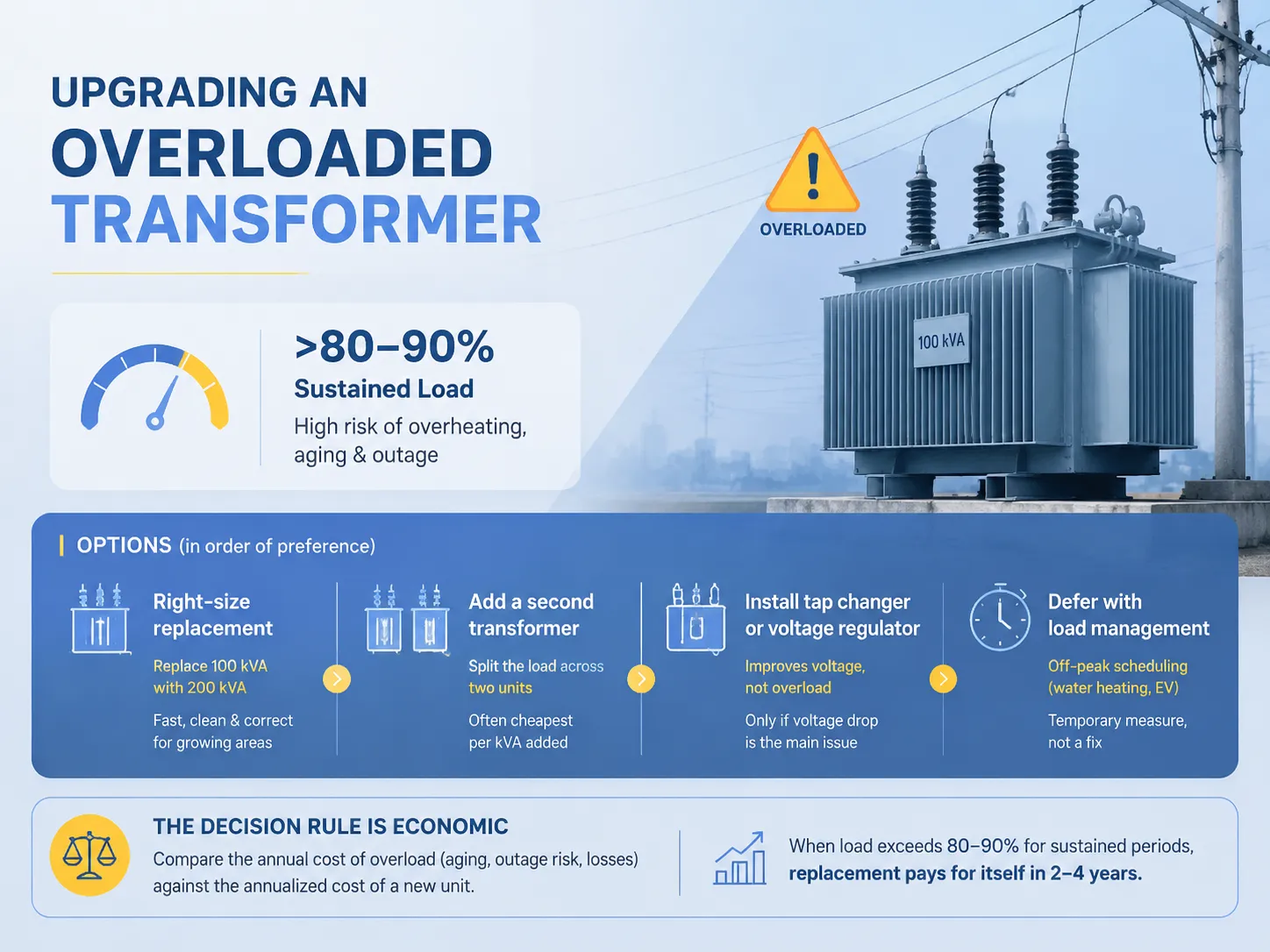
When a residential transformer is subject to the load limit, the preferences are listed as under:
- Change to the appropriate size transformer: The replacement of 100 kVA transformer with 200 kVA transformer is the right approach — the cost of the whole process would be around $2,500–$5,000.
- Consider the installation of an additional transformer: The load can be divided between the two transformers where the network allows — this is usually the least expensive option.
- Install either an on-load tap changer or a voltage regulating device: This might help to solve the problem of the voltage drop; however, in this case, the problem of the overload aging remains.
- Strategize with the help of load managing: This way you obtain temporary relief, but as an outcome, the problem with the overload is still left unattended.
The guideline in this case relies on the costs of the excess load (rapid aging, the possibility of the failure, and energy losses) that need to be compared to the annualized cost of the new transformer. In most situations, when the transformer is not able to handle the load correctly for a long time and is operating near the 80-90% of its rated output, the expenses justified within 2-4 years.
Frequently Asked Questions
How many homes does a 100 kVA distribution transformer serve?
Assuming a maximum utility demand of 1-2KW per household for lighting, refrigeration, television, and some cooking, then at peak times of consumption approximately 60-120 households can be supplied from a utility. Heavy usage of air conditioning, electric water heating or charging of electric vehicles reduces this number to a range of 30–60 residences. The values that utilities refer to come from the load research of their specific regions.
How long does a residential distribution transformer last?
25-35 years under the right loads, protection, and maintenance. That is a right overload is the main killer: every 8 K above the 65 K winding temperature rise decreases insulation durability by half. A unit operated at a 1.3× rating each summer can be completely worn out in 10-15 years, that is why electric companies like to right-size.
Why does my neighborhood transformer hum and sometimes buzz?
The humming sound can be attributed to magnetostriction. Magnetostriction is the action of the core’s silicon steel that expands and contracts 100 times each second producing the sound of 100/120 Hz which is normally around 40-55 dB(A) at a distance of 30 meters. The intensity of this sound increases as the load increases. A loud, distorted, or irregular buzzing sound may indicate incorrectly fixed core clamping, presence of high-frequency harmonics (often generating due to many switching and LED drivers), or emergence of internal faults which should be reported to the electricity supplier.
What causes a pole transformer to catch fire or explode?
In most scenarios, the insulation defect arises due to lightning surges or excessive loading conditions, and most of the time the situation is aggravated by humidity-ridden oil which is mostly old. Fault current vaporizes oil, and pressure relief ways open to avoid tank explosion. Zinc oxide surge arresters, proper fuse sizing, oil testing, and not loading too much work as the methods of prevention of such failures. New tanks also have hermetic designs and pressure relieving installations in order to decrease the failure risk.
How much does it cost to replace a residential transformer in 2026?
Regarding the transformers, FOB China prices quoted are single-phase models between $350-$1,500, and for three-phase models between $1,500-$8,000 (for 15-500 kVA units). The pricing for dry-type models is about 30-50% higher. Adding around 30-50% more cost for transportation, installing, armoring, fuses, and commissioning gives us around $4,000-$8,000 for a 200 kVA pole transformer, while the total cost for a pad-mounted transformer will typically range between $6,000-$15,000.
References
- IEC — Publisher of IEC 60076, the core standard for distribution transformers.
- IEEE — Source of IEEE C57.12.00 / C57.12.20 standards for the Americas.
- NEMA — TP-1 efficiency standard for distribution transformers.
- U.S. Department of Energy — Distribution transformer efficiency and reliability data.
- International Energy Agency (IEA) — Distribution losses and grid reliability analysis.
- U.S. EPA — Guidance on surge protection and transformer environmental management.
- Jiangsu Subian Electric Power — Manufacturer of residential pole- and pad-mounted distribution transformers.
Conclusion
This transformer is said to play the central role in power supply for the residential sector because all electrical power required for home usage comes through this device, and it is the condition of this device that determines whether thirty or three hundred homes have electricity even in the hottest night. Correct size, protection, and maintenance are combinations that allow this transformer to operate without disturbances for up to 25-35 years.
- Make the size selection based not on the number of sockets, but rather on the load study and make sure to add a margin of 15-25% of capacity growth.
- Make sure that every transformer in the subgroup has proper surge arresters, correctly rated fuse cutouts, and good grounding.
- Conduct oil tests every two or three years and shut down and replace transformers that were overloaded long before their reached the end of their operation.
- In buying transformers, specify that the manufacturer must provide IEC 60076 testing results and loss guarantees regardless of whether the manufacturer is ABB, Siemens, Schneider or Jiangsu Subian Electric Power.