


When the substation engineer looks at the document for a tender concerning the 132 kV transmission upgrade, one of the first specification sheets being reviewed is normally the power transformer classification table since a wrong choice can cost up to hundreds of thousands as well as cause months of delay in the commissioning process. Each of the types of power transformer classification is created to address a particular problem in terms of voltage, load, and reliability no matter whether it is a 10 MVA distribution unit operating in a block of factory factories or a 400 MVA generator step-up transformer installed at a coal power plant.
The provided article describes all the possible methods to classify power transformers, which could be by power function, by voltage level, by configuration of winding, by type of cooling, and by type of insulation material, etc.
Briefly put, power transformers can be categorized based on their function such as step-up transformer, step-down transformer, distribution transformer, isolation transformer and auto-transformer; based on their voltage class such as generator transformer, transmission transformer and distribution transformer; based on their winding configuration such as single phase transformer vs three phase transformer, two winding transformer vs three winding transformer; based on their cooling approach such as ONAN transformer, ONAF transformer, OFAF transformer and ODAF transformer and based on their insulation method such as oil immersed transformer and dry-type transformer.
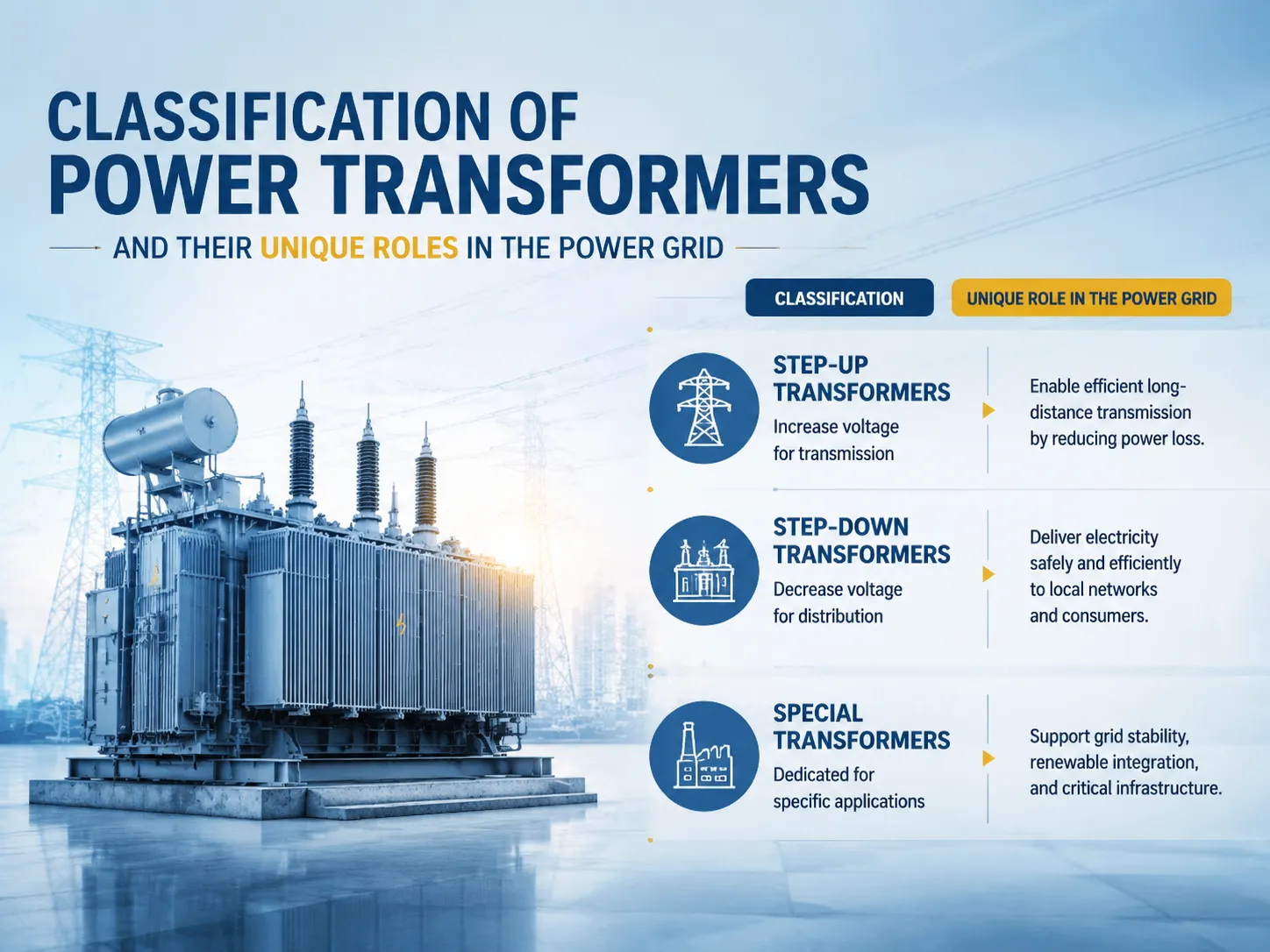
What Is a Power Transformer? (Definition & Core Function)
A power transformer is a static electromagnetic instrument that transmits electrical power through two or more circuits via the process of electromagnetic induction with a modification of the voltage levels while keeping the frequency and apparent power constant (with any losses). While distribution transformers primarily do the final voltage drop for consumption, power transformers are found in substations, generating plants, and big industries with ratings over 200 kVA and are able to process voltages starting from 3.3 kV to 1,150 kV class.
A power transformer can be characterized by three values: the rated apparent power in kVA or MVA, the rated voltage relation, and the impedance in case of short circuit (that is usually between 5% and 15% according to the international standard IEC 60076-5). The efficiency of a transformer at maximum operating capacity is usually between 98% and 99.7%. That is why utilities are willing to spend big money on low-loss amorphous core designs as well as on high-quality grain-oriented silicon steel to minimize no-load losses.
How a Power Transformer Works: The Electromagnetic Principle
The fundamental operating principle is based on Faraday’s law of electromagnetic induction. Alternating current in the primary winding produces fluctuating magnetic flux in the silicon steel core, linking the secondary winding, and inducing an electromotive force (emf) proportional to the number of turns according to the classic formula:
Vprimary / Vsecondary = Nprimary / Nsecondary (this is known as the turns ratio), so that Iprimary × Vprimary ≈ Isecondary × Vsecondary if other conditions are ideal.
A transformer operating in step-up mode has more turns in the secondary winding than the primary. A transformer operating in step-down mode has more turns in the primary coil. However, actual power transformers operate with losses of around 0.3% to 2%, which are due to copper the losses (I²R losses in the copper wires) and iron losses (due to hysteresis and eddy currents). Consequently, technical characteristics of any transformer mention the efficiency level, whether it is 50%, 75% or 100%.
Classification by Function: Step-Up, Step-Down, Distribution, Auto
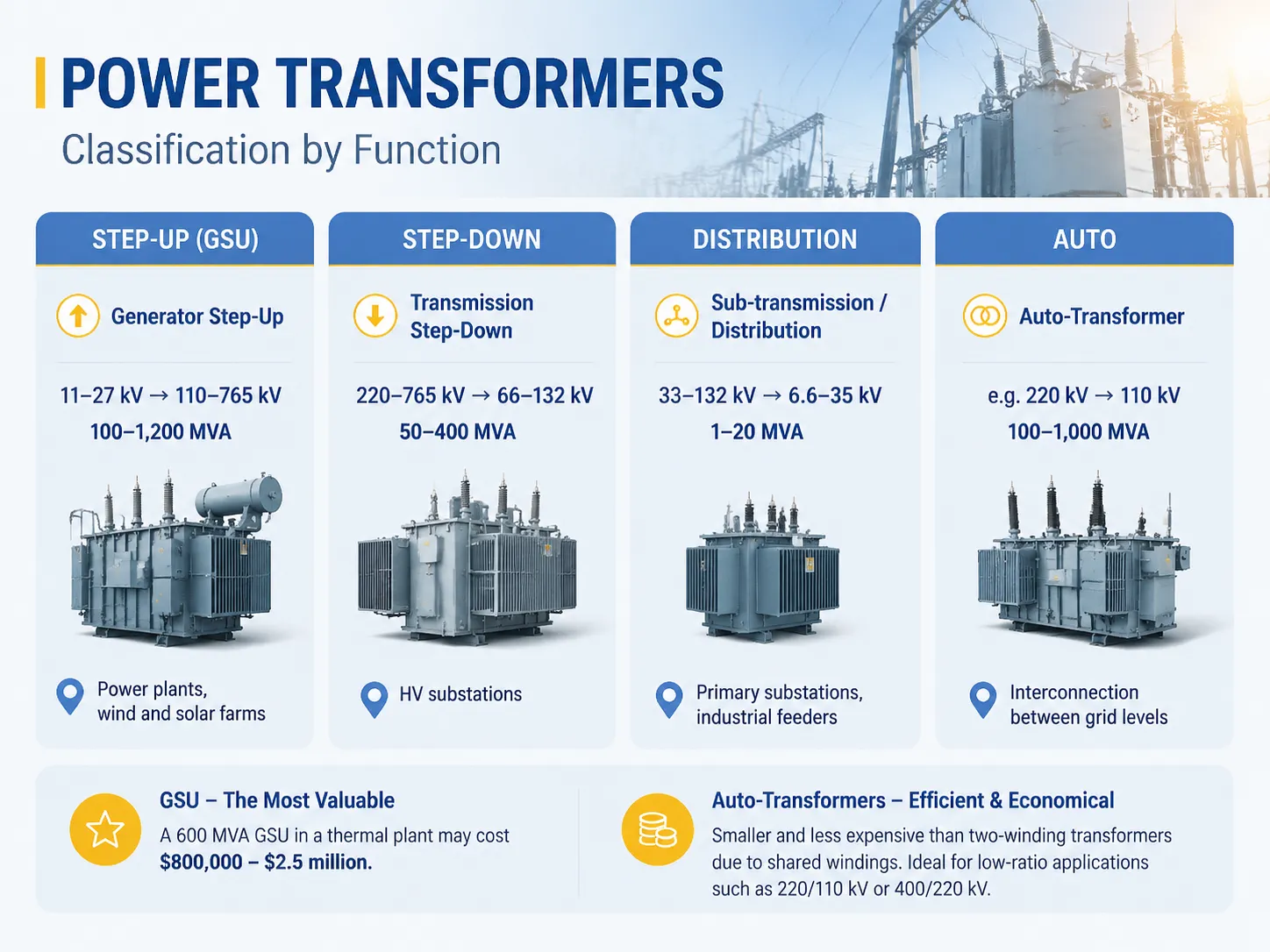
The function is the most pragmatic means of classifying power transformers since it indicates the location of the unit in energy transfer. The table that follows summarizes four different functional families of transformers commonly used by engineers in the grid.
| Function | Typical Voltage Change | Typical Rating | Where You Find It |
|---|---|---|---|
| Generator step-up (GSU) | 11–27 kV → 110–765 kV | 100–1,200 MVA | Power plants, wind and solar farms |
| Transmission step-down | 220–765 kV → 66–132 kV | 50–400 MVA | HV substations |
| Sub-transmission / distribution | 33–132 kV → 6.6–35 kV | 1–20 MVA | Primary substations, industrial feeders |
| Auto-transformer | e.g. 220 kV → 110 kV | 100–1,000 MVA | Interconnection between grid levels |
The GSU (Generator Step Up) transformer is located at the generator end of the spectrum, making it the most valuable piece of equipment within a power plant. In fact, a 600 MVA GSU transformer in a thermal plant may be priced between $800,000 and $2.5 million. While auto-transformers tend to be smaller and less expensive than the traditional two-winding transformer, it is possible since some of their winding is shared. Consequently, interconnection utility companies would choose to use auto-transformers, especially for low ratio voltage applications such as 220/110 kV or 400/220 kV.
Classification by Voltage Level in the Grid
The voltage class influences design of insulation and in the design of energy equipment including insulation techniques. The price of energy equipment is affected by the voltage class. Both standards IEC 60076-1 and IEEE C57.12.00 determine insulation techniques.
| Grid Level | Nominal Voltage | BIL (Lightning Impulse Withstand) | Typical Role |
|---|---|---|---|
| Generator voltage | 3.3–33 kV | 40–200 kV | GSU input side, auxiliary supplies |
| Medium voltage (MV) | 6.6–35 kV | 75–250 kV | Distribution substations, industrial |
| High voltage (HV) | 66–220 kV | 325–950 kV | Regional transmission |
| Extra high voltage (EHV) | 330–765 kV | 1,175–1,950 kV | National transmission backbones |
About 70% of all transformers in place globally are at the distribution stage, yet they account for only approximately 30% of the cost. A high-voltage unit with a 500-kV electrical system and a BIL value of 1,550 fills the requirements for thick insulation, wide neutral zones, and special test procedures (partial discharge tests and impulse tests according to IEC 60076-3), so installation of a powerful transformer may require spending $1.5–$3 million.
Classification by Phase and Winding Configuration
Power transformers can be classified based on their construction into either single-phase or three-phase transformers. This is based not just on their types but also on the number of their windings i.e. as two-winding transformers, three-winding transformers or auto-configured transformers. Single-phase transformers are widely accepted since they are cheaper and easier to transport, which is particularly helpful when it comes to highest EHV ratings (e.g. the formation of 3×333 MVA bank consisting of three single-phase transformers operating at 500 kV), while for 300 MVA or smaller variances three-phase transformers would be more suitable due to their advantage over single-phase variants in terms of losses, cost-effective solutions, and efficiency.
Three-winding transformers come with a tertiary winding and can thus be used not only for standard electrical loads but for harmonic filters, and to derive the third voltage (e.g. 220/110/35 kV). The vector group can be defined with the help of special designations, such as Dyn11, YNyn0, YNd11 etc., which show the transformer configuration and point of the voltage.
Classification by Cooling Method (IEC 60076-2)
The cooling system is what dictates the maximum amount of electrical energy that a transformer is able to handle safely. The acronym used in line with IEC 60076-2 refers to the type of cooling medium and method of its circulation.
| Cooling Code | Meaning | Typical Rating | Load Capability vs. ONAN |
|---|---|---|---|
| ONAN | Oil natural, air natural | 50 kVA–60 MVA | Baseline (100%) |
| ONAF | Oil natural, air forced (fans) | 1–150 MVA | ≈120–135% |
| OFAF | Oil forced, air forced | 10–300 MVA | ≈140–160% |
| ODAF | Oil directed, air forced | 100–1,200 MVA | ≈150–170% |
A transformer designed to operate in two cooling modes, ONAN and ONAF, means that a power utility can run it under normal circumstances in natural cooling mode while using fans in case of sudden overloads. A transformer with a capacity of 40 MVA, indicating its ratio as “40/56 MVA ONAN/ONAF” is a viable example. The necessary device components such as fans or oil pumps are not simple to maintain thus, smaller substations prefer ONAN designs only.
Oil-Immersed vs. Dry-Type Power Transformers
The insulation medium separates the market into two distinct categories, with both differences in pricing, safety, and use.
| Parameter | Oil-Immersed | Dry-Type (Cast Resin / VPI) |
|---|---|---|
| Insulation medium | Mineral oil or ester | Epoxy resin / air |
| Typical rating | 50 kVA–1,200 MVA | 100 VA–40 MVA |
| Price (1 MVA class) | $18,000–$45,000 | $28,000–$70,000 |
| Fire / environmental risk | Higher (oil containment needed) | Low, flame-retardant |
| Best locations | Outdoor substations | Indoor, high-rise, offshore |
There are oil-immersed transformers that dominate in the zero2 MVA range due to the efficient dielectric properties of oil. Dry transformers perform better in places like office buildings, hospitals, and on-offshore oil rigs and platforms where there are laws, such as NFPA 70, that prevent the use of oil-filled transformers due to fire dangers. Cast resin transformers usually cost between 40%-60% more than comparable oil models, but they do not require oil-saving pits and fire extinguishing systems.
Key Specification Table for Common Transformer Classes
In order to make a fair comparison among transformer models, engineers will choose the necessary fundamental parameters for each of the options in question. One of the charts below shows nameplate data of three typical units.
| Parameter | Distribution Unit | Substation Power Unit | GSU Unit |
|---|---|---|---|
| Rated power | 1,000 kVA | 20 MVA | 250 MVA |
| Voltage ratio | 11/0.4 kV | 110/20 kV | 18/400 kV |
| Vector group | Dyn11 | YNd11 | YNd11 |
| Impedance voltage | 6% | 10% | 14% |
| No-load loss | ≈1,150 W | ≈14 kW | ≈90 kW |
| Load loss | ≈10,500 W | ≈98 kW | ≈620 kW |
| Cooling | ONAN | ONAN/ONAF | ONAF/ODAF |
| Reference standard | IEC 60076-1 | IEC 60076-1 | IEC 60076-1 |
Loss assurance is important for people dealing with business: the loss value can improve or hinder the price of a transformer and can represent a 5%–10% difference as to the price of a transformer because a 1 kW difference in no-load losses over thirty years may cause the loss of tens of thousands of dollars.
The Unique Role of Each Transformer Class in the Power Grid
Each class is placed in its position in the energy chain, and none can be replaced with another one:
- GSU transformers — change the voltage produced by generators to the voltage for transmission at the generating plants and alternative sources site.
- Transmission step-down transformers function to interconnect high voltage and low voltage levels at major substations where they also regulate the voltage using on-load tap changers.
- Distribution transformers — are the last transformer which sets the voltage for consumption to 400/230 V and therefore constitutes the largest number of transformers in the world.
- Auto-transformer — interconnects neighboring voltage levels like 220 kV and 110 kV but should be installed only when the grounding is available due to its design.
- Phase-shifting transformer — an important tool in dealing with the issue of power flow in a parallel corridors and used more and more in mesh high voltage networks.
Distribution network designers say that up to 90 percent of losses in energy due to transformers happen in the distribution networks, which causes many countries (e.g. China and EU by virtue of GB 20052) to promote the use of amorphous core transformers with lower energy losses among the distribution transformers.
Top Brands & Realistic Price Ranges
Choosing a brand of power transformer comes down to balancing the initial purchase price, efficiency, lead time, and after-sales services that manufacturers provide. Well-known brands in the industry define the standard, whereas the oldest Chinese players provide approximately the same products that are compliant to IEC 60076 standards, but at 30%–50% lower prices.
| Brand | Headquarters | Strength | Indicative Price (20 MVA, 110 kV) |
|---|---|---|---|
| ABB / Hitachi Energy | Switzerland / Japan | HVDC, EHV expertise | $450,000–$700,000 |
| Siemens Energy | Germany | EHV and digital substations | $430,000–$680,000 |
| Schneider Electric | France | Distribution, EcoStruxure | $280,000–$450,000 |
| GE Vernova / Prolec GE | USA / Mexico | Utility-scale GSU | $420,000–$650,000 |
| TBEA | China | Large MVA, global EPC projects | $180,000–$320,000 |
| Jiangsu Subian Electric Power | China | Custom 50 kVA–220 kV class, OEM/ODM | $160,000–$300,000 |
The pricing is not exact; it’s going to be variable depending on specification, loss levels and location. Thus, all these values given below should be understood as guides rather than fixed prices. Jiangsu Subian Electric Power offers transformers ranging from 50 kVA to 220 kV class with multiple options including dry-type and oil-filled transformers. The company provides a lot of additional advantages; first, they offer prices that are 30-50% lower compared to Europe; secondly, their distributors keep deadlines and deliver to over 60 countries of the world.
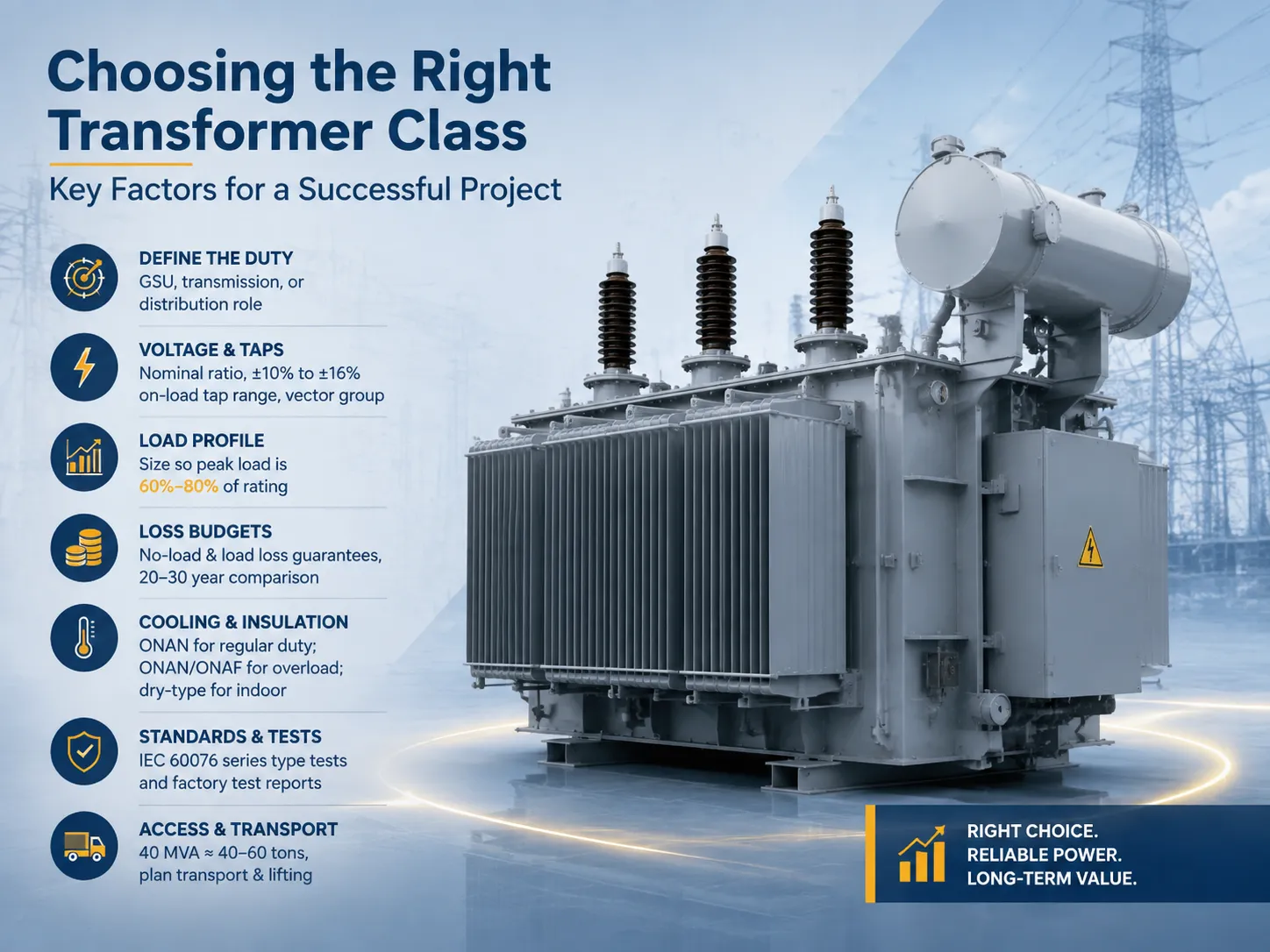
How to Choose the Right Transformer Class for Your Project
- Define the duty — a GSU, transmission, or distribution role resolves the entire design envelope.
- Check the voltage levels and tap range — establish the nominal ratio, ±10% to ±16% on-load tap range, and vector group with respect to your network.
- Calculate the load profile — determine the kVA/MVA size so that peak load lies between 60%–80% of the rating for the highest efficiency and margin.
- Establish loss budgets — ask for the no-load and load loss guarantees and carry out capitalized-loss comparison for a span of 20–30 years.
- Select cooling and insulation — ONAN for regular outdoor duty; ONAN/ONAF for overload flexibility; dry-type within the building.
- Check standards — obtain IEC 60076 series type tests (dielectric, temperature rise, short-circuit) and factory test papers.
- Consider access and transport — a 40 MVA unit has a weight of 40–60 tons and may need special transportations and labor study.
Frequently Asked Questions
What is the difference between a power transformer and a distribution transformer?
Power transformers manage high capacities (generally over 200 kVA) at the transmission or sub-transmission level and are built for full-load operation with voltage regulation; a distribution transformer is the last step-down transformer (normally 5 kVA–2,500 kVA) that reaches end users and operates mostly at partial load. Distribution transformers greatly outnumber power transformers; there are millions of them in the world while power transformers make the most valuable part of the substation.
What does the turns ratio of a transformer mean in classification?
The turns ratio N1/N2 is equal to the primary-to-secondary voltage ratio at no-load conditions which provides a true indication as to whether the transformer is a step-up transformer (i.e. N2 > N1), a step-down transformer (i.e. N1 > N2) or if it is an isolation transformer operating at 1:1 ratio. For example, the transformer having 110 kV/20 kV rating will have a ratio of 5.5:1 whereas GSU transformer stepping voltage down from 18 kV to 400 kV will have a ratio of around 22:1.
Which cooling class is best for a 20 MVA substation transformer?
The majority of electricity providers opt for ONAN/ONAF models, as its normal load is supported by natural cooling and forced air cooling (usually in the range of 120%-135% of the ONAN rating) accommodates peak loads and temporary overloads. Complete OFAF/ODAF designs include a pump and the oil’s movement direction, increasing both the efficiency as well as its maintenance costs.
How much does a power transformer cost in 2025?
The majority of electricity providers opt for ONAN/ONAF models, as its normal load is supported by natural cooling and forced air cooling (usually in the range of 120%-135% of the ONAN rating) accommodates peak loads and temporary overloads. Complete OFAF/ODAF designs include a pump and the oil’s movement direction, increasing both the efficiency as well as its maintenance costs.
Do I need an oil-immersed or a dry-type transformer?
When it comes to outdoor substations with capacities greater than 2 MVA, the most cost-effective option is oil-immersed type. However, within the indoor or high-rise applications such as fire-sensitive locations and offshore buildings, dry-type varieties should be used since oil containment and fire suppression are thus difficult to achieve. So, while a 1 MVA cast resin unit may cost $28,000–$70,000, oil-immersed units are generally sold in the range of $ 18,000 to $45,000.
References
- IEC 60076-1: Power transformers — General — The international standard defining ratings, tolerances, and test procedures for power transformers.
- IEC 60076-2: Temperature rise — Specifies temperature-rise limits and cooling classes used in transformer classification.
- IEC 60076-3: Insulation levels and dielectric tests — Defines BIL and dielectric test requirements per voltage class.
- IEEE C57.12.00: General Requirements for Liquid-Immersed Distribution, Power, and Regulating Transformers — The North American companion standard to IEC 60076.
- NFPA 70: National Electrical Code — Governs transformer installation, clearances, and protection in the United States.
- Hitachi Energy Transformer Portfolio — Reference for modern EHV, HVDC, and generator transformer technology.
Conclusion
It is crucial to understand the importance of power transformer classification. This is the biggest factor that will determine whether one will buy correct equipment. The function of transformer, voltage class, winding configuration, cooling method, and insulation type will indicate the presence of the transformer in the grid, amount of load, and its price — starting from $1,500 for distribution transformers and ending with $2.5 million for EHV transformers.
- First of all, it is important to categorize equipment according to its function (GSU, transmission transformer, distribution transformer, and auto transformer), then according to its voltage, cooling method, and insulation type.
- Cooling class should be aligned to load profile of the transformer. Best flexibility-cost ratio for the transformer of up to 150 MVA is ONAN/ONAF.
- It is required to follow IEC 60076 in the contract for loss reserves, dielectric tests, and short circuit testing.
- There should be at least three suppliers compared according to the price for the MVA, capital loss estimation, and delivery period.
If your project needs distribution or power transformers from 50 kVA to 220 kV class with custom ratios and IEC type-test documentation, contact Jiangsu Subian Electric Power for a direct factory quotation and engineering consultation.