


Vous êtes soit l'ingénieur électricien travaillant sur un projet d'extension de réseau régional, soit un responsable des achats qui s'occupe de la mise en place de l'approvisionnement pour une usine de fabrication, soit le distributeur qui gère un projet d'électrification rurale et chaque devis d'équipement que vous recevez a un élément en commun : un transformateur de distribution immergé dans l'huile de 1000 kVA 35 kV. Lorsque vous demandez un devis à vos fournisseurs, la moitié d'entre eux mentionnera “S11-1000/35-0.4”, tandis que l'autre moitié se contentera de mentionner le nom sous “transformateur à huile 1000 kVA 35 kV S11”. Si vous vous êtes demandé ce que signifie ce numéro de modèle, pourquoi exactement S11 est une amélioration par rapport au modèle S9, et quel devrait être le prix de l'appareil, continuez à lire ce guide.
S11-1000/35-0.4 est le transformateur de distribution de choix à l'international dans la catégorie 35 kV. Il s'agit d'un transformateur triphasé, immergé dans l'huile, de 50 Hz et de 1000 kVA, responsable de la conversion de la tension de 35 kV en 400/230V. Dans cet article, nous décrirons les principes de fonctionnement du modèle S11, y compris la signification de tous les composants du numéro de modèle.
Réponse courte : Le S11-1000/35-0.4 est un transformateur de distribution triphasé, immergé dans l'huile, de 50 Hz avec une capacité nominale de 1000 kVA. Il a une tension primaire de 35 kV et une tension secondaire de 400 V (0,4 kV). “S” représente la configuration triphasée ; “11” désigne le numéro de série de conception avec des pertes à vide réduites de presque 30% par rapport à un ancien type S9 ; tandis que “1000” représente la capacité nominale et “35-0.4” le rapport de tension.
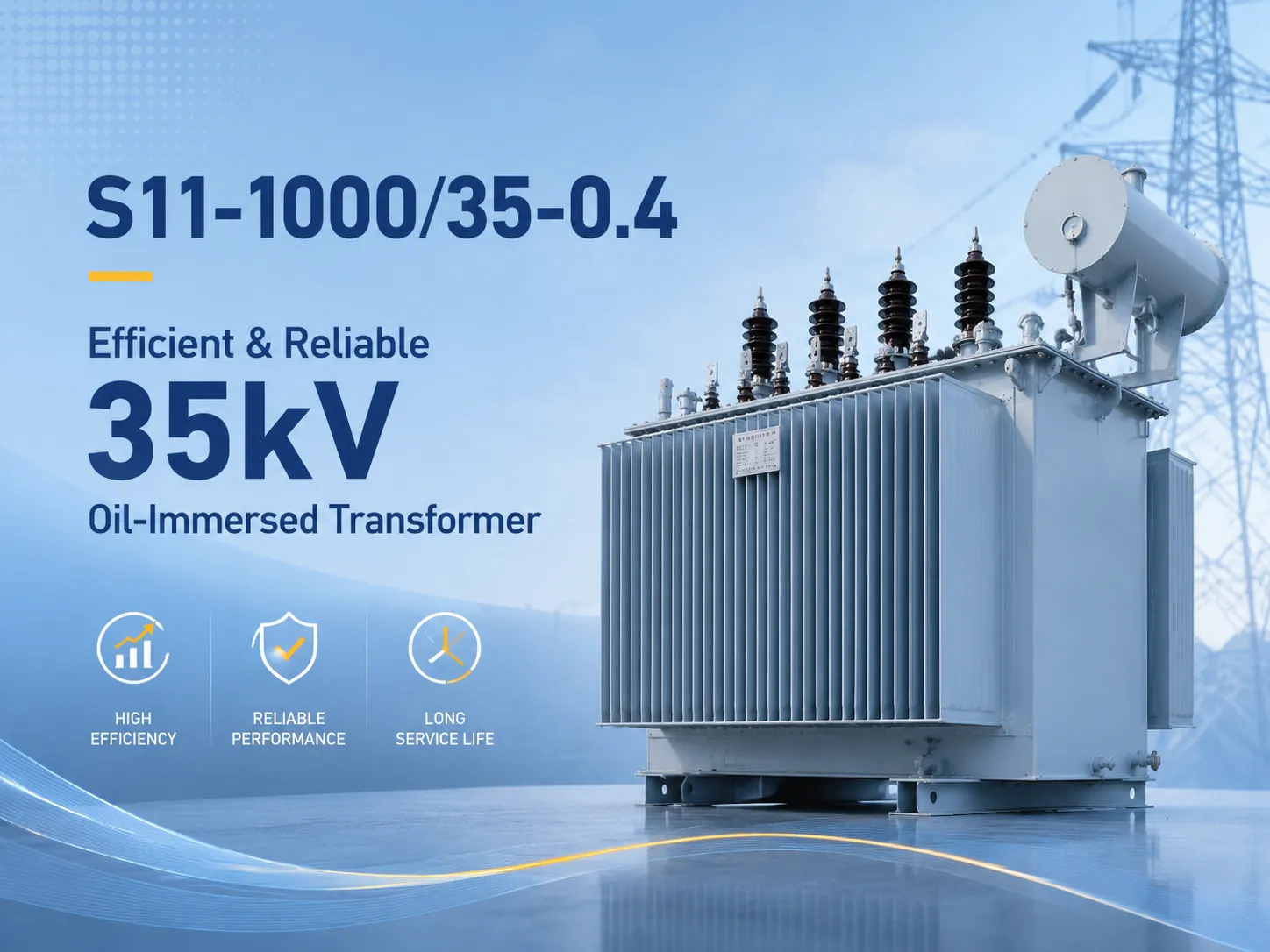
Décodage du numéro de modèle : Que signifie S11-1000/35-0.4
Les numéros de modèle de transformateur semblent cryptiques, mais dans la convention de nommage chinoise/ISO, chaque partie a une signification spécifique. Pour le S11-1000/35-0.4 :
| Partie | Signification | Détail |
|---|---|---|
| S | Triphasé | “S” (san xiang, 三相) indique une unité triphasée, par opposition à “D” pour monophasé |
| 11 | Série de conception | La 11ème série de conception, caractérisée par un noyau à faible perte utilisant de l'acier au silicium orienté à grain à froid |
| 1000 | Capacité nominale | Évaluation de la puissance apparente de 1000 kVA |
| 35 | Côté haute tension | Tension primaire nominale de 35 kV |
| 0.4 | Côté basse tension | Tension secondaire nominale de 0,4 kV (400V) |
Ainsi, “S11-1000/35-0.4” peut être interprété comme un transformateur triphasé de série 11 avec une capacité de puissance de 1000 kVA fonctionnant à 35 kV du côté d'entrée et 0,4 kV du côté de sortie. Certains fabricants indiquent les transformateurs comme S11-1000/35 ou S11-M-1000/35 ; la dernière lettre signifie que l'unité de transformateur est entièrement fermée et possède une isolation électrique profonde par le biais de l'huile. Lorsque la spécification contient des informations telles que “combinaison de tension 35 ± 2×2.5% / 0,4 kV”, cela signifie que le transformateur a un changeur de prises hors circuit avec la possibilité d'effectuer des ajustements par le biais de 5% du premier côté et fonctionnant à 0,4 kV du second côté du transformateur.
Qu'est-ce qu'un transformateur immergé dans l'huile de 1000 kVA 35 kV ?
Un transformateur à huile de 1000 kVA est qualifié de transformateur de distribution à moyenne tension qui reçoit l'énergie du réseau à 35 kV (ou d'une sous-station de 35 kV) et la réduit au niveau de basse tension de 400 volts – 230 volts obtenus à l'extrémité de la charge. Le terme “ à huile ” indique que l'enroulement et le noyau sont complètement immergés dans une huile isolante à des fins d'isolation et de refroidissement.
Dans la gamme des transformateurs de distribution, le transformateur de 1000 kVA est suffisamment grand pour fournir de l'énergie à des usines, des bâtiments, des hôpitaux et des groupes de centaines de maisons. En même temps, il est suffisamment petit pour être transporté par le fabricant en tant qu'unité unique (sur un camion) et installé soit sur une base à l'extérieur, soit dans une petite pièce de la sous-station. C'est un transformateur standard pour les réseaux de distribution de 35 kV en Chine, en Asie du Sud-Est, en Afrique, au Moyen-Orient et en Amérique latine.
Les données les plus importantes de toute fiche technique du transformateur sont :
- Capacité nominale = 1000 kVA (peut également être noté comme 1 MVA)
- Rapport de tension = 35kV / 0.4 kV (avec des prises hors circuit à 35 ± 2×2.5% kV)
- Fréquence = 50 Hz
- Groupe vectoriel = Yyn0 (ou Dyn11 sur demande)
- Refroidissement = ONAN (Huile Naturelle, Air Naturel)
- Tension d'impédance = 6.5% (pour cette taille)
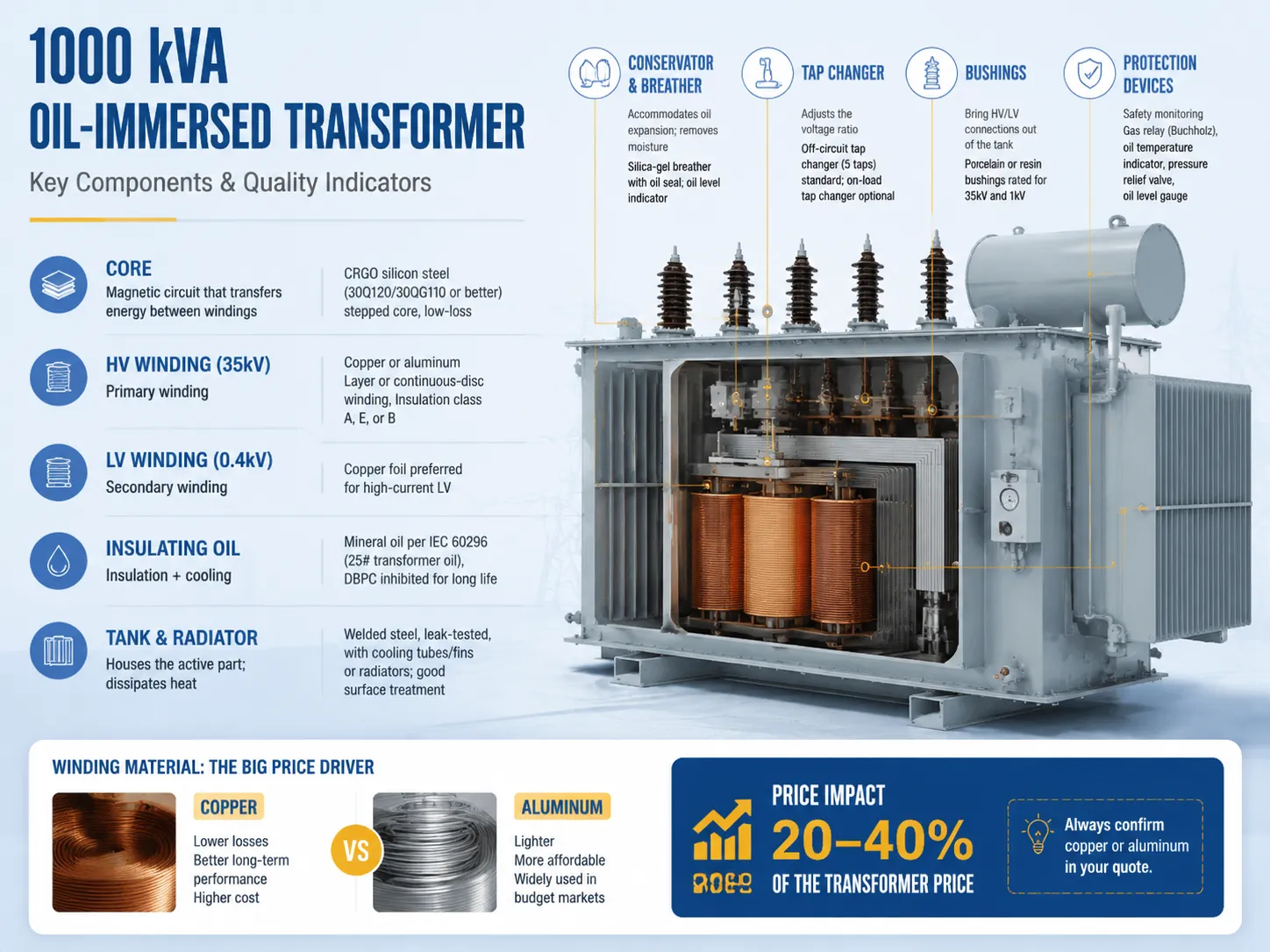
Construction & Composants Clés
Comprendre ce qu'il y a à l'intérieur du réservoir vous aide à juger de la qualité lors de la comparaison des devis. Un transformateur à huile de 1000 kVA se compose de ces principales parties :
| Composant | Fonction | Indicateur de Qualité |
|---|---|---|
| Noyau | Circuit magnétique qui transfère l'énergie entre les enroulements | Acier au silicium orienté à grain à froid (CRGO), conception de noyau en escalier, grades à faibles pertes (30Q120/30QG110 ou mieux) |
| Enroulement HT | Enroulement primaire de 35kV | Cuivre ou aluminium ; enroulement en couche ou en disque continu ; classe d'isolation appropriée (A, E, B) |
| Enroulement BT | Enroulement secondaire de 0.4kV | Enroulement en feuille ou en fil ; feuille de cuivre préférée pour le BT à fort courant |
| Huile isolante | Isolation + refroidissement | Huile minérale selon la norme IEC 60296 (par exemple, huile de transformateur 25#) ; inhibée DBPC pour une longue durée de vie |
| Réservoir & radiateur | Contient la partie active ; dissipe la chaleur | Acier soudé, testé pour les fuites, avec tubes/ailettes de refroidissement ou radiateurs ; bon traitement de surface |
| Conservateur & respirateur | Accepte l'expansion de l'huile ; élimine l'humidité | Respirateur en gel de silice avec joint d'huile ; indicateur de niveau d'huile approprié |
| Changeur de prises | Ajuste le rapport de tension | Changeur de prises hors circuit (5 prises) standard ; changeur de prises sous charge en option |
| Bagues | Amène les connexions HT/BT hors du réservoir | Bagues en porcelaine ou en résine classées pour 35kV et 1kV |
| Dispositifs de protection | Surveillance de la sécurité | Relais de gaz (Buchholz), indicateur de température de l'huile, soupape de décharge de pression, jauge de niveau d'huile |
Deux choix de matériaux dominent la différence de prix : enroulements en cuivre vs en aluminium. Le cuivre offre des pertes plus faibles et de meilleures performances à long terme, mais coûte significativement plus cher. L'aluminium est plus léger et moins cher et est courant sur les marchés orientés budget. Confirmez toujours quel métal est cité — c'est l'un des principaux moteurs de prix, et la différence peut être de 20–40% du prix du transformateur.
Spécifications techniques en un coup d'œil
Voici les spécifications représentatives pour un transformateur S11-1000/35-0.4 construit selon IEC 60076 / GB 1094 (valeurs typiques, confirmez les chiffres exacts avec la fiche technique du fabricant) :
| Paramètre | Valeur typique |
|---|---|
| Capacité nominale | 1000 kVA |
| Rapport de tension | 35 ± 2×2.5% / 0.4 kV |
| Fréquence | 50 Hz |
| Groupe vectoriel | Yyn0 (Dyn11 en option) |
| Méthode de refroidissement | ONAN |
| Perte à vide (P0) | ~1.15 – 1.45 kW |
| Pertes à vide (Pk à 75°C) | ~10.3 – 11.4 kW (cuivre) / ~11.5 – 13 kW (aluminium) |
| Tension d'impédance (Uk) | 6.5% – 7.0% |
| Courant à vide (I0) | ~0.7 – 1.0% |
| Niveau d'isolation (HV) | LI 200 kV / AC 85 kV |
| Niveau sonore | ~60 – 65 dB(A) |
| Normes | IEC 60076, GB 1094, GB/T 6451 |
| Type d'huile | Huile minérale selon IEC 60296 |
| Poids (total) | ~3,200 – 4,200 kg selon les matériaux |
| Dimensions (approximatives) | ~2.2 × 1.5 × 2.4 m (L×l×H avec radiateurs) |
Selon ces chiffres, le S11-1000/35-0.4 tombe dans la catégorie de perte standard “T2” dans le système chinois de classification de l'efficacité énergétique (GB 20052), qui est en dessous des modèles amorphes haut de gamme S13/S15, mais encore bien meilleur que les modèles S7/S9 obsolètes qui sont encore présents dans les anciens réseaux.
S11 vs S9 vs S13 : Comment les séries de conception se comparent
Les gammes de conception pour les transformateurs de distribution chinois sont marquées selon leurs générations, chaque génération étant plus efficace que sa prédécesseur. Voici une répartition des trois séries où l'efficacité à 1000 kVA à 35 kV est mesurée.
| Série | Matériau du cœur | Pertes à vide (1000kVA, approximatif) | Niveau de perte relative | Statut |
|---|---|---|---|---|
| S7 | Acier au silicium laminé à chaud | ~2.0 – 2.3 kW | Référence (la plus élevée) | Retiré (interdit pour les nouvelles acquisitions de réseau) |
| S9 | Acier au silicium CRGO | ~1.7 – 1.8 kW | ~25% inférieur à S7 | Héritage, encore courant en service |
| S11 | Acier au silicium CRGO de haute qualité | ~1.15 – 1.45 kW | ~30% inférieur à S9 | Norme actuelle dominante |
| S13 | Acier au silicium CRGO de haute qualité + conception améliorée | ~0.9 – 1.1 kW | ~25% inférieur à S11 | Option premium d'efficacité énergétique |
| S15 (amorphe) | Ruban en alliage amorphe | ~0.55 – 0.7 kW | ~50% inférieur à S11 | Efficacité maximale, coût plus élevé |
La série S11 est devenue le choix standard pour la distribution utilitaire et industrielle en raison de son rapport qualité-prix idéal. Une perte à vide de ~30% inférieure à S9 d'un S11 se traduit par des économies d'énergie de milliers de dollars USD pendant une durée de vie de service de 20 ans, c'est pourquoi de nombreuses entreprises de services publics dans le monde exigent désormais des unités S11 de la part des fournisseurs, et la Chine a cessé de permettre l'utilisation des unités S7 et plus anciennes dans le processus de connexion au réseau.
Si le projet est situé dans un pays avec des réglementations strictes en matière d'efficacité énergétique comme l'Eco-conception de l'UE ou le niveau 2 de la norme GB 20052 de la Chine, un S13 ou un S15 amorphe serait requis. Pour le reste des marchés, le S11 ferait l'affaire.
Applications : Où ce transformateur est utilisé
Le transformateur S11 de 1 000 kVA, 35/0,4 kV est utilisé dans diverses applications, qui incluent :
- Secteur industriel : pour les usines impliquant des lignes de production, des moteurs, le soudage et la CVC.
- Bâtiments commerciaux : il fournit de l'énergie aux bureaux, centres commerciaux, hôpitaux, hôtels et centres de données en tant que transformateur de distribution pour les systèmes basse tension.
- Électrification rurale : pour les réseaux de distribution des villages et des villes rurales alimentés par des lignes de 35 kV.
- Secteur de l'énergie : il réduit la tension des sous-stations PV et alimente les centrales éoliennes et solaires.
- Industrie minière : il fournit de l'énergie à des sites de travail isolés alimentés par une tension de distribution de 35 kV.
- Infrastructure : il est utilisé dans les aéroports, les gares, les stations de pompage d'eau, etc.
- Modernisation des systèmes électriques : il remplace les unités S7/S9 obsolètes par des unités à pertes plus faibles et à fiabilité accrue.
Dans tous ces projets, les transformateurs alimentent les tableaux de distribution basse tension, qui à leur tour fournissent de l'électricité aux systèmes de puissance de 400 V. Par conséquent, la défaillance de tels équipements électriques pourrait entraîner des problèmes significatifs qu'il faut éviter à tout prix.
Avantages clés de la série S11
Pourquoi l'électricité se vend-elle si bien ?
- Faibles pertes à vide : environ 30% inférieures à celles du S9, ce qui signifie qu'il y a moins de pertes avec les transformateurs stationnaires.
- Longue durée de vie : il est utilisé dans le monde entier depuis de nombreuses années.
- Faible entretien : La seule chose à faire est de changer l'huile et de réaliser des contrôles périodiques.
- Haute capacité de surcharge : Un réservoir d'huile a une grande capacité de surcharge (par exemple, 120% pendant au moins 2 heures selon la norme IEC 60076-7).
- Économies réalisées : Les prix des transformateurs à huile sont inférieurs à ceux des transformateurs à sec dans cette gamme.
- Standardisé : Les appareils ont été fabriqués selon les normes IEC 60076 et GB 1094 afin que les pièces puissent être facilement trouvées dans le monde entier.
- Installation simple : Tous les appareils sont livrés assemblés et mélangés à l'huile.
Les transformateurs à huile sont moins chers que les transformateurs de type sec car leurs prix varient de 30 à 50% selon leurs caractéristiques. Bien qu'il faille prendre en compte que l'unité à huile nécessite l'utilisation d'un conteneur en béton ainsi que le respect des réglementations incendie et des règles d'entretien.
Guide des prix : À quoi s'attendre
Les prix des transformateurs varient considérablement en fonction des matériaux, des accessoires et de la certification. Voici un guide réaliste pour 2026 pour un S11-1000/35-0,4 (FOB usine, hors fret et installation) :
| Configuration | Plage de prix (FOB) | Remarques |
|---|---|---|
| Enroulements en aluminium, accessoires de base | $11,000 – $15,000 | Option économique ; pertes plus élevées |
| Enroulements en cuivre, accessoires de base | $14,000 – $18,000 | Recommandé pour la plupart des acheteurs |
| Enroulements en cuivre + changeur de prises sous charge | $18,000 – $24,000 | Pour des charges sensibles à la régulation de tension |
| Enroulements en cuivre + package de protection complet | $16,000 – $22,000 | Relais Buchholz, manomètre de température d'huile, soupape de décharge, jauge de niveau |
| Marque premium (ABB/Siemens/Hitachi) | $25,000 – $45,000+ | Marque premium, réseau de service local |
Ce qui est inclus vs. éléments supplémentaires : le prix de base couvre souvent le transformateur lui-même, son huile, son réservoir, son bushing et les accessoires de base (qui incluent le conservateur, le déshydrateur et la jauge d'huile). Des coûts supplémentaires s'appliquent généralement au coût des changeurs de prises sous tension, des isolateurs de surtension, des armoires de contrôle de température, d'un type de peinture spécifique, d'une inspection par un tiers (SGS/BV/Intertek) et des frais d'expédition/emballage et de documentation. Demandez toujours une offre complète basée sur tous ces éléments pour des raisons de comparaison.
Pour le transport : une unité avec une valeur de puissance de 1 000 kVA pèse environ 3,5 à 4,5 tonnes tandis que le coût d'expédition est d'environ $1,500 à $4,000 selon le point de destination, plus les frais de douane et de transport locaux.
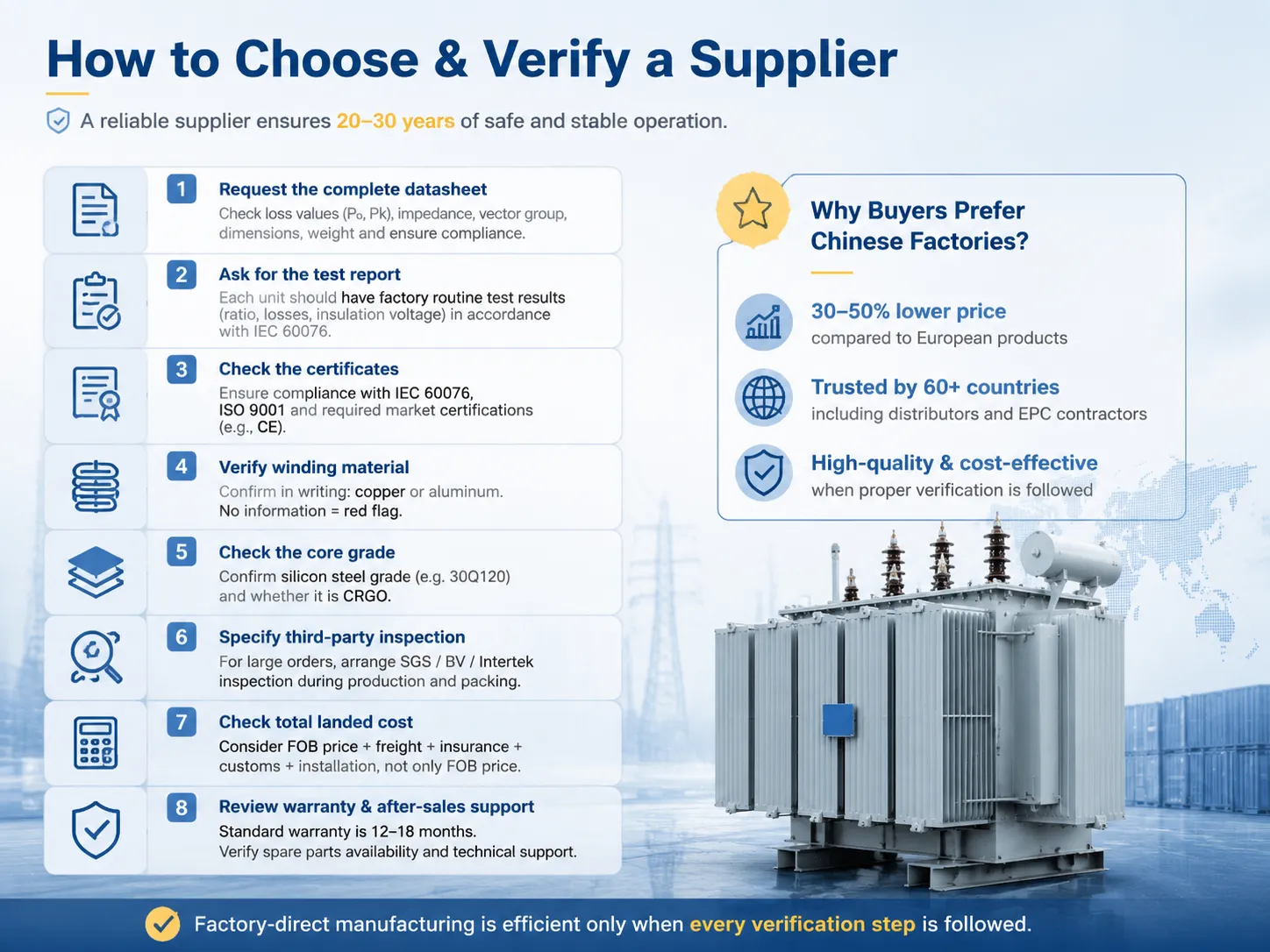
Comment choisir et vérifier un fournisseur
Étant donné l'espérance de vie du transformateur de 20 à 30 ans, le choix de son fabricant est tout aussi crucial que le choix des spécifications. Voici un processus de vérification simple à suivre.
- Demandez la fiche technique complète : ses valeurs de pertes (P0, Pk), impédance, groupe vectoriel, dimensions, poids et vérifiez si les données obtenues correspondent aux normes pour votre classification.
- Demandez à l'usine de fournir le rapport d'essai. Chaque unité est expédiée avec les détails des tests de routine de l'usine (rapport, pertes, tension d'isolation). Notez que le rapport doit être conforme aux règles IEC 60076 en cas de conformité IEC/GB.
- Vérifiez les certificats : vérifiez la conformité avec IEC 60076, le certificat d'usine ISO 9001 ainsi que les certificats demandés spécifiques à votre marché (ayant des tampons CE, etc.).
- Vérifiez le matériau des enroulements. Confirmez par écrit qu'il s'agit de cuivre ou d'aluminium. Si le devis ne contient aucune information sur le métal utilisé dans la fabrication, c'est un mauvais signe.
- Vérifiez la qualité du noyau : renseignez-vous sur la qualité de l'acier au silicium (par exemple, 30Q120), ainsi que sur le fait qu'il s'agit de CRGO.
- Spécifiez l'inspection par un tiers (le cas échéant) : en cas de grosses commandes, il est préférable d'ajouter une inspection SGS/BV/Intertek pendant la production et à l'étape d'emballage.
- Vérifiez le coût total à destination : pensez au prix FOB + fret + assurance + douanes + installation, pas seulement au prix FOB.
- Parcourez les conditions de garantie et de service après-vente : la période de garantie standard est de 12 à 18 mois ; vérifiez la disponibilité des pièces de rechange et du support.
Pourquoi les acheteurs préfèrent-ils les usines chinoises ? La Chine, représentée par Jiangsu Subian Electric Power et d'autres entreprises d'État, produit la majorité des transformateurs de distribution. Le prix des produits en provenance de Chine est généralement inférieur de 30-50% par rapport aux produits européens, c'est pourquoi les distributeurs et les entrepreneurs EPC dans plus de 60 pays achètent leurs transformateurs 35kV auprès des usines chinoises. Cependant, l'utilisation de la fabrication directe en usine n'a d'efficacité que si toutes les procédures de vérification sont respectées.
Essentiels de l'installation et de la maintenance
Notions de base sur l'installation
- Installer sur une base plane, en veillant à une circulation adéquate dans la zone entourant le réservoir ; respecter les exigences minimales du fabricant concernant l'espace entre les bushing et les radiateurs.
- Vérifiez les conditions de l'huile, tout en observant le gel de silice (bleu = sec, rose = imbibé), et les manomètres.
- Confirmez que le groupe vectoriel et les réglages de prise sont en accord avec le réseau en question.
- Connectez le réservoir au système de mise à la terre de manière appropriée ; ne jamais mettre sous tension un réservoir qui n'a pas été mis à la terre.
- Effectuez les tests essentiels : résistance d'isolement (IR), rapport, et résistance diélectrique de l'huile si l'unité a été hors service pendant longtemps.
Liste de contrôle de maintenance routinière
| Intervalle | Vérifications |
|---|---|
| Mensuel | Inspection visuelle ; vérification du niveau d'huile et des fuites ; couleur du gel de silice ; bruit inhabituel |
| Trimestriel | Vérifiez l'indicateur de température de l'huile pendant la charge ; confirmez que les ailettes de refroidissement sont propres |
| Annuellement | Test de résistance d'isolement ; analyse d'échantillon d'huile (résistance diélectrique, humidité) ; vérifiez le relais Buchholz et le dispositif de décharge de pression ; testez le fonctionnement du changeur de prise |
| Tous les 3–5 ans | Test complet de l'huile (tension de claquage, acidité, analyse des gaz dissous DGA) ; inspectez le revêtement du réservoir ; vérifiez les joints et les bushing |
L'analyse des gaz dissous (DGA) est considérée comme la meilleure analyse disponible car elle alerte sur les fractions de défaillances imminentes (qui impliquent une surchauffe, une décharge partielle et un arc). C'est une méthode rentable pour les tests annuels de toute machine essentielle de 1 000 kVA.
Questions Fréquemment Posées
Que signifie S11-1000/35-0.4 ?
La désignation S11-1000/35-0.4 désigne un transformateur de distribution triphasé à faibles pertes de la série 11 (S11) qui est immergé dans l'huile et a une capacité de 1000 kVA avec une tension primaire de 35 kV et une tension secondaire de 0,4 kV. Dans le numéro de série 11, les transformateurs sont fabriqués en acier au silicium orienté à grain laminé à froid, ce qui leur permet d'atteindre une réduction des pertes à vide d'environ 30% par rapport à celles des transformateurs de la série S9.
Combien coûte un transformateur 1000 kVA 35kV ?
Un transformateur immergé dans l'huile S11-1000/35-0.4 complet coûte généralement entre $11,000 et $22,000 FOB d'une installation de production chinoise, selon que les enroulements sont en cuivre ou en aluminium et en fonction du type de changeur de prise utilisé ainsi que d'autres accessoires. Les unités à enroulement en cuivre avec accessoires normaux coûtent entre $14,000 et $18,000 ; les prix des grandes marques européennes sont de $25,000 à $45,000+. Enfin, ajoutez entre $1,500 et $4,000 pour les frais de transport maritime vers la plupart des destinations.
Quelle est la différence entre les transformateurs S9, S11 et S13 ?
Ils font référence aux générations de conception récentes où chacun a moins de pertes à vide que son prédécesseur. Pour 1000 kVA, les pertes à vide sont (environ) : S9 : 1,7-1,8 kW, S11 : 1,15-1,45 kW (30 % de moins que le précédent S9) ; S13 : 0,9-1,1 kW (25 % de moins que S11). Les nouvelles unités à noyau amorphe S15 ont environ 50 % de pertes en moins, bien que leur coût soit supérieur à celui de S11. En attendant, S11 est la technologie actuellement dominante, tandis que S7 et les types plus anciens sont progressivement abandonnés à l'échelle mondiale.
Un transformateur de 1000 kVA 35kV peut-il être utilisé pour une usine ?
Oui, c'est l'une des capacités les plus utilisées parmi les usines de taille moyenne. Un transformateur de 1000 kVA à 400V a une capacité de courant d'environ 1400A par phase (environ 800-900 kW de charge continue selon le facteur de puissance opérationnel). Dans une usine avec plusieurs lignes de production, moteurs et systèmes CVC, c'est une taille idéale ; les usines plus grandes peuvent avoir plusieurs transformateurs ou un plus grand.
Combien de temps dure un transformateur immergé dans l'huile ?
À condition que le transformateur soit correctement entretenu, les transformateurs remplis d'huile S11 ont une durée de vie normale de 25 à 30 ans. À cet égard, certains des facteurs les plus importants affectant la durée de vie des transformateurs à huile sont : la qualité de l'huile (tests annuels de la qualité de l'huile), DGA, profil de charge (c'est-à-dire pour éviter les surcharges continues), température de fonctionnement et conditions de l'environnement. Des transformateurs bien installés et bien entretenus peuvent servir plus de 40 ans.
Références
- IEC 60076-1 : Transformateurs de puissance — Général — La norme internationale principale régissant les classifications, les pertes, l'impédance et les tests des transformateurs de puissance, y compris la classe 35kV.
- IEC 60076-7 : Guide de chargement des transformateurs de puissance — Le guide de chargement définissant la capacité de surcharge et les limites thermiques pour les transformateurs immergés dans l'huile.
- Série GB 1094 (Norme chinoise des transformateurs de puissance) — La norme nationale chinoise pour les transformateurs de puissance, fonctionnellement équivalente à l'IEC 60076 et requise pour les unités connectées au réseau en Chine.
- IEC 60296 : Fluides pour applications électrotechniques — Huiles minérales isolantes non utilisées — La norme spécifiant les exigences de qualité pour l'huile minérale des transformateurs.
- U.S. DOE — Efficacité des transformateurs de distribution — Contexte sur l'importance de l'efficacité des transformateurs pour la consommation d'énergie et l'économie des coûts de perte.
- Jiangsu Subian Electric Power Co., Ltd. — Fabricant chinois de transformateurs immergés dans l'huile et de transformateurs à sec (séries S11/S13/S15, 10–110kV), certifié IEC 60076 et exportant dans le monde entier ; une référence directe d'usine pour les prix et l'approvisionnement.
Conclusion
Le S11-1000/35-0.4 est un transformateur extrêmement fiable utilisé dans les systèmes de distribution de 35 kV. Le transformateur triphasé est imprégné d'huile et a une puissance de 1 000 kVA. Le nom du modèle de l'appareil sert de description. Il se caractérise par une conception triphasée à faible perte de type S11, étant un transformateur triphasé avec 1 000 kVA de puissance. Voici une liste de ce que les clients doivent suivre :
- Soyez aussi précis que possible concernant les spécifications. Il est essentiel d'indiquer si les enroulements du transformateur sont en cuivre ou en aluminium, le type de changeur de prises, les accessoires et les certifications (IEC 60076 / GB 1094).
- Vérifiez tout avant de faire un achat. Demandez à votre fournisseur les spécifications détaillées, le rapport d'essai d'usine et une offre avec une liste détaillée des extras.
- Estimez réalistement l'argent que vous prévoyez de dépenser. Le prix du transformateur variera de $11,000 à $22,000 avec livraison depuis la Chine.
- Achetez ce qui est correctement entretenu. Les tests annuels de l'huile et les tests de diagnostic vous aideront à protéger un actif pendant près de 30 ans.
- Faites des achats intelligents concernant les fournisseurs de l'unité en Chine. Les bons fournisseurs vous aideront à économiser considérablement votre argent.
Le S11-1000/35-0.4 est définitivement votre meilleur choix si vous remplacez votre ancien unité S7/S9 ou si vous mettez un S11 dans un nouvel emplacement.