


Un ingénieur du projet en charge d'une entreprise de services publics formule des spécifications pour un transformateur de puissance principal d'une capacité de 40 MVA avec une tension de 132/33 kV qui peut réguler le bus de distribution de 33 kV de toute la région. Le processus de conception du transformateur est presque terminé, mais un point a soulevé des questions lors des réunions tenues : il s'agit du changeur de prises sous tension, qui a suscité de nombreuses questions à son sujet. Les évaluations de divers fabricants ont été préparées du point de vue technique, mais leur coût peut différer de 30%, les intervalles de maintenance diffèrent par 3 fois, et les métriques de service à travers différents designs ne sont pas disponibles dans les fiches techniques. L'ingénieur comprend que l'utilisation du changeur de prises sous tension est critique pour le coût de l'exploitation du transformateur pendant une période de 30 ans.
L'objectif de cet article est de fournir des informations sur la sélection des changeurs de prises sous tension du transformateur de puissance principal, qui inclura la plage de prises, la taille des étapes, les courants et les tensions des étapes, les différences entre les types à résistance et à vide, leur coût, et les spécifications à envoyer aux fournisseurs.
Réponse : Un dispositif de changement de prises sous tension est utilisé pour ajuster la prise sur l'enroulement d'un transformateur lorsqu'il est sous charge afin de réguler la tension sans interruption de l'alimentation. Pour une unité de 10 MVA – 60 MVA, les plages de réglage possibles, respectivement, sont d'environ ± 8 × 1.25% ou ± 6 × 2.5%. Le dispositif OLTC est évalué pour le même courant continu que la capacité maximale continue du transformateur et a la tension d'étape égale à la tension de l'enroulement.
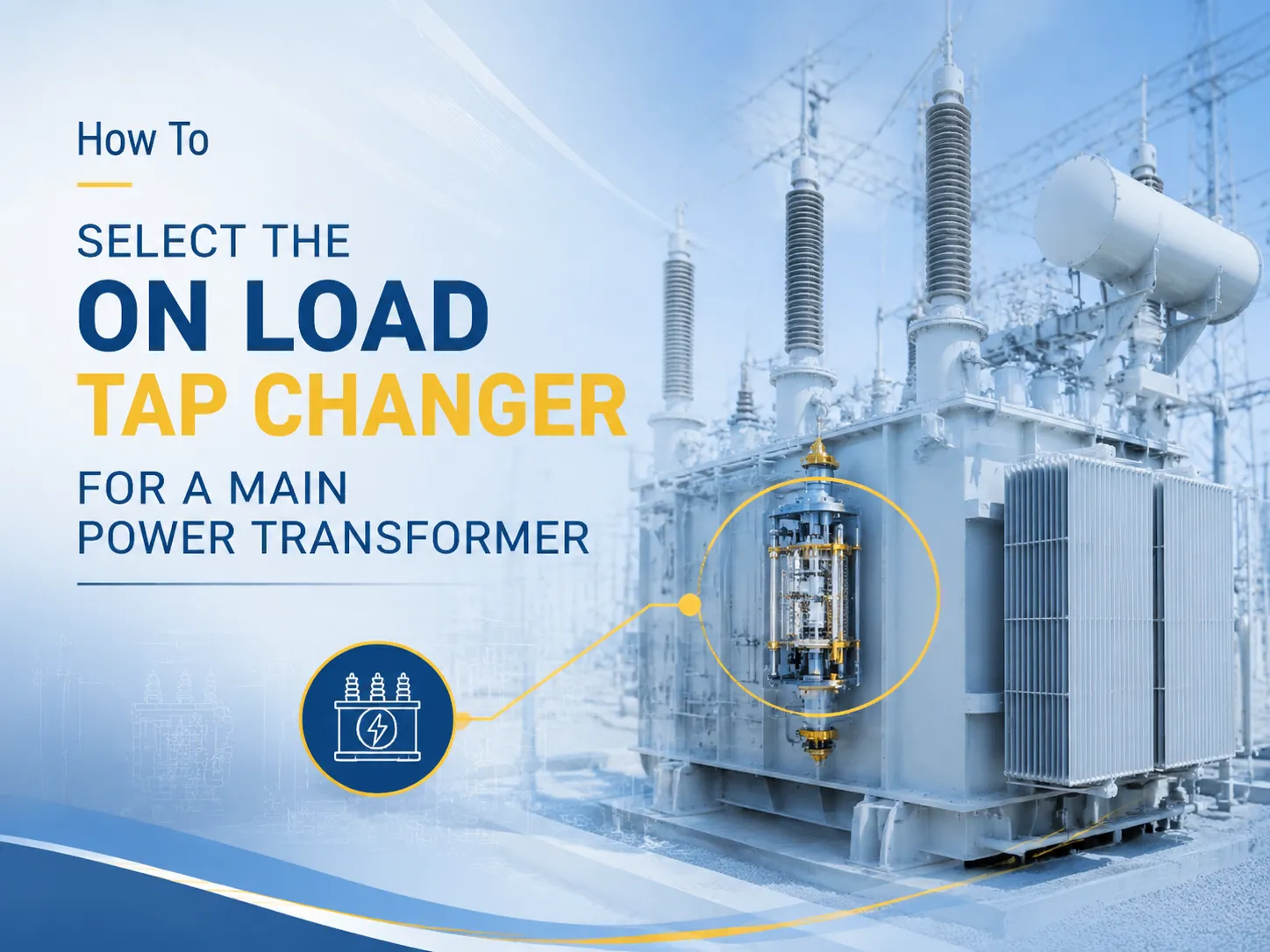
Qu'est-ce qu'un changeur de prises sous tension ?
Le changeur de prises sous tension (OLTC) est un dispositif contrôlé par moteur que l'on trouve dans les transformateurs de puissance qui modifie les connexions de prise de la bobine de réglage pendant que l'alimentation est utilisée. Cela se fait en augmentant ou en diminuant les prises, changeant ainsi le rapport de transformation et la différence de potentiel de sortie, ce qui indique que l'OLTC joue un rôle vital dans le processus de régulation continue de la tension sous des conditions de charge et de source changeantes.
Étant le type de dispositif qui effectue continuellement des opérations pendant que le courant circule, l'OLTC est un instrument de précision, ce qui signifie que le commutateur doit être effectué dans des conditions particulières, tandis que le processus de commutation doit avoir lieu des milliers de fois avant que l'OLTC puisse s'user.
Pourquoi un transformateur principal en a-t-il besoin ?
Les transformateurs sont installés entre le système de transmission et le système de distribution. Les deux côtés du transformateur peuvent connaître des fluctuations de charge tout au long de la journée, car la demande peut changer, tout comme la tension de transmission, qui varie en fonction de la configuration du réseau. Par exemple, lorsque le transformateur en question a une capacité de 40 MVA, la chute d'impédance peut varier entre 6-12%. Par conséquent, lorsqu'il s'agit de pleine charge ou de non-charge, les régulations peuvent affecter la chute de tension de plusieurs pourcents du transformateur lui-même. De plus, il existe un risque que le bus de 33 kV puisse descendre de 5-8% en dessous de la tension normale, ce qui, selon les réglementations locales, n'est pas acceptable.
Afin de maintenir les variations de tension requises dans une plage acceptable, un OLTC est généralement combiné avec le régulateur de tension automatique (AVR).
Comment un OLTC commute sans interruption
L'OLTC est conçu en deux phases. Le sélecteur trouve le nouveau point de prise mécaniquement avec les enroulements déjà connectés via la prise active. Ainsi, c'est à ce moment que l'opération du sélecteur est considérée comme se produisant avec une valeur de courant nulle. Après cela vient le moment de l'interrupteur de dérivation qui déplace conséquemment le courant de la prise principale vers la nouvelle prise. L'impédance de transition est placée entre le sélecteur et l'interrupteur de dérivation afin que le courant qui y circule ne soit jamais interrompu.
La conception du dérivateur à résistance fonctionne de telle manière que le courant passe par un ou deux résistances de transition qui sont placées entre les deux. La valeur de résistance est choisie de manière à ce que le flux de courant soit limité à la valeur minimale pendant le processus.
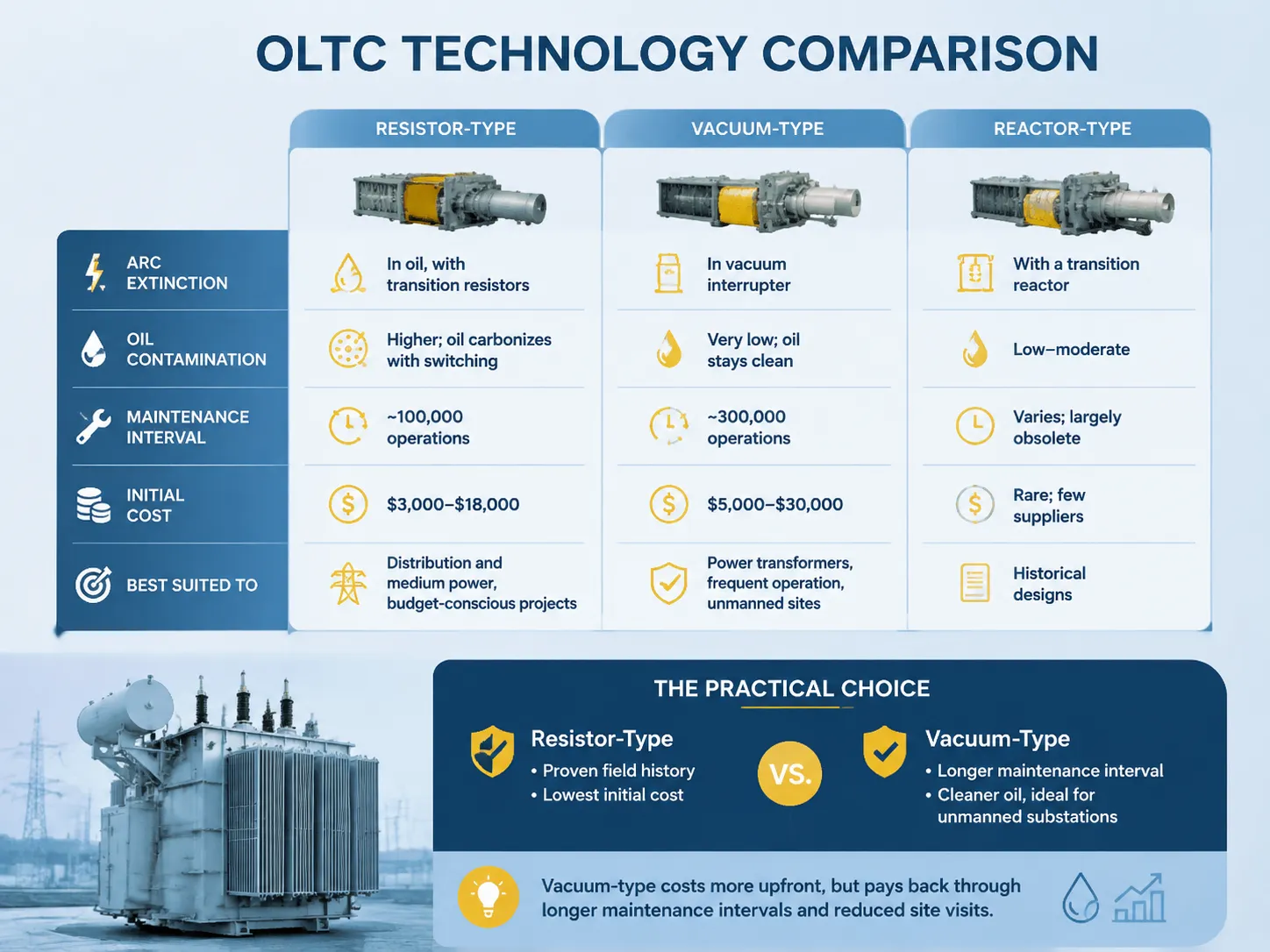
OLTC à résistance vs. OLTC à vide vs. OLTC à réacteur
| Caractéristique | OLTC de type résistance | OLTC de type vide | OLTC de type réacteur (héritage) |
|---|---|---|---|
| Extinction de l'arc | Dans l'huile, avec des résistances de transition | Dans un interrupteur à vide | Avec un réacteur de transition |
| Taux de contamination de l'huile | Plus élevé ; l'huile se carbonise avec la commutation | Très faible ; l'huile reste propre | Faible à modéré |
| Intervalle de maintenance | ~100,000 opérations | ~300,000 opérations | Varie ; largement obsolète |
| Coût initial | $3,000-$18,000 | $5,000-$30,000 | Rare ; peu de fournisseurs |
| Mieux adapté à | Projets de distribution et de puissance moyenne, soucieux du budget | Transformateurs de puissance, opérations fréquentes, sites non habités | Conceptions historiques |
En ce qui concerne les nouveaux transformateurs principaux, on peut généralement choisir entre des variétés à résistance ou à vide. La variété à résistance est utilisée depuis longtemps et a le coût initial le plus bas. Le type à vide, cependant, coûte plus cher au départ en raison d'intervalles de maintenance plus longs et de moins de besoins en changements d'huile, ce qui peut être une considération importante en cas de sous-stations non habitées où le remplacement de l'huile nécessite une visite sur site et un temps d'arrêt.
Sélectionner la plage de prises et la taille des étapes
La plage de prises est un calcul du contrôle de tension. Le processus consiste en plusieurs étapes :
- Prenez la fluctuation de tension réelle. Mesurez la tension du côté primaire et la tension du bus en état de pleine charge ; elle peut varier de ±3-8% sur un réseau réel entre des conditions de charge légère et de pleine charge.
- Ajouter la chute d'impédance du transformateur. À pleine capacité, la régulation des transformateurs de 10-40 MVA atteint 4-8%, et les prises doivent tenir compte à la fois du changement de source et de la chute interne.
- Déterminer la taille du pas. En général, des pas de 1.25% sont utilisés pour les grands transformateurs avec une régulation appropriée, tandis que les petits transformateurs fonctionnent avec des pas de 2.5%.
- Définir la plage. La plage de prises ±8×1.25% donne ±10% en 16 étapes, tandis que la plage de prises ±6×2.5% génère ±15% en utilisant 12 étapes. Pour la plupart des transformateurs dans la plage de 10MVA à 60MVA, la première plage est choisie comme standard.
- Pensez à l'AVR qui fournit une tension de bus avec l'aide d'un relais en une étape avec un temps de retard permettant d'éviter le hunting, et le nombre d'étapes doit répondre aux exigences mentionnées.
En conclusion, faire de mauvaises estimations peut entraîner des conséquences : si la plage est étroite, le transformateur ne pourra pas maintenir la tension dans les pires conditions, et si elle est trop large, cela signifiera la nécessité de dépenses supplémentaires pour l'OLTC ou son enroulement de régulation.
Comprendre les courants et les tensions de pas
| Puissance | Signification | Valeurs typiques pour 10-60 MVA |
|---|---|---|
| Courant nominal | Courant continu maximum que l'OLTC supporte | 300-1,250 A (selon la puissance du transformateur) |
| Tension de pas nominale | Tension entre les prises adjacentes | 500-3,000 V par étape |
| Capacité de commutation nominale | Produit du courant × tension d'étape que le dérivateur peut supporter | Jusqu'à ~1,000 kVA par étape de commutation |
| Cycles de fonctionnement | Durée de vie en opérations | 100,000-300,000+ |
| Normes | Base de conception et d'essai de type | IEC 60214-1/-2, IEEE C57.131 |
Le courant de passage doit couvrir le courant continu maximal du transformateur plus le facteur de surcharge, le cas échéant, de sorte que pour un contrat de surcharge 20%, la classification OLTC devra également le refléter. En d'autres termes, la tension d'étape est tout aussi importante puisque la haute tension d'étape signifie beaucoup plus de stress sur le dérivateur que le courant élevé avec une faible tension d'étape ; cela est vérifié par le fournisseur lors de l'essai de capacité de commutation.
Pour vous aider à visualiser la relation, nous vous fournissons la référence de dimensionnement suivante liée au transformateur que vous spécifiez.
| Classification du transformateur | Tension HV | Courant continu maximal | Classification OLTC typique | Plage de prix OLTC |
|---|---|---|---|---|
| 10 MVA | 66 kV | ~88 A | 100 A, étape 500-800 V | $4,000-$12,000 |
| 20 MVA | 110 kV | ~105 A | 125 A, étape 800-1,200 V | $6,000-$16,000 |
| 40 MVA | 132 kV | ~175 A | 200 A, étape 1,200-1,800 V | $8,000-$22,000 |
| 60 MVA | 220 kV | ~157 A | 200 A, étape 1,500-2,500 V | $12,000-$30,000 |
Après avoir établi les classifications, il est essentiel que la spécification délimite toutes les exigences en utilisant un langage détaillé. Au minimum, la demande de prix doit spécifier les éléments suivants de manière claire :
- Plage de prises et étapes : doit être spécifiée clairement, par exemple, ±8×1.25% (17 étapes) au niveau du enroulement HV.
- Le courant de passage nominal : quel est le courant continu maximal, y compris l'opération de surcharge.
- Tension d'étape : tension maximale entre les prises.
- Type : soit un type résistor soit un type vide, conception de montage sur tourelle (type tête) ou une unité en réservoir.
- Motorisation : tension (110/220 DC ou AC), limitations de couple, fonctionnement local ou à distance, et interface AVR.
- Surveillance : affichage de position, compteur d'heures de fonctionnement, niveau d'huile et surveillance de la pression de l'espace OLTC.
- Normes et essais de type : essais de type selon IEC 60214-1, plus IEEE C57.131 si le projet est basé en Amérique du Nord.
- Pièces de rechange et services : pièces de rechange et services disponibles auprès des fabricants.
Il y a deux points de spécification les plus importants qui sont souvent ignorés. Tout d'abord, la base de surcharge, qui stipule que l'OLTC doit être classé pour la capacité de surcharge du transformateur et non seulement pour la capacité continue nominale. Deuxièmement, l'interface AVR et le protocole de communication, qui montrent si le changeur de prises peut faire partie des systèmes d'automatisation de sous-station ou fonctionnera sur une base manuelle isolée.
OLTC par taille de transformateur et service
- Transformateurs de puissance inférieure (moins de 5 MVA) : Transformateur immergé dans l'huile ou transformateur à circulation d'huile (OLTC) n'utilise donc pas d'OLTC ; le prélèvement sur circuit est effectué complété par la régulation au niveau des régulateurs en amont.
- Transformateurs au niveau de la sous-station (5 à 60 MVA) : La plage de puissance pour l'installation d'OLTC ; des régulateurs basés sur des systèmes causés directs sont utilisés avec des impacts tentatifs standard sur le bus régulé.
- Transformateurs de générateur élévateurs ; L'option OELTC est rare ; la régulation se fait au niveau du générateur ou du réseau en fonction de la capacité de production des générateurs.
- Transformateurs au niveau industriel (10 à 50 MVA) : L'option OLTC est également disponible à ce niveau ; cependant, le type OLTC à vide est choisi lorsque les changements d'exploitation sont fréquents.
- Transformateurs de four et transformateurs redresseurs ; il y a une fréquence élevée d'opérations de prise, donc le type OLTC à vide est souhaité pour l'opération.
Marques et comparaison des prix
| Marque | Origine | Produits OLTC | Plage de prix approximative |
|---|---|---|---|
| M. Reinhausen | Allemagne | Série de résistances VACUTAP à vide et OILTAP — la référence mondiale | $6,000-$35,000 |
| ABB | Suisse/Suède | Paquets complets de transformateurs + OLTC | $5,000-$30,000 |
| Siemens | Allemagne | OLTC pour grands transformateurs de puissance | $6,000-$32,000 |
| Hitachi Energy | Suisse | Changement de prises de transformateur de puissance | $7,000-$35,000 |
| Schneider Electric | France | Changeurs de prises de classe distribution | $3,000-$15,000 |
| Jiangsu Subian Electric Power (intégré) | Chine | Transformateurs avec OLTC éprouvés coordonnés à la norme IEC 60214 | $4,000-$15,000 (en tant qu'option de transformateur) |
alors que la technologie MR ou les conceptions sous licence sont utilisées par presque tous les principaux transformateurs dans le monde. La série VACUTAP de changeurs de prises à vide est celle qui a établi la norme pour un fonctionnement sans entretien. ABB, Siemens et Hitachi Energy proposent leur propre technologie OLTC ou des partenariats. L'OLTC est généralement un élément nommé dans le contrat de transformateur et le choix dépend des capacités du fabricant de transformateurs et de la philosophie de maintenance du projet. Jiangsu Subian Electric Power fait partie des fabricants qui installent des OLTC testés dans leurs transformateurs, y compris le type à vide pour des commutations fréquentes. Au lieu d'obtenir un produit avec un OLTC supplémentaire, l'acheteur reçoit un assemblage clé en main couvrant la tourelle, l'entraînement et l'AVR comme un système complet. En raison de la politique de production et de tarification efficace de Subian, la plage de prix des transformateurs OLTC est d'environ 40-60% inférieure par rapport aux offres similaires des fabricants européens. Cependant, quel que soit la marque que vous choisissez, indiquez toujours le type d'OLTC dans le contrat et vérifiez le certificat d'essai de type.
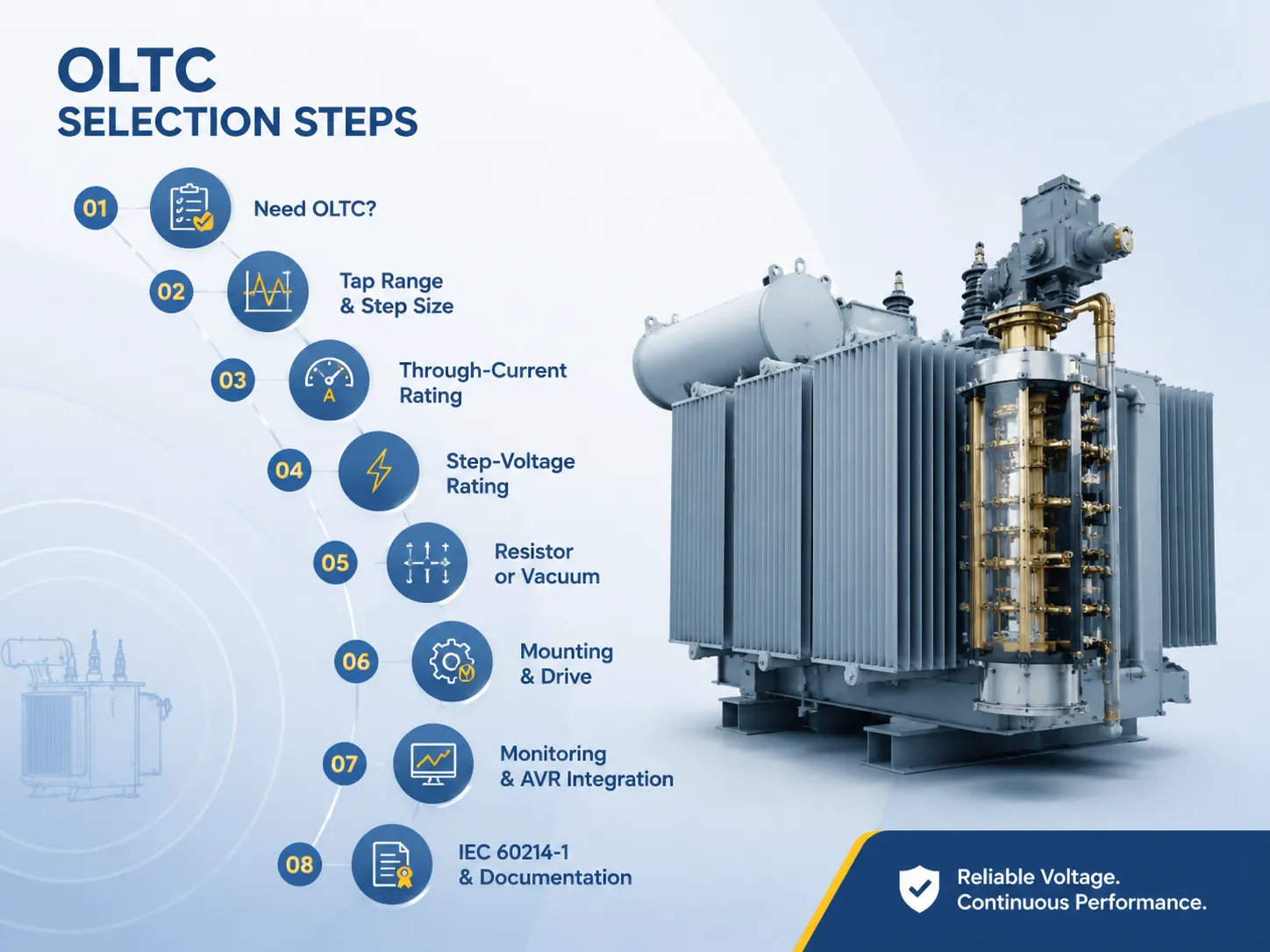
Procédure de sélection étape par étape
- Évaluer si un OLTC est nécessaire. Si la source et la charge sont stables, vous n'aurez peut-être besoin que de prises manuelles, mais dans le cas d'un transformateur de puissance, la régulation automatique est presque toujours requise.
- Déterminer la taille et la plage de pas de prise selon la régulation interne du transformateur et les fluctuations de tension.
- Déterminer la capacité de courant en fonction du courant maximum disponible pendant le fonctionnement continu avec des surcharges.
- Vérifier à nouveau la tension de pas avec la tension de prise à prise de l'enroulement de régulation.
- Décider d'utiliser des résistances ou un vide en fonction du budget, du domaine d'application et de la fréquence de commutation.
- Identifier si un montage sur tourelle ou sur tête est nécessaire et décider du moteur d'entraînement, en s'assurant qu'il supporte la bonne tension et les contrôles.
- Lister les exigences de surveillance et les exigences pour l'intégration du régulateur de tension automatique, y compris la position, le compteur, le niveau d'huile et les protocoles de communication.
- S'assurer que le certificat de l'essai de type et de l'essai de processus conformément à la norme IEC 60214-1 est disponible, et inclure la désignation de l'OLTC dans le contrat.
Fonctionnement, surveillance et maintenance
Le besoin de service OLTC est principalement influencé par le type d'OLTC et la fréquence de ses commutations. Les recommandations incluent :
- Suivez combien de fois l'OLTC a été utilisé chaque mois. Un OLTC utilisé en association avec un transformateur de puissance peut effectuer 1 000 à 10 000 commutations par an ; par conséquent, les intervalles de maintenance doivent être calculés en fonction du nombre d'opérations, plutôt qu'en fonction du nombre d'années.
- Dans les OLTC à résistance, l'huile d'installation du dérivateur doit être considérée séparément de l'huile dans le réservoir principal, car elle se carbonise pendant l'opération de commutation et se dégrade beaucoup plus rapidement ; filtrez ou remplacez-la selon l'intervalle spécifié par le fabricant (~100 000 commutations).
- Dans les OLTC à vide, aucune contamination ne se produit pendant l'opération ; par conséquent, les intervalles peuvent être beaucoup plus longs (~300 000 commutations) ; néanmoins, le mécanisme et l'entraînement doivent être vérifiés à chaque grande opération.
- Le couple de l'entraînement du moteur, la position de l'interrupteur de relais AVR et la position de l'indicateur de position doivent être vérifiés chaque année.
- Surveillez les températures et les pressions de l'huile du dérivateur ; une augmentation de la température indique un défaut dans les contacts ou un processus de commutation anormal.
- L'enregistrement du compteur d'opérations est le plus rentable, car il transforme “effectuer la maintenance tous les cinq à sept ans” en “effectuer la maintenance tous les 100 000 opérations”, ce qui représente une différence considérable pour un transformateur très sollicité.
La maintenance requise par différents designs est radicalement différente. Les deux principaux types d'OLTC doivent être comparés en fonction de vos dépenses.
| Élément de maintenance | OLTC de type résistance | OLTC de type vide |
|---|---|---|
| Intervalle de changement d'huile du dérivateur | ~100,000 opérations | ~300,000 opérations |
| Taux de carbonisation de l'huile | Modéré à élevé | Très faible |
| Intervalle d'inspection des contacts | À chaque changement d'huile | Tous les 2-3 changements d'huile |
| Maintenance de l'entraînement du moteur | Identique pour les deux (vérification annuelle) | Identique pour les deux |
| Coût de maintenance estimé sur 20 ans | $8,000-$20,000 | $4,000-$10,000 |
Questions Fréquemment Posées
Combien coûte un changeur de prises sous tension ?
Quelle plage de prises devrais-je spécifier pour mon transformateur principal ?
Quelle est la différence entre un changeur de prises à résistance et un changeur de prises à vide ?
À quelle fréquence un OLTC a-t-il besoin d'entretien ?
Puis-je retrofitter un changeur de prises sous tension sur un transformateur existant ?
Rarement et rarement économiquement. L'enroulement de régulation, le montage en tourelle, les dégagements du réservoir et le refroidissement doivent tous convenir à l'OLTC, et la plupart des transformateurs à prises fixes n'ont jamais été conçus pour cela. Si vous avez besoin d'une régulation continue sur une unité existante, envisagez un transformateur de régulation de tension séparé ou un régulateur de tension en série à la place. Sinon, spécifiez l'OLTC au stade de la conception.
Références
- IEC 60214-1 — Changeurs de prises, Exigences de performance et Méthodes d'essai — La norme de base OLTC couvrant les essais de type et les classifications.
- IEC 60214-2 — Changeurs de prises, Guide d'application — Guide de sélection pour les gammes, les étapes et les classifications.
- IEEE C57.131 — Exigences pour les changeurs de prises sous charge — Norme OLTC nord-américaine.
- MR Reinhausen — Portail des changeurs de prises — La documentation et les données de cycle de vie du fabricant OLTC leader VACUTAP/OILTAP.
- IEC 60076-1 — Transformateurs de puissance, Exigences générales — Contexte au niveau du transformateur pour l'intégration et les essais des changeurs de prises.
- Transformateurs ABB — Référence pour l'intégration des transformateurs et des changeurs de prises.
Conclusion
Choisir le changeur de prises sous charge pour un transformateur majeur est un processus basé sur des faits. La variation de tension et la régulation du transformateur déterminent la plage, tandis que le courant du transformateur et la capacité de commutation déterminent la sortie. Tant que tout est fait correctement, l'OLTC remplira ses fonctions pendant de nombreuses années.
- Calculez la plage de prises en utilisant les valeurs de tension réelles et la régulation interne.
- Évaluez l'OLTC selon la performance en surcharge, pas seulement selon la classification sur la plaque.
- Optez pour le type à vide lorsque des commutations fréquentes sont impliquées et qu'il n'y a pas d'homme.
- Suivez les dossiers de performance, enregistrez le compteur et conservez le certificat de l'essai de type joint au contrat.