

見積もりをリクエスト
ニュース

35Kv Transformer Factory from the Perspective of Green Production

When the auditor came to the 35kV transformer manufacturer, she came prepared. With a clipboard and the knowledge of promises made in the supplier’s brochure, she wondered how the supplier, who promises IEC 60076 type test reports and GB 20052 loss grade, could also claim to be green by stating that it reduced its electricity consumption per MVA produced by 22% over three years.The auditor began her observation in the winding shop, where she saw how an automatic machine wound copper wire at constant tension under paper insulation, while the electronic meter measured the moisture level of the kraft paper before it touched the conductor, for the second observation she moved to drying oven with the log indicating vacuum below the level of 100 Pa and the temperature of 120 °C maintained for 48 hours, after having finished her observations, the auditor concluded that the factory operated both effectively and ecologically, demonstrating that their promises were real.

This paper gives a detailed description of the manufacturing process used at the 35kV transformer manufacturer based on the green production approach – the processes, standards, energy, and waste figures you need to have when auditing a factory of this type.

Brief response: A transformer factory with 35kV transformer outputs employs the manpower in processing grain-oriented silicon steel, copper or aluminum, kraft paper, and insulating oil in the manufacture of power transformers whose ratings ranges between 3.15 and 31.5 MVA according to IEC 60076 standards in the production process. In general terms, green production means spending less energy per MVA produced and applies recycling of steel and copper, oil recovery, usage of renewable electricity, and being acknowledged as a green factory.

35Kv Transformer Factory From The Perspective Of Green Production


The Anatomy of a 35kV Transformer Factory

A factory producing 35kV transformers operates using a straight-line method of manufacturing, where raw steel and copper enter at the one end, while tested transformers are taken out of the other end. The main processes involved in the manufacture of a transformer are core cutting and stacking, winding, core and coil assembly, drying under vacuum, tank making and assembling, painting, filling with oil, and testing. Two things which are responsible for a good quality process are process control and traceability.

In a really good factory, every coil has its own production history which contains information about steel grade and lot, conductor lot, moisture level, winding tension, drying program, and test results. This is what changes warranty complaint into a root cause investigation rather than a quarrel. Thus, the distinction between a 35kV transformer factory and assembly shop is based on paper evidence, and it can be seen right away in the first ten minutes of a plant visit.

Core Production Processes and Checkpoints

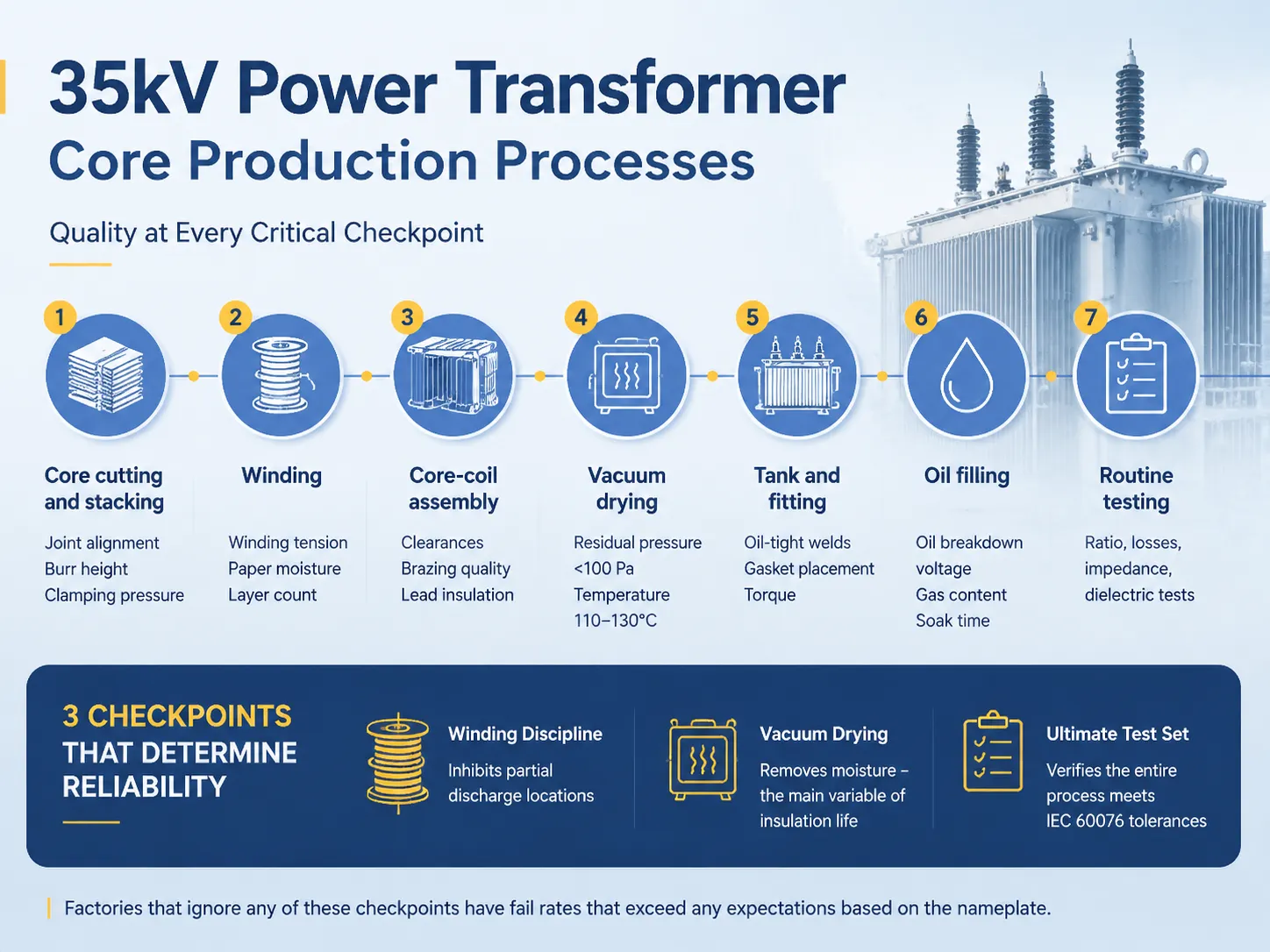
The production sequence for a 35kV power transformer, with the quality checkpoints that matter:

ステップ Process Critical checkpoint
Core cutting and stacking GOES slit, cut, and stacked with mitered (45°) joints Joint alignment, burr height, clamping pressure
巻き線 LV and HV coils wound under constant tension with paper insulation Winding tension, paper moisture, layer count
Core-coil assembly Windings placed on core legs; leads brazed and insulated Clearances, brazing quality, lead insulation
真空乾燥 Active part heated and dried under vacuum Residual pressure <100 Pa, temperature 110–130°C, duration
Tank and fitting Active part lowered into tank; bushings, tap changer, coolers fitted Oil-tight welds, gasket placement, torque
Oil filling Degassed, filtered oil introduced; soak period Oil breakdown voltage, gas content, soak time
Routine testing Ratio, losses, impedance, dielectric tests Results within IEC 60076 tolerances

Core Production Processes and Checkpoints

Three of these checkpoints determine the majority of the story of reliability. Winding discipline inhibits partial discharge locations, vacuum drying takes care of moisture, which is the main variable of insulation life, and the ultimate test set checks the entire process. Factories that ignore any of these checkpoints have fail rates that exceed any expectations based on the nameplate.

What Green Production Means at a Transformer Plant

“Green” production in a 35kV transformer manufacturing plant is equivalent to energy-saving transformer production: less resources consumed. Concrete actions include:

  • Energy efficiency: replacing old drying ovens and test loads with energy-efficient technologically perfected apparatus, measuring electricity consumption by individual manufacturing lines, and switching to renewable electricity where it is available.
  • Material recovery: recycling of cut steel plates, copper, and oil from testing and tank washing.
  • Waste management: segregating hazardous materials (oils) from waste materials which can be recycled; sanitary disposal of insulating oil.
  • Water and emissions control: treatment of painting and washing effluents and control over emissions of dust particles from core cutting.
  • Low-carbon product options: provision of amorphous steel cores and natural ester oil which allows conveying of green technologies with the products.

From the operational point of view green activities and quality control compatibility is detected: measuring energy consumption reveals idle machine time, recycling inspires cleanliness in the shop floor, and making oven efficiently operated improves both energy efficiency and quality of an end product.

Energy and Waste: The Measured Numbers

Representative environmental numbers for a well-run 35kV transformer factory:

メトリック 一般的な範囲 注記
Factory energy intensity 30–60 kWh per MVA of shipped capacity Varies with product mix and utilisation
Steel yield in core cutting 85–92% Offcuts and edge scrap are recycled
Copper recovery >95% of winding scrap Recycled, not landfilled
Renewable electricity share 0–60% depending on location and procurement Green factory certification rewards higher share
Oil recovery from testing >90% Filtered and reused where spec allows

While this is what you should expect in theory, the actual situation differs depending on factors like the age of a factory, whether it produces electric goods or not, and other local parameters. Nevertheless, such numbers give you some tools to evaluate a vendor – you can always ask them for their energy consumption statistics and recycling ratio in order to see if one can trust their assertions.

Green Factory Certification and Standards

Green production is increasingly certified, and the certifications carry procurement weight. The main frameworks:

フレームワーク 地域 What it evaluates
MIIT Green Factory (绿色工厂) 中国 Energy intensity, renewable share, water, waste, recycling, emissions
ISO 14001 国際 Environmental management system
ISO 50001 国際 Energy management system
ISO 9001 + IEC 60076 testing 国際 Quality management and product test evidence

The practical framework for export buyers comprises ISO 9001, which relates to quality management, ISO 14001 for environmental management, IEC 60076 for the product itself and — where it is needed by tenders — national green factory status. A manufacturer having all four shows that green production is a whole system supporting its operations instead of just being a marketing gimmick.

Testing: Where Reliability Is Proven

Test bays are the heart of manufacturers of transformers at 35kV voltage levels since the equipment they have often defines what kind of manufacturer they are. A renowned manufacturer of 35kV transformers possesses the following test bay equipment:

  • A power frequency test cabinet which can perform all necessary applied and induced voltage tests at 70 kV and above for 35kV devices.
  • A lightning impulse generator which can perform full-wave and chopped-wave tests at 170 kVp.
  • Noise measurement devices for measuring no-load and load losses according to IEC 60076-1 tolerances.
  • Partial discharge measurement devices where necessary.

However, it must be noted that the discipline in testing matters as much as the equipment. Design tests provide proof for the design itself while the routine tests provide proof for each device manufactured. A factory which undertakes the full routine set of tests for every 35kV device manufactured shall be regarded as an advanced manufacturing facility unlike the one that performs only ratio checks before the shipment.

Typical Products and Specifications

What a 35kV transformer factory actually ships:

製品 一般的な定格 構成
35/0.4 kV distribution type 315–2,500 kVA Dyn11, off-circuit taps, pole or pad mount
35/10.5 kV power type 3.15–31.5 MVA YNd11, OLTC option, ONAN/ONAF
35/6.3 kV power type 2–20 MVA For industrial distribution networks
Step-up type (generator) 5–50 MVA For renewables and small thermal plants
Three-winding type 6.3–31.5 MVA 35/10/6 kV, mixed-voltage substations

The segment of 6.3–20 MVA is the critical segment for the factory as it is big enough to require serious engineering and yet small enough to be transported by land on a standard trailer. The 10 MVA unit weighs around 20–25 tons and fits standard low-bed trailers, and for the 31.5 MVA unit weighing around 50–60 ton, route surveying and provision of cranes are required for transportation.

What to Check in a Factory Audit

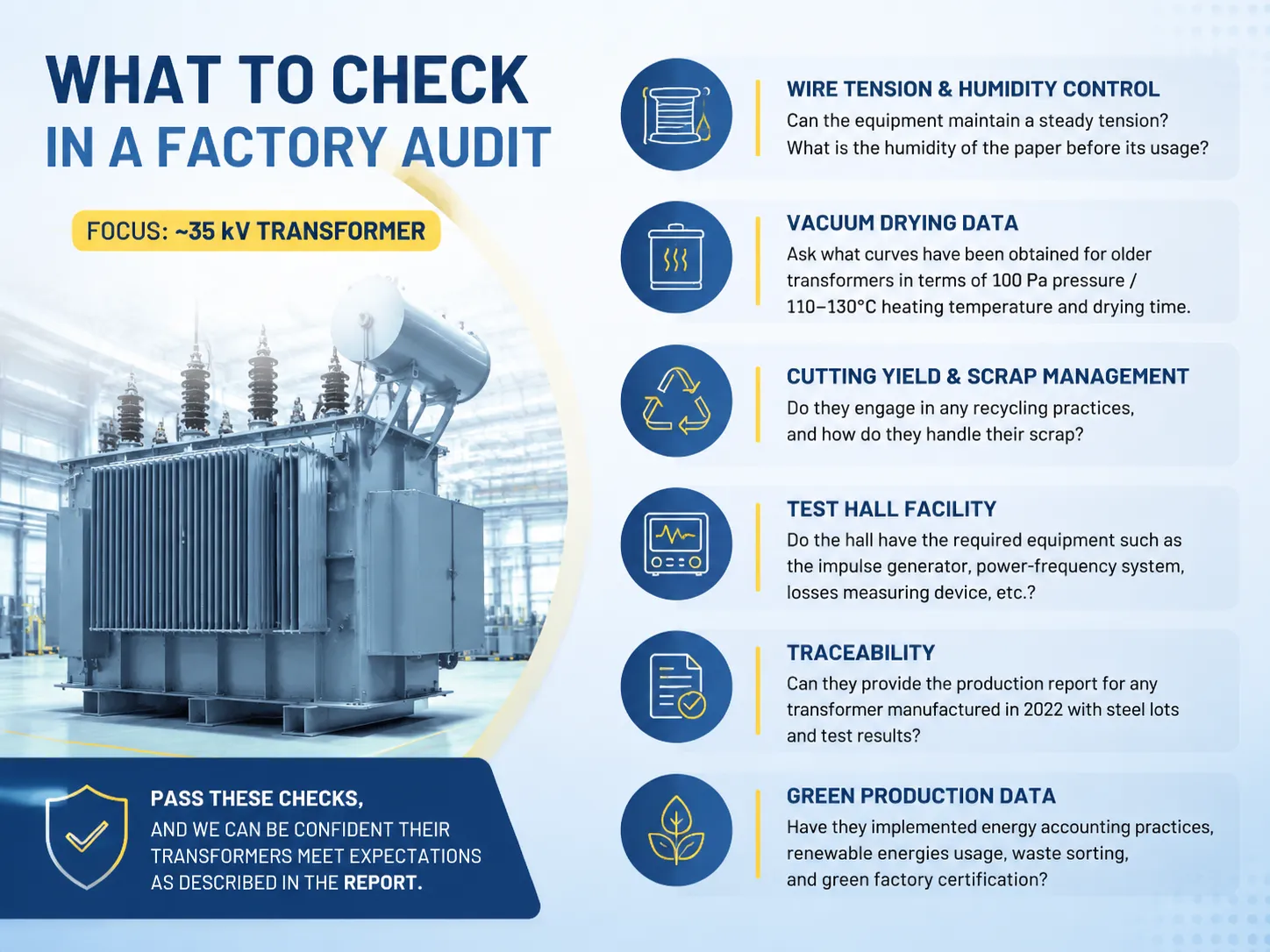
What to Check in a Factory Audit

When inspecting a transformer factory for a ~35 kV transformer (in person or via an inspector), pay attention to the following items:

  • Wire tension and humidity control: Can the equipment maintain a steady tension? What is the humidity of the paper before its usage?
  • Vacuum drying data: Ask what curves have been obtained for older transformers in terms of 100 Pa pressure / 110–130°C heating temperature and drying time.
  • Cutting yield and scrap management: Do they engage in any recycling practices, and how do they handle their scrap?
  • Test hall facility: Do the hall have the required equipment such as the impulse generator, power-frequency system, losses measuring device, etc.?
  • Traceability: Can they provide the production report for any transformer manufactured in 2022 with steel lots and test results?
  • Green production data: Have they implemented energy accounting practices, renewable energies usage, waste sorting, and green factory certification?

If the factory is able to pass these checks, we can be sure that their transformers meet expectations as described in the report.

Factories and Price Ranges

Indicative FOB pricing for a 10 MVA 35/10.5 kV transformer from factories by brand:

ブランド 起源 10 MVA price 一般的なリードタイム
日立エナジー Japan/Global $55,000–$82,000 16–36 weeks
ABB Switzerland/Global $52,000–$78,000 16–32 weeks
シーメンスエナジー Germany/Global $50,000–$75,000 16–32 weeks
シュナイダーエレクトリック France/Global $48,000–$72,000 14–30 weeks
Toshiba / Hyundai Japan/Korea $46,000–$68,000 12–28 weeks
江蘇省蘇辺電力 中国 $28,000–$48,000 8–20 週間

Pricing is influenced by loss class, tap changer, accessories, copper pricing, and method of delivery so they should be considered as planning ranges rather than fixed prices.

Premium companies price their transformer based on decades of type test results, presence of service around the world, and risk mitigation process that they have developed. 35 kV Chinese manufacturers are known to compete using the same IEC 60076 standards but at prices 40–50% less, with certification of green factories becoming a given among manufacturers. Jiangsu Subian Electric Power has a 35kV transformer factory that is certified green and produces distribution and power transformers from 10 kVA to 63 MVA with core cutting, winding, vacuum drying, and full routine test bay in one place. Each unit is shipped with routine test report; amorphous core and ester oil options are available, and the client base includes utilities and EPC contractors in Asia, Africa, Middle East, and the South America.The factory’s products and certifications are documented at subian-electric.com.

よくある質問

What does a 35kV transformer factory actually build?

Distribution and power transformers in the 35 kV category are comprised of 35/0.4 kV distribution units ranging from 315 kVA, and 35/10.5 kV power units ranging from 3.15 up to 31.5 MVA, having different designs like step-up or three-winding designs, and are tested as stipulated in IEC 60076. This is due to the fact that the success of the transformers lies in the manufacturing process — winding, drying and testing.

How much does a 35kV transformer cost from a Chinese factory?

The price of 3.15 MVA 35/10.5 Kv equipment is between $18,000 and $30,000, while a unit of 10 MVA costs between $28,000 and $48,000. The cost of the 31.5 MVA unit is higher—between $65,000 and $110,000. The prices can be as high as 50 to 80% for well-known global companies. The prices vary also depending on the copper prices, loss class, extra features, and tap changer used in the manufacturing process.

How do I know a factory actually tests its transformers?

Request to obtain the record of routine testing performed on a recent shipment together with the type test reports pertaining to the design – these being temperature rise, lightning impulse, and short-circuit withstand. Check whether either you personally or a third party glorious can observe the routine tests. If the factory has the necessary testing equipment (impulse generator, power frequency set, and capacity for loss measurements), they would be happy to provide you with a show.

What makes a transformer factory “green”?

The energy intensity measured per unit of production, the percentage of renewable energy consumption, and the scrap recycling of steel and copper, as well as the oil recovery process, waste sorting, and certification according to ISO 14001/50001 or a state green factory program. Ask for the energy intensity and scrap recovery figures.

How long does it take a 35kV factory to build a transformer?

The time between ordering and shipping for a 3.15 to 10 MVA machine usually lasts from eight to sixteen weeks, while the same process requires fourteen to twenty-four weeks for a 31.5 MVA machine and even longer if special fittings or type testing are necessary. In case of a shortage of copper or steel supply, delivery times will increase. Therefore, the supply of parts should be scheduled in advance before upgrading of the grid system starts.

参考文献

結論

In the case of a 35kV transformer factory, eco-friendly production and the quality of the engineering work is viewed as the same approach evaluated in two different forms — kWh per MVA, recycled waste, drying curves, and standard tests provided. A factory that manages its energy, its waste, and its operation is the same factory whose transformers withstand impulse testing and remain within IEC 60076 limits.

Main points to keep in mind:

  • Process control is what defines reliability of transformers; bookkeeping shall be checked, not brochures.
  • Eco-friendly production involves energy intensity of 30-60 kWh/MVA, more than 85% of recycled steel, and certified environmental management system.
  • $28000-48000 is sufficient for a 10 MVA unit from Chinese manufacturers while premium brands are placed at 50-80% higher prices.
  • Check out the test site, drying records and evidence of environmental friendliness before placing an order.

If you are sourcing 35kV transformers and want a factory you can verify, 江蘇省蘇辺電力 runs a certified green factory with full on-site testing and documented routine reports. Review the factory’s products and certifications at subian-electric.com.