


Uma fábrica têxtil no Vietnã estava prestes a colocar em operação doze máquinas de tecelagem com 15 kW de potência cada. A conclusão do proprietário era bastante simples: doze máquinas multiplicadas por 15 kW resultam em 180 kW, consequentemente, um transformador de 200 kVA é necessário. Nesse ponto, o empreiteiro elétrico cancelou o pedido. Na realidade, cada máquina consome cerca de 18 kVA com fator de potência de 0,83; sua corrente de partida é até seis vezes maior do que a corrente de operação; compressores de ar que alimentam essas máquinas adicionam 60 kVA; além disso, duas linhas estão planejadas para serem adicionadas à fábrica já. Ao usar uma abordagem cientificamente justificada, os cálculos mostraram que um transformador de 500 kVA é necessário, o que é mais do que o dobro do valor obtido por um método de cálculo simples. É por isso que a seleção do transformador não deve ser baseada na potência do equipamento.
Neste artigo, a seleção de transformador cientificamente correta é apresentada, com base nas necessidades de potência dos equipamentos elétricos.
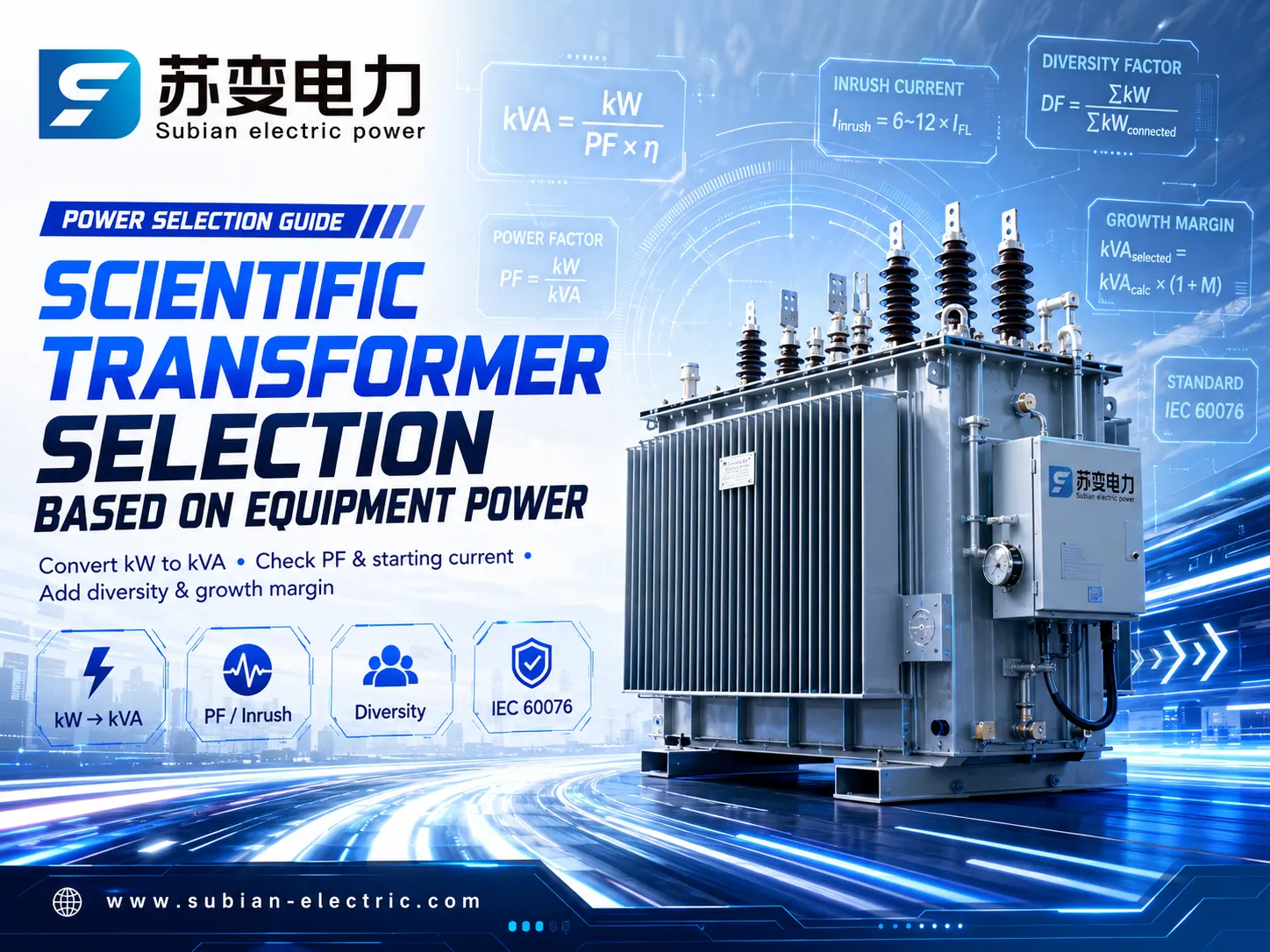
Razões para a Falha da Adição de kW como Método de Dimensionamento
Usar a soma dos kW de placa de cada peça de equipamento para escolher um transformador que forneça essa classificação de kVA é o erro de dimensionamento mais comum que existe na indústria. A seguir estão as razões científicas para sua falha:
O fator de potência é negligenciado. A potência real é muito menor do que a potência aparente de um motor, compressor ou lâmpada. Por exemplo, motores que utilizam 180 kW de potência real, com um fator de potência de 0,85, precisariam de 212 kVA. Isso mostra uma diferença de 18 por cento que sobrecarregaria um transformador de 200 kVA.
A diversidade é negligenciada. Na prática, raramente as máquinas operam em capacidades máximas ao mesmo tempo. A adição da potência nominal das máquinas cria uma lacuna de 20-40 por cento, o que significa dinheiro desperdiçado em um transformador classificado acima de seu valor necessário.
A corrente de partida é negligenciada. Grandes motores elétricos podem consumir até seis vezes sua corrente normal quando iniciam. Isso significa que a tensão pode colapsar e o relé ser desligado.
Uma abordagem acadêmica é um método de combinar todos os efeitos e obter o tamanho final do transformador não determinado pela intuição, mas pela física.
De kW de Equipamento para kVA de Transformador
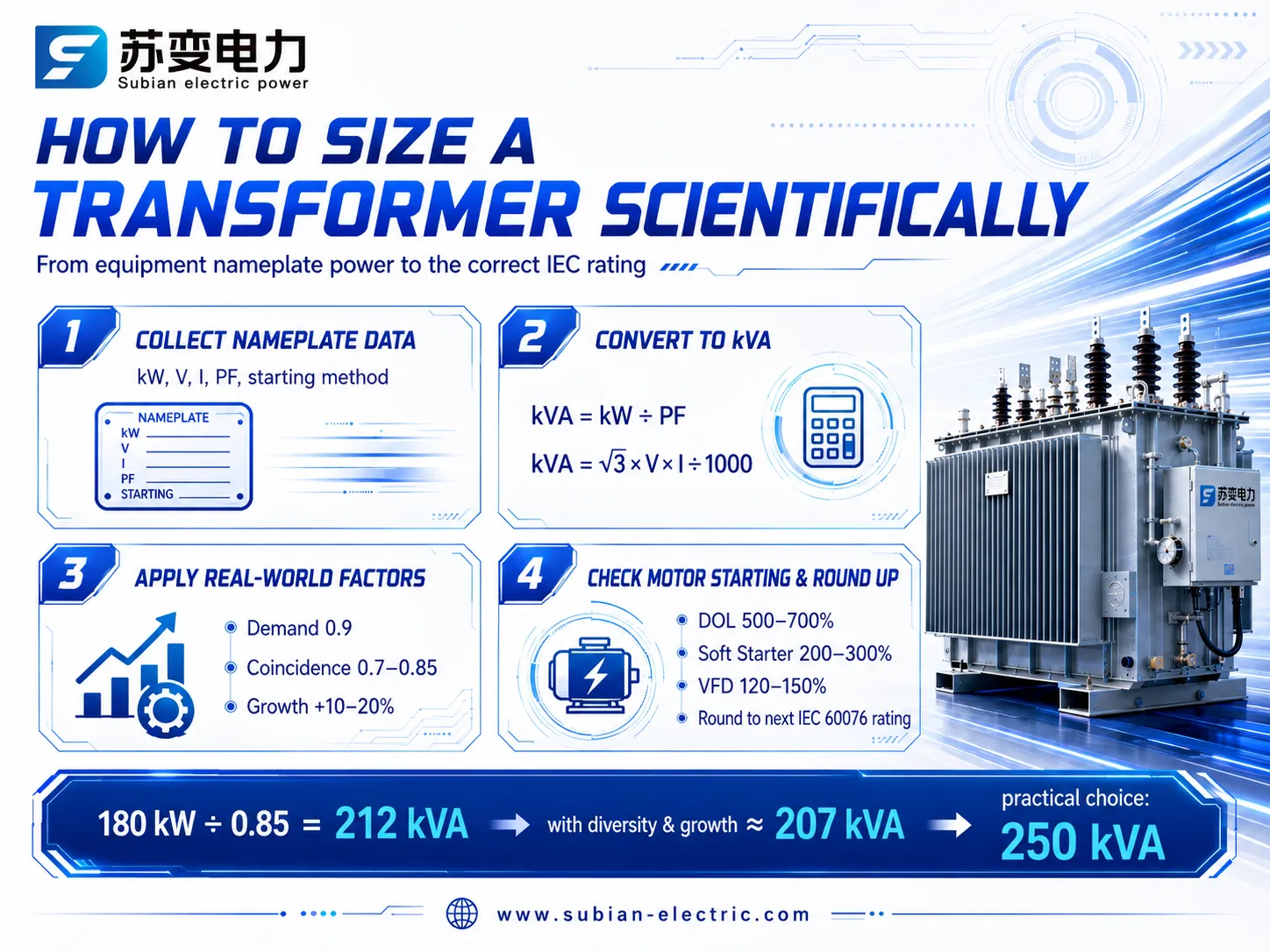
A equação primária é kVA = kW ÷ fator de potência. Nos casos em que dispositivos e equipamentos trifásicos estão envolvidos, também se pode calcular kVA usando a expressão kVA = (√3 × V × I) ÷ 1000. A placa da máquina contém todas as informações necessárias: kW nominal, tensão, corrente de carga total e às vezes um valor de eficiência. Você deve sempre usar kVA do barramento do transformador em vez de kVA para kVA de terminal do motor, pois isso levaria em consideração quaisquer perdas ao longo dos alimentadores (perdas de 2-5% em longas distâncias).
Para configurações onde apenas a potência do motor é conhecida, deve-se calcular usando a conversão 1 hp ≈ 0,746 kW e dividir o número pelo valor de eficiência do motor (geralmente entre 0,90 e 0,95). Neste caso, um motor de 100 hp consome 100 × 0,746 ÷ 0,93 ÷ 0,85 resultando em aproximadamente 94 kVA enquanto em operação e cinco a oito vezes maior na partida.
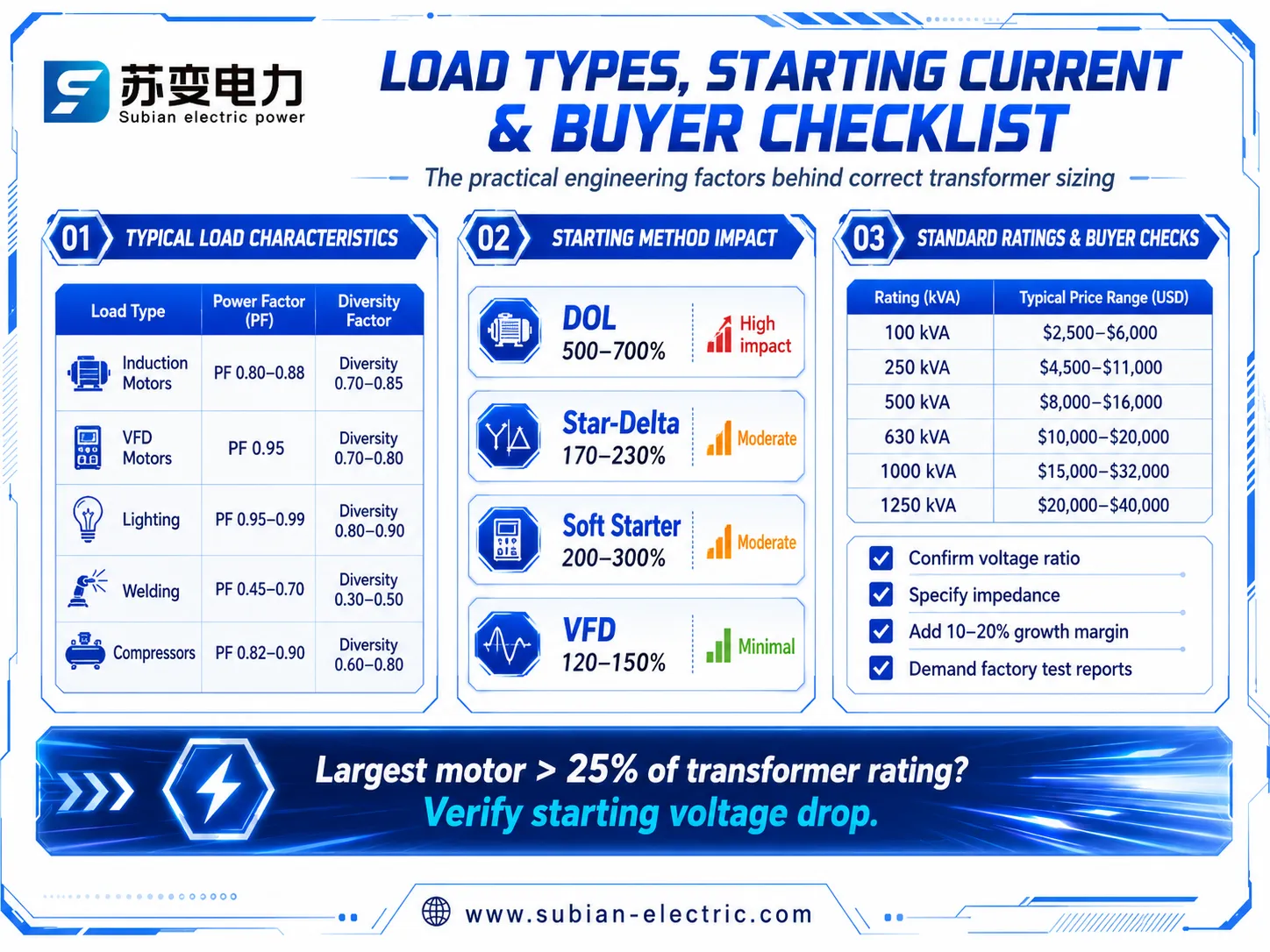
| Tipo de Equipamento | Fator de Potência Típico | Diversidade Típica | kVA por 100 kW de Placa de Identificação |
|---|---|---|---|
| Motores de indução (geral) | 0.80–0.88 | 0.70–0.85 | 114–125 |
| Motores acionados por VFD | 0,95 (entrada) | 0.70–0.80 | 105 |
| Aquecimento resistivo / fornos | 1.00 | 0.60–0.80 | 100 |
| Iluminação LED | 0.95–0.99 | 0.80–0.90 | 101–105 |
| Máquinas de soldagem | 0.45–0.70 | 0.30–0.50 | 143–222 |
| Compressores (parafuso) | 0.82–0.90 | 0.60–0.80 | 111–122 |
| Chilllers HVAC | 0.80–0.88 | 0.70–0.90 | 114–125 |
Observe a linha de soldagem: baixo fator de potência e diversidade muito baixa significam que o transformador deve ser dimensionado para uma alta razão kVA por kW, mesmo que a demanda simultânea real seja pequena. É por isso que regras genéricas falham — o método científico sempre trabalha a partir das características elétricas reais do equipamento.
Fatores de Demanda, Diversidade e Coincidência
Os fatores de demanda, diversidade e coincidência explicam todos a mesma relação entre como as cargas atuam no barramento do transformador.
O fator de demanda é definido como a demanda máxima dividida pela carga conectada para o grupo e é tipicamente menor que um, pois uma carga tende a operar abaixo da capacidade total.
O fator de diversidade é conhecido como a demanda máxima total dividida pela demanda coincidente máxima e é geralmente maior que um.
O fator de coincidência é semelhante ao fator de diversidade, pois governa a quantidade real de carga funcionando ao mesmo tempo e geralmente está entre 0,5 e 0,9.
Os engenheiros geralmente combinam um desses fatores com a quantidade de kVA porque isso leva a um exemplo claro de como encontrar a quantidade total de demanda de projeto em termos de economia em perdas e compra de transformadores.
Por exemplo, com a carga conectada de 500 kVA, o valor do fator de demanda é 0,9 e o do fator de coincidência é 0,8, então a demanda de projeto resulta em 500 x 0,9 x 0,8 = 360 kVA.
O Problema da Partida do Motor
A corrente de partida pode ser conhecida como o assassino silencioso quando se trata de pequenos transformadores. Para um motor de 150 kW, a partida direta requer uma corrente de partida que pode ser de 5 a 7 vezes a corrente de carga total, que dura de 3 a 10 segundos. Isso deve ocorrer enquanto o transformador fornece kVA de partida e o restante de sua carga de corrente, além de tentar limitar as quedas de tensão nos terminais do motor a cerca de 10 a 15% para que o contator não desarme.
Uma das três soluções discutidas aqui ajuda a resolver problemas de dimensionamento. Partidores suaves ajudam a reduzir as correntes de partida para entre 2 a 3 vezes a corrente de carga total. VFDs reduzem a corrente de partida para cerca de 1,2 a 1,5 vezes. A partida estrela-triângulo reduz para 33% da partida direta, mas esse método tem torque reduzido. Muitas vezes é possível reduzir o tamanho em uma classificação padrão se for possível controlar a corrente de partida. Se o controle não for possível e se a instalação tiver motores de velocidade fixa grandes, então o tamanho do transformador deve ser baseado na corrente de partida em vez de qualquer carga em operação.
| Método de Partida | Corrente de Partida Típica (% de FLC) | Impacto na Dimensionamento do Transformador |
|---|---|---|
| Direto na linha (DOL) | 500–700% | Significativo — pode adicionar um passo de classificação |
| Estrela-delta | ~170–230% | Moderado |
| Partida suave | 200–300% | Moderado |
| VFD | 120–150% | Mínima |
A regra prática da engenharia: se o maior motor exceder 25% da classificação do transformador, verifique o cenário de partida explicitamente com um cálculo de queda de tensão. Se exceder 50%, espere aumentar a classificação ou mudar o método de partida — a aritmética está na IEC 60076-7 e na orientação IEEE C57.12.00 sobre carregamento cíclico e de curto prazo.
Exemplos Trabalhados em Diversas Indústrias
Exemplo A – Fábrica de Têxteis. Carga conectada = 12 teares (15 kW cada (PF = 0,83)) + 3 compressores (30 kW cada (PF = 0,85)) + 40 kW de iluminação (PF = 0,95) + 20 kW de HVAC. kVA em funcionamento = 12 * 18,1 + 3 * 35,3 + 42 + 21 = ~ 345 kVA. Fator de demanda = 0,9 e coincidência (CF) = 0,8 -> 345 * 0,9 * 0,8 = 248 kVA. Com um crescimento de 15%, a classificação de potência necessária = 285 kVA ou classificação padrão de 315 kVA. A maior carga única é 35 kVA (cerca de 11% da classificação), portanto, sem restrições de partida.
Exemplo B – Fábrica de Processamento de Alimentos. Compressor de resfriamento (100 kW) (6× partida/PF = 0,85), maquinário (60 kW), bomba CIP (30 kW) e iluminação (25 kW). kVA em funcionamento = 118 + 71 + 35 + 26 = 250 kVA e fator de coincidência (CF) = 0,75 -> a potência necessária = 188 kVA. Durante a partida, o compressor de resfriamento momentaneamente tem uma demanda de potência de cerca de 6 x 118 = 708 kVA por 5 segundos. Condição de projeto: 188 + (708 – 118) = ~ 778 kVA momentaneamente. A unidade de 315 kVA não suportaria isso, a solução prática é uma unidade de 630 kVA e/ou partida suave.
| Cenário | Soma ingênua de kW | Resultado científico de kVA | Diferença |
|---|---|---|---|
| Fábrica de têxteis (Exemplo A) | 270 kVA | 315 kVA | +17% |
| Fábrica de alimentos (Exemplo B) | 250 kVA | 630 kVA | +152% |
| Iluminação de armazém + HVAC | 150 kVA | 160 kVA | +7% |
| Oficina de máquinas com tornos de 50 kW | 300 kVA | 400 kVA | +33% |
O padrão é claro: quanto mais motores e maior o maior motor, maior a diferença entre o dimensionamento ingênuo e o científico. O método científico não se trata de inflar cada número — trata-se de encontrar a verdadeira restrição, que às vezes é a capacidade e às vezes a corrente de partida.
Classificações Padrão e a Tabela de Dimensionamento
Após calcular a demanda de projeto, selecione a próxima classificação padrão IEC 60076-1. Os valores padrão de kVA incluem 25, 50, 100, 160, 250, 315, 400, 500, 630, 800, 1000, 1250, 1600, 2000, 2500 e 3150. Classificações personalizadas existem, mas custam 15–30% a mais e aumentam o tempo de entrega porque núcleos e tanques não são padrão.
| Equipamento Conectado (kVA, diversificado) | Adicionar Crescimento (15%) | Classificação Recomendada | Faixa de Preço Típica |
|---|---|---|---|
| Até 85 | 98 | 100 | $2.500–$6.000 |
| 86–135 | 155 | 160 | $3.500–$8.000 |
| 136–215 | 247 | 250 | $4.500–$11.000 |
| 216–270 | 310 | 315 | $6.000–$13.000 |
| 271–430 | 495 | 500 | $8.000–$16.000 |
| 431–545 | 627 | 630 | $10.000–$20.000 |
| 546–870 | 1,000 | 1,000 | $15.000–$32.000 |
| 871–1,090 | 1,254 | 1,250 | $20.000–$40.000 |
Os preços são indicativos FOB China para unidades imersas em óleo e variam de acordo com a especificação, marca e região. O custo de aumentar uma classificação — digamos de 500 para 630 kVA — é tipicamente 15–25% do preço da unidade, enquanto o custo de falha de um transformador subdimensionado é de 100% mais o tempo de inatividade. A folga é barata.
Especificações de Apoio: Tensão, Perdas, Invólucro
Uma vez que o kVA é estabelecido, os demais parâmetros são determinados cientificamente em vez de com suposições arbitrárias. A partir do design do sistema do cliente, a relação de tensão é determinada: a tensão primária é de 11, 22, 33 ou 35 kV (ou seja, a tensão na qual a eletricidade entra nas instalações do cliente), e a tensão secundária é igual a 400, 415 ou 480 V (tensão de utilização). O grupo vetorial é baseado no padrão do sistema de aterramento e deve ser Dyn11 para uso de estrela aterrada em baixa tensão, e normalmente Yd11 (de onde a tensão é aumentada, corrente de baixa tensão inferior a 5% no sistema anterior) ou Yd1 para o respectivo caso de alta tensão. A impedância (uk%) é usada para obter coordenação de falhas: 4% (para transformadores de distribuição menores), de 5% a 6% (para classificação de potência de 630-1250 kVA), e superior a isso para classificação de potência acima de 1250 kVA ou conforme exigido pelos códigos de rede.
As perdas são o custo dominante ao longo de um período de 30 anos. Seria crucial declarar as perdas garantidas em vazio e as perdas garantidas em carga de acordo com os padrões IEC 60076-1 e comparar os custos totais de propriedade com os concorrentes. Assim, por exemplo, um transformador de 1.000 kVA com núcleo amorfo que economiza 600 W de perdas em vazio economiza uma quantidade considerável de eletricidade (quase $2.000 em 15 anos a uma taxa de 0,1 USD por um kWh) que torna razoável pagar pela diferença. Além disso, o invólucro deve ser escolhido de acordo com as condições do ambiente (classificação IP): IP54 para imersão em óleo ao ar livre, IP21 a IP44 para tipo seco em ambientes internos, e IP56 para aplicações de lavagem.
Marcas e Faixas de Preço por Classificação
A escolha da marca é a camada comercial sobre a qual se baseia o cálculo técnico. Para a mesma especificação científica, os preços divergem por um fator de dois a três dependendo do posicionamento da marca e da qualidade da documentação.
| Marca | Força | Preço de 250 kVA | Preço de 630 kVA | Preço de 1.250 kVA |
|---|---|---|---|---|
| ABB | Serviço global, gama completa | $12.000–$20.000 | $22.000–$38.000 | $38.000–$60.000 |
| Siemens | Eficiência, monitoramento digital | $12.000–$22.000 | $24.000–$40.000 | $40.000–$65.000 |
| Schneider Electric | Tipo seco e integração de LV | $11.000–$18.000 | $20.000–$34.000 | $35.000–$55.000 |
| Hitachi Energy | Ativos de rede, transformadores de potência | $12.000–$21.000 | $23.000–$38.000 | $39.000–$62.000 |
| Eaton | Conformidade na América do Norte | $10.000–$17.000 | $18.000–$32.000 | $32.000–$52.000 |
| CG Power / TBEA | Preços por volume | $7.000–$12.000 | $13.000–$22.000 | $24.000–$40.000 |
| Jiangsu Subian Electric Power | IEC 60076, relatórios de teste, cobre | $6.000–$11.000 | $11.000–$20.000 | $20.000–$36.000 |
As empresas globais mencionadas acima alcançaram seu status através de anos de trabalho e contribuição para o setor de energia e outras áreas críticas. No entanto, a mesma abordagem não funcionará para plantas industriais, armazéns e instalações de energia renovável, onde você já está protegido por especificações científicas. A Jiangsu Subian Electric Power produz transformadores certificados pela IEC 60076 na faixa de 10 kVA a 100 MVA e fornece transformadores com enrolamento de cobre como produto padrão, e todos os itens vêm com um relatório comprovando que as perdas e parâmetros que você precisava para o transformador correspondem ao item entregue. No caso de transformadores onde os cálculos mostram alguma classificação específica, é fácil avaliar o nível de trabalho realizado pelos fornecedores. Em vez de pedir aos clientes que confiem no que está escrito nos folhetos, a Subian compartilha provas de suas alegações.
A Fórmula de Seleção Completa e Lista de Verificação
Em resumo, o cálculo para dimensionar transformadores com base na fórmula de seleção de potência do equipamento é:
O kVA de projeto definido = Soma (carga_kVA × fator de demanda) × fator de coincidência × (1 + margem de crescimento)
e então os dois critérios de cargas alcançáveis: carga sustentada ≤ classificação (óleo/seco) em 80–90%, e o transiente de partida ocorre dentro do limite de capacidade de curta duração da unidade conforme IEC 60076-7. A lista de verificação consistirá nas seguintes operações:
Compilar a lista de máquinas com parâmetros de kW, PF e corrente de carga total.
Converter para kVA por aparelho e classificar por alimentador.
Aplicar pacotes de demanda e coincidência por grupo.
Verificar a demanda máxima de partida do motor em relação à classificação.
Adicionar 10–20% de margem de crescimento e arredondar para uma classificação padrão.
Especificar tensão, grupo vetorial, impedância, perdas e invólucro.
Comparar os licitantes com base em seu desempenho e requisitos de TCO.
Perguntas Frequentes
Como dimensiono um transformador a partir da classificação em kW do equipamento?
O kW de cada carga deve ser dividido pelo seu fator de potência para que você possa convertê-lo em kVA, somá-los para obter o total e, em seguida, deve aplicar o fator de demanda (cerca de 0,9 para a maioria das máquinas) e o fator de coincidência (entre 0,7 e 0,85), certifique-se de contabilizar cerca de 10-20 por cento de crescimento no total e arredondá-lo para a próxima classificação padrão. Por exemplo, 180 kW a PF de 0,85 equivale a 212 kVA, aplicando coincidência de 0,85 e 15 por cento de crescimento, obtemos a demanda de projeto de aproximadamente 207 kVA, o que implica que devemos usar uma máquina de 250 kVA.
Qual é a regra prática para dimensionamento de transformadores a partir da carga?
Uma regra comum de primeira passagem é que o transformador deve ser classificado em 1,2–1,5× a demanda máxima de kW esperada, dependendo do fator de potência e do crescimento futuro. É apenas uma ferramenta de triagem. O método científico sempre vence onde os motores são grandes, os fatores de potência são baixos ou harmônicos estão presentes — use a fórmula acima, não a regra, para a decisão final.
Por que a classificação do transformador é maior do que a soma do meu equipamento?
Três razões: fator de potência (kVA > kW), corrente de partida (um motor de 100 kW pode demandar 600+ kVA por segundos) e crescimento futuro (que você sempre adiciona). Se seu equipamento opera a 0,8 PF com um grande motor DOL, uma classificação 25–60% acima da soma ingênua de kW é normal — o exemplo da planta de alimentos neste guia precisou de 152% a mais.
Posso superdimensionar um transformador para expansão futura?
Sim, e geralmente é sábio — mas apenas dentro de limites razoáveis. Uma margem de 10–20% custa 15–25% a mais por passo e aumenta ligeiramente as perdas em vazio, que ocorrem 24/7. Superdimensionar além de cerca de 40% desperdiça capital e energia, a menos que você tenha certeza de que a carga chegará dentro de 2–3 anos. A resposta científica: ajuste a margem ao plano de expansão real.
Quanto custa atualizar a classificação do transformador um passo?
Mover de 500 para 630 kVA geralmente adiciona $2.000–$4.000 (cerca de 15–25%) para a unidade em si; mover de 1.000 para 1.250 kVA adiciona $4.000–$8.000. Em contrapartida, um transformador subdimensionado que falha em serviço custa $8.000–$30.000 em substituição, além do tempo de inatividade da produção. O prêmio de atualização é o seguro mais barato do projeto.
Referências
- IEC 60076-1: Transformadores de Potência — Geral — o padrão para classificações, tolerâncias e testes de rotina.
- IEC 60076-7: Guia de Carga para Transformadores de Potência Imersos em Óleo — limites de carga de curto prazo e cíclica para transientes de partida.
- IEEE C57.12.00: Requisitos Gerais para Transformadores Imersos em Líquido — estrutura de classificação e teste da América do Norte.
- Electrical4U — Dimensionamento de Transformadores — exemplos de dimensionamento trabalhados e orientação sobre fator de demanda.
- Eaton — Consultor de Transformadores — ferramentas de engenharia para cálculo e seleção de kVA.
- Fluke — Entendendo o Fator de Potência — uma referência prática para medição de fator de potência e demanda.
- Wikipedia — Fator de Demanda — definição e aplicação de fatores de demanda, diversidade e coincidência.
Conclusão
A seleção científica de transformadores com base na potência do equipamento é simplesmente a disciplina de converter kW em kVA com o fator de potência correto, levando em conta a demanda e a coincidência, respeitando os transientes de partida do motor e adicionando uma margem de crescimento honesta. A aritmética não é difícil — mas pular qualquer termo produz uma unidade que falha sob carga de partida ou desperdiça capital em capacidade ociosa. O exemplo da planta de alimentos provou o custo de atalhos: uma estimativa ingênua de 250 kVA versus uma correta de 630 kVA.
- Sempre converta kW em kVA usando o fator de potência real — nunca some kW diretamente.
- Aplique fatores de demanda e coincidência e verifique a demanda de partida do maior motor.
- Adicione 10–20% de crescimento e arredonde para uma classificação padrão IEC 60076.
- Exija relatórios de teste de fábrica de demanda para que as perdas e a impedância especificadas sejam verificadas.
Quando seu cálculo de potência do equipamento estiver concluído e a classificação estiver definida, Jiangsu Subian Electric Power irá cotar um transformador certificado IEC 60076 de 10 kVA a 100 MVA de acordo com sua especificação — com o relatório de teste de fábrica anexado para que o número na placa de identificação seja o número para o qual você dimensionou.