


Um gerente de compras de uma concessionária de energia da África Ocidental está em sua mesa em Lagos olhando para uma planilha com onze linhas vazias. A empresa foi certificada para a eletrificação de quatro novos parques industriais em 2023, e o edital afirma que deve ser um contrato turnkey, incluindo obras civis, baias de transformadores, equipamentos de manobra, painéis de proteção e equipamentos de medição de um único contratante. As únicas soluções que ele encontra são ou um transformador vazio que não pode ser comissionado pelo cara, ou uma subestação totalmente equipada de uma empresa baseada na Europa cotada em 60% acima do orçamento.
Exatamente essa planilha representa o assunto deste artigo. Abaixo você encontrará dez soluções completas de subestação para os compradores globais — de uma subestação compacta a uma subestação turnkey 110/35kV totalmente equipada — com seus números reais, preços realistas, normas com as quais estão em conformidade e as armadilhas ao adquirir de um fornecedor de subestações da China.
O que é uma Solução Completa de Subestação?
O termo solução completa de subestação refere-se a mais do que apenas um transformador com uma caixa — é um único contrato que exige que fabricantes ou contratantes EPC sejam exclusivamente responsáveis por tudo o que este sistema abrange. Neste tipo de produto, os fabricantes fabricam o transformador, o equipamento de manobra de alta tensão, o equipamento de manobra de baixa tensão, bem como a energia auxiliar, o painel de proteção e controle, medição e, no caso de fábricas, a própria estrutura. Assim, ao adquirir a unidade, um cliente obtém um sistema totalmente testado que está pronto para operar assim que conectado à rede elétrica, em vez de vários elementos separados para conectar e instalar no local.
Esta solução de embalagem se tornou tão popular nos últimos 10 anos devido à falta de engenheiros qualificados na área. A Agência Internacional de Energia relatou em 2023 que é necessário aumentar os investimentos totais em redes para mais de $600 bilhões por ano até 2030, a fim de cumprir as metas de eletrificação e energia verde, com empresas de utilidade e desenvolvedores investindo uma quantia significativa sem ter as respectivas competências e capacidades para montar subestações de acordo com cada componente.
Além disso, o uso de subestações fabricadas em fábrica acelera o processo de fabricação. Uma subestação padrão ao ar livre de 35 kV é normalmente construída no local em 12-18 meses desde a ideia até a energização, enquanto uma subestação compacta semelhante pode ser produzida e entregue em 45-90 dias e se tornar operacional em uma semana após a entrega.
Por que os Compradores Globais Preferem Subestações Embaladas
Existem quatro benefícios sólidos que impulsionam as soluções embaladas:
– Responsabilidade em um único ponto. Uma empresa é responsável pelo design, fabricação, teste e comissionamento. Se um relé funciona com a proteção diferencial do transformador, o proprietário só precisa ligar para uma empresa e não lutar com quatro subcontratados.
– Controle de qualidade de fábrica. A qualidade de fabricação e o teste de tipo são realizados de acordo com IEC 62271-202, IEC 60076, sob certas condições e os relatórios de teste chegam com o equipamento.
– Tempo de implementação do projeto mais curto. A produção paralela significa transformador em uma oficina e equipamentos de manobra em uma segunda oficina, e a estrutura em uma terceira oficina, levando eventualmente a um tempo de execução drasticamente menor.
– Previsibilidade de custos. O orçamento fixo cobre todo o pacote e permite que o cliente assegure financiamento, caso contrário, o cliente terá que lidar com um empreiteiro civil, empreiteiro elétrico, fabricante de painéis e fabricante de transformadores, todos adicionando suas margens.
De acordo com a pesquisa de mercado de 2022 realizada pela Global Market Insights, o mercado de subestações compactas/prefabricadas foi avaliado em $18 bilhões e crescerá a uma CAGR de 7% até 2030, devido à integração de energias renováveis, atualizações de redes de distribuição urbana e projetos de infraestrutura na África, Sudeste Asiático e Oriente Médio.
As 10 Soluções Completas de Subestação em um Relance
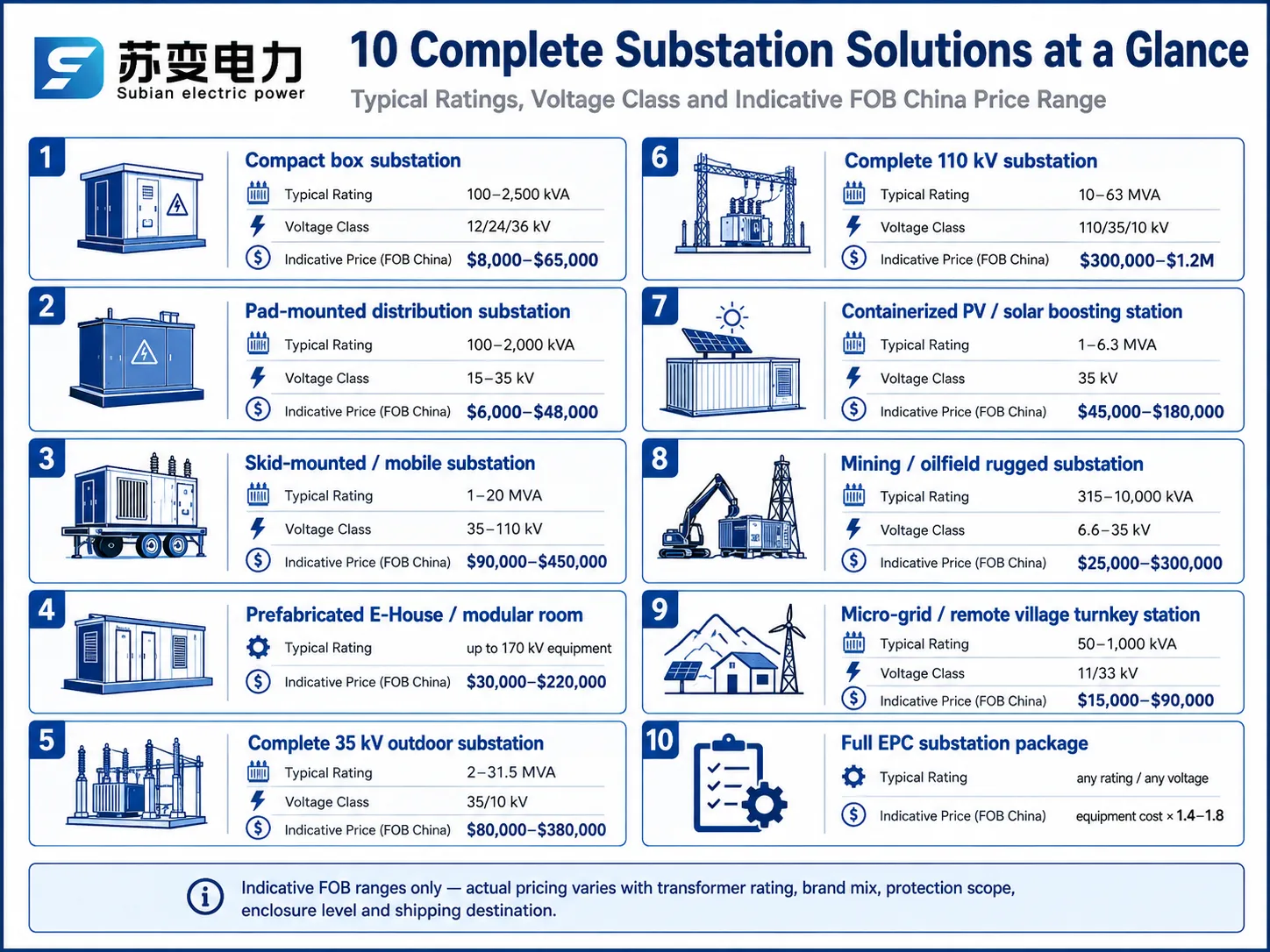
A expressão “subestação completa” inclui muitos tamanhos e configurações. A tabela abaixo lista os dez tipos mais populares, juntamente com suas faixas de preço de fabricantes na China. Deve-se notar que todos os preços mostrados são ilustrativos e dependem da marca, parâmetros, nível de proteção e localização da entrega.
| # | Tipo de solução | Classificação típica | Classe de tensão | Preço típico (FOB China) |
|---|---|---|---|---|
| 1 | Subestação compacta em caixa (estilo americano/europeu) | 100–2.500 kVA | 12/24/36 kV | $8.000–$65.000 |
| 2 | Subestação de distribuição montada em base | 100–2.000 kVA | 15–35 kV | $6.000–$48.000 |
| 3 | Subestação montada em skid / móvel | 1–20 MVA | 35–110 kV | $90.000–$450.000 |
| 4 | E-House / sala modular prefabricada | — | Equipamento de até 170 kV | $30.000–$220.000 |
| 5 | Subestação externa completa de 35kV | 2–31,5 MVA | 35/10 kV | $80.000–$380.000 |
| 6 | Subestação completa de 110kV | 10–63 MVA | 110/35/10 kV | $300.000–$1.200.000 |
| 7 | Estação de aumento de PV / solar em contêiner | 1–6,3 MVA | 35 kV | $45.000–$180.000 |
| 8 | Subestação robusta para mineração / campo de petróleo | 315–10.000 kVA | 6–35 kV | $25.000–$300.000 |
| 9 | Estação turnkey de micro-rede / vila remota | 50–1.000 kVA | 11/33 kV | $15.000–$90.000 |
| 10 | Pacote completo de subestação EPC (projeto + civil + instalação) | Qualquer | Qualquer | Custo do equipamento × 1,4–1,8 |
As primeiras sete formas são fabricadas em uma fábrica e estão prontas para testes antes do envio. Os produtos 8-10 são preferencialmente encomendados separadamente e têm prazos de espera mais longos, mas atendem a restrições mais rigorosas para o cliente. Os clientes podem escolher se desejam um dispositivo completamente móvel, uma estação externa que permanece em um lugar ou um módulo que pode ser deslocado para onde uma planta solar ou mina for.
Subestação Compacta vs Subestação Convencional
A decisão de aquisição geralmente tomada por gerentes de compras para grandes operações de distribuição é se a escolha deve ser feita entre uma subestação compacta (geralmente referida como unidades de geração e localizada acima do solo) e uma estação convencional que precisa ser construída nas instalações. Abaixo está uma comparação de dados indicativos simplificados coletados em várias licitações recentes.
| Critérios | Subestação compacta | Subestação convencional ao ar livre |
|---|---|---|
| Área ocupada | 6–30 m² | 150–1.000 m² |
| Tempo de projeto para energização | 45–90 dias de fábrica + 1–2 semanas de instalação | 12–18 meses |
| Obras civis no local | Mínimas (somente base de concreto) | Fundação completa, cercas, edifícios |
| Esforço de engenharia pelo comprador | Baixo — o fornecedor faz isso | Alto — consultores separados necessários |
| Relocabilidade | Sim (montado em skid/container) | Não |
| Custo total instalado (35kV/10kV, 5 MVA) | ≈ $180.000–$280.000 | ≈ $320.000–$520.000 |
| Acesso para manutenção | Bom para unidades pequenas; mais restrito para baias de HV | Excelente |
Subestações em caixa não são comumente usadas quando o nível de potência excede 20 MVA devido à necessidade de construções especiais devido aos requisitos de resfriamento e distância entre os barramentos e disjuntores. Mas para níveis de potência entre 100 kVA e 10 MVA, sabe-se que reduzem os custos totais de montagem em 30 a 50 por cento e o tempo de instalação em 60 por cento ou mais.
Normas e Conformidade a Especificar
Qualquer que seja o formato que você escolher, o equipamento interno deve atender a normas internacionais reconhecidas. Os documentos mais importantes a serem referenciados em sua licitação estão listados abaixo, com as cláusulas exatas que importam.
| Padrão | Escopo | Por que isso é importante para os compradores |
|---|---|---|
| IEC 60076 (partes 1–17) | Transformadores de potência | Define classificações, perdas, resistência a impulsos, faixas de derivação |
| IEC 62271-200 / -202 | Subestações compactas pré-fabricadas | Norma reguladora para estações de transformadores do tipo caixa |
| IEC 62271-1 / -100 | Equipamentos de manobra e disjuntores de MV | Verificação da capacidade de interrupção e classificações de falha |
| IEC 60529 | Proteção contra entrada de invólucro | Classificações IP54/IP65 para proteção contra intempéries externas |
| IEEE C57.12.20 | Transformadores montados em pad | Comumente exigidos para montagens em pad no mercado dos EUA |
| IEC 60255 | Relés de proteção | Garante que o comportamento de coordenação do relé seja testável |
Para projetos destinados aos EUA, os níveis de eficiência ANSI/IEEE C57.12 e NEMA TP-1 são frequentemente exigidos ao lado ou em vez de IEC. Especifique um regime claramente na licitação; misturá-los cria disputas de teste e aceitação posteriormente.
Especificações e Classificações Chave
Uma especificação corretamente elaborada para uma subestação inteira contém as seguintes informações. Se uma das informações for omitida, isso levará a confusões e mudanças necessárias no projeto.
Potência nominal: é medida em kVA com a tensão nominal e se o transformador em si é projetado para carga base contínua ou para sobrecarga (resfriamento ONAN/ONAF).
Tensão primária e secundária: por exemplo, 35/10,5 kV ou 33/0,4 kV, com faixas de derivação (geralmente cerca de ±2×2.5% ou com OLTC sob carga).
Grupo vetorial: Dyn 11, YNd11 ou Yyn0 dependendo da filosofia de aterramento.
Impedância de curto-circuito: é igual a 6-10% na classificação indicada.
Esquema de proteção: esquemas de diferencial de transformador (87T) e sobrecorrente (50/51) e falha de terra restrita (64) e falha de terra em espera.
Condições ambientais: faixa de temperatura no local, altura acima do nível do mar (desclassificação na altura acima de 1000 m), nível de umidade e classe de poluição.
Classe de invólucro: classificação IP, materiais utilizados, nível de ruído e tipos de entrada de cabo.
Medição e telemetria: mostra se há necessidade de medição de receita, interfaces SCADA e monitoramento remoto.
Por exemplo, se houver uma estação compacta classificada em 35/10,5 kV com um transformador de 5 MVA, a especificação mais provável contém um transformador com um transformador de resistência a impulso de 170 kV (classe LI conforme IEC 60076-3), um disjuntor a vácuo com classificação de 31,5 kA/4 s e invólucro IP54 com proteção de relé de acordo com a norma IEC 60255.
Seleção de Subestação Orientada pela Aplicação
A solução correta depende fortemente da aplicação. A tabela abaixo mapeia tipos comuns de projetos para o formato preferido de subestação.
| Aplicação | Formato recomendado | Classificação típica | Consideração chave |
|---|---|---|---|
| Rede urbana de baixa tensão (400V) | Subestação compacta | 315–1.000 kVA | Baixo ruído, pequena área ocupada, IP54 |
| Fornecimento de eletrificação rural para vilas | Montagem em base / montagem em poste + quiosque | 50–315 kVA | Menor custo inicial por residência |
| Coleta de planta solar PV ou eólica | Estação de reforço contêinerizada | 1–6,3 MVA | Compatibilidade do inversor, carga harmônica |
| Local de mineração / acampamento remoto | Subestação móvel montada em skid | 1–10 MVA | Relocabilidade, estrutura de transporte robusta |
| Distribuição de utilidade (35kV) | Subestação externa completa de 35kV | 3,15–20 MVA | Confiabilidade, redundância, SCADA |
| Planta industrial com fornecimento próprio | Montagem em pad + sala de controle E-House | 500–5.000 kVA | Coordenação de arco elétrico, capacidade reserva |
Os clientes tendem a cometer um erro quando tomam uma decisão dependendo do formato do fator preço e depois percebem que é necessário obter um equipamento de manobra isolado a ar ao ar livre de acordo com o código da rede local ou construir uma sala de medição separada antes de assinar o contrato. Certifique-se de consultar tanto o seu código de rede quanto a política da concessionária elétrica local sobre interconexão.
Principais marcas de subestações e faixas de preço
O mercado global de subestações consiste em algumas grandes empresas da Europa e América e um número crescente de fabricantes da China e Índia. Os preços abaixo referem-se a subestações compactas equivalentes de fábrica da classe 1 MVA/12 kV, com base FOB, apenas para referência.
| Marca | País | Preço típico (1 MVA, 12 kV) | Observações |
|---|---|---|---|
| ABB | Suíça | $48.000–$85.000 | Total experiência em e-house e GIS |
| Siemens | Alemanha | $50.000–$90.000 | Forte portfólio de subestações digitais |
| Schneider Electric | França | $45.000–$80.000 | Excelente integração LV/MV |
| Hitachi Energy | Suíça/Japão | $52.000–$92.000 | Patrimônio de transformadores premium e HVDC |
| Eaton | Irlanda/EUA | $40.000–$75.000 | Forte em montagens em pad e mercados dos EUA |
| Toshiba / Hyundai | Japão / Coreia do Sul | $38.000–$70.000 | Estabelecido na Ásia e Oriente Médio |
| TBEA / China XD | China | $18.000–$35.000 | Grandes fabricantes estatais chineses |
| Jiangsu Subian Electric Power | China | $14.000–$30.000 | Soluções focadas em exportação, testadas pela IEC |
Empresas internacionais proeminentes, como ABB, Siemens, Schneider Electric e Hitachi Energy, fornecem aos desenvolvedores design excepcional, ampla experiência e redes de suporte local. Dado esse fato, pagar preços premium (excedendo 1,5-2,5 vezes o preço equivalente de fábrica de fabricantes chineses) só faz sentido para projetos importantes, onde a certificação pela marca, bem como o suporte local, se tornam mais importantes do que o custo inicial do equipamento.
Caso os desenvolvedores estejam procurando fabricantes que produzem transformadores em conformidade com a IEC 60076 e relatórios de teste completos, a Jiangsu Subian Electric Power definitivamente vale a pena considerar. A empresa está envolvida no design e fabricação de transformadores, equipamentos elétricos e pacotes de estação completos que são enviados para mais de 40 países na África e América Latina. Assim, a Subian também oferece suporte OEM/ODM para que os desenvolvedores de projetos possam escolher entre várias marcas de relés, tipos de bushing e grupos vetoriais, enquanto desfrutam dos benefícios da abordagem de fornecedor único.
Como Escolher uma Solução Completa de Subestação
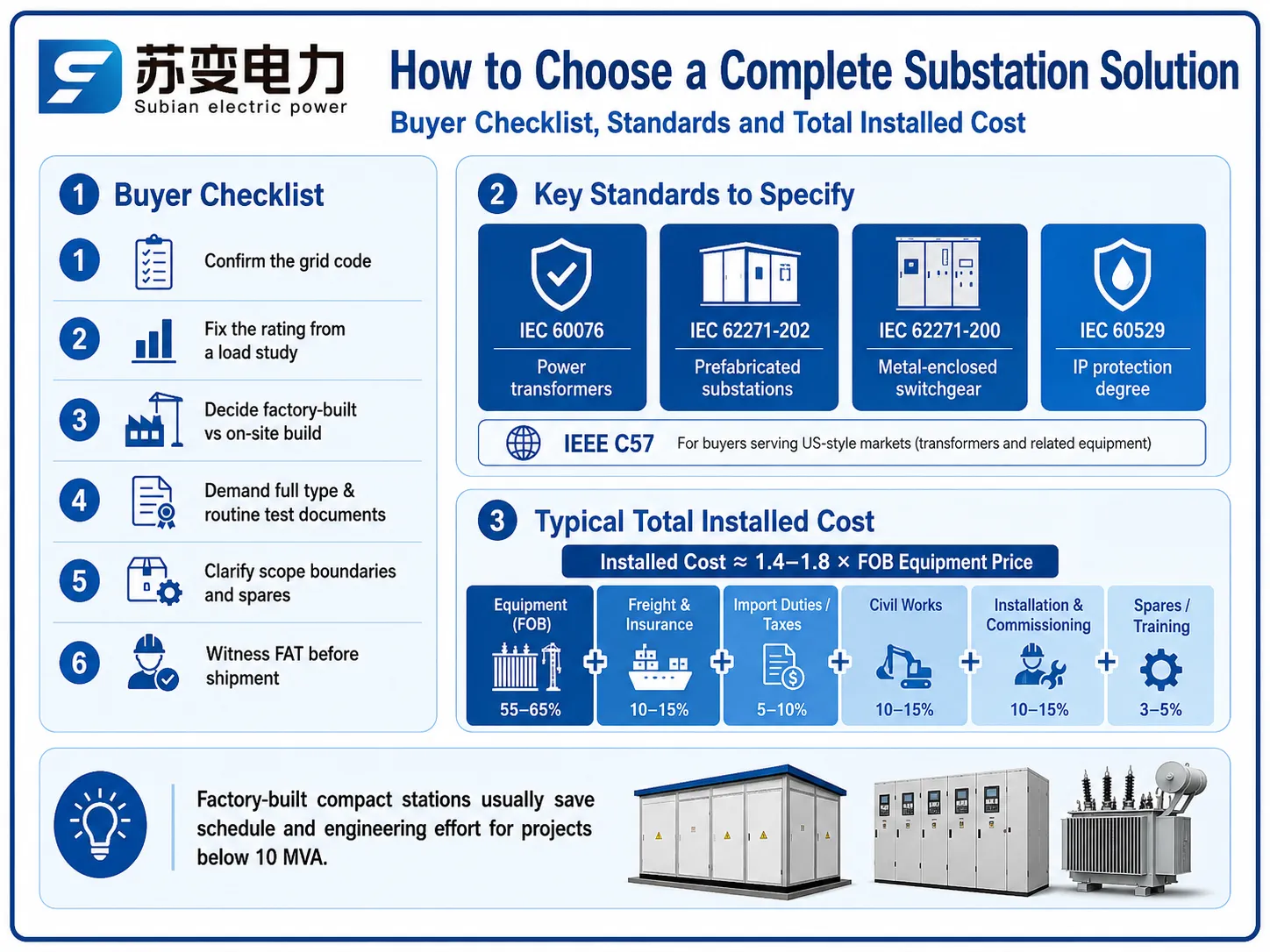
Esta lista de verificação deve ajudá-lo a selecionar os fornecedores certos e finalizar suas especificações antes de fazer um pedido.
Primeiro, confirme o código da rede e assegure-se de que você possui os requisitos de interconexão da concessionária, filosofia de proteção e requisitos de aterramento por escrito.
Descubra sua classificação com base em um estudo de carga.
Faça uma escolha entre equipamentos fabricados em fábrica e fabricação no local, pois equipamentos fabricados em fábrica são quase sempre preferidos em casos onde a capacidade requerida é inferior a 10 MVA e pouco tempo está disponível.
Exija documentação de teste completa do fornecedor.
Por favor, assegure-se de que as definições de escopo estejam claras.
Solicite um convite para o teste de aceitação na fábrica, pois com seu próprio engenheiro presente, a maioria dos problemas de comissionamento é resolvida antes do envio do equipamento.
Faça um plano para peças de reposição e consumíveis.
Negocie as indenizações por violação de contrato.
Custos Ocultos e Custo Total de Propriedade
O preço do equipamento FOB é geralmente menos da metade da história. Compradores experientes orçam com base no custo total desembarcado e instalado:
| Componente de custo | Participação típica do preço FOB | Observações |
|---|---|---|
| Equipamento (FOB) | 100% (base) | Inclui teste de fábrica |
| Frete marítimo + seguro | 8–15% | Contêiner de 20 pés/40 pés ou carga solta para unidades de 110kV |
| Impostos e taxas de importação | 5–30% | Dependente do país; verifique os códigos HS e isenções |
| Obras civis e fundação | 10–25% | Mesmo estações compactas precisam de uma base e valas para cabos |
| Instalação e comissionamento | 8–20% | Maior onde a mão de obra qualificada local é escassa |
| Peças sobressalentes, ferramentas, treinamento | 3–8% | Orçar 2 anos de peças críticas ao fazer o pedido |
Como regra geral, multiplique o preço FOB por 1,4–1,8 para estimar o custo total instalado e adicione uma contingência adicional de 5–10% para locais remotos ou logisticamente difíceis. Uma subestação compacta de R$20.000 pode realisticamente acabar custando R$30.000–R$38.000 instalada, então a proposta que parece barata muitas vezes não é a solução mais econômica no geral.
Perguntas Frequentes
Qual é a solução de subestação completa mais barata?
Quando se trata de requisitos de tamanho de distribuição, a subestação compacta em caixa que se enquadra na categoria de 100-630 kVA é a solução mais econômica geral dentro da faixa de $8,000-$25,000 com base no envio da China. Para requisitos inferiores a 100 kVA, transformadores montados em poste ou montados em base com um quiosque relativamente pequeno serão mais baratos ($3,000-$8,000), embora não possam sempre ser considerados como uma subestação completa. Para requisitos de potência que excedem 2,5 MVA, o design mais econômico seria o uso de estações externas padrão ou equipamentos montados em skid.
Quanto tempo leva para obter uma subestação completa de um fabricante chinês?
Uma subestação compacta comum é entregue em 45-90 dias a partir da confirmação dos desenhos. Grandes subestações de 110 kV levam de 6 a 14 meses devido aos ajustes de design e preparação do local. O teste de aceitação na fábrica geralmente é adicionado a isso e é altamente recomendado que seja feito antes da reserva para frete marítimo.
Quais testes devo exigir antes do envio?
No mínimo, deve-se realizar medições de resistência de enrolamento, relação de transformação, resistência de isolamento, resistência dielétrica e teste de aumento de temperatura de acordo com a IEC 60076.
Em relação ao equipamento de manobra a ser inspecionado, são necessárias medições de tempo de disjuntor, resistência de contato e testes de isolamento.
Caso o projeto suporte, registre o teste de tipo pessoalmente na fábrica (impulso de relâmpago de acordo com a IEC 60076-3, arco interno de acordo com a IEC 62271-202) ou solicite cópias certificadas da planta.
Uma subestação em caixa pode ser realocada posteriormente?
Sim. Unidades montadas em skid/containerizadas podem ser transferidas através de guindastes e caminhões de plataforma. Estações compactas do tipo europeu em invólucro de aço também podem ser movidas, mas obras de engenharia civil no novo local, como fundações/covas de cabos, ainda se aplicam. Se uma relocação for necessária, é vital indicar na ordem original informações sobre ganchos de elevação, estrutura reforçada e caixas de terminais à prova d'água.
Por que as subestações europeias são tão mais caras do que as chinesas?
Fabricantes europeus (ABB, Siemens, Schneider) têm custos de mão de obra mais altos, P&D local mais profundo e redes de serviços altamente desenvolvidas – mas seus produtos atendem aos mesmos padrões IEC que os fabricados por empresas chinesas hoje. A diferença de preço, que muitas vezes é de 1,5 a 2,5 vezes maior, é justificada pela segurança da marca e representação, bem como muitos anos de instalações comprovadas. Enquanto isso, empresas chinesas como Jiangsu Subian Electric Power podem fechar uma grande parte dessa lacuna em termos de sua oferta de equipamentos, pois fornecem produtos que cumprem os padrões IEC e toda a documentação relatada, permitindo que um cliente que possui suas capacidades de engenharia economize significativamente.
Referências
- IEC (Comissão Eletrotécnica Internacional) — Publicador das normas IEC 60076 para transformadores e IEC 62271 para equipamentos de manobra.
- IEEE — Fonte das normas de transformadores montados em pad IEEE C57.12 e C57.12.20 para as Américas.
- Agência Internacional de Energia (IEA) — Dados sobre investimento em rede e perspectivas de eletrificação citados acima.
- Insights do Mercado Global — Pesquisa de mercado sobre o mercado de subestações pré-fabricadas.
- NEMA (Associação Nacional de Fabricantes Elétricos) — Normas de eficiência TP-1 e equipamentos de distribuição.
- ABB — Páginas de produtos de referência para subestações compactas e e-houses.
- Siemens — Referência para subestações digitais e soluções pré-fabricadas.
- Jiangsu Subian Electric Power — Fabricante chinês de transformadores e pacotes completos de subestações.
Conclusão
Ao selecionar a solução completa certa para sua subestação, considere fatores como o formato certo, classificação e escopo do projeto a ser instalado em seu local. Não se trata apenas de encontrar a oferta mais barata em qualquer mercado online. Os dez formatos disponíveis de subestações variam de $8.000 variantes compactas até subestações de 110kV de multimilhões de dólares. Portanto, dependendo do seu estudo de carga, cronograma e engenharia disponível em seu local de trabalho, você obterá a resposta correta.
Algumas das subestações compactas construídas na fábrica podem ajudá-lo a economizar cerca de 30-50% em custos de instalação e 60% de tempo quando comparadas à construção no local.
É importante declarar claramente IEC 60076, IEC 62271-202, bem como IEC 60529 e exigir certificados de testes de tipo.
Finalmente, é útil planejar os custos totais de instalação na faixa de 1,4-1,8 do preço FOB do equipamento.
Independentemente de você escolher Siemens, ABB ou Schneider para seus projetos mais importantes, ou se você optar por Jiangsu Subian Electric Power para seus projetos orientados para exportação, certifique-se de receber a documentação de teste de fábrica juntamente com a contratação de apenas um fornecedor responsável.