


Вы когда-нибудь сталкивались с табличкой трансформатора, на которой было указано Dyn11, и задумывались, что означают эти буквы и цифры? Если да, то вы смотрите на трансформатор дельта-вай, который является наиболее популярным трехфазным соединением в распределительных системах по всему миру. Когда инженеру поручают ввод в эксплуатацию новой распределительной подстанции или промышленного завода, он встретит этот трансформатор почти в каждом проекте. Эта статья представит определение трансформатора дельта-вай, а также суть соединения с точки зрения напряжений и фазового сдвига, его преимущества по сравнению с другими типами соединений и как правильно выбрать трансформаторы для ваших проектов.
Что такое трансформатор дельта-звезда?
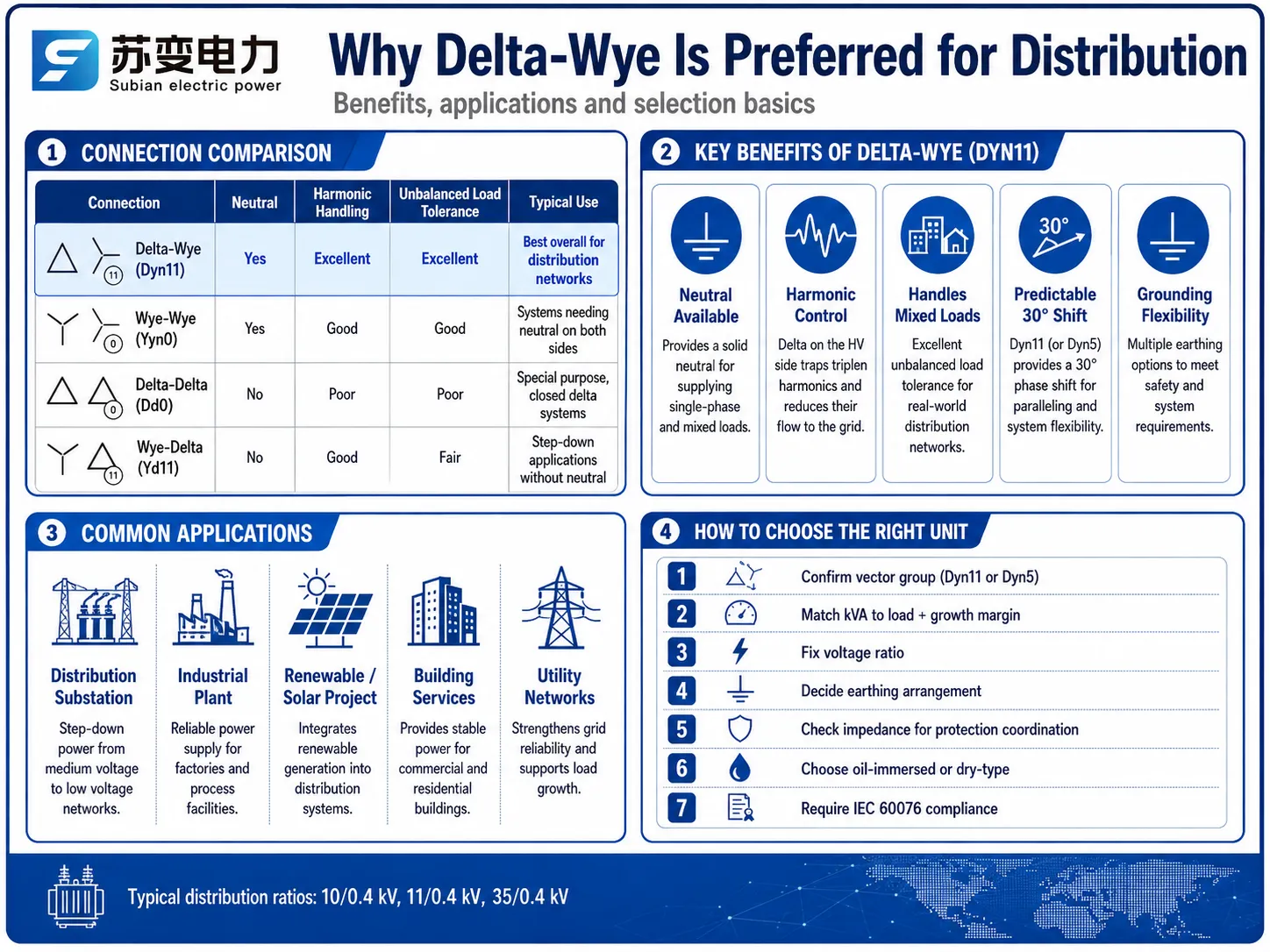
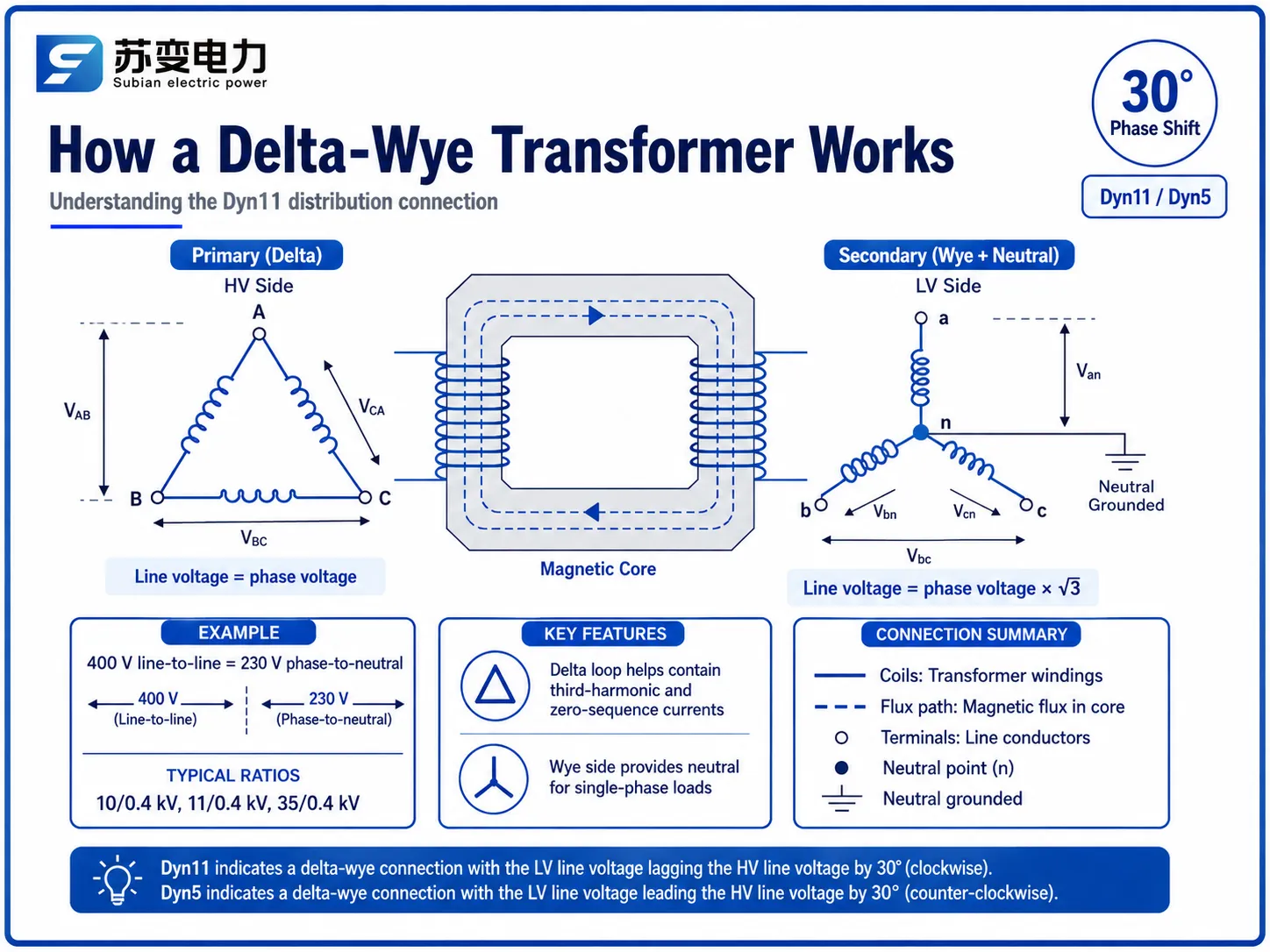
С точки зрения топологии, трансформатора дельта-вай он относится к категории трехфазного трансформатора с обмотками на стороне высокого напряжения (HV), сконфигурированными в дельту, и обмотками на стороне низкого напряжения (LV), сконфигурированными в вай. Конфигурация дельты включает соединение каждой обмотки последовательно, создавая замкнутый треугольный контур, в то время как в конфигурации вай один конец каждой из обмоток LV соединен в общей нейтральной точке. Нейтраль вай обычно выводится на четвертый вывод, что и обозначает название Dyn, указывая на то, что сторона HV имеет конфигурацию дельты, а сторона LV — вай, в то время как n относится к нейтрали. Сочетание двух конфигураций приводит к трансформатору дельта-вай, который предоставляет преимущества, предлагаемые двумя конфигурациями. Например, соединение дельты обслуживает первичную сторону, предлагая способ, с помощью которого можно обрабатывать незаземленные вторичные токи вместе с содержащими третий гармонический поток. С другой стороны, соединение вай помогает стабилизировать нейтральные точки для однофазных нагрузок и обеспечивает заземление системы.
Как работает соединение дельта-вай
Лучше всего начать с анализа стороны вай, так как она дает напряжение, воспринимаемое оборудованием. Поскольку каждая обмотка фазы проходит от линейного терминала до нейтрального соединения в соединении вай, фазное напряжение (напряжение обмотки) определяется как √3 (1.732) от линейного напряжения. Трехфазная система на 0.4 кВ имеет фазное напряжение менее 0.4/1.732 = 0.23 кВ (или 230 В). Именно поэтому низковольтное питание IEC дает 230/400 В. Нейтральный провод переносит избыточный ток во время несбалансированных однофазных нагрузок.
Сторона дельты имеет три обмотки, соединенные в кольцо, и здесь линейное напряжение соответствует фазному (напряжению обмотки) из-за отсутствия какого-либо деления на √3 или нейтраль. Кольцо образует замкнутый контур, который позволяет нулевой последовательности и третьему гармоническому току циркулировать в конструкции дельты. Преимущество дельтового соединения заключается в том, что оно не позволяет третьегармоническим искажениям влиять на уровень питания. Кроме того, преобразование напряжения в устройстве происходит в соответствии с коэффициентом трансформации, что отличает его от соединения вай, в то время как дельтовая схема всегда вводит постоянный фазовый сдвиг, т.е. 30°.
| Система | Линейное напряжение | Фазное напряжение (вай) | Соотношение |
|---|---|---|---|
| Низковольтное обслуживание IEC | 400 В | 230 В | 400 / 1.732 |
| IEC LV, Великобритания | 415 В | 240 В | 415 / 1.732 |
| US LV сервис | 208 В | 120 В | 208 / 1.732 |
| US промышленный | 480 В | 277 В | 480 / 1.732 |
| Дельта сторона (без нейтрали) | Равно фазному напряжению | — | Без деления на 1.732 |
Векторные группы: Dyn11, Dyn5 и что они означают
Код обозначения векторной группы указывает на фазовые отношения и способ подключения. D обозначает, что высоковольтная обмотка соединена по дельте; y означает, что низковольтная обмотка соединена по звезде; n указывает на то, что нейтральный провод низкого напряжения выведен. Число в обозначении векторной группы указывает на фазовое различие низкого напряжения относительно высокого напряжения в терминах кратных 30° как на часах. Если векторная группа Dyn11, то в ней линейное напряжение низковольтной системы опережает линейное напряжение высоковольтной системы на 11*30° = 330° (или отстает на 30°); в Dyn5 оно опережает на 150°. Используемые числа, либо 11, либо 5, имеют большое значение, когда трансформаторы работают параллельно или когда требуется фазовое соотношение для режима защиты трансформатора. Иногда подключение двух трансформаторов дельта-звезда параллельно будет возможно только в случае, если их векторные группы и последовательности фаз совпадают. Важно проверить и подтвердить группу в спецификации заказа, а также в отчете о тестировании, так как, например, Dyn11 не будет работать параллельно с системой трансформаторов Dyn5.
| Часовой номер | Фазовое смещение | Общее использование |
|---|---|---|
| 0 | 0° | Звезда-звезда и дельта-дельта банки |
| 1 | 30° (НН отстает) | Дельта-звезда, некоторые североамериканские банки |
| 5 | 150° | Дельта-звезда, специальные схемы заземления |
| 6 | 180° | Звезда-звезда в обратном порядке, зигзагообразные варианты |
| 11 | 330° (НН опережает на 30°) | Стандарт распределения дельта-звезда |
Ключевые особенности и преимущества
| Особенность | Преимущество |
|---|---|
| Нейтральная сторона звезды | Обеспечивает однофазные нагрузки и предоставляет ссылку на заземление |
| Первичная петля дельты | Циркулирует нулевые последовательности и токи третьей гармоники, защищая питание |
| 30° фазовое смещение | Стандартное, предсказуемое фазовое соотношение для параллельной работы |
| Тolerance к несбалансированной нагрузке | Смешанные однофазные и трехфазные нагрузки вызывают меньшее напряжение несоответствия |
| Гибкость заземления | Neutral can be solidly earthed or connected through an earthing impedance |
Delta-Wye vs. Other Connections
| Connection | Neutral available | Third-harmonic handling | Тolerance к несбалансированной нагрузке | Общее использование |
|---|---|---|---|---|
| Delta-wye (Dyn11) | Yes (LV) | Good — delta loop circulates it | Хорошая | Distribution, industrial supply |
| Wye-wye (Yyn0) | Yes (both sides) | Poor without tertiary winding | Poor | Rarely used alone in three-phase |
| Delta-delta (Dd0) | Нет | Хорошая | Poor — no LV neutral | Industrial loads, no grounding need |
| Wye-delta (Yd11) | No (LV delta) | Хорошая | Хорошая | Step-up in generation |
Delta wye is the only widely adopted connection which gives you a grounded neutral on the load side and harmonic mitigation on the supply side. Wye wye, without the third winding, will have some neutral displacement and third harmonic distortion for unbalanced loads. Delta delta does not have any neutral at all. So, in case the load needs 230/400 V four-wire supply, delta wye is going to be your connection of choice almost invariably.
Common Applications
- Substations that decrease 35 kV or 10 kV to 0.4 kV for the supply of four-wire systems in the commercial field and industry. Manufacturing companies needing three-phase electric power (for motors and compressors) and the neutral for lighting and controlling devices. Renewable energy projects where the neutral reference and harmonics are contained at the inverter cluster output by means of the transformer on the collector side. Construction of plant operations that require grounded supply in accordance with safety standards. Utility systems that create a delta-wye unit sometimes by means of the own grounding transformer.
Типовые спецификации
| Номинальная мощность (кВА) | Напряжение | Векторная группа | Импеданс | Indicative price (US$) |
|---|---|---|---|---|
| 100 | 10/0.4 кВ | Дин11 | 4% | $3,000–$6,000 |
| 315 | 10/0.4 кВ | Дин11 | 4% | $5,500–$10,000 |
| 630 | 10/0.4 кВ | Дин11 | 4.5–6% | $9,000–$16,000 |
| 1,000 | 35/0.4 кВ | Дин11 | 6% | $14,000–$25,000 |
| 2,500 | 35/0.4 кВ | Дин11 | 6–8% | $28,000–$45,000 |
Prices are indicative FOB for oil-immersed units with standard loss levels; dry-type cast resin versions run about 20–40% higher at the same rating. Confirm impedance against your protection scheme, because it governs fault current and discrimination.
Как выбрать правильное устройство
- Confirm the vector group. Dyn11 for most distribution duties; Dyn5 where the network requires a different phase relationship. State it on the order.
- Match the kVA to the load. Size from the connected load, the largest starting load, and 10–20% growth margin.
- Fix the voltage ratio. 35/0.4 kV, 10/0.4 kV, or 11/0.4 kV depending on your primary network and LV panel voltage.
- Decide the earthing arrangement. Solid neutral earthing is simplest; use a neutral earthing resistor (NER) where fault-current limits are required.
- Check the impedance for protection coordination. A 4–6% impedance is typical; higher values limit fault current but raise voltage regulation.
- Choose insulation and cooling for the site. Oil-immersed outdoors, dry-type cast resin indoors; ONAN standard, ONAF for high load factors.
- Require IEC 60076 compliance. Confirm insulation levels, temperature rise, and short-circuit withstand, and request the routine test report.
Топовые бренды и ценовые категории
| Бренд | Страна | Product focus | Ориентировочный диапазон цен (US$) |
|---|---|---|---|
| ABB | Швейцария/Швеция | Distribution and industrial delta-wye units | $4,000–$60,000 |
| Сименс | Германия | IEC distribution transformers | $3,500–$55,000 |
| Schneider Electric | Франция | Dry-type and cast resin units | $3,000–$45,000 |
| Hitachi Energy | Швейцария | Utility-grade distribution transformers | $4,500–$70,000 |
| Итон | США | North American distribution units | $2,500–$42,000 |
| Jiangsu Subian Electric Power | Китай | Oil-immersed and dry-type, custom vector groups | $3,000–$45,000 |
The mentioned prices are not fixed and can vary among manufacturers based on the quality of the products as well as damage and equipment used. Well-known companies that make delta/wye transformers include ABB, Schneider Electric, Siemens, Hitachi Energy and Eaton. The documentation of these companies serves as an excellent point of reference for specifications. Those who are interested in getting delta/wye transformers manufactured according to IEC 60076 standards at better prices can buy wick transformers from Jiangsu Subian Electric Power Co., Ltd. This company manufactures oil (湿型) and dry (干型) type delta-wye transformers in all capacities starting from small distribution units up to several MVA and with various vector groups including Dyn11 and Dyn5. Jiangsu Subian Electric Power Co., Ltd. uses high-quality oriented steel and copper for their transformers and can provide full testing documentation and necessary support for their exports.Review the product range on the сайте Subian Electric.
Часто задаваемые вопросы
Why is the delta-wye connection so common in distribution?
The benefit that comes from this connection is the ability to provide everything at once: neutral grounding on low-voltage for single-phase loads and earthing; the ability to make a delta loop on high-voltage side that traps third-harmonic and zero-sequence currents, and a reasonable degree of resistance to unbalanced loads. No other connection has those three features, and that is the reason why Dyn11 has been chosen for distribution transformers in the voltage range from 10 kV down to 0.4 kV.
What does Dyn11 mean on a transformer nameplate?
D shows that the high-voltage winding is in a delta connection, y lets us know that the low-voltage winding is in a wye (or star) connection, and n indicates that the low-voltage neutral is out. The 11 indicates clock hour: this means that LV line voltage leads HV line voltage by 330 degrees (this is equivalent to lagging LV line voltage by 30 degrees), which gives us the characteristic of the delta-wye connection—30-degree phase shift.
Why is there a 30° phase shift in a delta-wye transformer?
The transformation is a result of the changes in the connections of the windings on the two sides. For the wye connection, the line voltage phasor is the difference between two phase voltages which are separated by 120 degrees, while for the delta connection, it is equal to the voltage of one phase. By comparing the two line voltages, one can find out that the angle between the phasors is 30 degrees, which is the reason why delta-wye transformer is referred to as 11 or 5 (30 or 150 degrees).
Can a delta-wye transformer handle unbalanced loads?
Quite well. When delta type connections are present in a primary winding, unbalance current in the secondary winding will flow through the delta network and be suppressed. This makes this type of connection favorable when utilizing a combination of single phase and three phase supplies. In situations of high imbalance it is essential that the system is properly rated and the neutral current accounted for.
Does Subian manufacture delta-wye transformers for export?
Indeed! Jiangsu Subian Electric Power can supply delta-wye transformers according to IEC 60076 with the vector group, capacity, and voltage ratio you need, and also provides routine testing reports and optional third-party inspections for international jobs. The factory is capable of supplying either oil-immersed or dry type construction for typical distribution classes.
Ссылки
- IEC 60076-1 — Силовые трансформаторы: Общие сведения — the governing standard for rating and testing, including vector-group designation.
- IEC 60076-3 — Уровни изоляции и диэлектрические испытания — defines insulation requirements for distribution-class delta-wye transformers.
- IEC 60076-5 — Способность выдерживать короткое замыкание — the short-circuit verification standard for the windings.
- NEMA TP-1 — Энергоэффективность для распределительных трансформаторов — efficiency benchmark used in loss evaluation.
- Hitachi Energy — Продукты трансформаторов — reference documentation for utility-grade distribution transformers.
- Eaton — Transformer Engineering Information — practical connection and application guidance from a major manufacturer.
Заключение
it combines a grounded wye secondary suitable for single-phase loads with an earth connection with a primary delta winding capable of performing harmonic suppression and absorbing unbalanced currents, at the same time allowing for a 30-degree phase shift. To ensure the success of using such transformers, the right combination of the following five elements should be achieved: the specification of the vector group (typically Dyn11), the determination of the transformer kVA based on load studies, the identification of voltage ratio matching the network, the selection of earthing mode, as well as the conformance of all specifications to the requirements of the IEC 60076 standard and the availability of testing documentation.Confirm your vector group and load data with the team through the официальный сайт to receive a specification-matched quotation.