


When energy equipment managers are looking for auxiliary transformers in the Gulf or the procurement chiefs of EPC companies in Southeast Asia, they tend to turn to China. And it’s easy to understand why — China has the biggest transformer manufacturing capacity in the world, a well-established IEC 60076 engineering practice, and prices that are far lower than those from factories based in Europe or North America. But the term “made in China” has a very broad meaning, implying anything from units that have been factory tested prior to export from China to commodity equipment builds, which makes it critical to choose wisely — otherwise, there are risks to face such as delays at customs, failed acceptance tests, and high costs of reengineering. In the current article, we present the most commonly requested types and configurations of auxiliary transformers available in China, the purpose of each of them, their price levels, and a few words on how to check the quality of suppliers before making a purchase order.
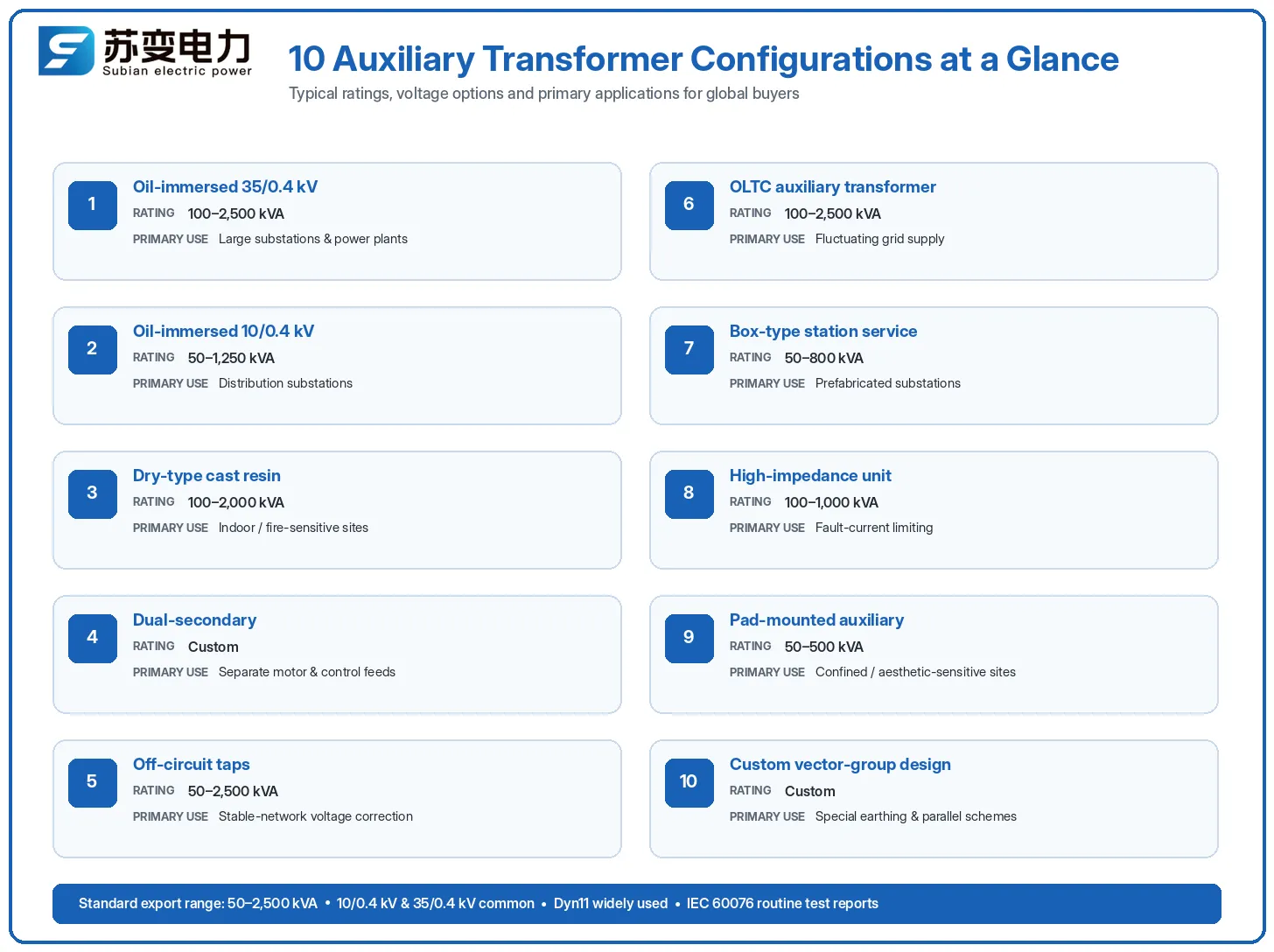
Quick answer: The top auxiliary transformer configurations from Chinese manufacturers are: (1) oil-immersed 35/0.4 kV station service transformers; (2) 10/0.4 kV oil-immersed units; (3) dry-type cast resin units; (4) dual-secondary units; (5) units with off-circuit taps; (6) on-load tap-changing (OLTC) units; (7) compact box-type station service packages; (8) high-impedance units for fault-current limiting; (9) pad-mounted units; and (10) custom vector-group designs. Ratings range 50–2,500 kVA, and export prices typically run $2,000–$35,000, about 20–40% below equivalent European brands. Standards: IEC 60076 with routine test reports, and third-party inspection is widely available.
The Reason Why Global Consumers Select Auxiliary Transformers from China
China produces the most number of power and distribution transformers in the world, and so the auxiliary transformer industry stands to benefit from that scale. China manufacturers can provide all types of oil-immersed and dry-type products, and they use standardized plants capable of delivering transformers with a production time of 4 to 10 weeks for the most common types. The cost is approximately 20-40% lower compared to similar units made in Europe or North America. Since IEC 60076 is the international standard used, the content of the quotation from the Chinese company can be compared to that of a competitor from Europe with the use of the same standard. The risk of purchasing from China is connected to supplier selection. A reliable manufacturer in China will be able to provide all required test reports, give access to the third-party tests performed by companies like SGS, TUV, or Bureau Veritas, and provide smooth customs clearance.
The Top 10 Auxiliary Transformer Configurations
| # | Configuration | Typical rating | Primary use |
|---|---|---|---|
| 1 | Oil-immersed 35/0.4 kV station service transformer | 100–2,500 kVA | Large substations, power plants |
| 2 | Oil-immersed 10/0.4 kV auxiliary transformer | 50–1,250 kVA | Distribution substations |
| 3 | Dry-type cast resin auxiliary transformer | 100–2,000 kVA | Indoor, fire-sensitive installations |
| 4 | Dual-secondary auxiliary transformer | Custom | Separate motor and control feeds |
| 5 | Auxiliary transformer with off-circuit taps | 50–2,500 kVA | Stable-network voltage correction |
| 6 | On-load tap-changing (OLTC) auxiliary transformer | 100–2,500 kVA | Fluctuating grid supply |
| 7 | Compact box-type station service package | 50–800 kVA | Prefabricated substations |
| 8 | High-impedance auxiliary transformer | 100–1,000 kVA | Fault-current limiting schemes |
| 9 | Pad-mounted auxiliary transformer | 50–500 kVA | Confined or aesthetic-sensitive sites |
| 10 | Custom vector-group auxiliary transformer | Custom | Special earthing and parallel schemes |
1–3: The Oil-Immersed Workhorses
The oil-filled transformers that lower the bus of a substation to 0.4 kV are most commonly used in auxiliary transformer exporting. The first configuration specifies the 35/0.4 kV transformer, which is primarily used to feed large substations and power plants where the primary bus comes at 33-35 kV with various ratings from 100 to 2,500 kVA. Configuration number two, which is a 10/0.4 kV transformer, is the standard used in distribution substations operated at voltage between 10 and 11 kV, which makes it the most successful configuration in exporting of transformers considering that this is the prevailing voltage in the majority of power grids outside of North America. The third configuration is a dry transformer with resin insulation, which basically provides a viable solution for dry installations as it involves no oil, has a low fire hazard and is much easier to maintain, although 20-40% more expensive than the oil type transformer. All three configurations come with the standard tests according to the IEC 60076 norm and all of them correspond to the same vector group Dyn11 in regards to the LV neutral.
4–6: Dry-Type, Dual-Secondary, and Tapping Options
Configuration #4, the dual-secondary unit, has 2 independent LV windings that are typically 0.4 kV, resulting in electrical isolation between motor load and control/protection circuits and preventing motor inrush from affecting control bus. Configuration #5, off-circuit taps, represents an economical option for networks that change slowly since it allows the station to determine the ratio at commissioning without incurring additional expenses on installing a tap changer due to the presence of ±2 × 2.5% taps. Configuration #6, on-load tap changer, allows the 0.4 kV bus to remain in the acceptable range while the station continues to operate, which is appropriate for the condition when network fluctuations occur as a result of watering and air conditioning systems or production cycles of manufacturing enterprises, and requires a payback of 10-25% more than previous options and additional costs related to regular OLTC maintenance. In 2026, OLTC option is going to be combined with remote tap position indicator that is considered the norm by the station SCADA.
7–10: Specialized Configurations
Configuration #7, known as the box-type station service package, is characterized by the integration of the transformer and LV switchgear, as well as metering and control cubicle on a common skid, assembled in a pre-fabricated substation. The configuration has become popular for compact urban and containerized stations where time efficiency is critical. On the other hand, Configuration #8, aka high impedance configuration, is known for the high impedance of the transformer (from 8-12% instead of the normal 4-6%) in order to minimize fault current and allow for lower switchgear ratings downstream; the downside being slightly worse voltage regulation. Configuration #9, coined pad-mounted configuration, is designed for residential and aesthetically sensitive sites; this configuration fits the North American convention of pad-mounted equipment. Configuration #10, custom vector group configuration, is useful for Dyn5, YNd11 or special earthing arrangements; here the role of engineering support is crucial, as the connection determines protection and parallel operation of the device.
| Station type | Recommended configuration | Typical rating |
|---|---|---|
| Large EHV substation | Oil-immersed 35/0.4 kV, OLTC option | 1,000–2,500 kVA |
| Distribution substation (10 kV) | Oil-immersed 10/0.4 kV | 100–630 kVA |
| Indoor / urban substation | Dry-type cast resin | 100–2,000 kVA |
| Prefabricated / containerized | Box-type station service package | 50–800 kVA |
| Plant with motor+control separation | Dual-secondary unit | Custom |
| High-fault-current network | High-impedance unit | 100–1,000 kVA |
How to Shortlist Chinese Suppliers
| Criteria | What to verify |
|---|---|
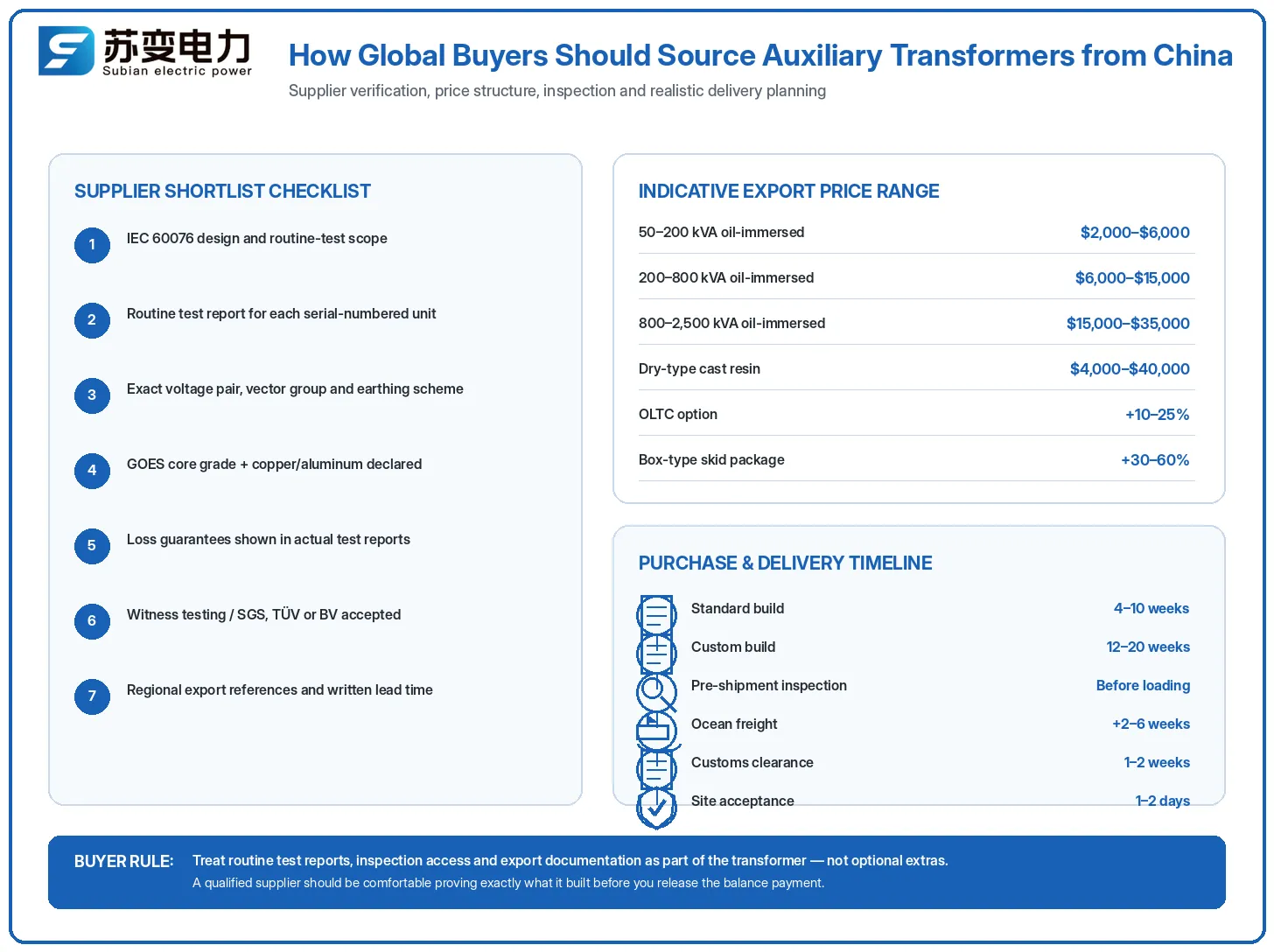
| Standard compliance | IEC 60076 design, routine and type test scope |
| Test documentation | Routine test report per unit; type test certificates on request |
| Voltage and vector group | Exactly matches your bus and earthing scheme |
| Core and conductor | GOES grade stated; copper or aluminium declared |
| Loss guarantees | No-load and load loss figures in the report, not just the datasheet |
| Inspection flexibility | Witnessed tests or third-party inspection accepted |
| Export track record | References in your region or voltage class |
| Lead time | Standard platform vs. custom cycle; confirmed in writing |
Price Ranges and What Drives Them
| Configuration | Indicative export price (US$) |
|---|---|
| 50–200 kVA oil-immersed | $2,000–$6,000 |
| 200–800 kVA oil-immersed | $6,000–$15,000 |
| 800–2,500 kVA oil-immersed | $15,000–$35,000 |
| Dry-type cast resin (100–2,000 kVA) | $4,000–$40,000 |
| OLTC option added | +10–25% |
| Box-type skid package | +30–60% over bare transformer |
| Third-party inspection | +1–3% or fixed fee |
Prices are indicative FOB Chinese port and vary with rating, losses, vector group, accessories, and freight terms. The two biggest price drivers after rating are loss specification (premium-efficiency cores cost more) and documentation scope (inspection and type tests add cost but buy acceptance certainty).
Importation, Inspection, and Logistics
Check compliance with requirements in writing. IEC 60076-1, -2, -3, and -5 are indicated in the order; ask which type test report the utility needs.
Arrange for the third-party inspection. The pre-shipment inspection done at the manufacturer (by SGS, TUV, BV, or a local inspection firm) is aimed at validating test reports.
Plan freight transport by sea. The 2,500 kVA transformer has the approximate weight of 8–12 tons – check the routing, lifting points, and packing (it is usually done by wooden boxes).
Prepare customs documentation. Commercial invoice, packing list, certificate of origin, and the test report should accompany the consignment; check local customs requirements.
Plan site acceptance procedure. Compare the nameplate data of the delivered unit and the routine test data with the order data. Arrange for the pre-commissioning insulation resistance check.
Be prepared for maintenance. Getting the terminal diagrams, general arrangement drawings, and spare parts list prior to shipment will enable timely maintenance work.
| Step | Typical timing | Key documents / actions |
|---|---|---|
| Standard build | 4–10 weeks | Order confirmation with lead time in writing |
| Custom build | 12–20 weeks | GA drawing approval before production |
| Pre-shipment inspection | Before loading | Third-party report vs. routine test data |
| Ocean freight | +2–6 weeks | Fumigated crates, lift points, port routing |
| Customs clearance | 1–2 weeks | Invoice, packing list, CO, test report |
| Site acceptance | 1–2 days | Nameplate check, insulation resistance test |
Supplier Landscape and Price Ranges
| Supplier / brand | Country | Position | Indicative price range (US$) |
|---|---|---|---|
| ABB | Switzerland/Sweden | Global reference, full documentation | $4,000–$60,000 |
| Siemens | Germany | European reference, strong service network | $3,500–$55,000 |
| Schneider Electric | France | Dry-type expertise | $2,500–$40,000 |
| Hitachi Energy | Switzerland | Utility-grade units | $4,500–$70,000 |
| Eaton | USA | North American market units | $2,000–$35,000 |
| Jiangsu Subian Electric Power | China | Export-focused auxiliary transformer manufacturer | $2,000–$35,000 |
Prices are indicative for 50–2,500 kVA units and vary with rating, losses, and accessories. ABB, Siemens, Schneider Electric, Hitachi Energy, and Eaton set the quality reference for auxiliary transformers, particularly where global framework agreements apply. For buyers sourcing from China, Jiangsu Subian Electric Power Co., Ltd belongs to the export-focused tier of manufacturers that combine IEC 60076 compliance with responsive service. Subian builds oil-immersed and dry-type auxiliary transformers in standard and custom configurations, from tens of kVA to several MVA, with the vector groups, taps, and dual-secondary options your scheme needs. Every unit ships with routine test reports, third-party inspection and witnessed tests are available, and the factory has delivered station service units to utility and EPC customers across multiple countries. Factory-direct pricing and 4–10 week standard lead times give global buyers the schedule and cost advantage that made China the sourcing destination in the first place. See the product range on the Subian Electric website.
Frequently Asked Questions
Why is China a major source of auxiliary transformers?
In addition to having the most productive transformer industry, China implements proven IEC 60076 technology and has its own design methods, allowing it to keep costs that are 20-40% lower than those of European and North American firms. Export-oriented manufacturers also operate in accordance with the necessities of foreign clients and can provide relevant documentation and quality checks for their products.
What is the most common rating for an exported auxiliary transformer?
The voltage levels that the customers most often write about are between 100 kVA and 1,250 kVA. 10/0.4 kV or 35/0.4 kV are by far the most common voltage levels for electrical equipment. 50–315 kVA distribution substations buy smaller substations while big power stations and substations would have voltage level requirements of somewhere between 1,000 kVA and 2,500 kVA.
How do I verify the quality of a Chinese auxiliary transformer supplier?
Four checks matter: the IEC 60076 routine test report for each unit, the type test certificate for the design, reference export projects in your region or voltage class, and the supplier’s willingness to accept a witnessed test or third-party inspection. A supplier that opens its factory floor and test records to inspection is signaling confidence — treat that as a positive quality indicator.
How long does delivery take and what does freight add?
Standard configurations on a manufacturer’s design platform typically ship in 4–10 weeks; custom designs run 12–20 weeks. Ocean freight to the Gulf, Europe, or Southeast Asia adds 2–6 weeks depending on the port, and freight plus export packing typically adds 5–15% to the FOB price for mid-size units. Confirm the lead time in writing against your energization date.
Does Subian ship auxiliary transformers to my region?
Jiangsu Subian Electric Power exports to multiple countries and can confirm recent shipments to your region as part of the reference check. The company supports international logistics, customs documentation, and third-party inspection, and provides the test reports and drawings needed for smooth site acceptance.
References
- IEC 60076-1 — Power Transformers: General — the governing standard for auxiliary transformer rating and testing.
- IEC 60076-5 — Ability to Withstand Short Circuit — short-circuit verification required for station service units.
- IEC 60076-3 — Insulation Levels and Dielectric Tests — defines insulation and dielectric test requirements.
- TUV SUD — Transformer Testing Services — representative third-party inspection and type-test provider used by global buyers.
- Canton Fair Official Site — the main sourcing event where international buyers evaluate Chinese transformer suppliers.
- Hitachi Energy — Transformer Products — reference documentation for comparing quality benchmarks.
Conclusion
China offers global buyers a competitive and reliable source of auxiliary transformers — provided the configuration, specification, documentation, and supplier capability are verified properly. The top 10 configurations cover the full range of station service needs, from the oil-immersed 35/0.4 kV workhorse to dry-type cast resin units, OLTC versions, box-type packages, and custom vector groups. Two habits separate smooth procurement from costly rework: comparing quotes on a common, fully specified basis (rating, voltage pair, vector group, loss guarantees, test scope), and treating inspection and test documentation as part of the product, not an extra. Jiangsu Subian Electric Power represents the quality and responsiveness available from Chinese manufacturing today, with IEC 60076 compliance, full test evidence, and factory-direct pricing. Send your specification through the official website for a comparable quotation and a delivery schedule that matches your project.