


The standard kVA rating used for distribution in three-phase electricity in North America is 112.5 kVA. With this number and the National Electrical Code requirements concerning dry type installations, its prevalence becomes easy to understand. This may come as an unexpected fact, but two transformers that share the same kVA and voltage ratio can differ significantly in many characteristics, for example, in the volume and weight being hundreds of pounds apart. In this article, I provide you with the exact specifications and explore the factors that have a significant impact on transformer sizes.
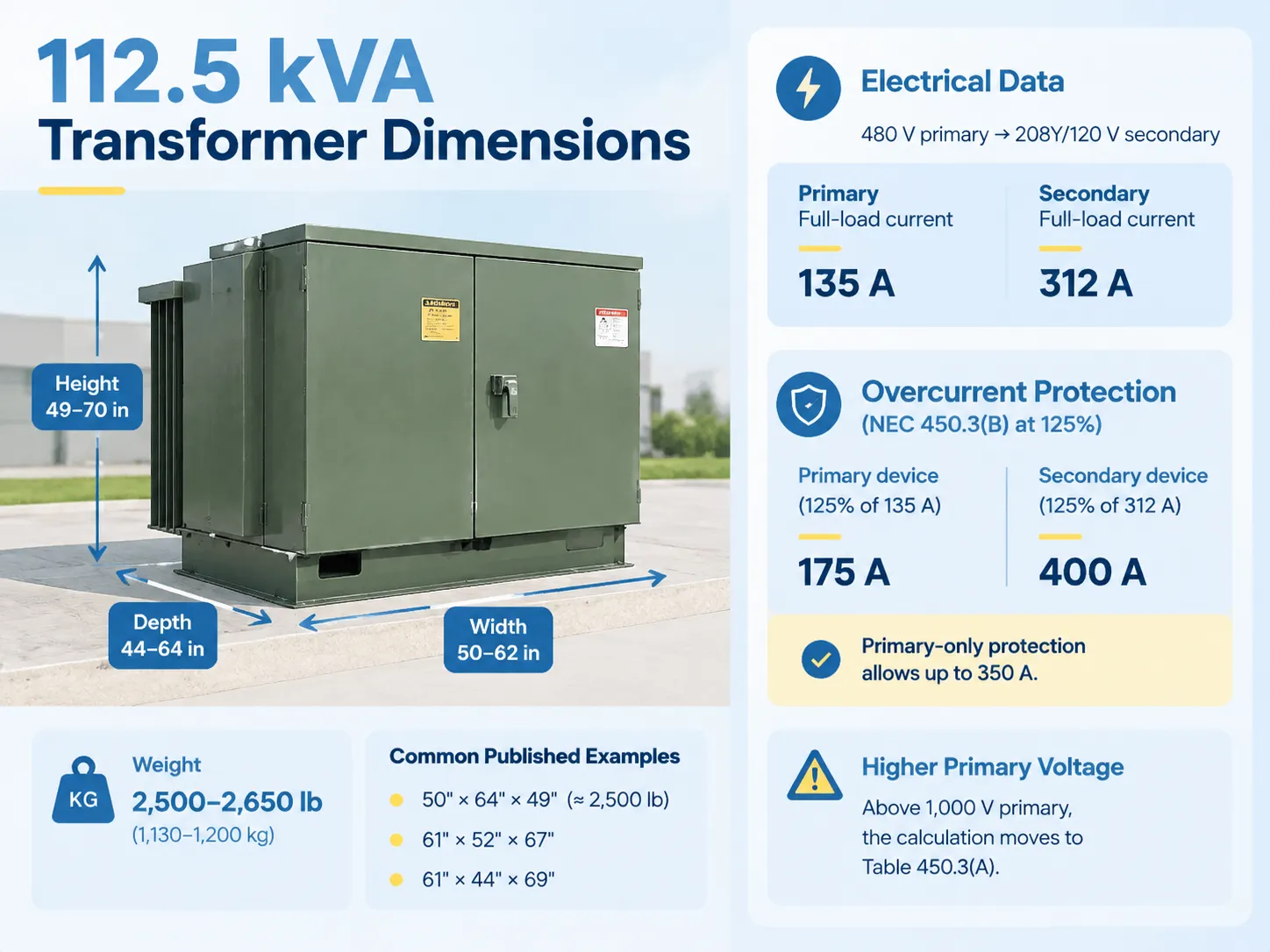
In brief, a 3-phase transformer rated at 112.5 kVA is around 50–62 inches in width, 44–64 inches in depth, and 49–70 inches in height while it weighs approximately 2,500–2,650 lb (1,130–1,200 kg). For example, the published dimensions of this transformer are 50″ × 64″ × 49″ and approximately 2,500 lb, 61″ × 52″ × 67″, and 61″ × 44″ × 69″. In terms of the capacity, when 480V is the primary voltage supplying 208Y/120V, the primary full load scale reads 135A and the secondary full load current reads 312A; hence, the primary unit of 175A and a secondary unit of 400A provide enough protection according to the National Electrical Code 450.3 (B) at 125%.
What 112.5 kVA Actually Means
A kVA of 112.5 belongs to the common ANSI distribution series. The standard ratings extend from 15-30-45-75-112.5-150-225-300-500-750-1000 and higher. It is a number which lies between that of 75 and 150, being a favorite number for commercial buildings because it permits load levels above what 75 kVA can justify without paying for unnecessary capacity of a 150 kVA plant.
This figure serves as a threshold figure for the Code, too. Dry-type transformer less than or equal to 112.5 kVA can be installed without a vault and outdoors per NEC 450.21(A), provided it is spaced from the combustible material at least one foot unless employing insulated barrier or fully closed transformer (except for ventilation openings). For the capacities above 112.5, a dry-type device located inside needs to be placed in a transformer room that would meet the fire resistance requirements while the exemptions apply to the installation with Class 155 insulating material or higher. Thus, moving from the 112.5 kVA range to the 150 kVA range can modify the characteristics of the room that has to be built and not only the type of the equipment being purchased.
It is important to note what kVA represents from the electrical point of view since it is not equal to kW. The transformer with a rated capacity of 112.5 kVA only produces 112.5 kW for purely resistive load; in practice its output in real watts is lower even despite the fact that the winding consumes the entire kVA amount. The relationship, and how to size against a real connected load rather than an assumed one, is set out in this explanation of what a kVA transformer rating is.
The Dimensions You Should Plan Around
The given numbers are taken from original data obtained from 112.5 kVA three-phase pad mounted units, which are completely self-cooled (KNAN), have a temperature rise of 65 °C, and operate on the frequency of 60 Hz according to DOE 2016 standards and ANSI/IEEE C57.12 standards.
| Configuration | Width | Depth | Height | Weight |
|---|---|---|---|---|
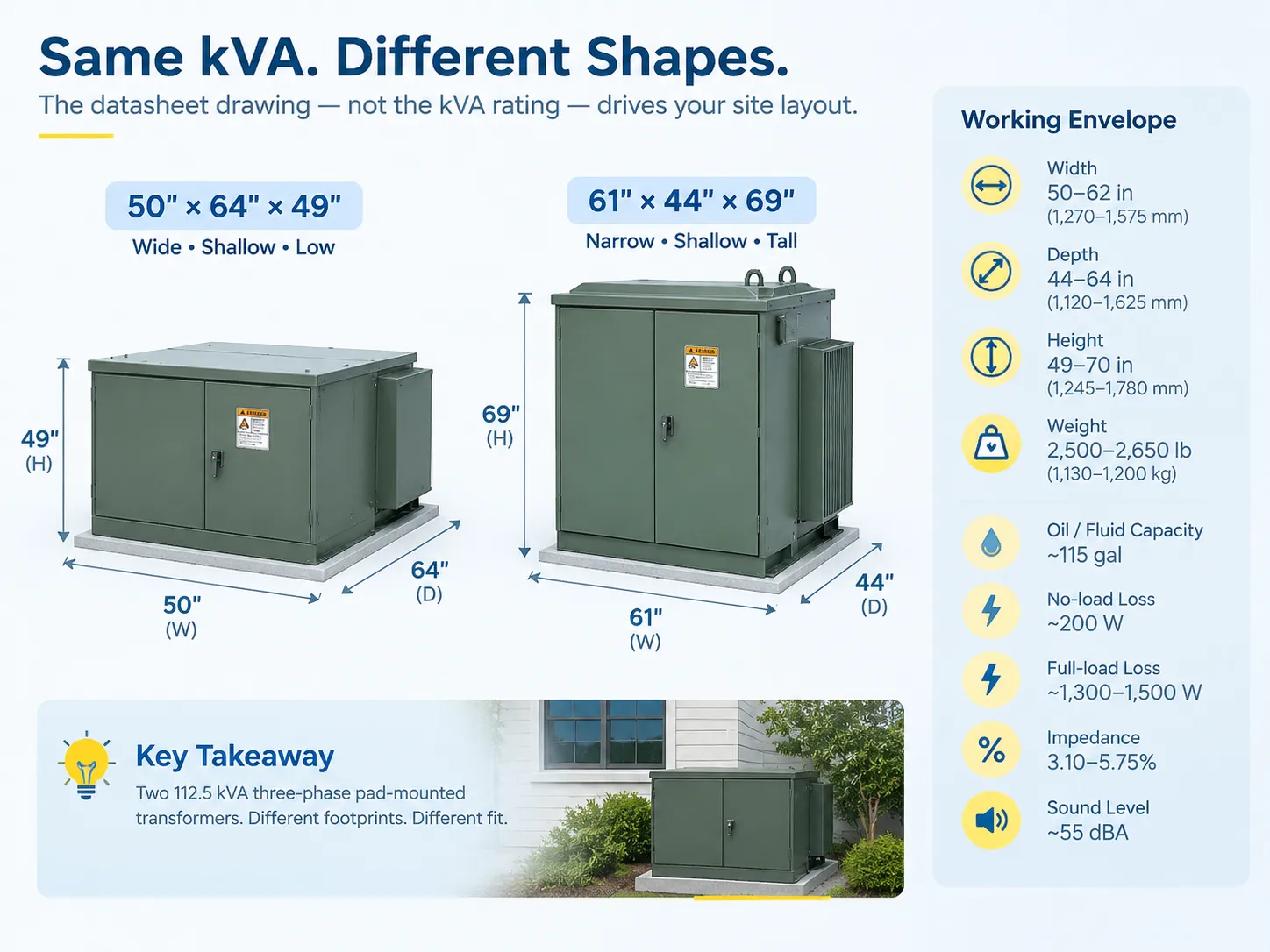
| 21,600Y/12,470 V → 208Y/120 V, dead-front, loop feed, aluminium winding | 50 in | 64 in | 49 in | ±2,500 lb |
| 4,160 V → 480Y/277 V, copper winding | 61 in | 52 in | 67 in | — |
| 13,200 V → 480Y/277 V, copper winding | 61 in | 44 in | 69 in | — |
| General three-phase pad-mount family, wide voltage options | — | — | — | 2,640 lb |
Converted to the working envelope for a specification:
| Parameter | Planning range |
|---|---|
| Width | 50–62 in (1,270–1,575 mm) |
| Depth | 44–64 in (1,120–1,625 mm) |
| Height | 49–70 in (1,245–1,780 mm) |
| Weight | 2,500–2,650 lb (1,130–1,200 kg) |
| Oil or fluid capacity | Roughly 115 US gal on a sealed-tank design |
| No-load loss | About 200 W |
| Full-load loss | About 1,300–1,500 W |
| Impedance | 3.10–5.75% |
| Sound level | About 55 dBA |
When comparing the dimensions of transformers, be more concerned about their shapes than the numbers. The transformer with dimensions of 50 inches wide, 64 inches long, and 49 inches high has a wide and low shape while the transformer of dimensions 61 inches long, 44 inches wide, and 69 inches high has a narrow and tall shape. Though their kVA rating is the same at 112.5, one of them can be placed under the window while the other cannot. Hence, the process of site layout should be driven by the drawing on the datasheet instead of kVA rating.
The Six Variables That Move the Numbers
By comprehending the figures spread, you can estimate the amount before the quotation comes in.
- Primary voltage and BIL. A 4160-volt primary just requires moderate insulation, while a grounded-wye primary of 21600 volts has a BIL of 95 kV. An increase in BIL causes an increase in clearances inside the tank, an increase in the bushing height, and a deep enclosure. The 4.16 kV transformer is 52 inches long, while the other transformer has a height of 64 inches.
- A dead-front transformer versus a live-front transformer. A dead-front design incorporates insulated high-voltage terminations and elbow connections, which means there is a need for a larger compartment. The reason that modern transformers are bulkier than their 1990s analogs is that they need to meet modern specifications of dead-front equipment.
- Copper transformer winding contradicts aluminum transformer winding. Copper winding takes less space than aluminum, and thus when a copper winding is used, the overall size of the transformer decreases. This factor is especially important when the manufacturers try to determine the pad footprint for the transformer.
- Coiling method: loop-feed versus radial-feed. Loop-feed coiling method requires more connection points and additional technology development, and thus it increases the dimensions of the transformer. That is why two transformers of “the same” design made according to the different coiling methods will have different parameters.
- Cooling class. As the cooling class increases – the temperature of cooling also increases. Thus, KNAF cooling class is larger than KNAN, while the parameters of the transformer remain unchanged. By way of example, we can say that a transformer with 65 °C rise will be larger than a transformer with 55 °C rise.
- Efficiency class. According to the Efficiency requirements outlined 10 CFR Part 431 that were imposed on the manufacturers back in 2016 and have affected the industry since then, the sizes of transformers manufactured before and after these limits will be distinct, and the prices for used equipment will not provide the accurate figures.
Dimensions by Transformer Type
The 112.5 kVA rating appears in more than one product family, and the families are not the same shape.
| Type | Typical footprint character | Where it is used |
|---|---|---|
| Three-phase pad-mounted, oil-filled | Wide, low, tamperproof enclosure on a concrete pad | Commercial and residential developments, outdoor distribution |
| Three-phase dry-type, ventilated | Taller, narrower, needs ventilation clearance and room for airflow | Indoor electrical rooms, 480 V to 208Y/120 V step-down |
| Three-phase dry-type, cast resin | Similar footprint to ventilated but no breathing clearance | Hospital, data centre and any indoor location where oil is unwelcome |
| Pole-mounted single-phase | Smaller tank, mounted overhead, different rating series | Overhead distribution; the single-phase series runs 5, 10, 15, 25, 37.5, 50, 75, 100, 167, 250 kVA rather than 112.5 |
| Unit substation / compact | Transformer, primary switch and secondary board in one enclosure | Industrial plants and utility installations where one assembled block is preferred |
From the given table, there arises two practical points that must be considered. First, if your project requires a step-down from 480 V to 208Y/120 V, the unit for the project will need 112.5 kVA which typically would be a pad-mounted or a dry-type three phase transformer rather than a pole-mounted one as the term 112.5 refers to three phase series value. Second, if there is a comparison between a pad mount transformer and dry-type transformer, then it is between a wide low outdoor box and a tall narrow indoor box, implying a difference in the room. Both families are covered in the pad-mounted three-phase transformer range.
Pad Size and Working Clearance, Not Just the Box
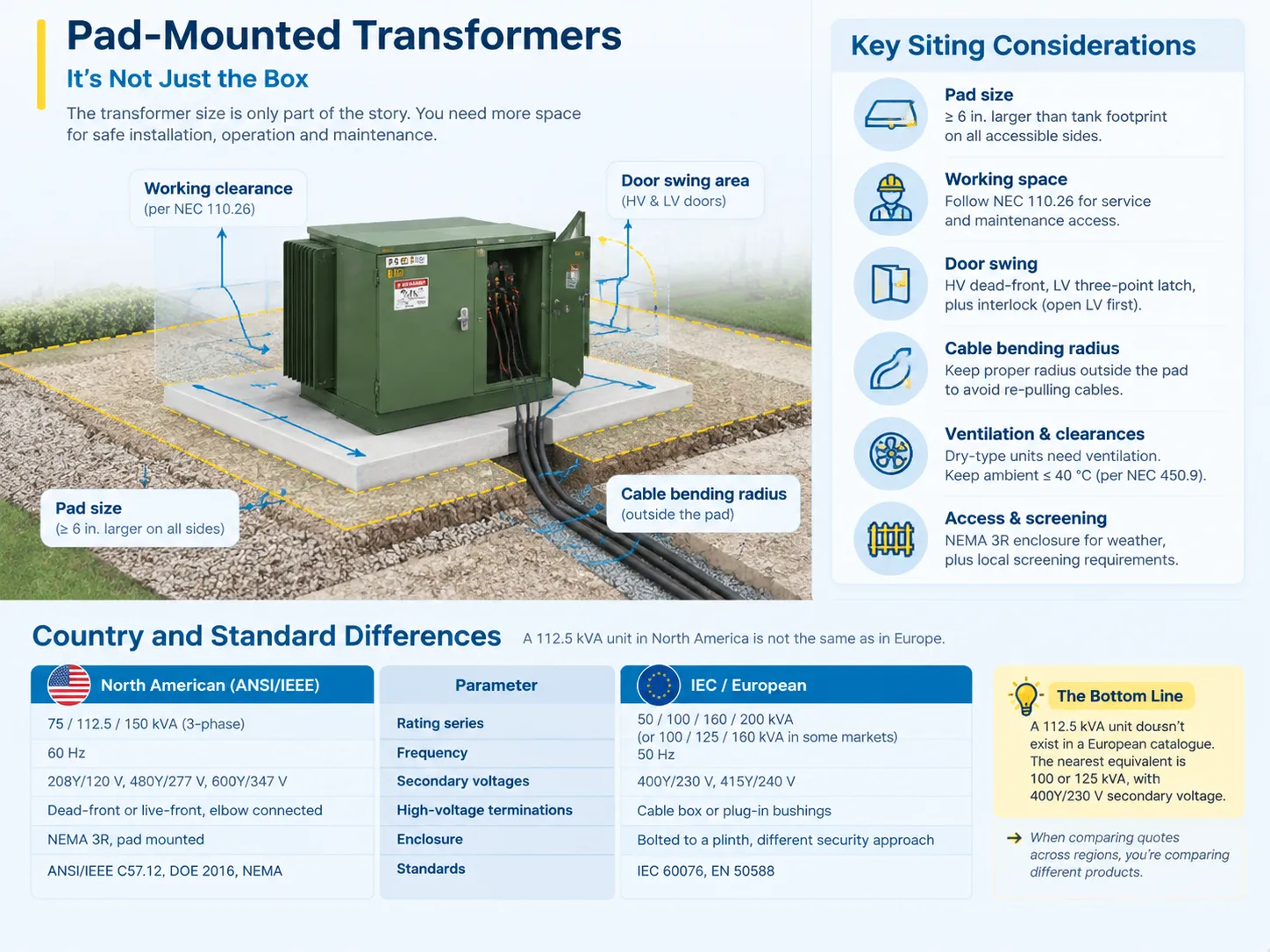
The size of the transformer is just a minor aspect. However, the actual space that you require will be significant, and this is a reason where site plans usually fail.
- Size of the pad. The concrete pad should be designed at least 6 inches larger than the tank footprint on all exposed sides, corresponding with the location of the conduit and cable trench.
- Accessible area. Article 110.26 of the NEC outlines working space clearance regulations for any serviceable equipment, and in case of a pad-mounted transformer being worked on, you have to ensure there is enough clearance around each high and low voltage door.
- Swing of the door. In case of a dead front high voltage door and low voltage door with three point latch, it is important to also account the area that needs to be swept in front of the unit due to doors opening.
- Cable bending radius. Insider the construction of the transformer you will have space for the cable. However, still enough bending radius would be needed for the cables as well, since they should not be kneeled when disposing next to the pad.
- Ventilation and clearance. Vegiper units shaould have a source of air for the proper operation that shouldn’t depend on the presence of clearance for combustibles.
- Placement. Usually, a tamper-resistant case obviously gets the job done, but depending on local rules you might also need a structure performing the job of screening electricity equipment так and even getting connections to this enclosure.
Where a development is laying out several pads rather than one, the clearance discipline changes the plot plan more than the transformer selection does. The siting considerations that actually matter in a residential or commercial development are covered in this look at pad-mounted transformers for modern communities.
Country and Standard Differences
A 112.5 kVA rated unit built to IEC standards and installed in Europe is not the same object as its ANSI counterpart, and the dimensions reflect that.
| Parameter | North American (ANSI/IEEE) | IEC / European |
|---|---|---|
| Rating series | 75 / 112.5 / 150 kVA for three-phase | 50 / 100 / 160 / 200 kVA, or 100 / 125 / 160 kVA in some markets |
| Frequency | 60 Hz | 50 Hz |
| Secondary voltages | 208Y/120 V, 480Y/277 V, 600Y/347 V | 400Y/230 V, 415Y/240 V |
| High-voltage terminations | Dead-front or live-front, elbow connected | Often cable box or plug-in bushings |
| Enclosure | Tamperproof, NEMA 3R, pad mounted | Often bolted to a plinth, different security approach |
| Standards | ANSI/IEEE C57.12 series, DOE 2016, NEMA | IEC 60076 series, EN 50588 efficiency |
The result is that a 112.5 kVA model is not found in the European catalog. The next best IEC equivalent specification-wise is 100 or 125 kVA, and its secondary voltage is 400Y/230 V instead of 208Y/120 V. In making regional comparisons of bids, one is comparing two different products that just happen to belong to the same price range.The full comparison is worth reading before any cross-border procurement, and it is set out in this breakdown of key differences between American and European transformers.
Do Brands Differ?
While voltage class does affect things from one provider to another, it has far less to do with the physical differences in equipment than would be expected. In practice, when looking at pad-mounted transformer manufacturers across the North American landscape that make 112.5 kVA units with the same primary, secondary, cooling class and feed, they have practically identical size dimensions: just inches difference is seen across the dimensions. Any perceived “brand” variation is simply not true, as companies could deal in loop feed with 95 kV BIL or radial feed with lower BILs, attributing differences in name to completely different equipment.
There are, however, three tangible differences among the products. Winding material choice plays a role but is rather a function of specification than brand characteristic. Efficiency tiers are important to consider, given that in 2016, the DOE regulations segmented products into pre-and post-2016 designs, meaning that a transformer used in 2012 will occupy less volume than the work of both years. Finally, it is enclosure design that really shows up competition among manufacturers. Enclosure that falls into the utility’s standard dimensions without variances gives one a commercial advantage.
What is ultimately required is to stop comparing brands and comparing transformer dimensions with the pad one has instead. Brand differences among inch dimensions between suppliers are negligible; for instance, a 12-inch depth gap between a 12.47 kV transformer and a 4.16 kV transformer is significant.
Breaker and Conductor Sizing for a 112.5 kVA Unit
This is the question that follows the dimension question, and the arithmetic is straightforward once you fix the voltages.
| Configuration | Primary FLA | Primary OCPD at 125% (next size up) | Secondary FLA | Secondary OCPD at 125% (next size up) |
|---|---|---|---|---|
| 480 V → 208Y/120 V, three-phase | 135 A | 175 A | 312 A | 400 A |
| 480 V → 480Y/277 V, three-phase | 135 A | 175 A | 135 A | 175 A |
| 600 V → 208Y/120 V, three-phase | 108 A | 150 A | 312 A | 400 A |
| 240 V → 208Y/120 V, three-phase | 271 A | 350 A | 312 A | 400 A |
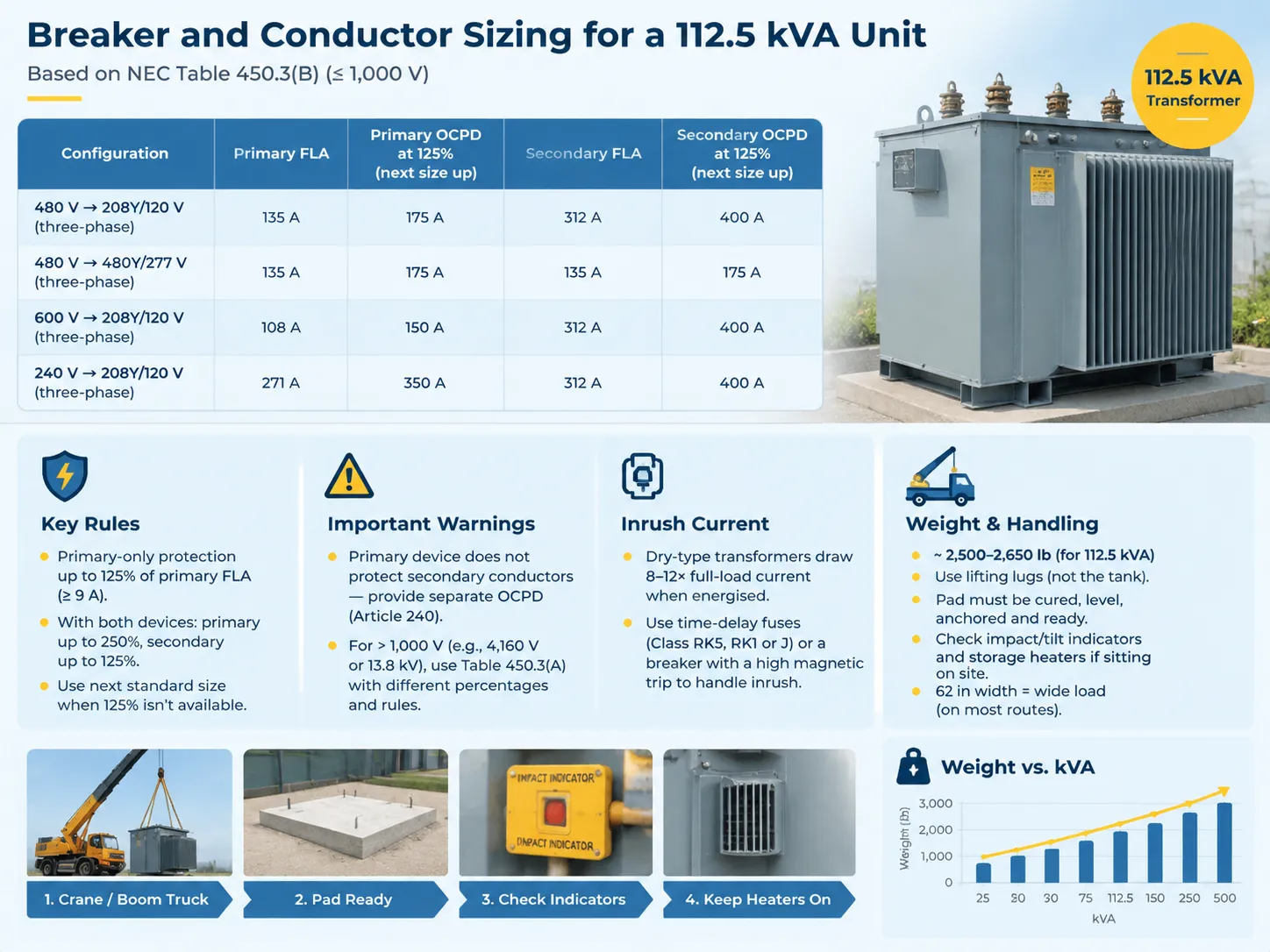
The guidelines for those data are found in Table 450.3(B), which is valid for transformers with a voltage rating up to 1,000 V. For transformers with a primary current of 9 A and more, primary only protection is allowed; the minimum value for this device is 125% of the full-load current (FLC). If 125% cannot be achieved with the help of the available number of values, the nearest value can be used instead. In case both primary and secondary devices are used, the ratio for the primary device can be 250% of the FLC and for the secondary device – 125% of the SLC. For instance, in case of a 112.5 kVA transformer connected to a primary voltage of 480 V, such a transformer can have a primary protection rated for 350 A when a secondary protection is provided.
However, there are two warnings with this table. First, the primary device does not protect any secondary conductors, for which separate overcurrent protection should be applied according to Article 240. One should also keep in mind that the table is valid for voltages lower than 1,000 V. For a 112.5 kVA transformer with a primary voltage of either 4,160 V or 13.8 kV, Table 450.3(A) should be used instead.
The second size consideration is inrush. Dry-type transformers consume 8 to 12 times of the rated or FLC for a very limited period of time when becoming operational. For this reason, a fuse with a rating of 125% must be used, which will burn off on activation. Instead, a time delay fuse (Class RK5, RK1 or J) or magnetic circuit breaker has to be used in order for inrush currents not to create problems in case there is a fault in an electrical circuit.
Weight, Handling and Delivery
Weight is a factor in the cost of the project since moving a unit weighing 2500-2650 lbs is something that a small team cannot do manually and not every type of transport can deliver such a unit.
- Crane or boom truck. There must be a plan describing which area will be used for lifting the unit and where it will be put after the lifting. The rigging needs to be connected to the tank lifting lugs instead of the tank.
- Pad readiness. Before the unit’s arrival the pad has to be leveled, cured, and tested for anchoring and the conduit stubs must be installed. The transformer cannot be left on a truck if the pad is not ready.
- Impact and tilt indicators. The unit must have been delivered with all necessary indicators; if one of the indicators was triggered it means it is necessary to carry out an internal inspection before the unit is energized.
- Storage. If the unit stays on site for weeks prior to installation its heaters must be energized so that no moisture gets into the insulation.
- Transport clearance. A unit of 62 inches in width is a wide load and so it may require special permits and have specific time limitations on the transport route.
How the weight and loss figures scale with rating is worth understanding before you decide between 112.5 kVA and its neighbours, and the trend across the distribution series is illustrated in this study of 500 kVA transformer weight. The short version: weight rises roughly with kVA but not exactly linearly, because the enclosure, tank and accessories form a fixed component that stops growing once it is big enough to hold the core and coils.
FAQ
What are the dimensions of a 112.5 kVA transformer?
50 in. to about 62 in. in width, about 44 in. to 64 in. in depth, and from about 49 in. to approximately 70 in. in height, while weighing around 2,500 lb (1,130 kg to 1,200 kg). Some published examples include a specification of 50 in. × 64 in. × 49 in. with a weight of about 2,500 lb, and others 61 in. × 52 in. × 67 in. and 61 in. × 44 in. × 69 in. All dry-type indoor units with the same capacity usually have a narrower profile, but different size in the depth is expected in the very case of ventilation requirements, rather than simply enclosures of the units.
What size breaker for an 112.5 kVA transformer?
The voltages dictate the regulations. For a primary voltage of 480 V to supply a 208Y/120 V circuit, the typical full-load primary current would equal 135 A, while concerning the secondary it would be equal to 312 A. If both the primary and the secondary protection schemes are used, according to NEC Table 450.3(B) it would be allowed to use a primary device with the rating of 125% of the current to be equal to 169 A, it would be rounded to the next standard size which is 175 A, and concerning the secondary protection it should not be more than 125% of the current which is 312 A, that would give the rating of 390 A rounded to 400 A. If only the primary protection scheme is implemented, the primary device should be rated how much could be 250% of the primary current which would give 338 A rounded to 350 A. In case there are primary voltages above 1,000 V NEC Table 450.3(A) shall be used. It’s recommended to use time delay fuses or trip high-magnetic breaker to protect the device from damaging due to magnetizing inrush.
What are the dimensions of a 100 kVA transformer?
The voltages serve as a guiding factor for the laws. In the case where the primary voltage of 480 V has been utilized in the circuit of 208Y/120 V, the full-load primary current’s value would be up to 135 A and the full-load current of the secondary power source would be 312 A. It would allow for the use of the primary device rated at 125% of the proposed current which would be equal to 169 A if both of the primary and the secondary protection schemes have been used according to the provided information from NEC Table 450.3(B) and it would be rounded to the nearest available size equal to 175 A. It should be mentioned that the secondary power source device must not exceed 125% of its full-load capacity meaning not more than 312 A and the final rounding procedure would give the result in the form of 400 A from 390 A. If only the primary protection mechanism has been employed, the device must be rated at 250% of its current that would provide a result of 338 A which should be rounded to 350 A. For the primary voltages in excess of 1000 volts the standard presented in NEC Table 450.3(A) must be referenced. Time delay or high-magnetic circuit breakers are recommended for the situation where magnetizing inrush may occur.
What is the size of a kVA transformer?
kVA mentions capacity; physical size is not mentioned. The physical size of the transformer depends on kVA and four more parameters: voltage class and impulse power, cooling class, winding material, and type of enclosure. As a rough guide, a three-phase oil-immersed pad-mounted transformer varies from about 75 kVA (about 30″ wide) to over 2,500 kVA (more than 100″), but for dry-type indoor designs, the same kVA will be in a completely different shape. Therefore, always ask for dimensional drawings with kVA.
Do 112.5 kVA transformers differ between brands?
In almost all cases, the difference between two units is due to configuration instead of popularity. If two machines have the same specifications concerning primary, secondary, cooling class, arrangement of feed, and efficiency, their sizes will be practically the same, regardless of the manufacturer. If the specifications provided bring about the change in the size of the machine, it is usually due to the use of a different specification, e.g., looping and radial feeds, the application of higher BIL for the primary winding or the use of another winding material, but not due to the brand’s differences.
Is 112.5 kVA relevant to the electrical code?
Yes, it is indeed a threshold value. NEC 450.21(A) allows the installation of dry-type transformers rated at 112.5 kVA or lower in the open without a vault, provided it is kept 12 in away from combustibles, unless a fire-resistant heat-insulating barrier is used, or unless the unit is enclosed with the exception of ventilating openings. Above 112.5 kVA, dry-type transformers usually need to be installed in a fire-resistant transformer room, except in the case of insulation systems with the Class of 155 or higher. The surpassing of the value may alter the room, and not only the equipment.
References
- IEEE Standards Association — ANSI/IEEE C57.12 series, distribution transformer standards
- NFPA — NFPA 70, National Electrical Code (Article 450, transformers)
- UL Solutions — transformer testing and certification services
- UL Standards & Engagement — UL 1562, Transformers, Distribution, Dry-Type
- International Electrotechnical Commission — IEC 60076 series, power transformers
Conclusion
The response to the question “how significant is a 112.5 kVA transformer?” is not easy and the ones who provide an answer generally reference and depend on their own catalogues. The right answer to this question is a range, approximately 50 to 62 inches in width, about 44 to 64 inches in depth, between 49-70 inches (high) in height, and from 2500 to 2650 pounds for a three-phase pad-mounted model.
Three steps can be taken in relation to this knowledge. First, before purchasing the pad, obtain the creation drawing as well as the weight; depth is where the voltage class comes into focus. Secondly, ensure that the model and type are checked before starting a comparison of the prices since it is the four reasons that cause price differences which people connect with the brands. Finally, do not forget that the 112.5 kVA transformer is the number in NEC 450.21 meaning it is the limit that you need to focus on.