


A factory owner in Ningbo sends us an easy question: “Our 2,500 kVA distribution transformer has been operational since 2009. If I replace it with an updated amorphous-core unit, how much reduction in my electricity bill will I see?” This question is valid since energy-efficient transformer innovation is now more of a commercial argument than a green slogan. The IEC 60076-20 and its equivalent Chinese standard GB 20052 have set no-load loss levels that the old transformers can’t meet. This makes calculations simple—in this example, a 63 kVA transformer with the no-load loss limit set at 2,300 kWh/year versus an old design consuming at least 4,000 kWh just to remain magnetized. This difference over twenty years accumulates to tens of thousands of dollars.
This article goes on to explain the sources of this saving—core materials, winding materials, geometrical design, cooling method, and load based on monitoring results—and gives appropriate price premiums so that one can make up a solid return-on-investment case.
The current developments in energy-saving transformers revolve around five key categories: using amorphous metal cores which reduce no-load losses by 60-80% when compared to conventional silicon-steel grain-oriented manufacturing; using upgraded versions of grain-oriented silicon steels (e.g., 23ZH90); using pure copper or pure aluminum windings for minimizing load losses; optimizing core design and using laser-scribed thin steel; and finally, employing smart monitoring tools that ensure transformers operate near max efficiency at their rated load.
What Is an Energy-Saving Transformer?
An energy-efficient transformer is recognized as any device that has better efficiency performance than a standard transformer of the time. Efficiency is based on losses in no-load and loaded condition, with parameters measured at a temperature of 75 °C according to IEC 60076-1. The difference in efficiency may seem minor, as a modern transformer is usually rated at 98.5–99.5% efficient, but considering a transformer that operates continuously, even a mere 0.5% of improvement at a transformer station becomes a significant sum, with a 10 MVA transformer saving about 50,000 kWh per year, which equals $6,000–$12,000 depending on industrial tariffs of $0.12–$0.24/kWh.
The definition of the term was established as a product category in the 1990s and 2000s when Japan, the USA, and later China developed efficiency categories for distribution transformers. China’s standard GB 20052-2020 and DOE’s 2016 efficiency standards promote the use of amorphous core technology. Thus, today, an energy-efficient transformer is the one that satisfies at least the second efficiency class according to IEC 60076-20 standards, while the highest class corresponds to a transformer with an amorphous core and enhanced winding materials inside it.
How Energy Losses Happen: The Physics Behind Savings
There are two kinds of losses in transformers, and methods of saving energy depend specifically on the kind. No-load loss (also called core loss or iron loss) occurs as soon as the transformer is switched on, even if it is not being used. No-load loss can be divided into two parts: hysteresis loss, which depends on the material used to make the core and on the frequency, and eddy-loss, which depends on the thickness of the lamination and the frequency. Together these two kinds of losses are responsible for approximately 30–50% of the total losses that happen in a typical distribution transformer working under moderate load. This is the reason for improving the technology of the amorphous metal, which provides hysteresis loss that is much lower than in grain-oriented steel.
With regard to load loss (copper loss), this type of loss is determined by I²R heating in the winding and also losses in the material used to make the transformer frame. The load loss increases exponentially. The proportion can be illustrated this way: at 50% load, the load loss is about 25% of the maximum loss, at 110% load the load loss is 121% of the maximum load. To minimize load losses, it is possible to make changes in the design, for example — increasing the area of the wire conductor, using copper instead of aluminum because resistivity of copper is 40% lower than of aluminum (copper = 0.0172 Ω·mm²/m; aluminum = 0.0282 Ω·mm²/m). Some design features also matter: certain kinds of winding patterns can lower stray losses and proper placing of different devices can help avoid creating circulatory currents.
Key Energy-Saving Technologies & Savings Potential
| Technology | What It Changes | Typical Loss Reduction | Extra First Cost |
|---|---|---|---|
| Amorphous metal core | Core material | 60–80% lower no-load loss | +15–30% |
| Premium grain-oriented silicon steel (GOES) | Core material grade | 15–30% lower no-load loss vs. older grades | +5–15% |
| Laser-scribed / domain-refined steel | Core surface treatment | 8–15% lower core loss | +2–5% |
| Copper instead of aluminum windings | Winding material | 20–30% lower load loss at same rating | +10–20% |
| Larger conductor cross-section | Winding geometry | 10–20% lower load loss | +5–10% |
| Improved cooling (ONAN→ONAF, upgraded radiators) | Thermal design | Allows higher loading without extra loss | +3–8% |
| Smart load monitoring & optimization | Operations | 3–8% fleet-wide energy reduction | +$1,500–$8,000 per unit (monitoring) |
The technologies are stacked one on top of the other. A high-quality amorphous core with copper windings and steel made with a laser can demonstrate 50-60% less total losses than the 20-year-old design made of silicon steel. However, be aware of the trades: amorphous cores are more sensitive to mechanical forces and have a reduced saturation flux density which incites the designers to make a larger core for compensation hence the increased initial cost. The choice is based on the number of hours that your transformer is in operation; in case it is functioning at the level of 20-30% most of the working time, no-load loss is dominating and amorphous is in demand.
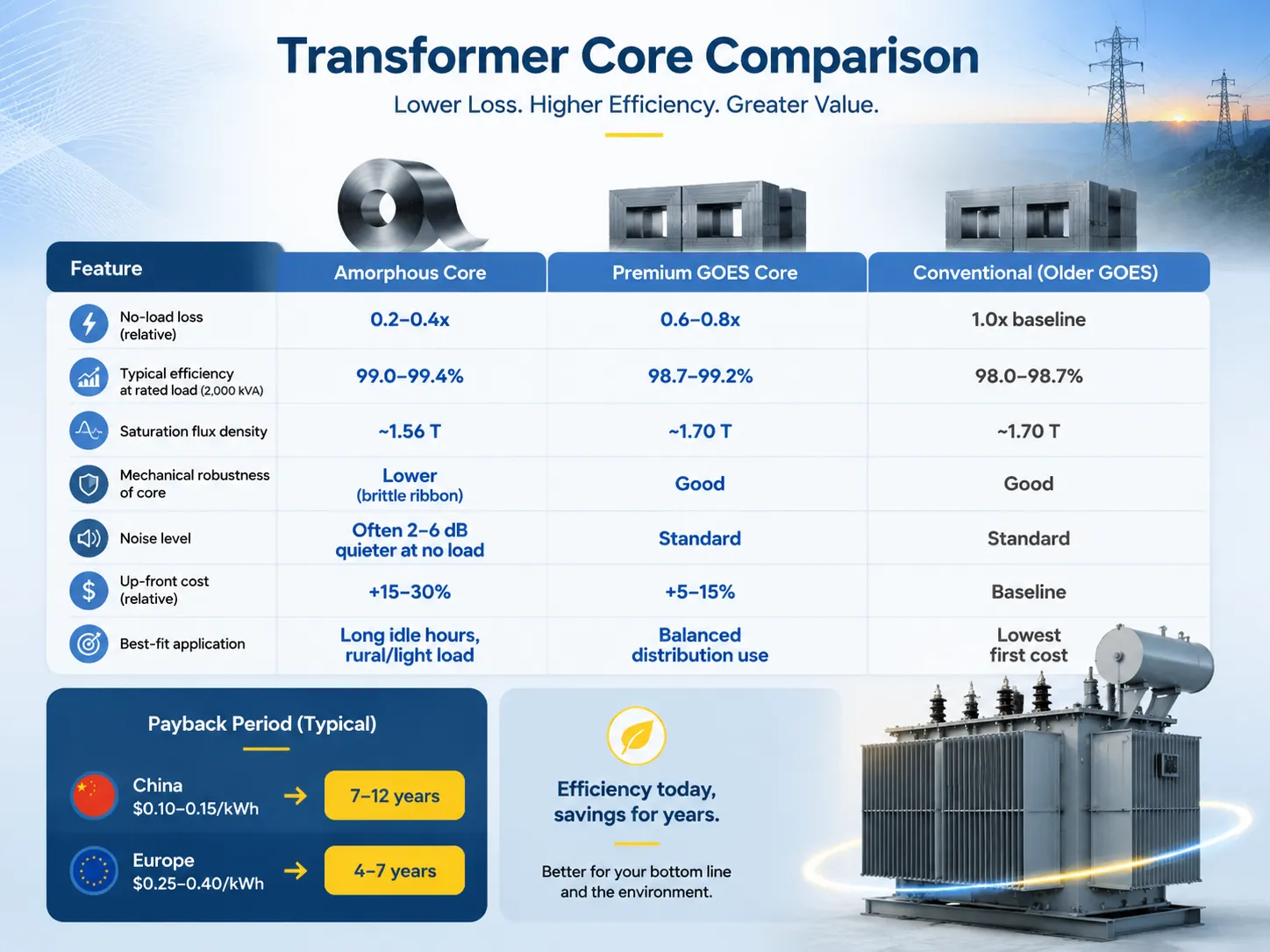
Amorphous vs. Silicon-Steel vs. Conventional Transformer
| Feature | Amorphous Core | Premium GOES Core | Conventional (Older GOES) |
|---|---|---|---|
| No-load loss (relative) | 0.2–0.4x | 0.6–0.8x | 1.0x baseline |
| Typical efficiency at rated load (2,000 kVA) | 99.0–99.4% | 98.7–99.2% | 98.0–98.7% |
| Saturation flux density | ~1.56 T | ~1.70 T | ~1.70 T |
| Mechanical robustness of core | Lower (brittle ribbon) | Good | Good |
| Noise level | Often 2–6 dB quieter at no load | Standard | Standard |
| Up-front cost (relative) | +15–30% | +5–15% | Baseline |
| Best-fit application | Long idle hours, rural/light load | Balanced distribution use | Lowest first cost |
| Payback period (typical) | 6–12 years | 3–8 years | n/a |
The context of the payback columns is important. Under China’s industrial tariffs of $0.10-0.15/kWh, an amorphous upgrade pays back in 7-12 years, whereas, in Europe, where industrial power costs $0.25-0.40/kWh, the same upgrade pays back in just 4-7 years. This is why efficiency-first regulation is becoming more widespread — the math for savings works even before accounting for environmental benefits.
Efficiency Classes & Standards
| Standard | What It Defines | Status / Notes |
|---|---|---|
| IEC 60076-20 | Energy efficiency classes for distribution transformers (class 1 = highest) | Current international reference |
| GB 20052-2020 | Energy efficiency values for power and distribution transformers in China | Mandatory; three efficiency grades |
| US DOE 10 CFR 431 (2016 rule) | Minimum efficiency for liquid-immersed distribution transformers | Amended to a stricter standard from 2027 in the US |
| EU Regulation 548/2014 (amended 2019) | Eco-design Tier 1 and Tier 2 efficiency levels for transformers | Bans sale of the lowest-efficiency classes in the EU |
| IEC 60076-1 | General power transformer rating and loss measurement methods | Basis for loss guarantees and test procedures |
Make sure to check the standard of “energy-saving transformer” mentioned in the product sheet whenever you come across it. A unit with “GB 20052 Level 3” on it is superior to a unit without a rating, but it is much less superior compared to one with “Level 1”. An ordinary top performer is a unit with “IEC 60076-20 class 1” on it. Guarantees on losses are negotiable too: companies like Jiangsu Subian Electric Power, which produce products according to IEC 60076 norms, will include P0 and Pk values in their offer and test them in production. This way, you will be able to hold them accountable for the figures mentioned with the help of tolerance clauses according to IEC 60076-1.
Where Energy-Saving Transformers Pay Off Most
The economic perspective differs considerably with respect to applications, where it is important to go by the load profile rather than the promotional material. Utilities and rural distribution represents the classic amorphous core application: rural transformers operate 8,760 hours per year; however, they are frequently discharging less than 25% of their load, which means that no-load losses are predominant and the payback is most attractive. Industrial plants operating around the clock have high load factors; in this case, the emphasis is on minimal load loss, meaning that copper windings, substantial conductors, and sometimes parallel small transformers are used. Commercial buildings and data centers need both efficiency and low noise levels, where amorphous cores are quieter than others, thus dry-type or cast resin units are often adopted. Renewable energy farms have their specifics: inverters have high harmonics in their output; besides, the pattern of generation is characterized by long hours of working under light loads, which calls for both low no-load losses and protection from harmonics.
For all these cases, the approach is the same: calculate the annual use profile, calculate costs of energy based on the ligation tariffs and compare total cost of ownership over the period of 15 to 20 years against the purchasing cost.
| Application | Load Pattern | Dominant Loss | Recommended Technology | Typical Payback |
|---|---|---|---|---|
| Rural distribution | Energized 8,760 h/yr, low load | No-load loss | Amorphous core | 5–10 years |
| Urban utility substation | Cyclic peaks, moderate average | Mixed | Premium GOES + copper | 4–8 years |
| 24/7 industrial plant | High load factor 70–90% | Load loss | Copper windings, larger conductors | 2–5 years |
| Commercial building / data center | Daytime peaks, high availability | Mixed + noise | Dry-type, low-noise, premium steel | 3–6 years |
| Solar / wind farm | Cyclic generation, harmonics | No-load + stray losses | Amorphous or premium GOES, harmonic-tested | 4–8 years |
Top Brands & Price Ranges
| Brand | Specialty | Typical Price Range (2,000 kVA class) | Region |
|---|---|---|---|
| Hitachi Energy (ABB) | Amorphous & large power transformers | $35,000–$70,000 | Switzerland/Global |
| Siemens Energy | Power transformers, grid solutions | $38,000–$75,000 | Germany/Global |
| Schneider Electric | Distribution & dry-type transformers | $25,000–$55,000 | France/Global |
| TBEA | Amorphous & large power transformers | $20,000–$45,000 | China |
| China XD / Baoding Tianwei | Power transformers, UHV expertise | $22,000–$50,000 | China |
| Jiangsu Subian Electric Power | Distribution & power transformers to IEC 60076 | $15,000–$38,000 | China/Global export |
The prices can differ depending on specification, efficiency class, cooling type, and accessories, so consider them as guiding values. Popular global manufacturers such as Hitachi Energy, Siemens Energy, and Schneider Electric have a good reliability record. Their prices reflect that. Chinese companies such as Jiangsu Subian Electric Power have managed to close much of the gap in terms of quality, as modern Chinese distribution and power transformers comply with established IEC 60076 and are made using the same measurement techniques. They are also sold globally 20-40% cheaper than their European counterparts. Those who maintain budget consciousness but want assured low losses can opt for a Chinese IEC-compliant product, just make sure to check the test report from the manufacturer and include a third-party test in the contract in case the order is significant.
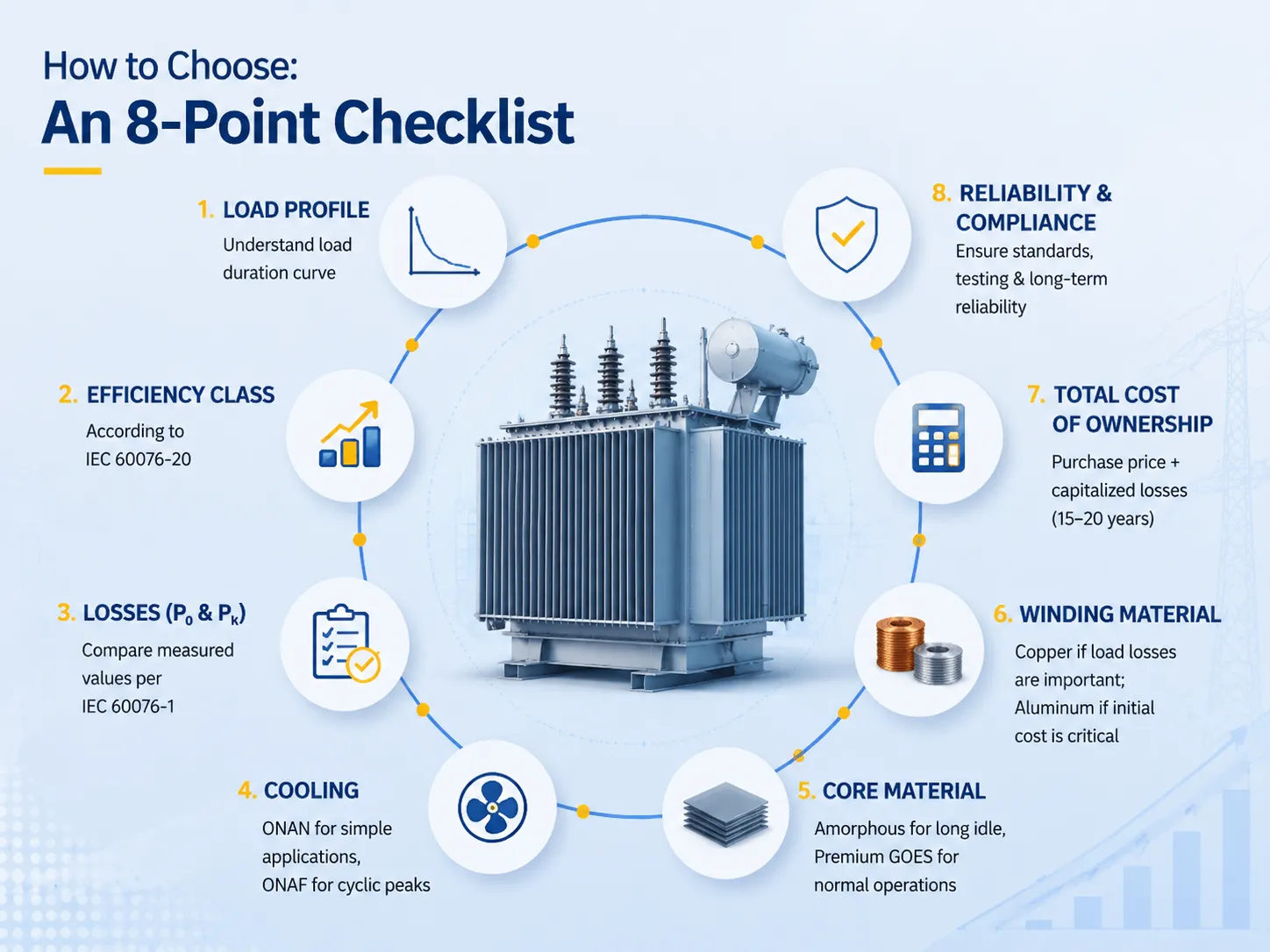
How to Choose: An 8-Point Checklist
- What is load profile? Estimate the annual load duration curve to determine whether no-load losses or load losses are predominant.
- Next, determine the efficiency class. IEC 60076-20 defines classes 1, 2 and 3 or the equivalent local standard based on tariff, load factor and estimated working life.
- Now compare P0 and Pk values as declared in measurements. Ensure that the manufacturer has conducted tests in accordance with IEC 60076-1 and not just relied on the catalog data.
- Make sure that the cooling is appropriate for the application. ONAN for simple applications or ONAF or forced cooling for cyclic peaks.
- Next check if the core material is suitable for the application. Use amorphous core for long idle conditions and premium GOES for normal operations, and also make sure you comply with noise and saturation limits.
- Decide what winding material has to be used in the transformer. Copper if load losses are important; aluminum only if initial cost is critical and load factor is low.
- Finally, calculate total cost of ownership. Price of acquisition and capitalized losses during next 15 – 20 years from the moment of commissioning will give you total cost.
Maintaining Efficiency Over the Long Run
Efficiency is not a static feature but one that erodes gradually over time or because of poor maintenance practices. The core losses will often remain unchanged for decades as long as the core is not subjected to mechanical disturbance, while winding losses will rise due to deterioration of the paper insulation and the increase of oxidation in oil, although this effect is relatively small. The major losses are caused by humidity and loading conditions. The moisture in the oil higher than 2% will help the paper insulation to age faster, resulting in an increase of dielectric losses; it is important to maintain high BDV, preferably above 30 kV and at all times test the oil to verify the moisture content (IEC 60156, Karl Fischer). It is important also to monitor the loading process because the prolonged overloading will increase I²R losses, so that at 120% load the load losses are already 44% higher than they should be.
For maintenance with regard to efficiency, the company must conduct annual DGA and oil quality controls, quarterly tests for the performance of the cooling system, continuous cleaning of the oil cooler from dust and vegetation, as well as quarterly analysis of the load data in order to detect any discrepancies. One more important thing to consider is the optimization of the voltage during the re-energizing process and the tap changer positions, since overloading can drastically increase the no-load losses in a unit. For example, by increasing the voltage by 5%, the core losses will grow by 10-12% approximately and hence accurate position should be chosen for the tap changer.
Frequently Asked Questions
How much electricity does an energy-saving transformer actually save?
Savings rely on load profile. For a distribution transformer of 2000 kVA replaced from an outdated silicon-steel design to an amorphous-core version, the typical known energy-saving potential is in the range of 8000 to 15000 kWh per year, which translates to a monetary equivalent of $1000 to $2500 at the electricity price of $0.12-$0.24 per kWh. If we include improvements in loss of power due to the application of copper winding technology, then in the case of high load factor, the total saving can be estimated at the magnitude up to 15000-30000 kWh per year. Power loss is greatest at low load and long duration of operation.
Is an amorphous core transformer worth the higher price?
Normally, this is true for devices that spend a lot of time operational under low load – for example, rural electrical distribution and renewable energy devices. The extra expense associated with this technology is about 15–30% more than the cost of traditional silicon steel, and the payback time is around 6–12 at standard industrial prices and 4–7 years in highly priced areas. In case the distribution transformer operates mostly under maximum load, the no-load savings become of less value, thus, the steel core made of premium materials and a copper winding wire can benefit more in this specific case overall.
What efficiency class should I specify for a new transformer?
In many markets, IEC 60076-20 class 2 should generally be taken as the minimum, with class 1 being used at times of high tariffs or low load factor. Under the rules of the EU eco-design, class 1 has almost turned into the standard for new distribution transformers. China’s GB 20052-2020 standard establishes three levels of efficiency, with Level 1 being the most efficient of the three. The efficiency premium can usually be recovered within less than a decade for an asset with a lifespan of 15 to 20 years; hence specifying the highest class is seen as the only rational economic option most of the time.
Does using copper instead of aluminum really matter?
Yes, it can be measured. Copper’s resistivity is around 40% lower than aluminum’s (0.0172 versus 0.0282 Ω·mm²/m, respectively, at 20 °C), so the copper winding uses less conductor volume to achieve the same loss and works at lower temperatures – it can carry a bigger current for the same losses. For high load factors, copper windings can decrease load losses by 20-30% compared to the equivalent aluminum design. What is the disadvantage? The pricing – copper windings increase the cost of the transformer by 10-20% approximately.
How do I verify a manufacturer’s loss figures?
Ask for the factory tests results performed according to IEC 60076-1 standards, which lay down required measurements for both the no-load losses and loading losses with tolerances applied. For large orders, ensure that a third party is there to witness the testing at the factory or in an independent testing lab along with getting a loss guarantee clause added to the contracts with penalties in case of exceeding losses above the contracted ones. The leading manufacturers such as Jiangsu Subian Electric Power will never hesitate to share the testing methods, references, and installations used unless they are trying to hide some facts.
References
- IEC 60076-20: Power transformers – Part 20: Energy efficiency — the international standard defining efficiency classes for distribution transformers.
- IEC 60076-1: Power transformers – Part 1: General — defines rating, loss measurement, and testing procedures.
- US DOE – Energy Efficiency of Distribution Transformers — US regulatory minimum-efficiency rules and technical background.
- EU Regulation 548/2014 on transformer eco-design — European efficiency requirements and tiered phase-in schedule.
- GB 20052-2020 (Chinese national standard) reference — efficiency grades for power and distribution transformers in China.
- Amorphous metal core technology resources — technical background on amorphous core properties and applications.
- Jiangsu Subian Electric Power — IEC 60076-compliant transformer manufacturer offering amorphous and premium steel designs with verifiable loss reports.
Conclusion
The invention of energy-efficient transformers has shifted from being a special feature to become an important criterion in purchasing decisions. The theory behind energy-efficient transformers is easy: the use of amorphous cores leads to a reduction in no-load losses by 60-80%, copper winding reduces load losses from the point of view of physics by 20-30%, and with smart load management, the transformer operates most efficiently. The key question asked is not “Are these transformers energy-efficient?” but “Does the payback period suit my loading and tariff?” The answer is positive in most cases within 4-12 years.
- Amorphous cores work well in case of idle transformers with little load, whereas the combination of GOES material and copper is more appropriate for transformers with high load factor.
- Make sure to choose transformers of IEC 60076-20 class 1 or 2 and to ask for graphs of factory transformer test results.
- Compare the total life cost over 15-20 years instead of purchasing cost.
- Make sure that you control tap position and keep oil dry.