


When the utility or EPC contractor gives you a specification sheet that specifies using an American-style transformer, your first question is whether your project actually requires such a transformer or if it might be using a cheaper IEC transformer. To illustrate, think about subdivisions around the vicinity of Houston, mining camps in South America, or hotel complexes in the Caribbean: all are getting their electrical supply from a 60Hz network and are therefore using ANSI/IEEE-compliant transformers, which differ from transformers designed for the European or Asian standard. This article discusses what American transformers are, plus their pros and cons, along with how much you can expect to pay for one of these transformers in 2026 and what two mistakes most buyers make about American transformers: using ANSI transformers in IEC operations or getting unnecessarily expensive features.
Short answer: An American-style transformer refers to a distribution transformer manufactured in accordance with North American standards, mainly goals set by IEEE C57.12.20, ANSI C57.12 series, and NEMA, which operate on a frequency of 60 Hz and takes the shape of either a single-phase or a three-phase ranging from 5 kVA to about 2,500 kVA. The pole and pad mounted transformers are more common with dead-front, difficult to tamper with casing, which are used to step-down voltages from 7.2–24.9 kV to 120/240 V or 277/480 V.
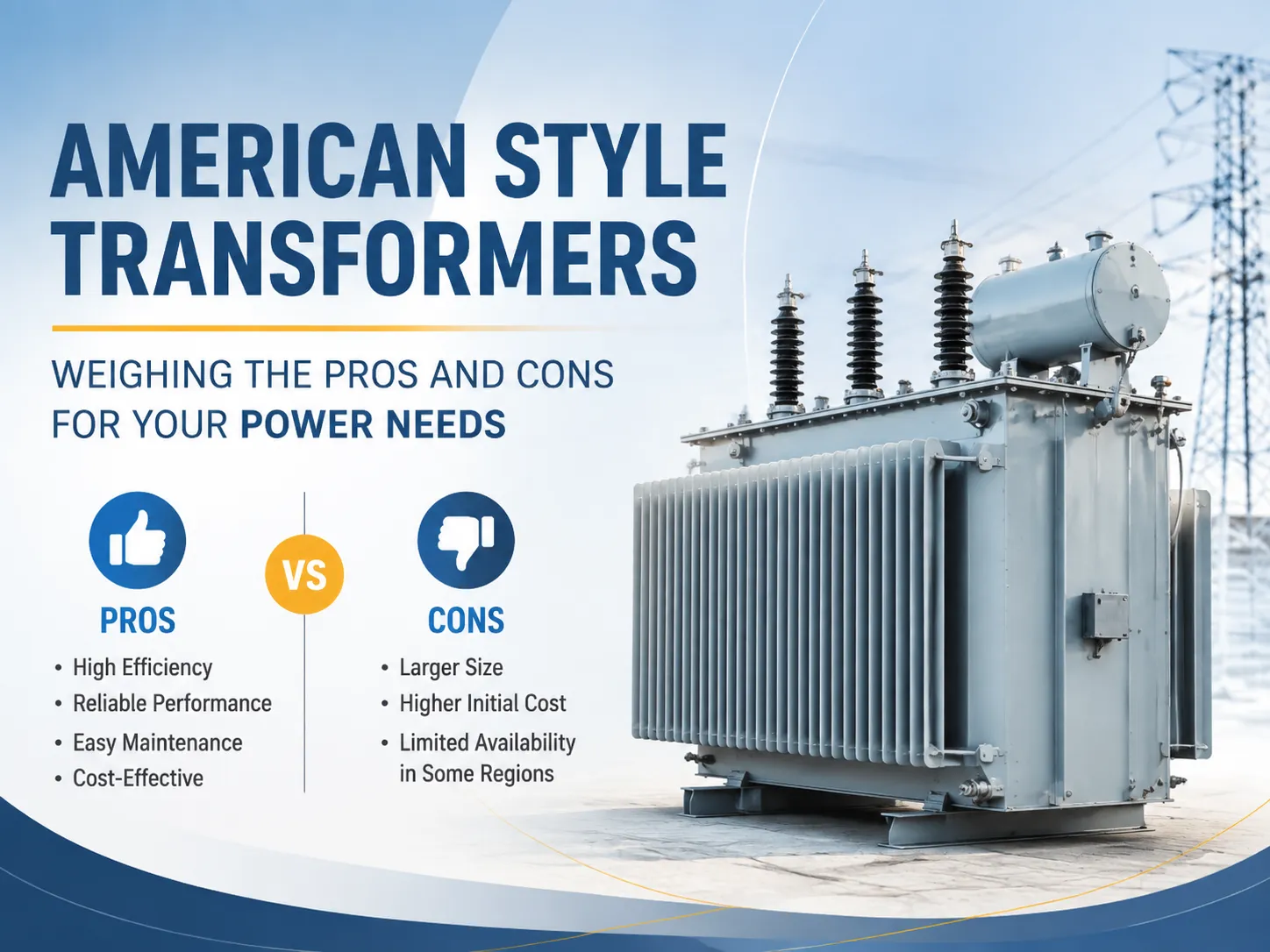
What Are American-Style Transformers?
American-style transformers are a type of distribution transformers which are tailored to follow the electrical principles; 60 Hz frequency, ANSI/IEEE specifications and designs prescribed by the North American power companies. This term may refer to single-phase pole-mounted transformers, single-phase and three-phase pad-mounted transformers, dry transformers used in buildings and oil transformers utilized by utilities. American-style transformers are created according to their own standards unlike the IEC-style transformers; for that reason, names of the transformers, cooling type, impedance, tap range, tank shape can’t be the same as those of IEC 60076-compliant equipment.
To an industrial purchaser, the practical difference with other kind of transformers is most significant at the outlet point. In fact, the American transformer should be fitted rather easily to a 12.47 or 24.9 kV power line, hence it provides 120/240 V or 277/480 V output and works according to the local requirements. US-based producers and dealers prefer to use American transformers, as the rest of the equipment for the 60 Hz operating projects is developed according to this scheme.
The Standards That Define Them: IEEE C57, ANSI, NEMA
In contrast to IEC equipment that is primarily regulated by IEC specifications series 60076, American transformers are regulated by a set of North American documents. Among these documents of importance are:
- IEEE C57.12.20, which specifies the guidelines for overhead and pad-mounted distribution transformers, specifically dealing with the design of single-phase and 3-phase transformers with performance levels ranging between 5 kVA to 500 kVA.
- IEEE C57.12.00 outlines the specifications for liquid-filled transformers, such as the distribution transformer, regulating transformer, and the power transformer.
- IEEE C57.12.90 publication specifies testing standards of transformers from design tests to routine tests.
- NEMA TP-1 sets the standards for measuring the efficiency level of dry and liquid filled distribution transformers in North America.
- UL 1561 / UL 1562 are the safety standards that are referred to in the case of dry and liquid transformers in the US and Canada.
These documents are not just documents, as they lead to engineering decisions. For example, they state that the temperature for windings should not be higher than 65 degrees, off-circuit taps should be at the level of +/-2*2.5%, basic impulse level needs to be designed for each voltage class, and liquid transformers must pass dielectric and short-circuit tests, according to ANSI standards. If you buy American transformers from any company, they will abide by these practices.
How American-Style Transformers Work
The fundamental principle involved is the same as that of any transformer — Faraday’s law being applied between the primary and the secondary winding on a laminated silicon steel core. What distinguishes American-type transformers is the arrangement of the system itself. At 60 Hz, a certain combination of the core and its winding has different induction losses and no-load characteristics than at 50 Hz, which means that it is optimized for the North American grid. Single-phase transformers are probably most widely used because the distribution method in the U.S. is single-phase, which means that the voltage is equal to 120/240 V in its secondary taps. Three-phase transformers are used in industry, reducing voltages of 12.47, 13.8, or 24.9 kV into 120/208 V or 277/480 V.
Most devices contain either on-load tap-changers, usually ±2 × 2.5%, which ensures that a utility can make an adjustment to the voltage at the time of installation of the device. However, pad-mounted transformers are equipped with dead front construction meaning that all live part of the device is hidden inside the tank or insulated elbows so that it is easy for the utility personnel to operate the switches with a hot stick ensuring safety for the general public.
Main Types and Classifications
| Type | Rating range | Typical primary / secondary | Where it is used |
|---|---|---|---|
| Single-phase pole-mounted | 5–167 kVA | 7.2–14.4 kV / 120-240 V | Residential subdivisions, rural feeders |
| Single-phase pad-mounted | 25–167 kVA | 12.47 kV / 120-240 V | Underground residential distribution |
| Three-phase pad-mounted | 75–2,500 kVA | 12.47–24.9 kV / 208 V, 480 V | Commercial parks, small industrial, solar |
| Three-phase substation-type | 500–5,000 kVA | 12.47–34.5 kV / 480 V-4.16 kV | Industrial plants, utility substations |
| Dry-type (ventilated / encapsulated) | 15–1,000 kVA | 480 V / 208 V, 240 V, 600 V | Indoor commercial and institutional buildings |
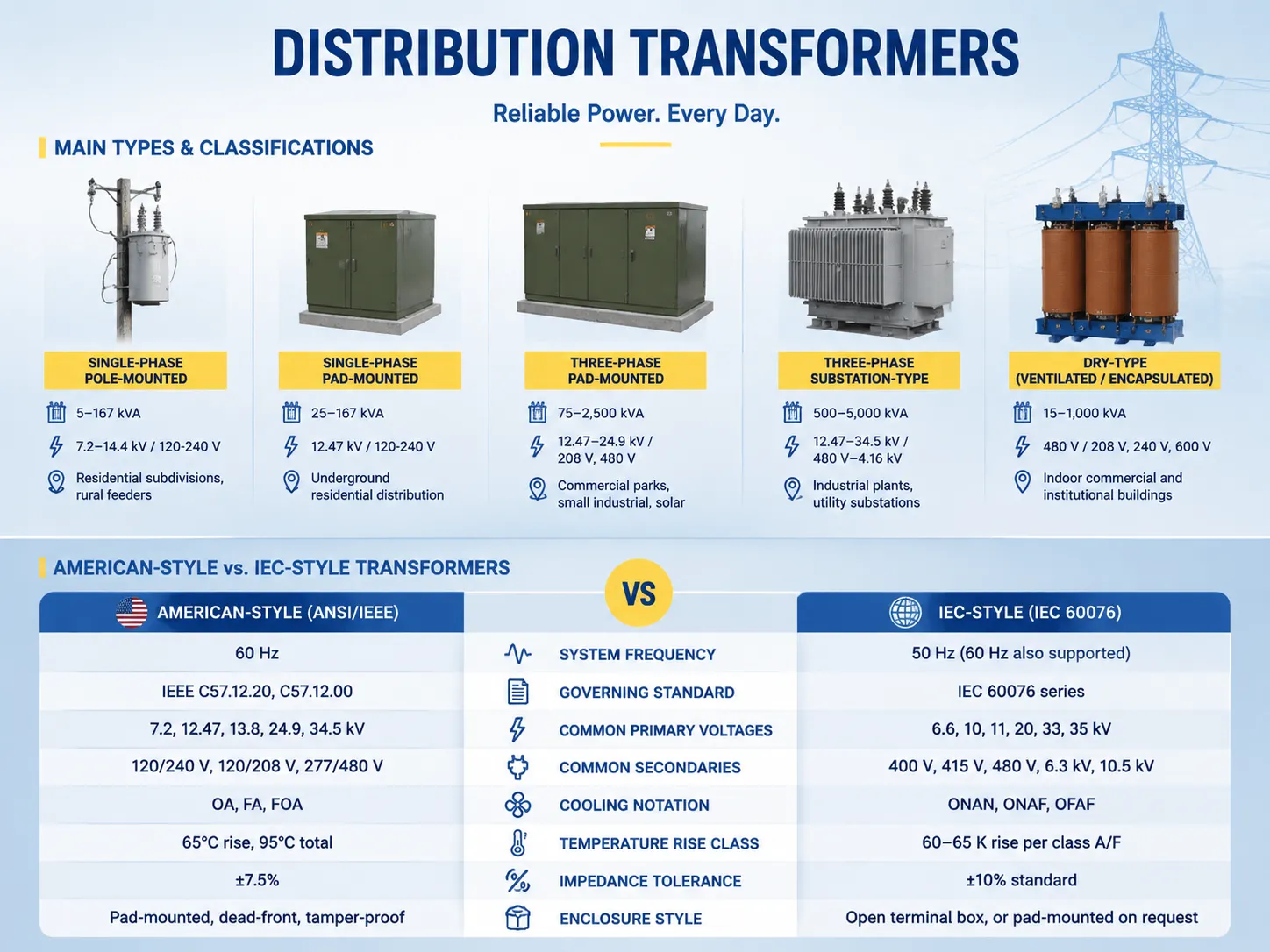
American-Style vs. IEC-Style Transformers
| Aspect | American-style (ANSI/IEEE) | IEC-style (IEC 60076) |
|---|---|---|
| System frequency | 60 Hz | 50 Hz (60 Hz also supported) |
| Governing standard | IEEE C57.12.20, C57.12.00 | IEC 60076 series |
| Common primary voltages | 7.2, 12.47, 13.8, 24.9, 34.5 kV | 6.6, 10, 11, 20, 33, 35 kV |
| Common secondaries | 120/240 V, 120/208 V, 277/480 V | 400 V, 415 V, 480 V, 6.3 kV, 10.5 kV |
| Cooling notation | OA, FA, FOA | ONAN, ONAF, OFAF |
| Temperature rise class | 65°C rise, 95°C total | 60–65 K rise per class A/F |
| Impedance tolerance | ±7.5% | ±10% standard |
| Enclosure style | Pad-mounted, dead-front, tamper-proof | Open terminal box, or pad-mounted on request |
The fact of the matter is that one family cannot just be exchanged for another. An ANSI 12.47 kV would not fit in an IEC 10 kV system and a 120/240 V output cannot connect to a European 230/400 V board. Differences in frequency also make a difference — a 60 Hz transformer running on 50 Hz will overheat because the core will saturate. A 50 Hz transformer running on 60 Hz power usually works with loss but with some change in impedance. Make sure to purchase a family that is compatible with your grid.
The Pros and Cons: What You Gain, What You Pay
On the plus side of the ledger, American-style units are designed for the grid they serve and for the safety rules of the markets they operate in:
| Advantage | What it means in practice |
|---|---|
| Direct grid compatibility | Drops into 60 Hz, 12.47 kV-class networks with no re-engineering of feeders, switchgear, or protection. |
| Proven, mature standards | IEEE C57.12.20 and C57.12.00 have decades of field data behind them; design and test expectations are unambiguous. |
| Public safety | Dead-front, tamper-resistant pad-mounted enclosures meet utility safety rules in residential areas. |
| Interchangeability | Standard ratings and dimensions mean replacements and spares from different brands fit existing utility stock. |
| Readily available accessories | Bushings, elbow terminators, arresters, tap handles, and monitoring packages are standardized across the market. |
On the downside, we see many drawbacks that need to be considered in the decision-making process too.
- Expense per kVA. The presence of a tank, dead-front enclosure, ANSI bushing configuration, and the necessity of following a specific testing process usually leads to the price increase by 15–40% as compared to an IEC transformer of the same kind.
- 60Hz-design only. An American transformer cannot be used in a 50Hz setup, which is important to take into account if the plant is located in the country of 50Hz use.
- The certification burden. Many US projects will require UL or CSA certification or a third-party inspection from the utility company, which will require additional expenses and take a considerable amount of time.
- Single-phase bias. The fact that residential supply is single-phase puts buyers with a three-phase requirement in danger of ordering a 3-phase unit instead of the model in high demand.
- Lead time from domestic suppliers. In the latest years, lead times for the pad-mounted units in North America have been between 20 and 50 weeks.
Typical Specifications and Rating Table
| Rating (kVA) | Voltage class | Typical no-load loss (W) | Typical load loss (W) | Impedance | Typical weight (kg) |
|---|---|---|---|---|---|
| 25 (1-phase) | 12.47 kV / 240 V | ~80–110 | ~350–500 | 1.8–2.5% | 180–260 |
| 75 (3-phase) | 12.47 kV / 480 V | ~180–250 | ~900–1,200 | 1.7–3.5% | 450–600 |
| 300 (3-phase) | 24.9 kV / 480 V | ~450–600 | ~2,800–3,600 | 4–5% | 1,200–1,600 |
| 1,000 (3-phase) | 24.9 kV / 480 V | ~1,100–1,500 | ~8,000–10,500 | 5–5.75% | 3,200–4,200 |
| 2,500 (3-phase) | 34.5 kV / 480 V | ~2,300–3,000 | ~18,000–24,000 | 5.75–6.5% | 6,500–8,500 |
Loss values serve as representative ranges for mineral oil-filled equipment; designs conforming to NEMA TP-1 premium efficiency have lower losses while custom designs can differ. Always ask for the no-load and load loss guarantee as specified in a test report before comparing available quotations.
Common Applications
American transformers are deployed throughout the entire tier of the 60 Hz distribution system. Utility companies implemented transformers on poles to provide power to houses and small farms, and underground residential distribution (URD) supplied with single-phase pad-mounted transformers periodically along the street. In business parks and industrial zones, the usage of three-phase pad-mounted transformers is common while factories choose transformers for converting voltage into 480 V. The United States and Canada extended the reaching of the carefully engineered transformers and started exporting them to the countries of Latin America, Mexico, the Caribbean, the Middle East, and the Pacific Islands. The technology is also widely applied in photovoltaic plants built according to the ANSI standards. If your project follows the IEEE C57 norms or assumes the voltages of 12.47 kV / 277-480 V, American transformers should be considered in the specification.
Top Brands and Price Ranges
| Brand | Country | Typical product focus | Indicative price range (FOB, US$) |
|---|---|---|---|
| ABB | Switzerland/Sweden | Full range, pad-mounted and substation units | $3,000–$60,000 |
| Hitachi Energy | Switzerland | Utility-grade distribution transformers | $3,500–$70,000 |
| Siemens | Germany | Commercial dry-type and liquid-filled units | $2,500–$50,000 |
| Schneider Electric | France | Dry-type and pad-mounted ranges | $2,000–$45,000 |
| Eaton | USA | Dry-type, pad-mounted, energy-efficient lines | $1,500–$40,000 |
| Prolec GE | USA/Mexico | Distribution transformers for US utilities | $2,000–$55,000 |
| Virginia Transformer | USA | Custom dry-type and liquid-filled units | $2,800–$48,000 |
| Jiangsu Subian Electric Power | China | ANSI/IEEE and IEC distribution transformers | $1,200–$38,000 |
American transformers are deployed throughout the entire tier of the 60 Hz distribution system. Utility companies implemented transformers on poles to provide power to houses and small farms, and underground residential distribution (URD) supplied with single-phase pad-mounted transformers periodically along the street. In business parks and industrial zones, the usage of three-phase pad-mounted transformers is common while factories cThe following are the indicative prices for FOB for standard configurations for the year 2026 with some variations due to the ratings, voltage class, tap arrangements, cooling method and the type of certification given to them. There are many manufacturers of transformers such as ABB, Hitachi Energy, Siemens, Schneider, Eaton, and Prolec GE that produce exceptional American transformers and their engineering documents that set standards of quality. For those buyers who want to shop for similar transformers that would comply with IEEE C57.12.20 and be more beneficial in terms of price, Jiangsu Subian Electric Power Co., Ltd is a good option. The company produces the standard 60 Hz transformers to comply with the ANSI and IEEE specifications, providing dead front transformers and third-party inspection. The company exported its transformers to more than received countries like the USA, Mexico, Caribbean and Middle East.
hoose transformers for converting voltage into 480 V. The United States and Canada extended the reaching of the carefully engineered transformers and started exporting them to the countries of Latin America, Mexico, the Caribbean, the Middle East, and the Pacific Islands. The technology is also widely applied in photovoltaic plants built according to the ANSI standards. If your project follows the IEEE C57 norms or assumes the voltages of 12.47 kV / 277-480 V, American transformers should be considered in the specification. You can review the company’s manufacturing capability on the Jiangsu Subian Electric Power website.
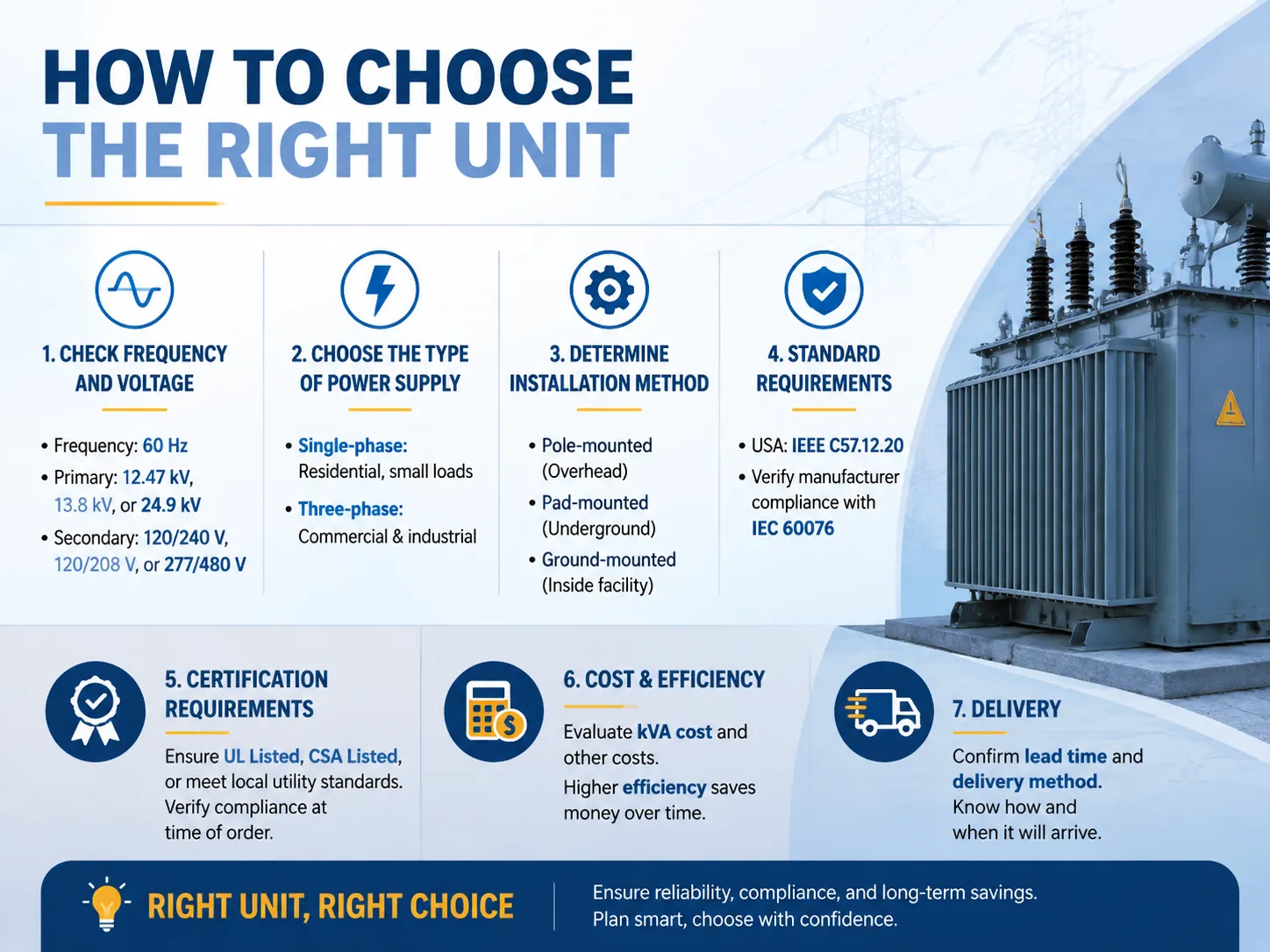
How to Choose the Right Unit
- Check the frequency and voltage of the system to confirm. The correct frequency for a system operating in America is 60 Hz; check both primary (12.47 kV, 13.8 kV, or 24.9 kV) and secondary (120/240 V, 120/208 V, or 277/480 V) voltage.
- Choose the type of power supply. A single-phase power supply is adequate for residential areas with small power needs, while a three-phase one is needed for commercial and industrial applications.
- Determine how the system will be installed, either on a pole for overhead installation, on a pad for underground installation, or on the ground inside the facility.
- Determine the standard options required. For the USA, the IEEE C57.12.20 standard is needed; verify if the manufacturer will be able to comply with IEC 60076.
- Make sure to check certification requirements. The system may need to be UL listed, CSA listed, or meet the standards of the local electrical utility; verify that there will be compliance at the moment of ordering.
- Determine kVA cost and other costs involved; consider the efficiency of the system as well, as an expensive energy-efficient unit will save money over time.
- Make sure you know how long the delivery will take and how the pounds will be delivered.
Frequently Asked Questions
Can an American-style transformer run on a 50 Hz network?
No, not safely. A transformer designed for 60 Hz has core and windings configured for that frequency; using that transformer at 50 Hz increases the core flux density by approximately 20%, requiring extra magnetizing current that can cause overheating and premature insulation failure. If your power system operates at 50 Hz, get an IEC 60076 transformer designed for a 50 Hz. A 50 Hz transformer is usually able to work with 60 Hz with satisfactory results (less losses and slightly different impedance), however, the reverse operation is not recommended.
What is the typical lead time for a pad-mounted transformer in 2026?
Depending on the manufacturer, domestic suppliers in the United States have reported lead times of 20-50 weeks for pad-mounted units. For imported units from manufacturers that come with standard configurations, such as Jiangsu Subian Electric Power, delivery times will generally range from 4-10 weeks, in addition to freight times of 2-6 weeks, depending on the port of delivery.
How much does an American-style transformer cost?
As a reference, a single-phase 25 kVA pole-mounted unit costs approximately $1,200, a three-phase 75 kVA pad-mounted unit costs approximately $3,500 to $7,500, a pad-mounted 300 kVA unit costs approximately $8,000 to $16,000, and a 1,000 kVA unit costs approximately $15,000 to $35,000. These prices can vary by brand, impedance, tap scheme, and certification, therefore always request a quote that matches specifications.
Do I need UL listing for an imported American-style transformer?
It depends on the buyer and the jurisdiction. Some US utilities and building codes require UL 1561/UL 1562 listing or equivalent third-party certification while some others give credit for IEEE C57.12.20 compliance along with a witnessed test or inspector report. Before you make a commitment, always check with your utility engineer and verify which certification options the manufacturer can offer.
Are Chinese-built American-style transformers accepted by US utilities?
When specifications are met, it is accurate to say that utilities will accept imported equipment. Electricity providers accept equipment that meets the requirements of IEEE C57.12.20, has been subjected to a factory test observed by either the utility or a third party and has the necessary documentation. Subtrans has sold 60 hertz ANSI-compliant transformers to buyers in Canada and the US under those conditions. Thus, acceptance depends on documentation and testing and not on the place of production.
References
- IEEE C57.12.20 — Standard for Overhead and Pad-Mounted Distribution Transformers — the core specification for American-style distribution transformers.
- IEEE C57.12.00 — General Requirements for Liquid-Immersed Distribution, Power, and Regulating Transformers — defines rating, losses, and testing basis for US practice.
- NEMA TP-1 — Guide for Determining Energy Efficiency for Distribution Transformers — the North American efficiency benchmark referenced in US procurement.
- UL 1561 — Standard for Dry-Type General Purpose Power Transformers — safety listing commonly required for commercial installations.
- IEC 60076-1 — Power Transformers, General — the IEC baseline used for comparison and for export projects that run on 50 Hz.
- Eaton — Transformer Product Information — representative North American manufacturer documentation for comparison.
Conclusion
The answer to your need for transformers that are compatible with your electric grid operating on 60 Hz and ANSI/IEEE standards, using either 120/240 V or 277/480 V services lies in the use of American style transformers. American style transformers ensure your projects adhere to public safety precautions and standards as required in the United States, Latin America, and the Caribbean. However, there are disadvantages to this type of transformers such as the fact that they are more expensive in terms of kVA and the necessity of undergoing complex certification processes. In order to avoid the disadvantages of American style transformers, those looking to buy them should determine their voltage, frequency, mounting configuration and certification requirements before making any comparisons between the offers they receive. Jiangsu Subian Electric Power manufactures American style transformers that comply with IEEE C57.12.20 standards, which ensures that customers only pay reasonable factory-direct prices while getting fully documented testing results.To get a specification-matched quotation for your next 60 Hz project, contact the company through the official website.