


The inception of a new era in transformer technology corresponds to the creation of a three-layer platform for technological modernization of production. Firstly, component innovation, such as the development of amorphous cores, ester oils, and high-purity winding materials, allows for losses to be reduced and installation options to be widened. Secondly, system innovation i.e. monitoring, digital twins, and predictive analytics, transforms assets into sources of data and diminishes forced outages by 30 to 50 %. Thirdly, business model innovation, like performance procurement and transformer-as-a-service, allows ownership of risk and capital to be changed. The ongoing three-way revolution turns transformer procurement from a simple purchase to a data-driven strategic decision-making process.
Upgrading efficiency to IEC 60076-20 class 1 allows for 30 to 50% losses reduction, resulting in return on investment in 4 to 9 years.
Investment in monitoring ensures the fastest return on investment for critical assets, often providing a return already after the first incident prevented.
Service models allow for capital freeing and risk transferring, which is especially important for cash flow purposes.
You should purchase transformers with reliability guarantees, digital documentation, and testing under supervision.
Jiangsu Subian Electric Power is the producer of modern transformers and transformers that are ready for upgrading monitoring solutions at affordable prices.
What Is a Transformer Tap Changer?
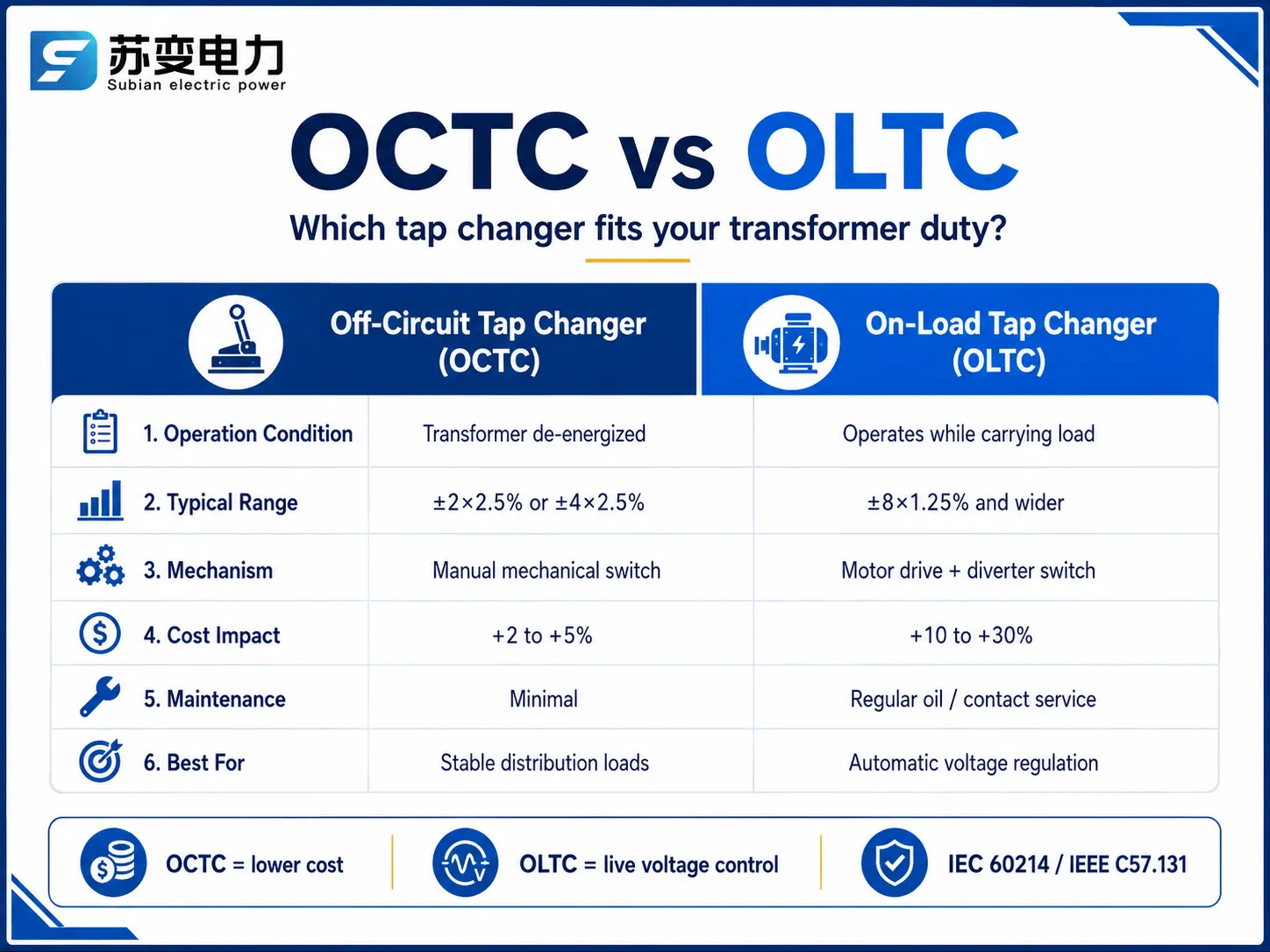
A tap changer is a switching device attached to a transformer winding at various tapping points. With the help of the device, it is possible to switch the connection between different taps that result in the changes in amount of turns of the winding and thus variations in voltage on the secondary side. Thus, the tap changer is in fact the mechanism of voltage adjustment built either within the tank of the transformer or mounted upon the winding.
Voltage experienced by various networks undergoes constant reductions and increases because of loads that vary during the day, sagging of the power line, changes in voltage provided by the network. The fixed voltage output of a transformer at a ratio gained during production can lead to problems with voltage supply and tap changer provides the reliable means of correction.
There are three critical aspects used to characterize any types of tap changers: their voltage step (expressed as percentage of rated voltage), their number of positions and the range of the regulated voltage. For example, there could be a distribution transformer which has the capability of functioning over a range of ±2×2.5% as it has 4 tap positions while larger transformers are provided with more advanced tap changers.
Off-Circuit vs. On-Load Tap Changers
| Characteristic | Off-Circuit Tap Changer (OCTC) | On-Load Tap Changer (OLTC) |
|---|---|---|
| Operation condition | Transformer de-energized | Transformer carrying load |
| Typical range | ±2×2.5% (5 positions), ±4×2.5% (9) | ±8×1.25% (17 positions) and wider |
| Mechanism | Manual, simple mechanical switch | Motor drive, spring-loaded diverter, vacuum or resistor transition |
| Cost impact on transformer | +2 to +5% | +10 to +30% |
| Maintenance | Minimal | Regular; oil filtration and contact inspection |
| Best for | Distribution, stable load, seasonal adjustment | Power transformers, fluctuating load, automatic voltage control |
The choice between the two options is based on one key aspect: does there need to be any adjustment to the voltage produced by the transformer when it is operating? Distribution transformers serving stable loads can be adjusted seasonally using an OCTC and therefore incur almost no costs. However, power transformers supplying fluctuating loads must be equipped with an OLTC in order to ensure the quality of the voltage supplied, and therefore to bear an additional 10-30% cost for compliance with the requirements concerning the voltage quality.
How an On-Load Tap Changer Works
It is not easy to switch taps under load. You cannot just open the circuit at the tap point because that would interrupt load current and result in an arc that would damage the contacts. The OLTC offers a two-step solution involving a selector that enables the new tap position to be chosen without current being switched on and a diverter switch that moves the current load at the current tap to the new position. The transition is provided by the transition impedance. This can be a resistive element, or a vacuum interrupter. Thus, current flows continuously and gets extinguished immediately.
In the resistor type OLTC, the diverter makes
the current load pass through a resistive element or two when switching taps. In case of a vacuum type design, it is the vacuum interrupter that takes care of the arc extinction thus keeping the oil cleaner and extending the time between maintenance. Both types are based on the performance requirements of IEC 60214-1 and the application specifications of IEC 60214-2 and the choice between them is determined mainly by the life-cycle cost calculations since vacuum OLTCs are more expensive to install but require less servicing.
Types of Tap Changers
| Type | Operating Principle | Typical Rating Range | Price Range |
|---|---|---|---|
| Off-circuit (manual) tap changer | Mechanical switch, no load | Up to 10 MVA typical | $200-$1,500 |
| Resistor-type OLTC (tank or head type) | Diverter with transition resistors | Up to ~60 MVA | $3,000-$18,000 |
| Vacuum-type OLTC | Vacuum interrupter in diverter | Up to 200+ MVA | $5,000-$30,000 |
| Reactor-type OLTC | Reactor transition, older designs | Large power transformers | Rare; replaced by resistor/vacuum |
| Motor drive unit (accessory) | Remote/auto operation of any OLTC | — | $2,000-$10,000 |
For most applications that we deal with today, the issue comes down to whether one chooses a resistor or a vacuum OLTC, although recently, the latter has become more popular and is usually employed in new power transformers because of the longer periods of maintenance. Off-circuit changers, on the other hand, are a completely different product type, simpler and quite inexpensive ($200-$1500), located inside distribution tanks and regulated few times a year when a transformer is switched off.
Key Ratings and Specifications
| Parameter | Meaning | Typical Values |
|---|---|---|
| Rated through-current | Maximum continuous load current the OLTC can carry | 250-1,250 A |
| Rated step voltage | Voltage across the tap range | Up to 3,300 V per step in large units |
| Rated frequency | Must match the system (50 or 60 Hz) | 50 Hz / 60 Hz |
| Number of positions | Total selectable taps | 5, 9, 17, 33 |
| Step voltage (%) | Voltage change per step as % of rated | 1.25%, 2.5%, 5% |
| Standard | Design and test basis | IEC 60214-1/-2, IEEE C57.131 |
There are two numbers that are typically out of order in purchase orders. These are the rated through-current, which must be greater than the maximum continuous current rating of the transformer (including overload ratings), and the step voltage — the high step voltage for a given current places quite different demands on the diverter than carrying the same current at a low step voltage and therefore the OLTC rating combines these two numbers.
To illustrate the subject, let’s bring in some guidelines on the tap changer parameters for the traditional types of transformers — the figures that you are supposed to mention in your RFQ:
| Transformer Class | Tap Changer Type | Typical Range | Through-Current | Approx. Price Impact on Transformer |
|---|---|---|---|---|
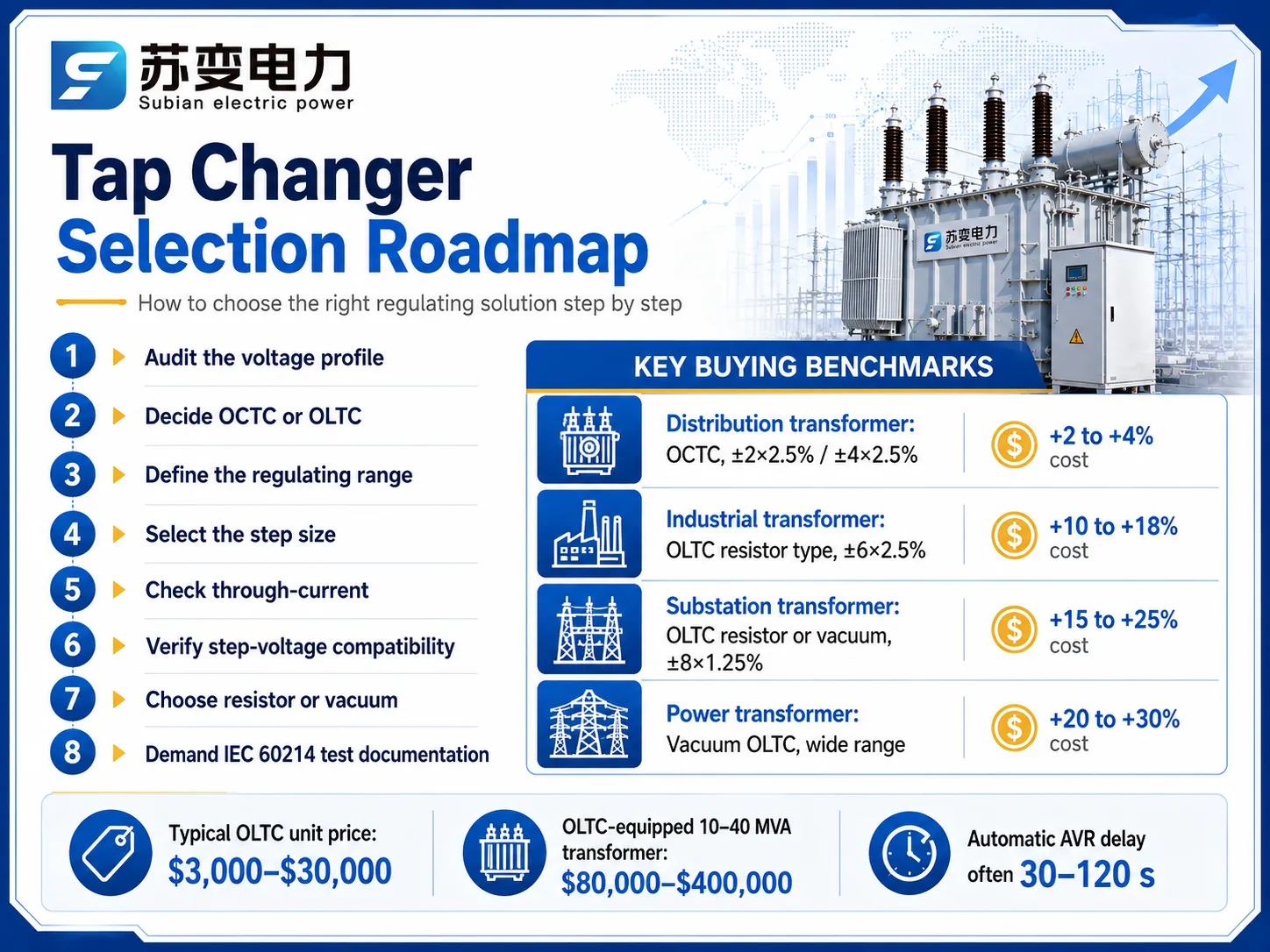
| 100-1,000 kVA distribution | Off-circuit (OCTC) | ±2×2.5% / ±4×2.5% | Up to 1,500 A | +2 to +4% |
| 1-10 MVA industrial | OLTC, resistor type | ±6×2.5% | 300-700 A | +10 to +18% |
| 10-60 MVA substation | OLTC, resistor or vacuum | ±8×1.25% | 400-1,250 A | +12 to +25% |
| Above 60 MVA power | OLTC, vacuum type | ±8×1.25% or wider | 1,250-2,500 A | +15 to +30% |
Tap Range, Steps, and Position Selection
Selecting the tap range is a voltage-regulation determination, as opposed to being an educated guess. The process goes generally as follows:
First step is measuring the voltage variation, by recording the primary-side voltage during a full load cycle. The primary voltage changes by ±5-10% from light loads to heavy loads.
Second step is to calculate the required regulation range. It is essential to add together impedance drop in the transformer, which is typically 4-8% when at full load, and voltage variation on the primary side to get to know regulations range.
Next step is to find out the step size used in establishments. Standard distribution step size varies according to each transformer used, which varies from 2.5% to 1.25% for power transformers needing more precision.
Fourth step is to pick out the midpoint of the range, which should be centered around a nominal ratio of ±8×1.25%, producing range of voltage regulation tapping by 10% for 33/11kV applications.
Final step is to synchronize with the AVR. When working on automatic mode, the relay keeps track of the voltage on the bus and sends the command to the motor drive to change each step in delay mode, which is approximately 30-120 seconds.
Where Each Type Belongs
- Distribution transformers (50-2,500 kVA): Off-circuit tap changers, ±2×2.5% or ±4×2.5%, adjusted at commissioning and seasonally;
Substation power transformers (5-60 MVA): Resistor-type OLTC with ±8×1.25% or ±6×2.5% adjustments with the possibility of automatically regulating voltage;
Large power and generator transformers (>60 MVA): Vacuum-type OLTC operating over wide ranges, sometimes on both HV and LV windings (two OLTCs);
Industrial furnace and arc loads: OLTCs made for fast operations and big switching rates;
Renewable energy tie transformers: OLTC to help with variable generation and hold voltage in the grid.
Brands and Price Comparison
| Brand | Origin | Strength | Approx. Price Range (OLTC, standalone) |
|---|---|---|---|
| MR (Reinhausen) | Germany | The global OLTC benchmark; vacuum and resistor types | $6,000-$35,000 |
| ABB | Switzerland/Sweden | Complete transformer + OLTC packages | $5,000-$30,000 |
| Siemens | Germany | OLTC for large power transformers | $6,000-$32,000 |
| Hitachi Energy | Switzerland | Power transformer tap changing | $7,000-$35,000 |
| Schneider Electric | France | Distribution-class tap changers | $3,000-$15,000 |
| Jiangsu Subian Electric Power | China | OCTC and OLTC-equipped transformers, IEC 60214 coordination | $2,000-$12,000 |
In the field of on-load tap changers, MR Reinhausen is regarded as the benchmark as the majority of large transformers globally are manufactured by MR or its licensed version; ABB, Siemens, and Hitachi Energy providing complete solutions around these machines or their partner’s OLTC technology. The equipment passes all necessary tests according to IEC 60214 and IEEE C57.131, having all required records of its lifetime and maintenance. For those who want the same result but at a more attractive price, Jiangsu Subian Electric Power creates equipment with the same OLTC able to make devices as one. Jiangsu Subian Electric Power supplies equipment successfully operating for IEC 60214 and shipping worldwide with all commonplace records of tests at a price 40-60% less than the cost of European transformers. If you opt for MR equipment or find a cost-efficient analogue, ensure that you mention OLTC’s name in your purchase agreeing to purchase the exact unit rather than just referring to it in general.
Step-by-Step Selection Guide
First, choose between an OCTC or an OLTC. If you can take the transformer out of service while changing taps and if the load changes gradually, then an OCTC is the way to go. If, however, you want to keep the voltage constant while the load is in a state of constant change, then you should choose an OLTC.
Next, define the regulating range. Take down the actual voltage variation and find the required range, keeping in mind that +8×1.25% is enough to cover most situations when using electricity.
Next, choose the step size; use 2.5% for economy purposes and 1.25% for more precise regulation.
Then, check the through-current. OLTC must have a capacity greater than the maximum continuous current of the transformer, which also includes any overload commitments.
Furthermore, ensure that the voltages are compatible. Confirm that the OLTC handles your transformer’s step voltage, because the product of the tap current by the step voltage will cause stress on the diverter.
Decide on whether you want to use a resistor or a vacuum. A resistor would be a better option as it is cheaper and has been in use for a long time, whereas a vacuum would have lower maintenance costs.
Finally, do not forget to include automatic controls. A motor drive, AVR relay, and position indicator are not only necessary for your OLTC, but you should also specify the control voltage needed for it to function.
Installation and Maintenance
The most maintenance-intensive aspect of a modern transformer is its use of on-load tap changers, as they are the only transformer components to perform mechanical work under load conditions. The switching oil used in typical resistor-type OLTC devices needs to be filtered or replaced according to the manufacturer’s schedule, usually after a period of 100,000 operations or 5-7 years, whichever comes first, while vacuum-operated OLTCs prolong the operating time considerably.
Maintenance procedures
1. Measure and draw up a monthly chart of the operating counter readings.
2. Take OLTC oil samples separately from the main tank oil. The diverter oil carbonizes under switching and gets deteriorated much quicker.
3. Inspect contacts for erosion during general overhauls, and take transition resistor readings according to the requirements of the manual.
4. Test torque characteristics of the motor drive and AVR-relay settings once a year.
5. Make sure that tap position indicator corresponds to the current winding position before any manual operation.
Frequently Asked Questions
How much does a tap changer add to transformer cost?
An off-circuit tap changer adds roughly 2-5% to the transformer price. An on-load tap changer adds 10-30%, because the OLTC itself costs $3,000-$30,000 (by rating) plus the motor drive and control system. For a 10 MVA transformer, budget $10,000-$25,000 for the OLTC increment.
What is the difference between an off-circuit and an on-load tap changer?
An off-circuit tap changer (OCTC) can only be operated when the transformer is de-energized; it is a simple, cheap switch used to match the transformer to its feeder’s average voltage profile. An on-load tap changer (OLTC) switches taps while the transformer carries load, using a diverter and transition impedance to avoid interrupting current, which makes it suitable for automatic voltage regulation under varying load.
What tap range do I need for my transformer?
For distribution transformers, ±2×2.5% (5 positions) or ±4×2.5% (9 positions) covers most cases. For power transformers feeding fluctuating loads, ±8×1.25% (17 positions) is the common choice, giving ±10% total range. The correct value comes from measuring your voltage variation and transformer impedance drop — do not pick a range from a catalog.
How often should an on-load tap changer be maintained?
Resistor-type OLTCs typically need oil filtration or replacement every 100,000 operations or 5-7 years, whichever comes first. Vacuum-type designs extend that to roughly 300,000 operations. Monitor the operation counter, sample the OLTC oil separately from the main oil, and inspect contacts at each major overhaul.
Can I retrofit an OLTC onto a transformer designed for off-circuit operation?
Infrequently, and typically not cheap. The winding should have the proper tap configuration, the tank should have a mounting turret, and the cooling and clearances must work for the diverter. It is nearly always cheaper to specify the OLTC at the design stage or buy a new transformer. If the need for voltage regulation exists for an already installed fixed-tap unit, one should think about a separate voltage-regulating transformer instead.
References
- IEC 60214-1 — Tap-Changers, Performance Requirements and Test Methods — The core standard for tap changer design and testing.
- IEC 60214-2 — Tap-Changers, Application Guide — Guidance on selecting ranges, steps, and ratings.
- IEEE C57.131 — Requirements for Load Tap Changers — North American OLTC standard.
- MR Reinhausen — Tap Changer Portal — The leading OLTC manufacturer’s product and application documentation.
- IEC 60076-1 — Power Transformers, General Requirements — Transformer-level standards that the tap changer must satisfy as part of the unit.
- ABB Transformers — Reference for transformer and tap changer integration.
Conclusion
The tap changer selection can be considered a voltage-regulation solution masquerading as a selection of components. It is necessary to evaluate the test results relative to voltage variation and transformer impedance decrease beforehand. The next step is to select the tap changer according to the proper voltage range and tap size, then select a corresponding model to meet its requirements and specifications, including selection of an off-load tap changer if applicable.
An OCTC adds to the cost of the transformer only roughly 2% to 5%, whereas an OLTC increases the cost in the amount of approximately 10% to 30%. The current and voltage should be matched according to the operating conditions, instead of naming the brand of the equipment.
For off-circuit and on-load tap changer equipped transformers built to IEC 60214 and IEC 60076, contact Jiangsu Subian Electric Power at www.subian-electric.com with your voltage profile and load data for a specification and quote.