


Electricity runs through many transformers before reaching a factory, data center, or a home, which is something many people are not aware of. Each of these appliances loses a small amount of energy in the form of heat. In the case of one transformer, the loss is negligible. When viewed in terms of millions of transformers being used every hour of every day, it becomes one of the largest sources of unnecessary energy loss in the power system. The energy saving transformer has been created to resolve this problem.
With the surge in electricity prices and the stricter carbon emissions regulations, purchasers have started taking into account not only the purchase cost of transformers. They consider the energy loss for the period of 20–30 years of the transformer’s service, all modern efficiency regulations complied with, and the carbon footprint of the transformer used. An energy saving transformer can resolve all these issues at once, which is the reason for the increasing demand for this type of transformers.The origin of this comes from the core‘s magnetization pattern as it remains non–stop throughout the day during the entire lifespan of transformers. Load or copper loss is connected with different levels of current resulting in losses caused by the windings‘ resistance.
What Makes a Transformer “Energy-Efficient”?
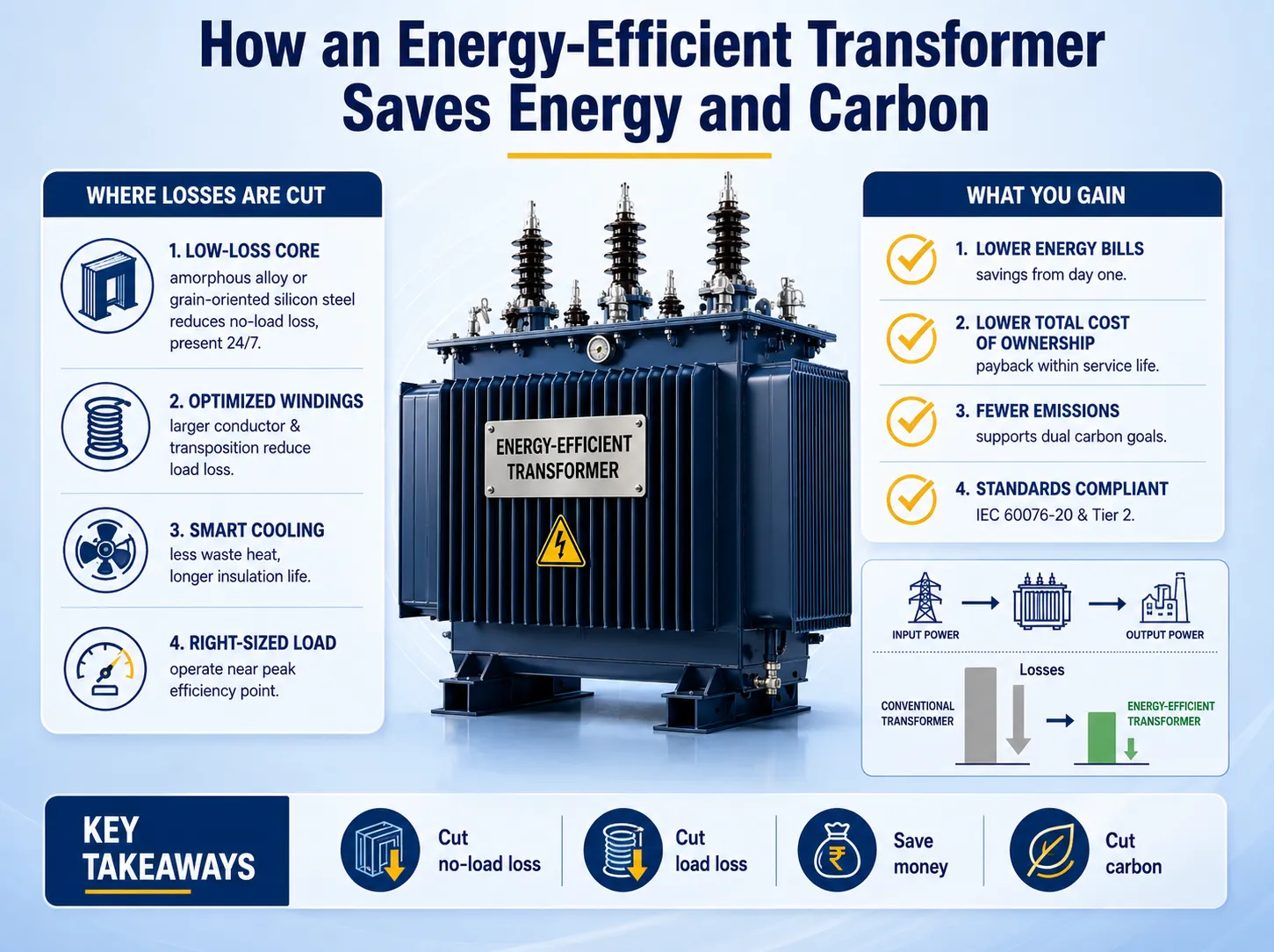
An energy efficient transformer is manufactured in such a way that both types of undesired losses are reduced as much as possible from the economical viewpoint. Since no-load loss is continuous, a slight decrease leads to considerable savings over a period of decades. A transformer designed in a proper way is capable of greatly minimizing no–load loss and ensuring lower load loss through the creation of good designs of conductors and windings with the same voltage transformation and considerably less energy losses.
The Technology Behind a Green Transformer
The improved efficiency of modern green transformer does not depend on any one factor. A set of designer solutions connected with heat management, winding design, and core design is responsible for improvements in efficiency. The knowledge of these details helps buyers understand what is claimed about the performance of devices.
Low-loss core materials
As it was mentioned before, the losses depend on the core of transformers, so here is the first place engineers will pay attention to. First-grade grain-oriented steel is used as it allows covering less energy in order to magnetize and demagnetize the core. The best option is to use an amorphous alloy core transformer which is a metallic ribbon allowing achieving the lowest number of losses connected with low resistance level compared to that of silicon steel.
Optimized windings and conductors
The reduction of losses connected with the load passes through the windings. The use of a thicker wire results in fewer losses and the use of alternating conductor leads to lower losses connected with swelling at higher loads. High-quality copper and accurate device‘s manufacturing lead to cheap transformer usage in all voltage range.
Smarter cooling and load management
The efficiency of a green transformer is closely connected with thermal performance of a device. Fewer losses allow producing less waste heat which means less noisy and more enduring insulating devices and more efficient cooling systems.
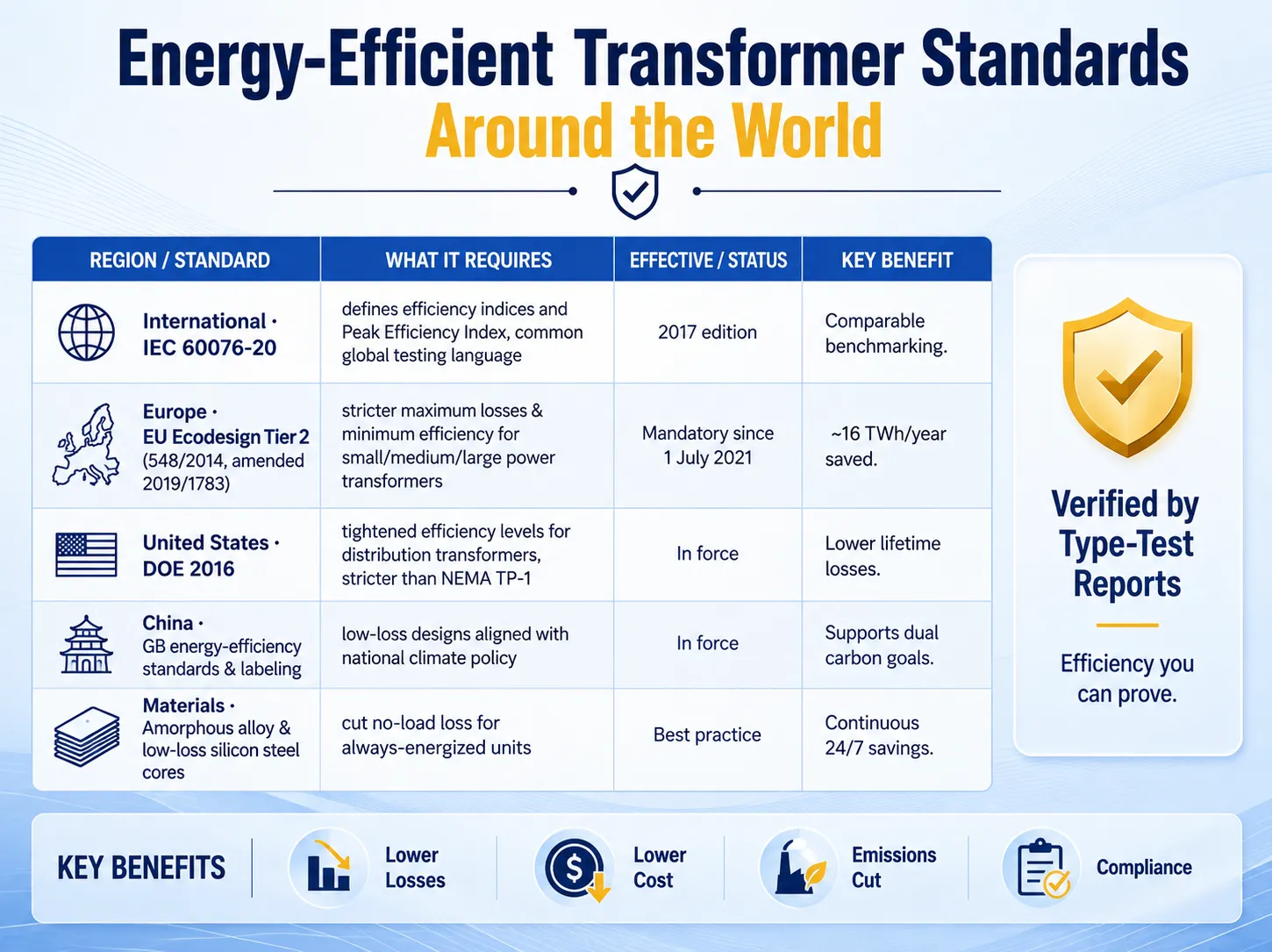
Global Efficiency Standards Every Buyer Should Know
Losses being an issue affecting the entire grid, governments have made transformer efficiency regulations mandatory rather than optional. To verify that the transformer is energy efficient, one has to take into account standards while purchasing, thus sparing the company from installing equipment that will not be able to pass inspections.
The international reference is the IEC 60076-20, which deals with energy efficiency. The IEC 60076-20 specification indicates efficiency indices and testing methods and defines, among others, the Peak Efficiency index characterizing the degree of transformer‘s efficiency while operating at its peak performance.
In Europe, the controlling document is the Ecodesign regulation for power transformers, EU Regulation 548/2014 updated by Regulation 2019/1783. Its second stage, known as Ecodesign Tier 2, has become mandatory since July 1, 2021, introducing limits for losses and minimum requirements for the efficiency of small, medium, and large transformers sold in the EU. The Ecodesign Tier 2 regulation is supposed to save around 16 TWh of electricity and reduce millions of tons of carbon emissions per year.
In the USA, the Department of Energy sets minimum efficiency requirements for transformers and DOE 2016 standards factualize the record for NEMA TP-1 standards for transformer efficiency.In China, the national GB efficiency regulations and energy efficiency labels propel the marketplace towards low-loss devices, in accordance with the nation‘s climatic policies. A reputable green transformer manufacturer will clearly indicate which of these standards its product uses and support that with test reports instead of descriptive words.
Energy Efficient Transformers and the Dual Carbon Objectives
The term dual carbon stands for two targets, namely reaching the peak of carbon emissions and future achieving of carbon neutrality. In September 2020, China proclaimed its own version of the dual carbon objectives, promising to reach the peak level of carbon dioxide emissions by 2030 and carbon neutrality by 2060, and outlining the “1+N“ policy framework to direct all the sectors to reach these dual carbon objectives. There are various commitments from other countries worldwide, thus, the direction of carbon reduction is common for many regions of the world.
Transformers occupy a strategically important position in this transition. They are widespread, operate all the time, and their losses mean that there is the same amount of power generation wasted as well as the amount of emissions as long as the power generation is based on fossil fuels. An energy efficient transformer can lower that loss at the very beginning. For instance, if an energy efficient transformer is used in one plant with several dozens or even hundreds of units, the considerable amount of electricity saving will be achieved, thus contributing to the realization of the dual carbon aim.
There is oneThe new clean-energy initiatives in the energy supply due to carbon goals signifies that solar farms, wind farms, energy storage facilities, and extended distribution network lines will need vast amounts of new transformers. Using the utmost efficient transformers in the infrastructure assures buyers that the devices to clean energy won‘t have high energy losses while working. Simply speaking, a green transformer matches the low-carbon grid perfectly, whereas it also is a must–have for the infrastructure to work properly.
Green production: Why factory is as important as product
Real green transformer are not only measured by the rate of losses. The way they are synthesized, checked, and monitored has great environmental and reliability importance to the serious customer. This is where the principles of certification and manufacturing come to prove the product.
Tests according to the IEC 60076 standards have proven that the transformer losses declared on the nameplate are real. Moreover, the internationally recognized process of certification gives the customer the confidence that the process is being double–checked. Besides the product, environmental credentials of the supplier‘s factories, such as ISO 14001 environmental management and ISO 50001 energy management, provide evidence of their waste and emissions management.When you choose a manufacturer that publishes their type-test reports, has relevant IEC certifications, and meets green factory standards, it means that the purchase becomes a verifiable performance instead of a gamble.
The Business Case: Total Cost of Ownership
Energy efficiency is regarded as an environmental decision, but in most cases it is first and foremost a financial one. The total cost of ownership of the transformer depends not on the purchase price, but on the cost of the energy losses throughout its lifecycle. The conventional unit might be cheaper to purchase, but through the years it consumes more electricity than the price difference suggests.
The financial case is even more compelling as the losses occur all the time. Since the no-load loss takes place whenever the transformer is on, any design that minimizes it will start saving money from the very first day of operation and will continue doing it for the entire lifespan of the unit. The load loss savings depend on usage pattern, so the industrial and commercial users will benefit from that as well. When all these savings are summed during the lifetime of the device as compared to small additional price, an energy efficient transformer usually earns back its extra cost even before its service life is over.
Therefore, the proper analysis needs to compare both the capitalized loss values and prices. Many utilities and also major consumers normally assign a monetary value to each watt of the no-load loss and the load loss and include it in the tender. In this way, the true cost of the equipment can be evaluated opening up the low-loss transformer option.
Where Energy-Efficient Transformers Deliver the Most Value
The efficiency advantage applies everywhere, but the return is largest in settings that combine long running hours, steady load, or a strong sustainability mandate. Common high-value applications for an energy-saving transformer include:
- Distribution networks and substations, where units run continuously and no-load loss dominates the lifetime cost.
- Data centers, where round-the-clock operation and aggressive efficiency targets make every saved watt count against the power usage effectiveness metric.
- Renewable energy plants, including solar and wind farms, where a green transformer keeps the clean power flowing to the grid with minimal loss.
- Industrial and manufacturing facilities with high, sustained loads and rising energy costs.
- Commercial buildings and campuses pursuing green-building certification and corporate carbon targets.
- Utilities and grid operators managing losses at scale to meet regulatory efficiency requirements.
In each of these, the same logic holds: the more hours the unit runs and the higher the price of energy, the faster an energy-efficient transformer repays its premium and the greater its contribution to the owner’s dual carbon objectives.
How to Specify an Energy-Efficient Transformer
Getting the full benefit of a low-loss transformer depends on specifying it correctly. A few points make the difference between a good purchase and a great one:
- State the required standard explicitly, such as IEC 60076-20, Ecodesign Tier 2, or the relevant national efficiency code, and require documented compliance.
- Ask for guaranteed no-load and load loss figures on the nameplate, not just an efficiency percentage, and request type-test reports.
- Size the transformer to its real expected load so it operates near its peak-efficiency point instead of being oversized and lightly loaded, or undersized and stressed.
- Choose the core technology to match the duty, with an amorphous alloy core transformer favored where continuous energization makes no-load loss the priority.
- Match the format, oil-immersed or dry-type, to the installation environment without sacrificing the efficiency class.
- Evaluate bids on capitalized loss values and total cost of ownership, not on purchase price alone.
- Confirm the supplier’s certifications, including IEC compliance and environmental and energy-management credentials from a recognized green transformer manufacturer.
Oil-Immersed and Dry-Type: Efficiency in Both Formats
Buyers sometimes assume that efficiency belongs to one construction type over the other, but a modern energy-efficient transformer is available in both oil-immersed and dry-type formats. Oil-immersed designs use insulating and cooling fluid to manage heat and have long been the workhorse of distribution and power applications, offering excellent thermal performance and a strong efficiency track record. Dry-type designs use air and solid insulation instead of liquid, which makes them well suited to indoor, fire-sensitive, and clean environments where oil is undesirable.
Historically dry-type units trailed oil-immersed ones slightly on efficiency, but advances in core materials and winding design have closed much of that gap, and many dry-type products now meet the same strict DOE 2016 and Ecodesign Tier 2 limits. The practical takeaway is that the choice between the two should be driven by the installation environment, fire and maintenance requirements, and space, while the efficiency class is specified separately. Whichever format fits the site, a properly specified low-loss transformer in that format keeps losses and lifetime cost low.
Frequently Asked Questions
What is an energy-efficient transformer?
An energy-efficient transformer is a transformer engineered to minimize both no-load loss and load loss, so it delivers the same voltage transformation while wasting far less electricity than a conventional design. Lower losses mean lower running cost and lower carbon emissions across a service life that often spans two to three decades.
How much energy can an energy-saving transformer really save?
Savings depend on the size, loading, and the design being replaced, but because no-load loss runs every hour the unit is energized, even a modest reduction compounds into large lifetime savings. Across a whole market the effect is dramatic; the EU’s Ecodesign rules alone are expected to save roughly 16 TWh of electricity per year.
Is an amorphous core transformer better than a silicon-steel one?
An amorphous alloy core transformer offers markedly lower no-load loss than conventional silicon steel, which makes it ideal for distribution duty where the unit is always energized but often lightly loaded. High-grade grain-oriented silicon steel remains an excellent, cost-effective choice for many applications, so the best core depends on the load profile and budget.
How does an energy-efficient transformer support dual carbon goals?
By cutting losses at the point of energy conversion, an energy-saving transformer reduces the electricity that must be generated, and therefore the emissions tied to that generation. Applied across an installation and across the clean-energy build-out, this makes high-efficiency units a practical tool for meeting dual carbon goals.
Which standards should I look for?
Look for compliance with IEC 60076-20 for internationally recognized efficiency evaluation, plus the regional rule that applies to your market, such as Ecodesign Tier 2 in Europe or the DOE 2016 levels in the United States. A reputable green transformer manufacturer will supply type-test reports confirming the guaranteed loss figures.
Green Power for the Future
The transformer is one of the most reliable and unglamorous machines in the entire power system, and precisely because it is so widespread and so long-lived, the efficiency of the units installed today will shape energy waste and emissions for decades. Choosing an energy-efficient transformer is a decision that pays back in lower bills, easier regulatory compliance, and a measurable step toward dual carbon targets, all at once.
Subian Electric designs and manufactures oil-immersed and dry-type energy-saving transformer solutions built to international efficiency standards, giving buyers verified performance and a partner aligned with their sustainability goals. If you are planning a new project, upgrading aging equipment, or building out renewable capacity, talk to our team about the right green transformer for your load, your environment, and your future. Efficient power is green power, and it is the power of the future.