


When an energy developer in Vietnam got a project to build a 50-megawatt solar power plant in Binh Phuoc province, the project procurement team had to find how to buy electrical equipment. The most difficult but also the most important item to source was the transformers, because it was necessary to buy twelve pieces of equipment with 2,500 kVA capacity for inverter stations and also one transformer of oil type with 40 MVA capacity which would connect the generator with the power grid. The developer had two options: purchase the equipment made by a well-known manufacturer, which was expensive and would take a lot of time to deliver, or take cooperation with a local company that is not experienced in developing such projects. The question which can bother many manufacturers and buyers from Southeast Asia is not just “who can sell cheap transformers”. It is much more complicated, because it is necessary to take into consideration a lot of factors when working in this region.
Summary: The market for transformers in Southeast Asia consists of a variety of local brands – especially from Thailand, Indonesia, and Vietnam – as well as many additional businesses from China and India that deliver transformers to the area according to the IEC 60076 standards in terms of distribution and power transformers. For decision-makers, there are a few necessary specifications that must be taken into account. These include local voltage and electricity frequency, the nature of the operation environment (especially in terms of temperature and humidity), certification and testing requirements, shipping, and import duty costs.
The Southeast Asian Electrical Landscape: Voltages, Frequencies, and Standards
Any buyer of a transformer from Southeast Asia’s countries has to check electrical regulations and standards in that region. The area has many differences from country to country. The table below shows the main parameters for large ASEAN markets. However, to get the most accurate information about the electricity requirements in Southeast Asia for any transformer project, one would have to check the required standards by local utilities and specifications as the standards differ from place to place for various electricity operations.
| Country | Nominal LV Voltage (Three‑Phase) | Frequency | Primary Transformer Standard | Key Notes for Transformer Buyers |
|---|---|---|---|---|
| Thailand | 380 V / 400 V | 50 Hz | IEC 60076, with Provincial Electricity Authority (PEA) and Metropolitan Electricity Authority (MEA) specific requirements | In Thailand, the local transformer manufacturing sector is quite advanced. Both the Provincial Electricity Authority (PEA) and the Metropolitan Electricity Authority (MEA) have created their own lists of approved suppliers and defined technical specifications. A buyer working with a Thai power project must ensure that the manufacturer is included in such lists. |
| Vietnam | 380 V / 400 V | 50 Hz | IEC 60076, with Vietnam Electricity (EVN) specific requirements | The country’s electricity grid is developing quickly because of growing industries and renewable energies. The Electricity of Vietnam, otherwise known as EVN, leads in utility companies and imports energy distribution devices from China and India. The government also established minimum energy efficiency standards for transformers, which one should check before buying. |
| Indonesia | 380 V / 400 V | 50 Hz | IEC 60076, with Perusahaan Listrik Negara (PLN) specific requirements | Indonesia is composed of islands that make the transportation of large transformers both challenging and costly. The buyer is advised to partner with a supplier familiar with the Indonesian environment who is capable of organizing the delivery, unloading, and installation at the required location. PLN also has technical requirements to be followed. |
| Malaysia | 415 V | 50 Hz | IEC 60076, with Tenaga Nasional Berhad (TNB) and Sabah Electricity Sdn Bhd (SESB) specific requirements | TNB of Malaysia is known as a very technically challenging utility in the region, and its specifications for transformers are intricate and stringent. Suppliers to TNB need to ensure that the manufacturer has the relevant type-test certificates and that the transformer conforms with the specific requirements of TNB with respect to losses, impedance, and accessories. |
| Philippines | 240 V / 480 V (60 Hz, North American influence) | 60 Hz | IEEE C57.12 and IEC 60076 (dual standards accepted, depending on the utility) | The Philippines is the odd one out in terms of operating at a frequency of 60 Hz instead of 50 Hz; due to this, its electrical standards are inspired by North American practices as well. Buyers have to check the voltage and frequency before making the transformer purchase. The country’s largest utility companies, i.e. Meralco and NGCP, have their technical standardization policies too. Also, the Philippines demands additional typhoon-resistance and seismic-resistance requirements for outdoor electrical equipment. |
Climate, Environment, and the Transformer’s Physical Design
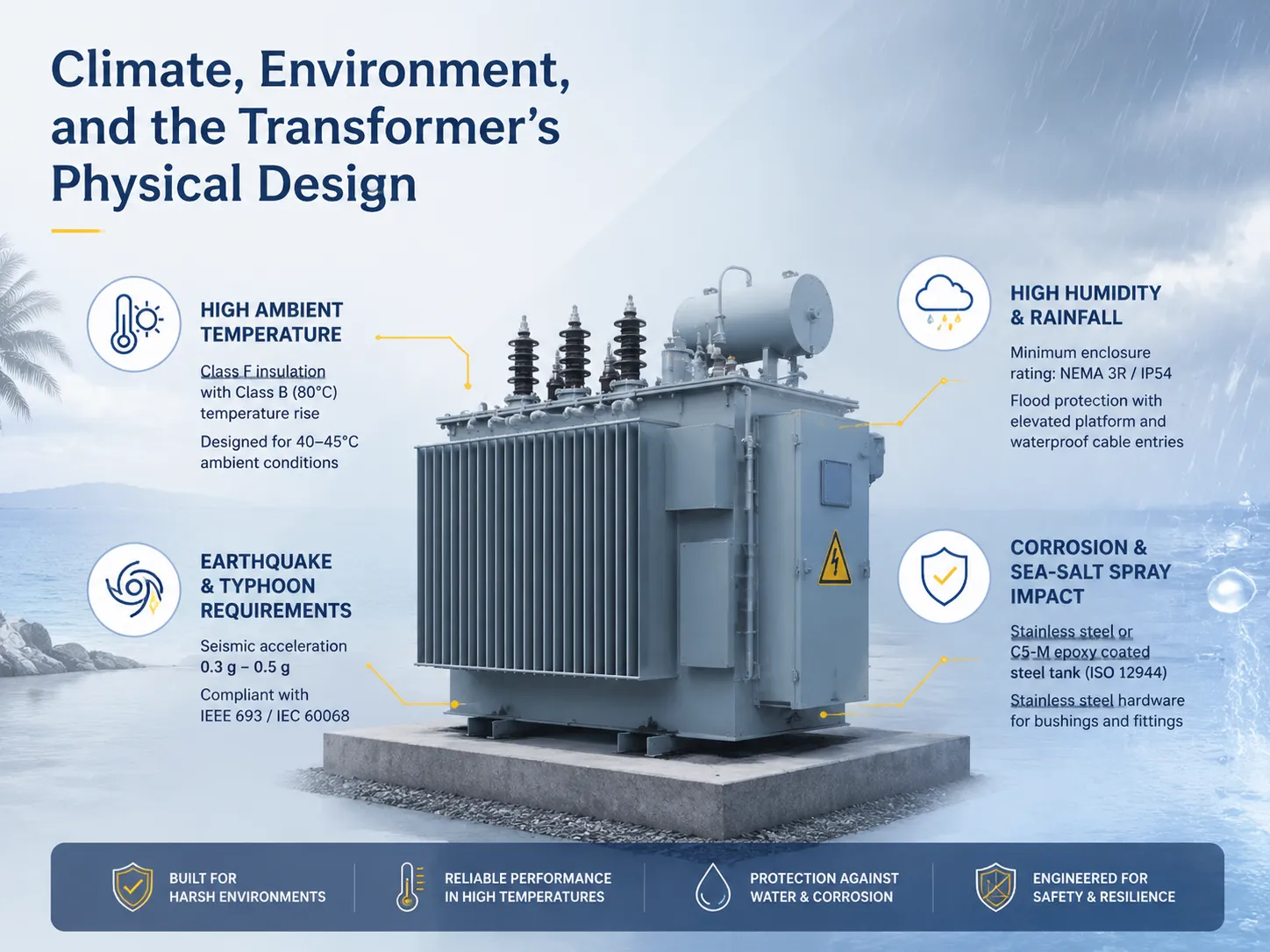
Southeast Asia has a very warm, wet, and often coastal climate. An outdoor transformer in this area (mounted on a pole, on a concrete slab, or in a transformer yard) needs to be specially engineered to meet the environmental challenges of the area. When buying a transformer, the customer needs to pay attention to the environmental conditions:
- High ambient temperature (the nameplate kVA rating for a transformer is calculated at a specific ambient temperature — standard values are 30 degrees Celsius for an average ambient temperature, and 40 degrees Celsius maximum for IEC transformers or 30 degrees Celsius average and maximum 40 degrees for IEEE rated transformers. In some places in Thailand, Vietnam, Indonesia, and the Philippines, ambient temperatures are regularly above this level and the transformer needs to be derated or designed with lower temperature rise to run at maximum kVA rating — for outdoor transformer in Southeast Asia, the most common specification is Class F insulation system with Class B (80 degrees Celsius) temperature rise, as it provides thermal clearance for using the transformer at temperature range of 40 to 45 degrees Celsius);
- High humidity and rainfall (the enclosure of outdoor transformers has to have adequate ratings to endure expected rains, humidity, and flooding. In terms of NEMA ratings, a minimum must be NEMA 3R or IP54, while in flood areas, the transformer might need to be located on a platform, and cable entries have to be waterproofed);
- Corrosion and sea-salt spray impact (if the transformer is in a few kilometers of the sea — and it applies to a huge number of people and businesses in Thailand, Vietnam, Indonesia, the Philippines, and Malaysia — it will be exposed to salt-laden air causing rust on metal structures. The transformer will need to have a stainless steel tank or carbon steel tank with high-quality C5-M epoxy coating according to ISO 12944 to combat corrosive effects, and stainless steel hardware in bushings and fittings);
- Earthquake and typhoon requirements (the Philippines, Indonesia, and parts of Vietnam are seismically active and prone to typhoons. Thus transformers in this area need to be built to meet the expected seismic acceleration of 0.3 g-0.5 g. It is necessary to specify the necessary regulation requirements in the purchase order — IEEE 693 for North-American specifications, and IEC 60068 for IEC standards).
For a comprehensive overview of the transformer types and configurations that are available for these and other demanding environments, see the product catalogue at Subian Electric, which includes oil‑filled, dry‑type, and specialty transformers designed for the specific climatic and environmental conditions of the Southeast Asian market.
Logistics, Import Duties, and the Total Landed Cost
The price of a transformer is only one part of the overall landed cost of the transformer. For a buyer in Southeast Asia, freight and installation costs, as well as the port handling, the inland transport and the commissioning costs, may cost as much as or even more than the purchase price, especially in case of a large power transformer which requires a heavy‑lift crane and a specialized transport trailer. Some of the key logistics issues include the country of origin of the transformer and the customs duties involved (ASEAN Free Trade Area (AFTA) lowers or removes customs duties for electrical equipment produced in ASEAN countries and meeting local content requirements; it is possible to import transformers produced in Thailand, Vietnam or Indonesia at a reduced tariff of 0 to 5% as opposed to transformers produced in China, India and Europe which may be subject to the Most Favored Nation customs duty of 10 to 30% depending on the country of origin of the appliance and its classification; it is important to check the tariff rate with local customs or with a freight forwarder), freight and the delivery route (for example, it can take 1–3 weeks to deliver a transformer from China to a main port of departure, e.g. Singapore, Laem Chabang in Thailand, Tanjung Priok in Indonesia, Ho Chi Minh City in Vietnam, although getting the transformer from a port to a remote project site can take additional weeks and cost thousands of dollars; the buyer should consider every aspect of logistics along the route and check whether the manufacturer can deliver the goods on time), and installation and after-sales support (it should be done by qualified engineers, i.e. the oil has to be filled in oil-filled transformers and this has to be done under controlled conditions; the manufacturer has to provide a commissioning engineer or comprehensive instructions; also, spare parts need to be available). For a buyer who is purchasing a transformer for a project in a distant area the reputation of the manufacturer should be critical because it is better to pay a higher amount to a manufacturer having an established record of delivering the transformers to the specific location rather than a lower price to a one lacking experience and support services.
How to Qualify a Transformer Supplier for a Southeast Asian Project
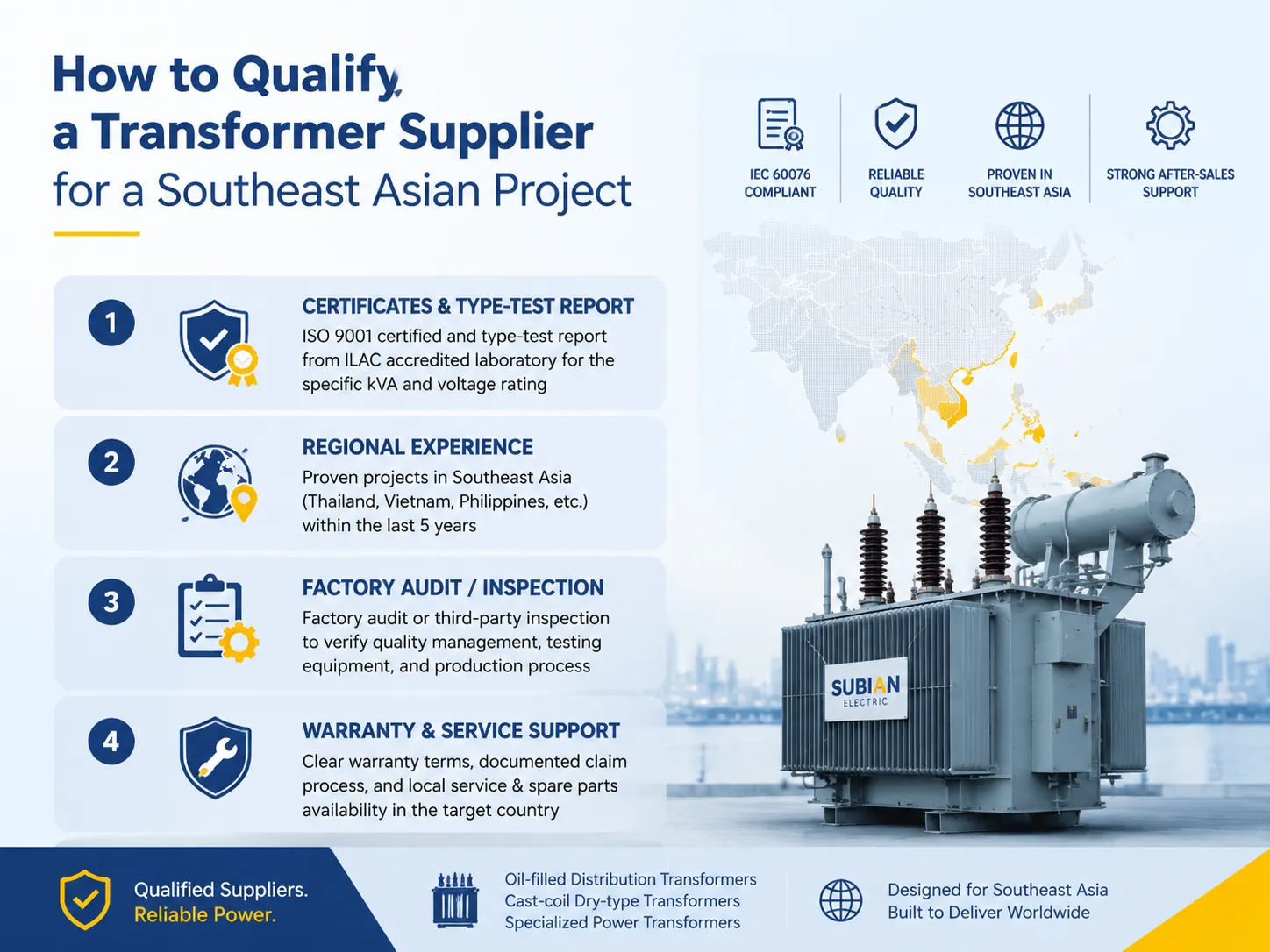
Choosing a transformer supplier for a Southeast Asia project involves checking the supplier’s technical ability, its experience in the country and the application, its compliance with the required standards, and its readiness to deliver and support the product. To facilitate this process, a structured qualification that any buyer can follow is offered in the paragraphs below.
For the first step, the buyer should check the supplier’s certificates and type-test report for the specific transformer model and power rating that they are procuring. The supplier must be certified according to ISO 9001 quality standards and provide certified type-test report from an independent and ILAC accredited laboratory for the specific kVA and voltage rating; in other words, the type test certificate for 500 kVA cannot be used for 2500 kVA of the same design.
Secondly, the buyer should ask the supplier for the reference list that includes projects in the target country or region; a company that was able to deliver transformers in Thailand, Vietnam or the Philippines over the last five years and provide contacts for these projects must have successfully handled the local regulations, logistics, and installation requirements.
The third step implies the factory audit and/or a third-party inspection; the facility visit or video inspection and evaluation of the quality management system, testing equipment, and production process allows the buyer to ensure that the supplier can deliver what they promised; in case inspection is impossible, then a third-party inspection from a relevant organization (SGS, Bureau Veritas, Intertek) is to be addressed.
The fourth step is about verifying warranty conditions and the service presence in the target country; a transformer sold with a warranty of two years but with no service or spare parts availability in the buyer’s region creates new risks for the buyer as the warranty should be clearly explained, the warranty claim procedure formally documented, and critical spare parts availability ensured before order placement.
For buyers that are looking for transformers for their Southeast Asian project, Subian Electric offers a number of products including oil-filled distribution transformers, cast-coil dry-type transformers, and specialized power transformers manufactured according to IEC 60076 standards and with the voltage, frequency, and environmental characteristics. The manufacturing facility located in China’s Zhejiang Province is the centre of the low-voltage electrical equipment production in the country and the factory produces transformers for export deliveries to Thailand, Vietnam, Indonesia, the Philippines, Malaysia, and the entire Asia-Pacific region. Each transformer supplied to the customers comes together with relevant type-test report, material test report, and the relevant routine tests documentation. The company has already successfully delivered its products throughout the region.For a deeper look at the transformer types and the selection criteria that apply across global markets, our article on the best basic electrical transformer buyer guide provides the comprehensive framework for specifying and evaluating any transformer purchase.
Frequently Asked Questions
What voltage and frequency do Southeast Asian countries use?
Most of the countries in South East Asia, including Thailand and Vietnam and Indonesia and Malaysia, use 50 Hz for their electrical power supply, with the nominal low-voltage three-phase supply voltage being 380-415 V, while the Philippines is the exception, using 60 Hz frequency and North American voltage standards. Before buying transformers, it is necessary to check with the local utility the types of transformer, frequency, and low-voltage supply being used, since transformers functioning at 50 Hz can overheat on 60 Hz supply, and vice versa.
What is the most common transformer standard used in Southeast Asia?
In Southeast Asia, IEC 60076 has become the most significant transformer standard in various countries like Thailand, Vietnam, Indonesia, Malaysia, Singapore and in ASEAN countries. Though Philippines is only one of the states considering both IEC 60076 and IEEE C57.12 standards based on certain parameters of the utility and the project.
Do I need to de‑rate a transformer for the high ambient temperatures in Southeast Asia?
Yes, in a majority of situations. The kVA rating on the transformer’s nameplate is based on an assumed ambient temperature which is usually 30°C average and a maximum of 40°C for IEC rated machines. In lots of places across Thailand, Vietnam, Indonesia and the Philippines, the ambient temperature goes beyond 40°C all the time and the transformer has to be de-rated or specified with a lower temperature rise to operate at full kVA rating. For outdoor transformers in Southeast Asia, a Class F insulation with a Class B temperature rise (80°C) is widely specified because it gives the necessary temperature margin due to the high ambient temperatures.
How do I protect a transformer from corrosion in a coastal environment in Southeast Asia?
If you are planning on installing a transformer close to the sea, you must use a special tank for it. The tank can be either made of stainless steel (stainless steel grade 316L for corrosive environments or stainless steel grade 304 for general use near coast) or carbon steel pm with a very good epoxy coating certified according to the C5-M category according to the ISO 12944 standard. The transformer must also include bushings, fittings, and other visible hardware made of stainless steel.
References
- IEC 60076 — Power Transformers. The international standard series that defines the design, testing, and performance requirements for power and distribution transformers, adopted across Southeast Asia and most of the world.
- ASEAN Free Trade Area (AFTA) — Common Effective Preferential Tariff (CEPT) Scheme. The trade agreement that reduces or eliminates import duties on electrical equipment manufactured within ASEAN, which can significantly affect the total landed cost of a transformer imported from one ASEAN country to another.
- Provincial Electricity Authority (PEA) of Thailand — Transformer Standards and Approved Supplier List. The technical standards and the procurement requirements of one of the largest utility buyers of distribution transformers in Southeast Asia.
- Meralco (Philippines) — Technical Specifications for Distribution Transformers. The technical standards of the largest private electric distribution utility in the Philippines, which operates at 60 Hz and requires compliance with both IEEE and local Philippine standards.
The transformer market in Southeast Asia represents a variety of challenges and requirements. One must be diligent in the selection process: make sure to check the voltage and frequency, the specific type of transformer suitable for the assigned climate and location, and the import-duties and logistics needed, while being strict enough in the selection of the supplier. The specification of
design might diverge for projects undertaken in Thailand and the Philippines. The transformer created for the use in factory that has air-conditioners might eventually end up being damaged in coastal climate of Indonesia. The one who knows all of those things and cooperates with the company sharing that knowledge is going to receive an operational transformer that will perform its duties for 25 to 35 years.