


When a typhoon bears down on a coastal region, the power grid is one of the first systems put to the test. Driving rain, flooding, flying debris, and lightning all converge on the substations and distribution equipment that keep the lights on, and few pieces of that equipment are more critical, or more exposed, than the transformer. The oil-immersed transformer is the workhorse of distribution and power networks across storm-prone areas, valued for its efficiency, cooling performance, and durability. But like any outdoor asset, it needs the right design, preparation, and operating discipline to come through a severe storm safely.
This guide explains how an oil-immersed transformer is built to resist harsh weather, what specific hazards a typhoon brings, and the concrete precautions operators should take before, during, and after the storm. Whether you are responsible for a single unit at a factory or a fleet of 35kV oil-immersed transformer installations across a network, the principles are the same: protect the equipment, protect the power supply, and above all protect the people around it.
Why Typhoons Are a Serious Threat to Transformers
A typhoon combines several destructive forces at once, and each one attacks a transformer in a different way. Torrential rain and storm surge cause flooding that can submerge equipment and force water past seals. Sustained high winds turn loose objects into projectiles that can strike bushings, radiators, and cooling fins. Lightning injects enormous voltage surges into overhead lines that travel straight into connected equipment. On the coast, wind-blown salt spray accelerates corrosion long after the storm has passed.
Because a liquid-immersed transformer relies on insulating oil and carefully controlled internal conditions to do its job, any breach of that sealed environment is dangerous. Water is the single greatest enemy: even a small amount of moisture entering the tank drastically reduces the dielectric strength of the oil and the insulation, raising the risk of internal flashover and failure. Understanding these threats is the first step toward defending against them, which makes oil-immersed transformer safety a planning priority in any typhoon-exposed region.
How Oil-Immersed Transformers Are Built to Withstand Harsh Weather
A well-made oil-immersed transformer already includes a great deal of built-in protection against the elements, which is one reason the format is trusted for demanding outdoor service. Understanding these features helps operators appreciate what the equipment can and cannot handle on its own.
The core and windings sit inside a sealed steel tank filled with insulating oil, which both cools the active parts and excludes air and moisture. The tank, radiators, and fittings are finished with weather-resistant coatings to resist rain and corrosion. A conservator and a silica gel breather manage the expansion and contraction of the oil as temperature changes while keeping incoming air dry. Porcelain or composite bushings carry the high-voltage connections through the tank wall with a long creepage path designed to resist flashover even when wet. Modern low-loss series such as the S11 and SZ11 transformer designs are widely deployed at distribution voltages, with SZ11 units adding on-load tap changing to hold output voltage steady as the grid fluctuates during a storm.
Protection continues outside the tank. A properly specified installation pairs the transformer with a surge arrester on each incoming line to divert lightning and switching surges safely to earth, and with solid transformer grounding that gives fault current a low-impedance path away from equipment and people. For the harshest sites, the transformer may be housed inside a prefabricated enclosure, and the following sections explain how to combine these built-in defenses with the right preparation.
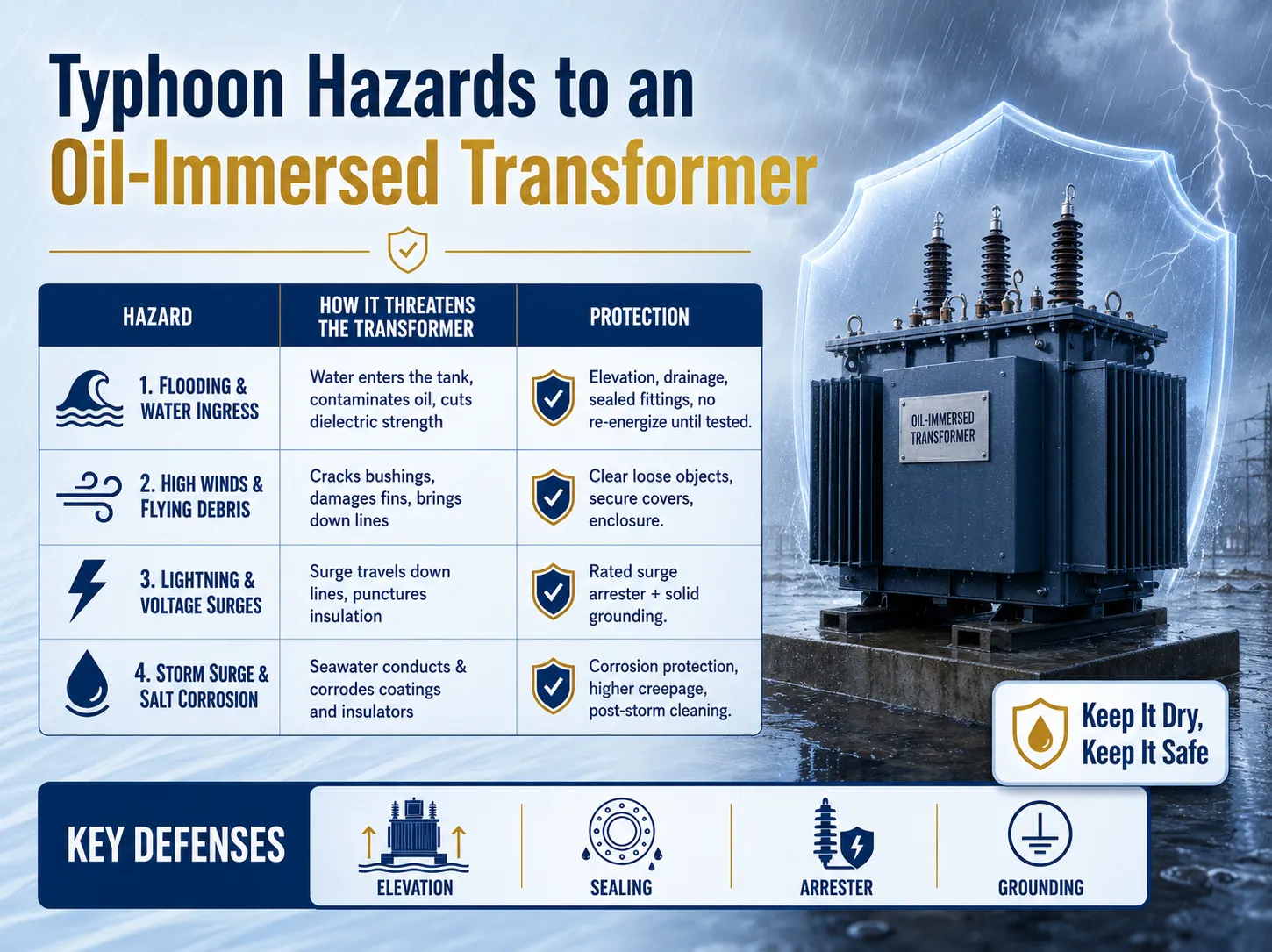
The Main Typhoon Hazards, Explained
To prepare effectively, it helps to look at each hazard individually and understand exactly how it endangers a liquid-immersed transformer.
Flooding and water ingress
Flooding is the most damaging and most common typhoon hazard for ground-mounted equipment. If floodwater rises to the level of the bushings, gaskets, or cable boxes, it can penetrate the tank and contaminate the oil. Water in the insulating system sharply lowers its dielectric strength, and a transformer that is energized or re-energized in that condition can fail catastrophically. Submerged control cabinets and tap-changer mechanisms are also vulnerable, and floodwater often carries silt and debris that clog radiators and drainage.
High winds and flying debris
Typhoon-force winds can exceed the design assumptions of nearby structures and throw signage, roofing, branches, and construction material across a site. A direct strike on a bushing can crack the porcelain and open a path for moisture or cause an immediate fault. Wind can also topple poorly secured poles and overhead lines, dropping energized conductors onto or near the transformer and its enclosure.
Lightning and voltage surges
Lightning does not need to strike a transformer directly to damage it. A strike anywhere on a connected overhead line sends a steep voltage surge racing toward every piece of equipment on that circuit. Without an adequately rated and correctly installed surge arrester, that surge can puncture insulation and destroy windings in microseconds. Switching operations during grid disturbances create similar, if smaller, transient stresses.
Storm surge and salt corrosion
Coastal installations face an additional threat. Storm surge can bring seawater far inland, and salt water is both highly conductive and aggressively corrosive. Even where flooding does not occur, wind-driven salt spray coats insulators and metalwork, degrading surface insulation and attacking coatings and fasteners over time. Sites near the sea therefore need extra attention to sealing, coatings, and post-storm cleaning.
Before the Storm: Preparation and Precautions
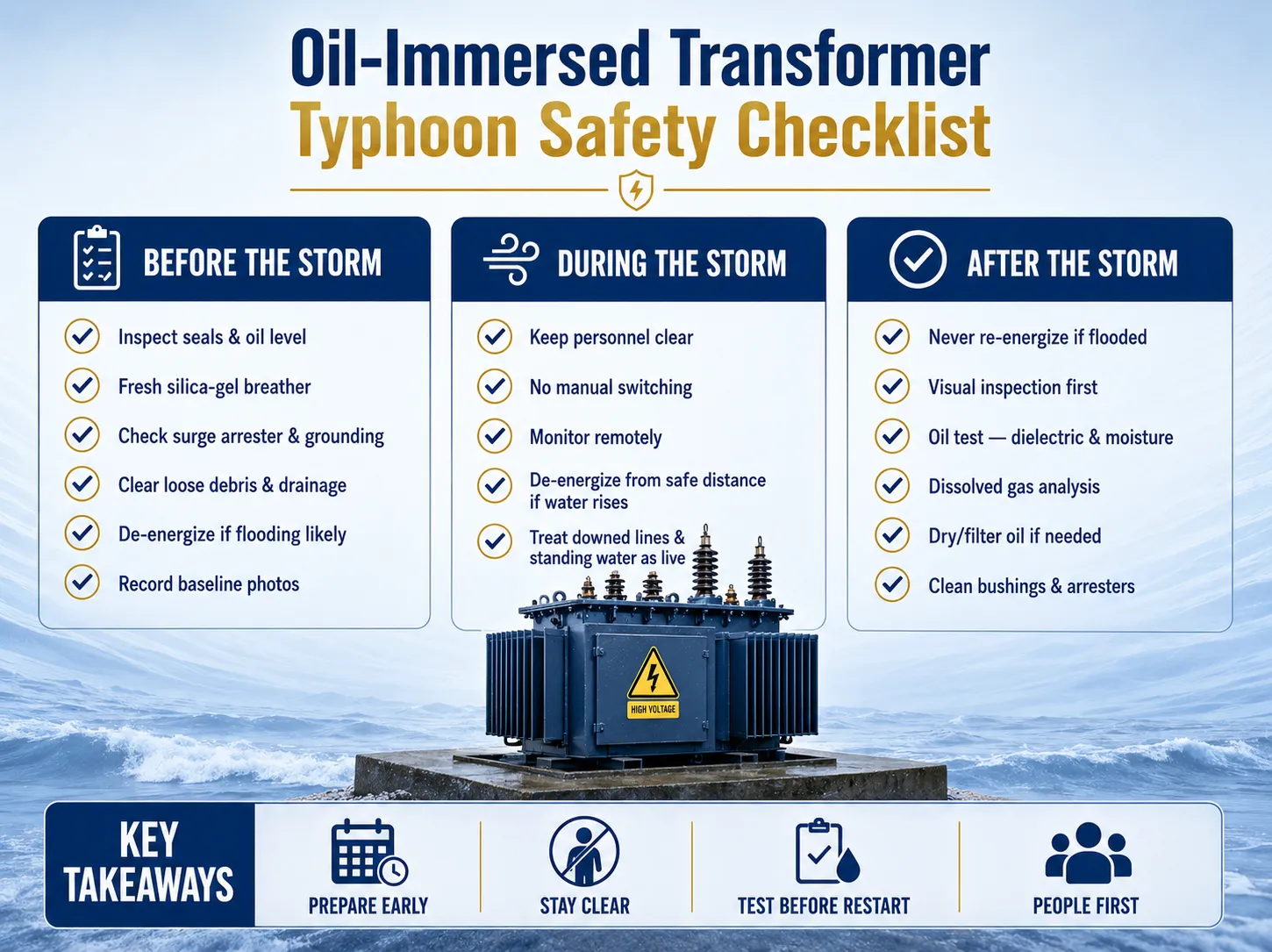
The single most important window for protecting a transformer is the day or two before a typhoon makes landfall, while conditions still allow safe work. A disciplined pre-storm routine dramatically improves the odds that an oil-immersed transformer survives intact. The following checklist covers the essentials:
- Inspect the tank, bushings, and gaskets for any existing leaks, cracks, or damage, and repair them before the storm arrives.
- Confirm the oil level is correct and that the conservator and silica gel breather are functioning, with the desiccant fresh and dry rather than saturated.
- Verify that each surge arrester is intact, correctly connected, and properly earthed, and check that transformer grounding connections are tight and low-resistance.
- Clear the surrounding area of loose objects, tools, and materials that wind could turn into projectiles, and trim nearby branches where practical.
- Secure enclosure doors, cable-box covers, and vents so wind and driving rain cannot force them open.
- Check and clear site drainage so water can flow away from the transformer foundation instead of pooling around it.
- Where flooding is a real risk, prepare to de-energize and, for mobile or skid-mounted units, consider relocating equipment to higher ground.
- Record baseline readings and take photographs, so post-storm inspection has a clear reference point.
- Confirm backup power, spare parts, and emergency contact procedures are in place before communications and access become difficult.
For fixed installations, the decision to keep a transformer energized or to shut it down ahead of the storm should follow the utility’s or facility’s emergency plan and local grid instructions. When in doubt, protecting the asset and the people around it takes priority over maintaining supply to non-critical loads.
During the Storm: Safe Operation and Decisions
Once a typhoon is actually striking, the guiding rule is simple: keep people away from energized equipment and let the prepared defenses do their work. This is not the time for manual intervention at the transformer. Trying to operate switches, open cabinets, or inspect a liquid-immersed transformer in high wind and flooding is extremely dangerous and should never be attempted.
Where a facility has remote monitoring and control, operators can watch oil temperature, load, and alarm status from a safe location and make switching decisions remotely. If floodwater is rising toward a transformer that is still energized, the correct response is to de-energize it through the proper upstream protection from a safe distance, not to wade in. A transformer that trips offline during a storm should be left offline until it can be properly inspected. Above all, treat every downed line and every patch of standing water near electrical equipment as live and lethal, and keep all personnel clear.
After the Storm: Inspection and Recovery
The period right after a typhoon is when costly mistakes happen, because the pressure to restore power is intense. The most important rule of recovery is this: never re-energize a transformer that has been flooded or submerged until it has been thoroughly inspected and tested. Doing so risks a violent failure that can injure personnel and destroy the unit. A careful, methodical recovery protects both.
Begin with a visual inspection from a safe distance, checking for leaning structures, damaged bushings, oil leaks, displaced covers, and signs that water reached the equipment. Once the area is confirmed safe and the unit isolated, a qualified team can carry out electrical and oil checks. Key steps include:
- Measure insulation resistance and winding resistance to detect moisture ingress or internal damage.
- Perform transformer oil testing for dielectric breakdown voltage and moisture content to confirm the oil still provides adequate insulation.
- Use dissolved gas analysis to reveal any internal faults such as overheating or partial discharge that the storm may have triggered.
- Inspect and clean bushings, arresters, and connections, paying special attention to salt deposits on coastal sites.
- Confirm that conservator, breather, and cooling systems are clear of debris and working normally.
- Dry out or filter the oil, or process the windings, if testing shows moisture has entered the insulation system.
Only when inspection and testing confirm the transformer is healthy should it be returned to service, and even then it is wise to monitor it closely during the first hours back online. A 35kV oil-immersed transformer feeding an important substation deserves particularly careful clearance before re-energization, because the consequences of a failure at that level are severe.
Oil-Immersed vs Dry-Type in Flood-Prone Areas
Buyers in storm-exposed regions sometimes ask whether a dry-type unit would be safer than an oil-immersed transformer when flooding is a concern. The honest answer is that neither format is designed to be submerged, and both must be protected from floodwater. What differs is the profile of their strengths.
An oil-immersed transformer offers excellent cooling, high overload capacity, and proven durability for outdoor and higher-voltage service, which is why it dominates distribution and substation applications, including 35kV oil-immersed transformer installations. Its sealed oil system is a robust barrier against moisture in normal weather, but if floodwater breaches the seals, the contaminated oil must be treated or replaced. Dry-type units avoid insulating liquid altogether and are often preferred indoors or in fire-sensitive locations, yet their exposed windings are highly vulnerable to moisture and contamination if they are flooded, and they generally suit lower voltages and sheltered environments.
In practice, the more decisive factor than format is installation: elevation above flood level, effective drainage, and a suitable enclosure protect either type far more than the choice between them. For most outdoor and coastal distribution needs in typhoon country, a well-sealed, well-sited liquid-immersed transformer from a quality manufacturer remains the dependable choice, provided it is kept out of the water.
Building a Typhoon Emergency Plan
Individual precautions work best when they are part of a written plan that everyone understands before the wind picks up. A practical emergency plan for transformer assets turns scattered good intentions into a repeatable routine that holds up under the stress of an approaching storm.
A sound plan assigns clear responsibilities, so each person knows whether they are inspecting, securing, monitoring, or making shutdown decisions. It defines trigger points, such as a forecast wind speed or flood level at which a transformer is de-energized, removing hesitation from the moment. It lists the pre-storm checklist, the safe-distance rules for the storm itself, and the inspection-and-test sequence for afterward, so nothing is forgotten under pressure. It keeps spare parts, insulating oil, testing equipment, and contractor contacts identified in advance, because sourcing them mid-crisis is slow and expensive. Finally, it records baseline data and photographs for every important unit, giving the recovery team a clear reference to judge storm damage against. Reviewing and rehearsing this plan at the start of each typhoon season keeps oil-immersed transformer safety from depending on memory or improvisation when it matters most.
Long-Term Resilience: Siting, Design, and Maintenance
Surviving one typhoon is good; being built to shrug off every storm season is better. Much of a transformer’s real-world storm resilience is decided long before any particular typhoon, in how and where it is installed and how well it is maintained.
Elevation is the most effective single measure against flooding. Mounting a transformer on a raised foundation or platform above the expected flood level keeps water away from the tank and bushings when the surrounding ground is inundated. Housing equipment inside a box-type substation or prefabricated enclosure adds a further barrier against wind, debris, and driving rain, and concentrates the sealing and drainage effort in one engineered package. Good site drainage, a stable foundation, and secure anchoring against wind uplift all contribute to a resilient installation.
Material and specification choices matter too. For coastal and industrial-coastal locations, specifying enhanced corrosion protection, higher creepage bushings, and sealed fittings pays off across the life of the asset. Choosing a robust low-loss series such as an S11 and SZ11 transformer from a reputable manufacturer ensures the unit is built to consistent quality with reliable seals and insulation. Finally, none of this works without maintenance: regular transformer oil testing, breather servicing, gasket inspection, and grounding checks keep the built-in defenses effective, so that when a typhoon arrives the equipment is already in the best possible condition.
People First: Electrical Safety Around Storm-Damaged Equipment
No transformer is worth a human life, and typhoons create exactly the conditions in which electrical accidents happen. Floodwater conducts electricity and hides hazards; wind brings down lines that may still be energized; and the urge to restore power quickly can tempt people into unsafe shortcuts. Everyone working near or around a liquid-immersed transformer during and after a storm should follow a few non-negotiable rules.
Keep well clear of any downed or sagging power line and assume it is live. Never enter standing water that could be in contact with energized equipment. Do not attempt repairs or switching without proper isolation, lockout, and the right personal protective equipment, and leave high-voltage work to trained and authorized personnel. Report hazards to the utility rather than trying to fix them independently. These habits cost nothing and prevent the tragedies that too often follow major storms.
Frequently Asked Questions
Can an oil-immersed transformer be used again after flooding?
Only after thorough inspection and testing. A flooded oil-immersed transformer must never be re-energized until transformer oil testing and insulation checks confirm that water has not compromised the oil and insulation. In many cases the oil must be filtered or replaced and the windings dried before the unit is safe to return to service.
How does water damage a liquid-immersed transformer?
The insulating oil and paper inside a liquid-immersed transformer depend on staying dry to hold off high voltage. Even a small amount of moisture sharply reduces dielectric strength, which can lead to internal flashover and failure. That is why sealing, breathers, and post-flood testing are so important.
Do surge arresters really protect against typhoon lightning?
Yes. A correctly rated and properly earthed surge arrester diverts lightning and switching surges to ground before they reach the windings, and it is one of the most cost-effective protections available. It must be paired with solid transformer grounding to work as intended, and should be inspected before storm season.
Is a box-type substation better in typhoon areas?
Often, yes. Housing equipment in a box-type substation or prefabricated enclosure adds protection against wind, debris, and driving rain, and makes it easier to elevate and seal the installation against flooding. It is a strong option for exposed coastal and industrial sites.
What voltage and model should I choose for a storm-prone site?
Match the voltage and capacity to your load and network, whether that is a distribution-class unit or a 35kV oil-immersed transformer for a substation. For reliability, a proven low-loss series such as the S11 and SZ11 transformer family, specified with corrosion protection and appropriate enclosure and elevation, gives a strong foundation for storm resilience.
How soon can power be restored after a typhoon?
It depends entirely on the condition of the equipment. A transformer that stayed dry and undamaged, with intact bushings, arresters, and grounding, may be cleared for service after a visual inspection and basic checks. One that was exposed to floodwater needs full transformer oil testing, insulation measurement, and often dissolved gas analysis before re-energizing, which takes longer but prevents a far more costly failure. Restoring power safely is always faster in the long run than restoring it hastily.
Weathering the Storm with Confidence
Typhoons will always test the power grid, but a well-designed, well-prepared, and well-maintained transformer can come through even a severe storm and be back in service quickly. The formula is consistent: choose robust equipment suited to the environment, prepare thoroughly before the storm, avoid dangerous intervention during it, and inspect and test carefully before returning to service afterward. Follow that discipline and oil-immersed transformer safety becomes a matter of routine rather than luck.
Subian Electric designs and manufactures reliable oil-immersed transformer solutions, including S11 and SZ11 series and 35kV oil-immersed transformer units engineered for demanding outdoor and coastal conditions. If your operation faces typhoon season, our team can help you select, specify, and protect equipment built to keep the power on when the weather turns its worst. Talk to us about transformers made to weather the storm.