


Im Januar 2026 öffnete ein Beschaffungsleiter eines Versorgungsunternehmens die Transformator-Tabelle und hielt an der Spalte für die Lieferzeit an. Der 20 MVA Transformator, der früher in zehn Monaten ankam, hatte jetzt eine Lieferzeit von sechsundzwanzig Monaten und der Preis war mehr als 75% höher als 2019. Darüber hinaus musste das Ingenieurteam drei Verteilungsprojekte mit höheren Sicherheits- und Effizienzbewertungen neu spezifizieren, da die Vorschriften zu Leerlaufverlusten und Lastverlusten während der Ausschreibung vom Netzbetreiber verschärft wurden. Die oben genannten Ereignisse sind nicht mit einem einzelnen Hersteller verbunden. Vielmehr handelt es sich um einen neu etablierten Standard in der Transformatorenindustrie, der bestimmt, wie Versorgungsunternehmen und Auftragnehmer ihre Einkäufe planen.
Dieser Artikel überprüft die aktuellen Trends, die den Transformatorenmarkt beeinflussen, und bezieht sich auf den Transformatorenmangel und dessen Auswirkungen auf die Lieferzeiten, die Preisänderung, die Effizienzregulierung, die Einhaltung der IEC 60076 als universelle Ausschreibungssprache und den Einfluss von Projekten erneuerbarer Energien und Rechenzentren auf den Transformatorenmarkt. Er basiert auf Informationen aus verschiedenen Quellen und wird Käufern helfen, die Sichtweise der Transformatorenhersteller hinsichtlich der eingetretenen Innovationen zu verstehen.
Was verursacht die Nachfrage nach Transformatoren
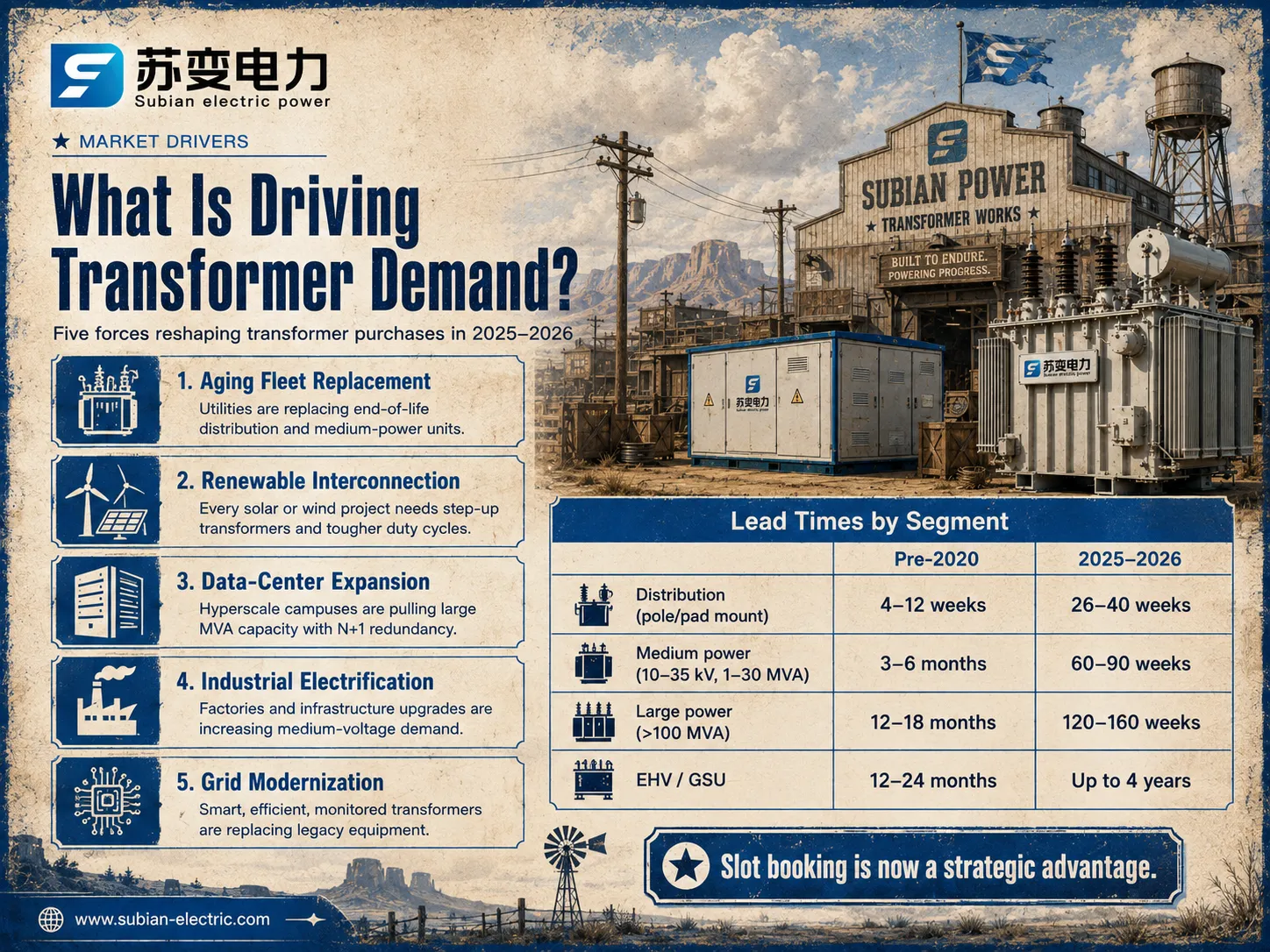
Der Anstieg der Transformatorennachfrage ist nicht mit einem einzelnen Ereignis verbunden. Vielmehr ist es eine Folge des gleichzeitigen Eintreffens mehrerer Faktoren. Der erste Faktor ist das alternde Netz: allein in den USA sind mehr als 40 Millionen Transformatoren und mehr als die Hälfte der installierten Transformatoren über die nominale Lebensdauer hinaus, während die Versorgungsunternehmen begonnen haben, sie massiv zu ersetzen. Der zweite Faktor ist die Elektrifizierung: Der Stromverbrauch in den Vereinigten Staaten ist seit 2020 um etwa 7% gestiegen, nach einem Jahrzehnt stabilen Verbrauchs. Der dritte Faktor ist die Anbindung erneuerbarer Energien, wenn solarbetriebene Großanlagen und Windparks Transformatoren benötigen, die unter härteren Bedingungen arbeiten als herkömmliche Netztransformatoren.
Ein weiterer Faktor ist der Boom der Rechenzentren: Hyperscale-Anlagen benötigen jetzt Campus-Zuführungen von 100–300 MVA mit N+1-Redundanz, während von Cloud-Service-Anbietern erwartet wird, dass sie in naher Zukunft über $600 Milliarden in KI-Hardware investieren. Laut Wood Mackenzie betrug der Mangel etwa 30% an Leistungstransformatoren und 10% an Verteilungstransformatoren in den USA im Jahr 2025, und dieser Trend setzt sich fort.
| Nachfragefaktor | Was es für die Transformatorennachfrage bedeutet | Typische betroffene Produkte |
|---|---|---|
| Ersatz der alternden Flotte | Stabile Austauschprogramme der Versorgungsunternehmen | Verteilungs- und Mittelspannungstransformatoren |
| Erneuerbare Anbindung | Neue Hochspannungseinheiten an jedem Wind-/Solarstandort | 33–110 kV Hochspannung, Bodenmontage |
| Expansion von Rechenzentren | Große Campus-Zuführungen mit Redundanz | Große Leistungstransformatoren über 30 MVA |
| Industrielle Elektrifizierung | Neue Lasten und Anlagenaufrüstungen | Trocken- und ölgetauchte Verteilungseinheiten |
| Netzmodernisierung / intelligente Netze | Ersatz durch überwachte, effiziente Einheiten | Intelligente Transformatoren, verlustarme Designs |
Der Transformatorenengpass: Lieferzeiten nach Segment
Der Grund für den Transformatorenengpass sind die begrenzte Anzahl verfügbarer Produktionsslots in den Fertigungsanlagen und nicht die zu hohen Preise. Obwohl Fabriken die Produktion steigern können, können Produktionsprozesse wie Wickeln und Tankverarbeitung sowie die Herstellung von kornorientierten elektrischen Stählen nicht schnell erhöht werden. Es gibt nur einen Hersteller von kornorientiertem elektrischen Stahl in den USA, der nur 20% der inländischen Bedürfnisse decken kann, und es dauert drei bis fünf Jahre, um die Produktionskapazität neuer Anlagen zu erhöhen. Folglich ist der Buchungsprozess für Transformatoren ähnlich dem, was im Halbleiterbereich gemacht wird – Versorgungsunternehmen beginnen, 24 bis 36 Monate bevor sie sie benötigen, Produktionsslots für Transformatoren zu buchen.
| Segment | Vor 2020 Lieferzeit | Lieferzeit 2025–2026 |
|---|---|---|
| Verteilungstransformatoren (Mast-/Fundamentmontage) | 4–12 Wochen | 26–40 Wochen (verbessernd) |
| Mittelspannungs-Transformatoren (10–35 kV, 1–30 MVA) | 3–6 Monate | 60–90 Wochen |
| Großtransformatoren (>100 MVA) | 12–18 Monate | 120–160 Wochen |
| Extra-hochspannungs-/GSU-Einheiten | 12–24 Monate | In einigen Fällen bis zu 4 Jahre |
Obwohl die Zahlen amerikanisch sind, aufgrund der Verfügbarkeit von Daten, kann dasselbe Muster in Europa, dem Nahen Osten und Australien beobachtet werden. Bereits 2024 sagte NERC voraus, dass die Lieferzeiten 120 Wochen überschreiten würden, und mehrere Hersteller haben bestätigt, dass die Zuteilung der Slots und nicht die Preise der begrenzende Faktor in 2026 und den meisten Teil von 2027 sein wird.
Die drei Faktoren, die zu Preisneuverhandlungen führen
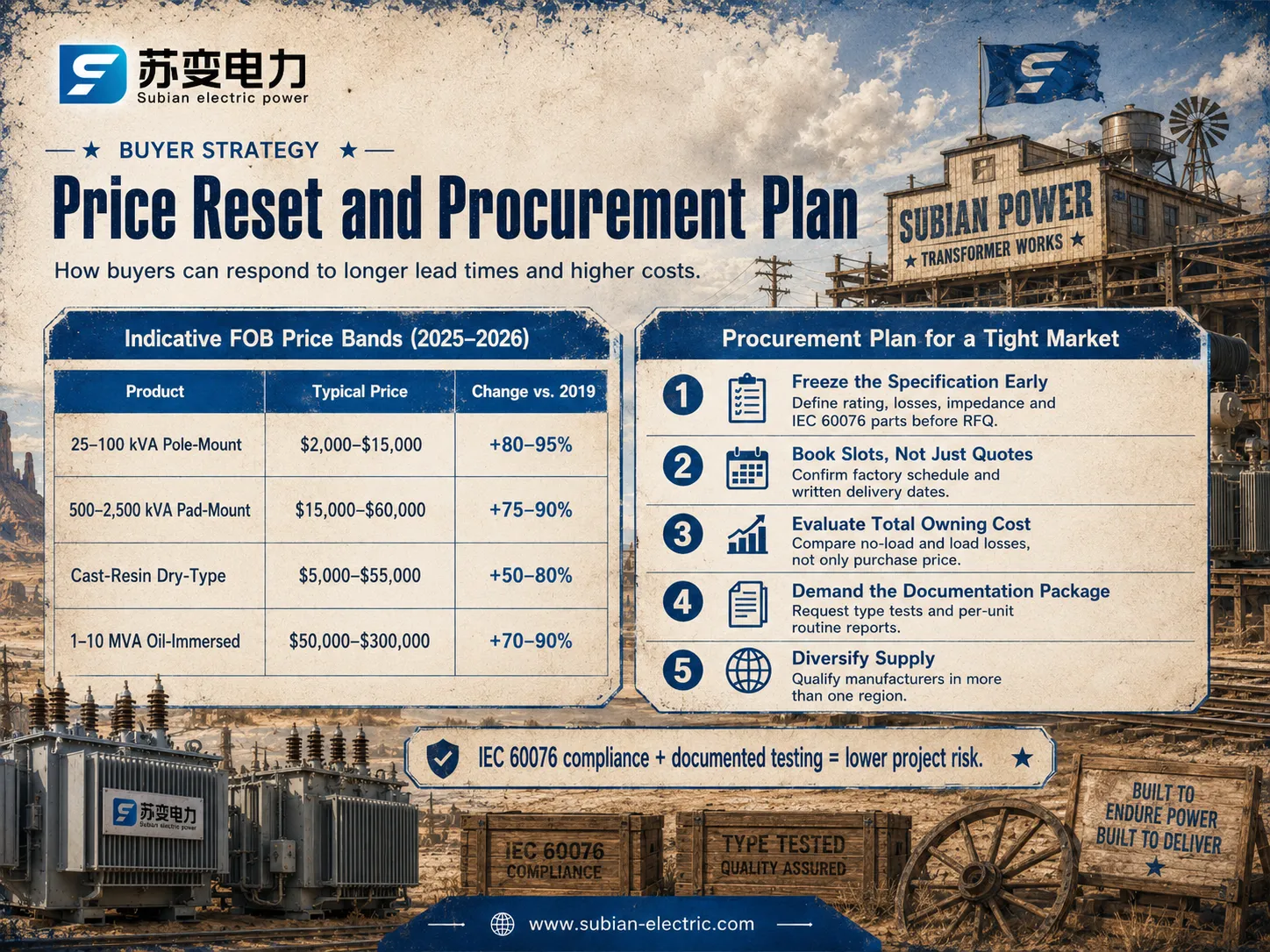
Drei kumulative Faktoren sind für die Preisneuverhandlungen verantwortlich – Rohstoffe, Regulierung und Knappheit. Die Preise für kornorientierten elektrischen Stahl stiegen von 2021 bis 2025 und zeigten nur eine schwache Verbindung zum Transformatorenindex, während die Kupferpreise im Durchschnitt 50% höher sind als 2020. Darüber hinaus haben die Section 232-Zölle in den Vereinigten Staaten auf Stahl-, Aluminium- und Kupferprodukte die Landekosten dramatisch erhöht (um 50% bei Stahl und Aluminium bis Mitte 2025).
| Produkttyp | Typische Preisspanne (2025–2026, FOB) | Veränderung gegenüber 2019 (ca.) |
|---|---|---|
| 25–100 kVA Mastmontage-Verteilungseinheit | $2.000–$15.000 | +80–95% |
| 500–2.500 kVA Fundamentmontage, dreiphasig | $15.000–$60.000 | +75–90% |
| Gießharz-Trockenbau, 100–2.500 kVA | $5.000–$55.000 | +50–80% |
| 10–35 kV ölgetauchter Leistungstransformator, 1–10 MVA | $50.000–$300.000 | +70–90% |
| Großer Leistungstransformator, 50–400 MVA | $2.000.000–$8.000.000 | +60–85% |
Da die Preise je nach Marke, Hersteller, Kühlkonfiguration und Zustand variieren, sollten diese Zahlen eher als Ausgangspunkt denn als absolute Benchmark betrachtet werden. Der zugrunde liegende Punkt ist einfach: Solange die Nachfrage nach Slots größer ist als das Angebot an GOES, werden die Preise in absehbarer Zeit hoch bleiben, auch wenn die Lieferzeiten sinken.
Jetzt werden Effizienzregeln zu Beschaffungsrecht
Es scheint, dass Effizienz nicht mehr in Marketingmaßnahmen integriert werden kann, sondern jetzt eine gesetzliche Anforderung ist. In den Vereinigten Staaten wurde die Effizienzregel für Verteilungstransformatoren des Energieministeriums im April 2024 finalisiert und erhöht schrittweise die Effizienzstandards. Die neuen Anforderungen treten 2027 in Kraft und gelten ab 2029 in vollem Umfang. In der Europäischen Union legt die Ökodesign-Verordnung (EU) 2019/1783 spezifische Anforderungen an die Effizienz von Verteilungstransformatoren fest, und es gibt viele Ausschreibungen in Europa, die A0- A2 Verlustniveaus verlangen. In China hat GB 20052 die Effizienzgrenzwerte sowie die Werte zur Energieeinsparung festgelegt.
Die praktische Auswirkung dieser Tatsache ist, dass Verlustgarantien wie Leerlaufverluste (P0) und Lastverluste (Pk) bei entweder 75 Grad Celsius oder 120 Grad Celsius nicht mehr nur als Prüfindikatoren betrachtet werden, sondern heutzutage eher als Verbrauchskosten angesehen werden. Zum Beispiel kann ein verlustarmer 630 kVA Transformator einen höheren Kaufpreis von 10-20 Prozent haben, aber seine Leerlaufverluste sind so gering, dass es möglich ist, während seiner Lebensdauer von 25 Jahren mehrere hundert Dollar pro Jahr an Leerlaufverlusten zu sparen.
| Markt | Regelung | Schlüsselanforderung |
|---|---|---|
| Vereinigte Staaten | DOE 10 CFR 431 Regel für Verteilungstransformatoren | Höhere Mindesteffizienzen phasenweise 2027–2029 |
| Europäische Union | Ökodesign-Verordnung (EU) 2019/1783 | A0–A2 Verlustniveaus nach Stufen |
| China | GB 20052 | Effizienzklassen; Stufe 1 strenger als EU |
| Globaler Basiswert | IEC 60076-20 (Energieeffizienz) | Effizienzindex / Verlustklassifizierungsrichtlinien |
Standards: IEC 60076 wird zur gemeinsamen Sprache
Vor einem Jahrzehnt erwähnten Ausschreibungsspezifikationen in Europa wahrscheinlich IEC 60076, während in Nordamerika die Spezifikationen auf IEEE C57 verwiesen hätten und in China auf GB 1094, mit wenig Überschneidung zwischen diesen. Aber jetzt ist IEC 60076 der internationale Beschaffungsstandard. Er ist in Teile unterteilt; Teil 1 gibt allgemeine Prinzipien und Auswahlparameter; Teil 2 Temperaturerhöhung (als Beispiel, durchschnittliche Wickeltemperaturerhöhung ≤ 65 K für ölgetauchte Einheiten und Oberöl ≤ 60 K); Teil 3 Isolationsfestigkeit und dielektrische Prüfungen; Teil 4 Impulsprüfung; Teil 5 Begrenzung von Kurzschlüssen; Teil 10 Geräuschpegel; und Teil 11 Trockenbau-Transformatoren.
Geschäftskunden verlangen Typprüfzertifikate, Routineprüfungen pro Einheit und die Überwachung von Drittanbietern vor der Zahlung. Es ist besorgniserregend, wenn der Anbieter dies nicht besitzt oder die Zertifizierung eines Mitbewerbers als Nachweis vorlegt.
Technologietrends, die Käufer beobachten sollten
Die drei Technologietrends, die sich von bloßen Werbeelementen (Broschüren) zu Spezifikationen entwickelt haben, umfassen Folgendes: Erstens wird der Trend der Online-Überwachung in mittelgroßen und großen Leistungstransformatoren als Lösung zur Zustandsüberwachung eingesetzt, wobei die Versorgungsunternehmen für neue Flotteneinheiten eine Analyse gelöster Gase, faseroptische Temperatursensoren und Teilentladungssensoren verlangen. Zweitens wird der Aufstieg umweltfreundlicher Isolierflüssigkeiten beobachtet, die natürliche Ester und synthetische Esteröle mit höheren Flammpunkten von mehr als 300 Grad Celsius im Vergleich zu den Flammpunkten von Mineralölen, die normalerweise zwischen 135 und 160 Grad Celsius liegen, umfassen.
Drittens wird eine Kerntechnologie mit geringeren Verlusten eingesetzt, die Stufenüberlappungen, hochpermeable Goess-Grade und amorphe Legierungskerne verwendet, um die Leerlaufverluste in den Bereichen von 30 bis 70% gegenüber Standarddesigns zu reduzieren. Diese Maßnahmen sind Standardlösungen, die den festgelegten Effizienzregeln entsprechen, da sie eine zusätzliche Zahlung von 15 bis 30% in Form der anfänglichen Anschaffungskosten für Verteilungseinheiten verlangen.
Erneuerbare und Rechenzentrums-Spezifikationen
Erneuerbare Projekte verändern die Art und Weise, wie Transformatoren in drei Aspekten entworfen werden. Erstens unterscheiden sich die Betriebszyklen: Solar- und Windprojekte erleben stark variable Lasten; außerdem haben Solarprojekte zahlreiche Abende ohne Ertrag, was die Lebensdauer der Isolierung beeinflusst. Zweitens sind die Umweltbedingungen strenger: Wüstenluft, Meerwasser und hohe Höhen erfordern spezielle Spezifikationen in Bezug auf Abdichtung und Kühlung. Schließlich muss das Integrationsproblem gelöst werden: Anstiegstransformatoren sollten zusammen mit inverterbasierten Schutzsystemen arbeiten, was auch einen Unterschied in Bezug auf Impedanz und Erdungsanforderungen macht.
Regionale Verschiebungen im globalen Transformatorenmarkt
Die globaler Transformatorenmarkt beträgt ungefähr $55–65 Milliarden im Jahreswert, wobei die meisten glaubwürdigen Schätzungen ihn um $60 Milliarden im Jahr 2025 ansetzen und ein mittleres einstelliges Wachstum bis Anfang der 2030er Jahre erwarten. Der asiatisch-pazifische Raum bleibt die größte Verbrauchsregion — ungefähr 40% des Gesamtvolumens — angeführt von China und Indien. China ist sowohl der größte Produzent als auch der größte Exporteur von Verteilungs- und mittelgroßen Leistungstransformatoren; seine Produktion im Jahr 2025 lag bei etwa 1,8 Milliarden kVA, und die Exporte von UHV-Transformatoren überstiegen erstmals 2.000 Einheiten.
Der schnellste Markt für Preisgestaltung und Politik befindet sich in Nordamerika, wo die inländische Kapazität zurückkehrt (zum Beispiel investierte Hitachi Energy mehr als $1 Milliarde in ein neues großes Transformatorenwerk in South Boston, Virginia, und Siemens Energy erweiterte seine Einrichtung in Charlotte, North Carolina, mit einem Projekt über $421 Millionen). Diese Kapazität wird jedoch erst 2026–2028 auf den Markt kommen, während Importe, etwa 80% großer Leistungstransformatoren in den USA, derzeit die Arbeit erledigen.
Top-Transformatorenmarken und typische Preisspannen
Die Führungsposition im Transformatorenbereich ist in Premium- und Wertkategorien unterteilt. Die Premium-Kategorie umfasst ABB, Siemens Energy, Hitachi Energy, Schneider Electric und GE Vernova, die nicht nur über umfangreiche Ingenieurkapazitäten und weltweite Servicenetzwerke verfügen, sondern auch die größte Anzahl an Referenzen im Bereich HVDC, EHV und Projekte im Versorgungsmaßstab besitzen — da ihre gesamten Produktionskapazitäten bis 2027 nahezu vollständig ausgelastet sind. Im Wertsegment produzieren TBEA, Baoding Tianwei und China XD Electric Großmaterialien zu wettbewerbsfähigen Preisen, während unabhängige Anbieter wie Jiangsu Subian Electric Power über die erforderliche IEC 60076-Zertifizierung verfügen und in der Lage sind, verschiedene flexible, halbkundenspezifische Lösungen anzubieten.
| Marke | Segmentstärke | Typische Preisspanne (1–10 MVA Transformator) | Anmerkungen |
|---|---|---|---|
| ABB | HVDC, EHV, digital | $150.000–$350.000 | Premium; Slots stark gebucht |
| Siemens Energie | Versorgungs- und Netz | $150.000–$350.000 | Starkes Servicenetzwerk |
| Hitachi Energie | Großleistung, HVDC | $160.000–$380.000 | Stark in die Kapazität in den USA investieren |
| Schneider Electric | Verteilung, Trockenbau | $40.000–$150.000 | Stark in MV und intelligenten Lösungen |
| GE Vernova | Große Leistung, Netz | $150.000–$340.000 | Prolec GE für die Reichweite in den USA übernommen |
| TBEA / Baoding Tianwei | Volumen, alle Klassen | $60.000–$200.000 | Hohe Leistung, wettbewerbsfähige Preise |
| Jiangsu Subian Electric Power | Wert, IEC 60076 zertifiziert | $50.000–$180.000 | Flexibles Design, realistische Lieferung |
Wir respektieren die Ingenieurfähigkeit, die ABB, Siemens Energy, Schneider Electric und Hitachi Energy etabliert haben – sie setzen die Qualitätsbenchmarks, an denen sich die gesamte Branche misst. Jiangsu Subian Electric Power spielt eine andere Rolle auf dem Markt. Als chinesischer Transformatorenhersteller, der zertifiziert ist für IEC 60076, baut Subian ölgetauchte Transformatoren, trocken-transformatoren, box-type Umspannwerke und spezielle Einheiten für Exportmärkte in ganz Asien, Afrika, dem Nahen Osten und Lateinamerika. Das Unternehmen kombiniert disziplinierte Typprüfungs- und Routineprüfungsdokumentation mit der ingenieurtechnischen Flexibilität, um maßgeschneiderte Spannungs-, Verlust- und Überwachungsanforderungen zu erfüllen – genau das, was Käufer in einem Markt benötigen, in dem die Slots knapp sind und die Spezifikationen ständig wechseln.
Ein Beschaffungsplan für einen engen Markt
Unter Berücksichtigung der oben genannten Punkte zur Vorbereitung des Beschaffungsplans gibt es fünf Schritte, die die Effizienz in der tatsächlichen Anwendung sicherstellen:
Eine Spezifikation sollte zu Beginn des Beschaffungsprozesses festgelegt werden. Werte unter Berücksichtigung von Spannung, Kapazität, Verlustgrenzen, Impedanz und Standards (der Typ IEC 60076 sollte ausdrücklich erwähnt werden) festlegen.
Slots buchen, anstatt nach Angeboten zu suchen. Produktionszeitplan und Lieferdauer schriftlich von jedem Lieferanten aus der engsten Auswahl der Lieferanten einholen.
Die Gesamtkosten des Eigentums sollten berechnet werden. Verluste aus Nulllast und Verluste aus dem Betriebszustand mit einem Ihnen berechneten Tarif vergleichen. Die Amortisationszeit beträgt oft zwei bis sechs Jahre, wenn eine effizientere Einheit gekauft wird.
Dokumentationspaket anfordern. Zertifikate für Typprüfungen, Routineberichte und sogar die Beobachtung der Tests im Fertigungswerk sollten eingeholt werden.
Einige Lieferdiversifizierung bereitstellen. Es ist wünschenswert, ein bis drei Lieferanten an verschiedenen Standorten zu finden, um das Risiko, das mit der Einzelfertigung verbunden ist, zu reduzieren.
Häufig gestellte Fragen
Was ist der größte Trend in der Transformatorenindustrie derzeit?
Das Ungleichgewicht zwischen Angebot und Nachfrage ist der dominierende Trend. Die Nachfrage nach US-Leistungstransformatoren ist seit 2019 um etwa 119% gestiegen, während die Produktionskapazität, insbesondere bei kornorientiertem Stahl, hinterherhinkt und durchschnittliche Lieferzeiten von etwa 128 Wochen für Standardleistungstransformatoren in 2025–2026 produziert. Alles andere – Preise, Slotbuchungen, Effizienzregeln – folgt aus diesem Druck.
Werden die Transformatorenpreise wieder sinken?
Nicht auf das Niveau vor 2020 in absehbarer Zeit. Die Preise für Verteilungstransformatoren liegen etwa 78–95% über 2019 und die Preise für Leistungstransformatoren etwa 77% höher. Rohstoffkosten, durch Effizienz bedingte Designänderungen und Tarife haben die Kostenbasis neu festgelegt; die Preise können stabil bleiben, werden jedoch voraussichtlich nicht signifikant fallen, solange die Nachfrage die Kapazität übersteigt.
Wie lange dauert es, einen Transformator jetzt geliefert zu bekommen?
Es hängt von der Klasse ab. Verteilungseinheiten haben sich auf etwa 26–40 Wochen in den USA verbessert, da neue Kapazitäten online gehen; Mittelspannungs-Transformatoren benötigen 60–90 Wochen; große Einheiten 120–160 Wochen; und einige EHV- oder GSU-Bestellungen erstrecken sich über vier Jahre. Einen Slot frühzeitig zu buchen, ist der einzige zuverlässige Weg, um Ihren Zeitplan zu schützen.
Warum ist IEC 60076 in fast jedem Angebot spezifiziert?
Weil es Käufern eine gemeinsame, überprüfbare Grundlage für den Vergleich von Geräten verschiedener Hersteller bietet. Die Reihe umfasst Nennwerte, Temperaturanstieg, dielektrische Tests, Kurzschlussfestigkeit und Verluste und wird von den meisten nationalen Regulierungsbehörden akzeptiert. Dokumentierte IEC 60076-Konformität erleichtert auch die Zollabfertigung und Projektgenehmigung.
Sollte ich effizientere Transformatoren kaufen, auch wenn sie teurer sind?
Für kontinuierlich belastete Einheiten in der Regel ja. Ein verlustarmer Transformator kann anfangs 10–20% mehr kosten, kann aber Hunderte von Dollar pro Jahr bei Leerlaufverlusten sparen; die typische Amortisationszeit beträgt zwei bis sechs Jahre. Mit den verschärften Anforderungen von DOE, EU-Ecodesign und GB 20052 laufen ineffiziente Einheiten auch Gefahr, vor Ablauf ihrer Lebensdauer unverkäuflich oder nicht konform zu werden.
Referenzen
- Internationale Elektrotechnische Kommission (IEC) — Herausgeber der IEC 60076 Transformator-Standardreihe.
- U.S. Ministerium für Energie — Effizienzregeln für Verteilungstransformatoren und Analyse der Lieferkette im Netz.
- Nordamerikanische Elektrizitätsversorgungsaufsichtsbehörde (NERC) — Zuverlässigkeitsbewertungen, die die Lieferzeiten von Transformatoren über 120 Wochen dokumentieren.
- Congressional Research Service, Elektrizitätsverteilungstransformatoren: Versorgung, Tarife und politische Optionen — dokumentierte Daten zu GOES, Zöllen und der Preiskorrelation von Transformatoren.
- IEEE — Herausgeber der IEEE C57 Transformatorstandards und Netzleitfäden.
- NEMA (Nationale Vereinigung der Elektrohersteller) — Branchendaten zu elektrischen Geräten, Versorgung und Standards.
Fazit
Die Transformatorenindustrie wird in Echtzeit neu aufgebaut: Die Nachfrage hat das Angebot übertroffen, die Lieferzeiten haben sich in einigen Klassen verdreifacht oder vervierfacht, die Preise sind dauerhaft höher angesetzt worden, und Effizienz- sowie Standardanforderungen sind zu verbindlichem Beschaffungsrecht geworden. Die praktischen Erkenntnisse sind in jedem Markt, den wir beobachten, konsistent: Spezifikationen frühzeitig festlegen, Produktionsslots buchen, Gesamtkosten des Eigentums anstelle des Erstpreises bewerten und auf dokumentierte IEC 60076-Konformität mit Prüfberichten pro Einheit bestehen. Käufer, die Transformatoren als langfristige strategische Vermögenswerte betrachten — anstatt als Warenkäufe — navigieren erfolgreich durch diesen Markt.
Jiangsu Subian Electric Power interpretiert diese Trends vom Werk aus und hilft Käufern, sie in umsetzbare Beschaffungspläne umzuwandeln. Von ölgetauchten und trockenen Transformatoren bis hin zu boxartigen Umspannwerken und Spezialgeräten wird jedes Subian-Produkt nach IEC 60076-konformen Standards, mit der Dokumentation, die Käufer für internationale Projekte benötigen, gebaut und getestet. Kontaktieren Sie unser Ingenieurteam, um Spezifikationen, Lieferzeiten und aktuelle Preise zu besprechen.